
In my experience, kids love nature and natural things. I also think it’s important for the adults around them to expand their exposure to the natural world and also to help them to embrace the role of caretaker and advocate for our earth and its resources.
Last week we learned a bit about Jane Goodall and her lifelong skill as a watcher. Then we did some watching ourselves. Since it was pouring down rain outside (not good weather checking on my part when I planned), I had to adjust my plan and instead of watching outdoors on our campus, I used a couple of animal cams for watching.
With our minds on nature and the natural world, I read students the book, The Keeper of Wild Words by Brooke Smith. The story is about the need for all of us to keep wild words alive (words like wren, dandelion, brook, blackberry…you get the idea) by paying attention to wild things and using these words in our lives or they will continue to be replaced by words like internet, chat room, and other non-natural words.
Recently I harvested an activity called the longest list from a colleague where students collaboratively work to create a list of words…in this case the longest list of wild words. Large sticky note posters worked their magic–students loved working together using markers to make a long poster list of words. Then I gave each student an index card-sized post it note and had them move from poster to poster with the goal of collecting the ten wild words they liked the best. I love the focused engagement during this stage of the work. First graders helped each other spell the words they came up with, helped each other read the words written by their classmates, and sparked ideas for new words all along the way.
Finally, I asked students to write a 7-up sentence (another something borrowed from a colleague). This sentence as I defined for the students (based on things I wanted them to demonstrate) must feature one wild word, have 7 or more words in it, begin with a capital letter, include ending punctuation (., !, ?), have no backwards letters, have very neat handwriting, and must make sense. I handed them each a 5×7 lined card and they set to work.
“Can I include metaphorical thinking?” I was asked. You know my answer! “This is so easy,” another student exclaimed. Everyone set to work, selecting a word from their list and composing a sentence to meet the criteria.
Here’s a few of their sentences:
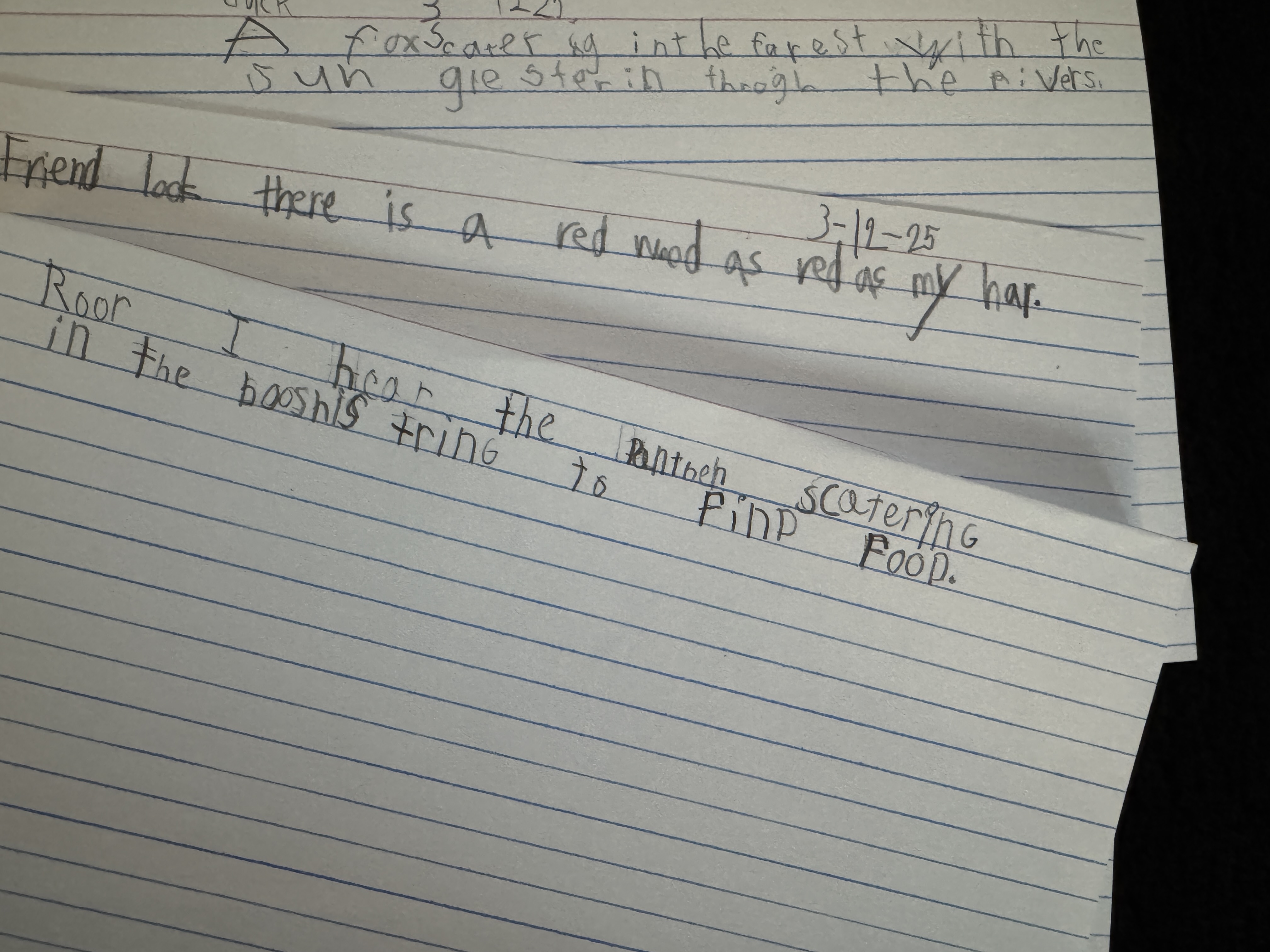
J wrote: A fox scattering in the forest with the sun glistering in through the rivers.
T wrote: Friend look there is a redwood as red as my hair.
D wrote: The red roses are scattered around the forest because there is a panther coming.
C wrote: Roar I hear the panther scattering in the bushes trying to find food.
B wrote: Roses rising up in the air high up to the clouds.
While they haven’t yet perfected punctuating the complex sentences they are composing, the sentences are interesting. They are using active words and working to be descriptive.
Were all seven criteria perfectly executed by all students? No. But there was great effort and every student was able to compose a sentence that was pretty close. They were engaged and wanted to craft a sentence unlike other’s. And this was an ideal formative assessment–short and sweet, showing me where to concentrate next instructional efforts.
Best of all, we are working to keep wild words alive: in our minds, in our words, in our writing. And I hope this is another stepping stone leading to students becoming the stewards that our earth and all its resources and creatures need.
 Thinking Through My Lens
I just love this. 🌱 Every smartly sequenced step. All the guides, and texts, and media, and activities, and student writing ✍🏼 and questions.
I loved reading this and especially the student examples. Thanks for sharing, your passion clearly shines through!
This is an altogether awesome activity! I love the concept of “wild words.” I want to spend more time outside during Spring Break next week, and I think I need to read a copy of The Keeper of Wild Words first.