
I live in a place filled with contrasts. There is the breezy casual of the beach to the west and less than a thirty minute drive away you can be hiking into dry, hot hillsides, exploring vineyards or admiring the abundance of avocado groves. Our weather reporters call them microclimates…and we tend to be adapted to the microclimate where we spend most of our time. But what I love most about this place that I call home is that it is not either/or, it is this and that.
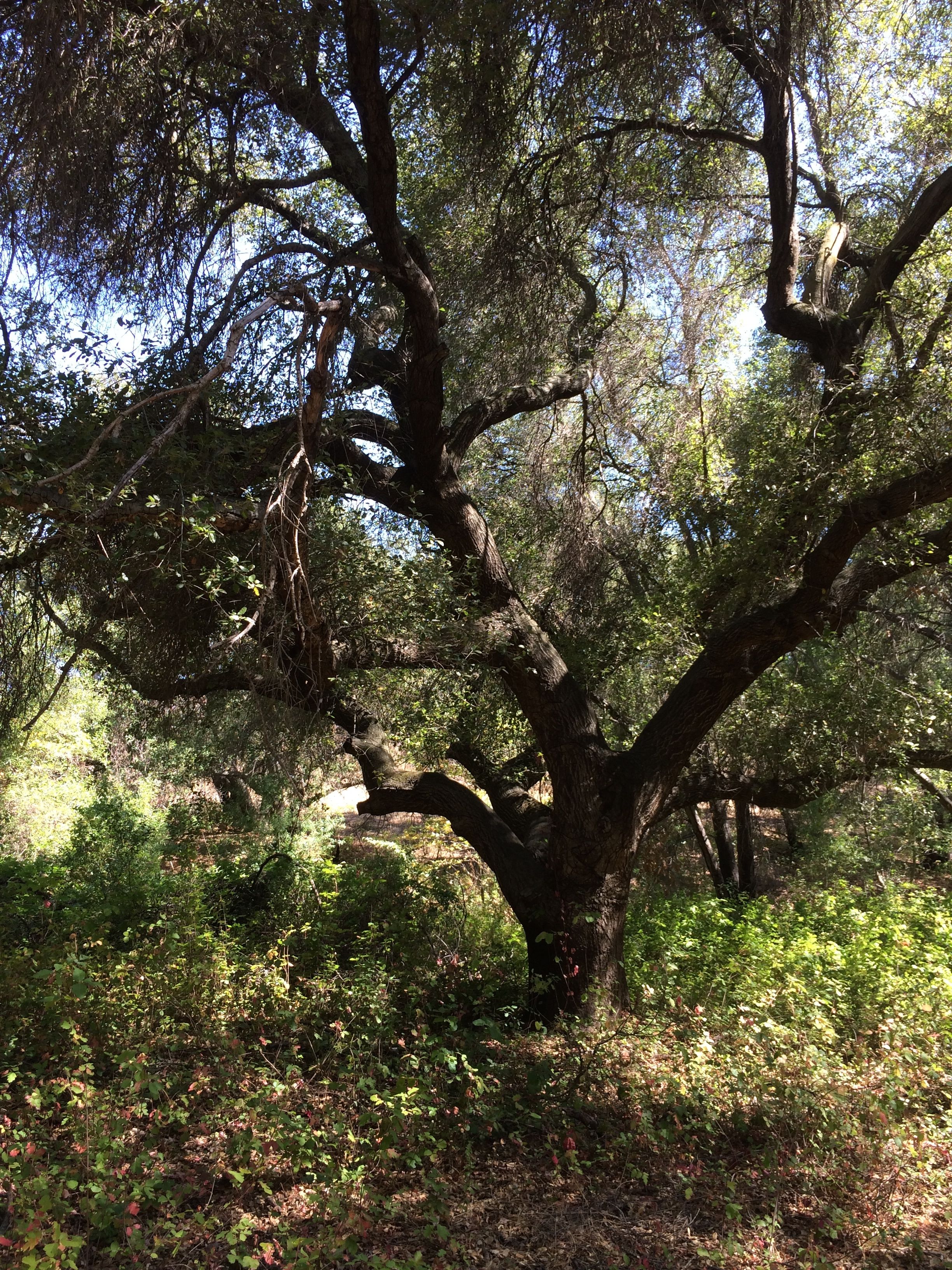
Just this weekend I spent time in two of these contrasting spaces…equally beautiful, equally interesting, but entirely different from each other. I loved exploring the old oak forest as I walked in the dappled sunshine…and looking up in surprise as I watched a mule deer leap across the path I was walking. It was hot early as I hiked uphill and I could see evidence of wildfires past and the dry brush that continues to be a threat for future fires.
And the beach is always a source of inspiration. The holiday weekend prompted us to get up early and walk the beach before the crowds arrived. It was sunny and warm and the water was unusually clear. We noticed sand sharks and stingrays swimming a few yards from us as the waves crashed. The water was warm by our standards…up to 70 degrees, perfect for barefoot walking.

I’m so happy that I don’t have to chose to love and visit only one part of my place. I’m feeling like there is such a push to simplify our choices, to turn every decision and discussion to the binary choice. Right or wrong, left or right, boxers or briefs, apples or oranges. In my experience, those binaries just don’t represent the rich complexities of everyday life. Just this morning a friend sent an article about “balanced literacy” where the author lamented the kind of “conventionally rigorous” instruction he had received as a young English learner. The article implied that “balanced literacy” was essentially an absence of teaching compared to the experience with the effort-full teaching he had received in his childhood.
I’m reminded of the reading wars in the not too distant past. The phonics versus whole language debate that implied an either/or approach to teaching. These arguments miss the subtleties and complexities of teaching and learning. This “all teacher” or “all student” approach ignores the body of student-centered teaching that effective teachers practice every day. It dismisses the diversity of the needs and interests of students as irrelevant and assumes that if the teacher simply transmits enough information, students will learn what they need to learn.
Let’s start a new conversation. One that is about learners: teacher learners and student learners. Let’s bring their microclimates into the conversation.

 Thinking Through My Lens