Tag Archives: teaching

Layers

Today’s Weekly Photo Challenge asks us to think about layers…how they reveal, conceal, and make things more complex.  When I think about layers, I think about teaching and learning.

photo_1

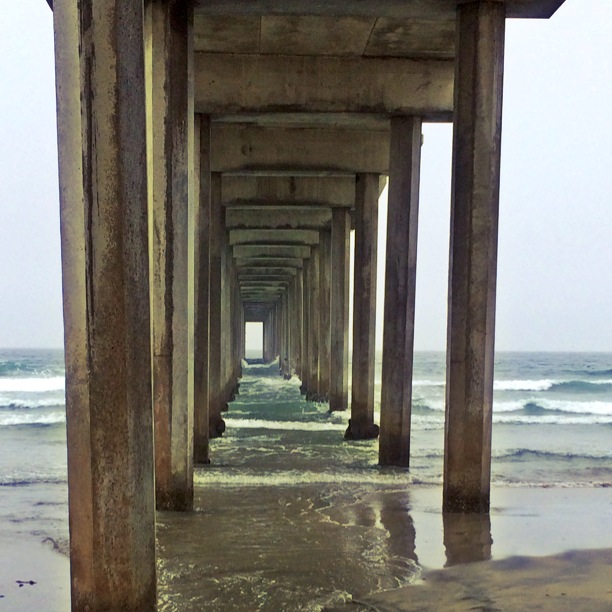
When I teach I have to decide if I will start with the broad overview…the big picture and then zoom into the details.  Or if I will start with a detail and continue to pull back to let the bigger picture be revealed.  The best teaching is layered…creating a foundation that is continually built up so that learners can access the tools they need to keep growing.  Learners need to see the beauty so they will continue to dig and uncover the magic of the subject at hand.  This pier makes me think of all those different views, it’s like windows layered on each other, creating a view of possibility.

photo

Some layers are more like the supportive structure of bridges or scaffolding.  The layers create footholds and braces for continual progress.  They are less about the view, but more about feeling safe enough to take some risks.  It helps to know that when you stretch to reach the next rung, there are some toe holds to prevent a total collapse.  When I teach, I want to layer supports like this bridge does, allowing students places to hang on to as they reach and stretch toward the next level.

photo-2

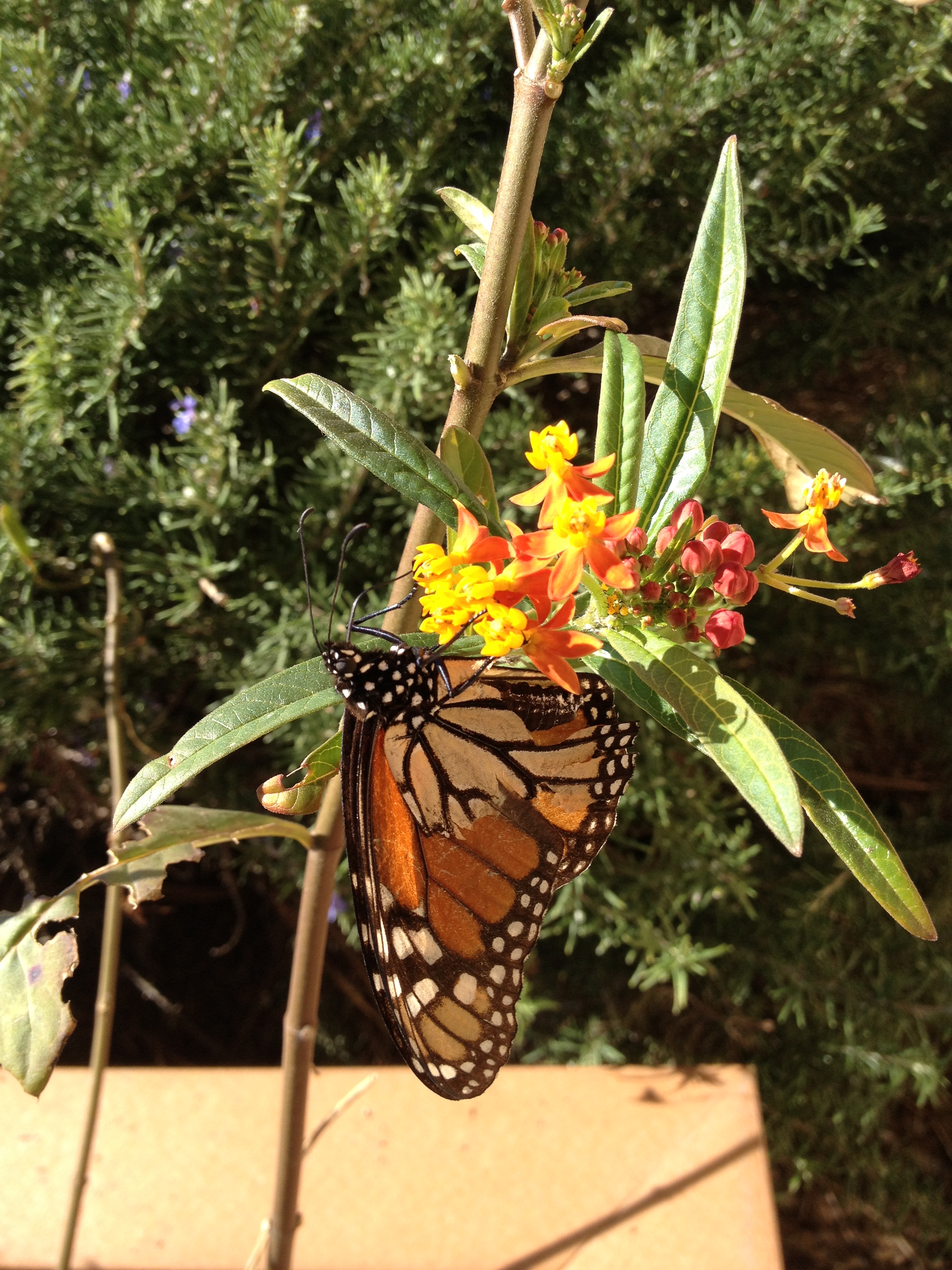
Other layers are more like the stripes on these monarch caterpillars.  The stripes represent the way our knowledge and skills continue to grow and build, layer upon layer.  It makes me think of the small group of students who gathered in the classroom before school this morning.  We’ve been learning computer programming…and some made a bit of a breakthrough earlier this week (see this post), and have been working in whatever stolen moments they can find to continue the designs they started.  They’re excited and motivated…and they’re teaching each other and learning from each other as they learn from their successes and their mistakes along the way.

Like these caterpillars, they have been layering on their knowledge, black on white on yellow, black on white on yellow…as they experiment with the programming tools in Hopscotch.  And like these caterpillars, they are getting bigger and stronger…and closer and closer to transforming into beautiful butterflies.

photo-6

Layers are like that!

Coming to a Close

As I wrote last week (here), beginnings and endings are challenging for young writers.  They often dive right into the heart of the writing…and then end abruptly when they come to the end of their content.  “The End” seems like a perfect ending for many of my students.

photo-9

And so…in an attempt to help our students with both beginnings and endings, we turned to some mentor texts to study and learn from.  In my work with the San Diego Area Writing Project (SDAWP), I am repeatedly asked for lists of mentor texts to use with students.  And I repeatedly remind teachers that great mentor texts are often within reach…right in their own bookshelves!

I do admit to being a bit of a book addict…constantly on the lookout for wonderful children’s books.  Books that are beautiful to look at.  Books that contain language that sings from the pages.  Books that present information in interesting and accessible ways.  And I use them as mentor texts…just like I use excerpts from text books, articles in the Scholastic News, texts from the internet…

Back to teaching conclusions…  Today we returned to the same books we used to teach introductions.  We revisited the graphic we created to remind students the importance of introductions and conclusions… (Here’s a rough sketch)

photo-8

The point of the thought bubble as a symbol for the conclusion is that we want to leave the reader thinking.  And so we studied our mentor texts with that in mind.

We started with Life in the Rain Forest, a Smart Words Reader by Scholastic.  This book concludes with an entire page that goes back to the big picture of the importance of the rain forest.  It ends with these last two sentences:

Many of the plants and animals in this book are in danger of becoming extinct.  Only by learning about rain forests can people work to protect them.

Students decided that was a “learn more” ending.  Then we turned to Let’s Go Rock Collecting by Roma Gans.  We decided that this book’s conclusion was an invitation to do something.

Rock collecting is fun.  And one of the best things about it is that you can do it anywhere. Wherever you go, try to find new rocks and add them to your collection.

In What Do You Do When Something Wants to Eat You? by Steve Jenkins, we noticed the use of a question that asks you to apply the information learned from the text.

What would you do if something wanted to eat you?

And a Scholastic News article from the October 28th issue entitled Supersized Pumpkins offered this ending.

Now Wallace is back in the pumpkin patch working on his next record breaker.  “I have my sights set on 2,500 pounds!” he says.

We decided that conclusion made us curious about what would happen next.

With those examples in mind, students returned to their writer’s notebooks to try out their own conclusions.  With the piece they had written about animal defenses in mind, they set out to “try on” some possible conclusions.

In some ways we made this a bit hard.  We didn’t give students back the writing they had done previously about animal defenses–so they had to depend on their memory.  But then, last week when we did give back the writing we had a number of students “forget” to focus on the mini lesson and instead either copied what they had already written or continued on from where they left off.

So at the “stuck” spot, we asked students who weren’t stuck to share their early attempts at conclusions.

Here’s a few examples:

From a third grader:  “Every single animal wants to stay alive…hiss…and some animals are defending themselves right now!”

From a second grader:  “All the animals try to stay alive and use their defenses.  One might be using one right now…you never know!”

From a first grader:  “Would you play dead of something wanted to eat you?”

Another third grader:  “Have you even seen an animal use its defense?  Did it play dead? Did it run? Did it roll up in a ball?”

Another second grader:  “What do you know that I don’t about animal defenses?”

I feel like it was a good first attempt.  We’ll continue with another try with a different topic tomorrow.

So here’s what I’ve learned.  Introductions and conclusions are hard.  It takes study and practice to figure out how to make them work in our writing.  And we need to experiment to see what the possibilities are.  In our class, we plan to continue to revisit introductions and conclusions throughout the year to help our students internalize this important aspect of their writing.

I also know that there is no “magic” mentor text…and in fact, especially with things like beginnings and endings it is important for students to see that there are multiple approaches rather than a “right answer” or formula.  So I will continue to “read like a writer” and mine everything I read for its potential as a mentor text…for introductions, conclusions, language use, grammatical constructions, use of evidence and examples, and more.

What mentor text is your current favorite?  How do you use it with your student writers?

Stamina for Writing

Over at the NWP iAnthology, Janet Ilko has invited teachers to consider, “How do you build writers with stamina?”  As a middle school teacher, she talks about how daily journaling is a way to build stamina in her young writers.  (She works to build her own writing stamina through her blog, Writing in My Hand, as well.)

Stamina and fluency are important characteristics of writers.  Fluency allows for the words to flow onto the page and stamina means working through the hard parts of writing to keep on writing, to rework writing, to improve writing, to understand the importance of writing to learning and thinking and communicating.

One of the ways we build stamina in our classroom is by creating a culture where writing is the norm.  It’s no big deal…we write all the time.  We write to explain our mathematical thinking as we explore math concepts.  We write to describe what we are learning through our science labs.  We write to learn about spelling patterns and grammatical concepts.  We write stories, poems, arguments, and to share information with others.  We write to plan, to remember, and we write to reflect.

This week we asked students to do some reflective writing in preparation for student-led conferences next week.  We asked them to think about their learning in math, reading, writing, science, and with our iPads.  And what I notice is that these students have stamina for writing.  They know that writing gives voice to their learning.  It matters to them, to us as their teachers, to their parents…and to each other.

We are a community of writers.  And writers write.  They write because writing helps them think, and remember, and communicate.  And sometimes they publish too.  But mostly they write because writing matters in our community of learners.

photo-7

I hope it lasts a lifetime.  How do you build stamina in your writers?  How do you build your own writing stamina?

Reflections: a Photoessay

I’m fascinated with reflection. Both the mental version and the physical version. Reflections appear in many surfaces…mirrors, metals, through shade and shadows…and in my favorite medium, water.

I love the idea of the way water captures the way reflection works with learning. Reflecting is a way of reinforcing and internalizing your learning. Taking time to think about why the learning matters and making connections to other experiences enriches learning.

Reflection is not the literal mirror image of seeing exactly what you experienced. Instead, reflection is the processing of experience. Like with peering into water, everything around you impacts the learning. The wind, the current, the life within the water…even the angle you take when you take a look.

I also love to play with reflection in my photographs. Sometimes I intentionally look for ways to capture reflection, but more often than not, I notice the reflection after taking the photo.

Here are a few of my favorites…

I love to capture birds on the beach.

20131110-204452.jpg

And the surprise of the cliffs reflected when I was trying to capture these birds.

20131110-204641.jpg

This fisherman has such a feeling of timelessness and captures the quiet and solitary beauty of individual focus.

20131110-204836.jpg

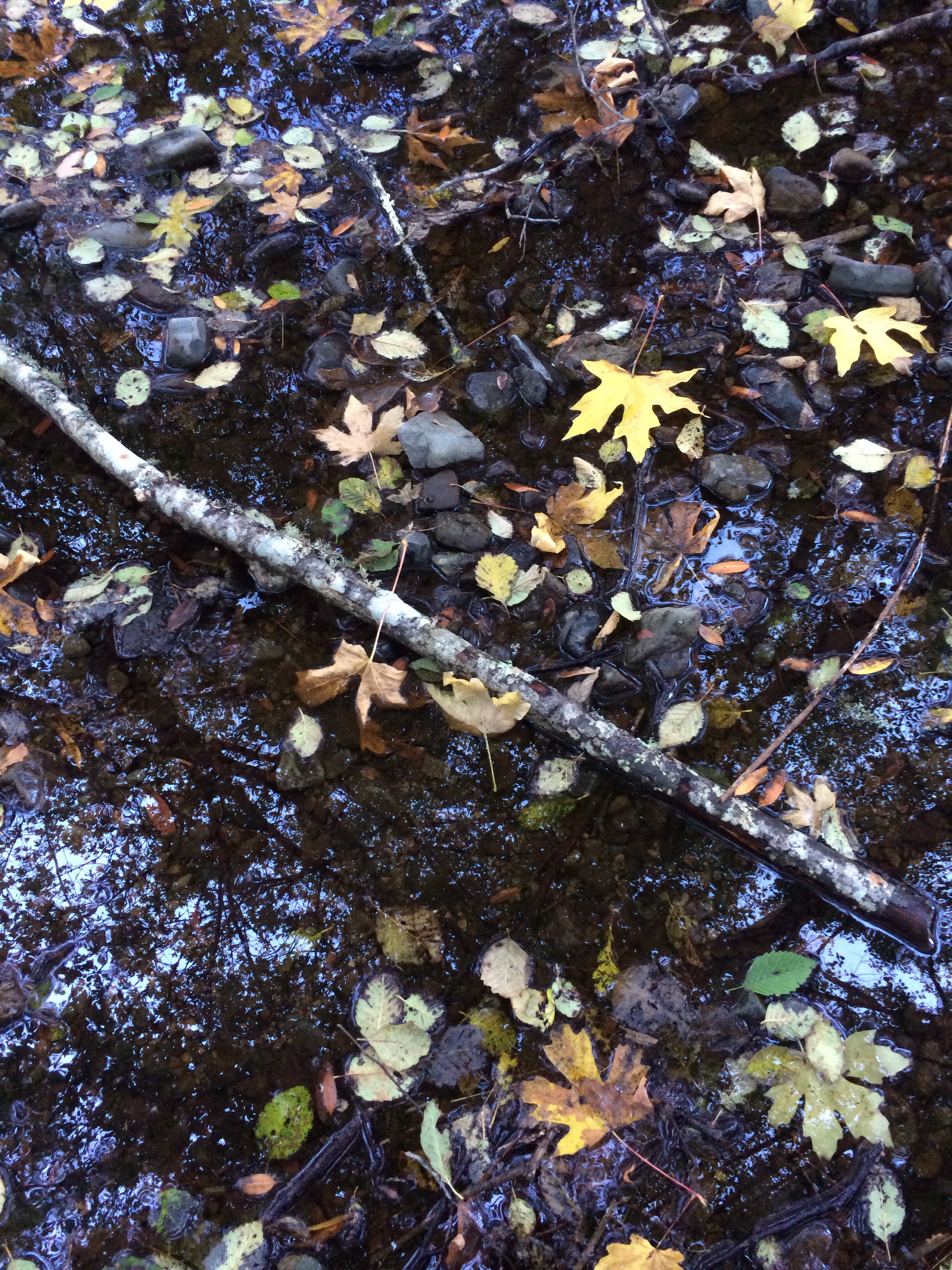
And I’m not limited to the beach. I love the ways the redwoods are captured in this stream. (I also love the colors of the fall leaves floating in the water!)

20131110-205147.jpg

And even at the zoo there are opportunities for reflection!

20131110-205311.jpg

These photos remind me that taking time for reflection matters. There is beauty and meaning in looking back to look forward. I’m reminded to pay attention to the angles, to consider the environment, and to be aware of the life within…in my photography and in my life.

How do you make time for reflection? Do you create opportunities for your students to reflect?

Introducing…

Beginnings and endings often confound writers.  And yet they are critical to the success of a piece of writing.  Many of the young writers I work with simply dive into their content…regardless of genre or text type.

We recently gave our students a writing performance task to inform our teaching of informational writing.  Students watched a short video about animal defenses and either read a short article on the same topic or listened to a picture book on that topic.  After reading, watching, taking notes, and answering a few questions, they were prompted to write an article describing and comparing animal defenses.  Our students were immediately engaged in the task, eagerly taking notes and excitedly writing about the animals.  It was clear that they understood the material and wrote effectively about the content.

But…many of our students dove directly into the body of their writing without any kind of introduction at all.  They started with sentences like, “The porcupine has sharp quills…” or “Puffer fish blow their bodies up so other animals can’t eat them.”

I’ve often wondered why this lack of introduction is so noticeable (not just in my class) in prompted writing and less evident in classroom products that make their way through the writing process, including the use of mentor texts and mini lessons along the way.  Does the written prompt encourage students to see the writing as an answer to a question rather than writing that stands alone?  Or is the missing step the writing response group or individual teacher conference?  Or maybe it’s a combination of all of the above.

My teaching partner and I have thought long and hard about this phenomenon and decided that we would use our students’ prompted writing, and our analysis of it, as an opportunity to teach our students about introductions and conclusions.

In planning our introductions mini lessons, we took a careful look at non-fiction/informational texts we had read in our classroom recently.  We ended up using both texts from the performance task…a picture book and a short article.  We also used an article about pumpkins from Scholastic News that we had read as a class, a book about rock collecting, and then an unrelated book about rain forests that we had not read.  We chose all of these because they demonstrated different approaches to introductions.  With our students we noticed a “preview” introduction, one that set the stage with a context and overarching idea, an anecdote that took us right into a place, and one that used a list to get started.

We sent students off to try our a new beginning for their animal defenses piece…with varying success.  Some of our younger students actually started rewriting the same information they had already provided!  As a class, we looked at a couple of student examples and noticed what they had tried out.

Today we returned to our introduction mentor texts and reminded ourselves about the purpose of the beginning.  And then we asked students to write a short piece about the fruit trees we had been out photographing and studying yesterday.

photo_1-3

With beginnings fresh in mind, students began to write.  We limited the time…giving them 7 minutes of “power writing” to write their beginning and whatever else they had learned about fruit trees.

Here are a few examples;

photo_1-2

So here’s a second grader’s attempt, “Hey, want to know about trees?”  I’m not that crazy about the “Hey” or the simple rhetorical question…but it is an attempt at at a beginning.

photo_3-2

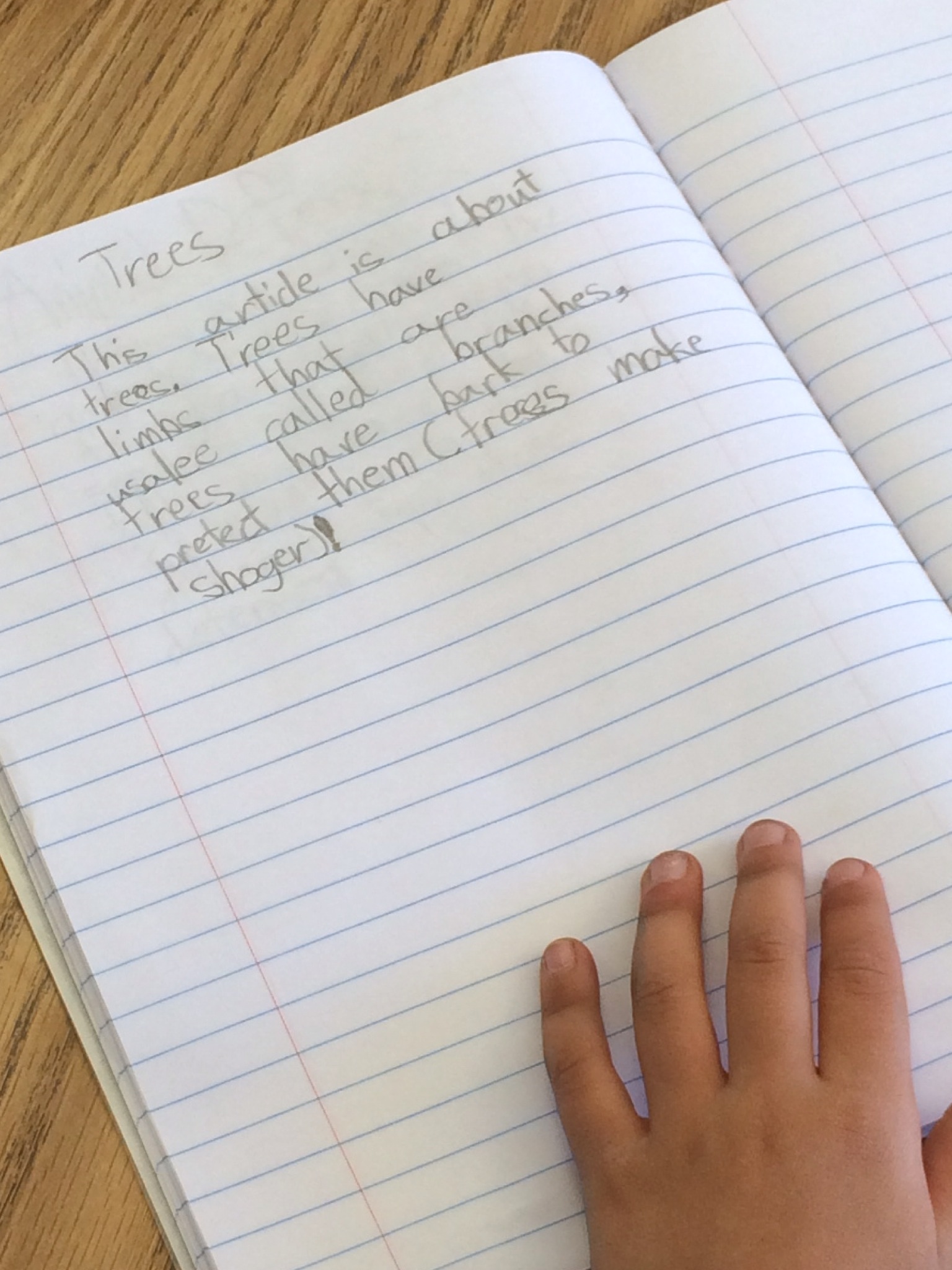
This first grader took a very formal approach, “This article is about trees.”  She made a very definite attempt to set the context and expectations for her writing.

photo_2-2

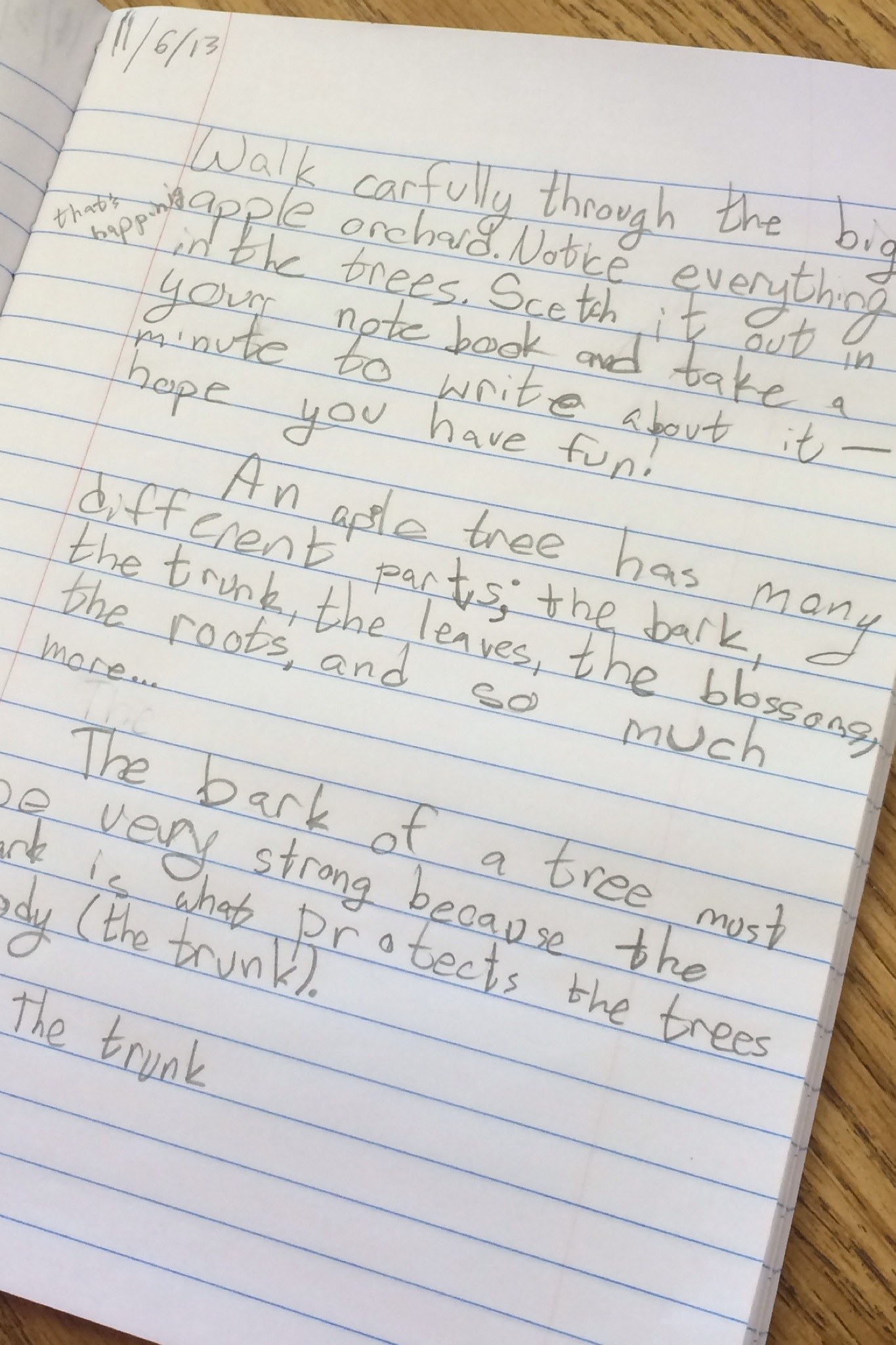
This third grader attempted the more complex and creative anecdote approach, “Walk carefully through the big apple orchard.  Notice everything that has happened in the trees. Sketch it out in your notebook and take a minute to write about it–hope you have fun!”

photo_4

And this second grader tried out a broad overarching idea, “Trees are amazing parts of Mother Earth.”

I feel like our students are getting the idea of the importance and variety of introductions. Tomorrow we will take another look at introductions–both from our mentor texts and from some student examples.  And then we will ask students to write another short informational piece about another topic they are familiar with…with an emphasis on the introduction.

And then next week we will shift our focus to endings…and continue to explore ways to support our students’ development of writing that includes beginnings and endings as well as rich content!

Writing is complex…and we can always work to make our writing better.  How do you support student writers?

photo_2-3

Ordinary

Today, out of necessity, I had to scrap a plan and invent another without notice.  For teachers, this is something that happens with some regularity and most of us pride ourselves on our flexibility. And I love it when that spontaneous plan blossoms into a wonderful learning moment.

We always have picture books at the ready to read to our class.  Some are set aside for specific purposes and lessons, others we know we want to read but are waiting for the perfect time to present itself.  Last year we read Spoon by Amy Krouse Rosenthal–a book that our students loved.  We revisited it a number of times throughout the school year for different purposes…from mentor sentences to a situation for opinion writing.

At the end of the year, I came across a new book by Amy Krouse Rosenthal: Exclamation Point. So today, in that moment when I needed a plan at a moment’s notice, I picked up Exclamation Point, reminded my returning students (two thirds of them) that this was the author of Spoon, and started to read.  I love those moments when each student’s attention is fully engaged…and they were hooked by the bright yellow cover and the whimsical smiling exclamation point. They noticed right away that there wasn’t a title…at least not written in words. The exclamation point itself stood as the title.

15815400

We read and discussed and noticed and connected all the way through the book.  We delighted in the words and the pictures and the message.  And we were inspired to write our own stories about punctuation.

And then later in the day we managed to get packed up and ready to go home with enough time for a book before the dismissal bell.  Overwhelmingly, students wanted me to read Spoon. It was sitting near Exclamation Point…and suddenly today became the day for a mini author study.  The second and third graders were treated to an old friend, and the first graders were anxious to get acquainted!

After reading, students volunteered their observations, connections, reactions, reflections. They had so many thoughtful comments and ideas for their own writing.  And one student pointed out that Amy Krouse Rosenthal wrote about ordinary things…in wonderful ways.  We started thinking about all the ordinary things we might write about and how our writing could transform them beyond the ordinary.  They were excited to write as the dismissal bell rang today…I hope they sustain that excitement long enough to actually get to the writing.

I’ve also been noticing the power of the ordinary.  Yesterday’s post was about the transformation of an ordinary photo into something I was willing to name as art.  And today on five minute friday the prompt is ordinary.  Today in the classroom the ordinary business of reading a book because an extraordinary opportunity to notice the magic of writers and writing…and turned students into active learners making meaning for themselves.  Today I was reminded that ordinary is a state of mind, and each of us has the power to re-look and re-see the ordinary in new ways.  I love when that wonderful learning moment in the classroom means that I learn too!

Driving in Los Angeles

Driving in Los Angeles is an unique experience. It can be daunting, stressful, confusing, exhausting, and sometimes downright harrowing! The roads and freeways are a relic of the L.A. of yesterday when there were fewer people, fewer cars, and lower speeds. As the city grew and sprawled, freeways were added that interconnect and crisscross…some to the left, some to the right, often with short on ramps and sometimes an immediate need to change lanes. The surface streets aren’t much better. Many are narrow with lanes unexpectedly ending or suddenly cars parking in what used to be your driving lane. There is evidence of attempts to update the roadways and to improve the driving experience, but most work is mostly cosmetic…keeping what already exists functional, while attempting to make the improvements when possible to the roads and freeways in use.

Sometimes our educational systems feels like driving in Los Angeles. Many of the structures in place are relics of days gone by. Schedules and groupings are mostly as they have always been. But we have more students, diverse learners, more access to information, and as a result of all of that, changing expectations for outcomes for student learning. With the Common Core State Standards (CCSS) there is a move to go in and remake some of those roads (to carry out the L. A. driving metaphor), the improve access to and delivery of robust learning experiences for students. But in many cases, instead of reconsidering the educational system…including testing, funding, organizing, professional development…teachers are being asked to fill in the potholes. They are taking old practices and adding a new activity or two to meet the new standards.

And I understand why this is happening…both with L.A. roads and our educational system. Change is hard and often painful. We would have to make sacrifices to tear down what isn’t really working and build new structures to meet emerging needs and those in the foreseeable future. Wow, I tackled a complex topic late on a Wednesday. There’s so much more to think about here…

Crows

As I walked across the parking lot toward my office today I heard a crow cawing. I looked and noticed it sitting in a tree at the edge of the parking lot. It was loud and totally unconcerned that I stopped to take a photograph.

20131001-232143.jpg

Thinking about that crow made me realize how much attention I pay to the crows in my life. Those that are loud or otherwise command my attention get more of my time and energy than those that are quieter and less assuming.

Too often that’s true in my classroom too. How often do I seek out the quiet, still child? Instead, all too often I am drawn to that loud voice or the wiggly body that can’t seem to keep in its own space.

I’m glad I stopped to photograph the crow today. I want it to serve as a reminder to look for and notice the quieter beings–the roly polies, the snails, the chickadees and sparrows– that blend into their surroundings and go about their lives without calling for attention.

What am I missing when I only see the crows? What can I learn by tuning my eyes and ears and other senses to the quieter students in my classroom? I’m going to find out…

Saturated

In our classroom we like to give students lots of ways to process information.  They listen, they speak, they sketch, they observe, they write, they read, they move, they sing, they paint…

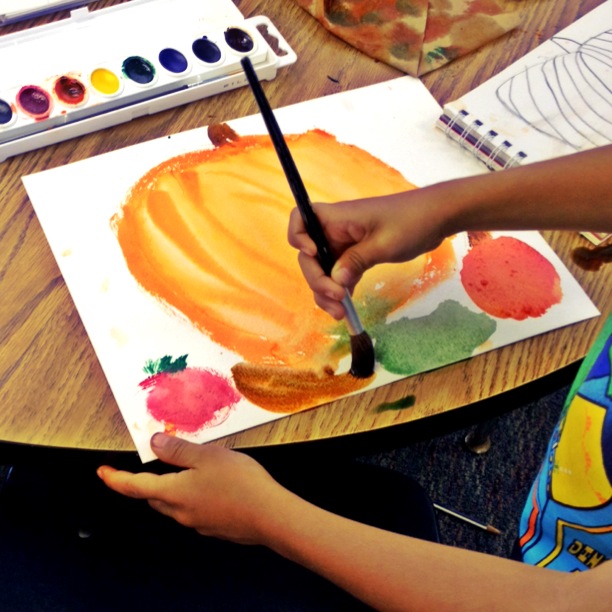
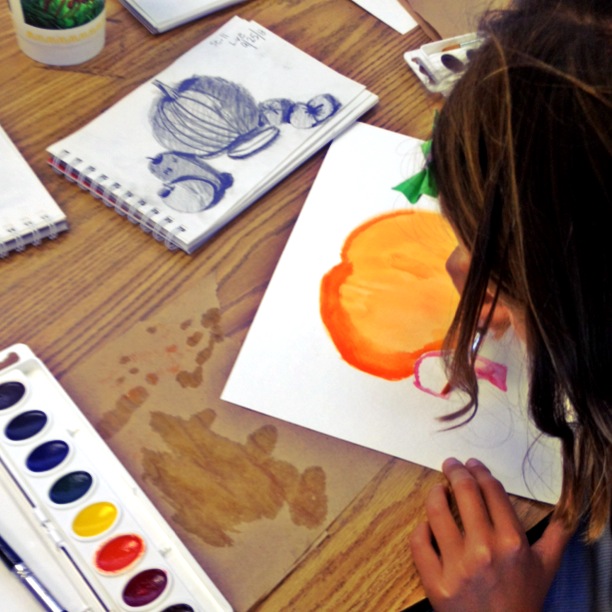
They are saturated with learning experiences.  Today we painted.  But it was just a part of a series of experiences to help students look closely, notice details, and then learn to sketch roundness by using curved lines and shading with their sketch pencils.  They started with pumpkins harvested from our school garden.  They moved to tomatoes, also harvested in the garden. They studied Vincent Van Gogh and learned about the concept of still life.  They arranged their own still life composition and photographed it using their iPads.  They used the photo as a guide for sketching their unique composition–and also learned some techniques for showing the overlapping of the fruits and vegetables.  And then today they tried the same techniques using watercolor paints.

photo_1-1

These six, seven, and eight year olds saturated their compositions with the brilliant colors of fall based on their experiences with the actual objects.

photo-3

In this photo you can see the gorgeous sketch (that the student made earlier this week) that guided this careful painting.  Saturating students in a variety of experiences related to a topic allows for deeper and more meaningful learning.  This learning is not just about art–although the art is beautiful–it’s also science and history and math and reading and writing…and so much more.

And conveniently, this week’s Weekly Photo Challenge is saturated.  It talks about color…but there is so much more to saturation than color, in my opinion!

How do you saturate yourself and your students in learning experiences?

The Action of Stillness: Still Life

Today’s daily prompt at The Daily Post is stillness.  In our classroom we’ve begun to work on sketching techniques that help artists capture roundness.  All this in preparation for sketching a still life of the fall bounty from the school garden.  Last week we sketched pumpkins.  Today…tomatoes!

photo-1

So here is the action of a child working to capture the stillness and roundness of a tomato just picked from the school garden.

photo

How do you capture stillness?