Category Archives: thinking

Remixing and the Cardiff Kook

Tomorrow my class is traveling up the hill (a mile or so) to the other school in our district to write with the older students in the other multiage class (many of whom were in our class a year or two ago).  We’re doing this to celebrate writing and the National Day on Writing and this year’s theme: write2connect.

In the spirit of connection and Jim Gray (the founder of the National Writing Project) and even the Common Core State Standards (CCSS), we will “try on” writing about the same topic in three different ways.  While the CCSS text types (narrative, informational, opinion/argument) will constitute our broad categories, students will be able to fuse and mold the writing to fit their own interests and purposes.

So…to get students started thinking about opinion/argument, this post will be my attempt to create an opinion piece focused on the Cardiff Kook.  The Cardiff Kook, a piece of public sculpture officially named “Magic Carpet Ride,” has been the center of mischief and controversy in the small coastal town where I teach.
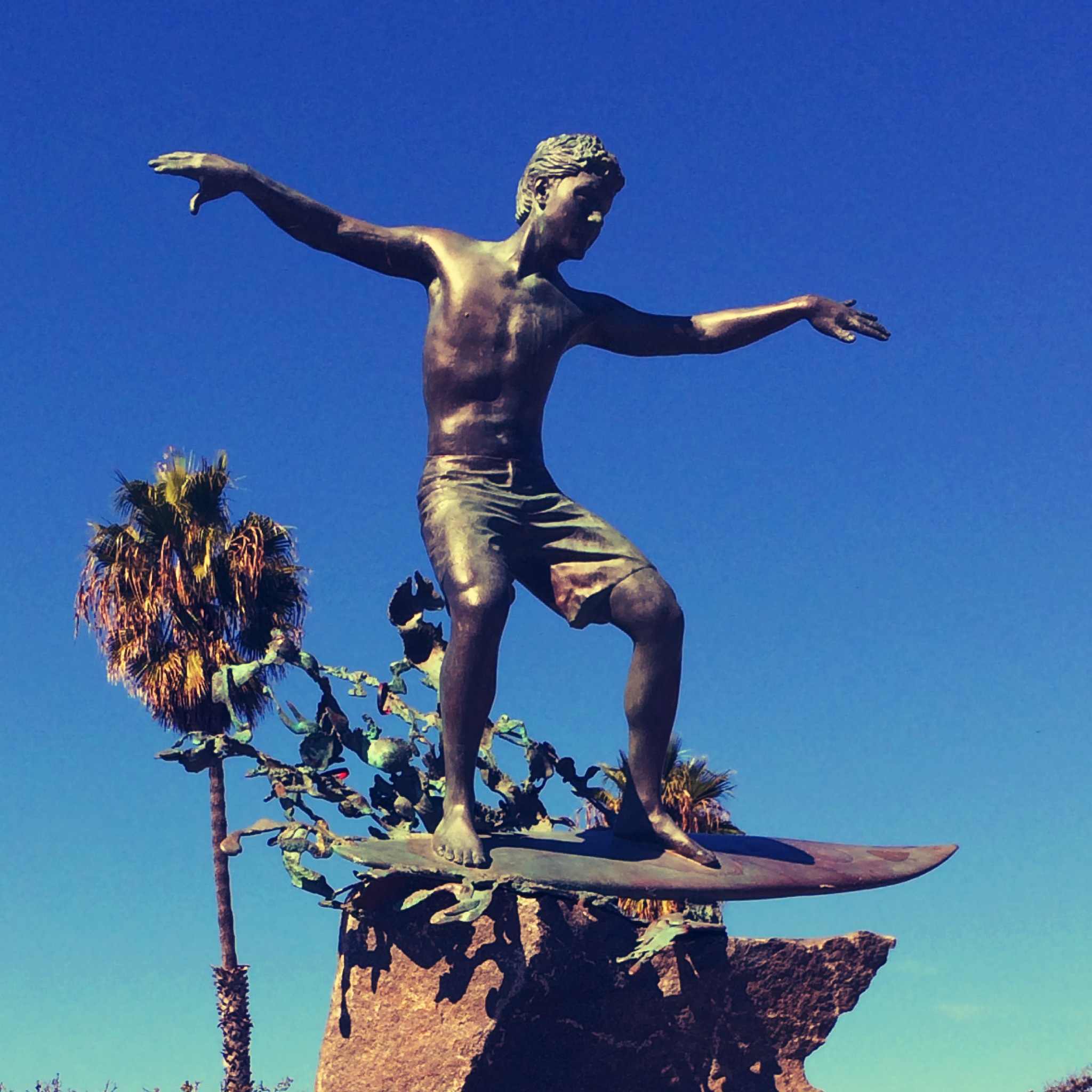
photo-3

So here I go:

Love it or hate it, the Cardiff Kook has become an iconic image in the seaside town of Cardiff-by-the-Sea.  Guerrilla artists creep up to the statue originally named “Magic Carpet Ride” in the dark of night to creatively adorn the controversial surfer in any number of theatrical props.  It has been transformed into Oprah in celebration of the last Oprah show, engulfed in the jaws of a great white shark, and carried off by a prehistoric flying creature.  I love the Cardiff Kook. It’s a great ambassador for Cardiff, bringing in tourists from all over and creating opportunities for community building within the town.
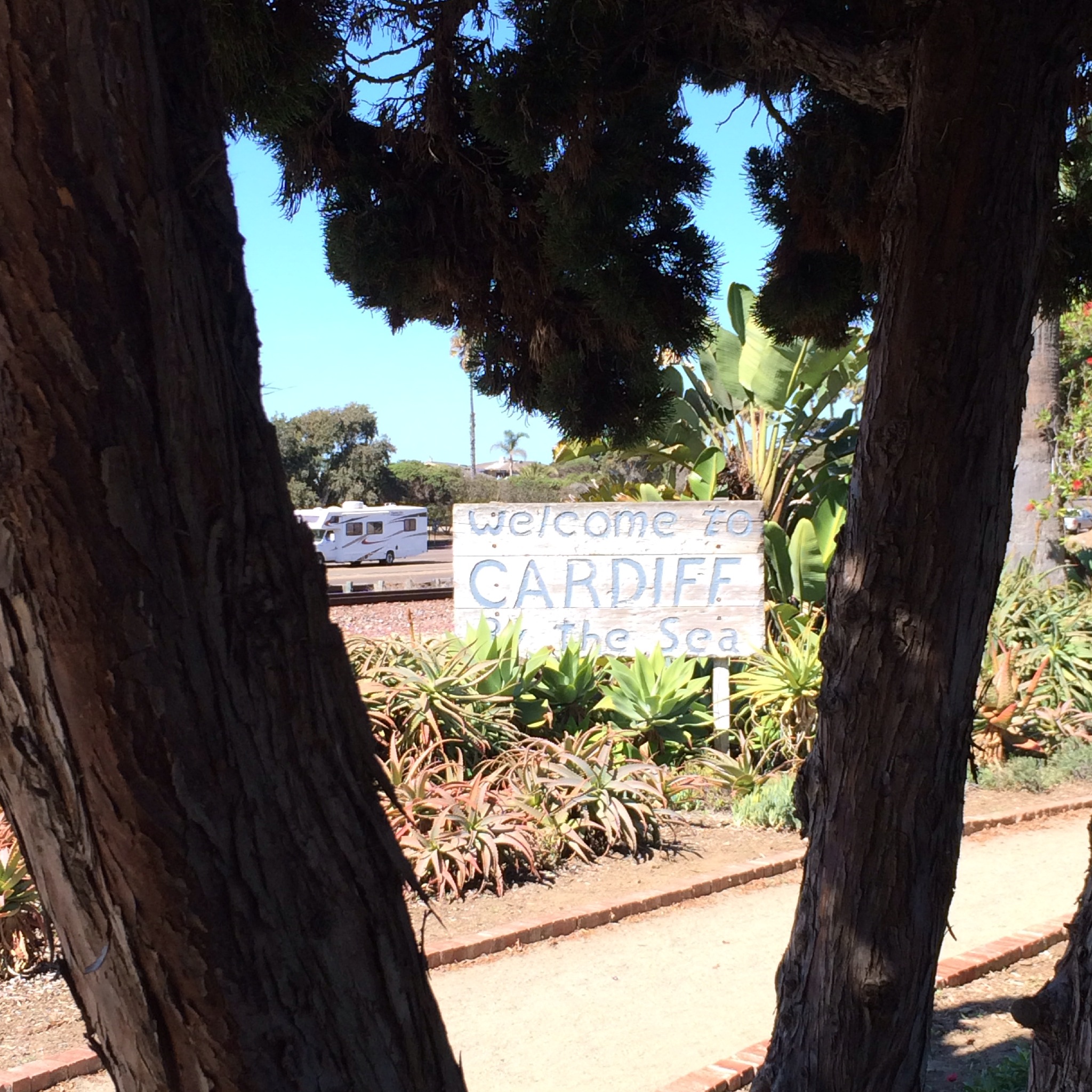
photo_2

It’s fun to see the kook all dressed up.  There is never a time when I drive by the statue at the intersection of 101 and Chesterfield Drive when I don’t slow down to take a look to see if there is a new creation.  For a while, a couple of years ago, the kook was transformed regularly and extravagantly. Lately that has slowed down and most days it looks like it did today when I took the photo in this post.  I love to take out-of-town guests and family members by to take a look at the statue…always hoping that it might be dressed up in some interesting way.

I recently read that images of the kook are now copyrighted and will be licensed to fund the upkeep of a public garden across the train tracks from the statue.  I’m guessing that was the thinking behind the Cardiff Kook calendar and maybe even the annual Cardiff Kook Run. These kinds of products and events can bring a community together as we all connect through our experiences with the kook.

Mostly, though, I just think the kook is fun.  I think the point of public art is to create conversation.  Some people will like some pieces and some won’t. But the conversations and arguments and conflict make us all think and engage and pay attention.  Not liking the original surfer sculpture resulted in creative and playful ways to re-envision this piece of public art.  And most of the time it remains unadorned as the sculptor created it…but every once in a while others add their own spin to the art, remixing the original artist’s vision with their own to create something new, different, interesting…and create a new conversation.  And for me, that is much more valuable than looking at a static,  unchanging piece of art day after day, year after year.  The Cardiff Kook reminds us to be playful, to have fun…and to connect with each other.

What do you think?

20131017-204042.jpg

Ordinary

Today, out of necessity, I had to scrap a plan and invent another without notice.  For teachers, this is something that happens with some regularity and most of us pride ourselves on our flexibility. And I love it when that spontaneous plan blossoms into a wonderful learning moment.

We always have picture books at the ready to read to our class.  Some are set aside for specific purposes and lessons, others we know we want to read but are waiting for the perfect time to present itself.  Last year we read Spoon by Amy Krouse Rosenthal–a book that our students loved.  We revisited it a number of times throughout the school year for different purposes…from mentor sentences to a situation for opinion writing.

At the end of the year, I came across a new book by Amy Krouse Rosenthal: Exclamation Point. So today, in that moment when I needed a plan at a moment’s notice, I picked up Exclamation Point, reminded my returning students (two thirds of them) that this was the author of Spoon, and started to read.  I love those moments when each student’s attention is fully engaged…and they were hooked by the bright yellow cover and the whimsical smiling exclamation point. They noticed right away that there wasn’t a title…at least not written in words. The exclamation point itself stood as the title.

15815400

We read and discussed and noticed and connected all the way through the book.  We delighted in the words and the pictures and the message.  And we were inspired to write our own stories about punctuation.

And then later in the day we managed to get packed up and ready to go home with enough time for a book before the dismissal bell.  Overwhelmingly, students wanted me to read Spoon. It was sitting near Exclamation Point…and suddenly today became the day for a mini author study.  The second and third graders were treated to an old friend, and the first graders were anxious to get acquainted!

After reading, students volunteered their observations, connections, reactions, reflections. They had so many thoughtful comments and ideas for their own writing.  And one student pointed out that Amy Krouse Rosenthal wrote about ordinary things…in wonderful ways.  We started thinking about all the ordinary things we might write about and how our writing could transform them beyond the ordinary.  They were excited to write as the dismissal bell rang today…I hope they sustain that excitement long enough to actually get to the writing.

I’ve also been noticing the power of the ordinary.  Yesterday’s post was about the transformation of an ordinary photo into something I was willing to name as art.  And today on five minute friday the prompt is ordinary.  Today in the classroom the ordinary business of reading a book because an extraordinary opportunity to notice the magic of writers and writing…and turned students into active learners making meaning for themselves.  Today I was reminded that ordinary is a state of mind, and each of us has the power to re-look and re-see the ordinary in new ways.  I love when that wonderful learning moment in the classroom means that I learn too!

Rain and the Common Core

October in San Diego is often a hot and dry month characterized by Santa Ana conditions, creating a high risk for wildfire.  We’ve already had many “red flag” warning days.  These warm, dry October days are both wonderful…an extension of summer…and terrifying, having lived through some horrific urban wildfires in the last decade or so.

Rainy days are a rare occurrence here.  We average less than ten inches of rain a year…and I can’t remember the last time it rained!  (Was it in May or June?  Or even before that?)

With rain in today’s forecast, my students were dressed in an odd assortment of post-summer attire: shorts with sweatshirts, boots with tank tops, hoods and hats…  Like having one foot in summer and one ready for the impending storm.  Students were excited, edgy–some complaining of cold (in the 60+ degree temps), others in sleeveless tops running happily in the almost-weather.  The blustery conditions hinted at “real” weather–weather that didn’t arrive during the school day today.

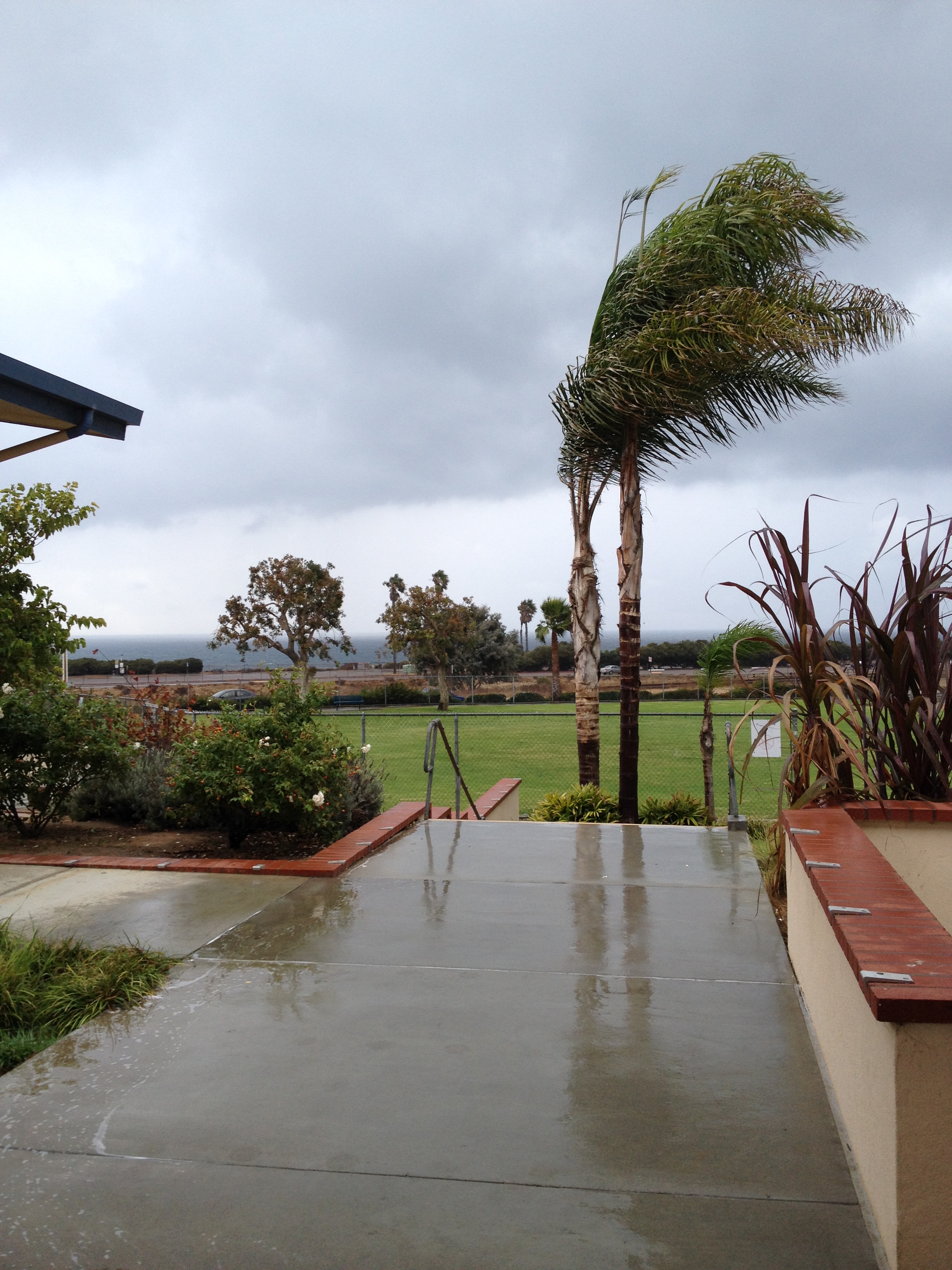
An hour or so after school ended for the day, the much anticipated rain arrived.  Not just the drizzles the we so often get, but real soak-the-ground kind of rain.

photo

Meteorologists, through the media, announce our “severe weather” and the roadways are a mess with spin outs and collisions caused by slippery conditions and out-of-practice rainy day drivers.  And yet, we need this rain.  We need it to ease the fire conditions that come with the parched earth.  We need it to lessen the demands on our over-stressed reservoirs.  We need it to water our lawns and gardens and native foliage.

And the rain is a reminder that change can be a catalyst.  In a place where the weather seldom changes, it’s easy to see rain as inconvenience.  It tangles the traffic, scares customers from the local farmer’s market, and causes many events to be canceled.  (Like I said, rain is rare here!) But change, like rain, is an opportunity to rethink everyday routines.

At lunch today, some of my colleagues and I were talking about the Common Core State Standards (CCSS) and the stormy conditions they are creating for many teachers.  They feel threatening like severe weather (or a rainy day in San Diego)…requiring a change in the ways teachers think about instruction and classroom routines.  It will take more than pulling on some rain boots to create an environment for deep learning, a place where students make sense of concepts rather than memorize facts and procedures.  Change feels hard and scary, but like the rain in San Diego, we need it.

And like my students on an almost rainy day, some teachers are ready to embrace the change and rethink their instruction and consider new ways to support students to more critical thinking and in-depth analysis.  And others will make more cosmetic changes, renaming old practices and repackaging old projects.  There will be an odd assortment like the tank tops and boots and shorts and hoods my students wear–a mish-mash in our educational system–as we figure out just how to deal with the change.

I’m choosing to embrace change and see it as an opportunity rather than an inconvenience. We need the rain in San Diego…and we need change in our educational system.

Informational Writing

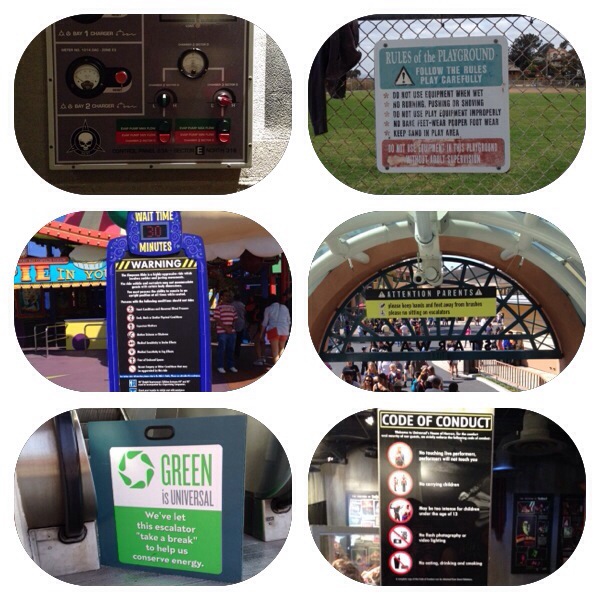
I’ve been noticing that my world is filled with text, much of it informational. When I look around I see signs that explain rules, warn me of danger, remind me of safety, let me know what is going on, and more.

20131004-234144.jpg

I’ve noticed that much of the informational text I see includes icons or images, sometimes even diagrams. It makes me wonder if this kind of text is meant to be read or merely noticed. By noticed, I mean put on warning that there are rules or dangers to heed…and the presence of the text implies that the risk, whatever it is, is yours. A notice of liability, of sorts.

This sign I saw in the Sacramento airport car rental center seems the kind of informational text that exists to fend off questions and complaints.

20131004-234750.jpg

I wonder who writes the texts like this. Is it someone’s job responsibility? Does it go through an revision and editing process? Who determines the clarity?

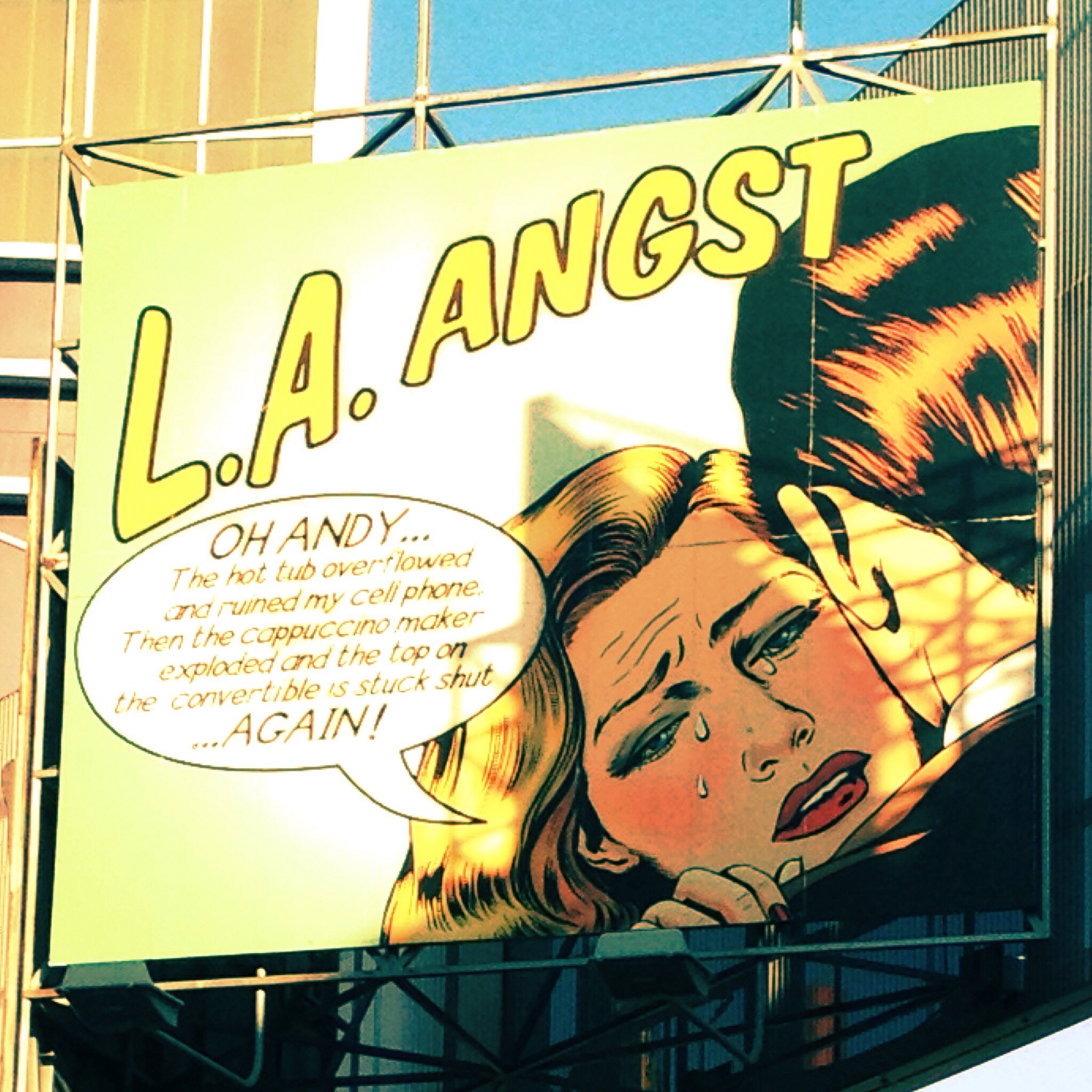
And what about something like this?

20131004-235159.jpg

Is it informational or just entertaining?

Driving in Los Angeles

Driving in Los Angeles is an unique experience. It can be daunting, stressful, confusing, exhausting, and sometimes downright harrowing! The roads and freeways are a relic of the L.A. of yesterday when there were fewer people, fewer cars, and lower speeds. As the city grew and sprawled, freeways were added that interconnect and crisscross…some to the left, some to the right, often with short on ramps and sometimes an immediate need to change lanes. The surface streets aren’t much better. Many are narrow with lanes unexpectedly ending or suddenly cars parking in what used to be your driving lane. There is evidence of attempts to update the roadways and to improve the driving experience, but most work is mostly cosmetic…keeping what already exists functional, while attempting to make the improvements when possible to the roads and freeways in use.

Sometimes our educational systems feels like driving in Los Angeles. Many of the structures in place are relics of days gone by. Schedules and groupings are mostly as they have always been. But we have more students, diverse learners, more access to information, and as a result of all of that, changing expectations for outcomes for student learning. With the Common Core State Standards (CCSS) there is a move to go in and remake some of those roads (to carry out the L. A. driving metaphor), the improve access to and delivery of robust learning experiences for students. But in many cases, instead of reconsidering the educational system…including testing, funding, organizing, professional development…teachers are being asked to fill in the potholes. They are taking old practices and adding a new activity or two to meet the new standards.

And I understand why this is happening…both with L.A. roads and our educational system. Change is hard and often painful. We would have to make sacrifices to tear down what isn’t really working and build new structures to meet emerging needs and those in the foreseeable future. Wow, I tackled a complex topic late on a Wednesday. There’s so much more to think about here…