Tag Archives: teaching

Spaces for Learning

Over at the Connected Learning MOOC on Google+, Terry posted this article by Valerie Strauss from the Washington Post about the struggles dedicated teachers face in our current climate.  He also invited us to respond…in a crowdsourced way.  Here’s my contribution:

I’ve just spent the past month with twenty educators passionate about improving their teaching and the learning experience of their students.  During this time they’ve read extensively, discussed and debated ideas and practices, demonstrated a practice from their own teaching setting in front of these peers, written and responded to writing—personal and professional pieces, all creative—and laughed and cried, dealt with worry and nerves, and invested countless hours because THEY want to be the best educators they can be.  Their districts and schools didn’t send them or pay for them—they came because they chose this experience.

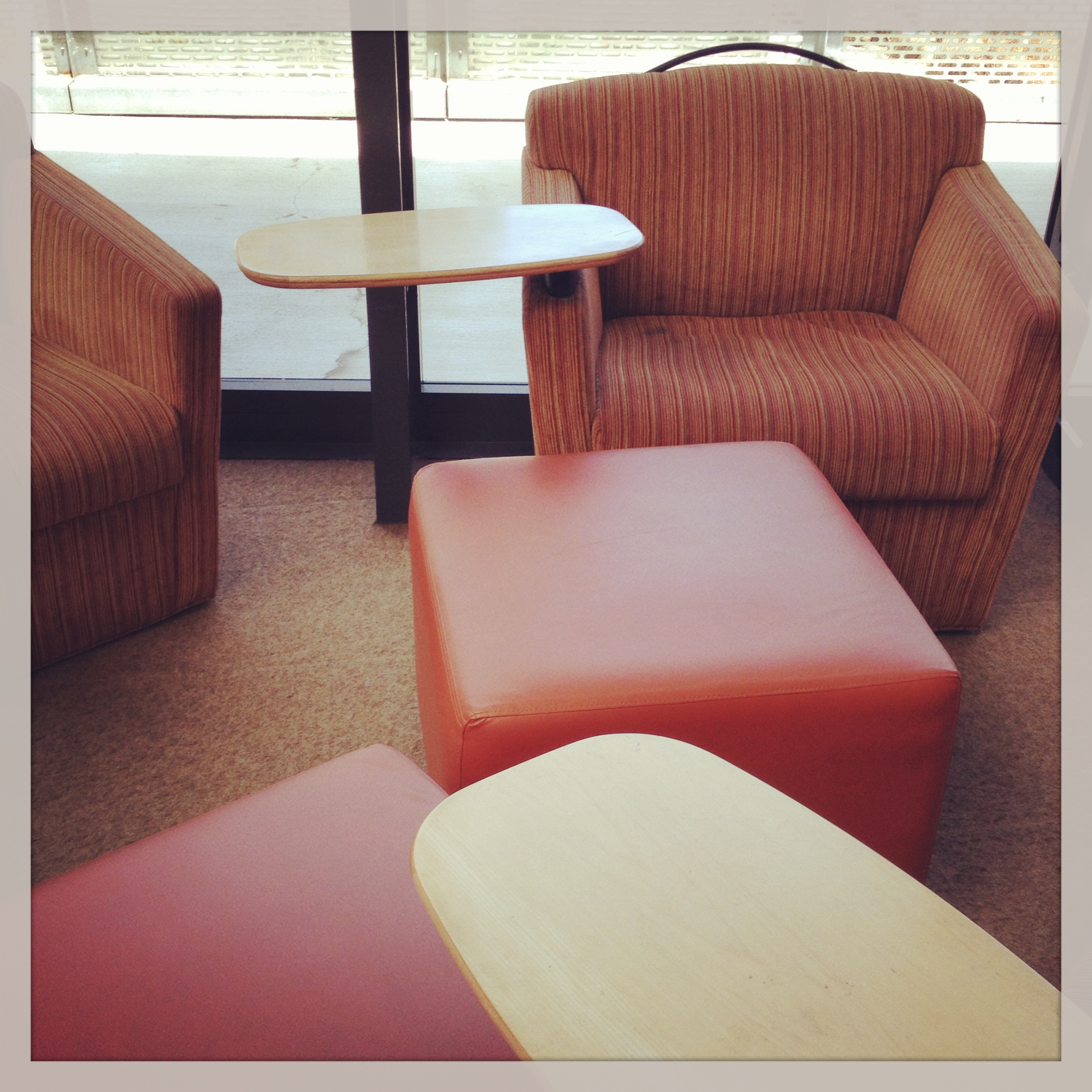
Many #si13 discussions take place on these #orange chairs and cubes.

Many #si13 discussions take place on these #orange chairs and cubes.

These “third spaces” like writing projects, the CLMOOC, and Twitter have become more and more necessary for educators to thrive in our challenging profession.  These are the spaces where teachers experiment, innovate, and most importantly, find support when they feel that our educational system isn’t working for them or for their students.  In the face of daunting constraints, teachers like the ones participating in the SDAWP Summer Institute and those making like crazy in the CLMOOC continue to seek out practices that support learners and celebrate the joy and purposes of learning.  In these spaces we make sense of our world, we build relationships, we blaze trails for learning for those that feel pinched by constant test prep and narrowing curricula and in doing so we stay the course.  Because like Valerie said,

But some teachers are fighting these trends. Teachers believe that education is not just teaching students to pass tests. They believe that education is not just about how to make a living, but also about how to make a life. They believe that school should be a place of joy in learning, not learning in fear. They believe that play, imagination, and creativity have a place in school, just as much as mastering difficult material. In fact, play and mastery go hand in hand. And these teachers are fighting to work harder than ever so they can continue to find ways to be creative in the classroom despite the pressure not to be. These teachers have classrooms you’d love to have your child in.

What kind of classroom or learning spaces do you want for your child, for your students, for yourself?  I’d love to hear about your “third spaces” or alternative ways of dealing with the constraints that are strangling the love of learning and passion for teaching.

Writing, Science, and Making

On my way to UCSD yesterday morning I listened to this story on our local public radio station about a zombie horror video game inspired by a nature documentary, with commentary from a local entomologist from the San Diego Natural History Museum, Michael Wall.  I’m not much of a video game player, but I love the idea that a nature documentary and the very real behavior of parasites inspired the story of this game.  I started to think about the ways that science and writing are natural partners and the roles that curiosity and creativity play in both.

And then I started to think about the ways that curiosity and creativity often get squished in schools in the name of supporting our learners.  We’ve been reading, writing, and debating formulaic writing in the SDAWP Invitational Summer Institute this week and asking ourselves what is gained and what is lost when writers, especially young writers, are encouraged or even forced to fit their thinking and ideas into five paragraphs (or three or…) predetermined and highly structured by a formula?

I’ve heard people say that “structures” (provided by formulaic writing) free young writers from the frustration of figuring out effective organization for their ideas and their writing.  But I’m guessing that neither the writer of the nature documentary nor the video game maker used a formula to craft the stories behind their movie and game.  I wonder if they even thought they were writing (as in school writing) as they crafted the narrative structures that hold their work…or were they simply making and/or playing as they explored the ideas in their heads?  I’m also wondering if they worked with collaborators–and how that shaped their stories and their productions.  (It sounds like both making and playing to me…and fun!)

My brain is already on fast forward to the new school year as I think about how my students might be inspired to write video games and documentaries and radio podcasts like the one above and who knows what else!  I know I won’t be providing any fill-in-the-blank formulas to structure their compositions.  Instead, I will help them locate mentor texts (texts in the broadest sense of the word) to play with, examine, and study to figure out how they will construct their own.  And I will create and compose along with them.

And for those of you who think your ideas are not clever or original or good enough, take a look at this video (thanks Kristina Campea for sharing on google+ at the #clmooc).

So what inspires your writing and creating?  What structures do you depend on to move from ideas to composition?

frames

With each photo I take with my cell phone, I spend more and more time thinking about how to frame the picture I see. I’ve learned that using the zoom feature on my phone helps me see the object clearly in the moment, but degrades the quality of the photograph when I go to edit. I can reframe in the editing process, pulling the image in closer, eliminating some of the background noise. If I shoot too “big” I often find myself with a nondescript landscape. Finding some kind of focal point makes the photo more interesting–and often evokes the curiosity of viewers.

This article in the New York Times on July 2, 2013 also has me thinking about frames and framing.  The author plans an outing for his 6 year old nephew based on both his budget and his nephew’s interests and personality.  A focus on Grady’s interest in art and low-key, meandering pace in life creates a day filled with drawing and art museums punctuated with opportunities for Grady to interact with working artists, study a variety of art forms, and enjoy a leisurely day with his uncle.  Framed in another way, Grady could have been disenfranchised, alienated by having to hurry here and there without the time to study and try out what he found interesting along the way.  Uncle Seth’s focus created spaces for Grady’s curiosity to blossom.

This has me thinking about ways I can use this idea of framing in my classroom and in my work with teachers, foregrounding student interests while keeping the skills and processes needed for learning success in mind.  I’m wanting each of my students to feel like Grady did on his outing with his uncle: like learning is what you do when you’re enjoying what interests you.  That’s what happening with my photography.  I’m learning as I play around–and through connections with others with a wide variety of interests and skills that relate to what I am doing.  My photography (and the photos themselves) are not framed in a permanent shape with a single focus, I am continually exploring frames and how they work with the images and ideas for each shot.

School curriculum often feels like it exists in the noun “frame” rather than used flexibly with the verb “frame”–ignoring students’ strengths, challenges, and existing interests and knowledge.  Does the frame/framing metaphor work for teaching and learning?  I’d love to know what you think!