Tag Archives: teaching

Wordless Books and the Power of Words

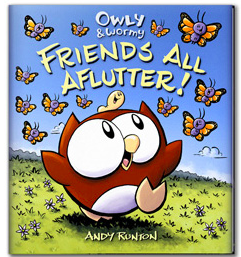
Yesterday we embarked on a study of graphic novels in our classroom by reading Owly and Wormy Friends All Aflutter by Andy Runton.

Screen Shot 2015-09-15 at 5.17.28 PM

This picture book is a nice entry into the world of graphic novels for our young students–even though it may not technically fit into the definition of graphic novel.

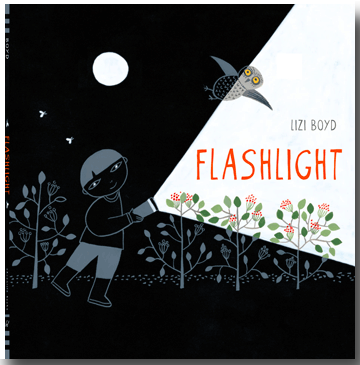
Our students aren’t new to reading wordless books, last year we delighted in the wordless books of Flashilight and Inside Outside by Lizi Boyd (you can read about these adventures in a post by my teaching partner here).

Screen Shot 2015-09-15 at 5.19.37 PM

So there were no surprises yesterday when we began to read about Owly and Wormy.  Our older students were eager to “read” as we turned pages under the document camera, and it wasn’t long before our young students began to join in, volunteering their own readings.

Wordless books, and particularly those with a graphic format, allow confident readers to emerge–even if they are still struggling with decoding print.  Our students showed off their wealth of symbolic knowledge–recognizing that a four leaf clover in a speech bubble is a message of good luck and that a light bulb represents a new idea.

Imagine my delight when one of our first grade boys raised his hand…with two things to share. He quickly pointed out that this book was filled with verbs.  You might wonder what he was thinking…this is a wordless book.  But I knew that we had been working with vivacious verbs last week, using George Ella Lyon’s All the Water in the World and Thomas Locker’s Water Dance as mentor texts for this year’s first attempt at poetry.  As I asked this student about the verbs in the book, he pointed out that Owly and Wormy were reading, sleeping, planting…  It was obvious that he understands verbs!  (And I wish I had recorded the actual verbs he pointed out…they were better than my memory!)  I don’t remember the second thing he shared–it was relevant–but not as exciting as his noticing of verbs in a wordless book!

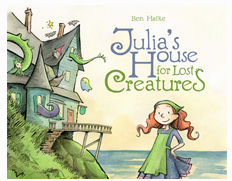
We’ll continue our study of graphic novels, focusing on the features as we connect back to Owly and Wormy and also to Julia’s House for Lost Creatures by Ben Hatke (a hybrid graphic novel/picture book that we read the first week of school to talk about what we needed to do to get along as a community).

Screen Shot 2015-09-15 at 5.27.50 PM

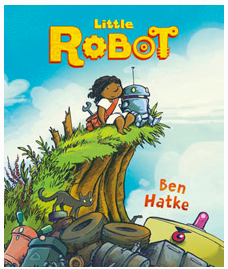
And we’ll take our study further as we explore Hatke’s latest graphic novel, The Little Robot as a class read aloud.

Screen Shot 2015-09-15 at 5.29.36 PM

The more I read wordless books and graphic novels, the more I am intrigued by the power of images and the resulting power of words that my students bring to our conversations about these rich, complex, and layered books.

What are your favorite wordless books and graphic novels to use with students?  For yourself?

One Word from Sophia, it’s Destiny!

Sometimes you know at first sight that you were destined to meet.  That happened to me today.

The SDAWP Summer Institute (SI) is in full swing, which means my head is full and my schedule is packed.  There is lots of reading and writing and thinking and talking going on…and I love it. Today at lunch I had a few minutes to myself, so I headed off to the coffee shop to treat myself to a latte. When I walked in and saw that there was no line, I immediately thought–jackpot!  I can take a few minutes and walk through the bookstore, just to look.

Coffee in hand, I headed toward the children’s book section.  And there it was…

I couldn’t resist.

One Word from Sophia by Jim Averbeck and Yasmeen Ismail grabbed me and wouldn’t let go!

IMG_5968

I was drawn in by this brilliant little girl who knows what she wants…and has a plan to get it.

Sophia’s birthday was coming up, and she had five things on her mind–One True Desire and four problems.

This girl is a student of rhetoric and knows how to make an argument.  She knows her audience and how to tailor her reasoning and evidence (love the variety and types!) to convince.  And she takes her feedback as information essential for revision and iteration.

I don’t want to spoil the story by giving away all the details here…but if you are a teacher of writing, of argument, of debate…or just love a great story…you will want to read and study and probably even own this book!

And there’s more…rich vocabulary, compelling characters, and a surprising ending.  And this is not a book just for children.  I can see community college instructors using this book in their composition classes and kindergarten teachers too.  And you don’t have to be a teacher…this is a book for readers and definitely for writers.

I think this will be a relationship that will endure…right now, it’s love at first sight!

Here’s Jim talking about the story:

Looking Beyond Ugly

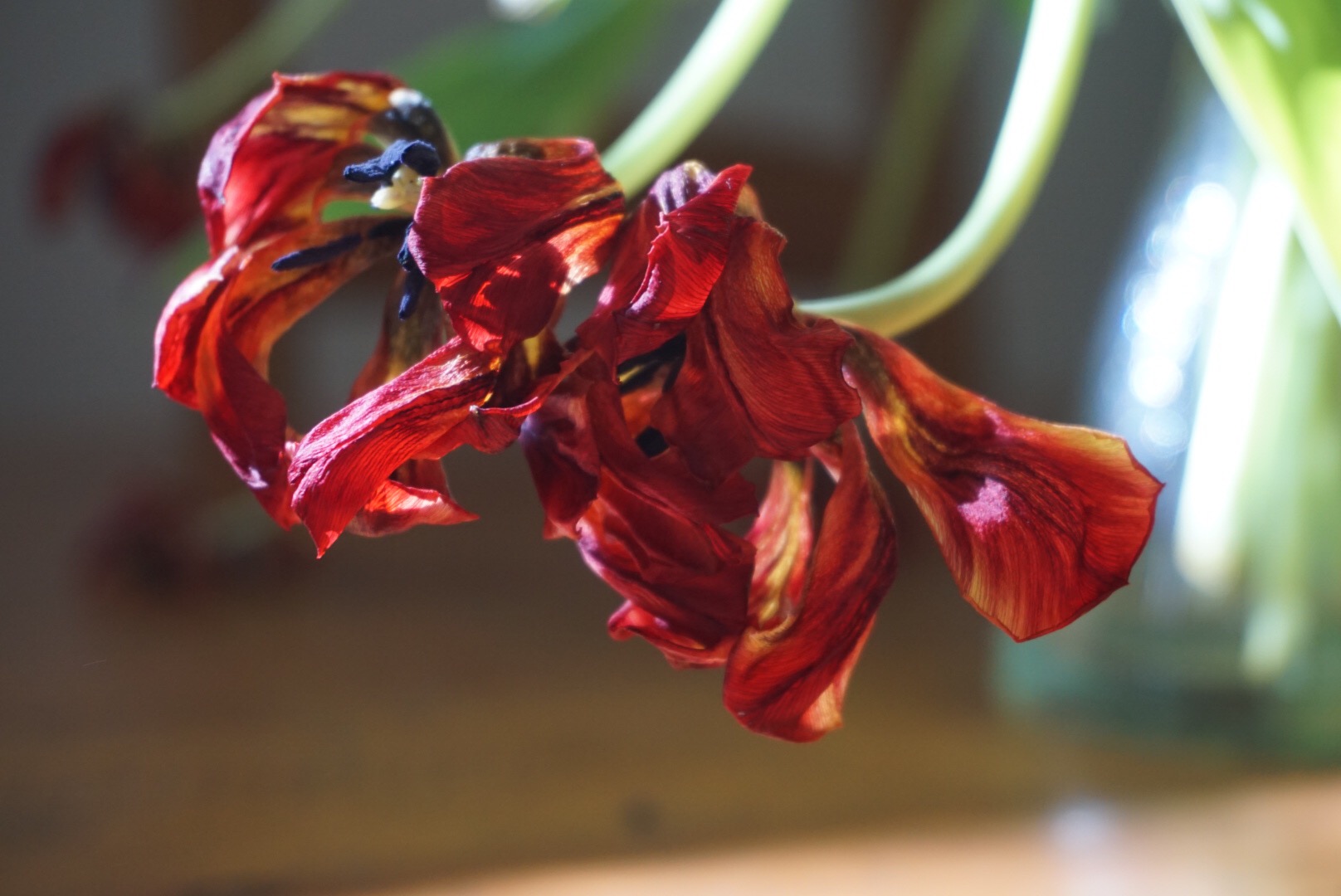
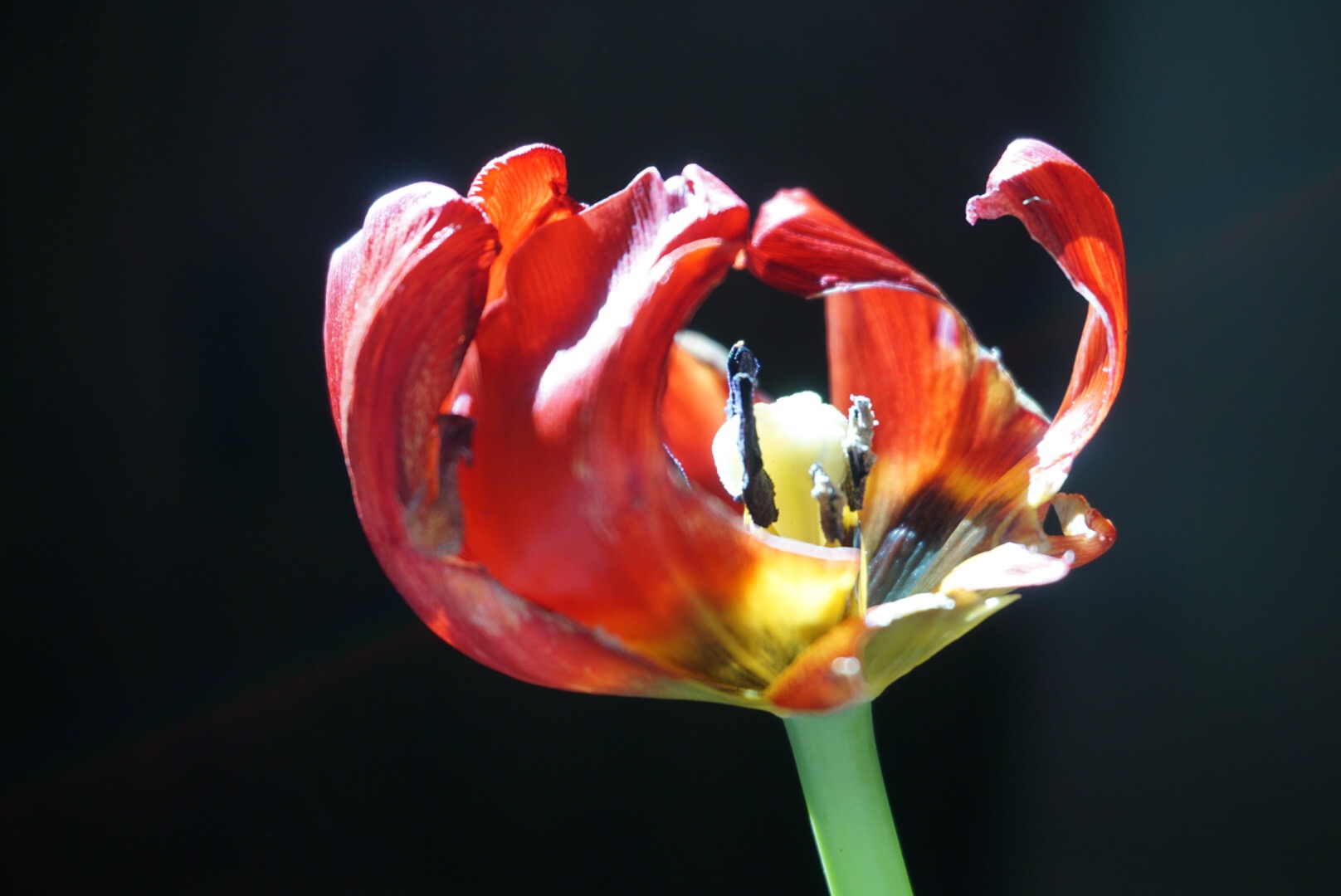
When I walked into the house today after work I noticed that the tulips in the vase on my dining room table were ready to throw out.  They were leaning over, their dried blossoms hanging upside down nearly touching the table.  I started to move them to the trash can…and then the afternoon light through the window shining on the near-dead plant caught my eye.  And suddenly I could see the beauty in the crumbling blossoms that had seemed so ugly only moments before.

IMG_5543

A  photography tip aside: It was just last week that Joy from Joyfully Green had posted an article where she described the place–her dining room–that served as a photo studio because of the light it offers.  (Joy has many tips to share…about photography and about living green.)

As a teacher, it’s my job to look beyond the ugly–the spaces where learning isn’t happening in the ways we want or expect–and figure out how to find the light that transforms.  And it isn’t always easy.  Sometimes it just seems easier to place blame, give in to frustration, or pass the buck.  But then the light shines through my dining room window and I can look beyond the ugly and find the beauty.

IMG_5542

(Five Stories…not sure if I followed the rules, but thanks for encouraging me to tell a story today!)

Enveloped in Possibility

I love this time of the school year.  At least the part that is about my students.  (Yeah…there are too many meetings, too much drama about which students are going where for next year, too much paperwork…filling in forms, checking off boxes, signing off forms for this and that.)

As a friend of mine recently said in an email, this is a time when we get to witness a fuller blossom of our students.  We get to see what they can do when given time and space and opportunity…if we give them time and space and opportunity.

Like this slightly chewed and fully blossomed tulip, students open up at this time of the year. They dig into projects and expose their interests and thinking.  They are enveloped in possibility.

IMG_5517

Our students recently went to the San Diego Natural History Museum on a field trip.  Their goal was to explore the new Coast to Cactus exhibit that features San Diego’s diverse ecosystems and find something that interested them.  When they returned to the classroom. they researched this interest and then create a movie or blog post to teach someone else about what they learned.  With time and a bit of technical support from us, our students inquired, composed, and created.

Here’s a couple of examples:

Ana (a third grader) got very interested in ghost shrimp…and couldn’t wait to learn more.  She researched and wrote…working hard to explain what she learned in her own words and voice…and included her own drawing of a ghost shrimp.  Here’s an excerpt:

Moist, murky water embraces the wetlands, cattails sway in the salty breeze, lush growth is everywhere. The wetlands are teeming with life. They are homes to birds, fish, and many mammals. However, many people ignore what’s happening deep down in the mud flats. The mudflat is a home to an amazing creature, the ghost shrimp

You can see her work here.

Eli (a second grader) noticed a mouse at the museum and couldn’t wait to learn more.  And when he didn’t find the answers to his questions during his time researching in class, he went home and got his parents to help him with his research.  He has also become our residence expert on iMovie…mentoring many of his classmates, helping them record and upload their own videos.  Here’s his movie.

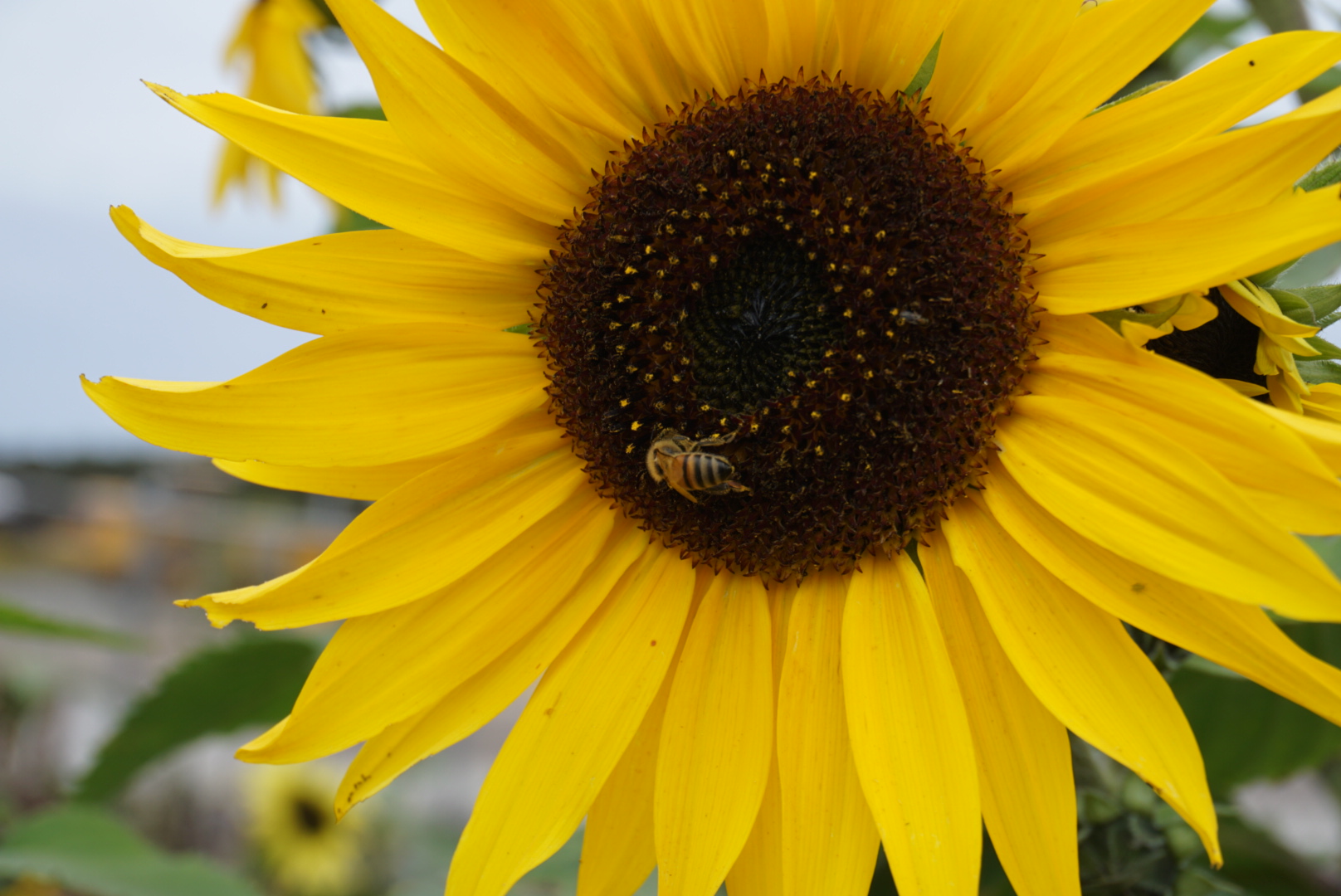
And those two are just the tip of the iceberg of what is happening in the classroom.  Our students have cross-pollinated, pushing each other to consider new possibilities.  Like the bee on this sunflower, they depend on each other as they reach and strive for new heights, solidify what they already know, and reach with a helping hand to lift their classmates.  They are enveloped in a community of learners that allows them to bloom, to stumble, and to get up and try again.

sunflower with bee

And I am so lucky, because I am part of this community too…reaching and learning, enveloped in the energy and excitement of possibility.

March Madness

It’s that time of the year…

No, I’m not talking college basketball, brackets, and the sweet sixteen.

It’s report card time, and I can feel the March madness starting to seep in.  That insidious doubt that narrows my vision and makes me doubt what I know to be true.

If I weren’t writing report cards right now and you asked me to describe student learning in my classroom in one word, I would say blossoming.

Our students are blossoming.  They are reading and writing eagerly.  There’s a sense of confidence and fluency among this group of 6, 7, 8, and 9 year olds that defies grade level benchmarks.  Last week when students learned about how reasoning could make their evidence more compelling in a piece they were writing about this special place where they live, they were undaunted and dug in to add reasoning to their evidence, carefully explaining just why the beach makes this place special and why having a family owned donut shop matters to them.  A line like this one makes my heart sing… A second grader describing an iconic statue in our community that makes the community a special place to live wrote:  We also have a Cardiff Kook that loves to get dressed up.  I think everyday is Halloween for him.  And I want to shout from the rooftops when I read an ending like this one a third grader used to close the essay: So where were we again in the beginning? Oh yes, the beach.  Now the sunset kisses the dusk with oranges, yellows, reds, pinks, purples, and blues too beautiful to explain, and as you see the last foamy white whale spout on the horizon, there’s no doubt Encinitas is a very special place.  

Of course they weren’t written on demand in an decontextualized setting.  They are the result of rich discussion and leveraging of background knowledge, a writing community where revision is ongoing and expected, instruction that encouraged students to go back and add reasoning to their claims and evidence, and a space filled with mentor texts that highlight and celebrate beautiful language.  These complex sentences mean that the punctuation isn’t perfect…and the vocabulary students use push them to depend on phonics to express the words they don’t yet know how to spell, but honestly, I wouldn’t have it any other way.

But I know the first thing people see when they look at student writing is the mechanics…and that sometimes it can stop them from even noticing the beauty of the language and composition.

And then there’s math.  All year we have worked to develop a strong sense of number and the ability to solve real life (or as close as you can get in a classroom) mathematical problems.  So why did we hand our students traditional equations to solve?  March madness is my best excuse.  Luckily I took the time to look closely and notice that every one of our third graders competently solved a problem that featured Alexander Calder and his wire circus–and required both multiplication and division to solve.  And the majority of them solved three different versions of the problem that varied the level of difficulty!  (Thank goodness we decided to add that problem to our assessment to represent the kind of problem solving we have worked on all year!)

And most people don’t even ask about students’ programming skills, design abilities, persistence and resilience, empathy…or even their dispositions as budding scientists.  (You can read a bit about that here and here)

So, as I write report cards I’m trying to remind myself to breathe…and focus on the blossoming, pushing against the March madness.  Are all our students right where we want them to be?  No. Is there still room for growth?  Of course!  Can I improve my instruction to better support student learning?  Yes–and I’m working on that every day.

But, our students are blossoming.  And I want to make sure that the way I communicate progress helps their families and other educators see all that they can do, all the ways they have grown as learners…and help our students recognize that growth can be measured and documented in lots of ways.  And also know where they need to continue to work and grow…because learning continues for a lifetime.

I understand the importance of accountability and communication in our educational system.  I want to make sure that students are making progress and not slipping through the cracks.  But I also want to honor hard-earned growth and pay attention to the attitudes and processes that aren’t measured by standardized tests or traditionally reported on through report cards and assessments.

I’ll keep pushing against the March madness…and once the report cards are done, maybe I’ll watch a bit of basketball…


Weekly Photo Challenge: Celebrate

Do you speak in images? Enjoy taking photos to document your experiences or just to express what you notice in the world? Love to share them with others? Welcome to the weekly photo challenge! I post a new challenge each week…check in regularly and join the fun!

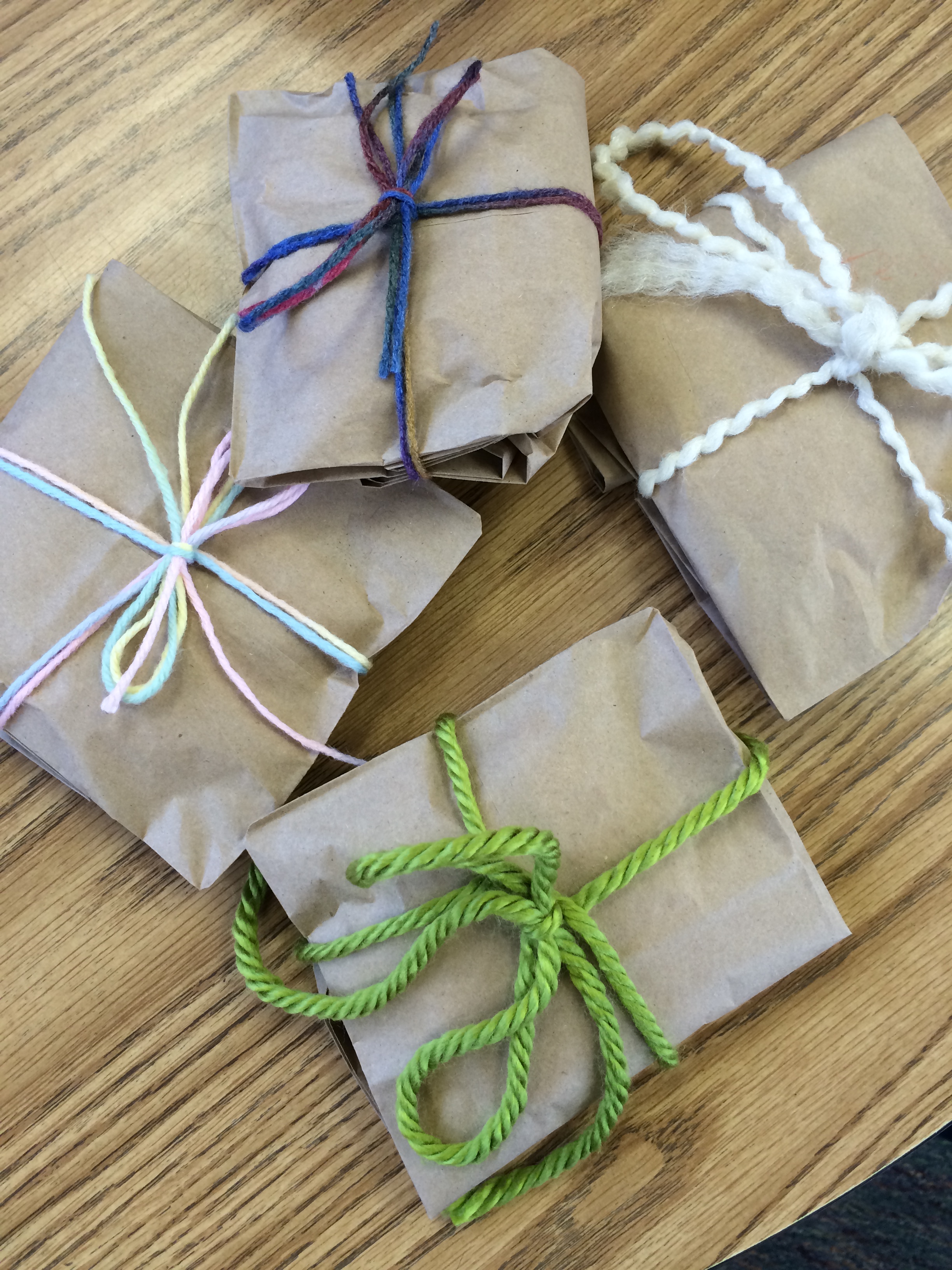
As teachers know, the week leading up to winter break is a busy one.  There’s so much more to teaching than reading and writing and math!  Kids heads are filled with the wonder and all the iconic imagery of the holidays, and we have to work hard to make learning relevant and engaging during this week.  And while there was plenty conspiring against us, there was a lot of great learning to celebrate.  Early in the week, kids put finishing touches on gifts they had made for their family and wrapped them up to take home.  I can’t give away what’s inside…there’s still a few days until Christmas!  There’s a lot of learning contained in these festive packages…from the creation to the presentation, each step is a learning opportunity that we, as adults, often take for granted!

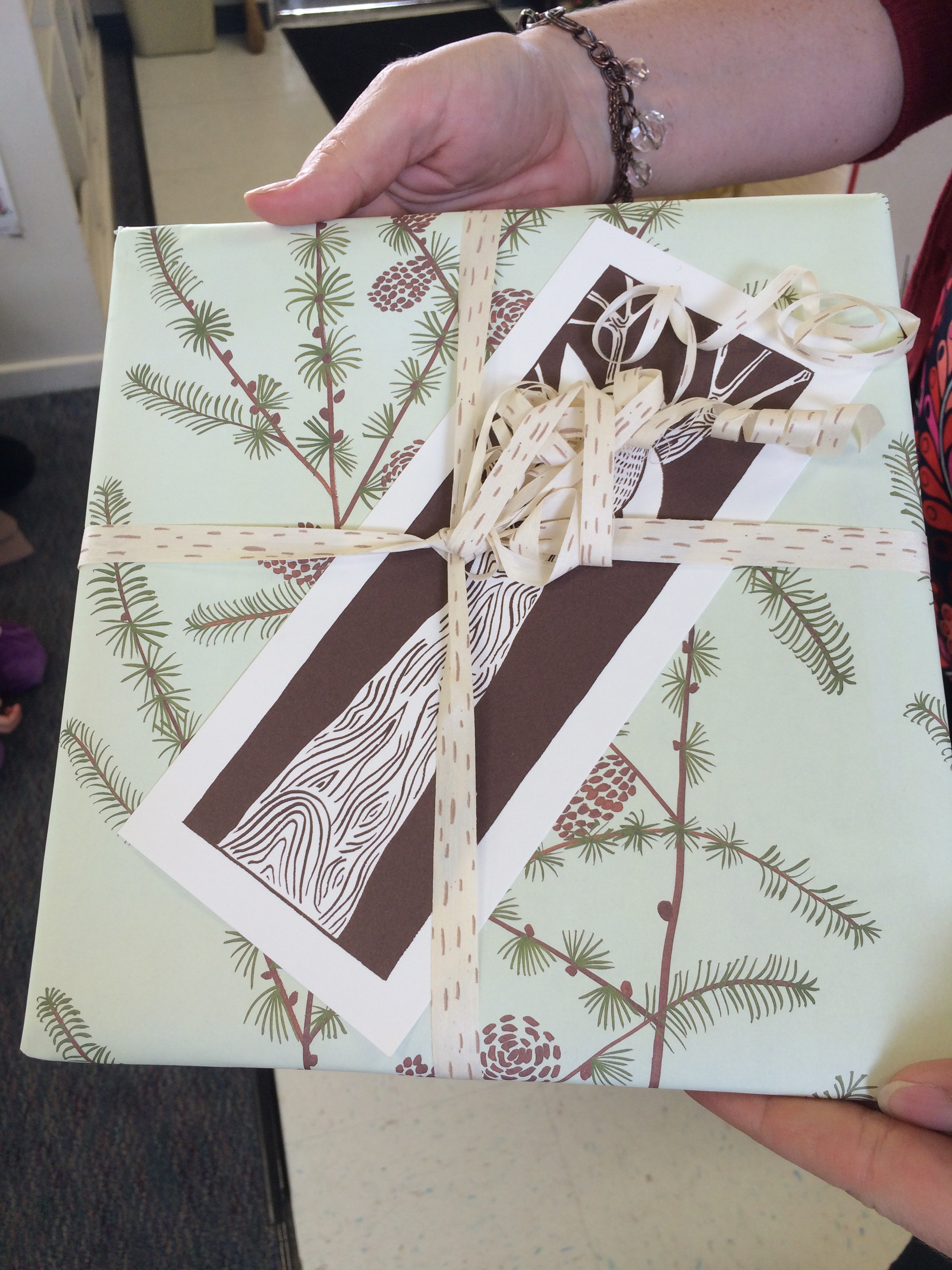
packagesWe were also surprised this week with a package from author/illustrator Lizi Boyd.  After reading Flashlight earlier this school year, our students had created Flashlight-inspired art and wrote stories based on Lizi Boyd’s wordless picture book.  When my teaching partner emailed her to share how much we loved her work…and sent some of our student products to her, she responded enthusiastically and sent our students beautiful blank notebooks, inspiring bookmarks, and encouragement to write, draw, and imagine.  She also sent a copy of her new book, Inside Outside, that we cannot wait to read and work with.  And the wrapping was a celebration in itself!

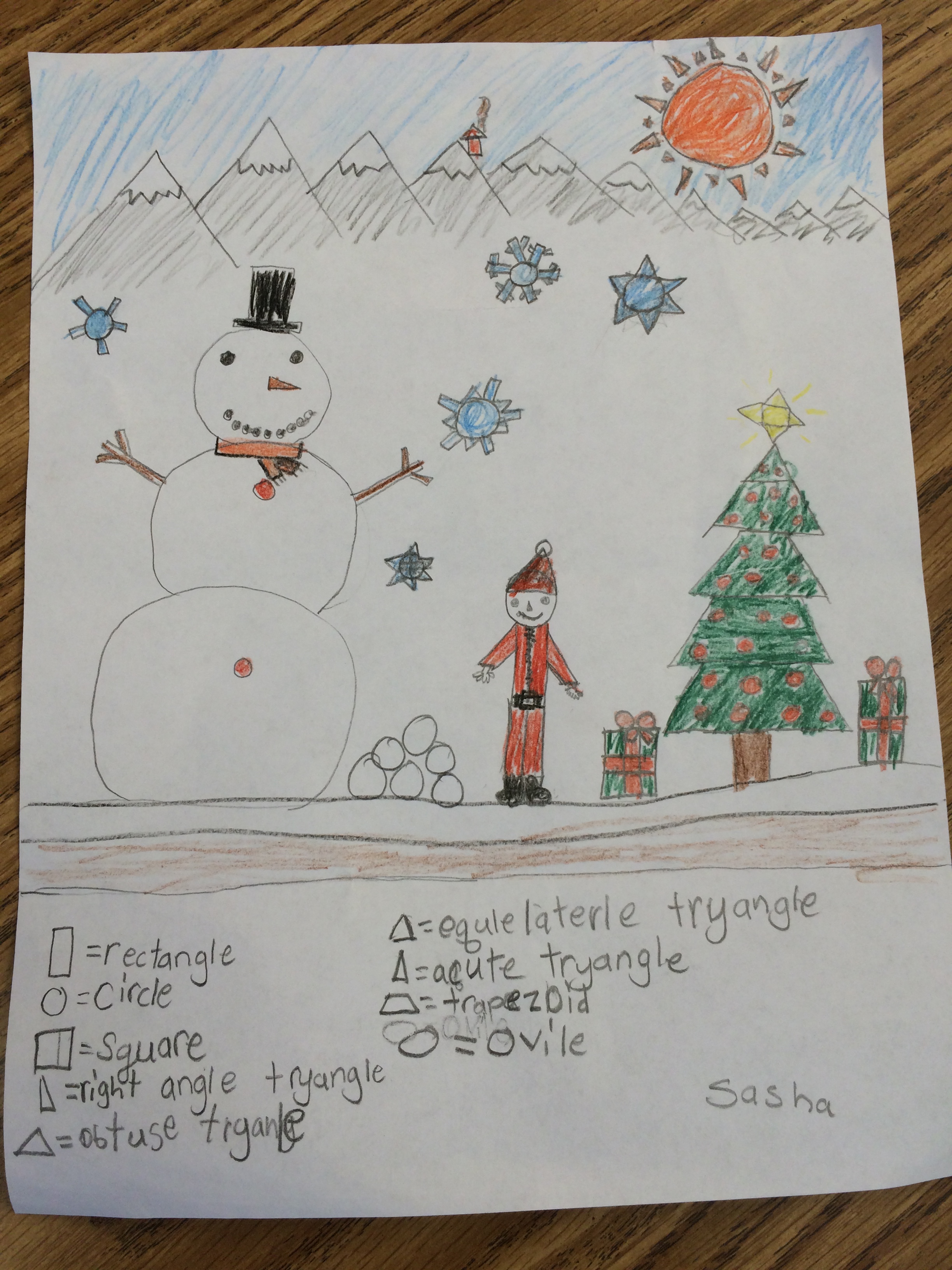
book from lizi boydAnd today, the last day before the break, we did our best to keep students focused on learning. We had a spectacular science lesson on buoyancy with our science teacher…and after working on claim, evidence, and reasoning for a little over a week with relation to buoyancy, students did some outstanding science writing today!  (More on that in another post)  We also continued our study of geometry by asking students to create a holiday or winter scene made up of geometric shapes.  There were some pretty clever geometric scenes to celebrate!

Geometry winter scene

And in my life outside of school there were also indications of celebration.  At my meeting at the local science museum on Saturday, even the dinosaur fossil was getting in the holiday spirit and adding to the celebration by sporting a santa hat!

Dino with hat

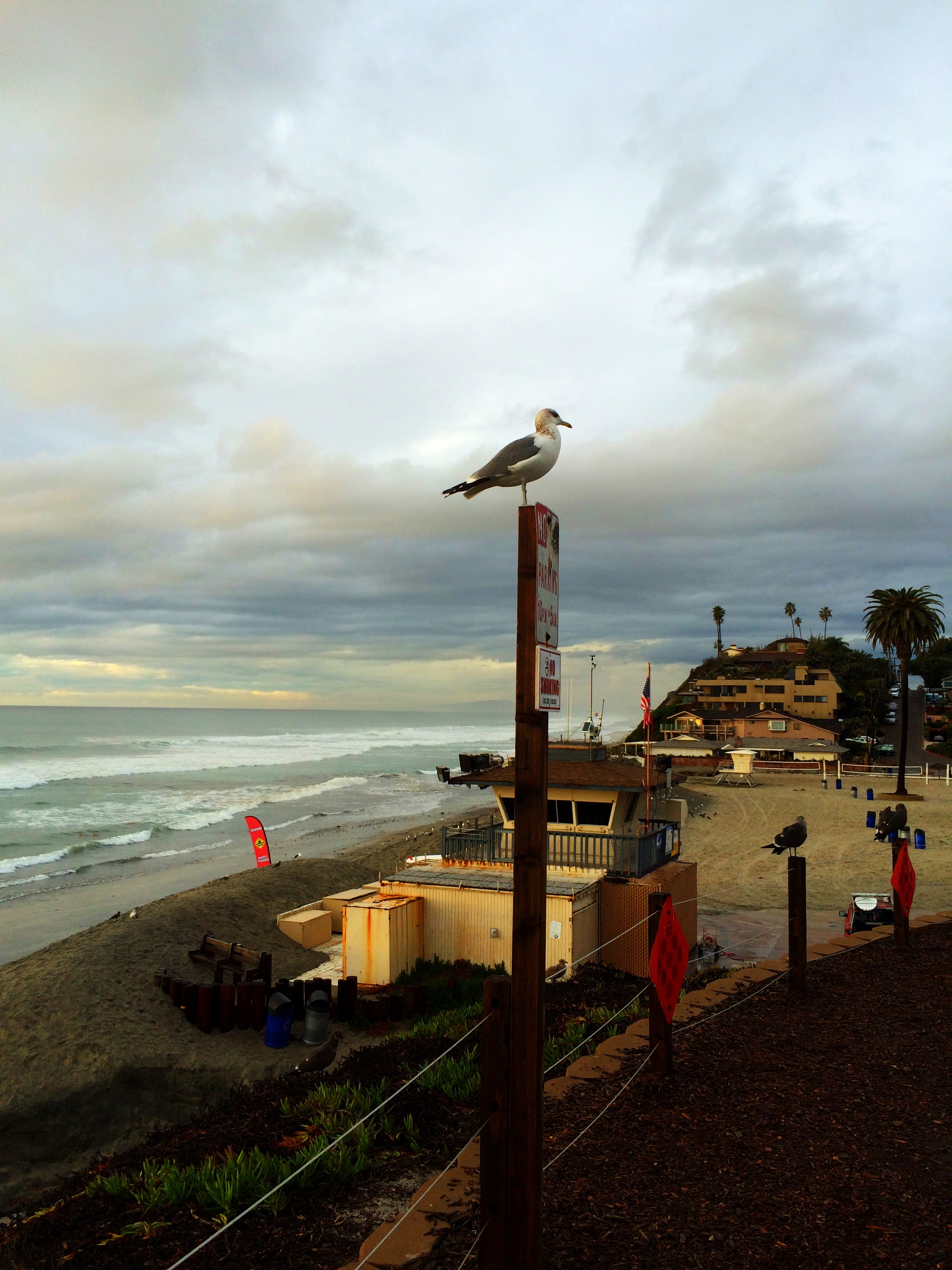
And we’ve had rain!  Yes, it’s annoying when trying to drive on freeways with people who don’t know a thing about driving in the rain.  Roads flood, traffic crawls, students are cooped up inside all day, everything is soggy…and we are celebrating.  We desperately need each and every drop right now.  And honestly, the cloudy skies are such a novelty that I can’t resist taking shot after shot.  I fell in love with this seagull enjoying the unusually moist air shortly before sunset.

seagull on a pole

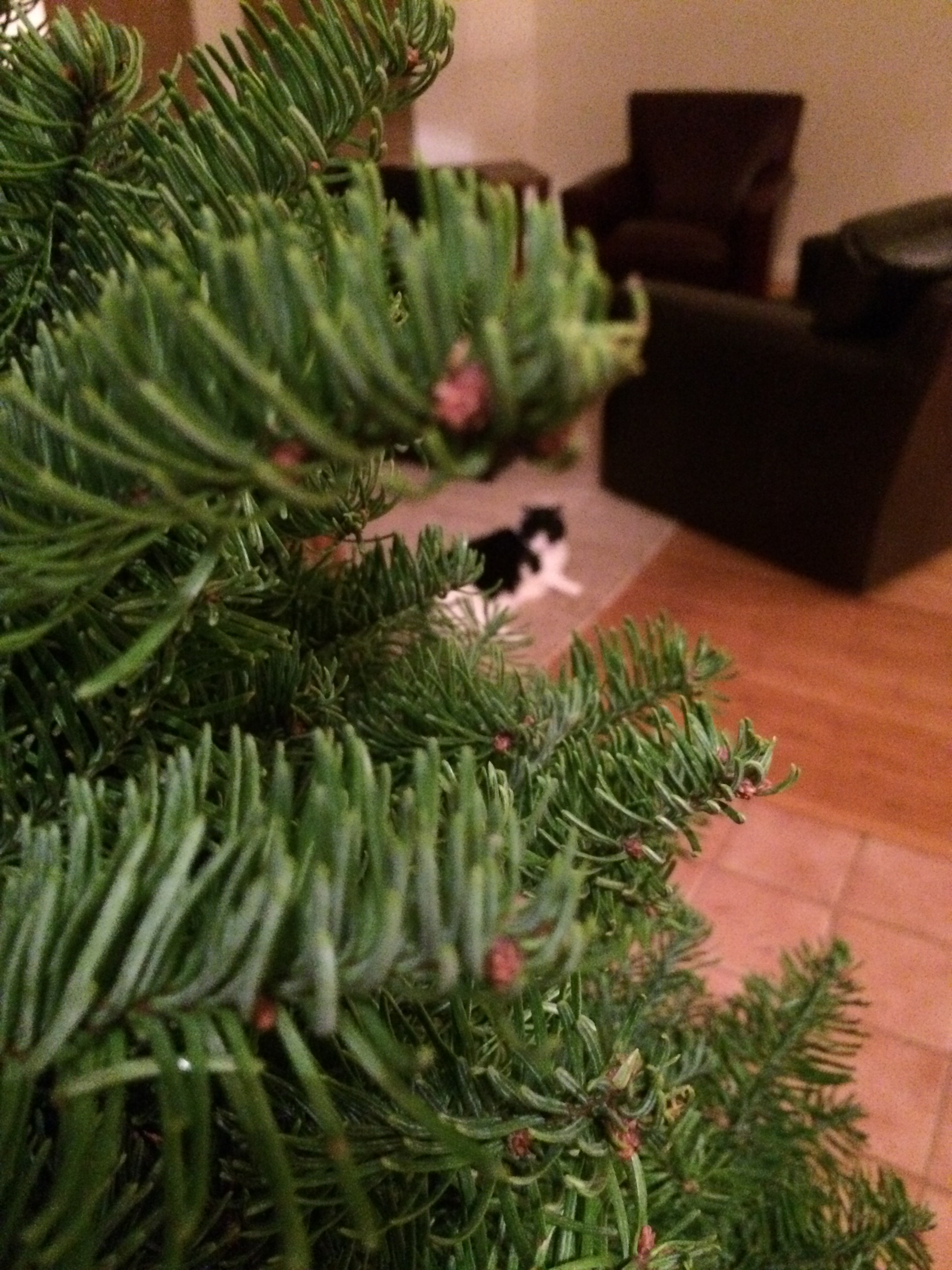
And although my husband brought a tree home on Sunday, it is still sitting bare in the living room waiting for celebratory decorations.  It’s a beautiful tree and I had some fun taking photos and playing with the focus of the foreground and background as I snapped a few photos of my cat, Phil through the branches.

Phil through the tree

What are you celebrating right now?  It might be Hanukkah or Christmas or rain…or even a two week break from your usual routine.  Snap a few shots and share celebrate through your images.

You can post your photo alone or along with some words: commentary, a story, a poem…maybe even a song! I love to study the photographs that others’ take and think about how I can use a technique, an angle, or their inspiration to try something new in my own photography. (I love a great mentor text…or mentor photo, in this case!)

I share my photography and writing on social media. You can find me on Instagram and Twitter using @kd0602. If you share your photos and writing on social media too, please let me know so I can follow and see what you are doing. To help our Weekly Photo community find each other, use the hashtag #celebrate for this week and include @nwpianthology in your post.

It’s time to celebrate!  What says celebration to you?  Can’t wait to see your version of celebrate as you share your world through your lens.


The Gift of Words

Inspired by a blog post on Edutopia by a colleague of mine from the UCLA Writing Project, our class began to explore the idea of gifts.  This is a hard time for young students, this season seems to make them want everything!  There is talk of what Santa will bring, what antics and gifts the elf carries, along with lots of decorating and baking and performances and outings…

So last week we began by reading a beautiful picture book that my teaching partner found at Powell’s books in Portland called Immi’s Gift by Karin Littlewood.  This gorgeous book about an Inuit girl is perfect for setting the stage for expanding the idea of gifts beyond what can be purchased.  And honestly, our students, even before reading the book had many ideas about those “priceless” gifts…of time, nature, acts of kindness…  And this simple book is filled with beautiful language, ideas, and images.

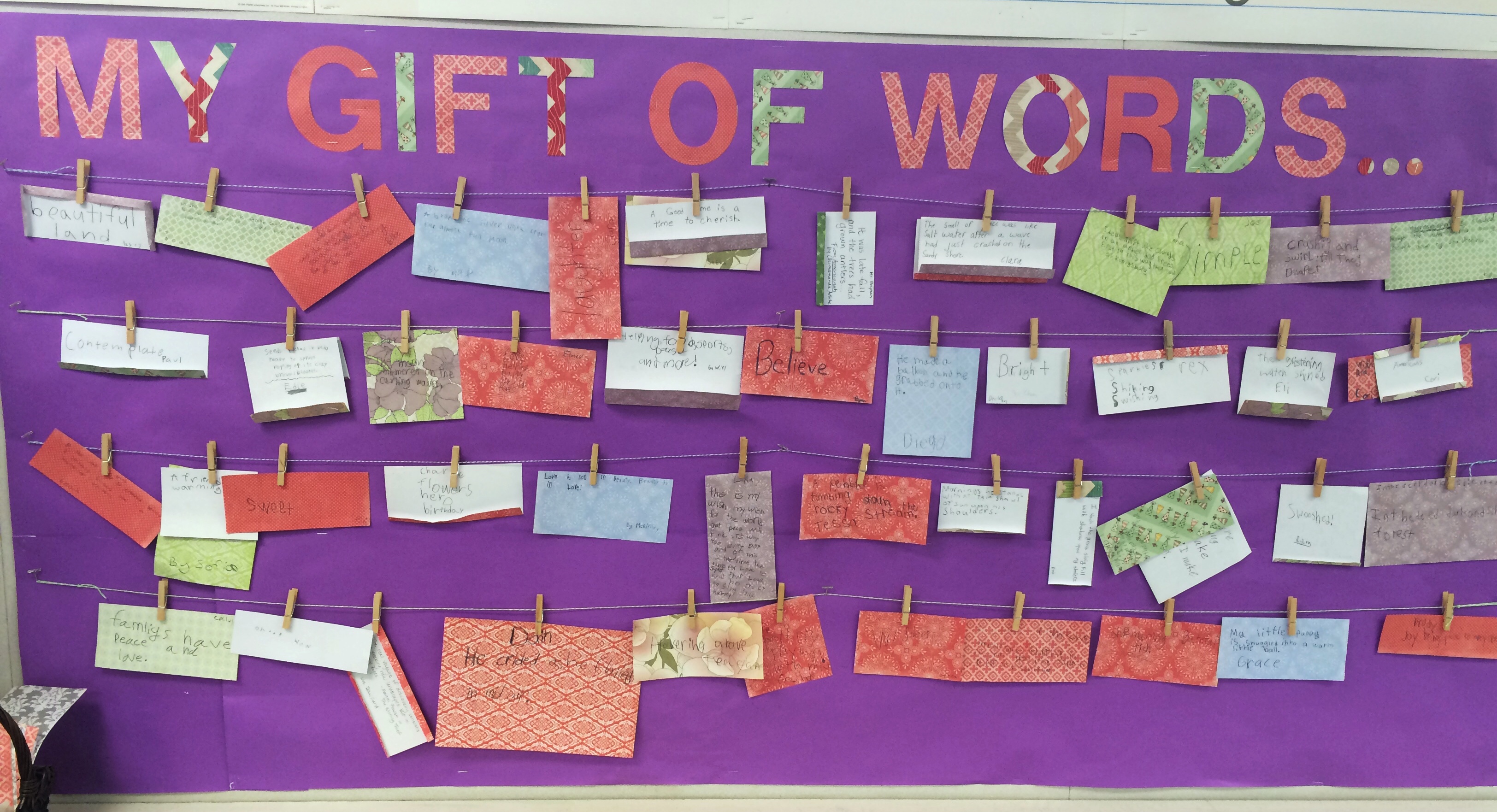
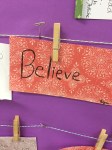
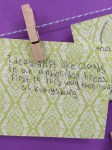
And then we gave the students the invitation to become word-sleuths…to be on the lookout for words, phrases, sentences..that were worthy of gift status.  Words that were special to them in some way.  They collected these words on yellow stickies and then carefully wrote them on some pretty pieces of paper to hang on the “My Gift of Words” board in our classroom.

My Gift of Words

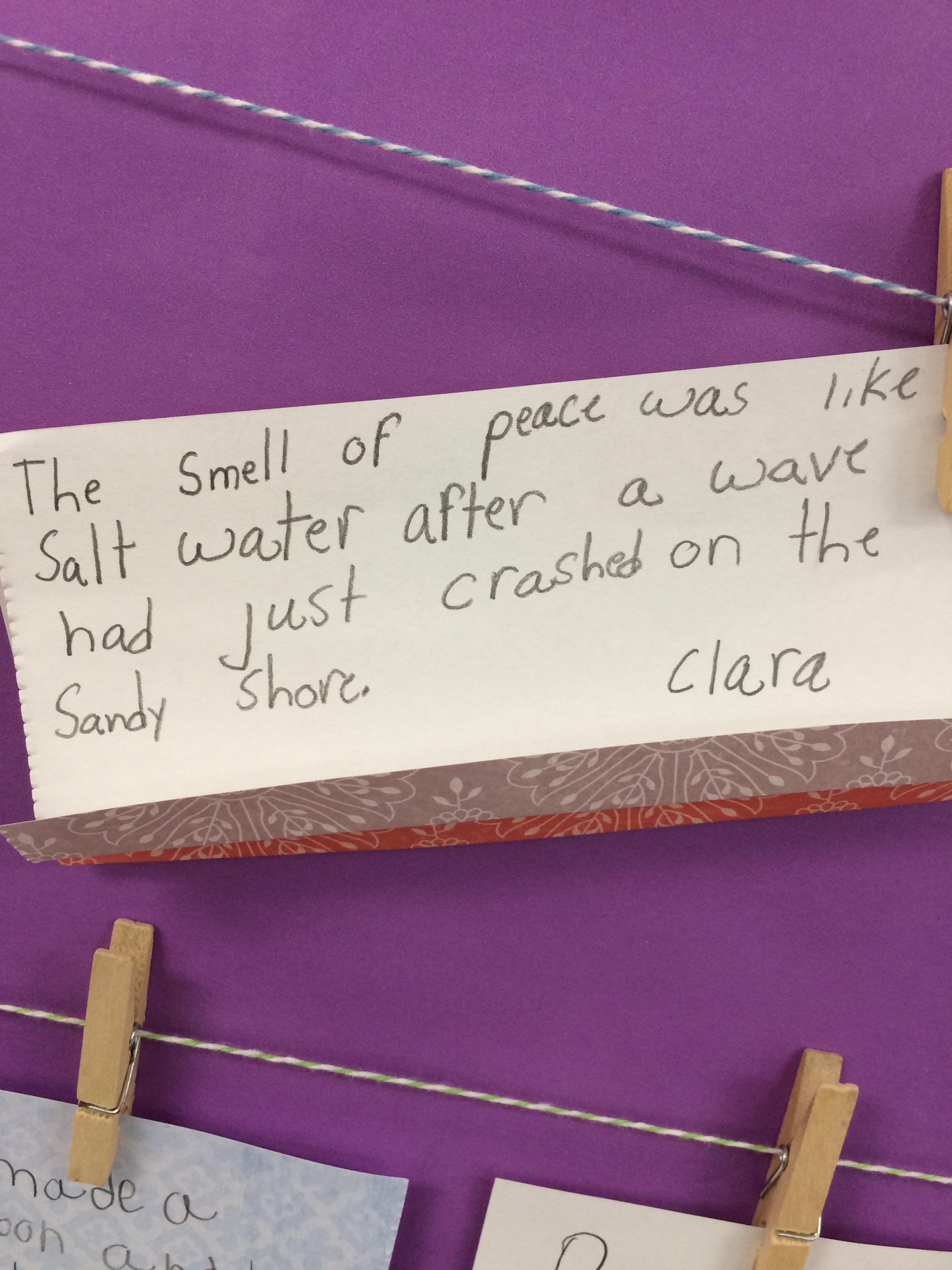
The collections are growing–and students are not only finding words others wrote, they are writing their own too!  This third grader came in on Tuesday with this line that she had written in her notebook on her way to school.  (And I suspect also influenced by another book we read, What Does Peace Feel Like? by Vladimir Radunsky.)

peace like salt water

Here’s a glimpse at some of the other word gifts hanging on our board.

And suddenly, not only are my students noticing and appreciating words everywhere, but so am I!  At a meeting at school on Monday, one of my colleagues used this Michelangelo quote to call us all to action and urge us to dream big.

The greater danger for most of us lies not in setting our aim too high and falling short; but in setting our aim too low, and achieving our mark.  Michelangelo

A word fairy has been leaving inspirational quotes in our mailboxes at school this week…and a friend of mine just gave me this beautiful necklace with a quote from Albert Einstein on it.  (I love the sentiment!)

necklace

And the cherry on top of all these words is that at The Writing Thief MOOC our most recent make is a scavenger hunt for mentor texts!  It feels like I have been bathed in words this week, they are falling like raindrops, gathering in puddles, splashing ideas and inspiration into my thinking and writing and living.

And I see it with my students too.  They are tuned into words, catching them in their nets, and sharing them with each other, their families, and with us.  In this season of giving, the gift of words has been spectacular…and a tradition that I hope carries on into the New Year!

What words are inspiring you this holiday season?  What words have you given and received as gifts?  What are your favorite mentor texts?  And feel free to join us over at The Writing Thief MOOC and share some of your favorite words, phrases, sentences, and books…you’re all welcome.  Come join the fun!

Write My Community

We are writers…and today we celebrated writing.

I teach in a pretty unique situation, in a multiage class of first, second, and third graders.  I co-teach this class with another amazing teacher and we keep our students for three years.  We are not merely teachers and students, we are a learning community.  We support each other, challenge each other, learning together over an extended period of time.

And this is the third year where we have celebrated the National Day on Writing by joining up with our district’s other multiage class–this one of fourth and fifth graders–many who were our students.  This time, the older kids joined us at our school starting with some shared play time on the playground…and lots of hugs as kids reconnected, siblings sought out their brothers and sisters, and older kids reminisced about their days as “little kids.”

And then the fun began…

As 80+ students headed into the auditorium, they each had a part of an animal picture to match to find their cross-age partner(s).  After spending a few minutes getting to know one another, partners were ready to begin a collaborative writing activity.

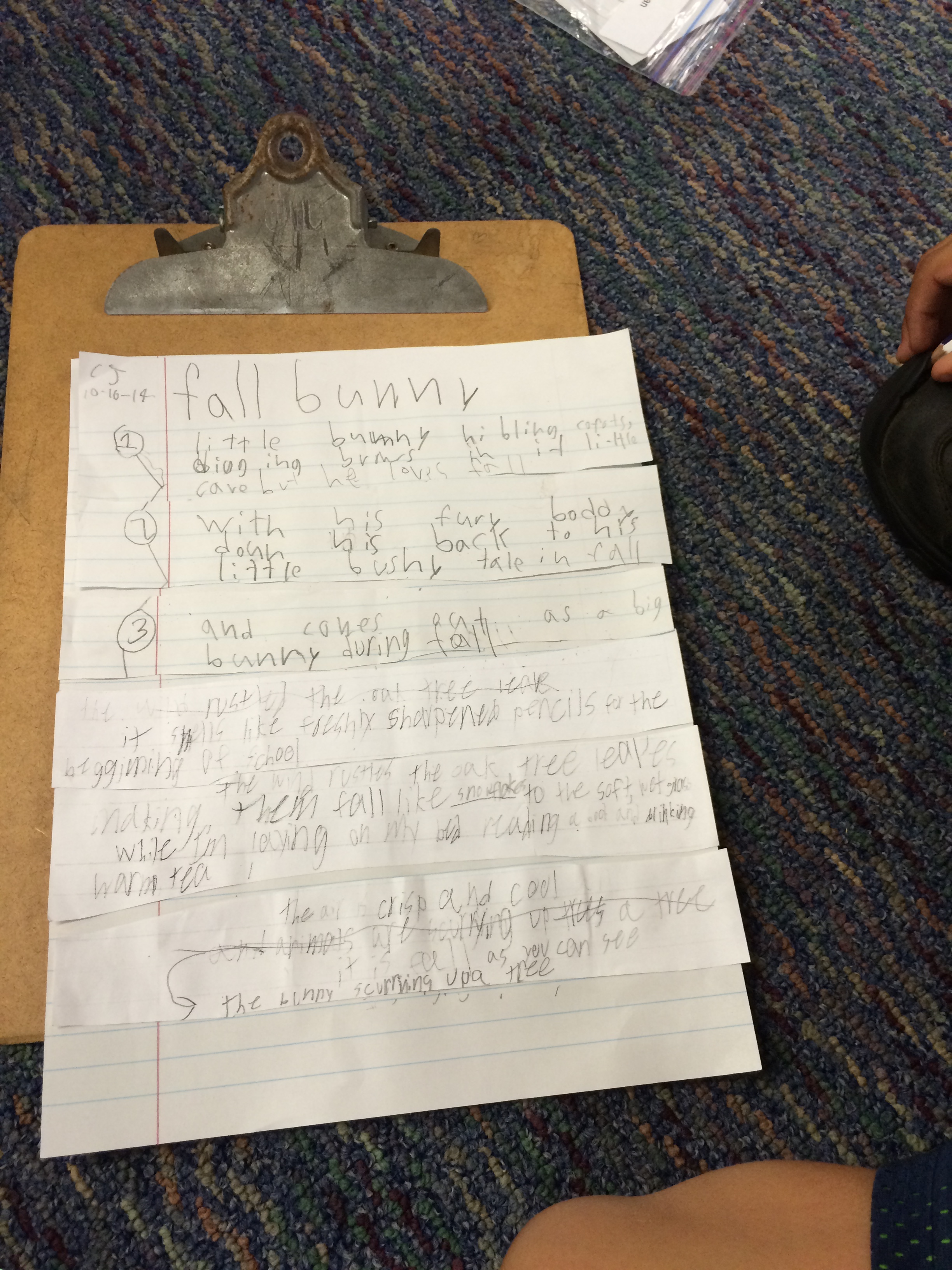
Believing that writers write best from abundance, last week students in both our classes drafted some poetry.  Our students had studied some poetry mentor texts from some of our favorite poets including Kristine O’Connell George and Valerie Worth and then, considering things they care about and know about, set off to write some poetry.  Once drafted, they separated their poems into individual lines and then cut the lines apart to store in a baggie. The other class used a similar process and came to our event today with lines of poetry in a baggie as well.

ndow protocol

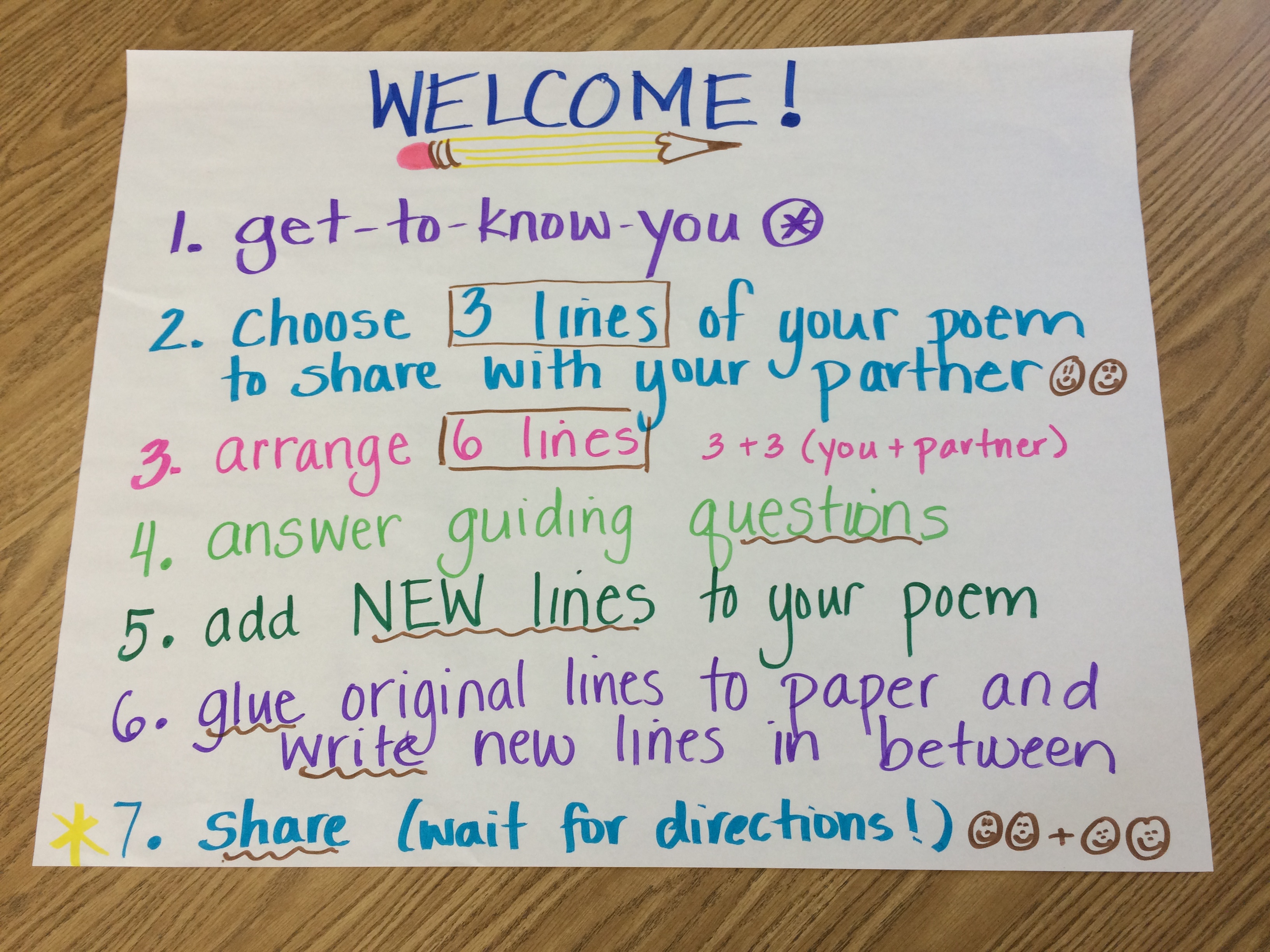
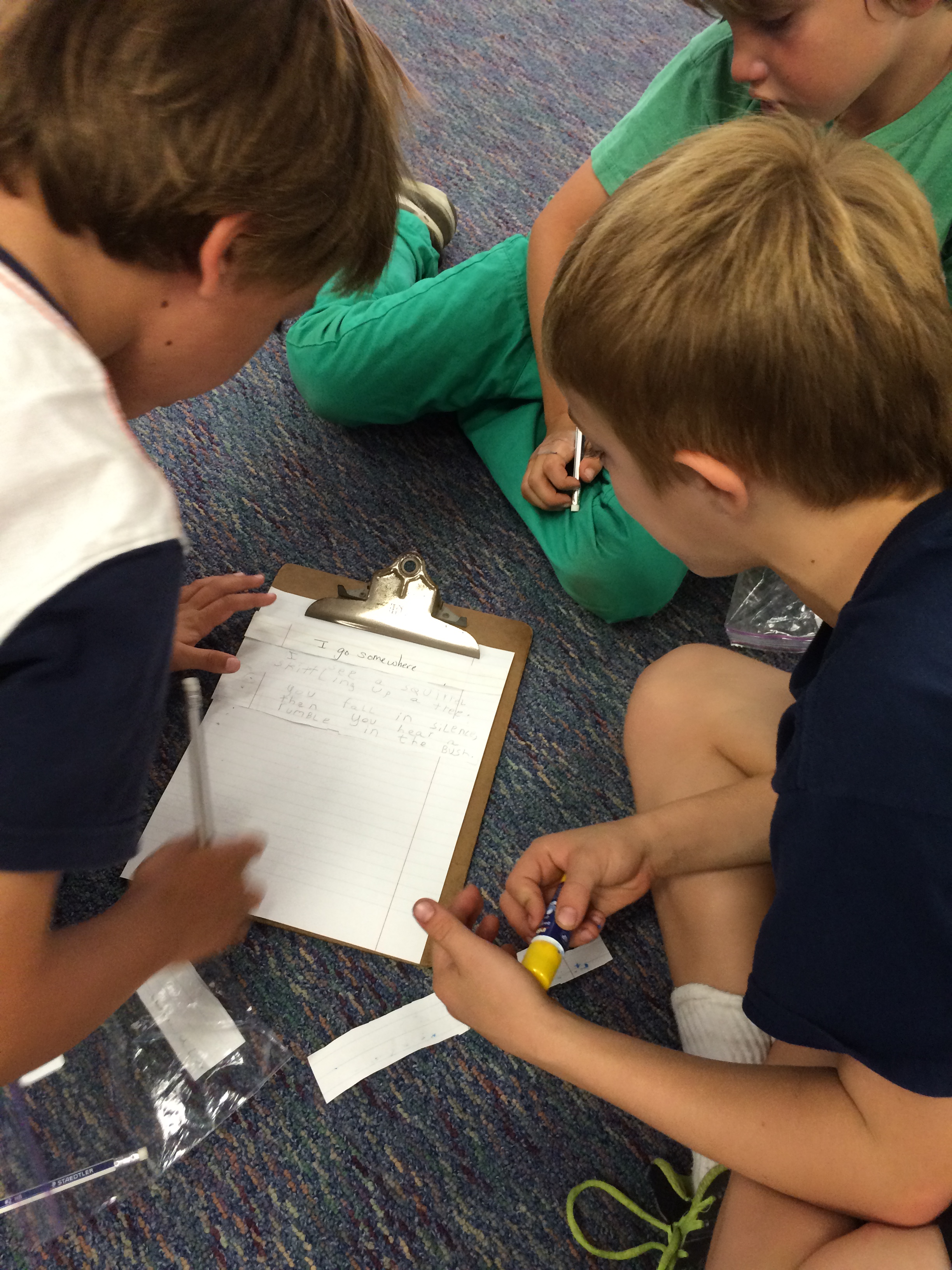
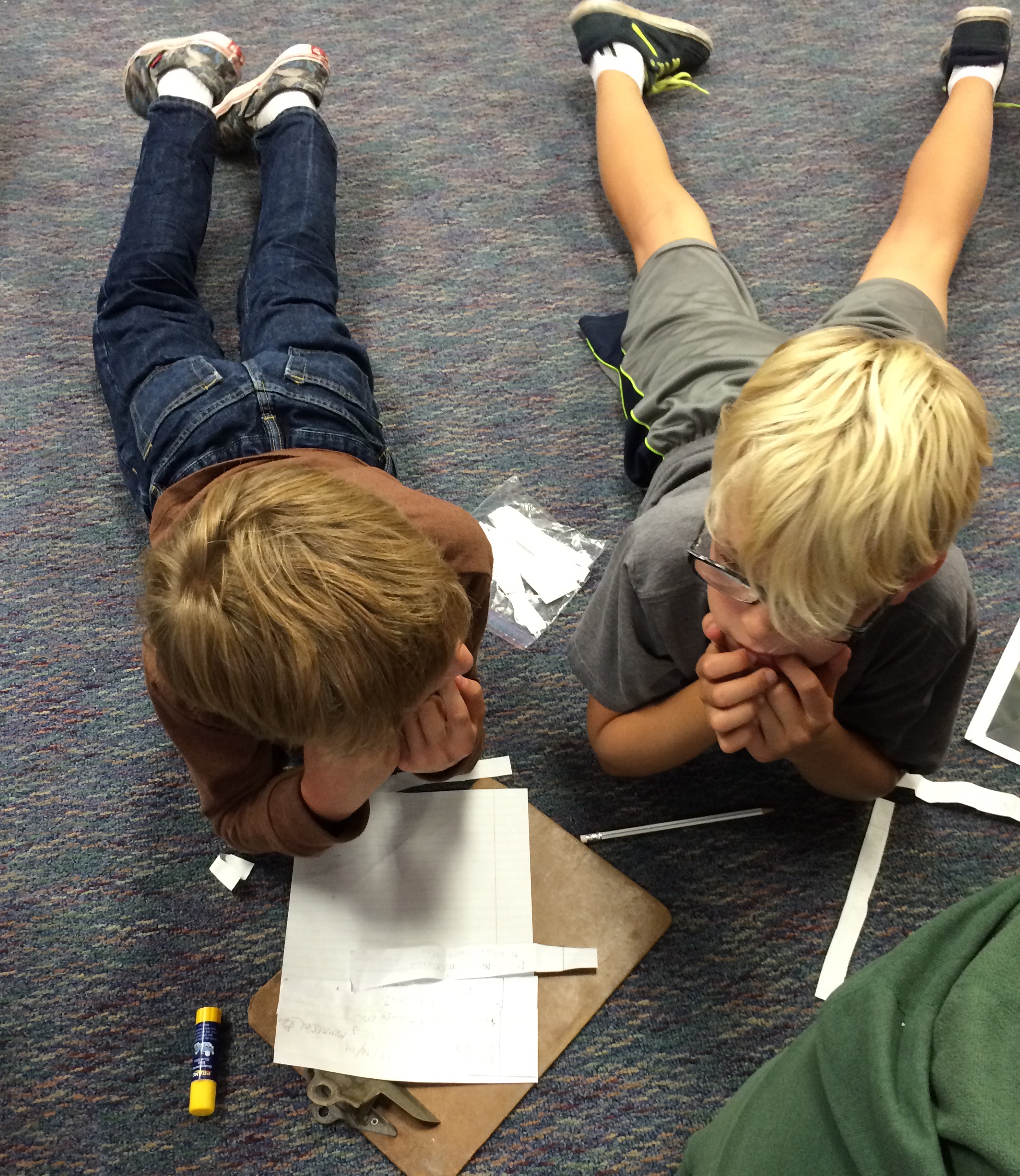
After getting to know each other, students pulled three lines from their poem from the baggie to share with their partner and after reading and listening to the six lines of poetry, decided how to build on those ideas to create a collaborative poem representing the partnership.  A hush fell over the room as poets set to work negotiating and collaborating, crafting poetry together.
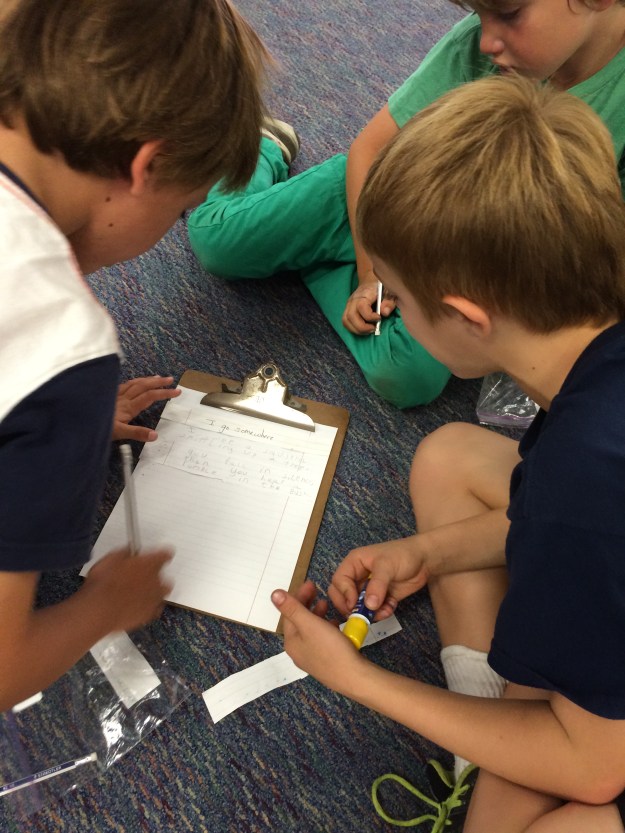
collaborating

And even though the room was full, it was if each partnership worked in a bubble of creativity and focus of their own.
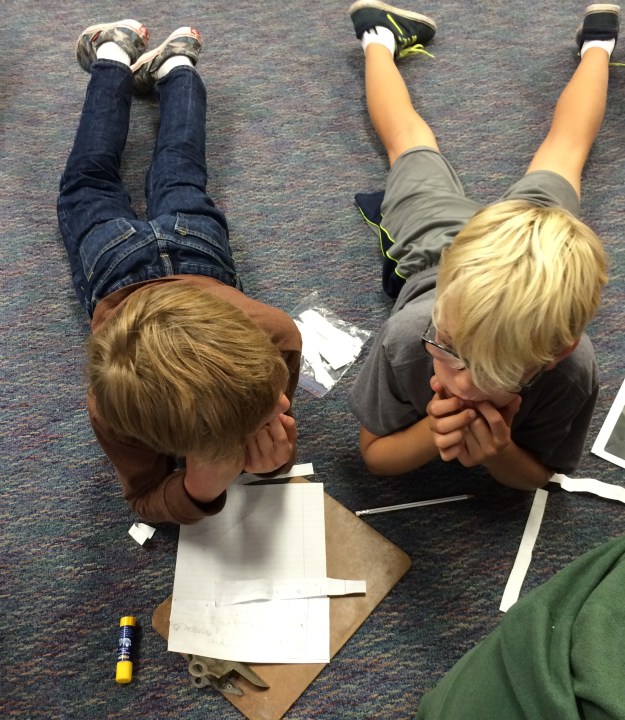
poets at work

And it wasn’t long before drafts were prepared…and the writers were ready to go public with their poems.
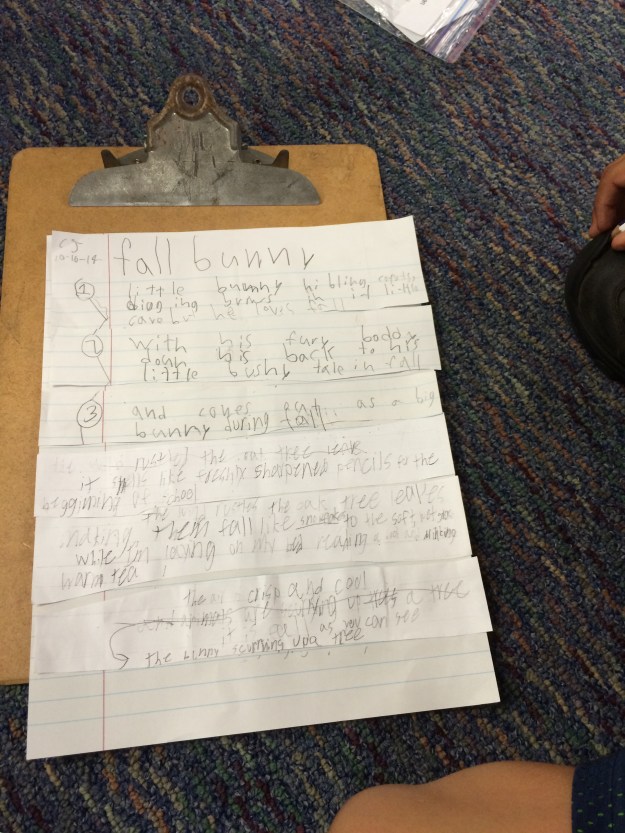
poem draft

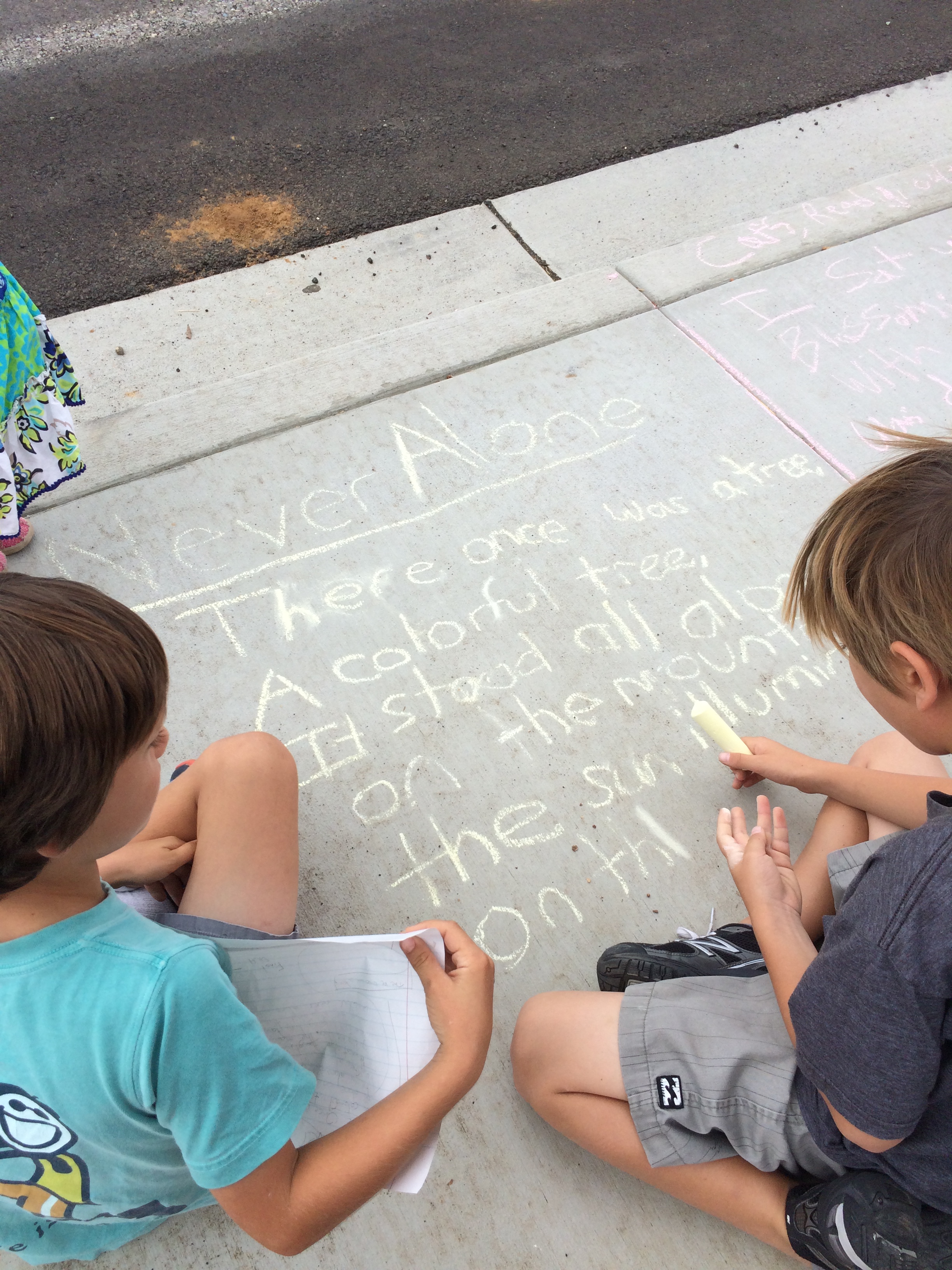
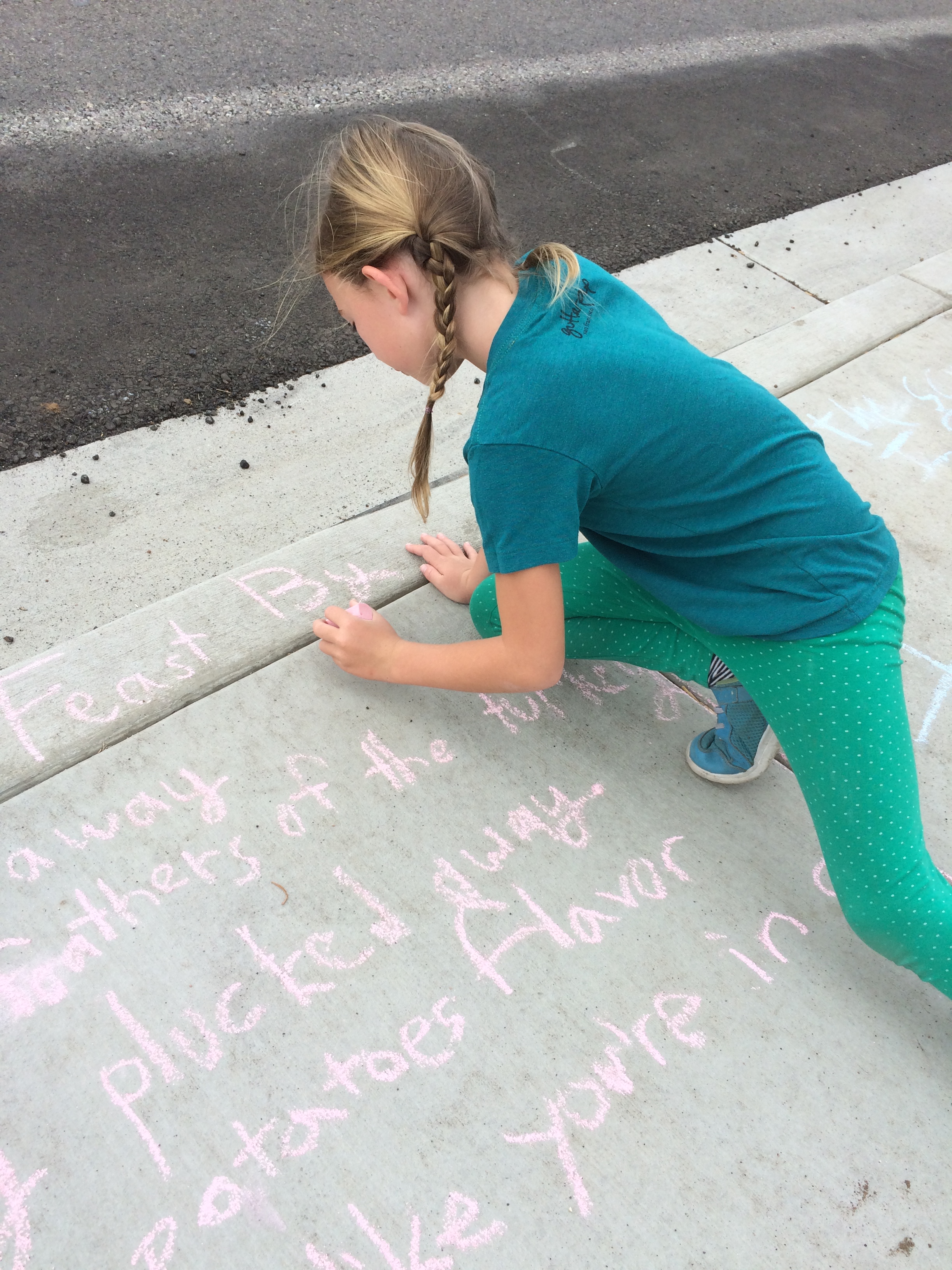
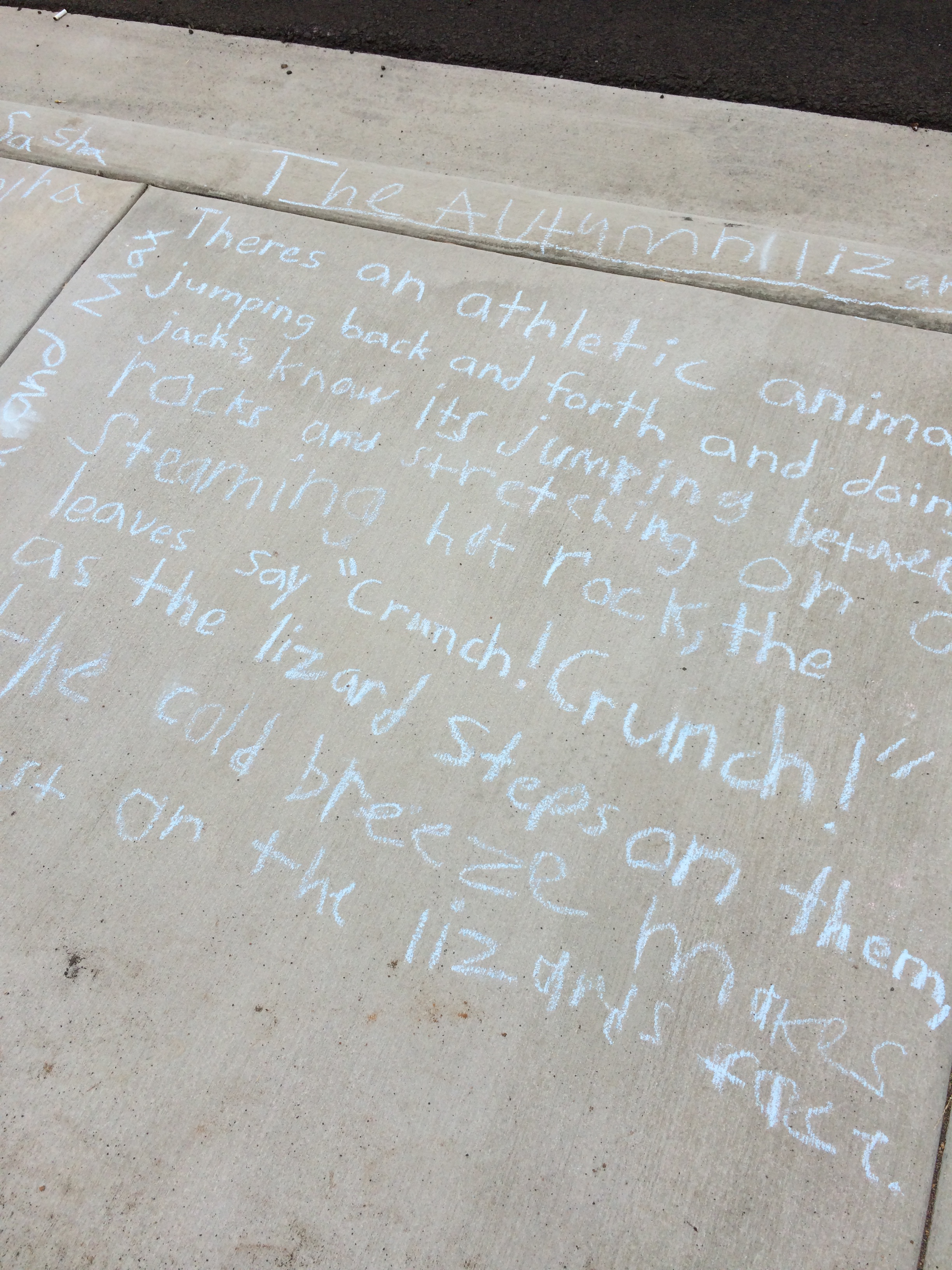
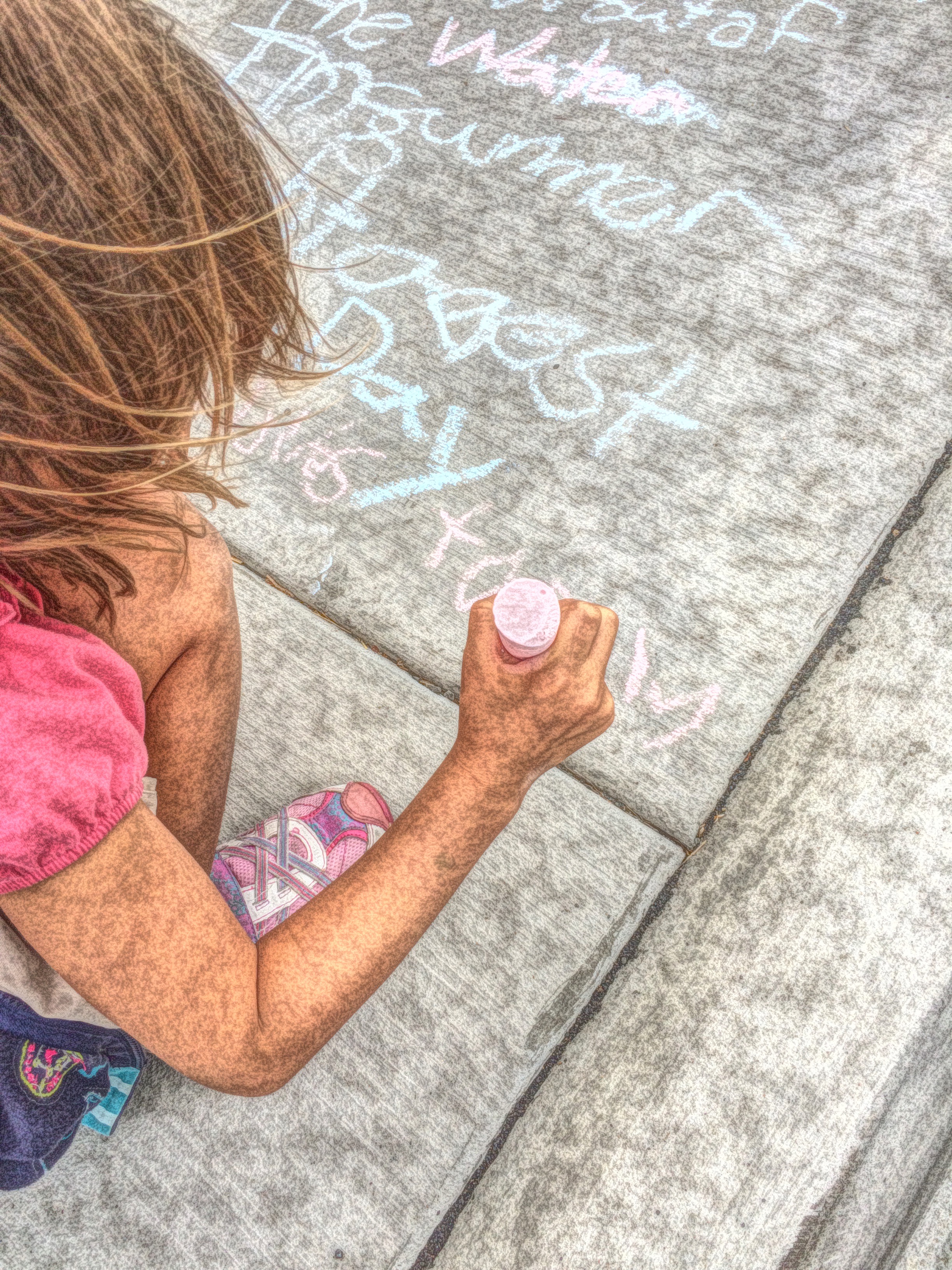
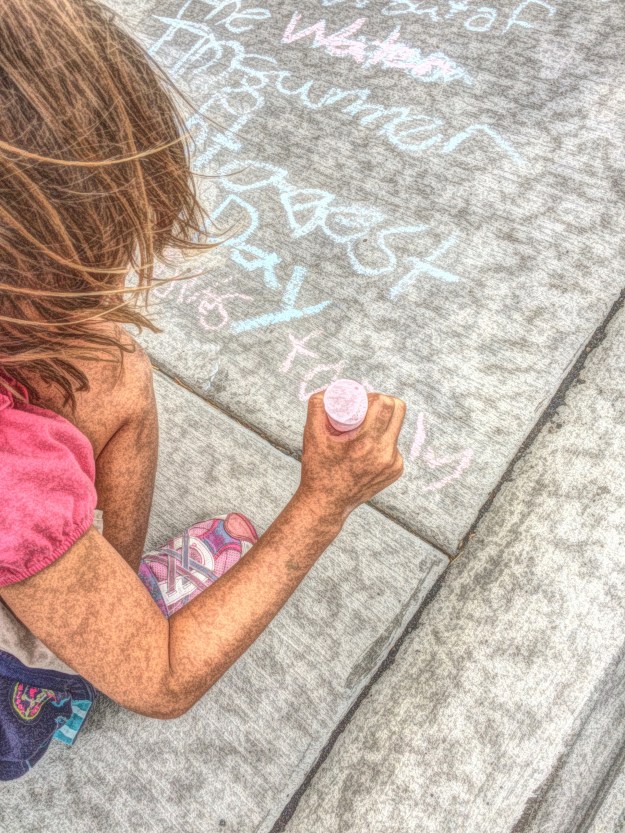
We headed out…beyond the school gate…to the sidewalk outside of our school, out into the community.  And with sidewalk chalk and their drafts in hand, our writers chalked their poems onto the sidewalk for the public to see and read: a chalk-a-bration!
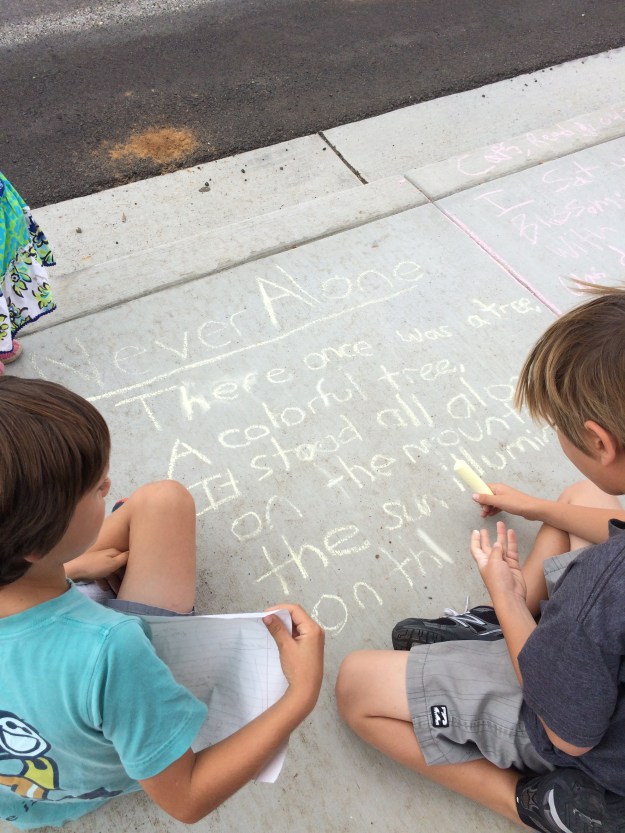
making it public

It was fun to watch cars slow down to see what we were doing and people with their dogs stop to admire our handiwork.  Chalking their poem onto the sidewalk was not as easy as students first thought.  There was the dilemma of figuring out which direction to write and how much space it would take.  And then applying the right pressure to make the words readable…and even finding a comfortable position to do the writing came into play.
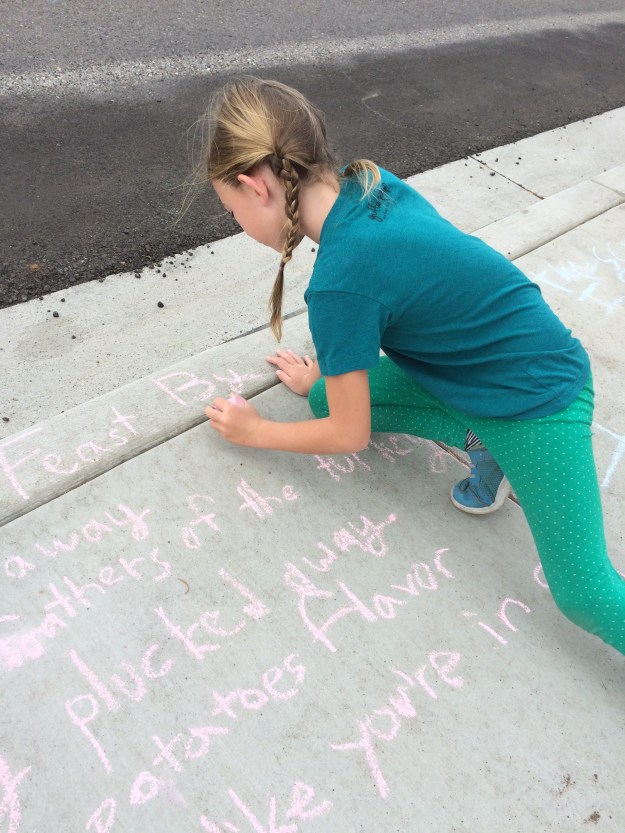
chalking the sidewalk

Students began to suggest that we post the written poems on the fence near the sidewalk, realizing that reading pencil on paper might be easier than chalk on sidewalk.  We’re looking into the feasibility of the possibility.
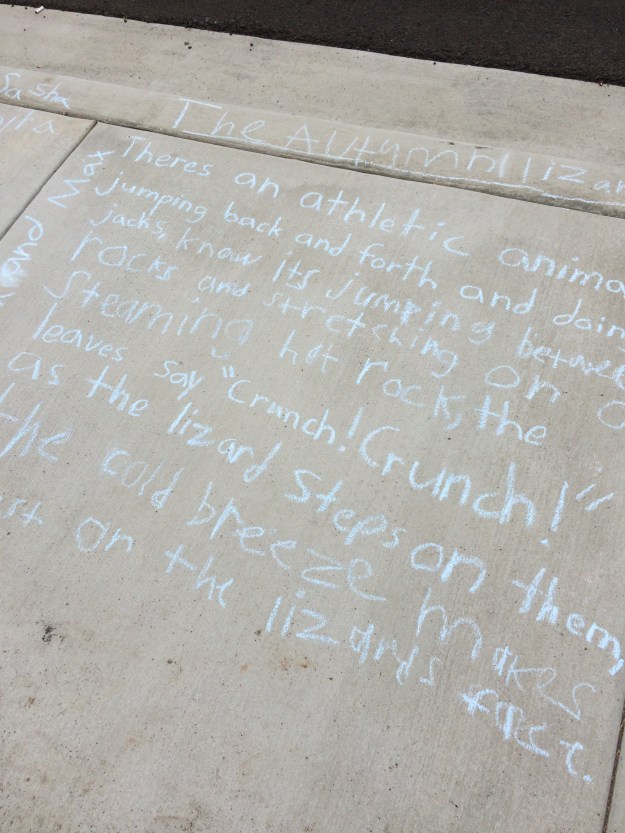
sidewalk poem

Our celebration ended with an open mic back in the auditorium.  I’m always amazed with how eager our students are to share their writing.  We could have stayed for another hour listening to the poems, but had to limit ourselves to a few random poem selections…for now!

For us, the National Day on Writing is an opportunity to publicly celebrate what we do every day…write.  And this year’s theme: write my community, was perfect for us.  We are a community of writers that extends beyond the classroom and across age and grade levels.  We write to learn, to remember, to explain, to share our knowledge, to explore, to convince, to analyze, to reflect, and to express ideas and feelings.  We write for ourselves, for each other, and for the public.

We are writers.

Happy National Day on Writing!
ndow setting


Looking for Signs…

Six weeks into the school year with unseasonably warm temperatures…I find myself looking for signs of fall.  Southern California is not known for spectacular fall colors: the changing leaves, colorful gourds, and orange pumpkins decorating doorsteps.  Instead, I notice things like the orange and red kelp washed up by hurricane Simon off the coast of Mexico,

orange and red kelp

the orange beach umbrella near the lifeguard tower,

orange umbrella

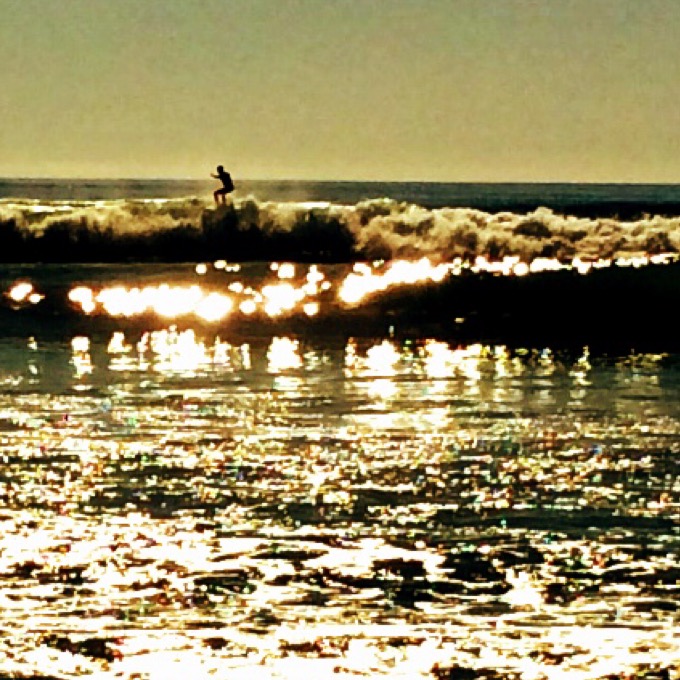
and the golden sun highlighting the surfer atop the bigger than usual waves.

golden surfer

And I’m starting to see some even more exciting signs of fall…and of the writing community growing in my classroom.  Some signs are subtle, like students settling into writing without any urging from us and sticking with the writing for longer and longer periods of time.  There’s a willingness to share writing with one another and with the class as a whole…even from our shyer students.  And then there’s the risk-taking…trying out new strategies for revision and composition with independence and confidence.

This third grader uses her reflection notebook to write about a tool we use in class to help with revision.  It’s clear that she sees the value of revision for improving her writing…knowing writers, even good writers, have to work at improving their craft.

elke's reflection

It’s also fun to see students bring their voice to informal, reflective writing.  They are writers whenever they put words to a page…like this student describing something learned from reading a Scholastic News magazine,

reflectionand the student who began her reflection on a writing and art project with, “It all started when Ms Boyesen read us a book called Flashlight.”

Like the more obvious brilliant crimson leaves, sweet apple cider, and crisp autumn evenings that signal fall, these subtle signs in the classroom represent our growth as a community of learners and writers.  We are ready to dig in, to stretch ourselves as learners, and to learn from and with each other throughout the school year.

I have to look carefully for signs of fall in my place…they aren’t easily recognized by those looking for the gorgeous iconic images we see represented in the media.  The same is true in my classroom, looking carefully uncovers signs that might be overlooked otherwise.  The signs are there and I’m looking forward to the journey with these young writers.

What signs of a developing learning community are you seeing in your place?


Sunshine on a Stem

I spied it from afar as I was heading to my car this morning.  And I had to stop.  Right in the middle of our gasping-for-water, drought stricken lawn a dandelion stood tall and yellow, sunshine on a stem.

dandelion painting

I’ve definitely become obsessed with dandelions…in all their forms.  They represent the tenacity, resourcefulness, and strength I want to help cultivate in learners and teachers. Learners as hot house flowers that have to be carefully controlled and cultivated seem too fragile to become the innovators and explorers we need in the world.  Teachers are often portrayed as gardeners, nurturing their crop of learners…but I’m wanting to reject that image too, it seems to take all the energy and agency away from students in that scenario.

Like dandelions, I want learners to thrive where they live.  I want them to land in places where they can dig in and grow tall.  And I want teachers to be like dandelions too, not dependent on specialized tools but instead drawing on the processes that honor writers and tinkerers and explorers.  And when they happen to be plucked by the curious child who takes a big breath and blows on the puff, I hope the wishes fly far and wide and land on fertile ground so that these tenacious and resourceful survivors populate our classrooms and our world.