I love children’s picture books. I might even fancy myself a connoisseur of sorts. I have old favorites, but I am always on the look out for new titles. Apparently I have a “type” when it comes to books. Our school librarian can pick a book for me…and most of the time, it is a perfect book for me.
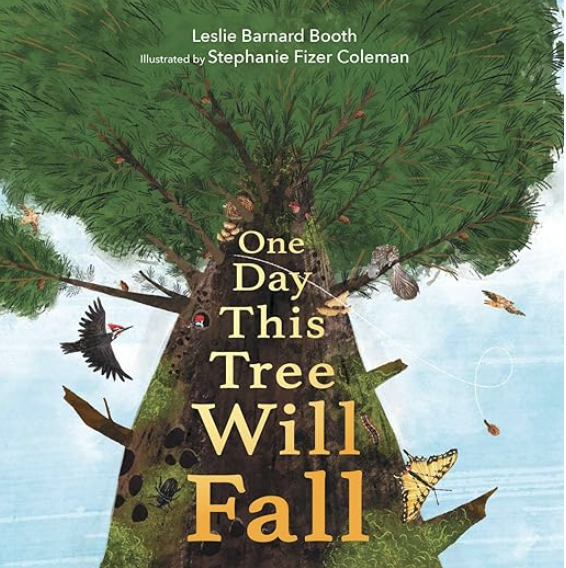
One Day This Tree Will Fall by Leslie Barnard Booth appeared in my book bag a week or so ago…and before I even opened the cover, I was pretty sure it was a book for me. When I opened it and read through it, I nodded to myself. Yes, I’ll be reading this to my students, I said to myself. But of course, the true test is reading it aloud to kids.
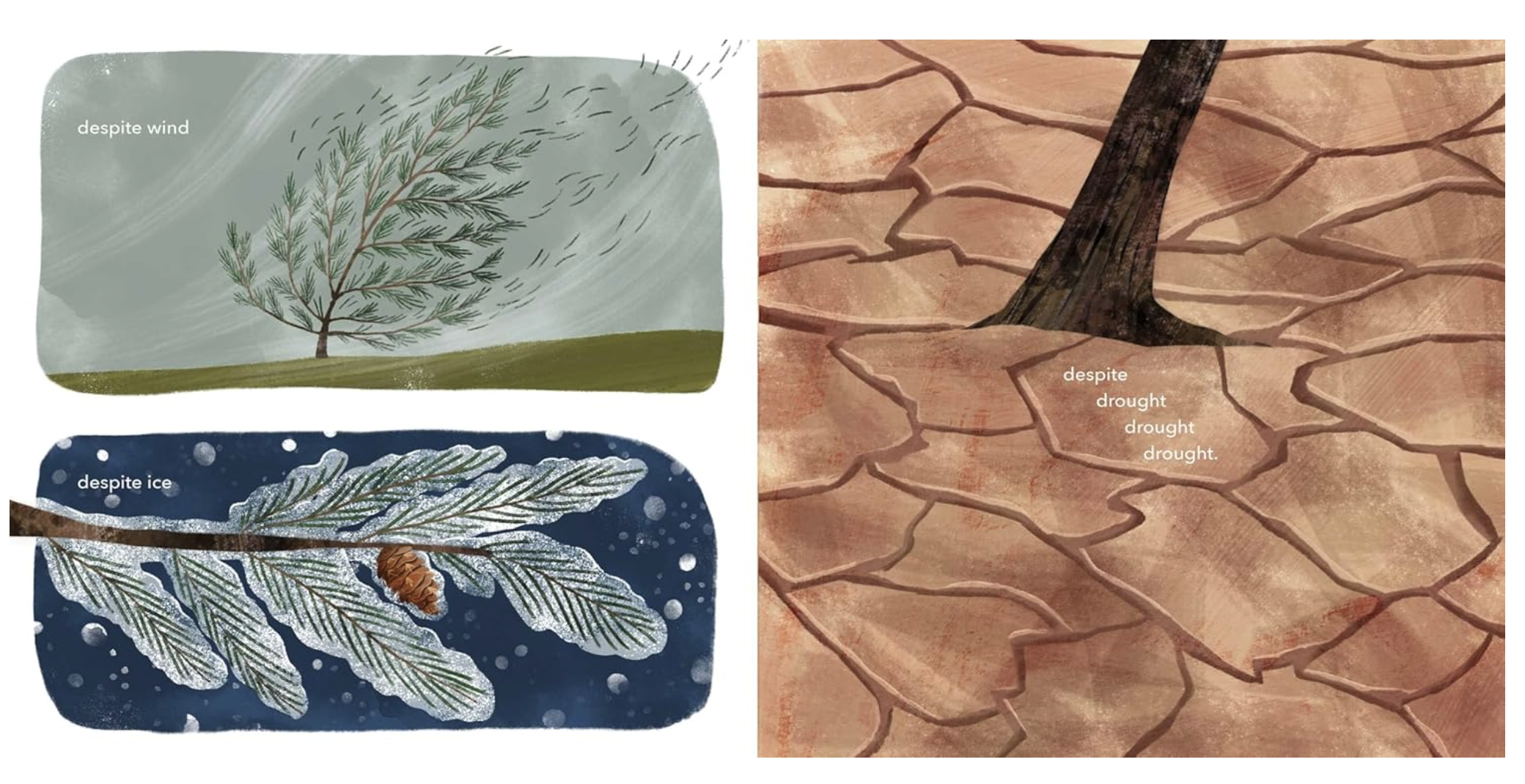
Ah…the language flowed. Rhymes mingled with repetition, questions jumped in creating a refrain like a long lost friend. And wrapped in this gorgeous package was an appreciation of nature and an acknowledgement of the resilience and fragility of this ecosystem along with the introduction of important concepts like drought and decomposition (we had quite a discussion about drought–something we deal with regularly in our Southern California community).
Honoring the value of scars and hardship is a river that runs along the story of the tree. It’s a story of ecology and of acceptance and inclusion. When I finished reading it I told my students I knew I would read it again.
And I did. Later that same day, before we headed into some writing under the influence of acorns, I read the book to my students again. They didn’t complain. They noticed more…and so did I. I’ll be reading this one again…probably even buying my own copy. If you love great non-fiction for children, written with attention to the beauty and purposefulness of language…you’ll love this book. I’ll probably read this book to my students again before the school year ends! It really is that good.
On this second to the last day of National Poetry Month my students and I are still writing poems. I woke this morning to a suggestion from Abigail at #writeout in the NWP Teachers Studio to go outside and find a poem.
So I pushed and shoved at my lesson plans for today to make room for getting out of the classroom to collect a poem. We grabbed our sketchbooks and pencils and headed out toward the pollinator garden which sits on the edge of the playground. My directions to my first graders were to collect 5 words or ideas (they could sketch if there was time) and that when we returned to the classroom, they would turn those words or ideas into a poem.
As they reminded me, we do this kind of thing pretty regularly–sometimes by taking photos, sometimes with sketchbooks. So, they knew what to do. There’s plenty for curious kids to pay attention to: the playground ball stuck in the tree, the plant growing in the middle of another plant, bees buzzing, rocks and wood chips and so much more.
And when we got back inside, the writing began. All this happened toward the end of the school day, so there was not much time left for the writing, but we did take the time to share a few of these poems in progress. Here’s a sampling.
M asked me if showering was a real word as he composed.
It’s Earth Day, a perfect day to celebrate the earth and nature and our connections to them. Donnetta at #verselove suggested crafting a poem that honors Mother Earth in some way. Abigail, part of the #writeout team from the National Writing Project shared a recoding of Ada Limon reading the Mary Oliver poem Can You Imagine?
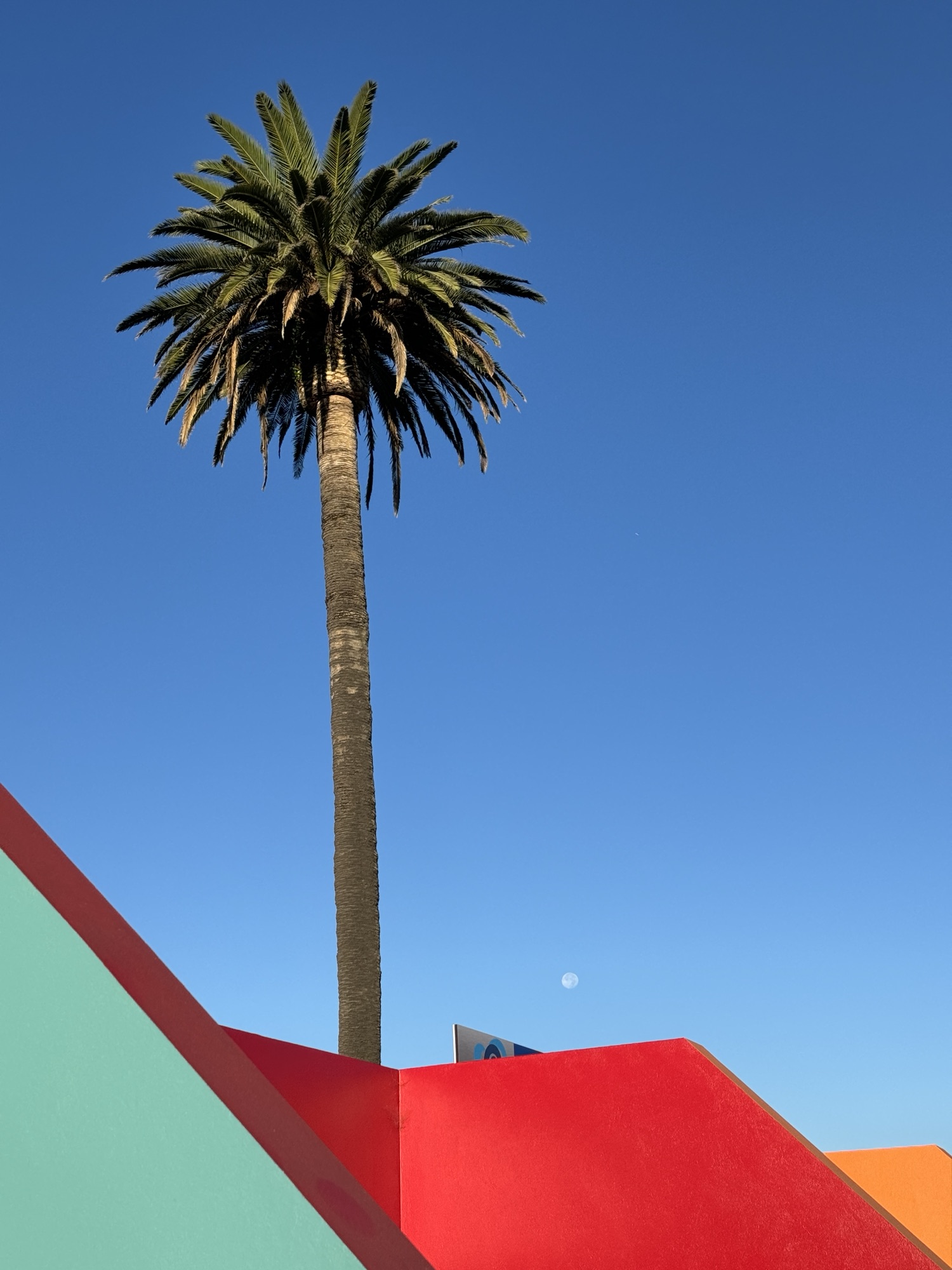
After a day spent with first graders talking and learning about all the reasons and ways we can and should honor and care for our planet, I found myself thinking about the ever-present tall palm tree that has been a constant on our playground for longer than I can remember. This is the tree that inspired my poem for today.
If you want to know when it’s spring, don’t bother with a calendar, just walk into my first grade classroom. The energy is palpable. Those babies that entered the classroom at the end of last summer are growing into knowledgeable and sassy almost second graders. They are readers and writers and fact collectors extraordinaire (although fact-checking is not yet in their realm of expertise). So what do you do at the end of conference week when it feels like the classroom is fitting like last year’s t-shirt–way too tight? Head out to the garden…with iPads in hand!
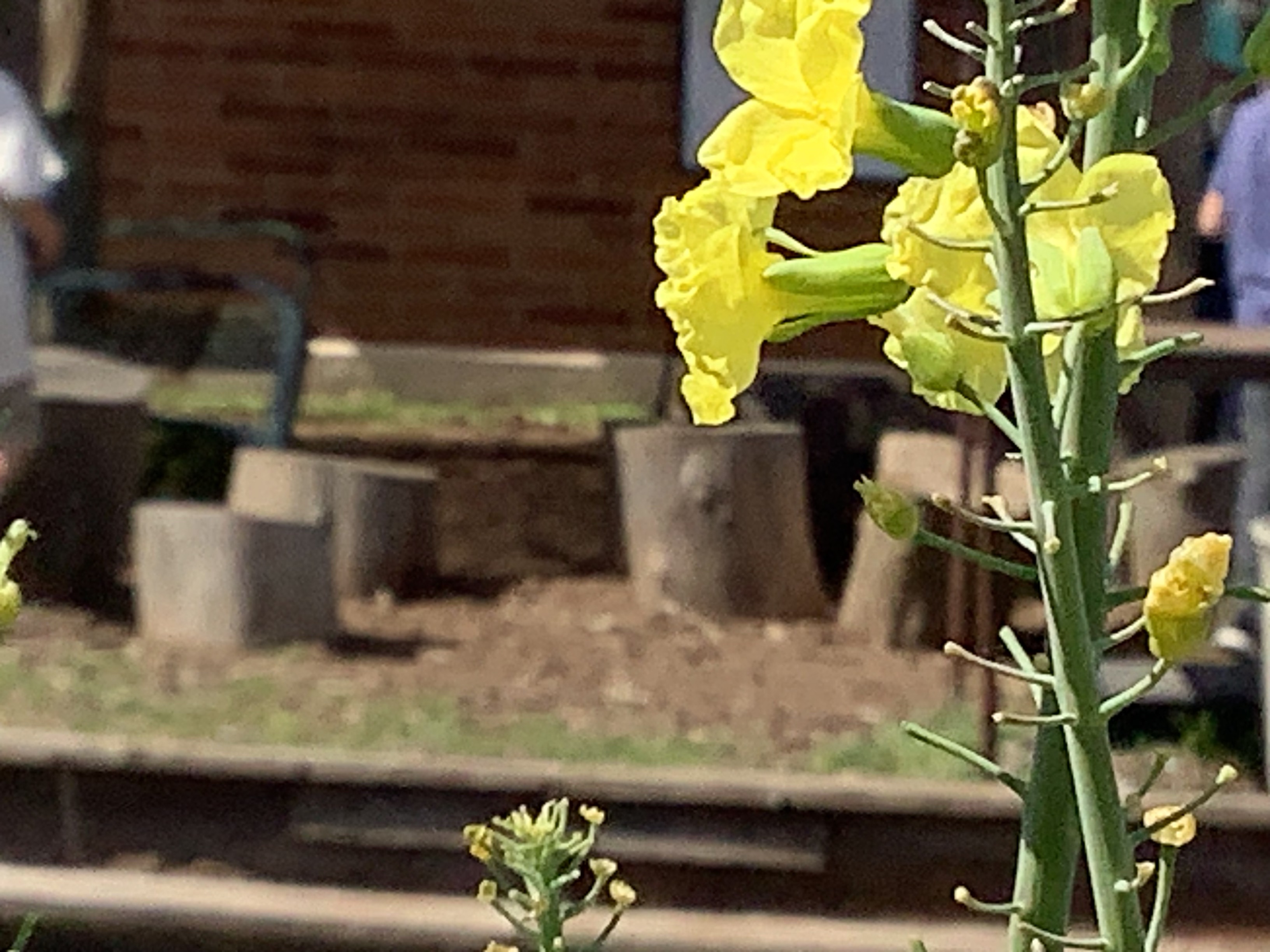
We’d been out in the garden with our notebooks earlier in the week–observing carefully in the spirit of Jane Goodall. So on Friday I asked students to go back to the place where they observed earlier in the week and find three photos to take. I reminded them of the photography techniques we had learned and set them loose to explore. There was the insect on the screen that first caught students’ attention. The lizard almost created a need for crowd control as these little paparazzi swarmed the cold-blooded sunbathers against the brick wall. They photographed strawberries, broccoli, fruit tree flowers, aloe, and who knows what else.
Yesterday, we studied the poem, Things to do if you are Rain by Elaine Magliaro. We noticed her action words (polka-dot sidewalks, freckle windowpanes…) and did not miss the metaphor of the rain tap dancing on the rooftop. After choosing one of their photos as the subject, they set off to write their own Things to do… poems. And since it’s mid March, I asked them to include three things in their poems: action, a comparison, and some metaphorical thinking.
We ran out of time…which I should say was intentional planning on my part. It wasn’t, but I am reminded of the value of time away from a draft if you want the young writer to really take another look and make the piece better. Using my poem as an example, we read it carefully, looking for the action, the comparison, and the metaphorical thinking. Then they went back to their drafts to finish them and to make them better. And they did.
O took one of those infamous lizard photos and wrote a short but sweet piece.
Things to do if you are a Lizard
Climb up walls like a snake.
Climb up on a sun on a bright green stem.
Run fast, fast, fast, fast!
Grow back your tail.
G found a flower in one of the garden beds, stretching a bit further with her words.
Things to do if you are a Flower
Reach for the sun
get picked into a bouquet
Blossom in spring
Be in a wedding and shine like the sun
Enjoy your life
Share life and health and happiness
Shine like the bright yellow sun
Tap dance in the breeze like a bird’s chirp is music
Send invitations to animals far and wide
to pollinate and see you bloom into
the prettiest flower
F is one of those quick-to-get-done students and thought he had finished yesterday. Today’s mini lesson was the perfect nudge to get him to push himself a bit further–although there’s still some room for growth.
Things to do if you are a Strawberry
Be red and shiny.
Let yourself grow!
Don’t let bugs eat you!
Have a big family that lives on a big bush.
Your petals help you grow and get washed by the rain.
The strawberries are like red poinsettia flowers.
Red strawberries shine like rubies.
Red roses are like ripe strawberries.
And of course, I had to get in on the fun!
Things to do if you are a Yellow Broccoli Flower
Shoot towards the bright blue sky
Soak up the sun in your bright yellow flowers
Sway in the breeze like you’re dancing the tango
Send invitations to the pollinators: Party at Broccoli’s house–all are welcome
Shed your petals and become part of a child’s healthy dinner
As I finish this post, the spring equinox announces that spring has sprung. Welcome Spring! (Although the first graders have been feeling your presence all month!)
It’s October 20th…and that means it’s the National Day on Writing! We started our day by talking about the reasons we write during our morning meeting. It warms my heart that most of my students mentioned either that writing is fun or one of our recent writing activities (writing letters or making zines) as their reasons for writing. I do feel like we are building a wonderful writing community in our first grade classroom. It’s a place to take risks, a place to express ourselves, and a place to build our knowledge and skills related to writing.
So after recess today, I read my students Kiyoshi’s Walk by Mark Karlin. In this lovely story, Kiyoshi is asking his grandpa where poems come from. On each stop along the walk, Eto (Kiyoshi’s grandpa) writes a short three-line poem about something they see, hear, imagine, or feel…each adding to Kiyoshi’s understanding of where poems come from. At the end, Kiyoshi asks his grandfather if he can write a poem…and writes a beautiful three-line composition for his grandfather. While technically the poems in this book are Haiku, I talked about them as three-line poems rather than engage in syllable counts for my students today.
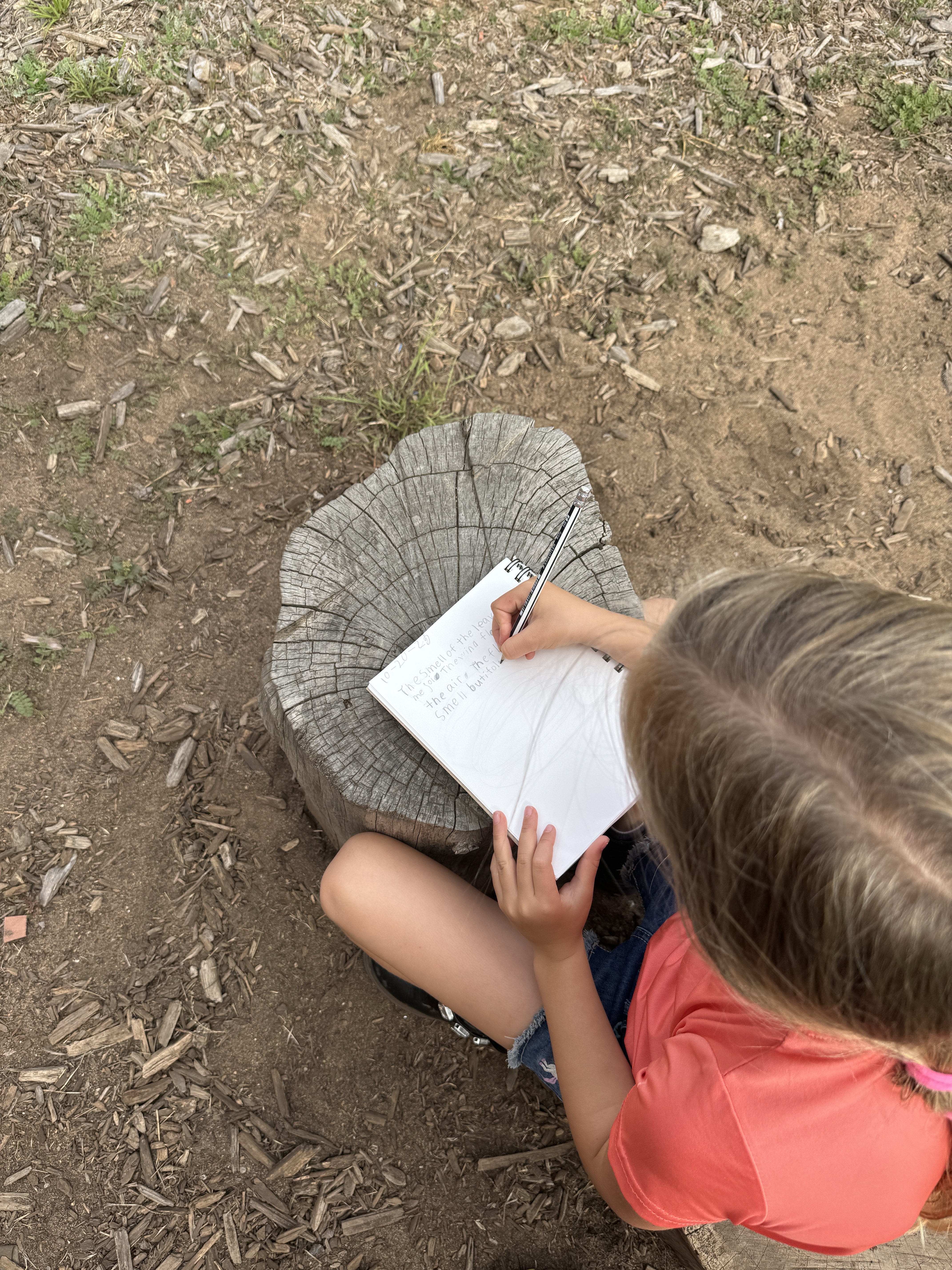
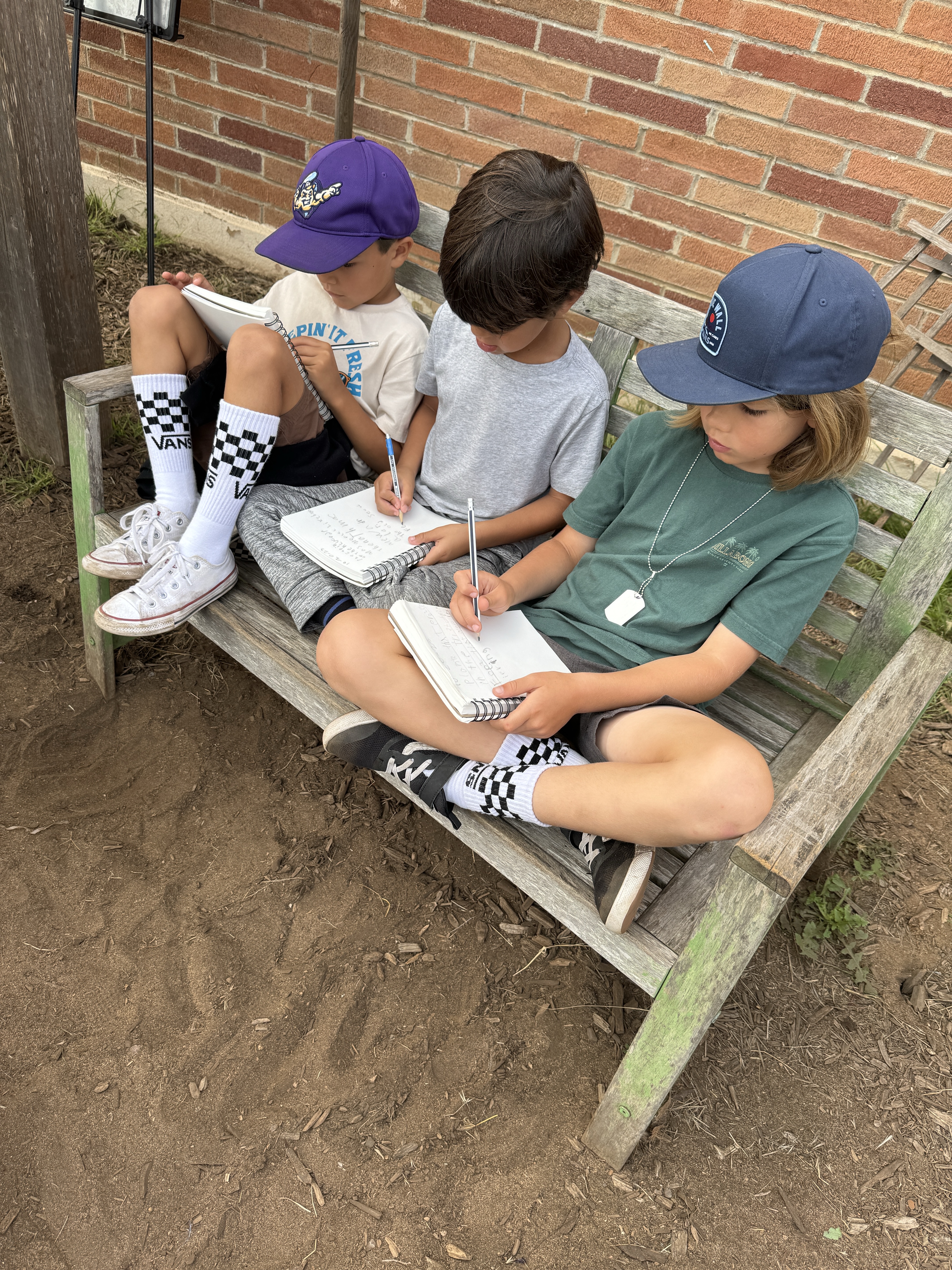
With this as inspiration, we grabbed our sketchbooks and headed out on our own walk, ending up in our school garden where we wrote our own three-line poems inspired by our walk and our time writing in the garden.
These first graders wrote as many three-lines poems as they could during the time we were in the garden. They wrote about the fog that wafted across the playground, the rollie pollies that they love to rescue from the sidewalks, ladybugs, passion fruit, the sky, tomatoes, potatoes, and so much more.
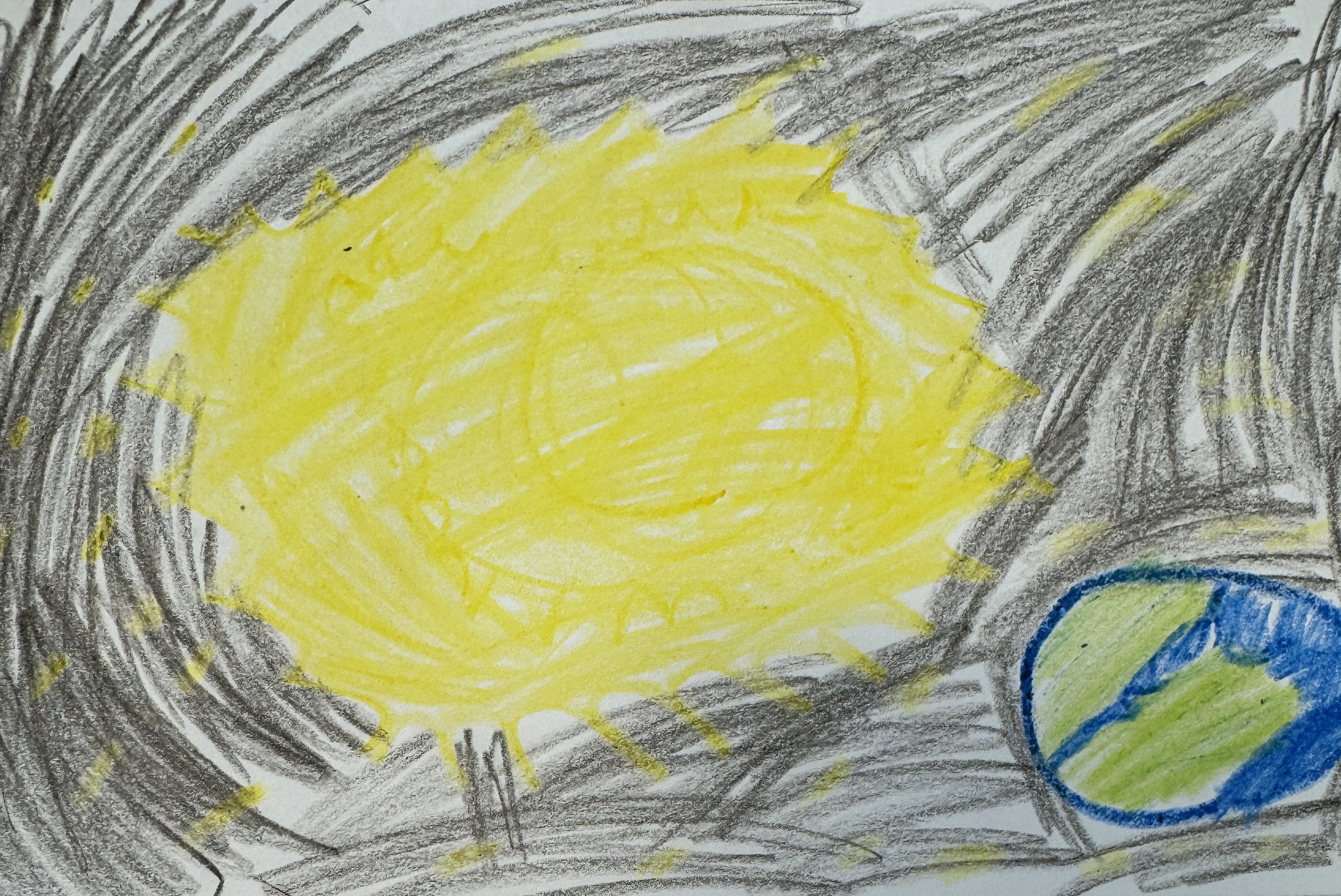
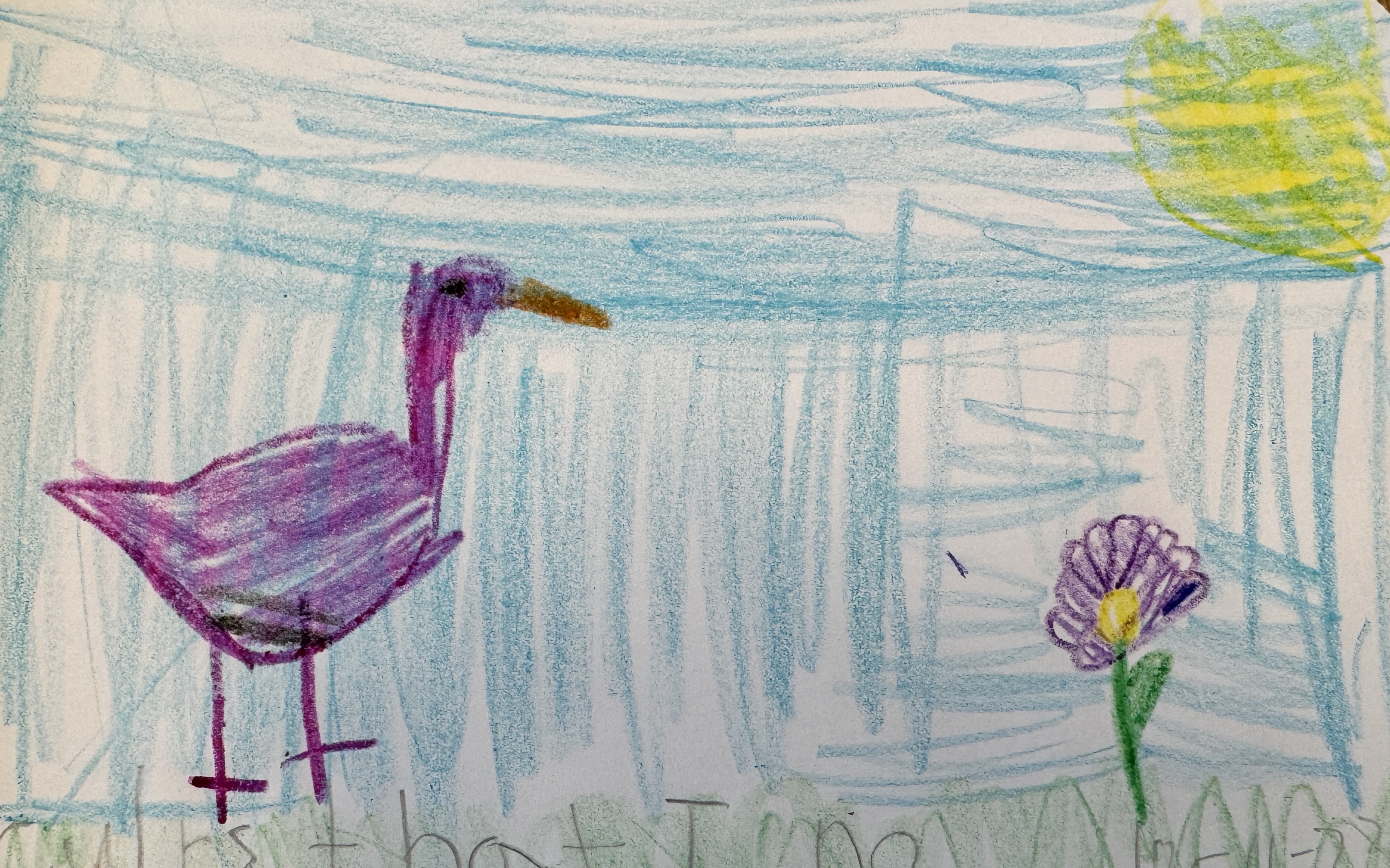
When we returned to the classroom, writers shared a few of their compositions and then picked their favorite to copy onto another sheet of paper and illustrate. While their poems are still developing, they are beginning to get the idea that there are many different reasons and inspirations for writing. Here are a couple:
I See a Butterfly by C
A butterfly flying
In the garden with yellow wings
Pollinating the garden flowers.
The Blowing Fog by M
The fog is blowing
The rollie pollies are crawling
The flowers are blooming.
I also know that being outdoors is a powerful motivation for writing for the first graders I teach. Changing our writing venue, writing in a sketchbook rather than a notebook, and writing under the influence of nature all keep writing fresh and novel. And my writing with them also matters. I hope they are learning that writing is not just for school, but that it is a lifetime pursuit that can serve many different purposes.
And I know that I don’t need #writeout or the National Day on Writing to keep writing at the forefront of the classroom–but it’s fun to know that there are educators all over taking their students outdoors, playfully approaching writing tasks, and making writing something students love…for so many different reasons.
So I leave this post with the NDOW question, Why do you write?
We study a poem each week in my first grade class and this week’s poem was Choose a Color by Jacqueline Sweeney. The first lines are… If I were brown I’d be cattail or turtle deep burrowed in mud… In our study we notice, we discuss, and we illustrate the poem. Today, we went a step further and. used the poem as a mentor text for our own writing.
Although my students didn’t know it at the time, I primed the pump earlier this week by posing the question, if you were orange, what thing in nature would you be? And then as they picked the thing (garibaldi–our state saltwater fish, a tiger, a fox…) I encouraged them to stretch out their idea…what is the thing (animal, plant, form) doing? And then today as part of our morning meeting I posed the question again, this time asking about yellow. So by the time we were ready to write after our snack recess, students had ideas galore! I asked them to include at least 3-5 colors in their own nature-inspired color poem.
Today is our minimum day, so time was limited. Students wrote and then used their crayons to illustrate. While we didn’t have time to go outside for our #writeout effort, we let our love of nature and color inspire our writing.
Here’s a few examples (typed by me for reading ease):
Choose a Color by M
If I were turquoise I’d be the cool ocean rising onto the shore. If red fire blazing in a forest. If yellow the sun blazing down to earth.
Colors that I Know by V
If I was blue I would be rivers floating by.
If I was purple, violets in spring.
If pink I would be a flamingo.
If green I would be grass swaying in the wind.
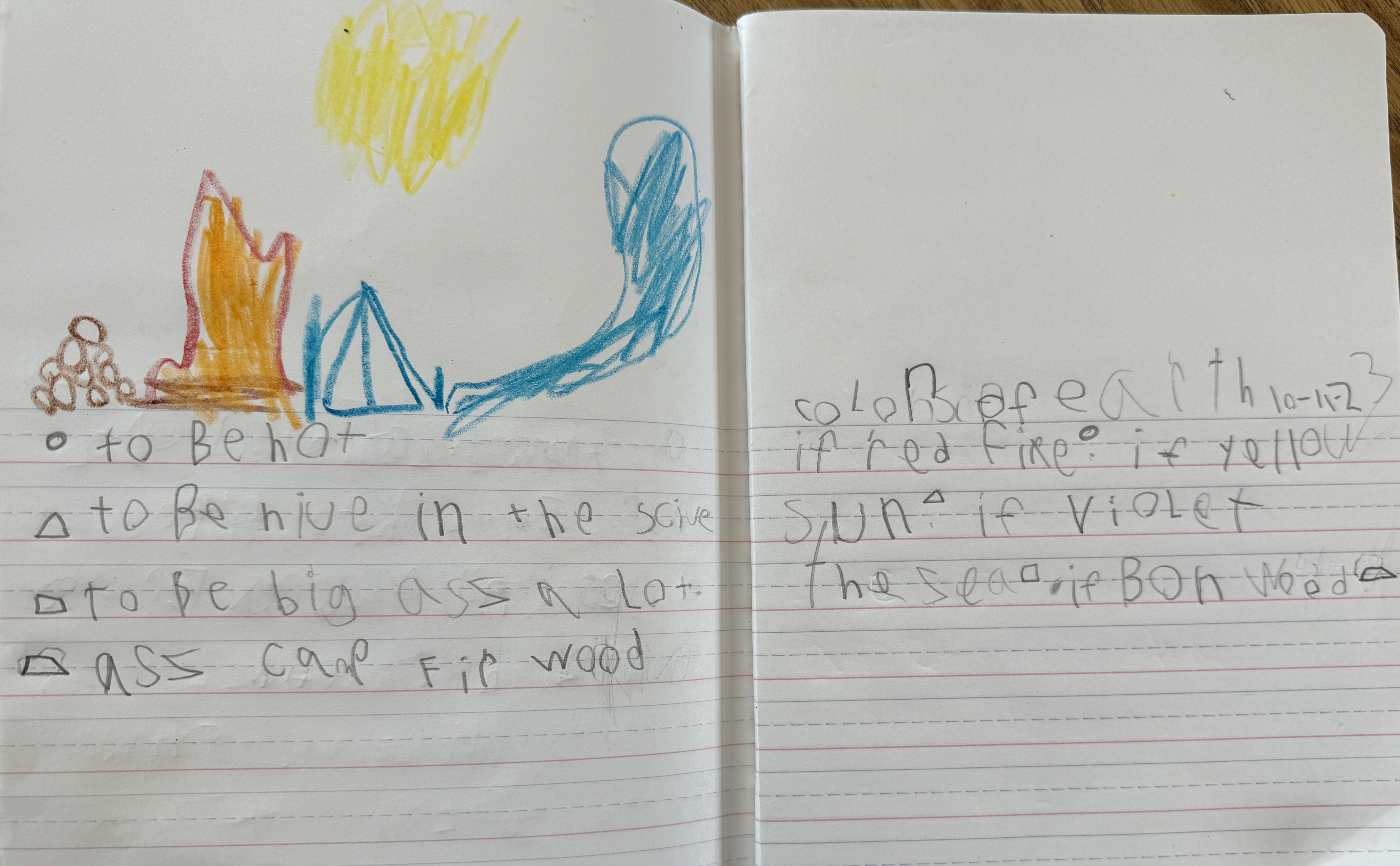
One of my more reluctant writers is now picking up the pencil and getting started. I noticed he was writing short–just picking a color and saying the thing. I quickly went over to get him to stretch past…but I could see him starting to shut down. I leaned in close and learned that he couldn’t do it because there wasn’t room…and he didn’t wait to erase. It was the perfect time to teach him a tool. I showed him how he could use a symbol to show that he needed to continue on another page. Lucky for him, he had written on the right hand page, leaving the left side open for those additions. This felt like a bit of a breakthrough teaching moment!
Colors of Earth by J
If red fire to be hot.
If yellow sun to be high in the sky.
If violet the sea to be big as a lot.
If brown wood as campfire wood.
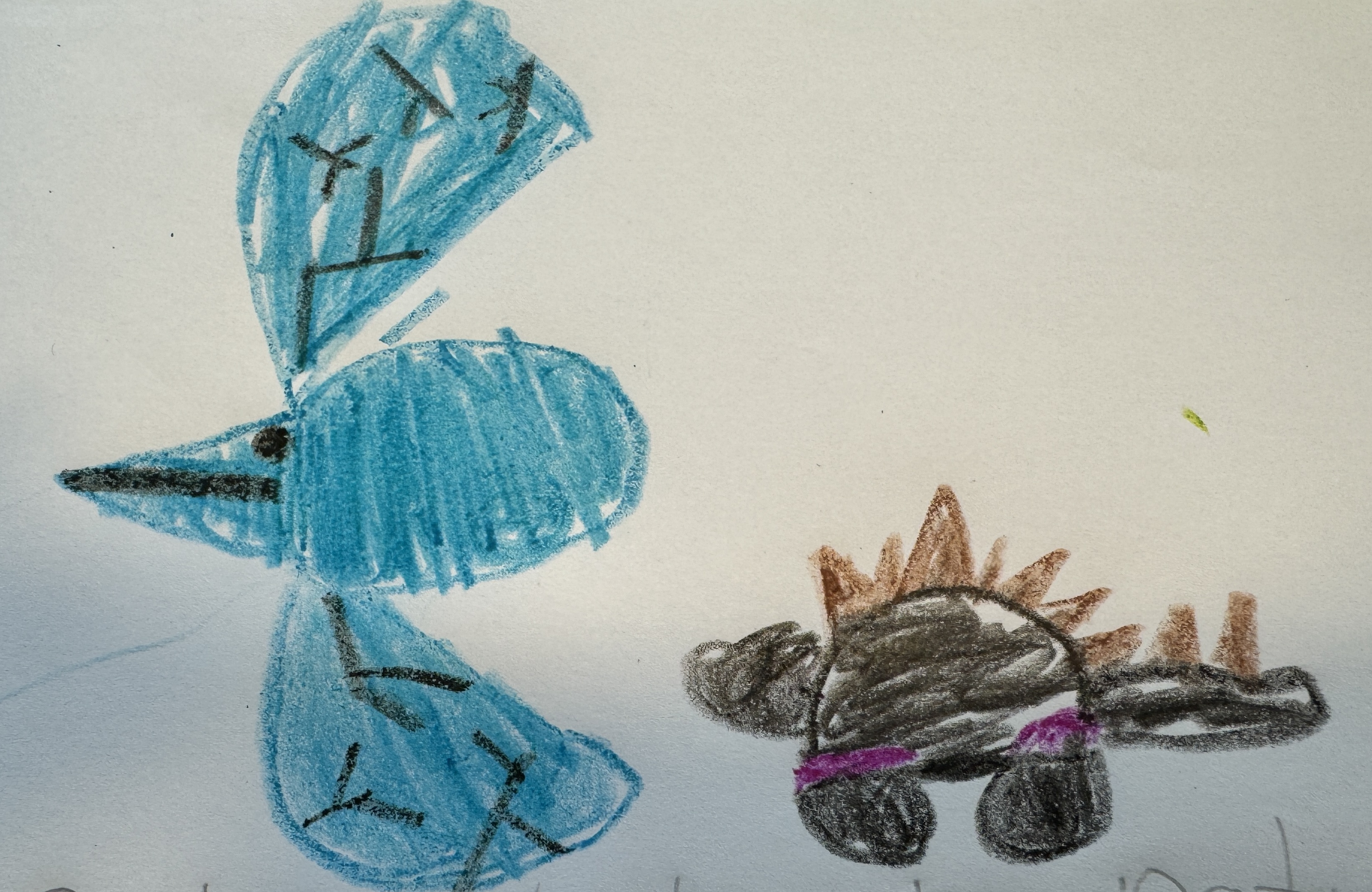
And then there is my Star Wars aficionado who can turn any writing invitation into a themed piece that is Star Wars from start to finish. He checked in with me…does it have to be nature? I reminded him that we were in the midst of #writeout and so were sticking to a nature theme. Here’s how he made it his own!
Colors that are not Primary by O
If light blue I would be a pterodactyl hunting. for food.
If I’d be black I would be stegosaurus drinking water.
If I’d be green I would be sabertooth tiger running from a volcano.
It’s such fun to watch my first graders grow as writers, learning to add details and stretch out their compositions, and to find their own writing voices. And what better writing invitation than #writeout?
On some days, my students and I head outside for inspiration for our writing and learning and on other days, we bring nature right inside the classroom. Fall is known for leaves changing colors, animals preparing for winter, acorns dropping… But in southern California that isn’t what we see outdoors. Our trees are mostly green, the weather is warm, and no one really hibernates. But in first grade students don’t seem to notice that our fall is different…and so, we often import the icons of fall.
Yesterday after reading, Because of an Acorn and talking about the interconnectedness of plants and animals, we watched a video from a park ranger at Sequoia National Park where we learned more about oaks, acorns, and the communications between trees. And then I pulled out my stash of acorns, saved from a year ago when a friend from the central part of our state shared some from her neighborhood. My students examined these extra large acorns carefully, delighting in the texture of their caps, the smoothness of the acorn itself, and the way it rattled when they shook it (they have dried out somewhat after being in my classroom for a year). Then then carefully sketched the acorns and some oak leaves (using our book as reference). Many spontaneously began adding notes, noticing the point at the bottom, the variations in color, and more. Obviously the note taking carried over from our nature notebooking described in my previous post.
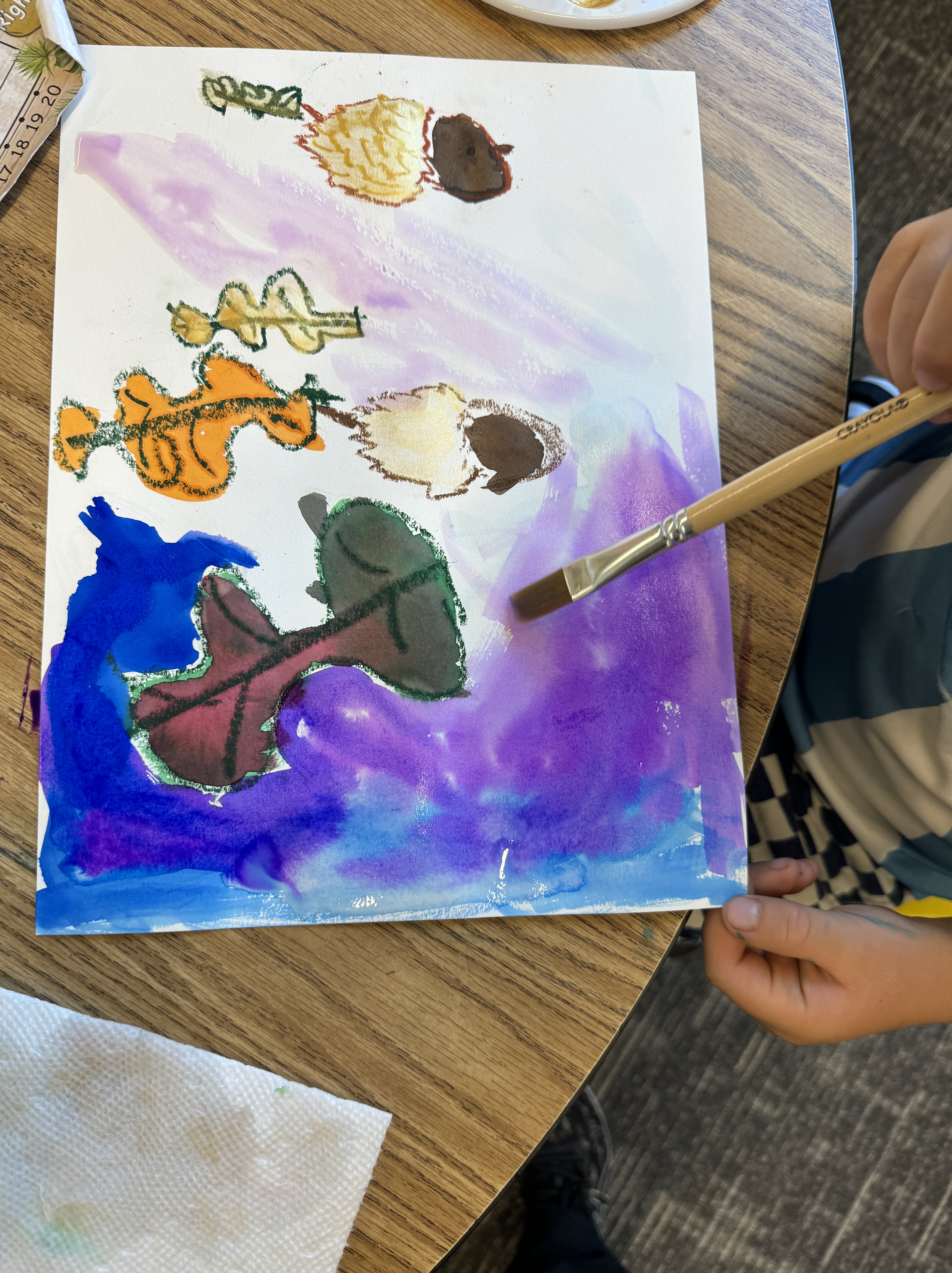
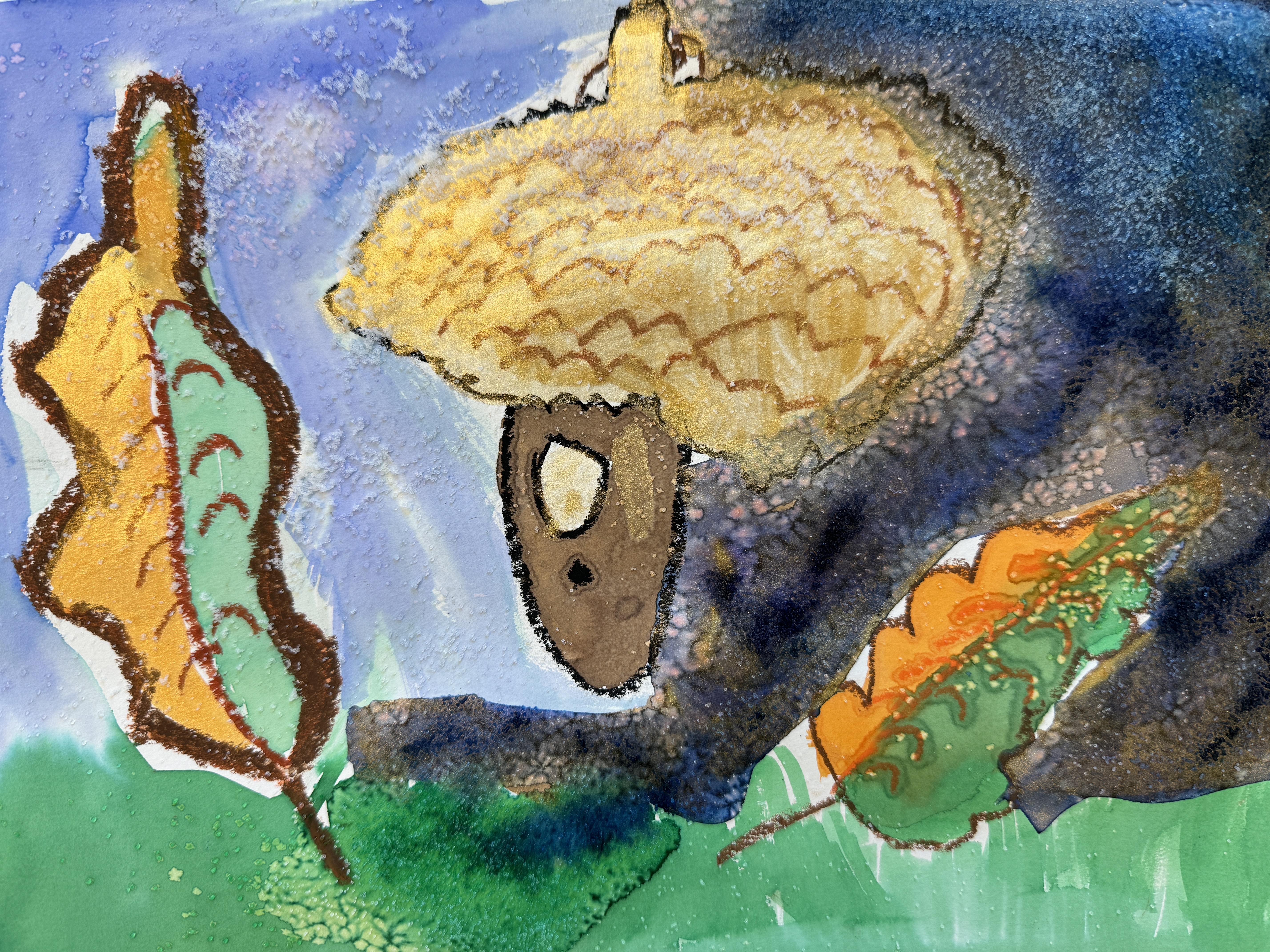
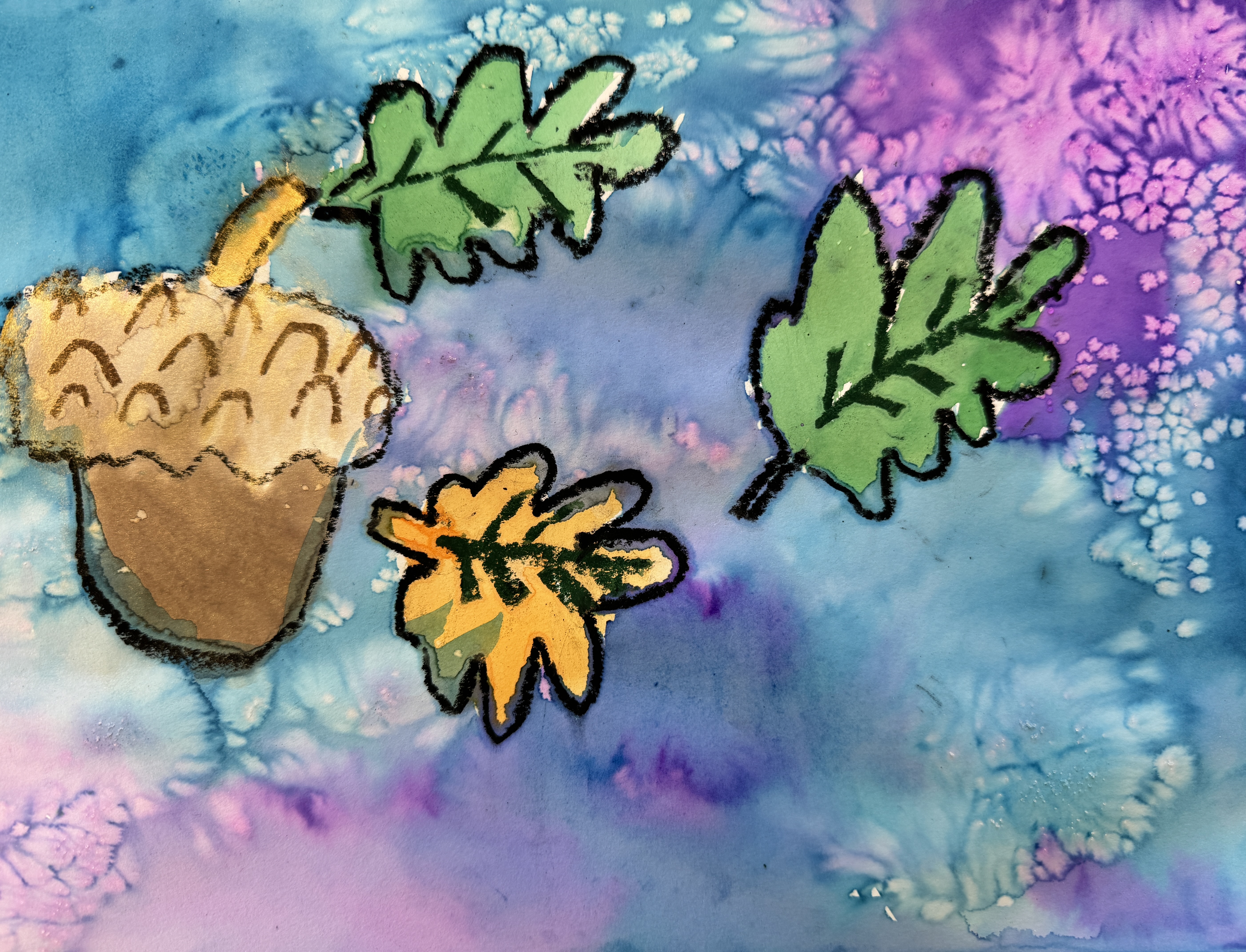
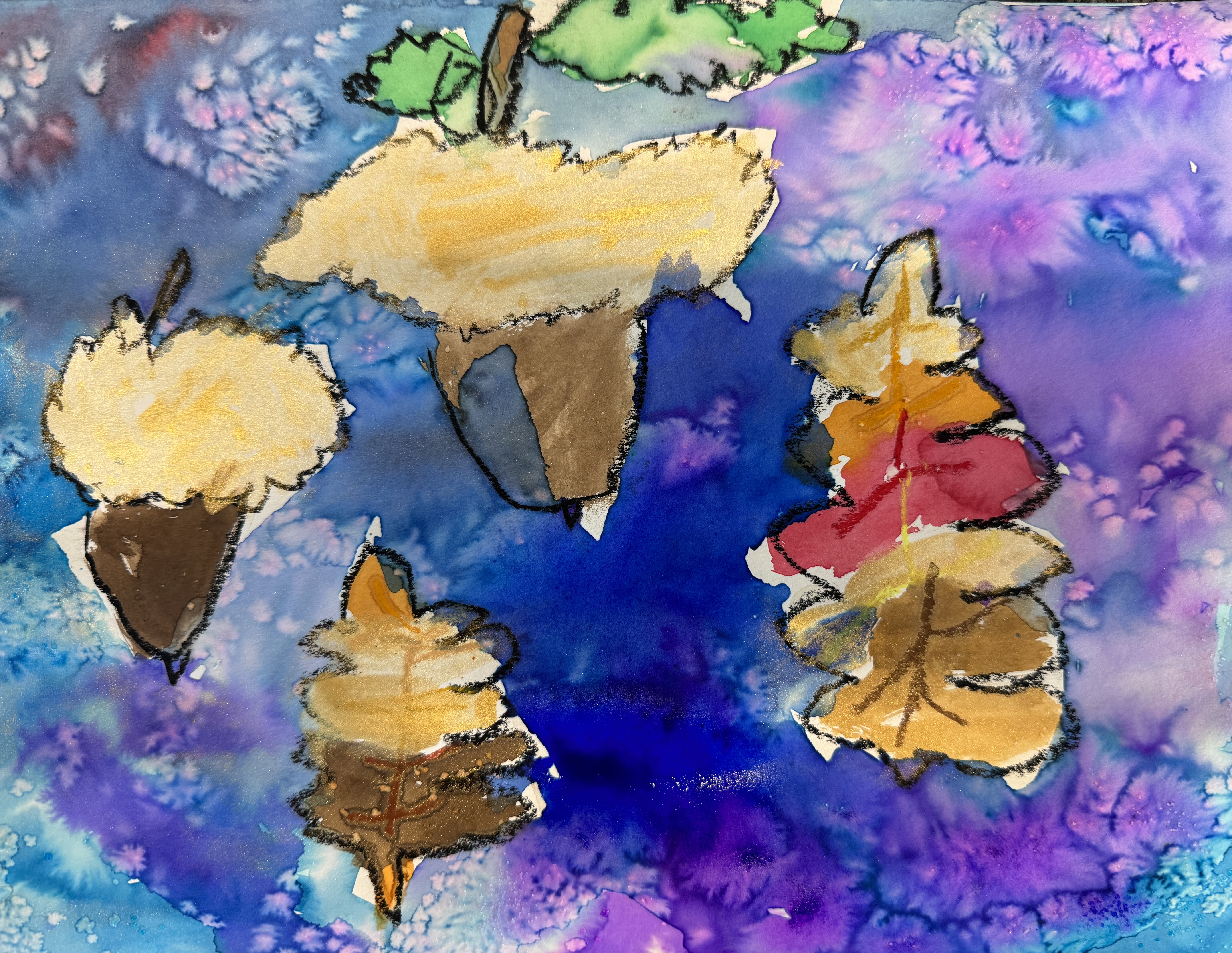
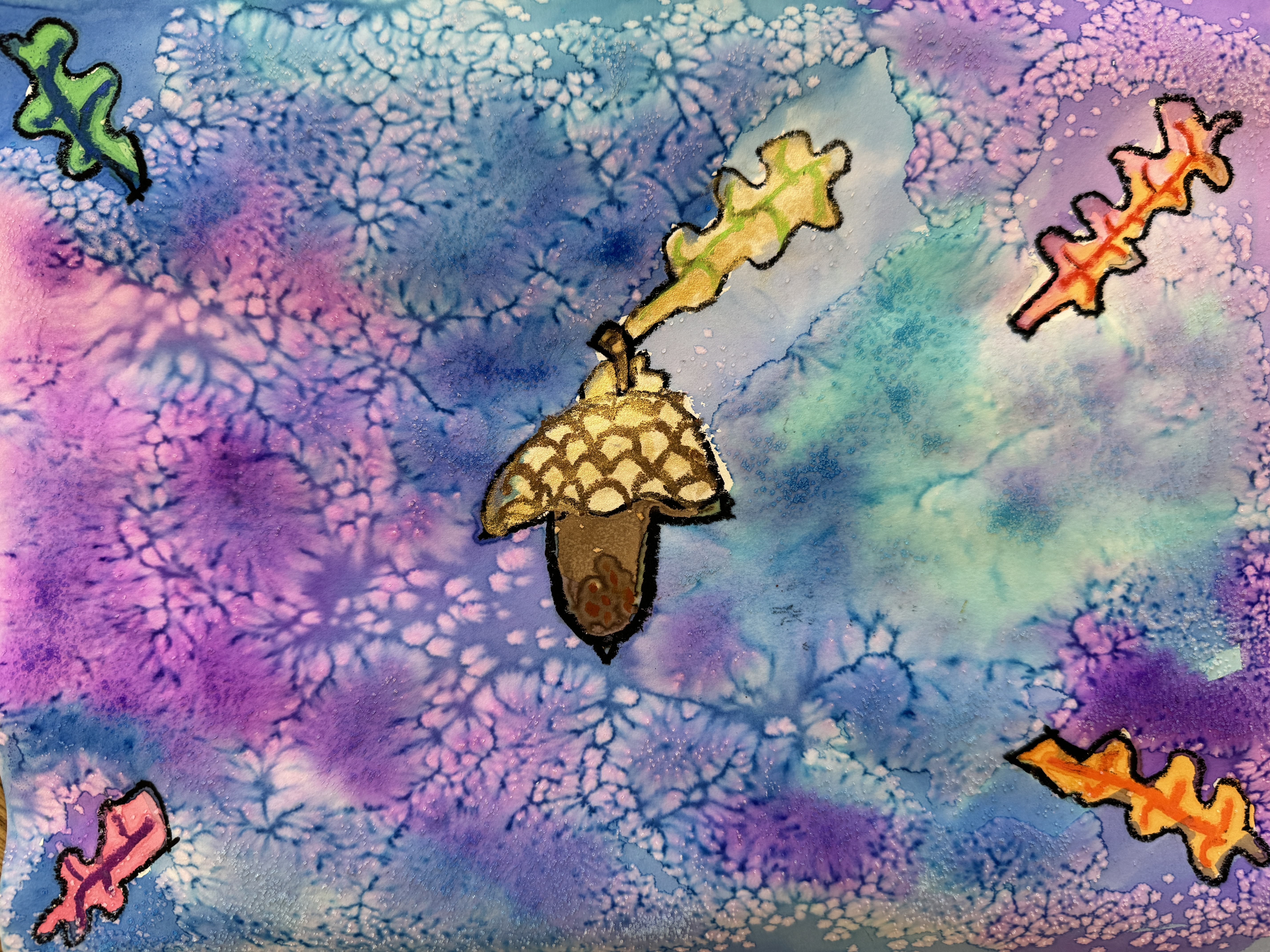
In this case, the goal of the sketching was practice for a watercolor project. Our subject was the acorn, and then we experimented with three different watercolor techniques: oil pastel resist (using oil pastel to create a border to keep paint from running), wet on wet (painting the background with water before applying the paint), and then adding some pinches of salt to create a starburst effect. First graders have so much freedom as artists, they grab the oil pastel with confidence, seemingly not worrying that they will not be able to erase a mistake. They drew and painted…with stunning outcomes.
And since the ranger in the video offered as a prompt, imagine a dialogue between trees…which we expanded to include a conversation between acorns and oaks, students experimented with writing about that interaction. They are new to the writing of dialogues, but their first drafts show some promise. Here’s a couple (typed by me for ease of reading).
An acorn falls off an oak tree. Am acorn hangs from a branch. An acorn drops and a chipmunk will eat it. Hi oak. Are you going to drop the acorns? Oh. I will when it is fall. Hey oak trees, you want to drop acorns! Now it is fall. The oak trees wait. Let me tell the other oak trees so they know. Now it is winter. The animals are hibernating. The bunnies are gathering food for winter.
And…
A squirrel asks an oak tree, can I have one acorn? The oak tree said no you can not have an acorn. Acorn said please! Okay said oak tree but I’m keeping an eye on you! And if you grow into a tree then I will talk to a scientist, so don’t forget squirrel. But wait! I have to tell the other oak trees so we can do a masting said oak tree. Hey oak trees, let’s do a masting yelled oak tree. The oak trees did.
My students were most impressed with their own volume of writing, most filling more than a page with their words. I love that they picked up on some of the science from the video–the idea of a masting, the phenomenon where oaks drop an extreme number of acorns every 3-5 years was information directly from the park ranger.
How are you letting #writeout influence your writing and the writing of your students?





 Thinking Through My Lens