I’m lucky enough to work at a school that has fruit trees growing throughout our campus. I had noticed the blossoms on the apple trees a couple of weeks ago, but today when I went to pick my students up from PE I had to double back and capture a photo of the explosion of tiny fruit that is now growing.
The #verselove prompt today was a complex one. Stefani introduced an Irish quatrain with both a syllable count and a rhyme scheme. At the end of a long week, I did cheat a bit with my ending!
Today’s #verselove prompt was offered by Shaun who introduced a Bukowski poem that was all about you taking care of you–or at least that was what I took away from it. It led me to thinking about all the ways we, as teachers, often do not take care of ourselves, which then led me to think about how little things can make a big difference.
So, here goes!
Do it for You
On days that feel like weeks and months
it’s the little things that matter
an early morning walk dodging snails and letting dew drops
give you that magical sparkle
even when it’s hard to get out of bed
a stop by the local coffee shop on the way home
for that expensive coffee (decaf of course)
that transports you to a place that is quiet and calm
and just the right kind of warm, the kind that feels like a hug
I’ve been inspired by Grant Snider’s comics for a while now and was super excited when I learned about his book Poetry Comics published at the end of March. (I wrote a mini review here). I knew I would be doing something inspired by his poetry comics with my first grade students this month. When I saw he had done a Haiku comic style, I knew this would be a perfect format for my students.
We’ve written Haiku this year–well, mostly 3-line poems without much attention to the syllable count. So when we took a look at Grant’s Haikomic this morning, students immediately understood (and recognized the metaphorical thinking in his last line).
I’ve learned when teaching first graders that sometimes a novel paper use can propel young writers forward, somehow tricking that treacherous writer’s block into disappearing. So instead of writing in their notebooks or on lined paper, I handed each student a 3″ square post-it note to draft their Haiku. It didn’t take long for students to have their Haiku ready to be transformed by the comic making process.
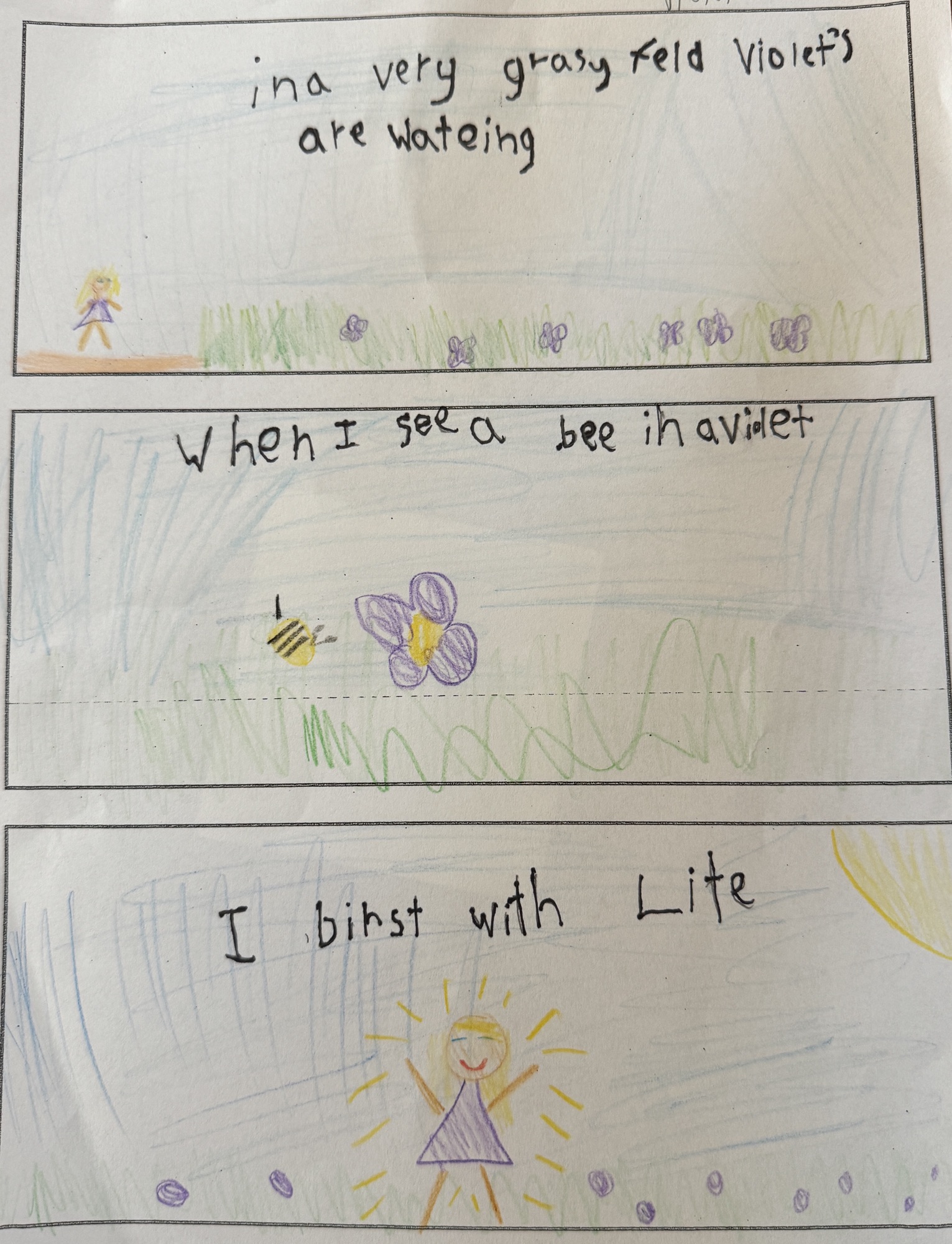
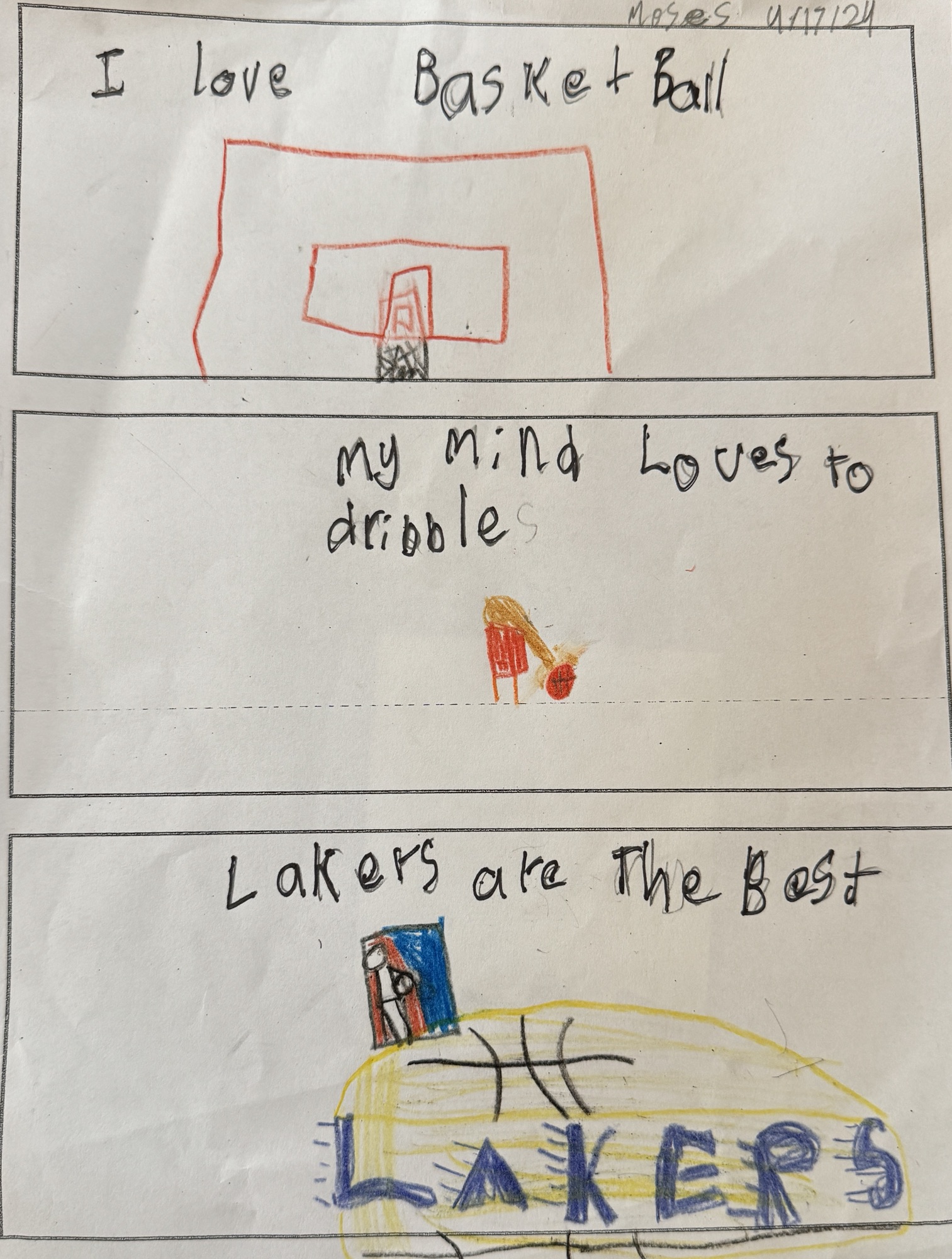
I distributed the comic paper–in this case, a page with three horizontal rectangular panels. Students wrote one line of their Haiku in each panel and added their comic drawing with colored pencil. As a final last step, they traced over the writing with a Sharpie marker.
Here are a few examples:
V can never help writing about violets!
M is obsessed with basketball!
In her piece, “I” decided to add speech bubbles.
And O celebrated flowers and springtime
While I wrote my Haiku about egrets with my students and drew along with them, later this afternoon with a group of Writing Project colleagues we crafted our Haikomics using photos instead of drawing (mostly due to severe time constraints). I then used Canva to write my Haiku directly onto my photo.
Maybe you’ll want to try your hand at a Haikomic too. I’d love to see what you come up with!
Today Dave over at #verselove introduced me to a new poetry format called Kwansaba. This format depends of sevens: seven lines, each line with seven words, all words seven letters or less, and the poem should be one of praise. (For more details read the #verselove post linked above) Here is my attempt:
Some days writing feels hard. Even when there is an interesting prompt, there are days when the words seem to be hiding. This has been one of those days for me.
With Angie’s invitation at #verselove, I used Clint Smith’s poem, No More Elegies Today to frame my poem, to get me started. Maybe this is one of those pieces I will return to on another day and find my way to another place with it.
Today I will Write a Poem
Today I will write a poem about writing
It will not dwell in the challenges of deciding on a topic
or the many chores that suddenly need my attention (instead of writing)
It will not illuminate the scribbled out words
or the dead end paths started but not followed
Instead
It will be a poem about how writing can be
the rainbow that colored my way to work this morning
reframing a Monday with scarlets, tangerines, indigos, and violets
It will use words as shovels and hoes
digging up the rich loam of meaning
sowing the possibility of a seed taking root
It will take me out of my writing funk long enough
A Golden Shovel? It’s a poetry form I’ve heard about, but have never tried until today. Margaret at #verselove today suggested picking a line from a Billy Collins poem as inspiration for a golden shovel or any other kind of poem. But I couldn’t get Ada Limon’s new book, You Are Here: Poetry in the Natural World out of my head. You can get a peek reading this article: Pick Your Poem: 6 Poems to Transport You into the Natural World. So I decided to pick a line from one of the 6 that has been speaking to me–it’s called Twenty Minutes in the Backyard by Alberto Rios.
After reading the poem a few times, I decided to use this line: While the whole world simply moves forward.
Nature’s Medicine
Backyarding with the crows and bees while
framing photos in my mind’s eye seeking the
sunlight’s warmth, trying to remain whole
as time stretches and contracts, I’m spinning in space atop the world
in this outdoor space, I stop the spinning to smell lavender blossoms, feel the ridged aloe simply
spreading, spreading, filling space along the path as it moves
greening and growing wholing my mind, calming frantic synapses, inching me forward
A brain dump. That’s what Barbara asked us to do as part of the #verselove poetry prompt for today. And I don’t think I followed the rules at all. Maybe my poem isn’t a poem at all or maybe it is an 100 word prose poem or even a manifesto in the making. Whatever it is, it was fun to write. There might be some more there there.
Teachers and Unicorns
They tell me I’m a unicorn. A serious person who believes that learning should be fun–should be real. Experiences immersive: audio, visual, tactile, numerical, connected. Classroom walls don’t contain learning. A serious person who believes that play is essential. For children in and out of school and for adults too. That reading and writing and math and science are all opportunities for play and playfulness. School is a place for making–friends, memories, art, poems… Where processes are more important than products and where kids matter. I’m a teaching unicorn who’s serious about the joy of learning. We need more unicorns.
What do you need right now? That was the question Amber over at #verselove asked today. While she suggested some fanciful supplies, I couldn’t get my current favorite pen out of my head. So today is a sort of ode to my pen.
Many days when I go to write a poem I have some idea what I will write about–often inspired by a photo I have taken or an experience I had. But today’s poem came from a different place. The #verselove prompt suggested borrowing a line for Jane Hirshfield’s poem My Life was the Size of my Life and using it to say something about yourself.
Weirdly enough, I picked the line “There were times we made bread.” I say weirdly because I am not a cook–my husband does all the cooking and baking in our family. But somehow, it spoke to me and represents for me the idea of making and nurturing–threads that do run through my life and my profession.
I’m not sure that I understand yet what I am saying in this piece, but I will let it sit a while. Maybe at some point it will speak its truth.