
What does it mean to identify as teacher-writer?
I write with my students, I write for my students, I write to understand my students, I write to understand my teaching and my students’ learning. That’s probably the definition of teacher-writer.
Today I experimented with a writing provocation I found in a Teachers and Writers Magazine article. It attracted my attention because it began with doing–actually with a blind contour drawing. I love to have students do something as a provocation for writing–probably because I like to DO as a way to instigate my own writing.
So, following the directions in the article, I used my non-dominant hand to draw my hand, keeping my eyes on my hand and not on the drawing. I tried not to lift my pen, keeping my pen following all the lines and shapes I saw on my hand.
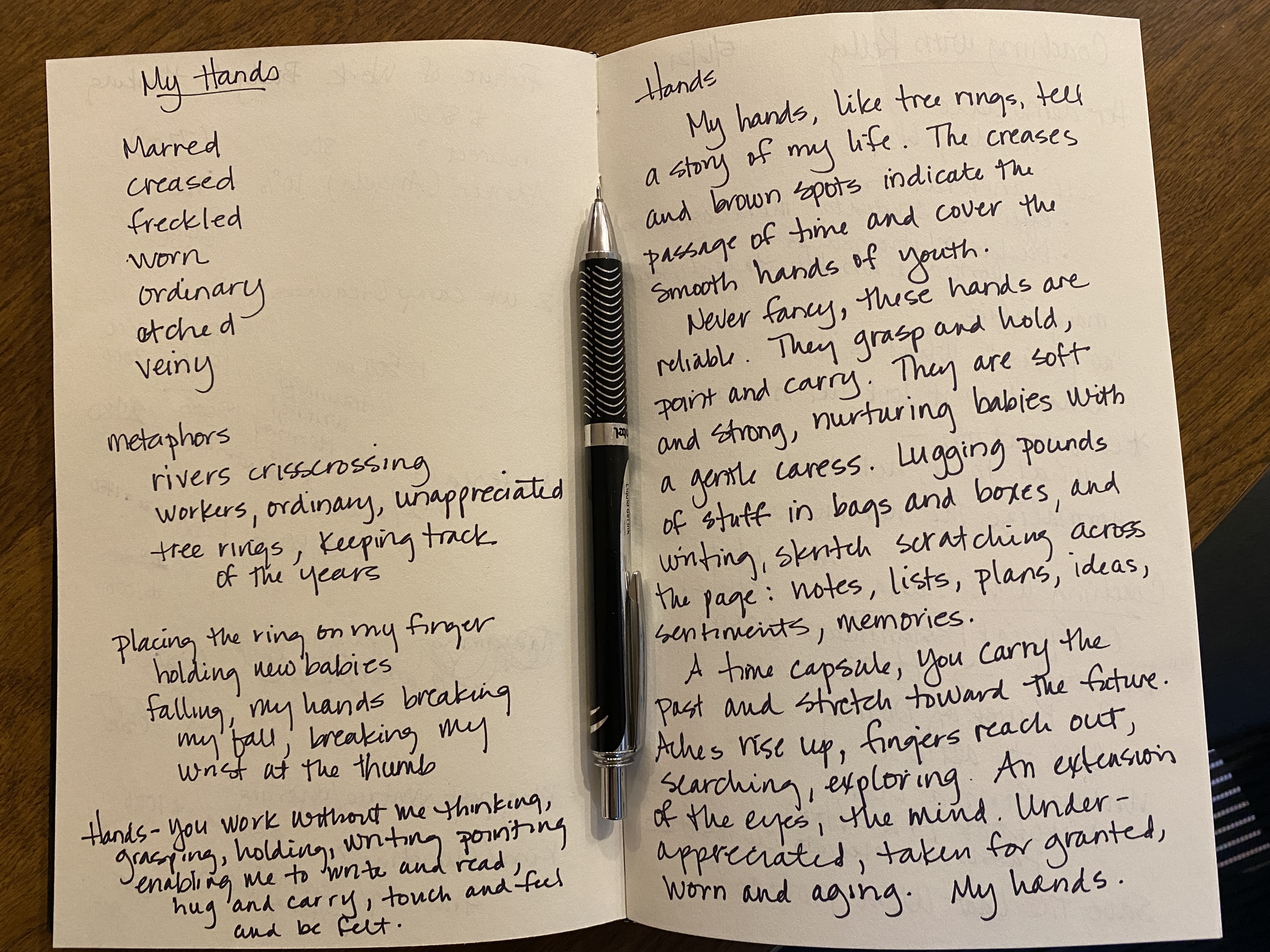
After drawing I opened my notebook and began a list of words evoked by my examination of my hand. then I came up with some metaphors. I thought back to memories about what my hands had touched or done, capturing some of those thoughts in my notebook. I went on to express my gratitude to my hands.
The next step was to write about my hand, using the ideas generated before–or not–for about 7 minutes (my favorite writing time!).
Finally, using a different colored pen, I added words to my blind contour drawing of my hand, creating a collage of sorts. I didn’t directly copy my writing, just added some of the words and phrases I had generated.

Students could go on to write an essay or ode about their hands, having generated a plethora of ideas.
Having tried this writing on as a writer myself helps me identify how it might or might not work for my students. My young students might do better studying their non-dominant hand and using their dominant hand for drawing. I know they will worry about how the drawing might come out–I’ll have to show them some strategies and perhaps do a practice or two before we start for real. We may brainstorm words about their hands as a group before they begin their individual lists. But, I think I’ll try this project with my students. I love the blind contour aspect, the close examination, and the way that careful attention leads to more interesting writing.
What strategies do you use to keep the writerly part of yourself sharp? How do you hone your skills as a teacher-writer? Does anyone know a great picture book that focuses on one body part that is not about hands?
We did it! I wrote last week about my experimentation with a poetry teller, a way for my students to go back through their own poetry and then play around with remixing their poetry with a classmate.
So this morning, students folded their way into their collaborative game. Some students were familiar with classic fortune tellers and were eager to put their fingers into the folds and start moving the teller around. And no one seemed to think it was one bit strange to make this into a poetry tool. They found colors, they located interesting nouns, and pinpointed some poetic phrases–all from their cache of poems written during April. In partners they played with their poetry tellers, collecting words and phrases that they knew they would use soon for some poetry writing.
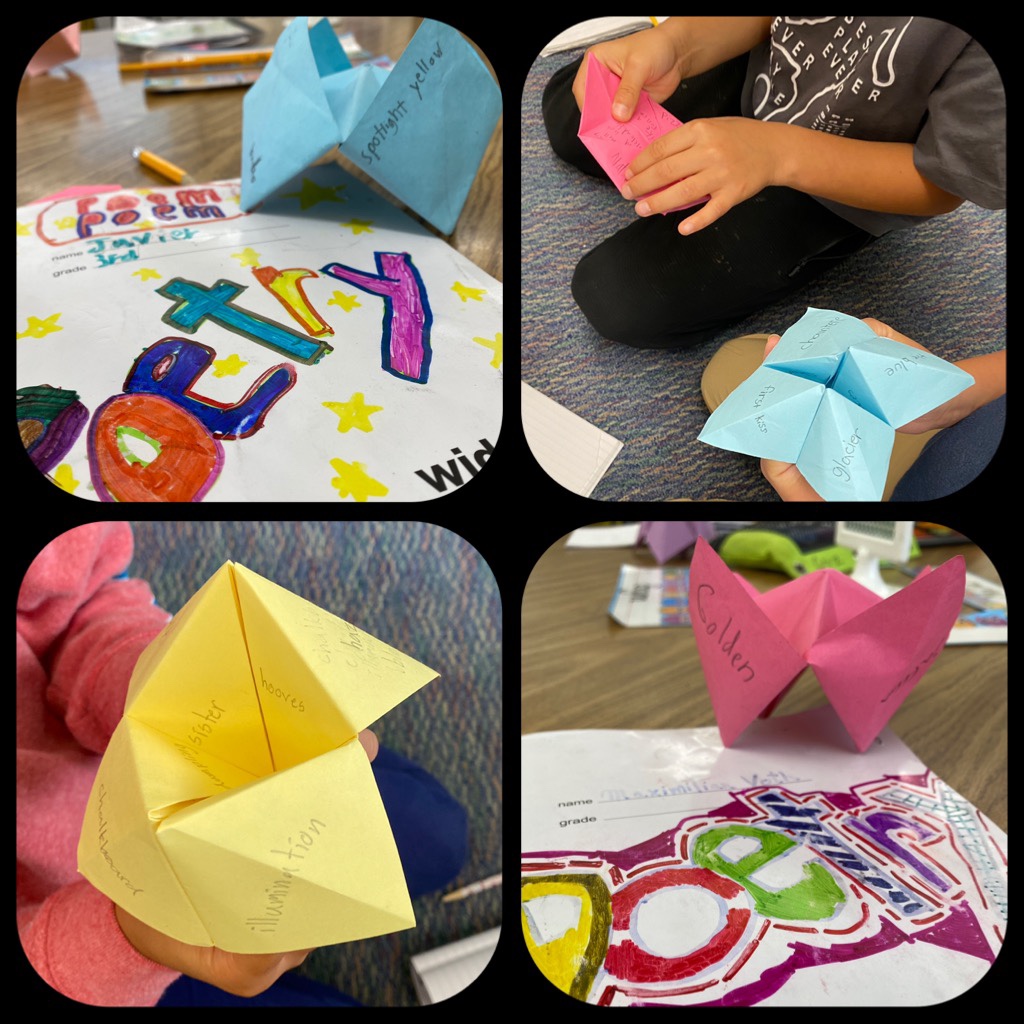
I set the parameters: use the words you collected (it’s okay if there is a word you decide not to use), you can add extra words of your choice, make the poem make sense, and have fun! We used that magical 7 minute timer and students’ pencils flew across the page. When the chime sounded, hands shot up. They had poems to share!
Here’s a couple (these are third graders, 8 and 9 years old):
Words collected: blood orange, green, snow, lamp, the sun is cotton candy, the puddles of the ditch
Poem:
Unusual
The sky is blood orange
the lamp is green
the trees are snow
the sun is cotton candy
the puddles of the ditch are rainbow
there’s something fishy today
And another:
Words collected: ice, profusion, cats, frame, the sunlight bounces into my eyes, illumination, snowy caps, sister, hooves, the cloud is as soft and big, it covers the sky like a blanket
Poem:
Transition to Spring
Ice.
A very cold word
You see it a lot during brutal winters.
Hooves pounding on cold snow under our feet.
Cats.
Sinking their paws into the snow.
The snowy caps on mountain tops
are guarded by a forest.
There are many natural frames in the
tree tops.
Then the snow is illuminated by the sun.
I step outside and the sunlight bounces into my eyes.
My sister’s snowman melts away.
The clouds are so soft and big.
They cover the sky like a blanket.
It is spring now.
Making games out of writing definitely infuses playfulness into the process for kids. They loved manipulating their poetry tellers and would have played with them much longer than I had time for today. I count this as a win–and as a great way to have students remix poems. I’d love to hear what you would do with a tool/toy like this one. How would you modify it to support writers and learners?
I so appreciate the community of writers and makers that take the time to read my posts and provide supportive feedback. And it’s because of them that I took the time to write this lazy Sunday. It was dreary and gray today, the perfect weather for staying inside to read and relax. Luckily, before we even realized it was damp and chilly, we headed to the beach for a low-tide walk. The mist dampened my cheeks and hair, but not my spirits as I explored the familiar shoreline. And the reward: breakfast out at the local diner just a short walk from the beach!
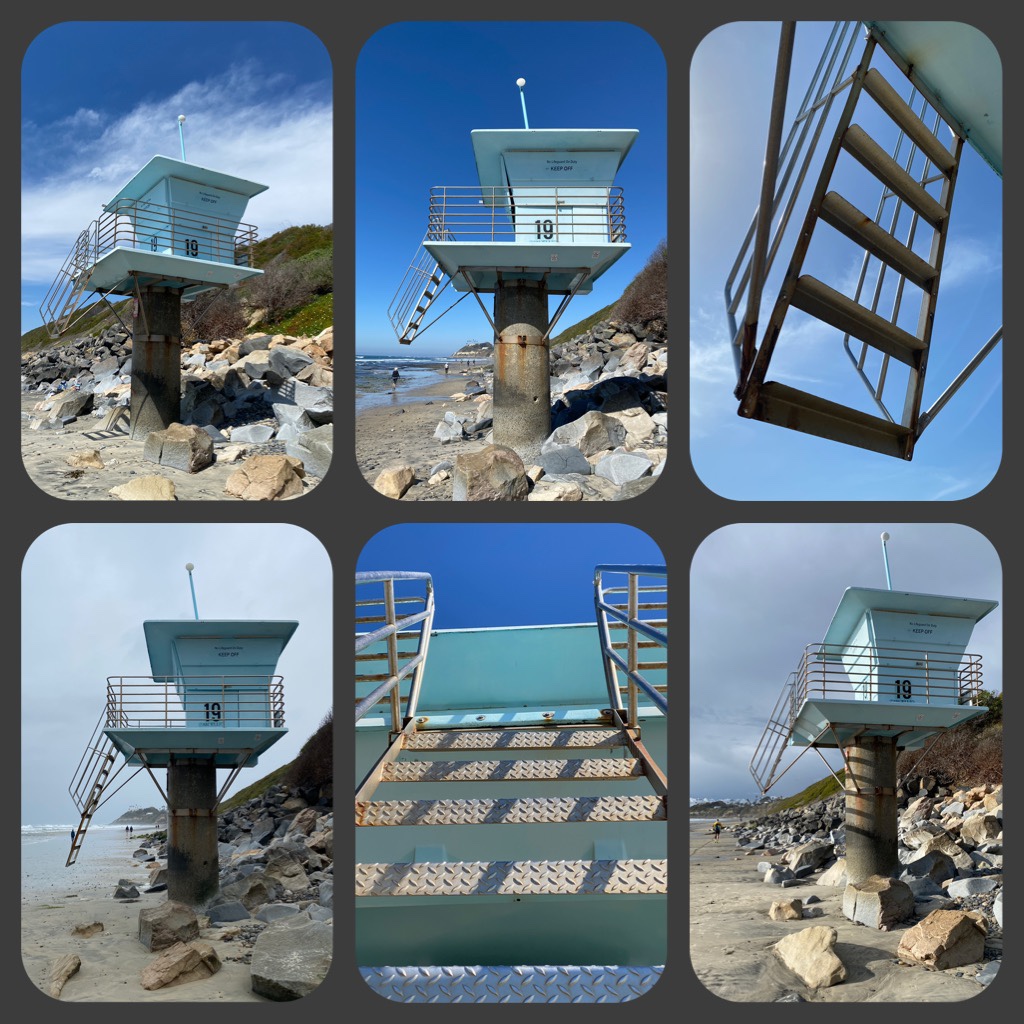
And thanks to Ronald who encouraged me to use the daily create suggestion as inspiration…I actually went back a day, inspired by “create a collage of a loved one,” I created a photo collage of lifeguard tower 19–the landmark I frequently walk to as my turn around point. I realize I frequently take a photo of tower 19: on gray days, on cloudy days, on brilliant blue sky days, looking up at the steps, facing north, facing east… And thanks for Margaret who offered a #poemsofpresence challenge in May, which today I took as an invitation to write a Haiku expressing an appreciation of Tower 19.
Tower 19
Beacon of safety
blue of ocean, sky, and dreams
comforting way point
®Douillard
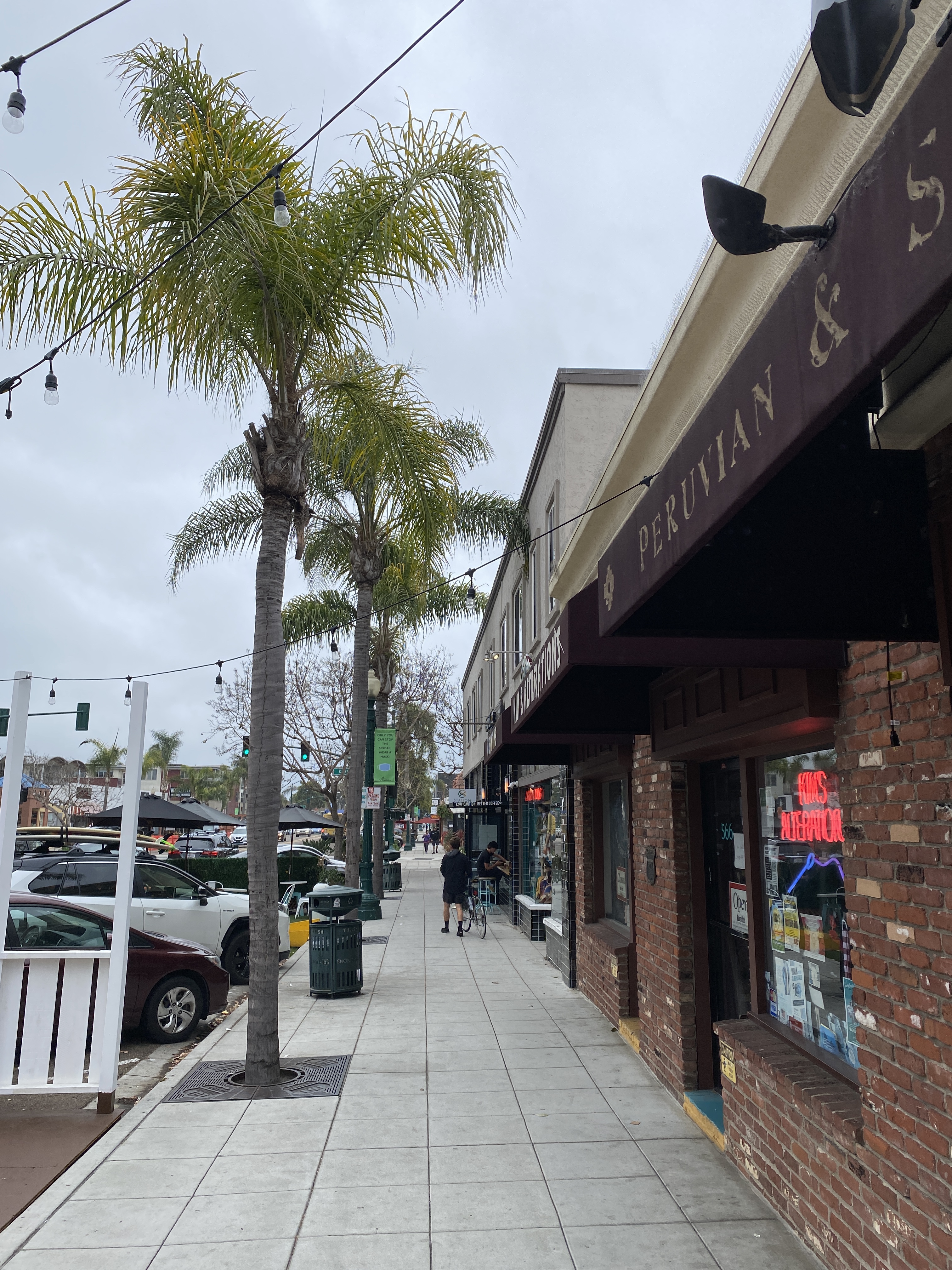
Why commit to writing and posting for 61 days in a row? Trust me, I asked myself that question many times during the past two months. During March’s Slice of Life Challenge, once I began the challenge, it was the writing community that kept me accountable. There is something about hundreds of people writing and sharing and commenting that keeps the urgency up. And since so many are writing every day, reading their posts also creates topic possibilities and keeps the momentum moving.
Writing and posting a poem a day, especially without that dedicated writing community, is a bit more challenging. But I know me, without telling myself I will write AND POST a poem each day I simply would get lazy and not write each day. So why did I want to write a poem each day? Because I wanted my students to write a poem each day–and I know that if I am writing along with them, not only do I have more credibility, but I am also looking for ways to support them and their writing when those doldrums inevitably sneak in.
So after writing for 61 consecutive days (62 if you count today), here are some things I have learned and/or am thinking about:
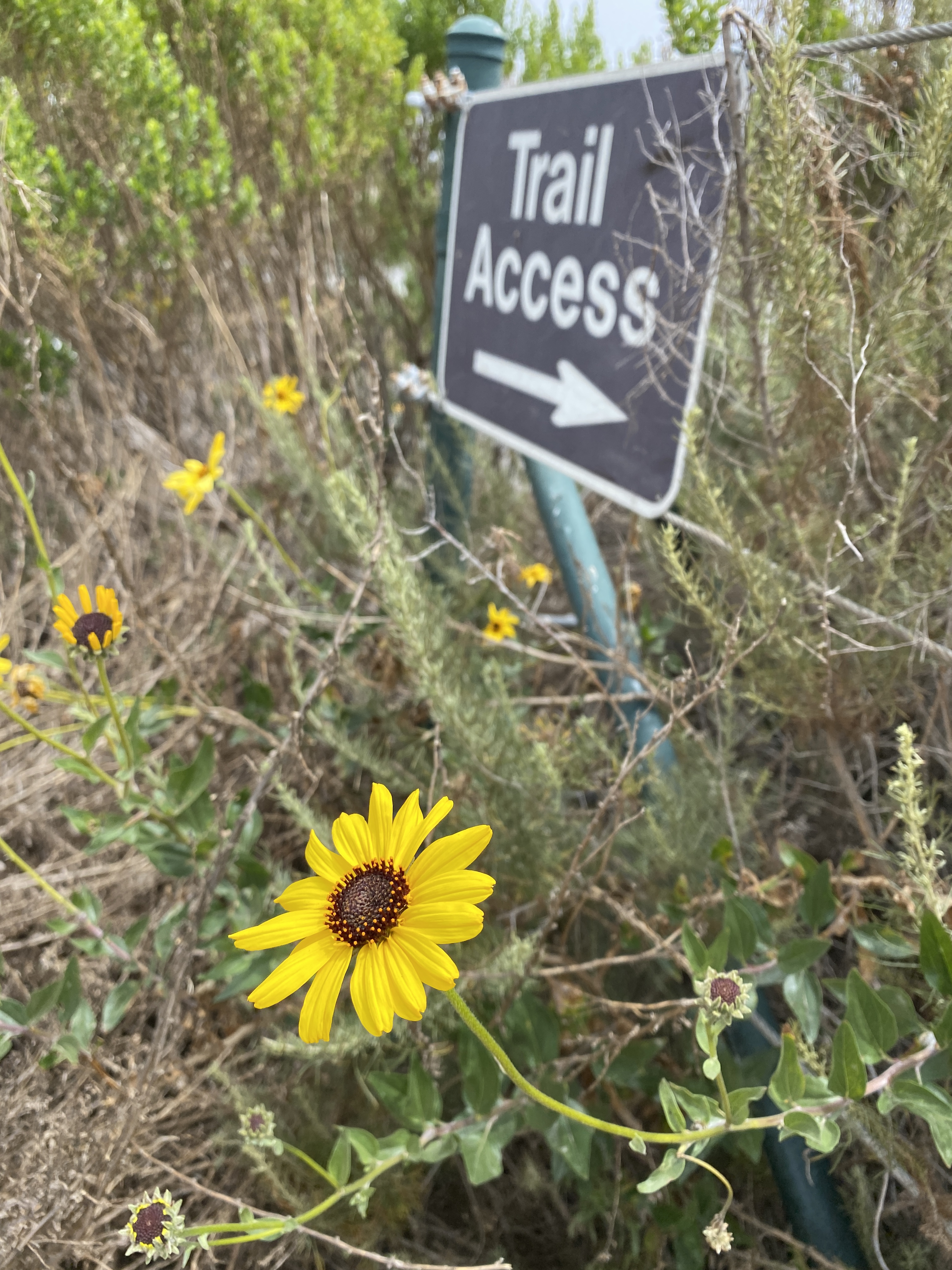
And as April turns to May, for the last several years I find myself facing the same dilemma, do I continue my daily writing and posting? Will I write daily if I don’t post? I don’t know the answers to those questions for this year. What I do know is that over the previous two years when I didn’t commit to the daily writing and posting, my writing decreased (I still always write with my students) and my posting became infrequent. I’d love to be the person who can commit to posting 2 posts a week, writing daily with that goal in mind. Maybe this is the year.
Earlier this week I read a post by a virtual friend, NomadWarMachine, who described her path to transforming the origami fortune teller of our youth into what she called a line of thought-une teller. I immediately knew that this would be a great activity to modify for my students as a culmination of our month of poetry writing.
My idea is to have my students mine their month of poetry, pulling colors, words, and poetic phrases to construct a poetry teller. Once constructed, I see it as a game where partners play the poetry teller to collect a set of words and phrases that they will then use to compose a version of a found poem that includes their words and those of their partner.
I experimented with my own poetry teller, playing this game with myself. I collected two phrases, two colors, and four nouns from my poetry. Then I worked to arrange and rearrange them into a new poem.
You can see my prototype poetry teller and resulting poem below.
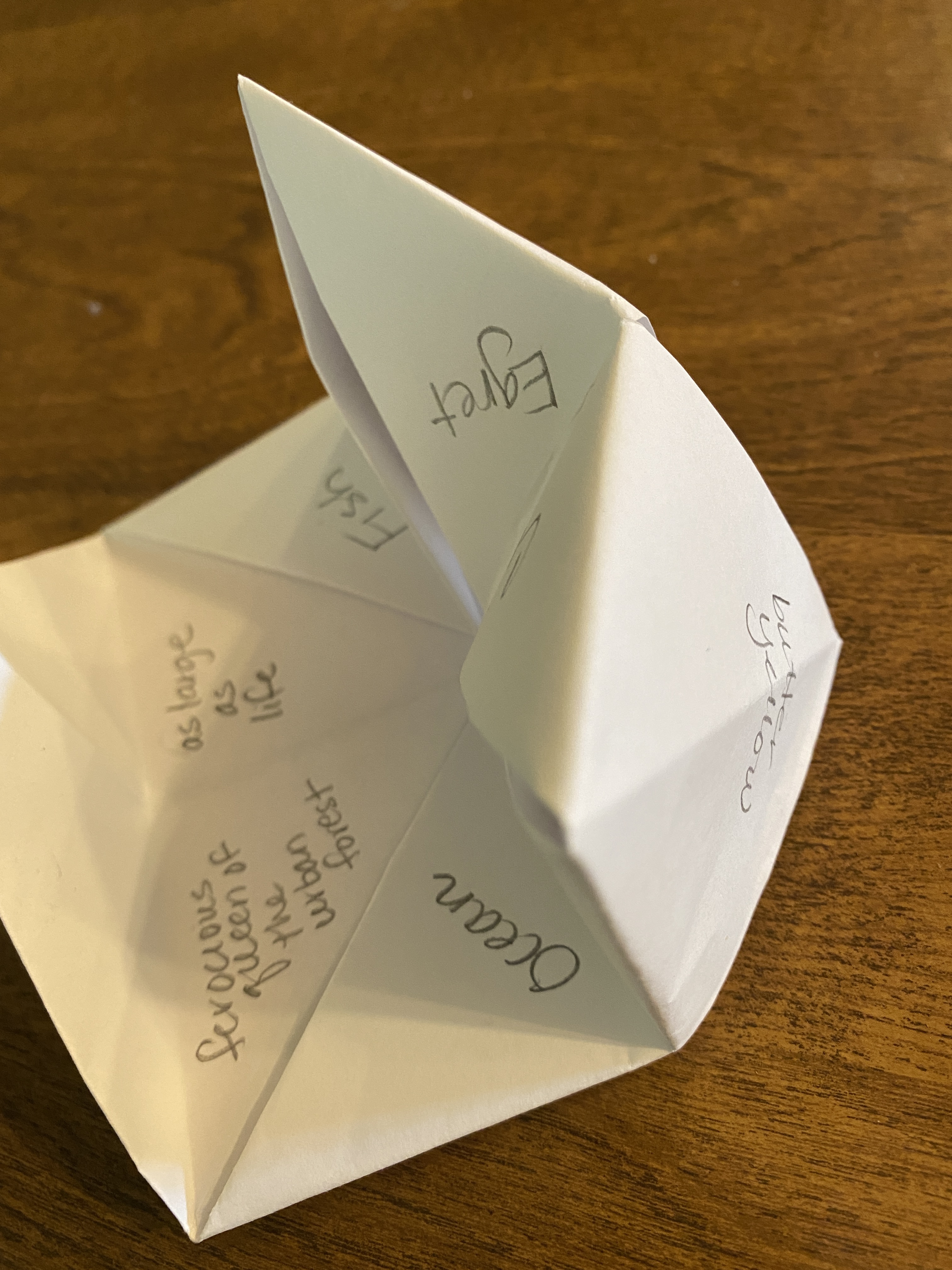
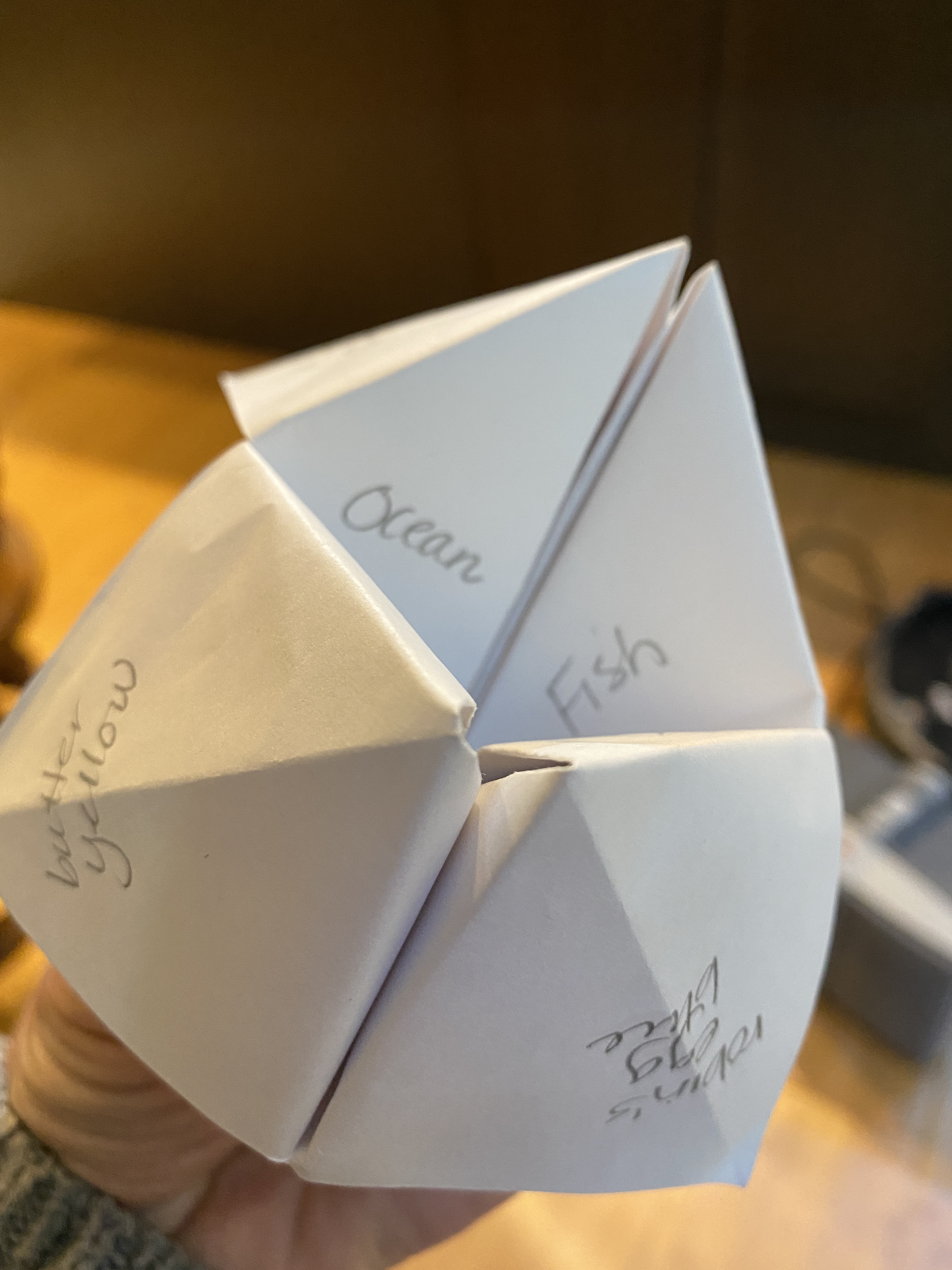
I look forward to trying this out with students next week, I hope they find this to be a fun and generative way to look back at their own poems, collect some language from their peers, and have a meaningful activity to remix the two as they create new poetic compositions.
Here is my poetry teller composition:
The Blues
More ancient than a dinosaur
Resilient as a dandelion
Blues ring out
Notes the color of robin’s eggs
Circling me in melodies
With rhythms as ferocious and regal
As the queen of the urban forest
Sounds as soft as butter
Wrapping me in the
Yellow of wildflowers
Tiny suns
The center of the solar system
Matching the pounding of my heart
The beat of my breath
Essential as air
®Douillard
Back in March I wrote a slice of life about a new structure I had noticed behind a fence and hedge in my neighborhood. Today I noticed something new, which also became the subject for poem #29 (one day to go!).
Free Range
It started with license plates
peeking up beyond the hedge
hinting at more inside
strung with lights
creating a romantic evening glow
What is behind the fence
beyond the hedge
beneath the license plates?
a playhouse for neighborhood children
a workshop for ambitious hobbyists
an escape for harried parents?
A clue emerged
pointing to the truth
or at least to the cardinal directions
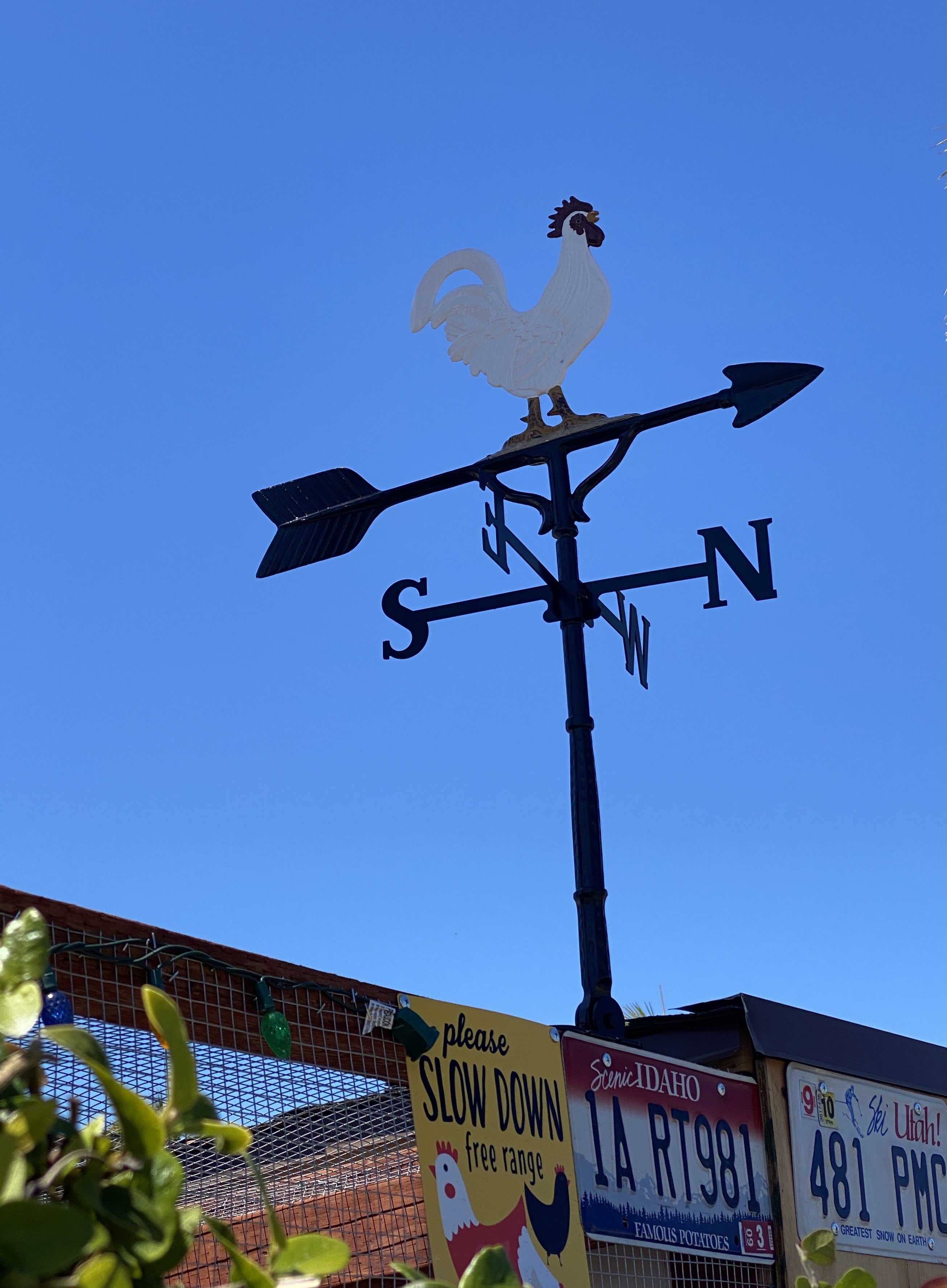
Atop the vane
the rooster crows
and when I looked down
it was announced
“Slow down”
“Free Range”
The chickens have
moved into
the neighborhood
®Douillard
Today we studied Francisco X Alarcon’s poem: Words are Bird as our mentor text. My students noticed that way words were described as birds, something that was new for them to think about. It took a bit of work and experimentation for the kids to find their own metaphors. Some that they came up with included: hand sanitizer is a warrior, trees are magical, and words are gum in your hair. I was a bit skeptical about that last one–and expressed that while I wouldn’t rule it out, it seemed like a difficult one to write for a word lover like me (and this student happens to be a word lover). While I don’t have the text in front of me to share with you all, let me tell you that she did manage it…in some interesting ways!
I may have taken the easy way out, writing my poem about poetry. Here’s the draft I wrote with my students today:
Poetry is Sunshine
Poetry is sunshine
that brightens each day
shining its light
on words
emotions
new ways to think
about the world.
Some poems reach deep
burning a little
touching on something
tender and sore.
Sometimes poetry
warms us from the outside in
when we’re struggling
to warm ourselves from the inside out.
Poetry blazes
even when we don’t see it.
Covered by clouds
it waits,
until we’re ready
finally burning its way through
the thick marine layer.
It’s the center
of our solar system
the gravitational pull of words
that express
our humanity.
®Douillard

We continued our work with color and poetry today using Marilyn Singer’s poem Watercolors as our mentor text. Students loved the way she described black in such detail. I offered paint chips again today–some kids used them, some went in other directions.
My paint chips were the yellow tones of chamomile tea and the green of cabbage patch. Students had just been out in the garden when they came in to write. You can see that influence in my poem for today.
After the Rain
When the gray clears and the sun peeks out
soothing and warm like chamomile tea,
children cheer!
The outdoors beckons, green and lush
cabbage patch
and pea soup
snails slide along the gravelly path
unaware of the
stomp and squish
of colorful sneakers.
She spies the slow slider,
plucks it by the
spiral curl
and gently moves it to the safety
of ice plant.
Rescued!
After the rain.
®Douillard
 Thinking Through My Lens