
Last week we returned to school after our two-week winter break. The first graders in my class were eager to talk, telling each other about all the things that had happened while they were apart. Knowing that students would be chatty, I planned lessons that would allow interaction and conversation on our first day back in class.
I’d been thinking about having students craft a collaborative poem for a while now. We’ve been studying poems and writing some of our own all school year, but still, it seemed that the time was ripe for something more. I began our lesson with Kwame Alexander’s delightful picture book, How to Write a Poem, illustrated brilliantly by Melissa Sweet. We read and noticed first, with students intrigued by the use of collage, the lyrical language, and colorful images. Before I began reading, I had asked my students what they knew about metaphorical thinking. What? That was their response. So after reading and talking about the book, we went back through the book so I could point out examples of metaphor…and just about then, my principal walked in. She comes in from time to time, pulls up a chair and sits and listens. She doesn’t interact and her poker face is nearly unreadable. I just went on with the lesson, feeling students pulled in as we talked about words falling from the sky like rain. We imagined ourselves outside, heads tipped, tongues out, ready to catch those words. As we became the metaphors we were studying, we talked about how metaphor lets us use ideas from our imaginations to make our writing become more clear…and more fun! When my principal left, I still had my students full attention as they grappled with this abstract idea of metaphorical thinking.
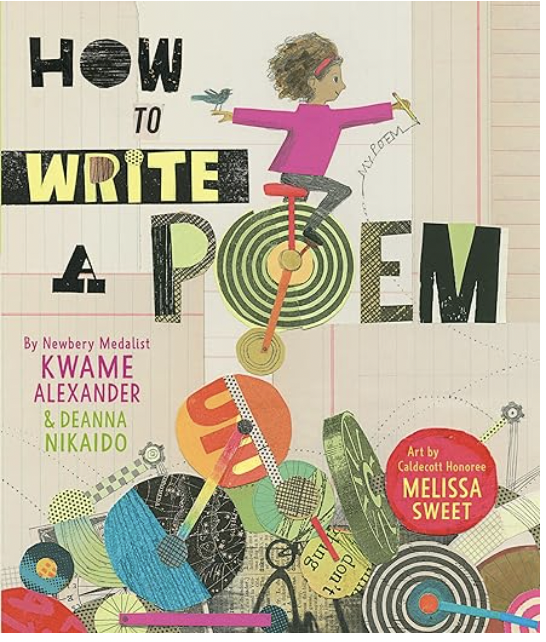
Now, we needed to try it on for ourselves. I decided on having students create a collaborative poem by having each student contribute one line to a “winter is…” poem. So I asked them, how might you use metaphorical thinking to describe what winter is? The first responses had them leaning back on what they already knew. Winter is cold, winter is when trees lose their leaves. In some ways, this was the perfect next step. We talked about how those are facts about winter…now we needed to think about how to make comparisons that were surprising. When one of my students got to snow was white cotton candy, I knew we were heading in the right direction! I had them try a few “winter is…” lines, and just when they were running out of steam, I pulled out the colorful sticky note sentence strips for each student to write their favorite “winter is…” line on. I could feel the motivation lift and even my most reluctant student eagerly chose a color and started writing his line (although there were none written in the notebook at this point). Once they had written, they stuck their post it on the white board.
I wasn’t quite sure where we were at this point. I let the post its sit over night and pulled them off the next morning with the intention of typing up their lines to form a poem. As I typed I divided the ideas into 3-line stanzas, that seemed to help give the poem shape. I was pleasantly surprised when the ideas seemed to come together into a poem that I felt we could all appreciate.
Winter Is…
Winter is white puffy cotton candy
A time for snowflakes that look like crystals
When snow foxes dig holes to keep their cubs warm
Winter is a cold hug in your heart
The wind at the beach
Time for hot chocolate
Winter is snowflakes blowing
Clouds melting
A freezing tree giving words to my pencil to write down
Winter is a snowflake full of thoughts
A snowflake falling down as fast a rocket
Pine trees covered with snow
Winter is a cold place to relax and slide your pencil to write down your mind
Snow soft and crunchy like people walking on the snow
Full of puffy snow like white cotton candy
Winter is a frozen lake waiting for spring
Holidays in your mind
A snow of thoughts flying through the air
Winter is a chilly place where it snows
Winter is so fun because you can play
Winter is a time for joy!
By Room 3 First Graders
1-8-24
I can see where students were inspired by their classmates and where some students are still not quite there when it comes to moving away from facts as they craft a line about winter, but I am pleased with this as a starting point. And even better, my principal saw me eating lunch on Wednesday and commented on the book and lesson–in a very positive way. She loved that I was introducing metaphorical thinking to first graders.
But honestly, the real payoff started to emerge in small moments as the week went on. My students started to point out metaphorical thinking throughout the school day, and in their own speech. On Tuesday, we returned to the book, Kiyoshi’s Walk by Mark Karlins as we embarked on writing 3-line poems about the cardinals we had created in the style of Charley Harper the day before.
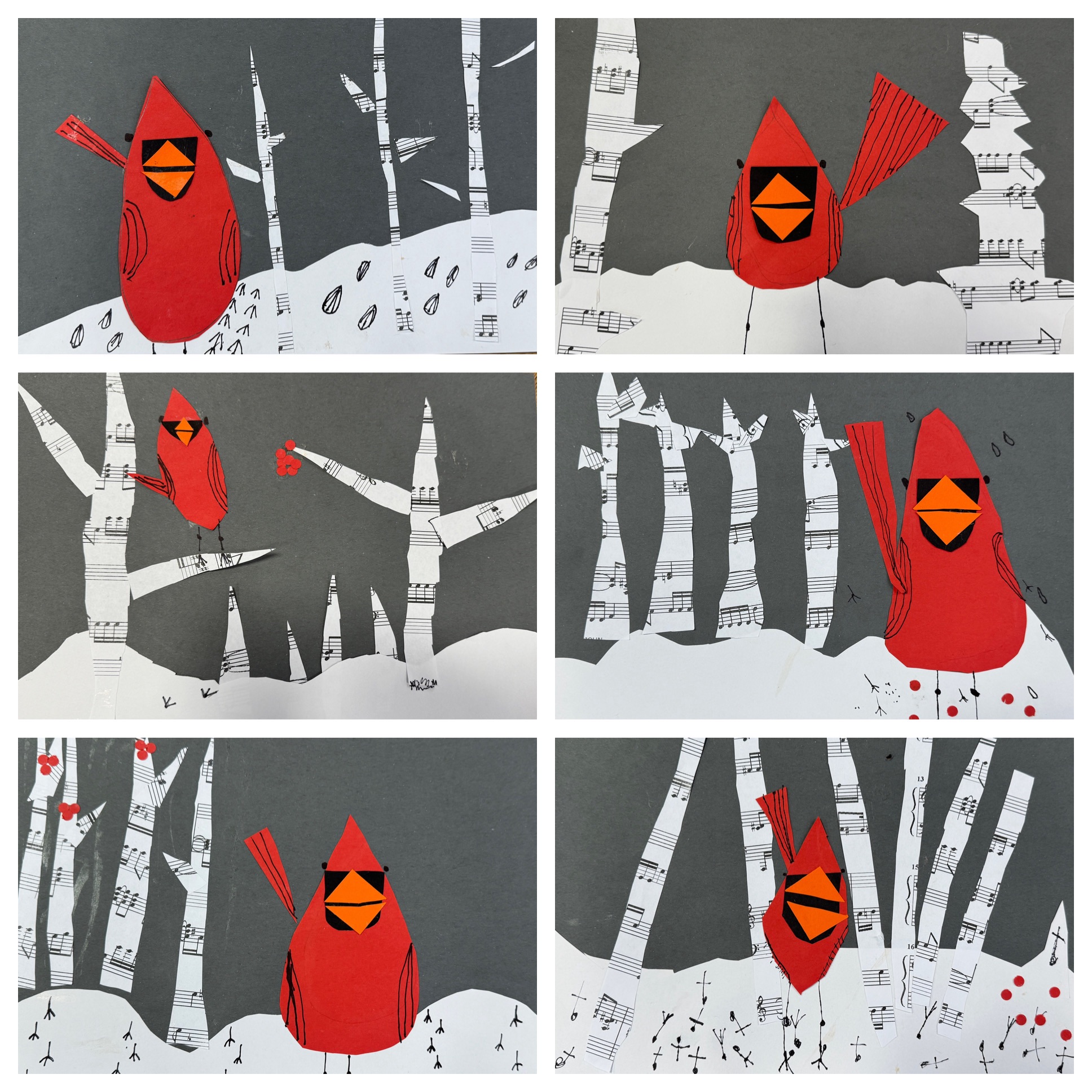
As I read the Haiku in Kiyoshi’s Walk, they pointed out the metaphors…a pile of oranges described as a “hill of orange suns.” Again, not every student is yet ready to employ metaphor effectively…yet, but the seeds are planted. So we wrote 3-line poems on Tuesday (I try not to have these poems be about syllable counts–trying instead to focus on ideas and word choice) and then on Wednesday, I asked students to go back to their poems and improve them by changing a word or two or adding another detail (revision!). Here’s a student who was clearly influenced by Eto’s poem in Kiyoshi’s Walk.
Cardinals
Champ 1964 St. Louis Wins
Cardinals fly to win
Trophy of suns
By J
When J read the poem to me, he pointed out that since trophies are golden, they are shiny like golden suns–something he changed from his first draft the day before. And I know, clearly his mind was on the St. Louis Cardinals (a favorite team) rather than on the bird we crafted the day before. But the win is in the poem–three lines, metaphor, revision…and pride in writing! I’ll take it! Another student wrote this to describe his cardinal.
The Red Cardinal
The red poinsettia feathers
keep me warm
and they fill the forest with love
By F
And there were also more subtle attempts like this.
Flying in the Wind
I see that cardinal
flying in the tree
just like the wind
By O
What I see is students experimenting, playing with ideas, playing with words…and growing as writers and poets (as well as readers and thinkers). I love that something as deceptively simple as reading How to Write a Poem resulted in our writing community learning together, composing together, and risking trying on some new techniques together. I am reminded once again of the power of poetry…so yes, I will continue to say, “More poetry please.”













 Thinking Through My Lens