Category Archives: Connected Learning

Digital Learning Day

Tomorrow is Digital Learning Day. It’s meant as a way to draw attention to the need for digital learning in our schools, to showcase the potential of digital learning, and as a way to highlight what is happening in places where digital learning is taking place.

But I like some of the other conversations that take place because of the emphasis on digital learning. In some places we are talking about issues of access and equity. And we must go beyond buying the device when we think about access and equity. What are students doing with their digital devices?  How is access to the digital transforming the learning process for students?  What  expectations come with the devices?  What are student s expected to do outside of school?  Even though many of these conversations take place on a small scale, they are important.  And we need to have more of these conversations and keep equity (not just hardware) at the forefront of our thinking.

There are still many places where students don’t have regular access to digital tools.  Or they are doing things on digital devices that simply replace what they were already doing without those tools, without changing the task in any significant way. Or teachers have a single computer or other device for use with a class full of students.  Or teachers have a class full of devices without the background and professional learning to help them put them to effective use.  Or they have devices and a lack of infrastructure…no way to work out the technical issues that inevitably plague working with the digital.

I’m lucky at my school. We are in our second year of 1:1 digital devices in my classroom and we have technical support available. I’ve been fortunate to work with many inspired and forward-thinking educators, especially my colleagues from Writing Project sites all over the country and throughout the state, who have modeled the potential of digital learning.  My teaching partner is a willing risk-taker who will learn as she goes…and we support each other moving forward into the digital world that isn’t yet mapped out in the educational landscape.

That doesn’t mean that things are flawless in their operation or that moving toward digital doesn’t increase demands on my time as a teacher.  It doesn’t make planning easy or learning effortless…my teaching partner and I spend precious time learning and relearning and helping our students navigate the inevitable technical difficulties that go with this digital territory.

And even though tomorrow is Digital Learning Day my students are doing digital learning every day.  Our forty-plus six, seven, eight, and nine year olds have been working at getting their blogs designed and posts ready over the last few weeks.  We discovered some new wrinkles in the way the Edublogs app works on our iPads this year…different than last year.  You have the love the third grader who discovered the “back door” fix to uploading media to posts when the app says it won’t do it!

I’m more convinced than ever that “digital natives” and “digital immigrants” are simply the wrong terms to describe my students and their teachers (my teaching partner and me).  But we are digital learners…together.  And our students need and appreciate the guidance they get from us just as we appreciate their enthusiasm, effort, and ingenuity.  As soon as I can get back to our class blog (maybe first thing in the morning), students’ first posts for this year will go public…I hope I can get to them all for Digital Learning Day.

And, we will launch into some digital stories tomorrow…in honor of the spirit of trying something new on Digital Learning Day.

What will you and your students be doing on Digital Learning Day?  And how is it different from all the other days in your classroom?

Connected and Digital: A Reflection

Today I had the opportunity to be a panelist on a webinar entitled, “Connected and Digital: Improving Learning for All Students,” put on by the Alliance for Excellent Education in conjunction with Digital Learning Day and their Digital Learning Transition MOOC.

I’ve been exploring connected learning for a while now, and love the way the learning principles:

  • interest driven
  • peer supported
  • academically oriented

and design principles:

  • production-centered
  • openly networked
  • shared purpose

work together to create a powerful dynamic for learning.  In my view, connected learning is the embodiment of what it means to be a lifelong learner, learning because you want to, because you are interested, because you find it compelling and enjoyable.  And that is what I want for myself and for my students.  And just like my students, sometimes my interest in a topic or activity is piqued because someone drew my attention to something I didn’t even know that I wanted to learn about.

When I was invited to talk about connected learning and digital learning and the relationship between the two I had a little laugh at myself.  A couple of years ago I remember asking over and over again, as part of a group exploring connected learning, if connected learning meant digital learning.  And while I was given answers, it was this summer when I participated in the Connected Learning MOOC (clmooc) that I came to a firm understanding that all connected learning doesn’t have to be digital, but that digital tools allow for an amplification of learning that is often not possible without it.  I know it has had a profound impact on my photography as I share my efforts and connect with others across the nation and all over the world who have similar interests.

What I loved most about my experience on the panel today was the opportunity to think deeply and carefully about why I believe connected and digital learning are important in schools and their relationship to issues of equity and access.  Mary Ann Wolf, who moderated the webinar, took the time before the actual webinar to talk with each of the panelists separately about our experiences and views and then constructed a series of questions for us to think about a few days prior to today’s event.  I like the question/answer format, that while structured, still allows for a flow of ideas and responses to one another’s ideas.

I also like that although I was one of the panelists and had already done a lot of thinking about this topic, I found the conversation interesting, illuminating, and stimulating.  Comments made and information shared by Bud Hunt and Sara Hall have me thinking about aspects of connected and digital learning that I haven’t given my full attention just yet.  I left the hour-long conversation with a full brain and many more ideas to think about, as well as resources to explore and new contacts to reach out to in this journey.

If you are interested, here is the archived version of the webinar:

What do you think about connected learning and digital learning?  How are they enacted in your classroom?  In your life?
Play is the Word

Today is January 18th…and I think I may have found my “word.”  Lots of people make resolutions for the new year to set their intentions and make change in their lives.  It’s evident from increased traffic at the gym and folks in exercise clothes walking in the neighborhood.  What I notice is that by the end of January, attendance in the gym is waning and best intentions are set aside…again.

My friend and SDAWP colleague Janet wrote about finding her word for the year here, and even though I read others’ blog posts about their words, it was reading her post that got me thinking about what my word might be for the year.  I thought about the usual suspects…focus, balance, love…but they weren’t resonating as the word.  And I let the idea of a word slip to the back burner.

This morning I woke up to find that Janet was authoring the writing prompt for the iAnthology this week, the same group that I am now posting a weekly photo challenge for, and that she had decided to riff off the photo challenge I posted for the week: frames.  Here’s what Janet wrote:

Kim Douillard has begun to curate a great Weekly Photo Challenge here on iAnthology,http://ianthology.ning.com/group/writingwithimages/forum…

and since we both hail from the San Diego Area Writing Project, I thought it would be fun to piggyback on her prompt this week with my own twist on Frames.

At the beginning of the year, many of us set goals and resolutions for the new year. I wrote about this on my blog http://writinginmyhand.org/?p=1082 at the beginning of January. Since we are about 3 weeks into the year, I figure many of those have already gone by the wayside. (For example I am on the couch writing this rather than hitting that 8 am cardio class this morning). But rather than frame my year as an “all or nothing” goal setting adventure, this year I have opted to frame my year with one or two focus words that guide my decisions this year.

My word to frame my year is PURPOSE.

It is quite an interesting way of looking at the world when I focus on my word. For example, rather than get down on myself this morning for not making the class, I remember my purpose for exercise is to stay healthy, and later today I can go walk the beach with my husband instead. It’s also healthy to write, to create, and to share, so all is not lost on the morning on the couch. See, framing your decisions with a word changes the perspective. It has influenced many decisions as I returned to the classroom this past week as well.

So I am asking you this week to set a word, or two if necessary that frame your thinking this year. How will you frame your world? You can use images, words, video, music, whatever you feel shares your word. In this busy time, a one word post or image will also give us all pause to think.

Looking forward to seeing how you frame your world.

Janet

As I read this invitation by Janet, I realized that I know what my word for the year is!  I will frame my year with the word play.  People who know me might be surprised by this decision. I’m often accused of being too serious…and working way too much.  But if you’ve read my blog over the last several months you’ll find evidence of my attention to play…both for myself and for my students.

In a #clmooc Twitter chat the other night, some of my colleagues and I talked about play…how we define it, why it matters, what it might look like in the classroom, and how we find it in our own lives.  Through that conversation, we found ourselves wanting to make more time for play in our lives…and to consider ways to infuse play into the things we do everyday.

In lots of ways, my photography has been a way of infusing play into my life. I find myself on the lookout for interesting photo opportunities while I’m commuting to and from work and making intentional plans to explore with my camera on my days off from work.  I’m taking time to pull off the freeway, find a parking place near something interesting and start shooting some photos.  Just the other day, after a routine doctor’s appointment, I followed a sign for a park I had never visited and discovered an amazing view of this region where I have lived most of my life.  I could see all the way to the ocean from this vantage point…and was surrounded by native plants, and even found a community of monarch butterflies dancing in the setting sun.

photo-66

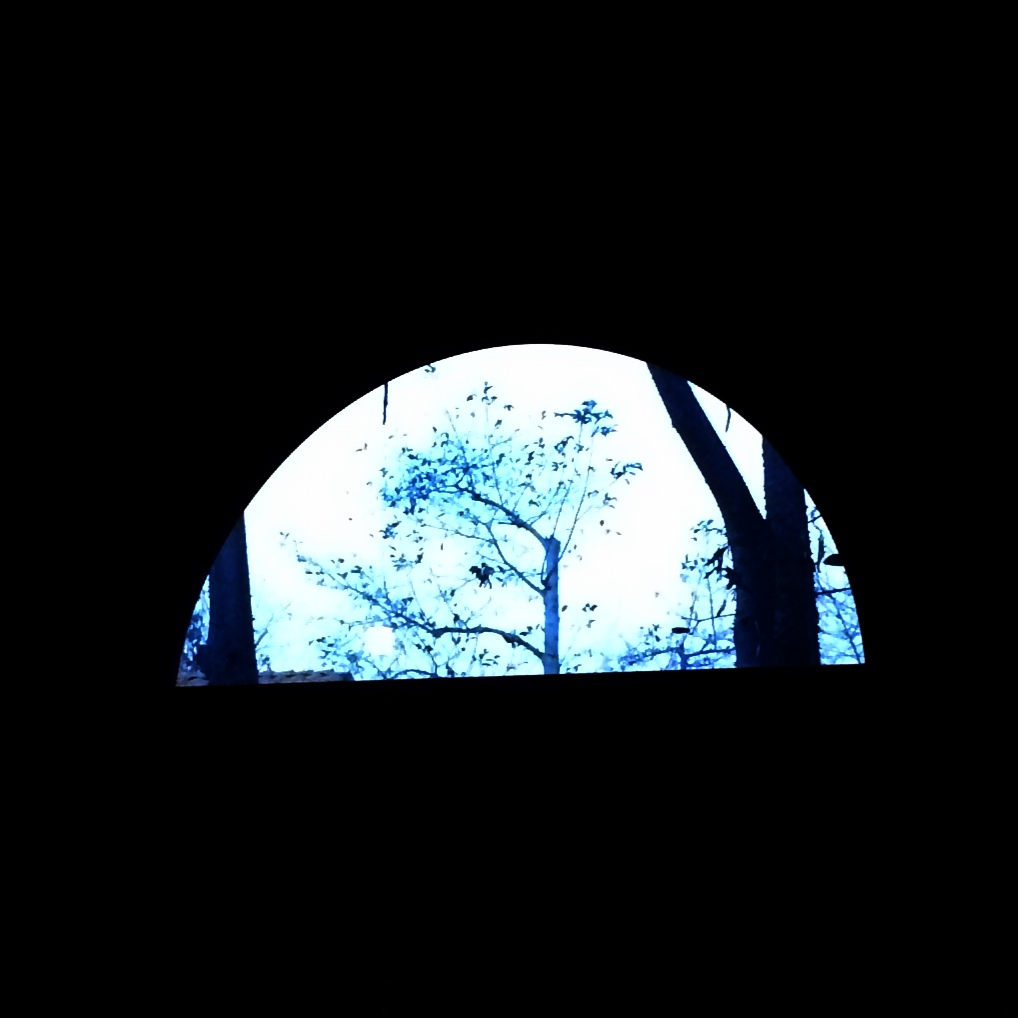
The other morning when I headed downstairs to have some breakfast before work, I noticed the full moon peeking through the half round window in my living room.  I grabbed my phone and captured a shot…knowing, as I’ve mentioned before, that the moon is tricky to photograph.  But when I had a bit of time today, I played with the photo in Camera+ (cropping and adjusting) until I created something more interesting…and if you look closely in the left hand side of the window, you will see the moon peeking through.

photo-67

When I take the time for play, I find that I have more energy and a better attitude to apply to all the other parts of my life.  I also find myself eager to try new things, experiment, and push my learning.  I’m studying photographs I admire to incorporate new techniques in my own. And my play is not only about photography (although lots of it is!), I’m also playing with some other things, especially digital tools.

And I want play to infuse my teaching too.  I want my students to find the play in their learning and I want to create opportunities for play to be the goal.  When we have a passion for the things we do, new possibilities open in front of us.  So, Janet, I want play to frame my year…and thanks for asking.

How about the rest of you…what word or words will frame your life and learning this year?

Making and Learning

Instead of thinking about teaching on Tuesday, I spent my day thinking about learning.  On the plane Tuesday morning I sat next to a young family who had vacationed in San Diego to go to Legoland with their two young boys…and got stuck Monday night because of the domino effect of the weather in the midwest and east coast.  For being pretty tired, the boys were great.  The littlest guy (maybe 3 or 4) was playing a game on his DS system.  Whenever he got “stuck,” he would hand the game system up to his older brother (who was maybe 5) in the seat in front of him and ask for help.  Brother would play the troublesome spot and then hand the game back and little guy would go on with his play.  After his brother tired of helping, mom would help…and coach as she did so.

At the same time I was reading Invent to Learn, a book about the maker movement and the value of engaging learners in meaningful activity to maximize learning.  It begins with the theory behind making as learning…including information about Piaget, Montessori, Dewey, Vygotsky, the Reggio Emilia system, and folks at MIT, including Seymore Papert.  The book emphasizes what they call the constructionist (rather than the constructivist) theory of learning.  Their argument is that through the concrete construction of meaningful projects, learners gain rich, layered skills that serve them in school and beyond.  They also emphasize the value of play.

I landed in Oakland and made it on time for my 9:00 meeting at the National Writing Project offices in Berkeley with a small group of like-minded educators interested in the maker movement, interested in the intersections of literacy and science and STEM-related learning, interested in meaningful learning, both in and out of schools, for young people in their community. We gathered to consider ways schools and writing projects might collaborate with other organizations to further these goals.

I wrote about my experience in Boston with paper circuitry here, and today we met with Jen Dick and David Cook to continue to build our relationship and thinking about the ways writing and circuitry enhance each other and might support student learning in and out of schools.  We began by talking about our own experiences with paper circuitry and the benefits and barriers to bringing it to our own contexts.  Lou had managed to secure some LED stickers from Jie in Boston and returned to his high school class in Northern California where he introduced his students to the paper circuitry project.  He described the success and excitement his students experienced and what he learned from both his students and his own children who also tried out the process.

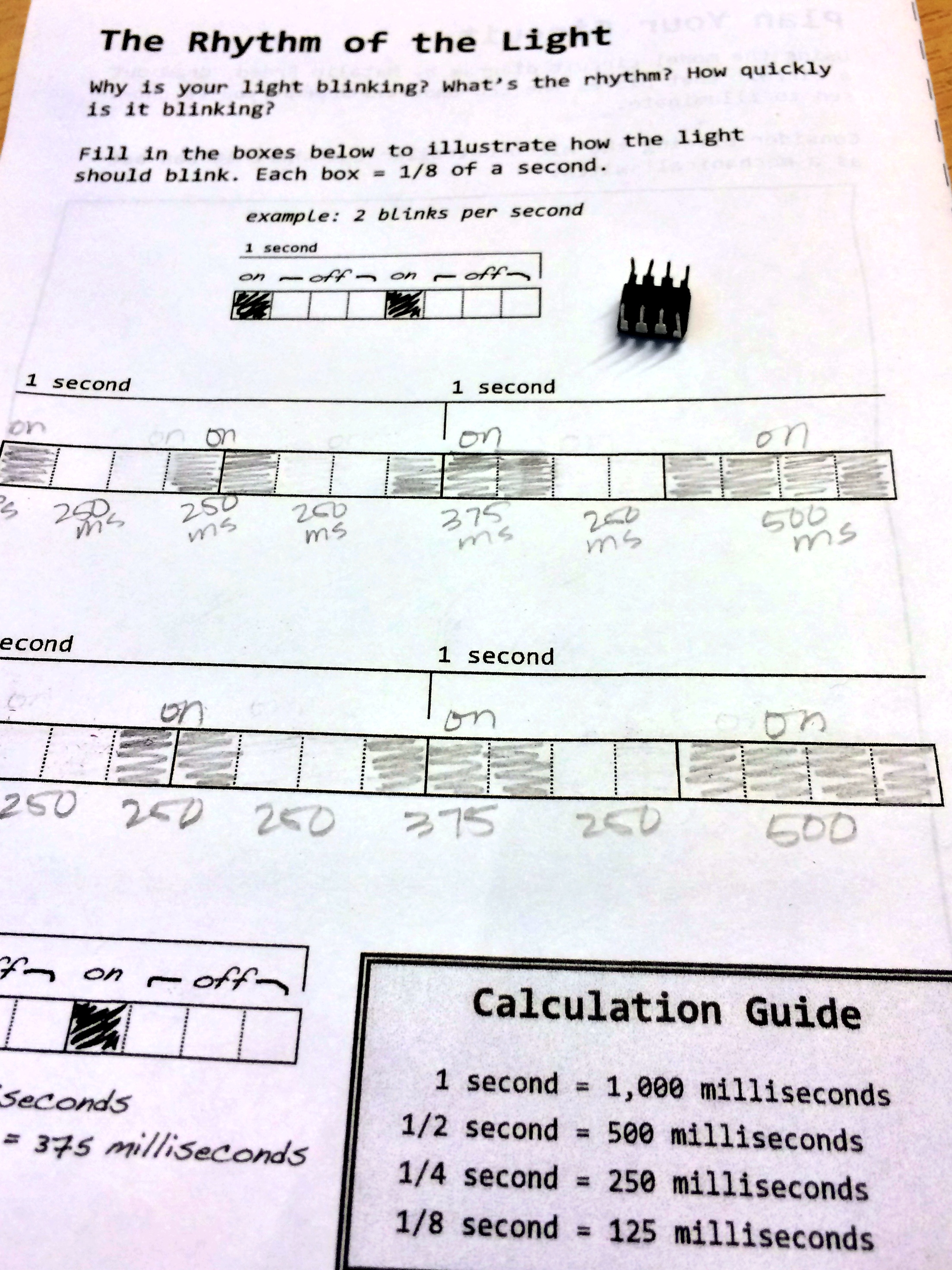
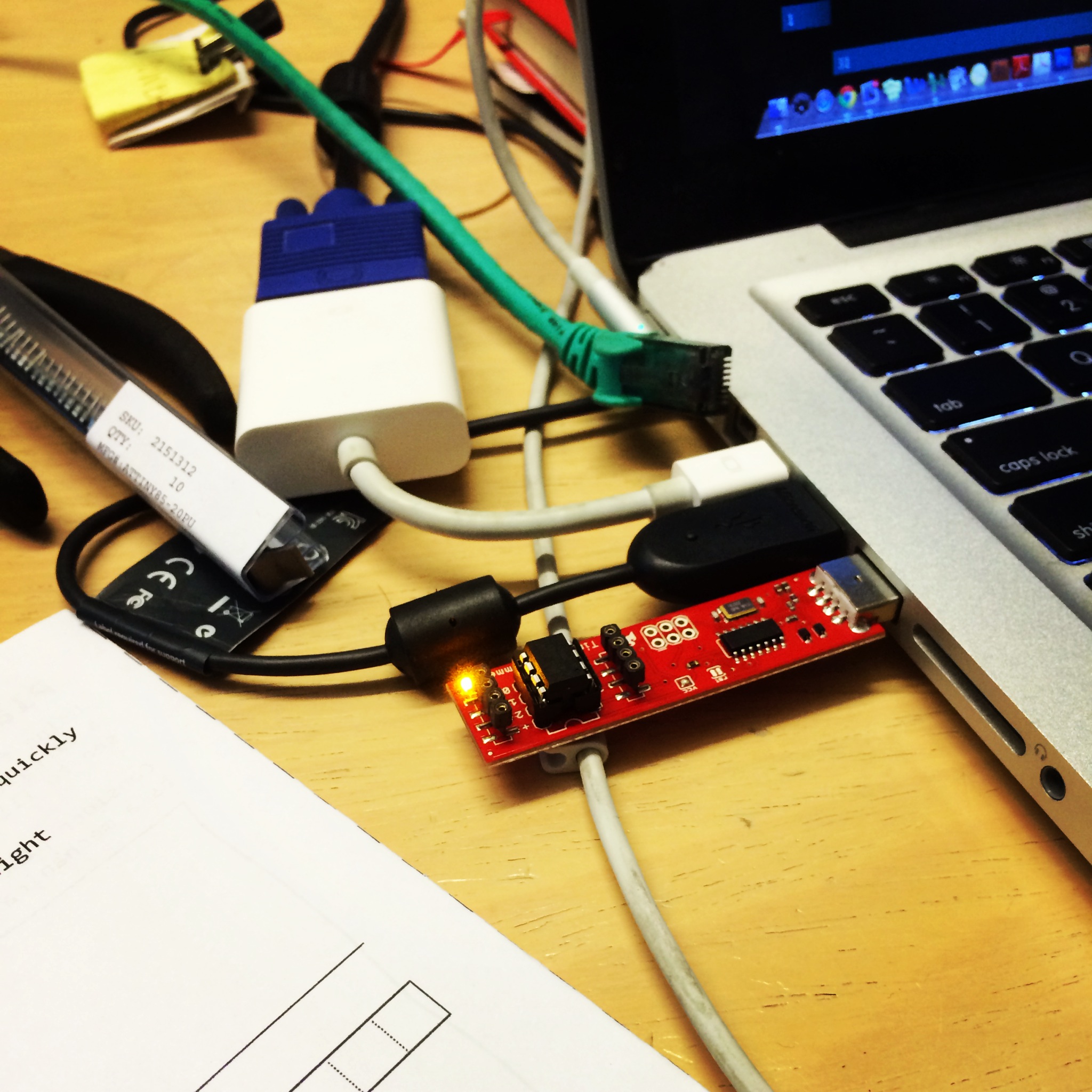
We took our circuitry learning a step further and programmed mini controllers to make our LED lights blink on and off at intervals we selected.

photo-44

photo-43

We also learned about some other exciting new developments on the horizon for merging the science of circuits, technology with programming, and writing.  I still find myself thinking mostly about what students learn when they make a plan and then need to troubleshoot and iterate to get it to work the way they intend.  Systems thinking is a powerful tool that we employ throughout our lives across subject matter and circumstances.

Jie, the designer of the LED stickers, also Skyped with us after we worked with the circuits and we all thought together about how these stickers impact the experience of working with the circuits..and with the the experience of the creating of writing and imagery with the lights.  I appreciate Jie’s attention to the aesthetic experience of composing writing and art and how it is enhanced or impeded by the circuits rather than putting the circuits themselves at the front of the project.  By considering the work as a whole…light and drawing and writing…she reminds us that it is the integration of these elements that create the meaningful result.

The morning ended with the group thinking about how we might put these LED stickers to use back in our classrooms and at our writing project sites.  There was much more to the day…but that will have to be another post.

And I am left thinking about learning.  Those little boys on the plane, the book I was reading, my experience programming to create a blinking light all remind me that the best of learning is meaningful, active and interactive, and collaborative.  Even though I understand the basics of circuitry, sitting next to Peter and examining his working circuit informed my thinking…and since I ran out of time before completing my mini project, I will finish it on my own, at home. I’m confident that I know how to make it work and if I do run into a problem, Peter and my others colleagues are just a tweet or email away.  If you want to see Peter’s finished mini project, see his Vine here.

I can’t wait to share my experiences with my students and with my colleagues.  I look forward to exploring all the ways that writing can enhance and expand this circuitry work along with how the circuitry and lights can add another dimension to the writing.

Poverty and Programming…and Questions

My internet crashed last night.  The TV wasn’t working, my computer wouldn’t pick up the wireless, and the micro-cell that boosts the cellular phone signal was down too.  I had digital devices…but no connection at all.

I had big plans…to watch some Sunday night football, to do some online holiday shopping, to put together a blog post, and to catch up on some reading of posts made by others.  Instead, I finished my book, put some laundry away, and went to bed a bit earlier than I might have otherwise.

My internet is back up and working today…but my experience last night turned my thoughts to issues of equity and access for students.

It seems that when people think about access to technology, devices are at the front of their thinking.  If only we could put a device in the student’s hand, issues of access are solved.

But there is just so much more to access.  Last night I had access to devices…but none of them would connect me to the internet or allow me to connect in any other way (text, phone, social media, even TV).  I thought about getting in my car and heading down to the local Starbucks to have a cup of coffee and accomplish some of what I planned to do at home.  I didn’t have any hard deadlines…and I knew that I would have internet access when I got to work this morning, so I decided to stay home and do without the connection.

But what if I were a high school student with a Monday morning deadline?  What if I didn’t have reliable internet access in my home…and what if I didn’t have transportation as an option to get me to the Starbucks, the library, or even a friend’s house with internet access? Even if the school provided me with a device, there are so many things I couldn’t do without internet access.

I know there are programs to provide internet service to families with limited means, but I also know that they require paperwork be filled out…and may even require some kind of bank account or credit card to pay the nominal monthly fee.

So why am I writing about this?  I’m thinking about the amount of school work that is assigned as homework. to be completed outside of school and the role that digital tools increasing play in our lives and I’m wondering about how access impacts our students.  Can they create digital portfolios to showcase their learning?  Can they access the information they need to locate resources for research, find scholarship and grant opportunities, secure internships or apply for employment?

How does access change when connectivity is only available outside of your home?  In public spaces?  Places with limited hours of operation?

And what do we take for granted?  We ask students to blog, to research, to reply to discussion boards, to collaborate with Google docs…often outside of the school day.  Which of our students have access…and what happens to those who don’t?  Do our students who come from the poorest families see themselves as producers of technology?  Who is learning to code?  Who is primarily consuming in our digital world and who is producing?  How often do we ask those questions…and how do the answers change the way we think about access and equity?

Last week on Teachers Teaching Teachers, we were on a Google Hangout talking about the Hour of Code and about Dasani.  Two disparate topics…or are they?  Poverty and programming…and questions of equity, voice, agency… What roles do schools play?  What roles should they play? What does it mean to be a learner in the 21st century?  How does “producing” change the learner…the learning?  I have many more questions than answers…and I would love to continue the conversation.  What do you think?

Hour of Code

Coding, programming…words that are used to describe the process of “speaking” a machine language.  This week classrooms and schools all over are participating in the Hour of Code, an attempt to get 10 million students to try computer science for an hour during Computer Science Education Week.

If you read this blog you already know that we have been working on computer programming using the Hopscotch app for a while now.  (See here, here, and here)  So in honor of the Hour of Code, we decided to pose a Winter Scene Design Challenge for our students.

Today was the day.  Students were asked to create a scene using Hopscotch that depicts some aspect of winter.  As you might expect, students thought snow, snowmen, Christmas trees, and more.  They were super excited…with my speech students arranging to get out of speech (something they love!) so they could be part of the challenge.

And there were many highlights today–lots of successes, lots of students genuinely collaborating with one another and supporting each other without teacher direction.  But my favorite moment was Esther.  Esther is an 84 year old grandmother who lives in Australia and visits her daughter in our town each year in the winter.  I taught her grandson and granddaughter many years ago (they are both college students now) and Esther has continued to come to our classroom several days a week when she is in town to help out and hang out.

As Esther began to watch the students at work on their winter scenes, I asked her if she would like to try it too.  I handed her my iPad and asked Sophie if she would show Ms. Esther how Hopscotch (and the iPad) worked.

photo

Esther was delighted!  And so was Sophie.  It is wonderful for my students to see the embodiment of lifelong learning…and Esther is just that!

An article I read recently points out the advantages of learning to code:  problem solving, (digital) confidence, and understanding the world.  And I see those advantages when my students work to program.  They also learn about systems…and working through the many variables to figure out why their plan isn’t working as they imagined.  They become persistent and learn the value of iteration.  Each mistake becomes another opportunity for learning rather than a sign of failure.

Here are a few examples of students’ winter scenes:

photo

A first grader who figured out how to use o’s as text features for eyes and nose on his snowman.

photo-2

A second grader’s winter tree.

photo-3

A third grader’s winter scene.

photo-4

A peppermint candy created by a third grader.

photo-5

And a holiday greeting card, Hopscotch style!

You can see that students are gaining confidence and expertise with this programming tool. Most of these projects were completed in less than 30 minutes and they represent only a fraction of the programming that was happening in the classroom today.  Some of our students are still struggling while others can’t wait to go home and try some more programming on their own time.

Next week we plan to have student-led tutorials where students will teach and learn from each other in small groups.

How was your Hour of Code?  What did students learn and create?

Systems Thinking

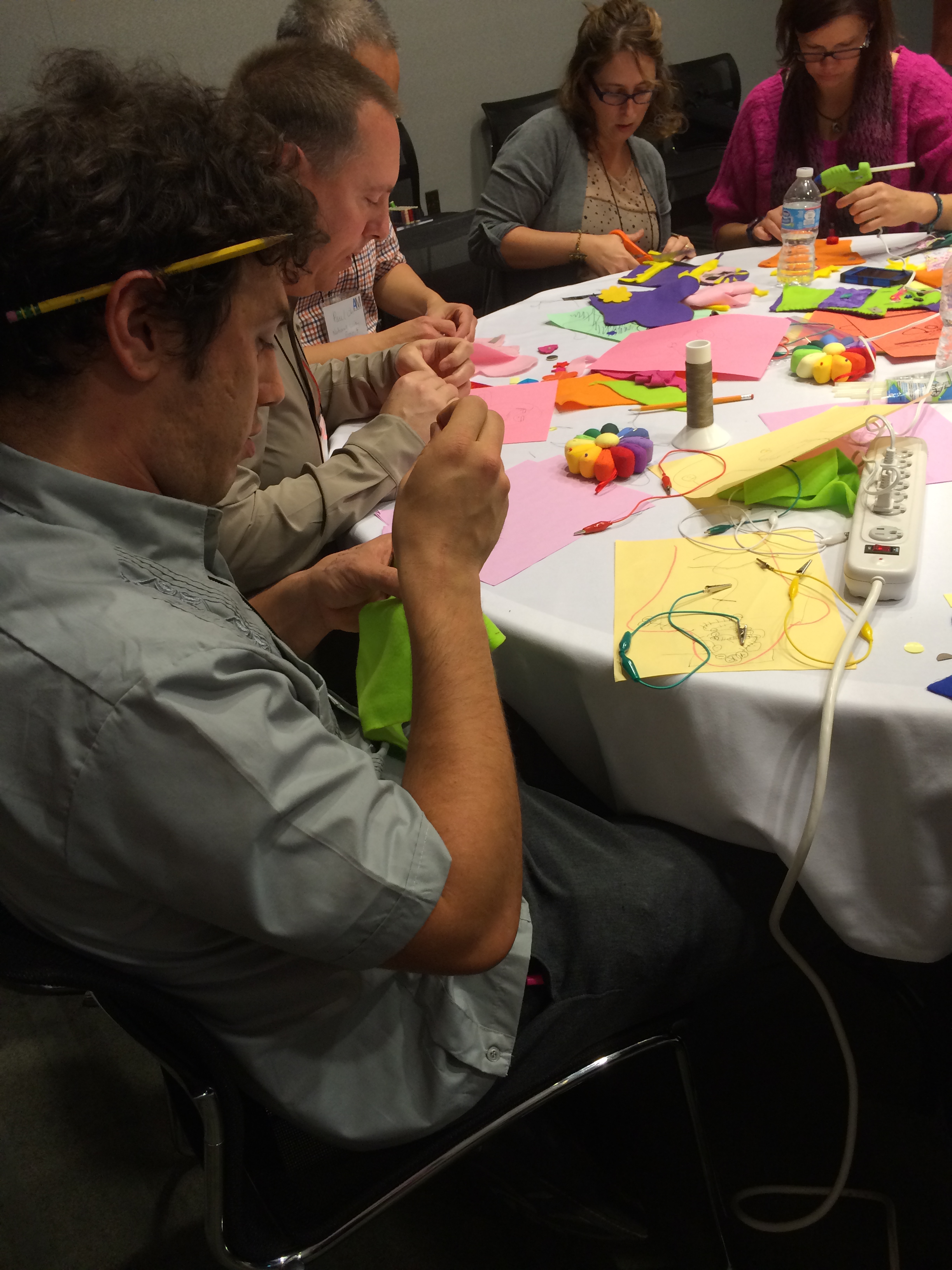
In addition to learning about circuits in the Hacking Your Notebook session, that I described here, at the NWP Annual Meeting in Boston, I also had the opportunity to participate in a three-hour workshop about e-textiles where we made puppets.  This session also involved the basics of circuitry and using a small battery to light up LEDs.

But Melissa and Kylie framed their session in the theory of systems thinking, which has continued to occupy my mind and thoughts ever since I left the session.  They talked about the ways we often simplify explanations in our society by turning to a binary cause and effect model.  Here’s an example of the cause and effect model: if we elect a new president, then the economy will turn around.  Actually, there are many other factors that impact the end result…and in fact, who is president may not even be the most important factor.

Our educational system (and our government) seems to spend a lot of time in the simple cause and effect model, rather than helping our students think more deeply about systems and the ways there are multiple factors, interconnections, and possibilities at work in the outcomes we see.  So the making of puppets in this workshop was about more than learning how circuits work or developing language and writing related to the puppet, it was also a way to think about systems and the problem solving and iteration that it takes to understand and make changes to the overall system.

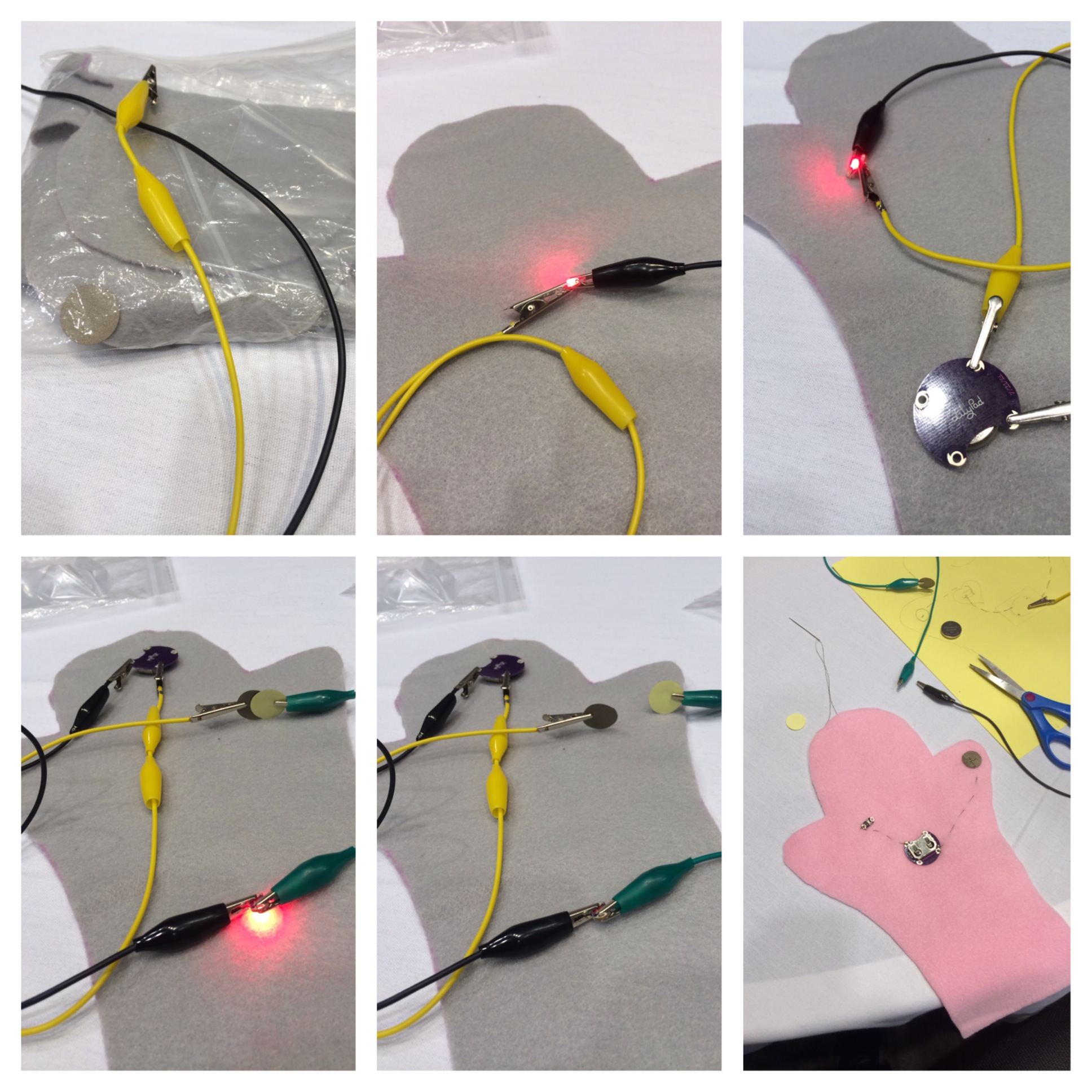
So…with systems in mind, we proceeded to explore circuits with a watch battery, LED lights, and wired alligator clips.  Because of my work with circuits the day before, this part was super easy!  And then they asked us to explore how a switch would work.  It didn’t take much to figure out how to touch the switches to each to open and close the circuit, lighting the LED, and then separating them to turn off the light.

Our goal was to make a puppet that had a light (or two) that would light when you turn on the switch (or make a connection that closes the circuit and turns on the light).  We had two pieces of felt cut out in a puppet pattern, a battery holder, a LED light, and two switches (small pieces of conductive material) along with a host of buttons, ribbons, fabric, yarn, and other materials to use to decorate the puppet.

We began by making a plan.  Tracing our puppet on paper, we drew a diagram of where we would sew our battery holder, LED light(s), and switches, labeling the +/- poles and drawing in the stitches we would sew in with conductive thread.  Having our model in front of us to plan was a perfect step.  We could test and physically trace how the connections should flow as we drew the diagram.

Like in yesterday’s post, there were trickier plans I could have tried, but I opted for a simple plan that I knew I could complete in the time allotted.  And then I got to work.

photo

As people worked through their plans and settled into sewing their circuit the room hushed and you could see the intensity of engagement.

photo-4

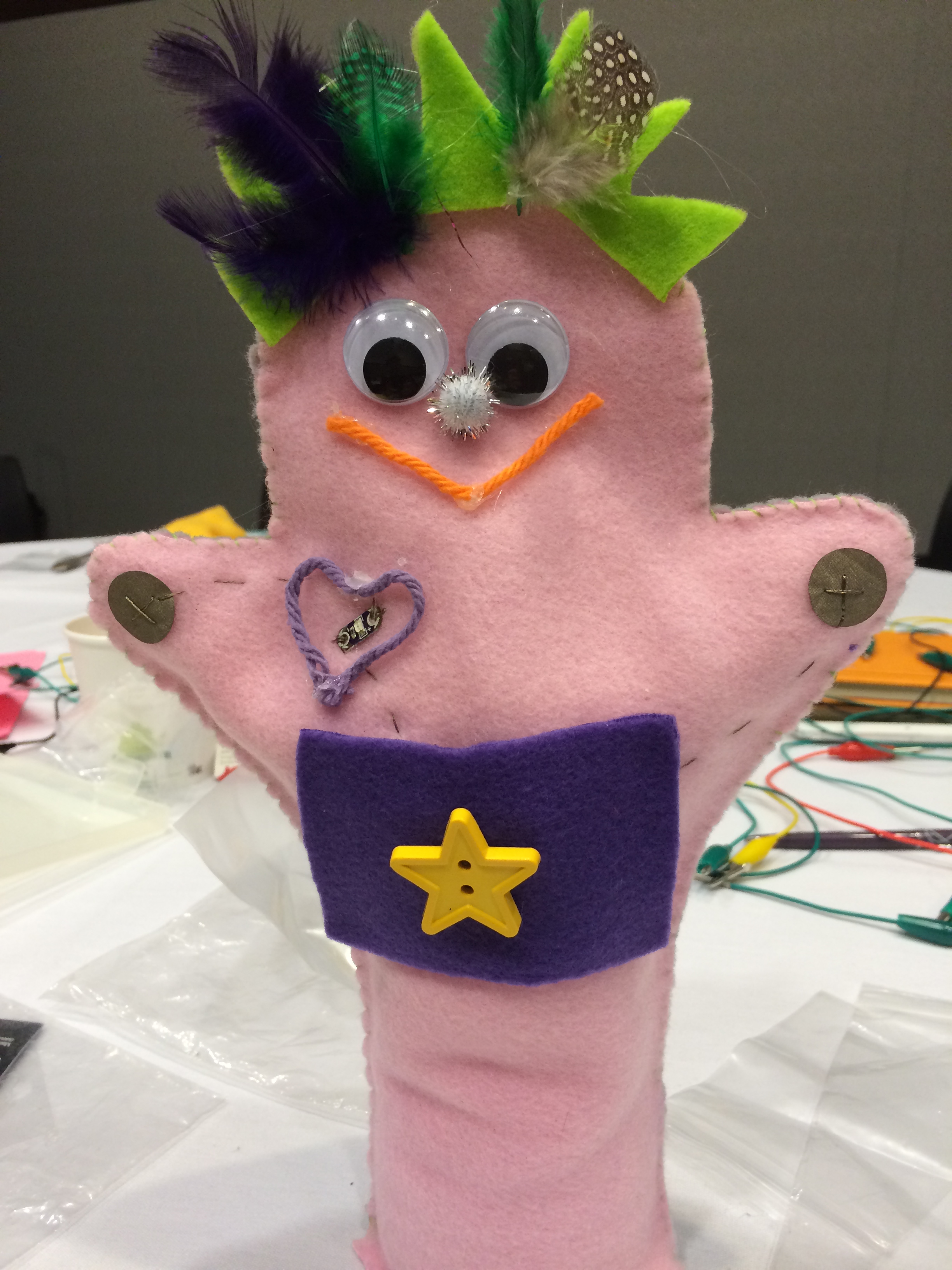
For some the sewing was the hardest part, for others it was working through the circuitry, and for others it was totally about creating the puppet character they had in mind.  Here’s my end result…his heart lights up when his hands touch.

photo-3

There are definitely some things I would do differently the next time I make a puppet.  I learned after I had sewn my circuit in that putting the hands together covered the light…you can see a glow, but it isn’t the effect I had in my head.  Other people were working on pirates and butterflies, some with eyes that lit, some with noses that lit.

And my takeaway has much more to do with systems thinking than it has to do with circuits. I find that I have a better grasp of how to explain some of the approaches I use in my classroom.  Like why design is so important to student learning, why mistakes are valuable to learning…if you take the time to work through what you did and figure out a better outcome, and why students need space to create their own plans and work through the spaces where things are not working the way they intend.

It also has me thinking about other learning opportunities.  I learned to sew as a child, and making clothes and other project definitely involves some systems thinking.  You have to think fabric, including weight, texture, stretch…  Even using a pattern, you have to think about how to lay out the pattern to make best use of the fabric, work with the grain, match the design if the fabric has one…

I’m worried when we make things in the classroom too “neat” that we are working harder and learning more than our students.  That’s one of the things I love best (and hate the most) about teaching writing.  When it’s at its best, it’s messy.  I can have an overall plan in mind for the outcome, but my students benefit from getting “just right” instruction along the way.  And not all my students need the same instruction…and some benefit from learning by watching and listening to their classmates.

After all, the classroom is another system.  When you tweak one aspect, there are many working parts that are impacted.  As an educator it’s important to problem solve and iterate.  It is impossible to make a year-long (or even week-long) plan that won’t change if you are really paying attention to the needs of your students.  We can help break things down for our students, but they also need to figure out how to examine the pieces of a system for themselves in order to understand how the parts interact with the whole.  After all, our students today will be the leaders of tomorrow!

What do you do in the classroom to help your students understand and work through the complexities of systems?

Lighting a Spark

In my last blog post (here) I touched on that idea of work and play and the way that they are often interconnected in the way I experience my life and work.  And as I am thinking through some of my conference experiences, I see the blurriness…and maybe even more than that, the overlap of work and play.

When one of my colleagues asked me about what sessions I intended to attend at the conference, I told her that I was planning to make my selections based on what sounded interesting and fun rather than what I “should” do for the good of my writing project site or someone else’s expectations.  I was already pre-registered on Friday for a session about Scratch, the platform designed for teaching computer programming to kids, and a session on e-textiles involving puppet making and circuitry.

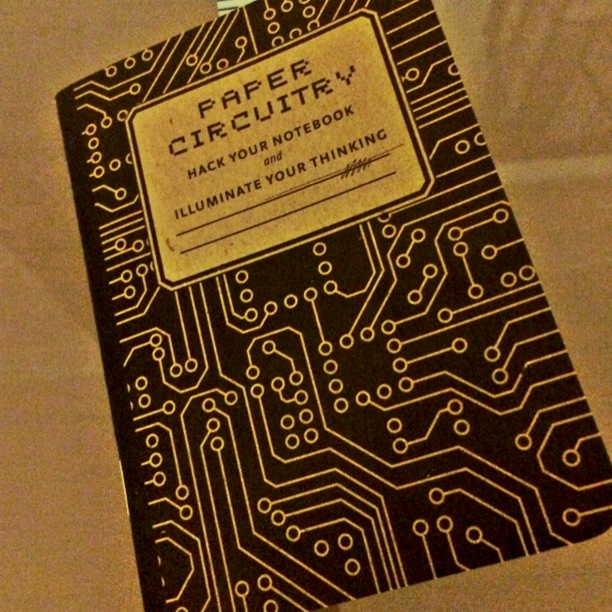
When I arrived at the welcome event for the National Writing Project Annual Meeting on Wednesday, I was drawn to a table near the door loaded with little notebooks…that upon closer examination had copper foil, watch batteries and LED lights.  Chatting with David, I learned about Jie’s graduate work and interest in the intersections between art, writing, and engineering.  Right away I knew that Jie’s session was one that I would prioritize!

photo_1

After two other sessions where I presented, a stimulating and thought-provoking plenary panel (more on that later), and a networking lunch, I headed off to the session with Jen, David, and Jie called Hacking the Notebook.

You could feel the energy surging in the room as we were handed notebooks, copper tape, a battery, and LED lights.  We listened to Jie share some of her work and thinking behind the idea of “lighting up” notebooks and stories and doodles…of combining science, technology, engineering and math with literacy and art (that STEM to STEAM connection).  She showed us an amazing work of art she created of dandelions that you could blow on to light up the puffs of white fluff.  (I encourage you to take the time to view this vimeo)

And then she walked us through the template she had created to teach about circuitry in these little notebooks that are a combination of background theory, documentation of Common Core and Next Generation Science Standards, instructional diagrams, sandbox for experimentation, engineering notebook…and more!

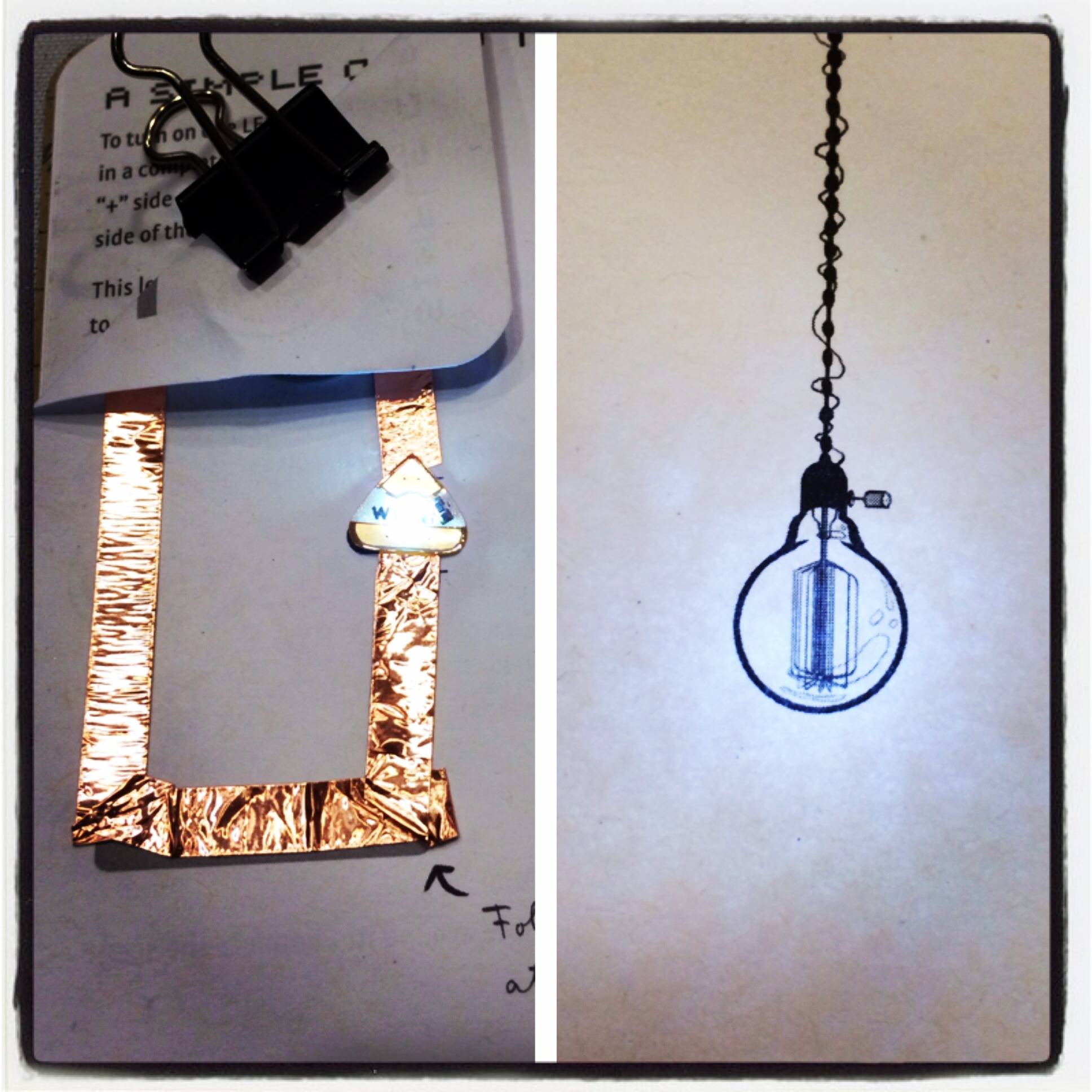
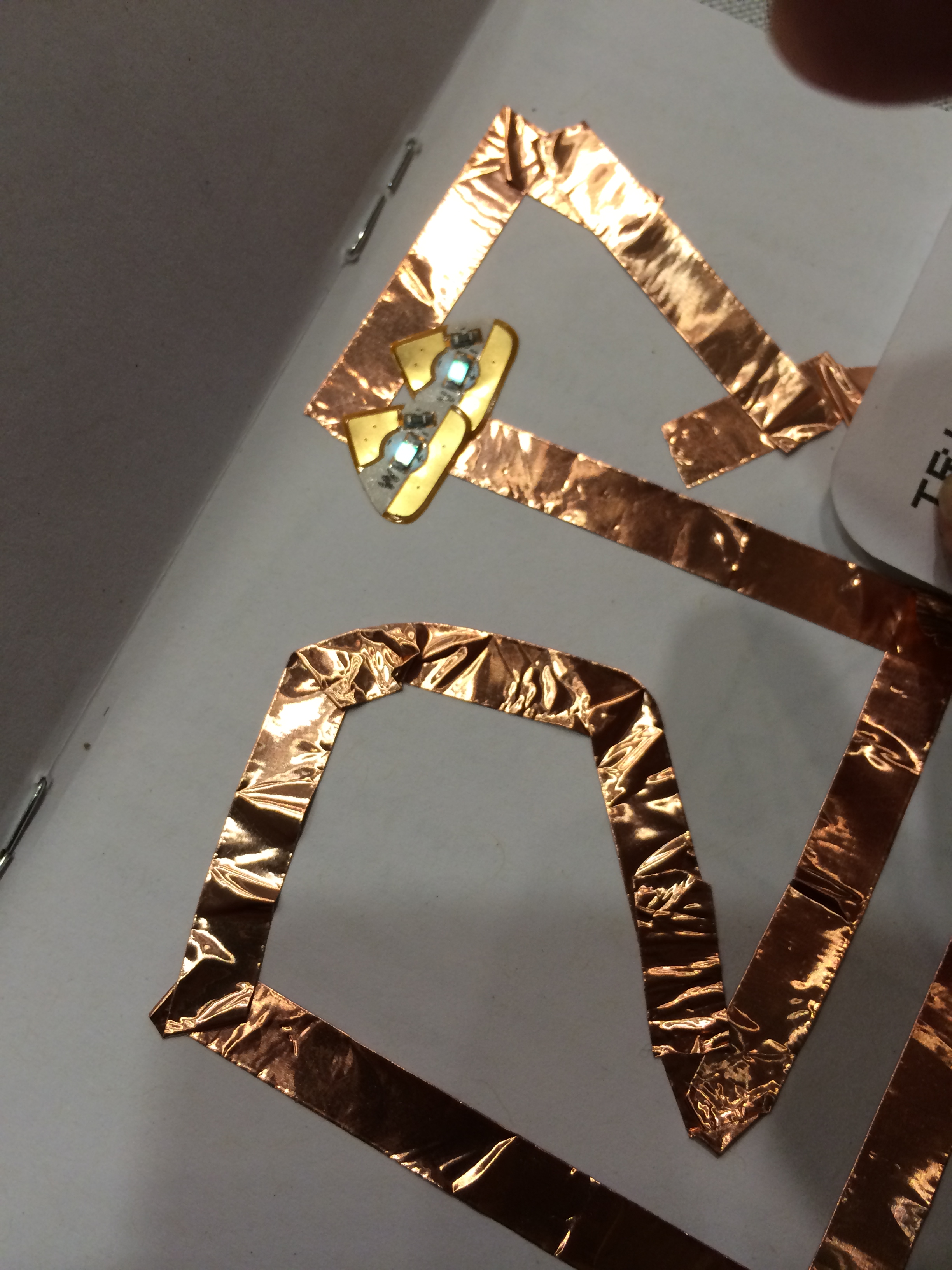
Our first task was to follow specific instructions and a diagram to lay down the copper tape, attach the LEDs, and then attach the battery to make the lights light up.  We followed a very specific diagram while learning (or being reminded) about the basics of circuitry.  That part was pretty easy…we just had to make sure that the pluses and minuses were facing in the right direction, that foil touched the electronics and didn’t touch places that would make a short.  And when we were successful, turning the page resulting in the light shining through the page and illuminating a lightbulb that we were then invited to draw and write around.

photo-2

And that’s when the task took us to the next level of thinking.  Taking what we had just learned about circuitry, we turned the page and were to create our own light up design with copper and bulbs.  We had a number of lights…so were encouraged to move beyond our simple experimentation of the previous page.  Jie encouraged us to notice how the copper tape could curve and how pieces could combine to create whatever we could imagine.  And…we had to remember how to make the lights go on.  I tried to get a bit tricky, adding two lights in a series…carefully lining up the poles to ensure it would work.  And it didn’t!  What was wrong?  Was it a connection (or lack of connection), an overlap that redirected the current, too much demand by the lights to allow a single battery to power them?

Problem solving and iteration became essential as I traced and retraced my circuits.  I consulted with my tablemates and observed their works-in-progress.  And I enlisted the help of Eunice, a graduate student helping out in the session.  With Eunice’s help I figured out that the serial circuit was likely requiring more power that my battery had to offer (my first light in the series would light, but the second stubbornly refused to light, even after making adaptations).  She suggested I try a parallel circuit design instead, explaining how if the lights were side by side they would require less energy to light.

And after more iteration and problem solving, I got both lights to light up!

photo

But what I wasn’t able to accomplish in that short, 90-minute session was both the science and a creative story-driven project.  I knew that for me, I wanted to focus on figuring out how to make my lights work and consider the possibilities before working on the story.  I struggle with the “creativity on demand” mode…but do have some more copper tape and lights…and my battery, so I plan to go home and do some more exploration on the creative, art and language-based, side of my project to combine with my knowledge of circuitry.

But my experience was not everyone’s experience.  Some people knew exactly where their stories and drawings would begin…and followed them as they experimented with their copper and lights.  And some people were so flummoxed by the science that progress was slow and frustrating.

In talking with Jie later that evening at the social event she said that she had learned a lot by working with us.  Writing project teacher leaders do a lot of meta-narrative thinking and talking, examining their own processes and experiences in service of the work they do with students and teachers.

And I did ask her how that dandelion art works since I couldn’t figure out how blowing would make lights go on!  She said the lights were connected to sound sensors and the blowing caused the sensors to hear the breath, like wind, and cause the lights to illuminate!

I can’t wait to get home and lay out my supplies and think and work through a piece of writing and art that will light up.  And I can’t wait to share this work with others as I consider how I might do this with students…my own and/or others that we might work with through the writing project.  I’ll let you know how it goes!

If you’re interested, here is page that lists the supplies and where you can get them.  I’d love to know what you create and discover when you play with circuits and lights in your notebook!

Work and Play

I’ve been accused–more than few times–of being a work-a-holic.  And maybe there is some truth to that notion, but it is because my work is so much fun that a lot of times it seems like play.

I headed out at the crack of dawn Wednesday morning to fly across the country to join my writing project colleagues in Boston for the National Writing Project Annual Meeting that is held every year in conjunction with the Annual National Council of Teachers of English (NCTE) conference.

20131120-231705.jpg

The Annual Meeting is an opportunity to gather with writing project people from all over the country, to learn from each other, to share ideas and reconnect.  And it is fun!

This conference begins by seeing old friends and learning about what is happening in their places and then offers more formal opportunities for learning from each other.

We’ll spend all day Thursday and Friday in more formal settings, thinking about our students and our teaching…and thinking about how to support teachers and their learning too.  We’ll consider writing in all possible contexts, across all content, across platforms, and across ages and experiences.  And even though we will think hard, write a lot, and at the end of each day feel exhausted, we will continue our conversations over dinner, walking to and from our hotels, over an evening cocktail, and maybe even into our dreams as we finally sleep.  Because these moments spent face to face with our colleagues from all over the nation are to be savored.  They are work and they are play.

We’re here, Boston!  Ready to work and play in this special place.

photo

Reach for the Sky

I spend many Saturday mornings immersed in professional learning.  This morning was our first meeting of this year’s SDAWP Study Groups (a hybrid of book study and teacher research).  Sixty teachers met this morning to participate in one of five groups…and the energy in the room was palpable!

In three hours we wrote, discussed our writing and the connections of our processes and preferences to the students we teach…and then broke into smaller groups to get to know one another, explore our new book, and make plans for reading and exploring ideas in our classrooms.  All this on our own time, because we want to grow professionally with others who are also passionate about teaching and learning.

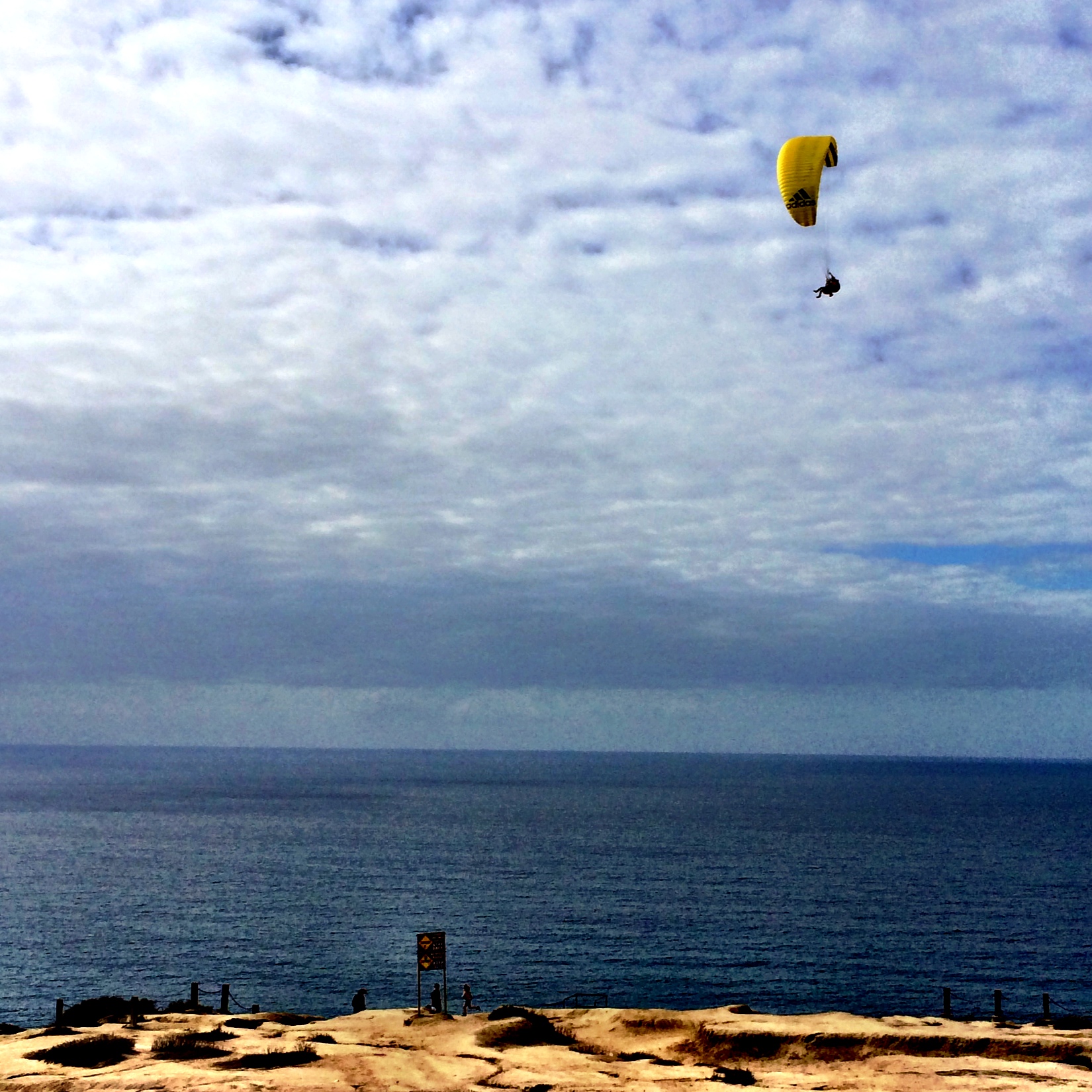
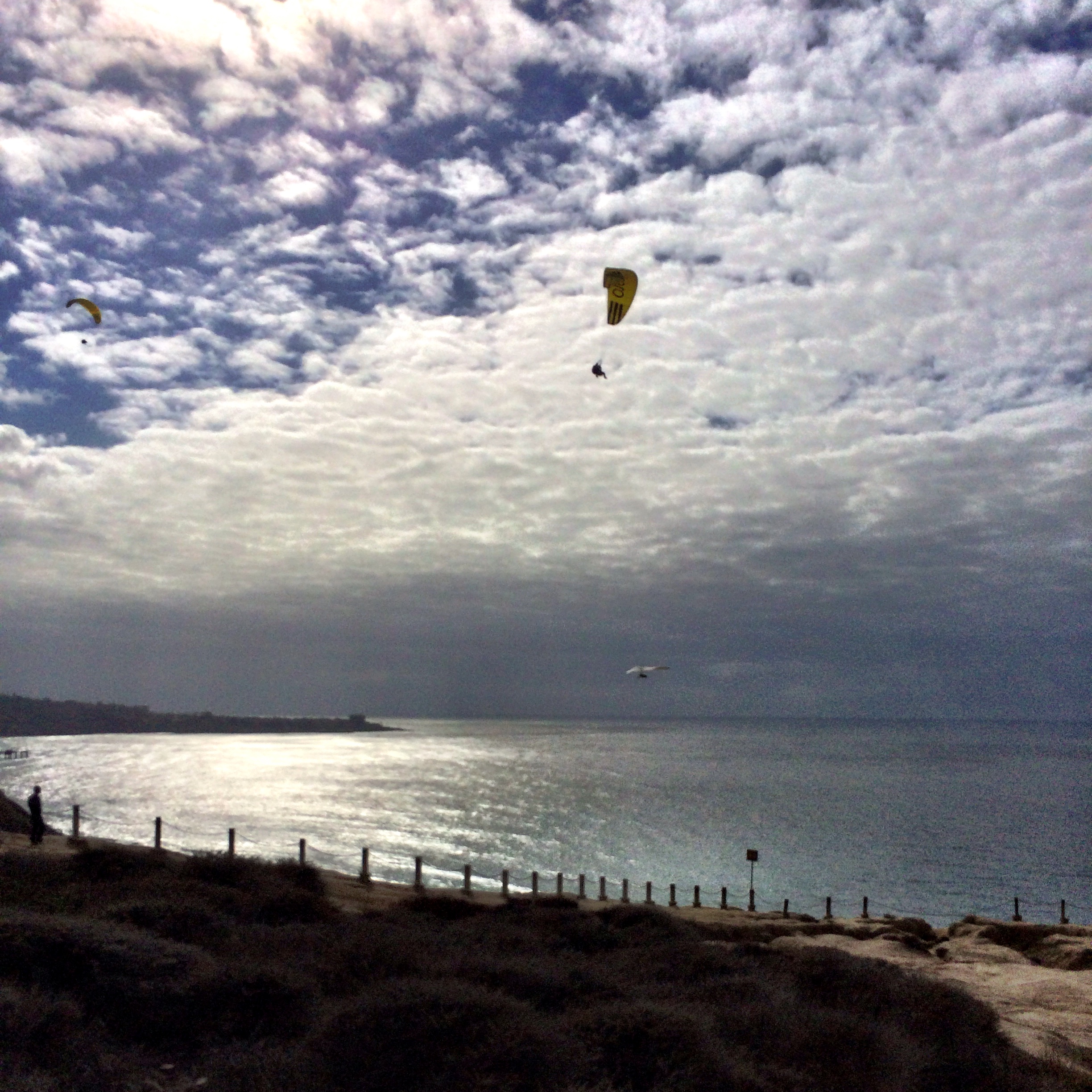
As I was leaving, I noticed hang gliders and paragliders soaring in the sky near the university.  I remembered that the Torrey Pines Gliderport turn off was nearby, so I turned and followed the road down to a dirt parking lot.  And there, along the cliffs overlooking the Pacific Ocean, was a spectacular view of the gliders and the ocean!

photo_1

In spite of the cooler weather (after our 80 degree temps earlier in the week), the conditions were perfect for gliding…and for watching and photographing the gliders in action.

photo_2

While I have no real desire to glide over the beautiful beaches of San Diego, I understand the urge to fly…to experience the freedom and excitement of soaring with the wind currents and looking at the world from a new perspective.

In some ways my experience in study groups this morning was a lot like hang gliding.  There is energy and excitement in gathering with other interested educators to continue learning together.  Interactions with teachers of all levels (K-college) and a variety of schools, districts, and teaching demographics offers new perspectives and views of teaching.  Rich conversations stimulate thinking and encourage actions…we can’t wait to come back next month to share our beginnings and continue our conversations and learning.

photo-3

What conditions for learning allow you to soar?  How do you set up those conditions for your students?