Category Archives: digital tools

A Study in Black and White…and Shades of Gray

I was reading a post on another blog yesterday with tips about black and white photography.  The person who wrote the post talked about “seeing in black in white.”

When I look at black and white photos I don’t see them as black and white at all…they seem all about shades of color ranging from dark black to gray to white, and all the variations in between.  The subtle shading creates a sense of depth and lets light and shadow play.

I frequently edit my photos and apply a black and white filter.  I love the sense of timelessness that black and white gives to certain photos.  It seems that there is a story-telling quality, maybe the lack of color invites each person to interpret the photo based on their own experiences.

These yellow pencils from my classroom look great in black and white.  It’s easy to colorize them in your mind when you look at the photo.

pencils

And I love the ways my students hands look in this one.  Even without color you can see the sun shining…and focus on those little hands holding even smaller seeds.

hands

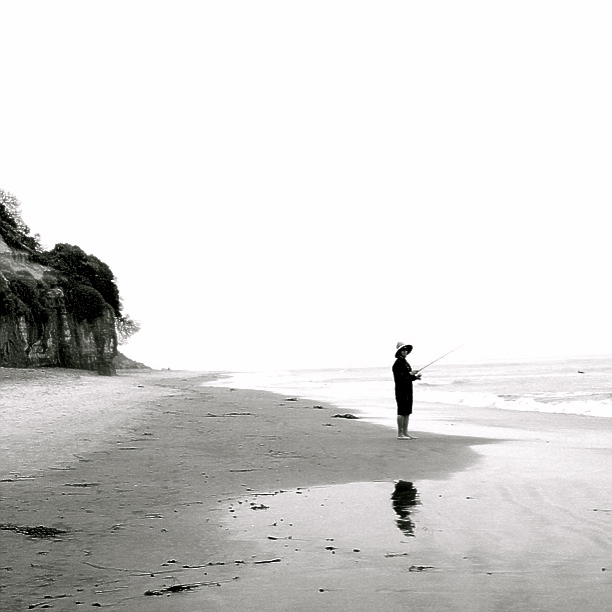
Who would guess I took this picture of a fisherman on an urban beach in 2013?
fisherman

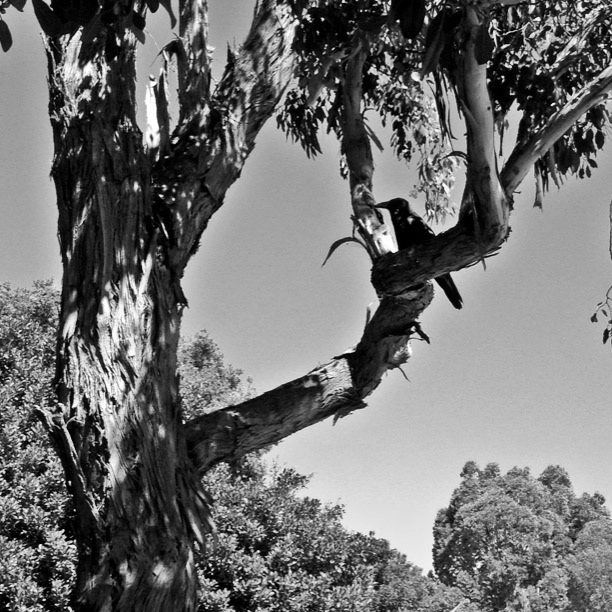
I think I liked this crow better in color.  The green leaves made the crow more prominent…it’s hard to make him out in this one.
crow

This one of the horse might be considered cheating.  I didn’t go all the way to black and white.  I just faded the colors a bit.
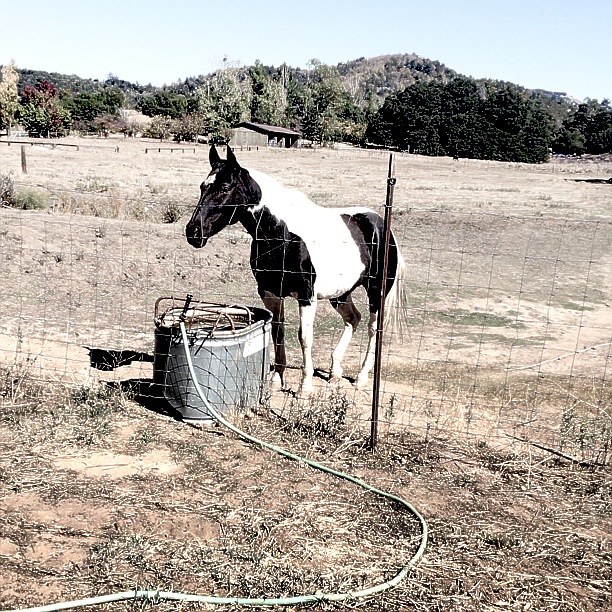
photo-3

And this is one of my favorites…my cat Phil.  I do lots of photos of him in black and white…he is a black and white cat, after all!  This photo is interesting because the color version looks quite similar.  A black and white cat in a white box with black print is already mostly black and white!

photo-2

The term black and white often makes me think of either/or.  But black and white photos are more like real life…built in shades of gray with plenty of room for interpretation and meaning making.

Which of these photos speaks to you?  How does the black and white impact your visual experience?
Outside

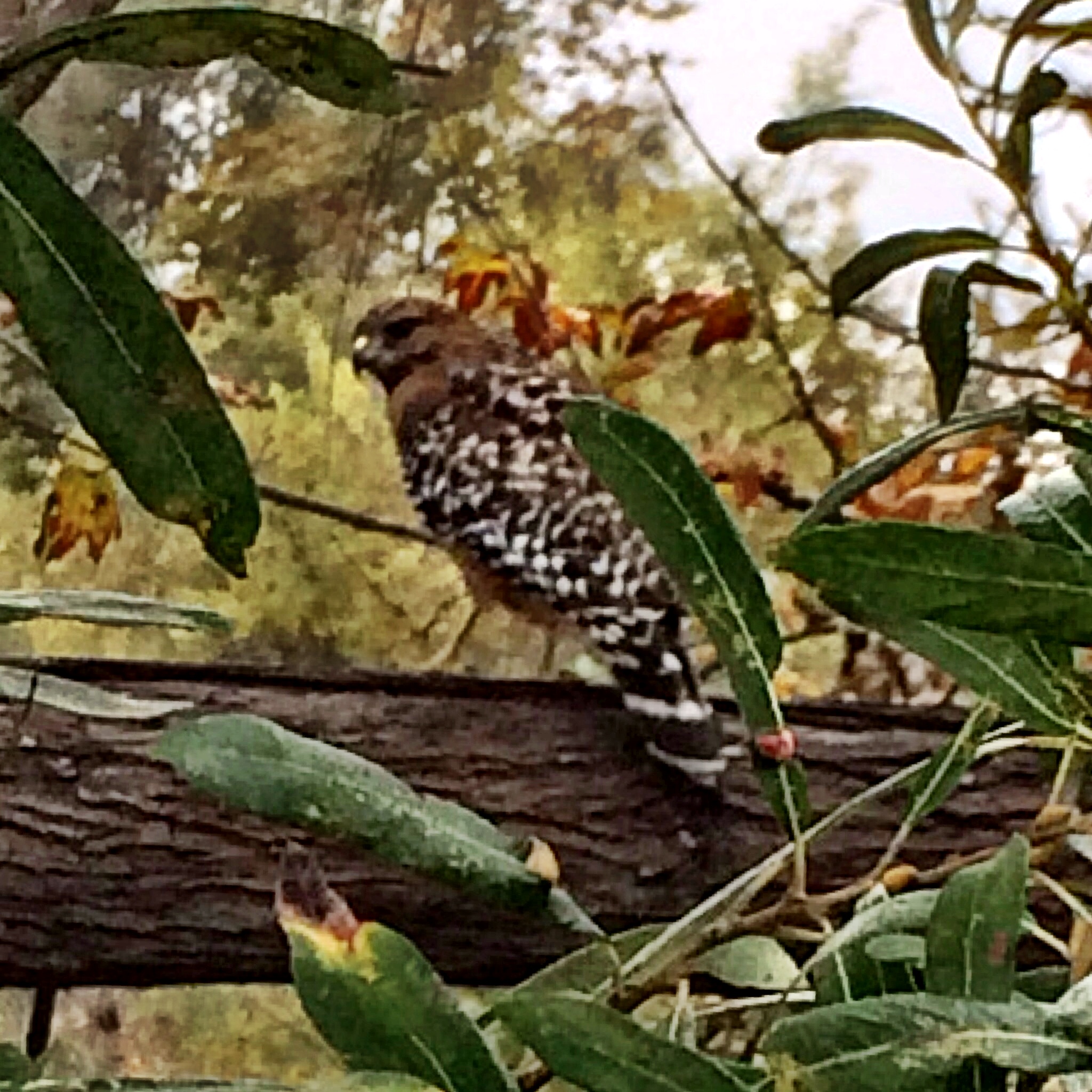
I spied this gorgeous hawk sitting in a tree not far from me as I was walking today.  I slowed and carefully positioned my camera, trying to capture this image.

photo-1

And as I watched and then continued my walk, a short 25 word story (or maybe the beginning of something more) was brewing in my head.

Tucked in behind the gas station and across the street from the McDonalds, hawk oversees wild space…what is left of what used to be.

I took a minute at the stop light and jotted notes down in my phone to remember this thought when I got back home.  Thinking about what used to be interests me.  What caused developers to leave this wild space untouched?

Last week a parent in our class sent us this article about going outside to write when you feel stuck or uninspired with your writing, saying that it reminded her of us and our classroom.  (Such a great compliment!)  I’ve shared it with many others…and was thinking about it this morning as I headed outside for a long walk.

I knew I had lots of writing to do today (beyond my blog post) and told myself I needed to get outside and be active before settling down to work.  To make the prospect more appealing, I planned my walk with a mid-walk stop at the local Starbucks and had my iPhone handy for any interesting photo opportunities.

As I started my walk I noticed that my “monkey mind,” as Natalie Goldberg calls it, took over.  I could feel my attention pulled in a million directions as I noticed sounds (cars, birds, breeze, leaves crunching, bicycles whizzing by…), smells (the smell of water in the curb drains, car exhaust, the damp of foggy air…), sights (the lone purple flower in a sea of ground cover, scraps of paper interwoven in the brush, leaves blowing…), and physical feelings (the sheen of sweat building on my shoulders, the push of air as cars rushed past, the uneven sidewalk under my feet…).  Before I started my walk, I had thought I might continue on a theme of water photos started yesterday with a walk on the beach, but the first half of my walk didn’t offer any interesting possibilities.

And then I noticed the hawk.  It literally stopped me in my tracks as I looked closely, noticing the beauty of this bird.  Crows and pigeons are pretty commonplace on my walks…and hawks are mostly noticed from a distance, flying high above.  I loved the opportunity to look closely as I angled my lens.  He watched me as I watched him.  And then he spread his magnificent wings and took to the sky.  I only wish I could describe the sound of those large, powerful wings as they lifted the bird from the branch.

As much as people complain about “screen time” and lament that devices are keeping our young people indoors, inactive, and uninspired, I find that it is my device that gets me moving, heading outdoors, and paying attention to my surroundings.  As always, we need balance in our lives.  Opportunities for solitude and times to interact.  Playtime and sustained work.  Time in nature to notice and question and wonder and time with our screens to produce, write and connect.  It doesn’t have to be either/or…can’t it be both?

How does your device (or devices) impact the ways you interact with the outdoors?

Structures

I treated myself to a walk on the beach today after a writing project meeting at the university.  So instead of walking on the beach near where I live, I walked on the beach down the hill from the university.  It was foggy and cool, a perfect day for thinking and reflecting.

As I was walking I was thinking about the meeting…a follow up to the Invitational Summer Institute (a 4-week intensive leadership institute in the teaching of writing)…and the structures that we need as learners to move along the continuum from novice to expert (with the endpoint constantly moving) and from follower to leader.

The structure of the Summer Institute (SI) is designed to immerse teachers in writing, researching, reflecting on their practice, and critical conversations about teaching and learning.  The structure is strong and well built, based on the 40-year-old model developed by National Writing Project founder, Jim Gray.

photo_1

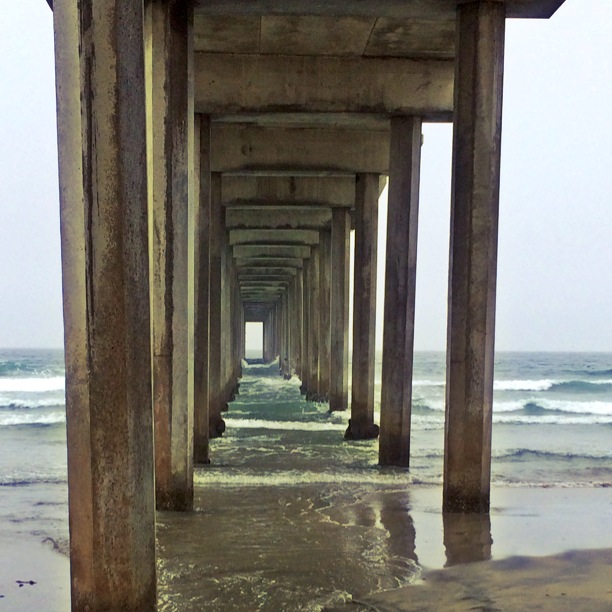
This pier is also a carefully designed, well built structure made to withstand the battering waves of the Pacific Ocean and the relentless wind and sun.  I love the way when you look through the pier it narrows and provides a window through the corridor of surf out to sea just like the SI helps teachers look carefully at policy and practice and then focus on instruction that best supports the students in front of them.

And some of the structures we depend on are organic like these cliffs.

photo_3

They are shaped by the natural environment.  I watched our SI participants create their own structures as well.  They gathered this morning, organically, catching up with each other as we, as facilitators, finalized our last minute plans.

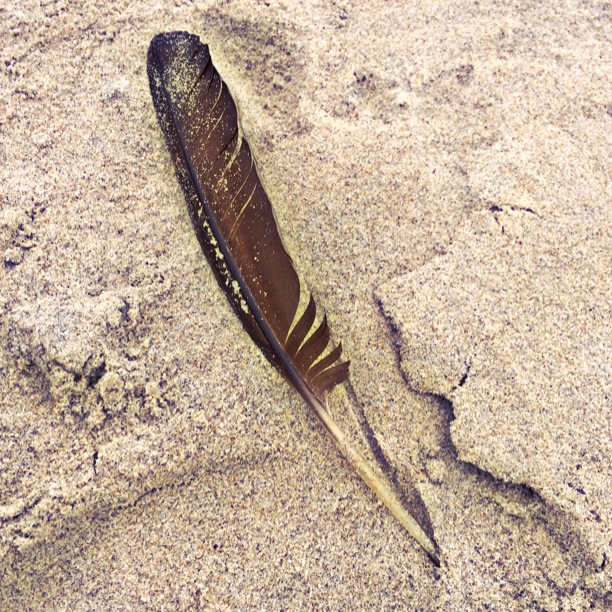
And then there are structures that are light and flexible, like this feather on the beach.

photo_2

It makes me think of our Twitter Fellow of the Week.  This playful use of social media supports more weight than you might imagine.  While we originally saw this program as a way to connect to one another within our project by giving each other a glimpse into a week in the life of an SDAWP educator, it has proven to do more.  When teachers use Twitter as a professional learning network, their interactions begin to impact their practice.  Suddenly they are reading more professional articles about education, “listening in” to debates about policy and practice, getting and sharing ideas from others (within our site and beyond our site), and making their own classroom practice more visible.

Today we asked our SI 2013 cohort to sign up as Twitter Fellows…and starting tomorrow we will begin to get a glimpse into their lives.  (You can follow @SDAWP_Fellow on Twitter) Those who are more confident on Twitter signed up first…but others are willing to dip a toe into this unfamiliar world of tweets and hashtags and mentions.  And they have the rest of the SDAWP community who are happy to help…and the others in their cohort will also be “listening” on Twitter, ready to respond and retweet and favorite…so they won’t be hollering into the dark.

My beach walk today was quiet and introspective as I thought about all the structures I noticed…and those we use to support learners.  Structures can help us stretch and reach and connect as we learn and grow.  What structures support you?  What structures support your students?

Horizons: The Edge of Learning

Today’s Weekly Photo Challenge on the Daily Post is about horizons…that place where the earth meets the sky.

photo-2

And as I headed to the beach to capture one of my favorite horizon vistas, I found myself thinking about the comfort of familiar places like the beach…and the stretch of reaching for new horizons.

In some ways my horizon photo this afternoon represents my feeling of reaching for new horizons and feeling the “edge” of learning as I work with my students to learn computer programming.  There’s that sparkle and shine and thrill of the new along with the hazy sun and encroaching marine layer representing all of the unknown and uncertainty.

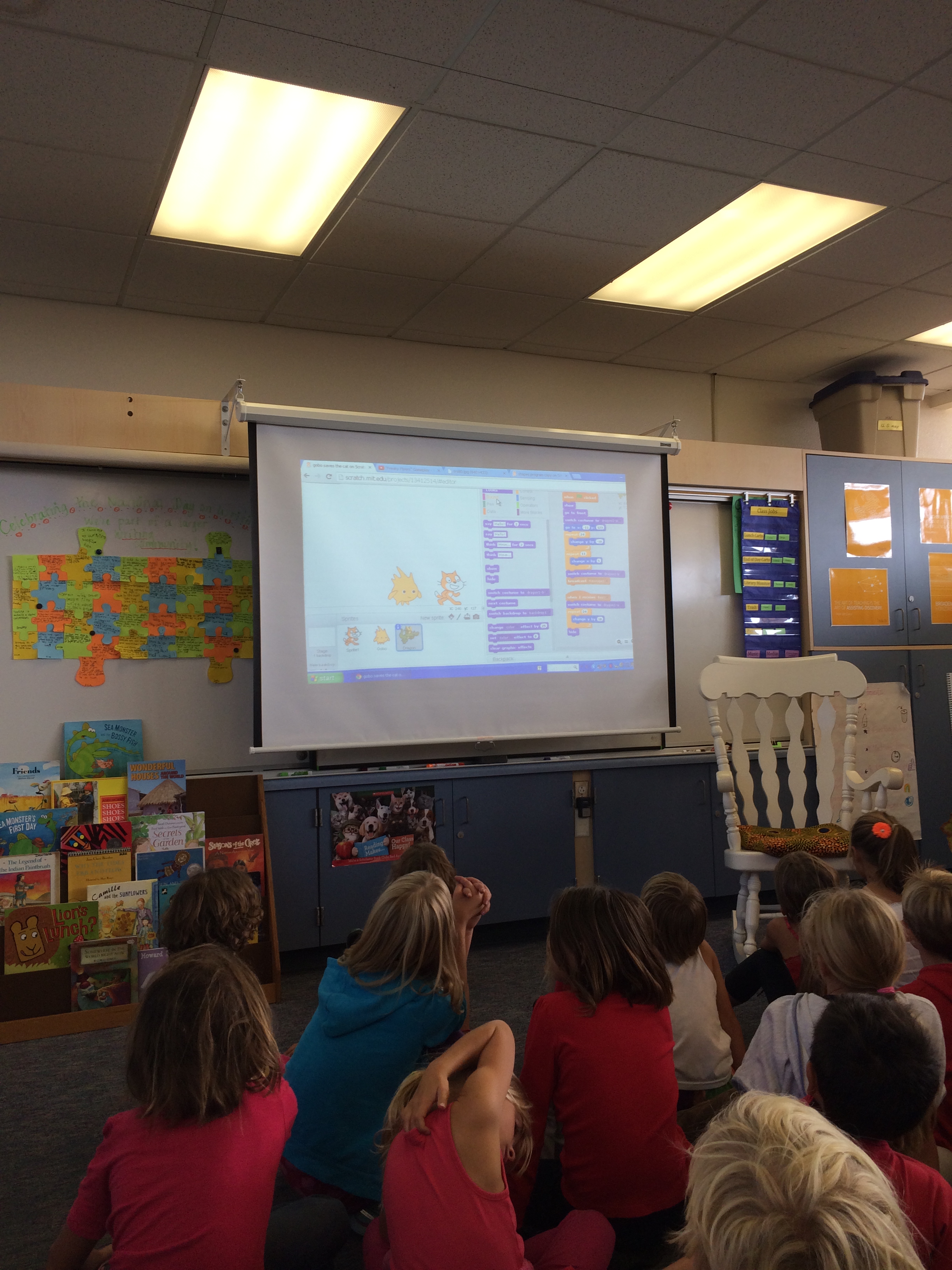
Today a parent in our classroom came in and shared his work as a video game programmer with our students.  He showed us a few of the games he has made…

photo_1-2

the first with a team of three including him.  The most recent included a team of 1,000!

Then he helped to connect this work that he does with our work on Hopscotch (an app), built on the shoulders of Scratch (a program developed at MIT).  He showed us a few kid-made Scratch programs and had the kids make suggestions for changes.  In a matter of a few minutes, he showed how the iterative process is essential for programming.

photo_2-2

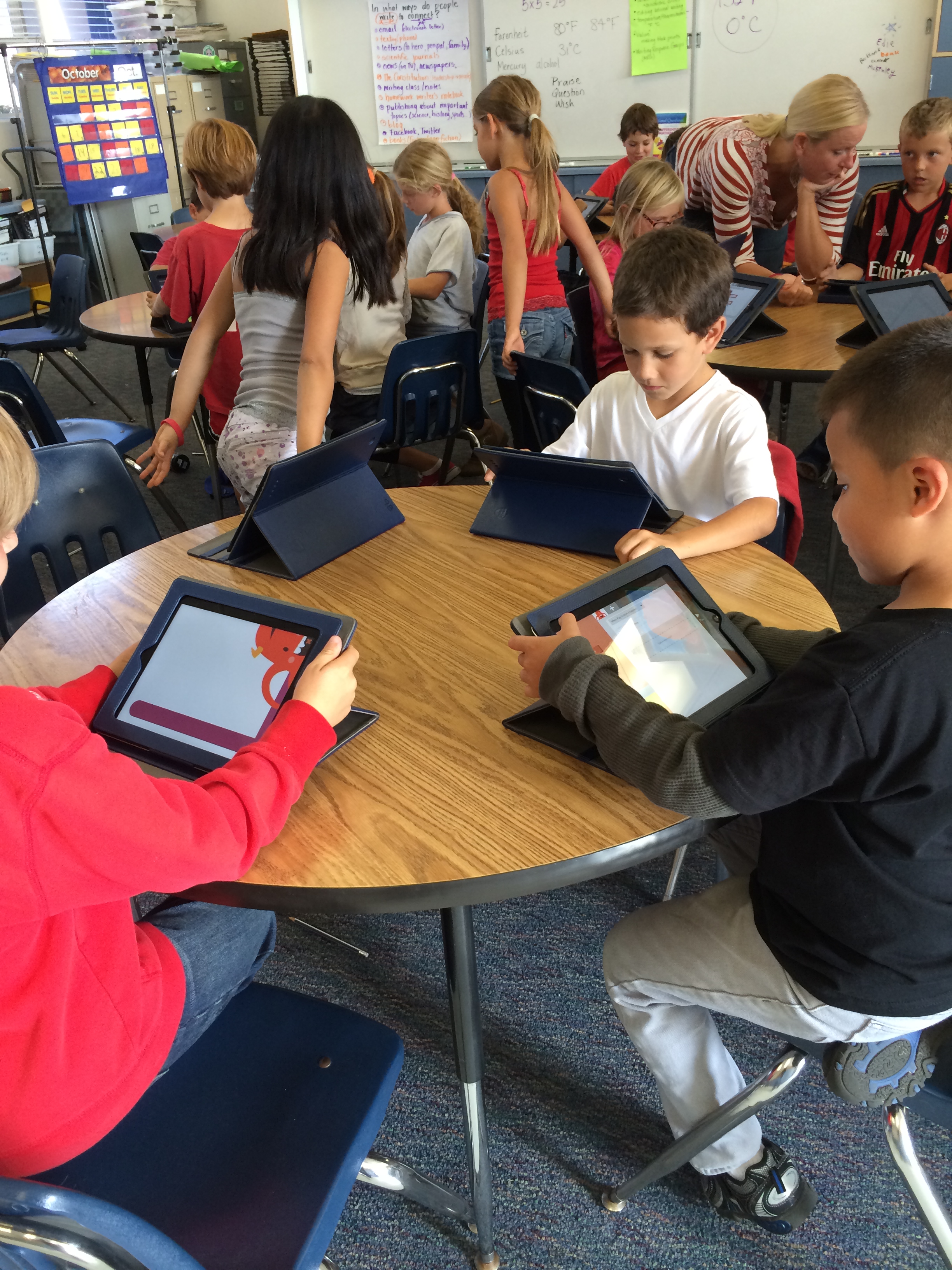
At this point there were about ten minutes before recess, so we offered our students this short time to return to Hopscotch and try their hand at some more programming.  Students were quick to get set up…and were immediately focused and engaged with working with code.

photo-3

I watched them try something and then go back and make a change and run their program again.  When students showed me something they had created, I also asked them to show me the code–and in many cases asked them explain their thinking behind the code–so I can learn along with them.  When it was time for recess, we offered students a choice…they could put their iPad away and go out for recess or they could stay inside and continue their coding.  Only 8 of our 44 students chose to go out.  The rest were totally absorbed with programming on Hopscotch!

I’m working at my edge on this new horizon of learning to code with my students…and it’s uncomfortable at times.  But knowing that this is also where learning happens is exciting.  I’ll probably spend some more time on Hopscotch (or maybe even Scratch) this weekend.  If you have any coding advice, I’m happy to receive it!

Here’s a great TED Talk by Mitch Resnick, one of the creators of Scratch, explaining why students should be involved in programming.  Maybe we should all try it out!

And if it’s not coding, what new horizons are in your future?  What are you doing to find the “edge” of learning?

Photo-Inquiry…Art, Science, and Writing

I’ve been taking pictures every day for more than a year now.  Some days it’s a struggle, other days it’s pretty easy.  But one of my favorite things about being a photographer (albeit, amateur) is that it makes me pay attention…and ask lots of questions.

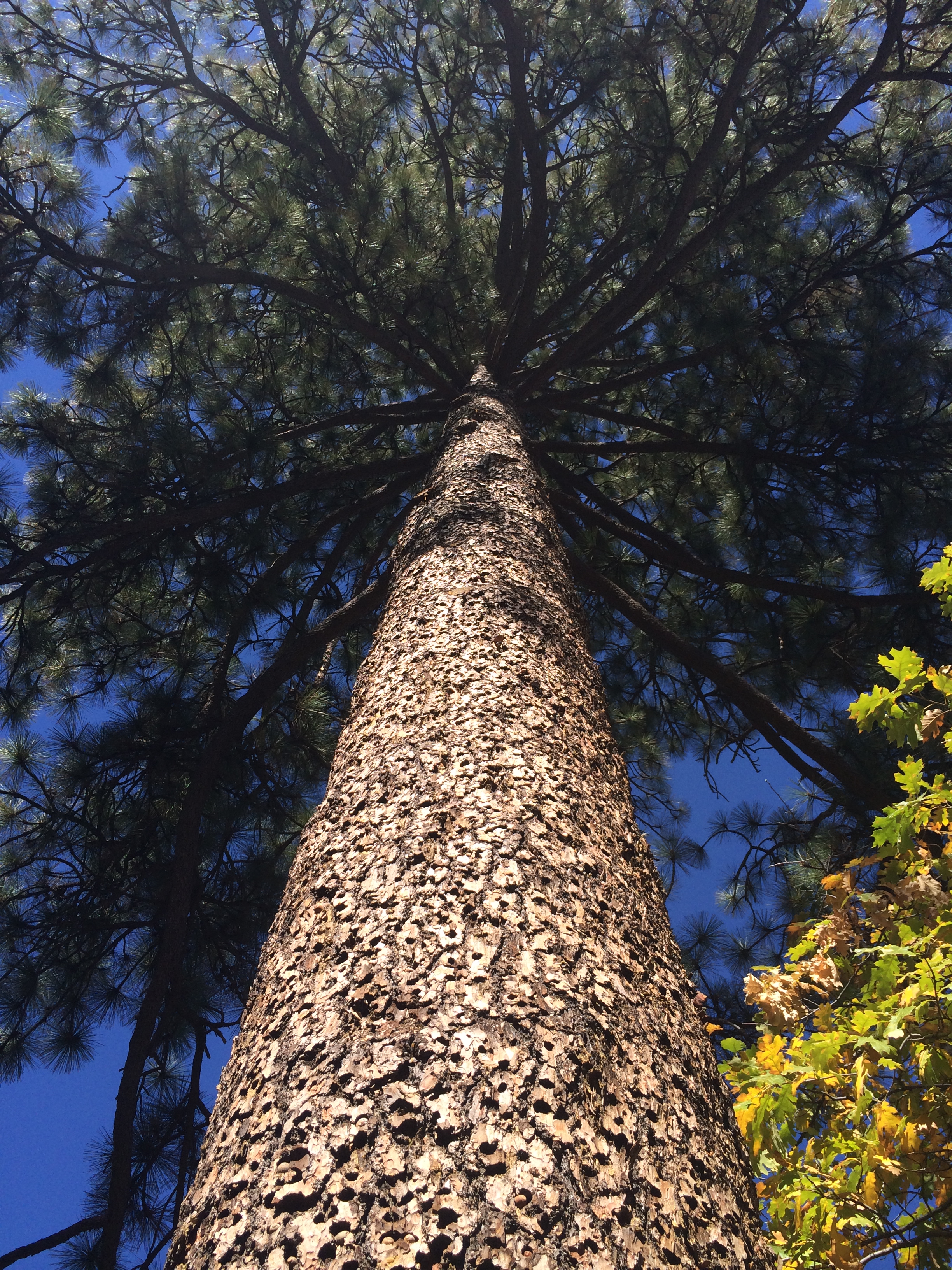
Yesterday I was up in our local mountains enjoying all that fall brings…colors and pumpkins and apples…on a warm fall day.  As I was photographing some beautiful leaves turning orange and red and yellow, I noticed this beautiful pine tree.

photo-12

Looking closely, I was fascinated by the texture of the bark on the tree.  And an even closer look revealed all these tiny holes…with many filled with acorns or other nuts.

photo_1

That observation set off a million questions…how does this happen, what animal does it? Does it hurt the tree?  Is it squirrels?  And then I noticed this nearby fence post.

photo_2

So it’s not only about trees…it’s about wood.  I noticed the nearby utility pole also had holes and nuts.

With all these questions running through my head, we continued our adventure and I continued to look for interesting subjects for my photography.  A while later, at the edge of a little pumpkin patch I looked up and saw a beautiful blue bird with red markings high up on a utility pole.  I thought it might be some kind of jay, but my husband was quick to point out that it was tapping the pole…a woodpecker!

We watched closely, listening to the persistent tapping as it pecked into the top of the pole.  I attempted several photographs…but one thing the iphone camera is not good at is long distance photos!  Here’s an attempt.

photo

If you look closely you can see a tiny silhouette at the top the pole.  As I watched I started to make connections to the pine tree and fence post I had photographed earlier.  These holes with the acorns in them were the work of an acorn woodpecker!  A little internet search today led me to this information:

The group will guard their territory, and will often have a single tree in which they store their acorns; known as a granary. A single granary may contain tens of thousands of acorns. The acorns themselves are placed individually into a hole drilled into the tree. Acorn Woodpeckers also feed on insects (including aerial flycatching), sap, and fruits.

I love that photography always ends up teaching me interesting things about nature and about the world.  It makes me pay attention, notice details, and ask questions.  It makes me curious…and makes me wonder…a perfect tool for inquiry!  And as I write this on the National Day on Writing, I get to share my photography and learning with you!  #write2connect in action!

How do you write to connect?  What do you learn from the activities you love?

Experiencing the Underbelly

I often write about the benefits of being a connected educator.  Today I experienced a bit of the underbelly.

As I do everyday, I spent my morning teaching students.  We sang, discussed, explored some new math strategies, wrote and shared.  From the time school started until lunch, I didn’t have time to email or post or tweet.  But apparently my twitter account did…

When I looked at my phone at lunchtime I noticed a number of twitter alerts and text messages visible on the lock screen.  Texts from my son and my nephew warning me that I’d been hacked alongside DM (direct message) notices from people I don’t know (even virtually) recommending web links to me–and one from a friend asking if I had been hacked.  I had a few twitter mentions from some virtual friends suggesting I change my password because they were getting DMs from me.  A peek at my email showed some more messages from people I know recommending that I change my password–they too were getting DMs from me.

I also got an email from Twitter telling me my password had been reset.  Apparently my account had been quite busy while I was otherwise occupied with my teaching!

So I spent some time resetting my password, and then responding to my friends and family to let them know that I appreciated their advice and warning.  I also noticed that I wasn’t the only one victimized by Twitter spamming today.  Here are a couple of other tweets pointing out the problem.

Screen Shot 2013-10-16 at 7.28.41 PM

Screen Shot 2013-10-16 at 7.29.24 PM

I don’t like that my account was hacked or that it looked like I was sending out annoying messages to my Twitter community.  But I also know that this goes with the territory.  Being a connected educator means that I have to deal with the hassles of technology and social media as well as reap the benefits of it.

I appreciate that my Twitter community remains cool and matter of fact even when faced with annoying and sometimes confusing security breaches…and they help me know how to act when I experience these same issues.

And in spite of the problems, I remain a connected educator.

Learning to Code

It seems perfect that this month that includes the National Day on Writing and Connected Educators’ Month is also the time when we have ventured into teaching coding to our students (and ourselves).  My teaching partner and I talked about doing this last year during our 1:1 iPad pilot…but were thwarted by the fact that Scratch requires flash and won’t work on our iPads.  We had even thought about it the year before, that but 30 minutes of computer time per week just didn’t seem adequate.

So to push myself to realize this goal of coding with my students, I have been telling people that I want to do this.  I know myself enough to know that if I don’t make my goals public, somehow it is easier to push them aside when they feel “hard.”  And In our school district this year we have a new Educational Technology teacher.  A credentialed teacher who was hired specifically to help teachers integrate technology into their teaching–in addition to the tech people in our district who help when our technology isn’t working.  I mentioned our desire to teach our students to code in an introductory meeting with the Ed Tech teacher before school began…and he was interested and excited about the prospect.

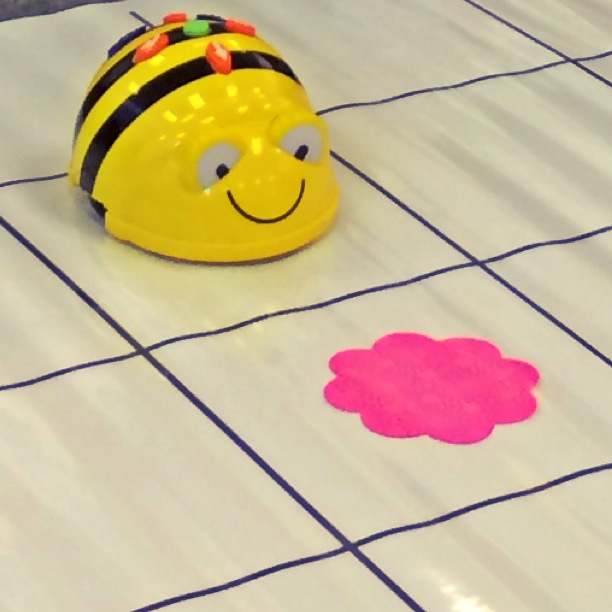
And so last week he ventured into our classroom at a perfect time to talk…and pinned me down on getting started with coding.  He would come in and get students started–using the Beebot I had purchased at the end of the summer and the Hopscotch app he had learned about.

photo

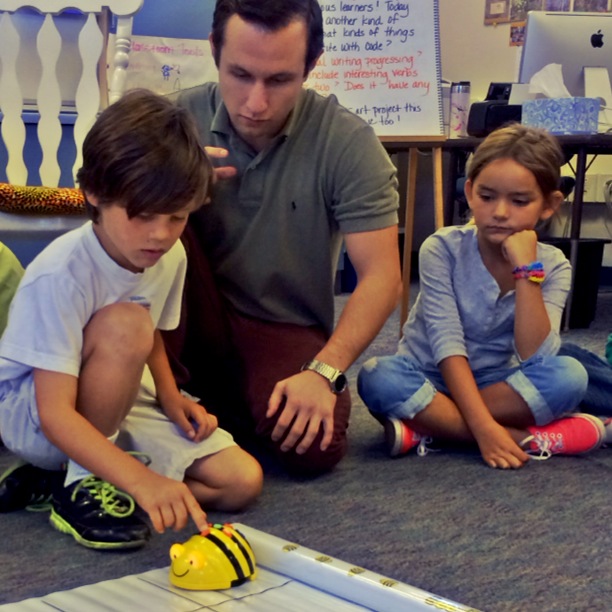
I love the way the simple, mechanical Beebot illustrates the basics of programming.  And I love that it also demonstrates how easy it is to have mistakes in your code, and the need to problem solve and “debug” through repeated trials and iteration.  My students were quick to understand the basics and very interested in the Beebot.  First graders could easily explain their thinking–and could figure out where they had made mistakes (older kids could too, and made mistakes too!).

photo-1

After exploring how to make Beebot move, we turned to our iPads and opened Hopscotch.  Similar to Scratch, Hopscotch uses interlocking blocks to make the characters move.  After trying a few moves in common and learning to make their character spin, we set students loose to explore the possibilities.

photo-2

And they began to “write” their own code!  We gave students the opportunity to share cool things they had figured out with all of us…and promised that we would give them more time to explore this app and create more code.

I don’t know any more about coding at this point than my students do, so we will continue to learn together.  And I think I am as excited about learning to code as they are.  I’m glad our Ed Tech teacher pushed us to set a date to start to work on coding with our students…and I’m glad he was there to get us started.  His checking in on our progress will also be an incentive to continue this with our students.  I have tons more to learn…but who better to learn it with than our students?

Making Art

Participating in photo-a-day means that I am always on the lookout for an interesting photo opportunity.  And even though this whole month is themed writing, that doesn’t mean that I don’t take and post other interesting photos.

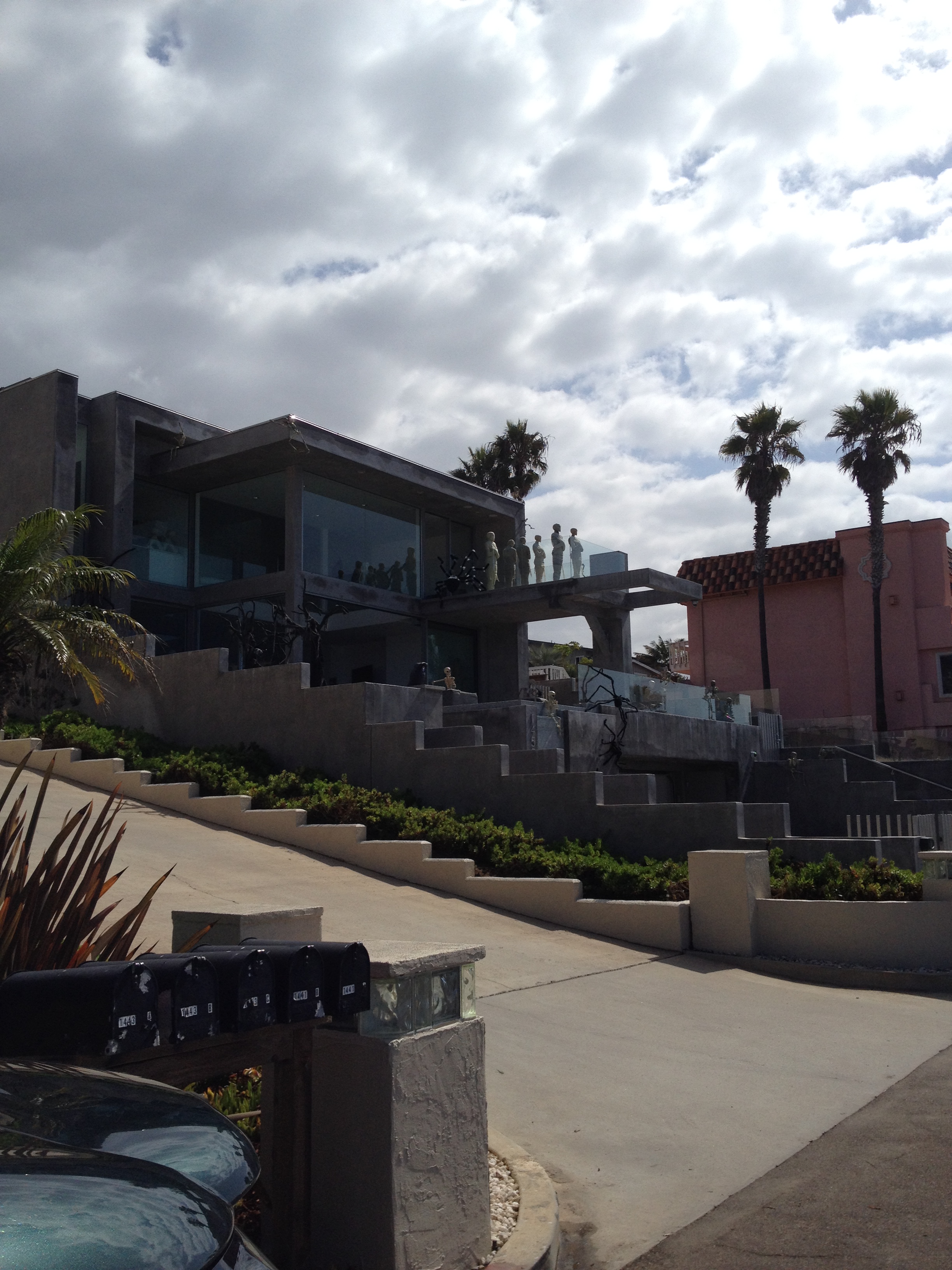
Driving to work is one of those times when I keep my eyes peeled for promising places to return to for a photo or two.  Over the last few weeks I’ve noticed a house not far from my school that seems to be made of concrete.  It’s huge, looks over the ocean, and has floor to ceiling windows…obviously designed for maximum visual impact, from inside and from outside.

And today as I drove by, I noticed skeletons and zombies and other creepy things through the windows and on the deck.  I knew I would stop by later and take some photos.  When I stopped on my way home I struggled to get a photo that captured what I could see with my eyes.

photo-1

So I took this photo and used an editing app to play around with it.  Could I pull the photo in and see those full sized bodies standing on the deck?  Could I see through the windows?  Here is what I was able to produce from the picture above using the app Tadaa and the filter otherland.

photo

I love that moment when a snapshot becomes a piece of art.  I wonder if that is what the owners of that house also had in mind?

Good Morning

When I saw the Weekly Photo Challenge on the Daily Post this week I realized that even though I am a morning person, I don’t take many photos in the morning.  So the prompt, Good Morning, has made me think about that.

Saturday, because I was at a conference at UC Davis, I stopped by our favorite bagel shop right next to the Starbucks for a quick and carry breakfast.  And while I was waiting for my order I noticed the beauty of the donuts in the case near the cash register.  That shiny chocolate was tempting…I resisted the donut, but did take a photo!

donuts

I also took a photo of the sun through the fall trees…and then played with it in one of my photo editing apps.

photo_2

Earlier in the week I spent some time with my son and daughter-in-law and stayed in this funky little hotel.  I took this photo as I headed to check out in the morning.

photo_3

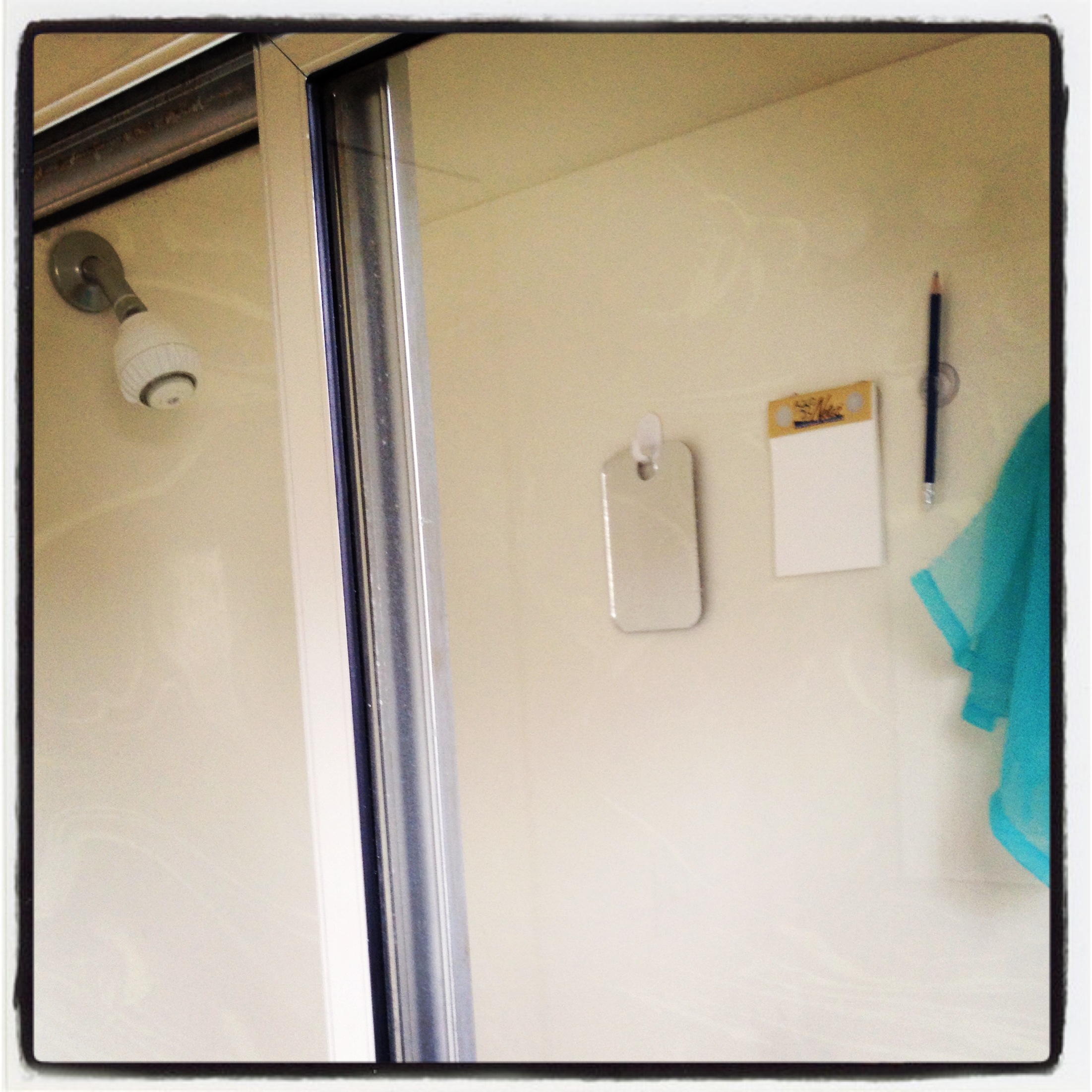
I like the hint of light over the top of the hills in the distance.  And then at my son’s apartment I noticed the tools in his shower.  Why don’t I have a pad of waterproof paper and a pencil hanging in my shower for those soothing water-induced inspirations in the morning?

photo_1

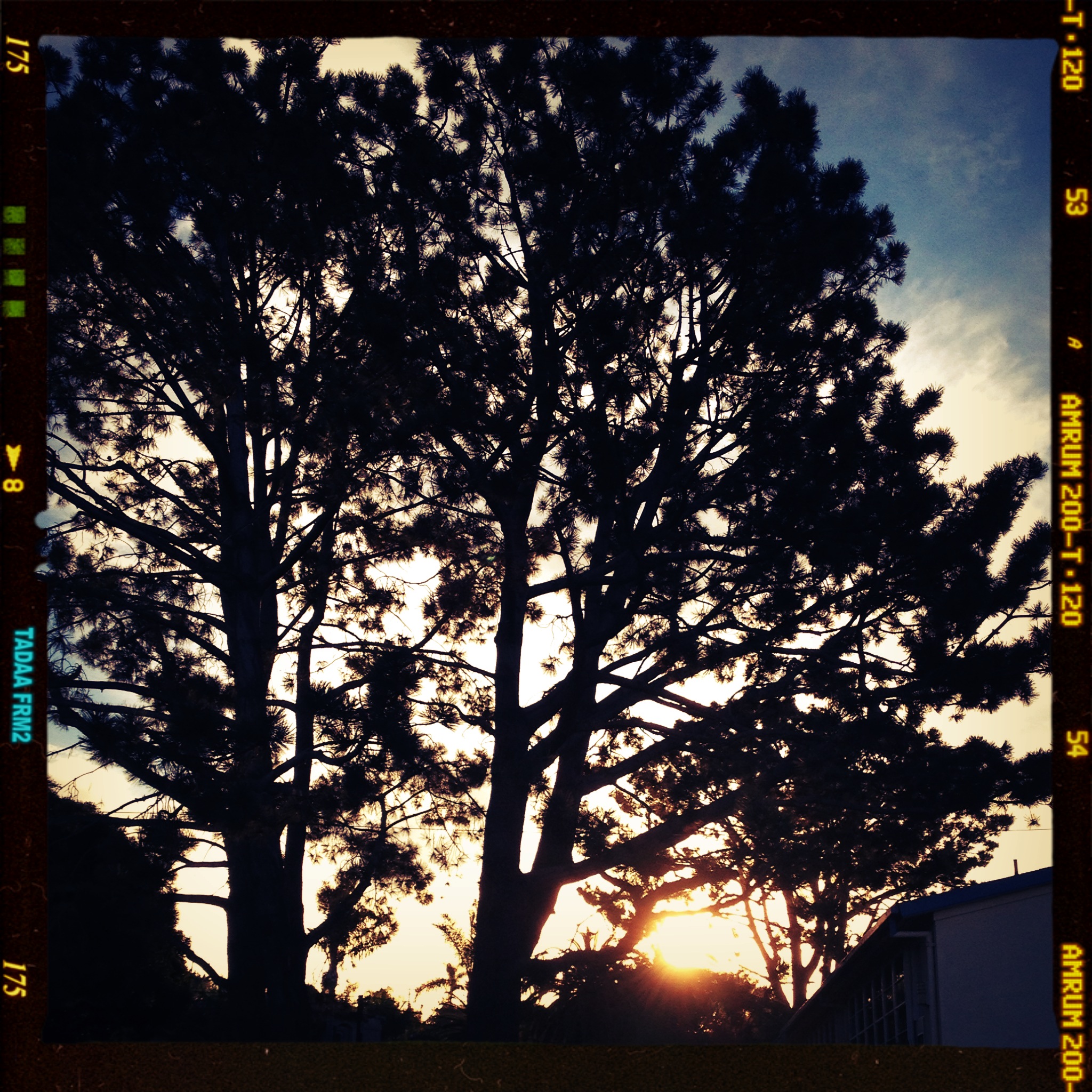
I found this one this morning on my way to work as the sun rose through the Torrey pines.

photo

What says good morning to you?

Listening: Becoming a Connected Educator

Earlier in the week I posted about being a Connected Educator.  Since then I’ve also been thinking about those educators who are connected but not yet putting their voices out in the digital space professionally.  Lurker is the term I’ve heard to describe people who read on social media but don’t comment or post themselves.  But lurker has such an evil sound to it–as though they lurk in order to gain information for underhanded reasons.  In some ways they seem to me to be listeners, like those students in my classroom who are soaking everything up like sponges but can’t yet bear to raise their hand and make a public comment.

Like the students in my classroom, I suspect that those digital listeners will at some point begin to comment and post for themselves, they just aren’t ready…yet.  And since I started this blog (almost three months ago), I have had many instances of people making comments about my content when I’ve had no evidence of their interaction.  It feels a bit odd at first.  Almost like someone is eavesdropping on a conversation that they are not participating in.  But then again, I am making a choice to put my writing and thinking out in the public sphere.  And whether people chose to comment or “like” my blog post is a decision for them to make.  It also reminds me as a reader of blogs and other social media that I read substantially more than I comment or otherwise indicate my presence.

And I also know that sometimes it just takes the right condition to get someone to dip their toe into the social media waters.  If you listen to the NWP radio show on being a Connected Educator you will hear Abby and Janis and Barb talk about getting started and how much it helps to have support, like when our SDAWP teachers take on the Twitter account as @SDAWP_Fellow for a week.  (We adapted that idea from Sweden’s practice of having a citizen take on the country’s Twitter account.)  It’s also like having Barb and Matt’s support when trying out blogging on our collaborative blog, SDAWP Voices.

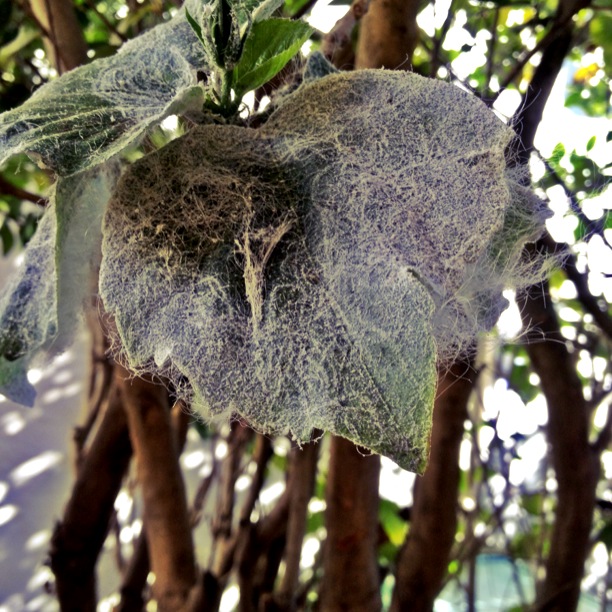
Today for my #sdawpphotovoices photo-a-day I took a photo of what I thought was some kind of fungus making a silky white coating on the leaves of our hibiscus plant.  When I posted it to Instagram and Twitter, I got a response from one of my colleagues from my school site via Twitter telling me that this “fungus” was in fact white flies.  I knew my colleague had a Twitter account, but she seldom tweets.  I do try to nudge my colleagues when I see something that I think will interest them by “mentioning” them on Twitter.  (I know I’m more likely to respond when someone “elbows” me and points me to something that has been posted.)  I did this on Friday with my colleague when I saw an app I thought she might find interesting.  And she acknowledged that tweet by replying.  And then today, without a nudge, she shared valuable information with me about my plant.

photo

There are stages to being connected.  Most people start slow (I know I did) and then work up to more active participation.  For most of us that’s how we learn to do a lot of things.  We watch, we listen, we test, we get some feedback and then continue to increase our confidence and participation–or abandon that thing altogether.  As educators we can’t afford to abandon digital literacy or being connected educators, but it isn’t necessary to jump in the deep end. There are lots of support systems out there.

In what ways are you connected?  What is the one thing you will do in the next week to increase your connectedness?  Will you comment on a blog?  Respond to a tweet?  Tweet a link to an interesting article or blog post?  Start a Twitter account?  (You are welcome to follow me @kd0602)  I’d love to know if you are willing to post your goal as a comment!