How to Add Some Joy to Teaching

I can be a bit serious. Okay, maybe a lot serious. And sometimes that means that the classroom can seem like all work and no play…and we all know that first graders (and maybe all students) both want and NEED some play to help learning move along.

For some reason, my school decided that again this year our winter holidays (two weeks of no school) would bump right up against Christmas. I’ll be loving the holiday when January gets here, but to be honest, it’s brutal right now. Instead of children who are focused on learning to read and write (and all our other subjects of study), they have visions of sugarplums dancing in their heads! (Or maybe that is just the candy cane overload coursing through their bodies!)

I made a deal with myself as I planned lessons for this week–leave spaces for play, expect silliness and louder than usual volume, smile and laugh more, enjoy the moments.

So…I planned a small writing lesson.

I remembered this wonderful book of poems called The Proper Way to Meet a Hedgehog and Other How To Poems selected by Paul Janeczko and started flipping through. If I had my students write a “how to” something, they would have many choices of topic and could draw on all that they already know. But which poem would work as a useful mentor text to get them started? There are many good choices…but I was looking for something short, a bit whimsical, and an idea that my students might find unexpected. How to Scare Monsters by Rebecca Kai Dotlich was just right! It starts out easy, “Keep a light on, that’s the thing… and turns a bit in the second (of two) stanzas with “Aim for the toe (did you know this?)…

I read it a few times, letting students soak into the language. They noticed the strange notation (parentheses) and were intrigued. We talked about the extra information in there and they definitely picked up on the personal, friendly tone. We brainstormed things we are “experts” at doing, and that list included A LOT of sports! After I wrote a poem in front of them (How to take Photos of Egrets), they opened their notebooks and began their own How To poems.

Students immediately got to their writing (along with plenty of talking) and a number of them included the parentheses in their poems. As they began to finish and read their writing to me, I could feel the smile genuinely creeping onto my face. The poems were fresh and their voices came through loud and clear. Some of the topics were predictable, but some were not…like this one by O:

How to Catch a Rattlesnake

Go to a desert.

Find a hole.

(Maybe it’s a snake hole.)

If it’s a snake hole,

get a good stick.

And do not grab it by the tail,

grab it by the neck.

If you grab it by the tail

they will swing and bite you.

If you grab it by the neck

they will not move

except their tail.

Did you notice the parentheses? I had encouraged students to pick small topics rather than trying to explain a whole game. But, you know, some students want to do what they want to do. But somehow J captured this game in a nutshell. I bet you know what game it is!

How to Play Ball

Get two teams

9 is enough

9 innings

1,2,3 bases and 

one home plate in a square.

(One out is three hittable balls

Four balls you can not hit go to 1st base)

A hit

run as fast as you can go

until you are thrown out

or tagged out

You are out.

Three outs is an inning

touch home plate to get a point.

who has the most points wins

if you are tied

overtime.

And who doesn’t love a how to poem about riding a bike? It’s obviously a childhood classic! Here is O’s rendition. (This is a different O–I have many in this year’s class!)

How to Ride a Bike

This is how we ride a bike

without training wheels.

First put your helmet on

and then get on your bike.

And try not to look down

look straight ahead and pedal

and make sure nothing is in front of you.

And that is how you ride a bike

without training wheels.

And a short but sweet one by V who did take my advice and decided not to capture all of gymnastics but to instead focus on a single trick.

How to do a Cartwheel

Start in a lunge

Put your hands on the ground

Then when you put your hands on the ground

Kick your legs up

(One foot up first, then the other)

Land with hands by your ears.

These small poems started this week off with a dose of joy. Students enjoyed writing and reading them, I enjoyed hearing them and rereading them. No one whined that they had nothing to write about, no one got teary with frustration (including me), and we all enjoyed writing and sharing and teaching someone else about our individual expertise. 

Reminder to myself: be playful, small can be powerful, enjoy the wonders of childhood and read and write more poems!

So…if you need to add a bit of joy to your teaching or writing life, take a look at How to Scare Monsters and write some how to poems!

Let’s Write: Celebrating the National Day on Writing

It’s October 20th…and that means it’s the National Day on Writing! We started our day by talking about the reasons we write during our morning meeting. It warms my heart that most of my students mentioned either that writing is fun or one of our recent writing activities (writing letters or making zines) as their reasons for writing. I do feel like we are building a wonderful writing community in our first grade classroom. It’s a place to take risks, a place to express ourselves, and a place to build our knowledge and skills related to writing.

So after recess today, I read my students Kiyoshi’s Walk by Mark Karlin. In this lovely story, Kiyoshi is asking his grandpa where poems come from.  On each stop along the walk, Eto (Kiyoshi’s grandpa) writes a short three-line poem about something they see, hear, imagine, or feel…each adding to Kiyoshi’s understanding of where poems come from.  At the end, Kiyoshi asks his grandfather if he can write a poem…and writes a beautiful three-line composition for his grandfather. While technically the poems in this book are Haiku, I talked about them as three-line poems rather than engage in syllable counts for my students today.

With this as inspiration, we grabbed our sketchbooks and headed out on our own walk, ending up in our school garden where we wrote our own three-line poems inspired by our walk and our time writing in the garden.

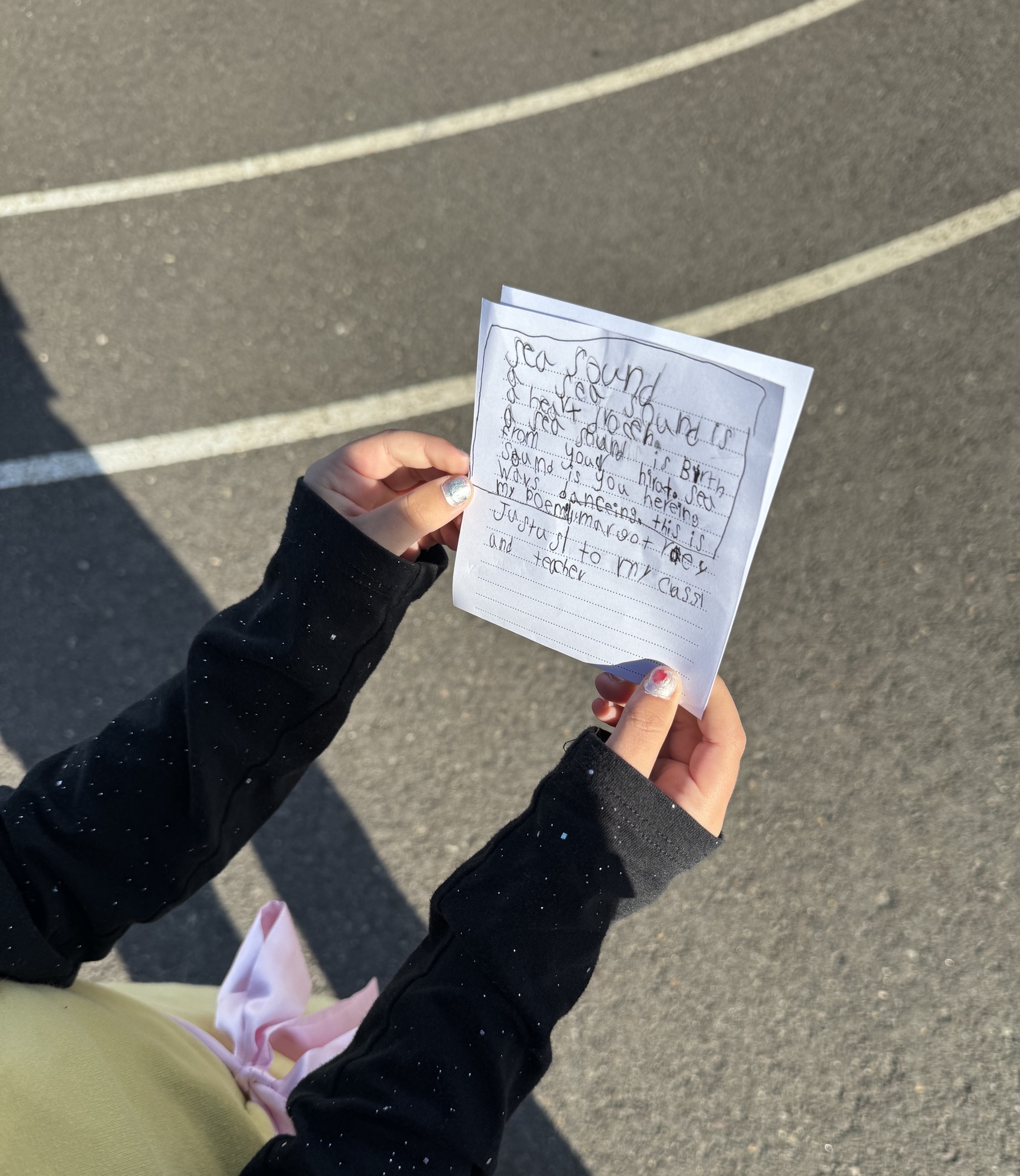
These first graders wrote as many three-lines poems as they could during the time we were in the garden. They wrote about the fog that wafted across the playground, the rollie pollies that they love to rescue from the sidewalks, ladybugs, passion fruit, the sky, tomatoes, potatoes, and so much more.

When we returned to the classroom, writers shared a few of their compositions and then picked their favorite to copy onto another sheet of paper and illustrate. While their poems are still developing, they are beginning to get the idea that there are many different reasons and inspirations for writing. Here are a couple:

I See a Butterfly by C

A butterfly flying

In the garden with yellow wings

Pollinating the garden flowers.

The Blowing Fog by M

The fog is blowing

The rollie pollies are crawling

The flowers are blooming.

I also know that being outdoors is a powerful motivation for writing for the first graders I teach. Changing our writing venue, writing in a sketchbook rather than a notebook, and writing under the influence of nature all keep writing fresh and novel. And my writing with them also matters. I hope they are learning that writing is not just for school, but that it is a lifetime pursuit that can serve many different purposes.

And I know that I don’t need #writeout or the National Day on Writing to keep writing at the forefront of the classroom–but it’s fun to know that there are educators all over taking their students outdoors, playfully approaching writing tasks, and making writing something students love…for so many different reasons.

So I leave this post with the NDOW question, Why do you write?