Tag Archives: first grade

Big…a mini review: SOL24 Day 6

I love picture books. I do have some old favorites, but I am passionate about reading my students newer books, especially those that represent positions and characters that haven’t historically gotten enough attention. In some years I look for stories that help my students see themselves, in other years I look for ways for my students to see beyond themselves.

We have an amazing school librarian who has been making an effort to make sure the teachers know about new books–especially those that represent diverse experiences and address issues of equity and inclusion. Big by Vashti Harrison was a book I had been hearing some buzz about, but I hadn’t yet come across it in person. So when I saw it in the basket of books in the teacher’s lounge, I had to pick it up. As I began to read it, surrounded by my colleagues chatting and eating, I felt drawn into a quiet place. It was just me and the words and images. My breathing slowed, my heart raced, and I could feel tears welling. The careful selection of words and the powerful, beautiful pictures grabbed hold of my heart. I needed to read this book to my first grade students, even though not a single one of them can be described as “big” in these terms. Maybe that’s why this book seemed perfect for them.

My class tends to run on the chatty side. They have a lot to say about everything. As I opened this book and started to read I heard a few comments about the baby, but as I got a few pages in a hush settled over the classroom. I watched students lean in, faces serious. When we got to the pages with no words (a powerful series of images), it was almost as if they were holding their breath. They stayed quiet and seemed to have a communal exhale as the book ended. After a breath or two, they had some things to say. They felt sad for the girl in the story and they were thinking hard about how the words had hurt her.

I read this book for a second time this week (I read it for the first time to students on Monday) because this book has so much to say. Again, my students settled into quiet attention. They paid close attention to the illustrations, noticing the use of color and space…and the ways that words were also part of the illustrations. We talked a bit about my favorite page…the one where the girl has a hand full of their hateful words and says, “These are yours. They hurt me.” as she hands them back to the people who used them.

This book won the Caldecott award and is a Coretta Scott King honor title and I can see why. I highly recommend this book not just for younger children, but for people of all ages. Bias–both implicit and explicit is something we can all learn more about and pay attention to in our daily interactions, especially as educators. And don’t miss the author’s note at the end! Add Big to your TBR pile today!

A Magical Start: SOL24 Day 4

Mondays can be hard, but I have a colleague who calls out an alliterative daily mantra to everyone she sees. “Magical Monday,” she calls as she passes my classroom before school started this morning. “Magical Monday,” I call back.

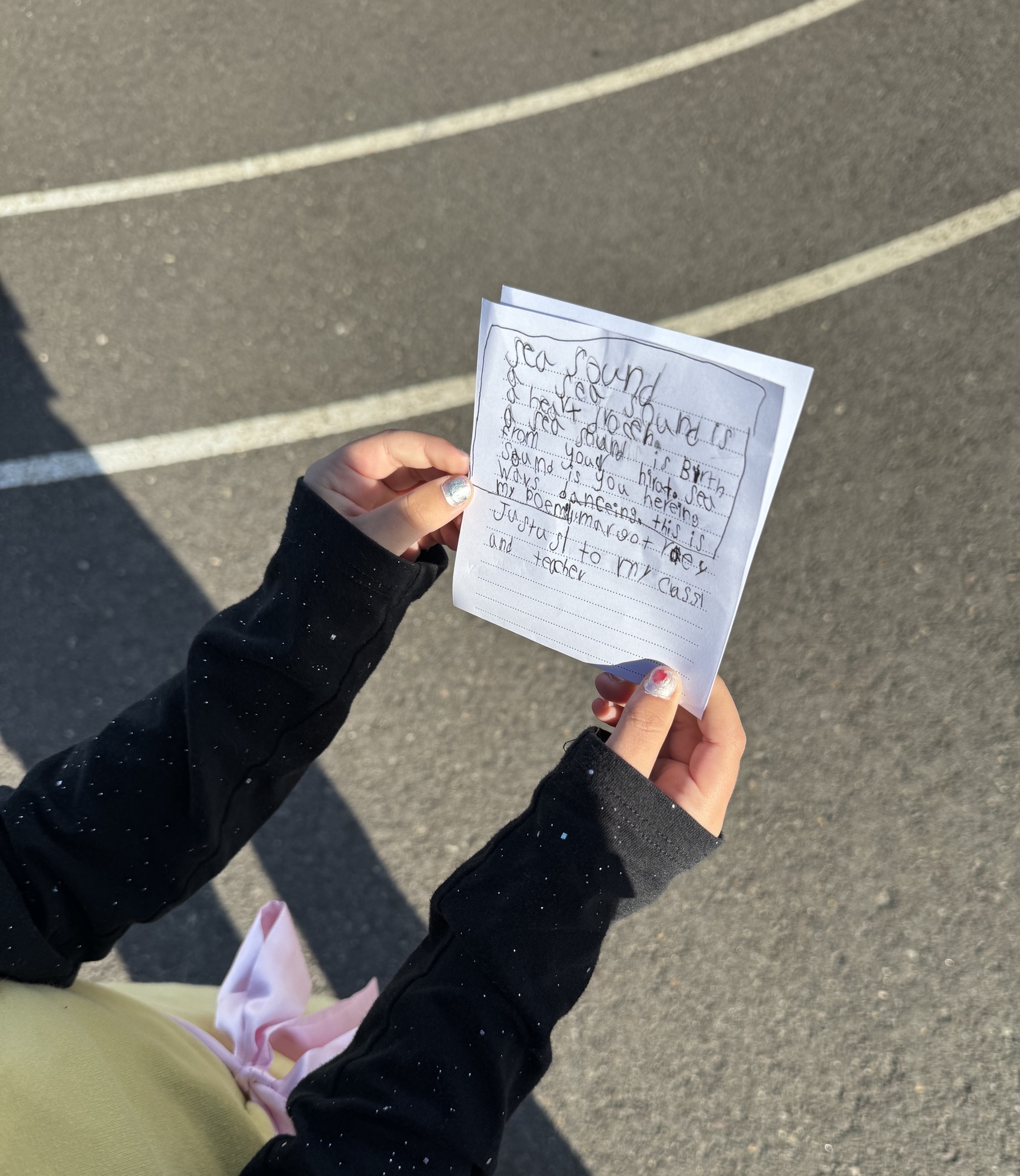
Mondays don’t always feel magical, but today felt different. I headed out for recess duty with the sun shining on my shoulders. As I walked out onto the playground one of my first grade students ran up with an envelope in her hand. “Mrs. Douillard,” she said, “I wrote a poem for you!”

In our class we study a poem every week, write poetry with some regularity, and delight in metaphorical thinking. Words matter. They help us express ourselves, understand our world, and communicate with others. I love it when students take our learning outside the classroom walls and write for their own purposes.

My student pulled her poem out of the envelope to show me. “Will you read it to me?” I asked. And she proceeded to read:

Sea Sound

A sea sound is a heart broken.

A sea sound is birth from your heart.

Sea sound is you hearing waves dancing.

This is my poem

When I asked what inspired her to write, she responded, “It was the waves dancing.” She told me I could keep the poem and off she went to play with her friends before the school bell rang.

That is a magical Monday for sure!

Time to Create: SOL24 Day 1

I have a love/hate relationship with technology in my teaching life. I love the possibilities that technology offers and hate dealing with the glitches, the learning curve, and the challenges of keeping my students on task with more creative tasks. When I moved to first grade after the pandemic, I left the creative use of technology mostly behind and instead depended on those practice apps as my primary use of technology in the classroom.

I’ve been starting to feel like my students need opportunities to be creators using technology instead of consumers of content that others have made. So with a bit of a nudge from my sister, I started thinking about a digital storytelling project where my students would create Public Service Announcements (PSAs) for things around our campus that were either going well or need more attention.

We spent time earlier this month studying stories and breaking them down to three main parts: the beginning where the context is set, the problem (or the danger as one student described it), and the solution. They took a wonderful wordless story, Flashlight by Lizi Boyd, condensing it to three drawings that told the major story elements. They wrote their own stories based on a character drawing from our fifth grade penpals including those same three story parts. At this point, I was ready to embark on the digital storytelling project.

So…this week we learned about three photography techniques: bird’s eye view (a perspective from above), bug’s eye view (getting low and looking up), and the rule of thirds (where the focal part of the photograph is positioned in a particular third of the frame). We studied some examples and then headed outside to try on these techniques by going on a photography scavenger hunt. The first graders in my class loved this activity and clearly began to understand the three different techniques. While not all the photos are stunning examples of photography, they are gaining experience with the camera on their iPads and making intentional choices about the photographs they take. Here’s a few first grade examples.

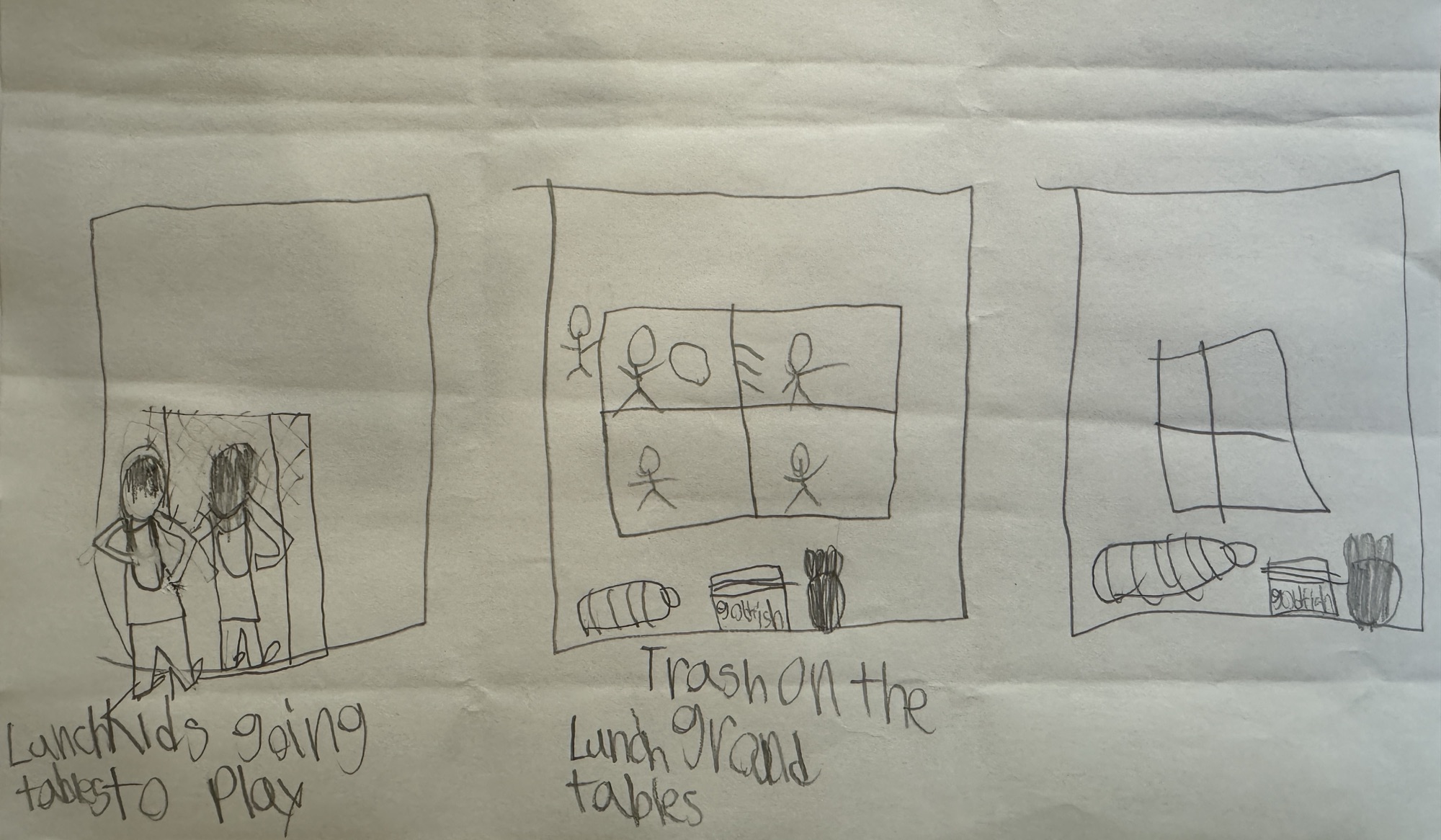
The next day we brainstormed things that our school does well and things that need more attention. We know that our school is quite good at composting and that students need reminders to eat their snack and lunch before running onto the playground to play. We ultimately came up with eight different topics. After students listed their top three topics to work on, I put them into teams so they could help each other to tackle the topic selected. Student then drew the three photographs they would take on campus to create a story of change…a public service announcement.

I was nervous this morning. Would they be able to take photos that would work in their PSA stories? Could they use each other as actors in the photos they envisioned? How would they handle the openness of this task? Would they be distracted and tempted to mess around instead of focusing on the photos?

After a little bit of in-class modeling, we all headed out with iPads in hand. I love it when students surprise me with their creativity and focus…and that was definitely what happened today. Students supported each other, posing and directing. They checked their photos to make sure faces were not visible (one of my requirements), and they all got their 3 photos taken. I loved watching the cooperation and teamwork and was thrilled that I didn’t have to referee any problems. I saw students who are often followers in the classroom take the lead in this creative pursuit and shy students step up to let others know exactly what they needed for their photos. When we returned to the classroom, we spent a few minutes back in teams giving each student a chance to show their photos to each other and tell their story based on the photos.

On Monday we will be learning iMovie and transforming these three still photos into a short video PSA, complete with voiceovers. Wish me luck! My fingers are crossed that our photos will turn into wonderful video PSAs!

More Poetry Please

Last week we returned to school after our two-week winter break. The first graders in my class were eager to talk, telling each other about all the things that had happened while they were apart. Knowing that students would be chatty, I planned lessons that would allow interaction and conversation on our first day back in class. 

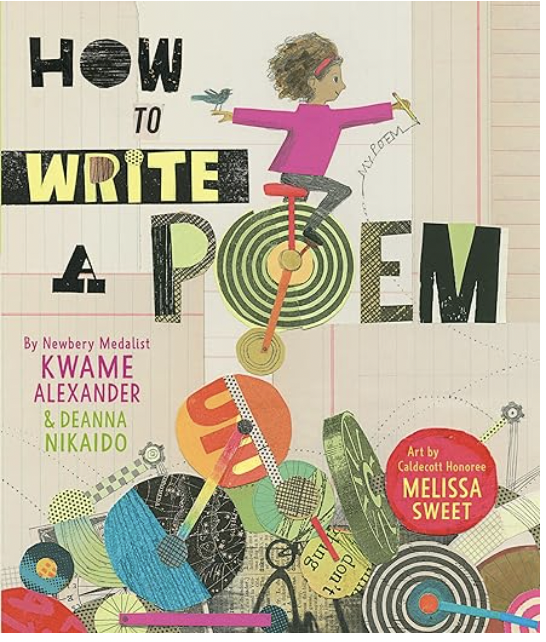
I’d been thinking about having students craft a collaborative poem for a while now. We’ve been studying poems and writing some of our own all school year, but still, it seemed that the time was ripe for something more. I began our lesson with Kwame Alexander’s delightful picture book, How to Write a Poem, illustrated brilliantly by Melissa Sweet. We read and noticed first, with students intrigued by the use of collage, the lyrical language, and colorful images. Before I began reading, I had asked my students what they knew about metaphorical thinking. What? That was their response. So after reading and talking about the book, we went back through the book so I could point out examples of metaphor…and just about then, my principal walked in. She comes in from time to time, pulls up a chair and sits and listens. She doesn’t interact and her poker face is nearly unreadable. I just went on with the lesson, feeling students pulled in as we talked about words falling from the sky like rain. We imagined ourselves outside, heads tipped, tongues out, ready to catch those words. As we became the metaphors we were studying, we talked about how metaphor lets us use ideas from our imaginations to make our writing become more clear…and more fun! When my principal left, I still had my students full attention as they grappled with this abstract idea of metaphorical thinking. 

Now, we needed to try it on for ourselves. I decided on having students create a collaborative poem by having each student contribute one line to a “winter is…” poem. So I asked them, how might you use metaphorical thinking to describe what winter is? The first responses had them leaning back on what they already knew. Winter is cold, winter is when trees lose their leaves. In some ways, this was the perfect next step. We talked about how those are facts about winter…now we needed to think about how to make comparisons that were surprising. When one of my students got to snow was white cotton candy, I knew we were heading in the right direction! I had them try a few “winter is…” lines, and just when they were running out of steam, I pulled out the colorful sticky note sentence strips for each student to write their favorite “winter is…” line on. I could feel the motivation lift and even my most reluctant student eagerly chose a color and started writing his line (although there were none written in the notebook at this point). Once they had written, they stuck their post it on the white board.

I wasn’t quite sure where we were at this point. I let the post its sit over night and pulled them off the next morning with the intention of typing up their lines to form a poem. As I typed I divided the ideas into 3-line stanzas, that seemed to help give the poem shape. I was pleasantly surprised when the ideas seemed to come together into a poem that I felt we could all appreciate. 

Winter Is…

Winter is white puffy cotton candy

A time for snowflakes that look like crystals

When snow foxes dig holes to keep their cubs warm

Winter is a cold hug in your heart

The wind at the beach

Time for hot chocolate

Winter is snowflakes blowing

Clouds melting

A freezing tree giving words to my pencil to write down

Winter is a snowflake full of thoughts

A snowflake falling down as fast a rocket

Pine trees covered with snow

Winter is a cold place to relax and slide your pencil to write down your mind

Snow soft and crunchy like people walking on the snow

Full of puffy snow like white cotton candy

Winter is a frozen lake waiting for spring

Holidays in your mind

A snow of thoughts flying through the air

Winter is a chilly place where it snows

Winter is so fun because you can play

Winter is a time for joy!

By Room 3 First Graders

1-8-24

I can see where students were inspired by their classmates and where some students are still not quite there when it comes to moving away from facts as they craft a line about winter, but I am pleased with this as a starting point. And even better, my principal saw me eating lunch on Wednesday and commented on the book and lesson–in a very positive way. She loved that I was introducing metaphorical thinking to first graders.

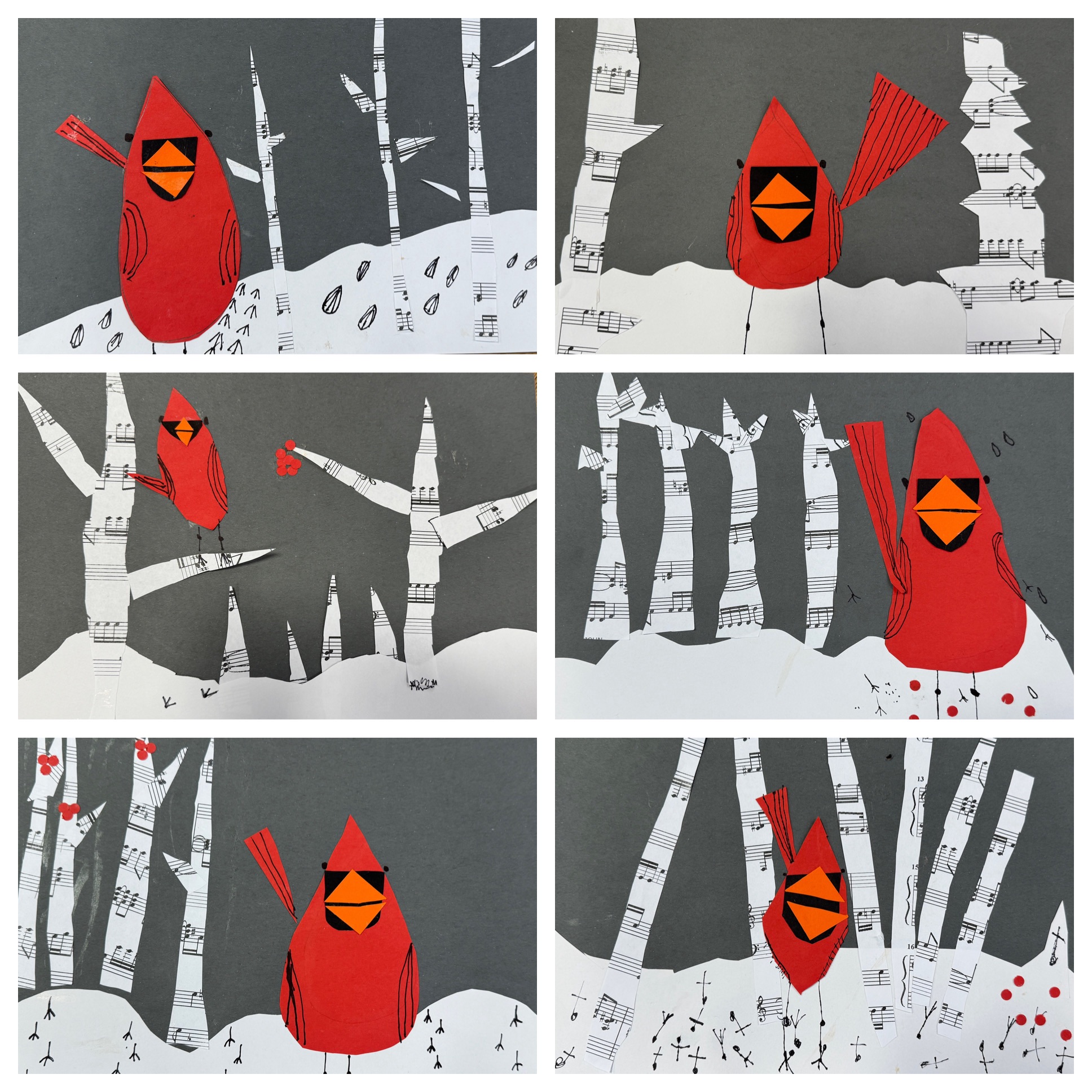
But honestly, the real payoff started to emerge in small moments as the week went on. My students started to point out metaphorical thinking throughout the school day, and in their own speech. On Tuesday, we returned to the book, Kiyoshi’s Walk by Mark Karlins as we embarked on writing 3-line poems about the cardinals we had created in the style of Charley Harper the day before. 

As I read the Haiku in Kiyoshi’s Walk, they pointed out the metaphors…a pile of oranges described as a “hill of orange suns.” Again, not every student is yet ready to employ metaphor effectively…yet, but the seeds are planted. So we wrote 3-line poems on Tuesday (I try not to have these poems be about syllable counts–trying instead to focus on ideas and word choice) and then on Wednesday, I asked students to go back to their poems and improve them by changing a word or two or adding another detail (revision!). Here’s a student who was clearly influenced by Eto’s poem in Kiyoshi’s Walk.

Cardinals

Champ 1964 St. Louis Wins

Cardinals fly to win

Trophy of suns

By J

When J read the poem to me, he pointed out that since trophies are golden, they are shiny like golden suns–something he changed from his first draft the day before. And I know, clearly his mind was on the St. Louis Cardinals (a favorite team) rather than on the bird we crafted the day before. But the win is in the poem–three lines, metaphor, revision…and pride in writing! I’ll take it! Another student wrote this to describe his cardinal.

The Red Cardinal

The red poinsettia feathers

keep me warm

and they fill the forest with love

By F

And there were also more subtle attempts like this.

Flying in the Wind

I see that cardinal

flying in the tree

just like the wind

By O

What I see is students experimenting, playing with ideas, playing with words…and growing as writers and poets (as well as readers and thinkers). I love that something as deceptively simple as reading How to Write a Poem resulted in our writing community learning together, composing together, and risking trying on some new techniques together. I am reminded once again of the power of poetry…so yes, I will continue to say, “More poetry please.”

How to Add Some Joy to Teaching

I can be a bit serious. Okay, maybe a lot serious. And sometimes that means that the classroom can seem like all work and no play…and we all know that first graders (and maybe all students) both want and NEED some play to help learning move along.

For some reason, my school decided that again this year our winter holidays (two weeks of no school) would bump right up against Christmas. I’ll be loving the holiday when January gets here, but to be honest, it’s brutal right now. Instead of children who are focused on learning to read and write (and all our other subjects of study), they have visions of sugarplums dancing in their heads! (Or maybe that is just the candy cane overload coursing through their bodies!)

I made a deal with myself as I planned lessons for this week–leave spaces for play, expect silliness and louder than usual volume, smile and laugh more, enjoy the moments.

So…I planned a small writing lesson.

I remembered this wonderful book of poems called The Proper Way to Meet a Hedgehog and Other How To Poems selected by Paul Janeczko and started flipping through. If I had my students write a “how to” something, they would have many choices of topic and could draw on all that they already know. But which poem would work as a useful mentor text to get them started? There are many good choices…but I was looking for something short, a bit whimsical, and an idea that my students might find unexpected. How to Scare Monsters by Rebecca Kai Dotlich was just right! It starts out easy, “Keep a light on, that’s the thing… and turns a bit in the second (of two) stanzas with “Aim for the toe (did you know this?)…

I read it a few times, letting students soak into the language. They noticed the strange notation (parentheses) and were intrigued. We talked about the extra information in there and they definitely picked up on the personal, friendly tone. We brainstormed things we are “experts” at doing, and that list included A LOT of sports! After I wrote a poem in front of them (How to take Photos of Egrets), they opened their notebooks and began their own How To poems.

Students immediately got to their writing (along with plenty of talking) and a number of them included the parentheses in their poems. As they began to finish and read their writing to me, I could feel the smile genuinely creeping onto my face. The poems were fresh and their voices came through loud and clear. Some of the topics were predictable, but some were not…like this one by O:

How to Catch a Rattlesnake

Go to a desert.

Find a hole.

(Maybe it’s a snake hole.)

If it’s a snake hole,

get a good stick.

And do not grab it by the tail,

grab it by the neck.

If you grab it by the tail

they will swing and bite you.

If you grab it by the neck

they will not move

except their tail.

Did you notice the parentheses? I had encouraged students to pick small topics rather than trying to explain a whole game. But, you know, some students want to do what they want to do. But somehow J captured this game in a nutshell. I bet you know what game it is!

How to Play Ball

Get two teams

9 is enough

9 innings

1,2,3 bases and 

one home plate in a square.

(One out is three hittable balls

Four balls you can not hit go to 1st base)

A hit

run as fast as you can go

until you are thrown out

or tagged out

You are out.

Three outs is an inning

touch home plate to get a point.

who has the most points wins

if you are tied

overtime.

And who doesn’t love a how to poem about riding a bike? It’s obviously a childhood classic! Here is O’s rendition. (This is a different O–I have many in this year’s class!)

How to Ride a Bike

This is how we ride a bike

without training wheels.

First put your helmet on

and then get on your bike.

And try not to look down

look straight ahead and pedal

and make sure nothing is in front of you.

And that is how you ride a bike

without training wheels.

And a short but sweet one by V who did take my advice and decided not to capture all of gymnastics but to instead focus on a single trick.

How to do a Cartwheel

Start in a lunge

Put your hands on the ground

Then when you put your hands on the ground

Kick your legs up

(One foot up first, then the other)

Land with hands by your ears.

These small poems started this week off with a dose of joy. Students enjoyed writing and reading them, I enjoyed hearing them and rereading them. No one whined that they had nothing to write about, no one got teary with frustration (including me), and we all enjoyed writing and sharing and teaching someone else about our individual expertise. 

Reminder to myself: be playful, small can be powerful, enjoy the wonders of childhood and read and write more poems!

So…if you need to add a bit of joy to your teaching or writing life, take a look at How to Scare Monsters and write some how to poems!

Let’s Write: Celebrating the National Day on Writing

It’s October 20th…and that means it’s the National Day on Writing! We started our day by talking about the reasons we write during our morning meeting. It warms my heart that most of my students mentioned either that writing is fun or one of our recent writing activities (writing letters or making zines) as their reasons for writing. I do feel like we are building a wonderful writing community in our first grade classroom. It’s a place to take risks, a place to express ourselves, and a place to build our knowledge and skills related to writing.

So after recess today, I read my students Kiyoshi’s Walk by Mark Karlin. In this lovely story, Kiyoshi is asking his grandpa where poems come from.  On each stop along the walk, Eto (Kiyoshi’s grandpa) writes a short three-line poem about something they see, hear, imagine, or feel…each adding to Kiyoshi’s understanding of where poems come from.  At the end, Kiyoshi asks his grandfather if he can write a poem…and writes a beautiful three-line composition for his grandfather. While technically the poems in this book are Haiku, I talked about them as three-line poems rather than engage in syllable counts for my students today.

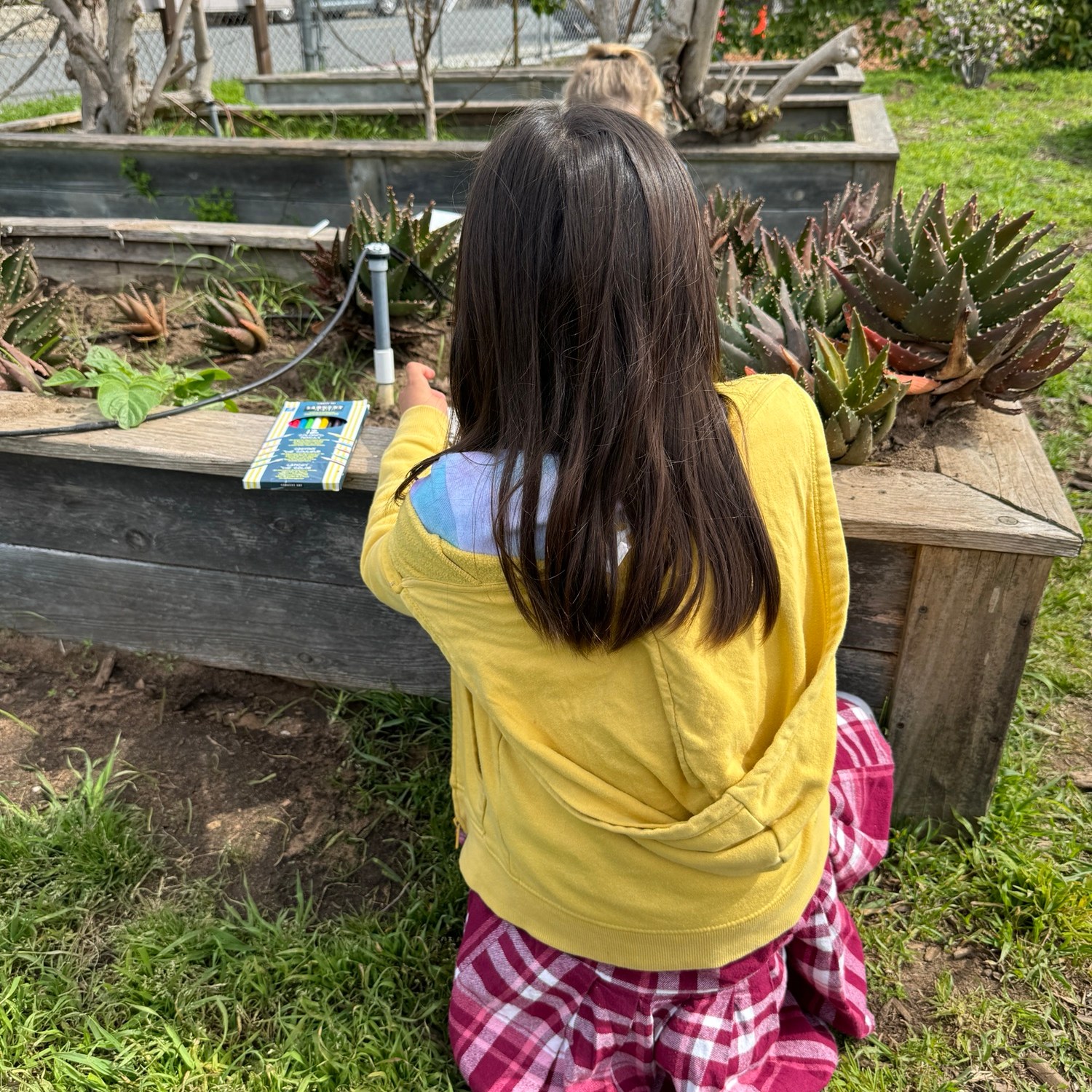
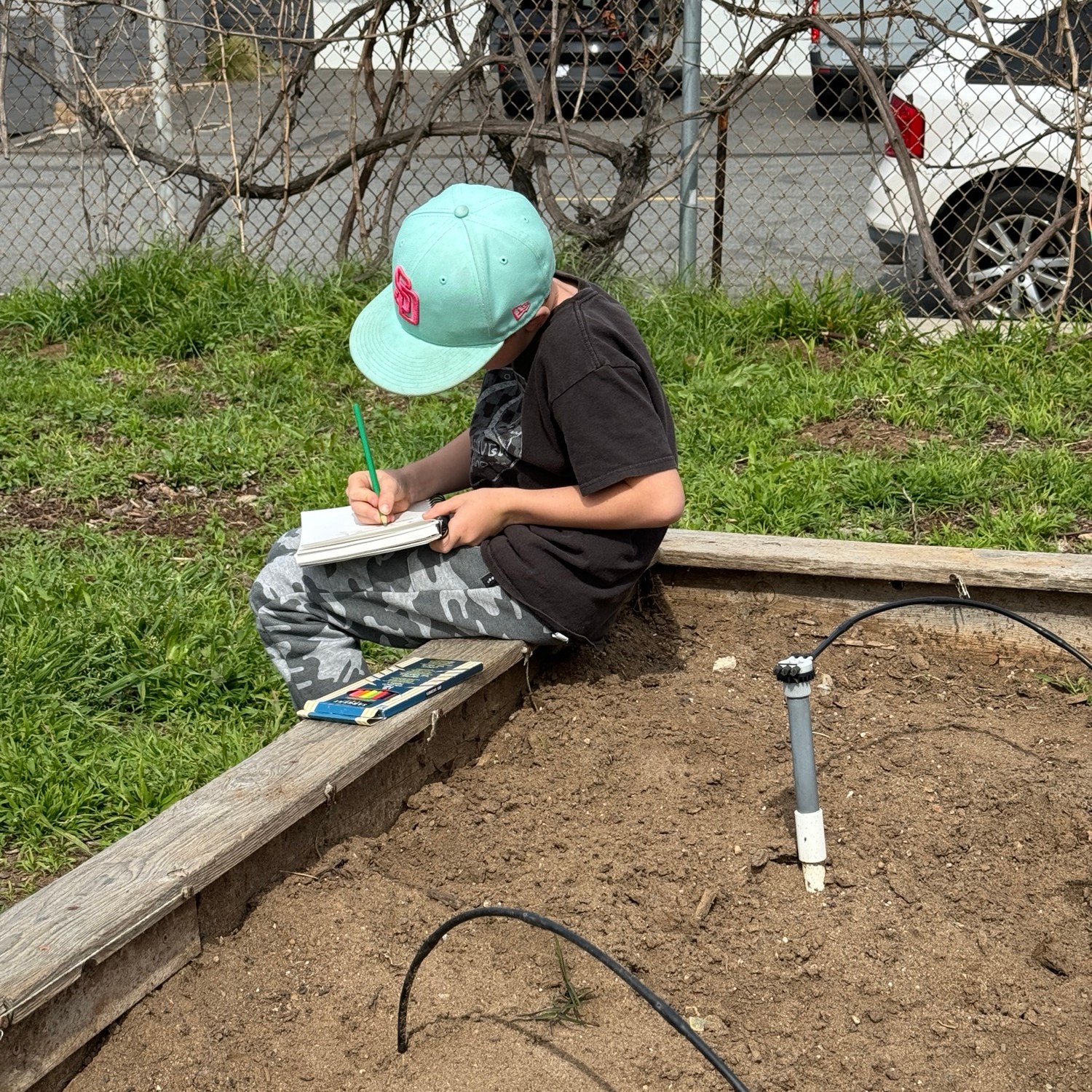
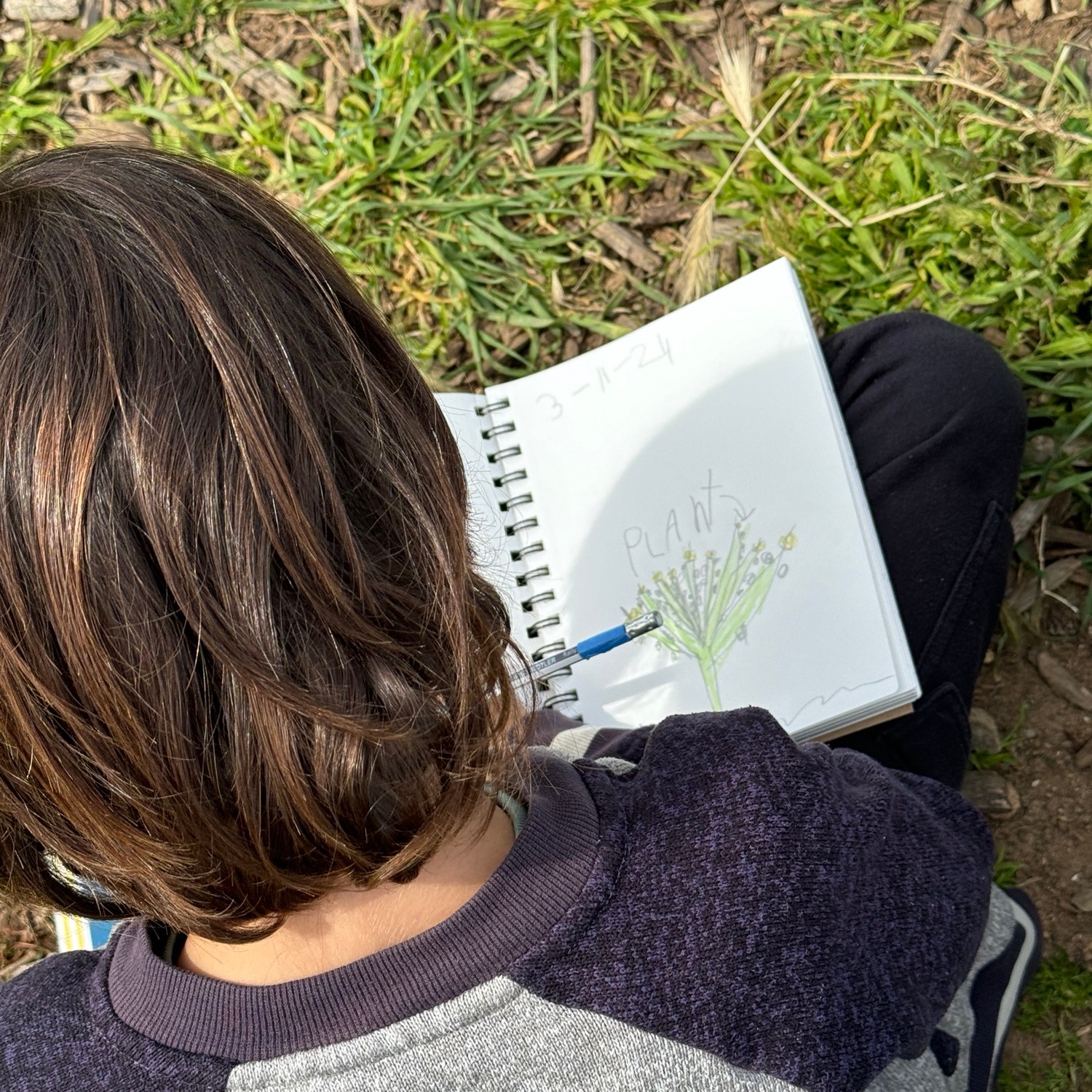
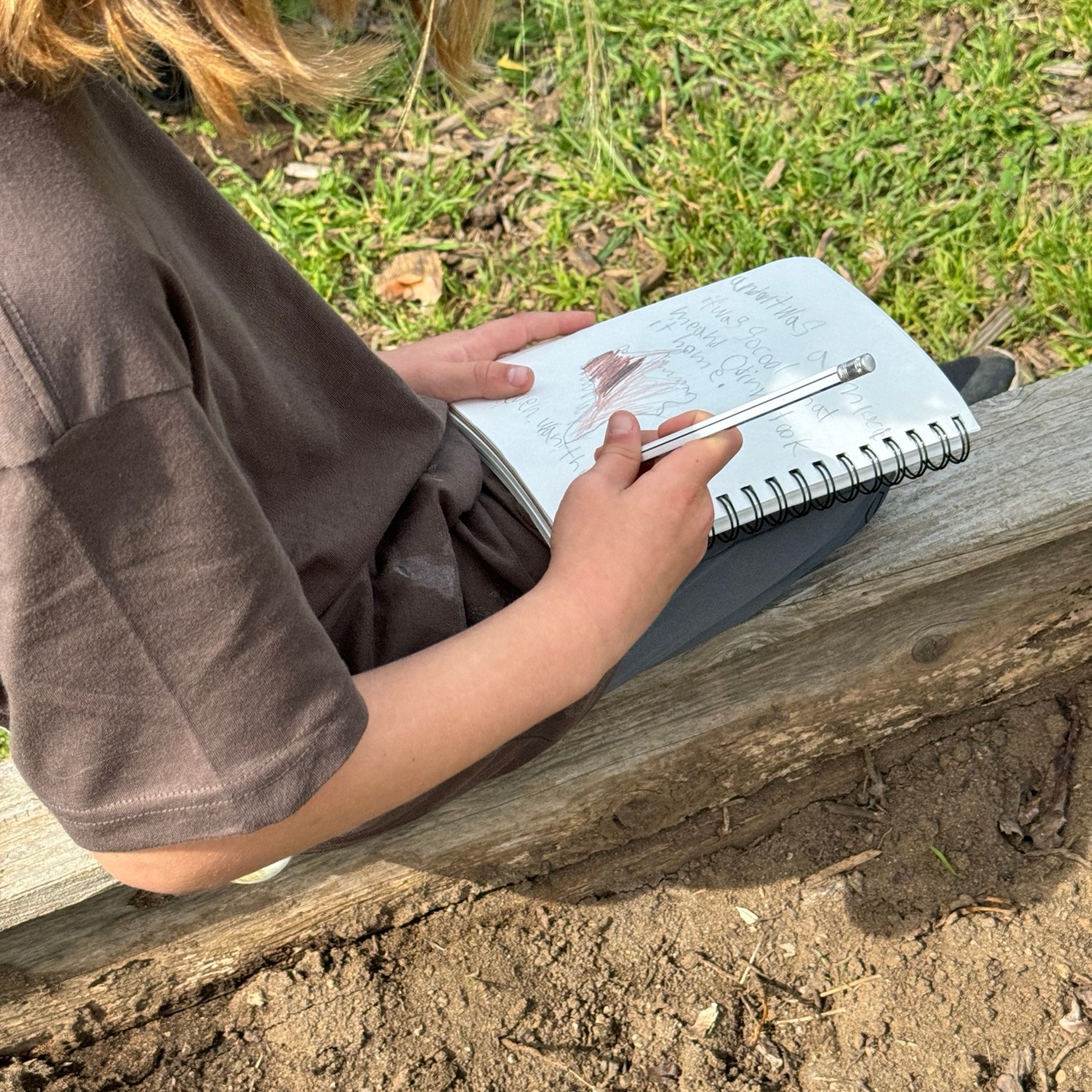
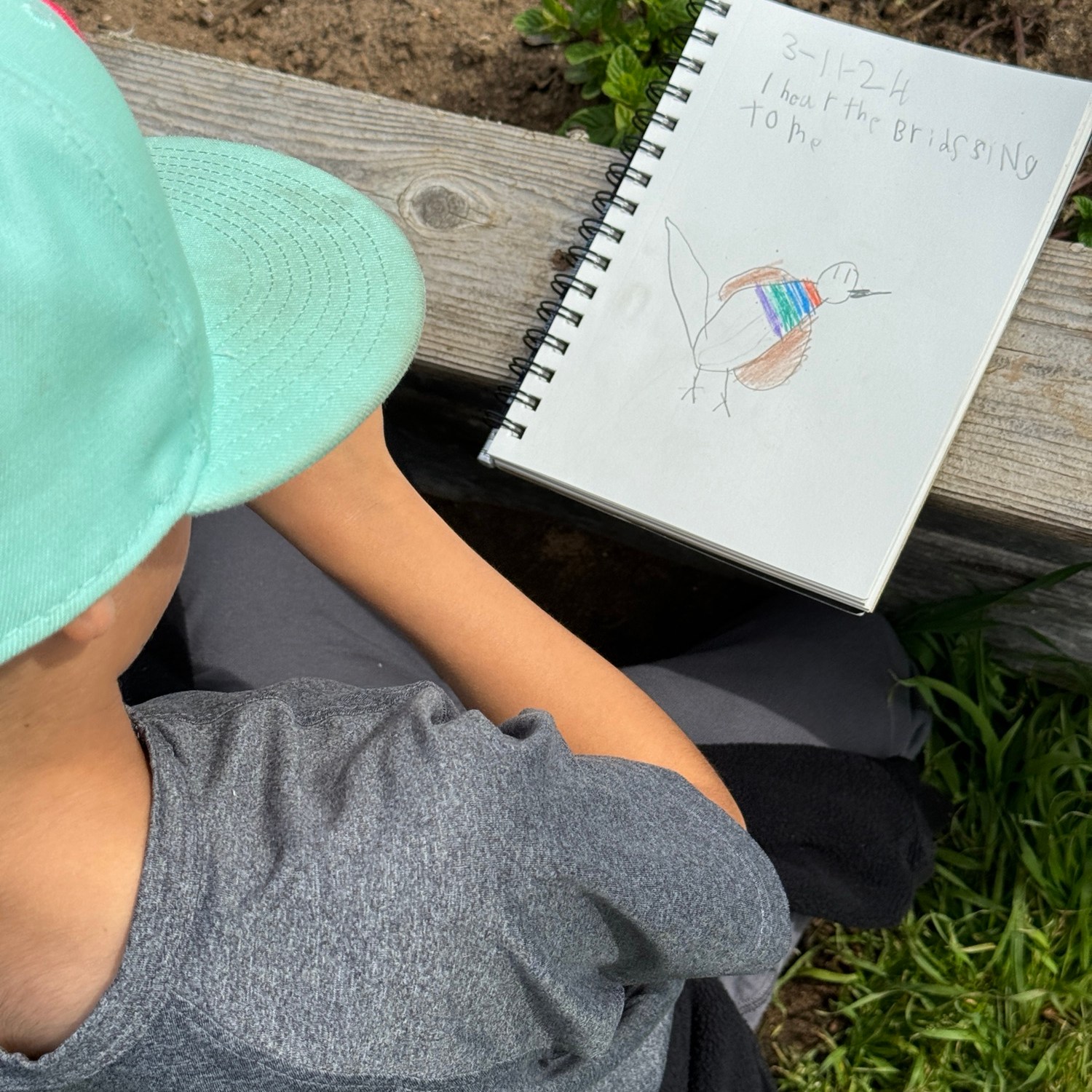
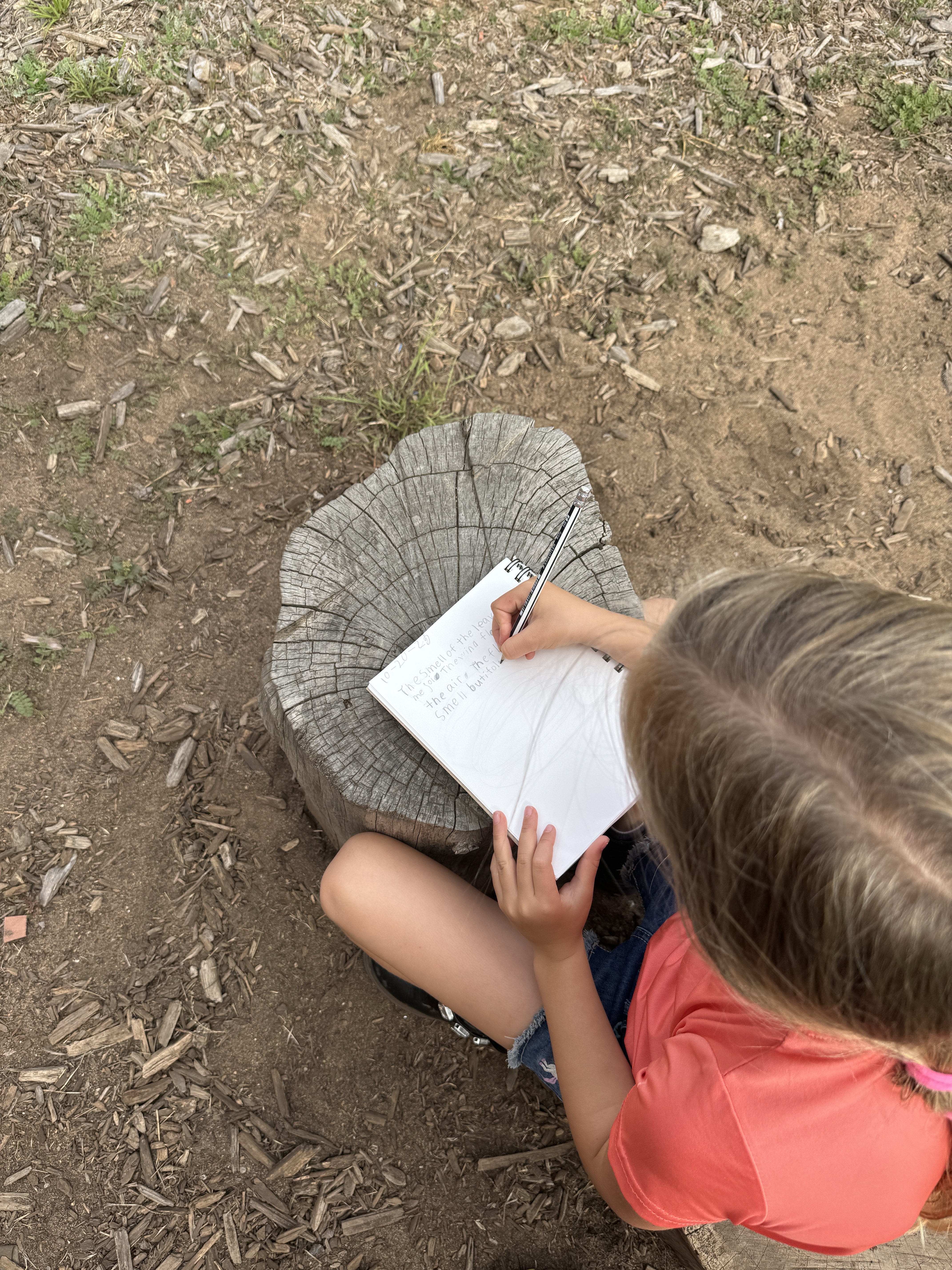
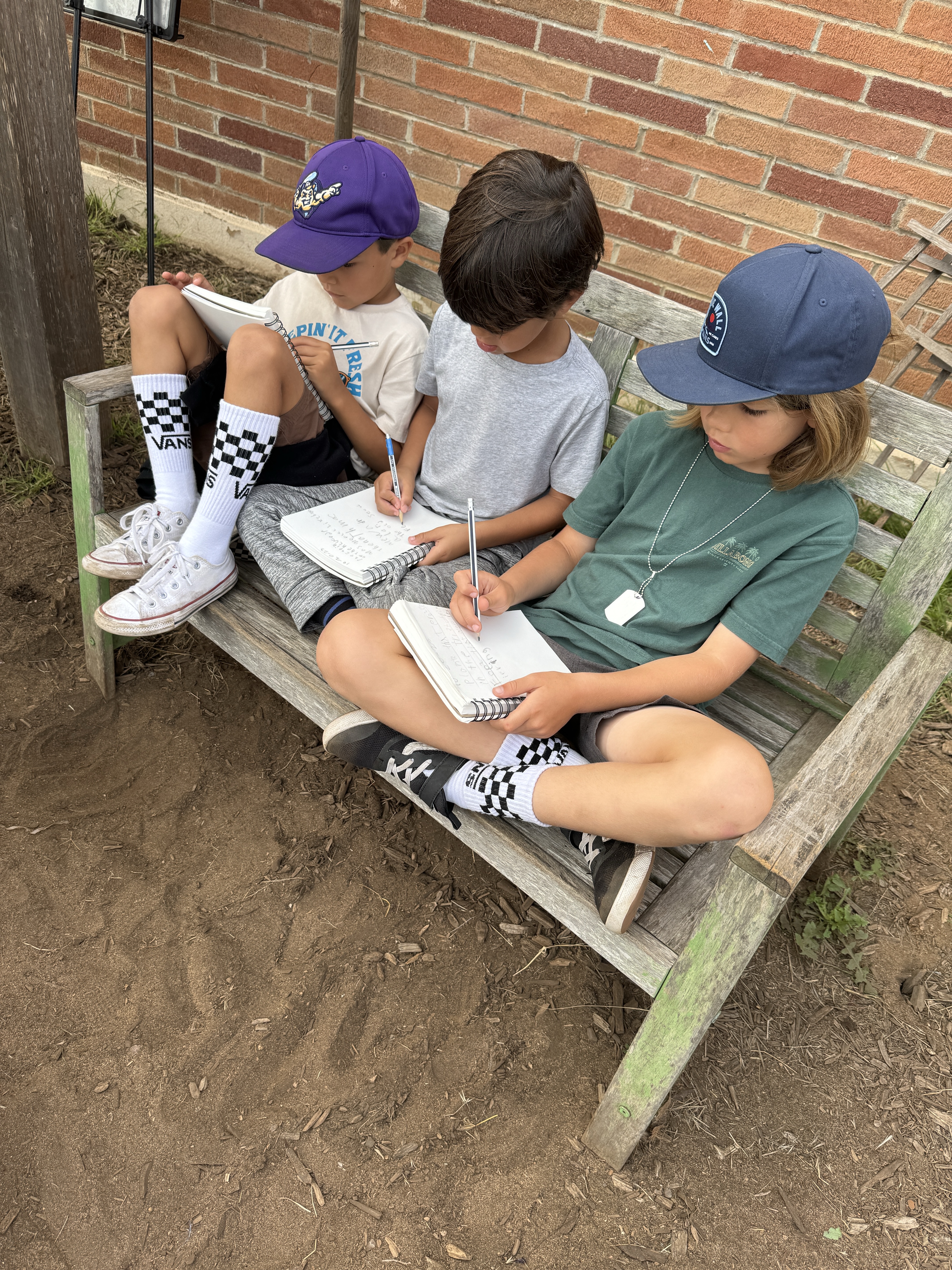
With this as inspiration, we grabbed our sketchbooks and headed out on our own walk, ending up in our school garden where we wrote our own three-line poems inspired by our walk and our time writing in the garden.

These first graders wrote as many three-lines poems as they could during the time we were in the garden. They wrote about the fog that wafted across the playground, the rollie pollies that they love to rescue from the sidewalks, ladybugs, passion fruit, the sky, tomatoes, potatoes, and so much more.

When we returned to the classroom, writers shared a few of their compositions and then picked their favorite to copy onto another sheet of paper and illustrate. While their poems are still developing, they are beginning to get the idea that there are many different reasons and inspirations for writing. Here are a couple:

I See a Butterfly by C

A butterfly flying

In the garden with yellow wings

Pollinating the garden flowers.

The Blowing Fog by M

The fog is blowing

The rollie pollies are crawling

The flowers are blooming.

I also know that being outdoors is a powerful motivation for writing for the first graders I teach. Changing our writing venue, writing in a sketchbook rather than a notebook, and writing under the influence of nature all keep writing fresh and novel. And my writing with them also matters. I hope they are learning that writing is not just for school, but that it is a lifetime pursuit that can serve many different purposes.

And I know that I don’t need #writeout or the National Day on Writing to keep writing at the forefront of the classroom–but it’s fun to know that there are educators all over taking their students outdoors, playfully approaching writing tasks, and making writing something students love…for so many different reasons.

So I leave this post with the NDOW question, Why do you write?

Inspired by Nature’s Colors and a Poem

We study a poem each week in my first grade class and this week’s poem was Choose a Color by Jacqueline Sweeney. The first lines are… If I were brown I’d be cattail or turtle deep burrowed in mud… In our study we notice, we discuss, and we illustrate the poem. Today, we went a step further and. used the poem as a mentor text for our own writing.

Although my students didn’t know it at the time, I primed the pump earlier this week by posing the question, if you were orange, what thing in nature would you be? And then as they picked the thing (garibaldi–our state saltwater fish, a tiger, a fox…) I encouraged them to stretch out their idea…what is the thing (animal, plant, form) doing? And then today as part of our morning meeting I posed the question again, this time asking about yellow. So by the time we were ready to write after our snack recess, students had ideas galore! I asked them to include at least 3-5 colors in their own nature-inspired color poem.

Today is our minimum day, so time was limited. Students wrote and then used their crayons to illustrate. While we didn’t have time to go outside for our #writeout effort, we let our love of nature and color inspire our writing.

Here’s a few examples (typed by me for reading ease):

Choose a Color by M

If I were turquoise I’d be the cool ocean rising onto the shore. If red fire blazing in a forest. If yellow the sun blazing down to earth.

Colors that I Know by V

If I was blue I would be rivers floating by.

If I was purple, violets in spring.

If pink I would be a flamingo.

If green I would be grass swaying in the wind.

One of my more reluctant writers is now picking up the pencil and getting started. I noticed he was writing short–just picking a color and saying the thing. I quickly went over to get him to stretch past…but I could see him starting to shut down. I leaned in close and learned that he couldn’t do it because there wasn’t room…and he didn’t wait to erase. It was the perfect time to teach him a tool. I showed him how he could use a symbol to show that he needed to continue on another page. Lucky for him, he had written on the right hand page, leaving the left side open for those additions. This felt like a bit of a breakthrough teaching moment!

Colors of Earth by J

If red fire to be hot.

If yellow sun to be high in the sky.

If violet the sea to be big as a lot.

If brown wood as campfire wood.

And then there is my Star Wars aficionado who can turn any writing invitation into a themed piece that is Star Wars from start to finish. He checked in with me…does it have to be nature? I reminded him that we were in the midst of #writeout and so were sticking to a nature theme. Here’s how he made it his own!

Colors that are not Primary by O

If light blue I would be a pterodactyl hunting. for food.

If I’d be black I would be stegosaurus drinking water.

If I’d be green I would be sabertooth tiger running from a volcano.

It’s such fun to watch my first graders grow as writers, learning to add details and stretch out their compositions, and to find their own writing voices. And what better writing invitation than #writeout?

Under the Influence of Acorns

On some days, my students and I head outside for inspiration for our writing and learning and on other days, we bring nature right inside the classroom. Fall is known for leaves changing colors, animals preparing for winter, acorns dropping… But in southern California that isn’t what we see outdoors. Our trees are mostly green, the weather is warm, and no one really hibernates. But in first grade students don’t seem to notice that our fall is different…and so, we often import the icons of fall.

Yesterday after reading, Because of an Acorn and talking about the interconnectedness of plants and animals, we watched a video from a park ranger at Sequoia National Park where we learned more about oaks, acorns, and the communications between trees. And then I pulled out my stash of acorns, saved from a year ago when a friend from the central part of our state shared some from her neighborhood. My students examined these extra large acorns carefully, delighting in the texture of their caps, the smoothness of the acorn itself, and the way it rattled when they shook it (they have dried out somewhat after being in my classroom for a year). Then then carefully sketched the acorns and some oak leaves (using our book as reference). Many spontaneously began adding notes, noticing the point at the bottom, the variations in color, and more. Obviously the note taking carried over from our nature notebooking described in my previous post.

In this case, the goal of the sketching was practice for a watercolor project. Our subject was the acorn, and then we experimented with three different watercolor techniques: oil pastel resist (using oil pastel to create a border to keep paint from running), wet on wet (painting the background with water before applying the paint), and then adding some pinches of salt to create a starburst effect. First graders have so much freedom as artists, they grab the oil pastel with confidence, seemingly not worrying that they will not be able to erase a mistake. They drew and painted…with stunning outcomes.

And since the ranger in the video offered as a prompt, imagine a dialogue between trees…which we expanded to include a conversation between acorns and oaks, students experimented with writing about that interaction. They are new to the writing of dialogues, but their first drafts show some promise. Here’s a couple (typed by me for ease of reading).

An acorn falls off an oak tree. Am acorn hangs from a branch. An acorn drops and a chipmunk will eat it. Hi oak. Are you going to drop the acorns? Oh. I will when it is fall. Hey oak trees, you want to drop acorns! Now it is fall. The oak trees wait. Let me tell the other oak trees so they know. Now it is winter. The animals are hibernating. The bunnies are gathering food for winter.

And…

A squirrel asks an oak tree, can I have one acorn? The oak tree said no you can not have an acorn. Acorn said please! Okay said oak tree but I’m keeping an eye on you! And if you grow into a tree then I will talk to a scientist, so don’t forget squirrel. But wait! I have to tell the other oak trees so we can do a masting said oak tree. Hey oak trees, let’s do a masting yelled oak tree. The oak trees did.

My students were most impressed with their own volume of writing, most filling more than a page with their words. I love that they picked up on some of the science from the video–the idea of a masting, the phenomenon where oaks drop an extreme number of acorns every 3-5 years was information directly from the park ranger.

How are you letting #writeout influence your writing and the writing of your students?

Time to #WriteOut!

I love October. The weather is warm–it’s still shorts weather. Many of the tourists have gone home, leaving the beaches and the freeways to the locals. My first graders are starting to believe they are writers–and it’s time for #WriteOut! #WriteOut is a partnership between the National Writing Project and the National Park service–a two week effort to encourage everyone to get outside, explore the nature around you, and write.

Last week we warmed up for #WriteOut by going for a Wonder Walk on our school campus. We started by reading the book Wonder Walkers by Micha Archer. This is a wonderful book full of questions like, “Is the wind the world breathing?” that also pushed my students to think beyond the literal, framing their observations through the lens of wonder. After reading and talking, students took their nature collectors (a piece of cardboard with rubber bands around it) and headed out to our pollinator garden to look and wonder and pick up some bits of nature to bring back into the classroom with us.

Later students had to pick just one item from their collection to examine much more closely. To facilitate that close observation, we pulled out our sketchbooks and started drawing, trying hard to capture all the details they could see in front of them. Using colored pencils to hone in on subtleties, they added dimension to their sketches. Then using nature notebooking prompts adapted from the work of John Muir Laws including labeling their sketch, adding what does it remind you of and what do you wonder about it, students completed their entry.

The results were stunning. And a perfect beginning to #WriteOut!

Slow as Snails: SOL23 Day 14

First graders are slow, especially when you want them to speed up. Today we were running late to get out to the line of cars picking students up after school. I was hustling along, trying not to tie up the line that sometimes snakes out of the parking lot, down the street, and then threatens to spill out onto the busy street around the corner. I turn around and I have only one student with me. The rest have stopped back inside the gate where they are crouched down, faces peering closely at the rain-wet sidewalk. Parents are peering in, probably wondering just what is holding their children up in there. But I knew. My students are nature lovers with the softest, kindest hearts and no regard for time as we adults know it. And sure enough, they were saving a slug from the potential trample of the oncoming feet of other classes.

On so many occasions, my students seem to slither forward, maybe an inch at a time. Putting away headphones and iPad–that seems to take an eternity. Zip up the backpack (if you have managed to cram the items actually into its belly instead of having them slip out in all directions), another lifetime. Put your name on your paper, along with the date…still waiting.

But head down to recess…wait, don’t run me over! Where did this speed come from? These slow-as-snail kids can go from 0-50 in no time when the word recess is associated!