Yesterday I wrote about my moist and cool foggy walk on the beach, today was like whiplash. Clear and twenty degrees warmer meant the beach felt like summer. At almost 7pm it is still in the low 80s! (Thinking of all my friends not on the west coast who are dealing with storms and cold temperatures!). None of this is normal or expected. While spring breakers are loving it, I’m not convinced this is a good thing.
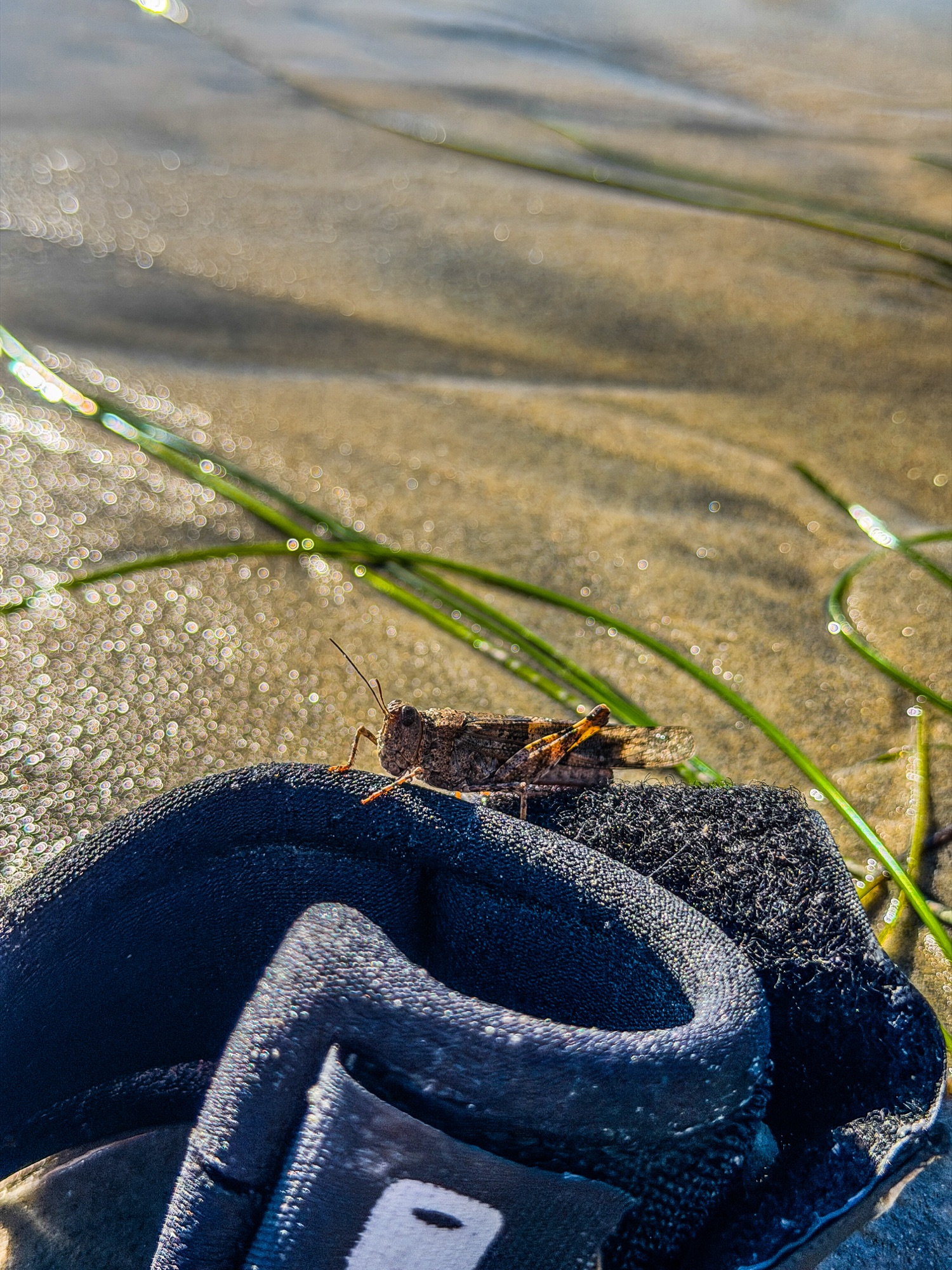
As we meandered along the shore I noticed a grasshopper perched on an abandoned piece of surfboard leash. What? Grasshoppers are not usual beach inhabitants. I leaned in close, trying to get a grasshopper portrait without making it leap away. I wanted to get close enough to see details and not capture that blur that happens when the focus and distance don’t line up. After a few tries, I got this unexpected shot.
I was feeling a bit uncertain about how this St. Patrick’s Day would go, especially when my students greeted me this morning with tales of leprechaun escapades that happened in their homes overnight. Glitter in the toilet, messes in the kitchen–and kids so excited they could barely contain themselves. But somehow, all that excitement channeled into a pretty calm classroom–that was unexpected (and felt like a St. Patrick’s Day gift).
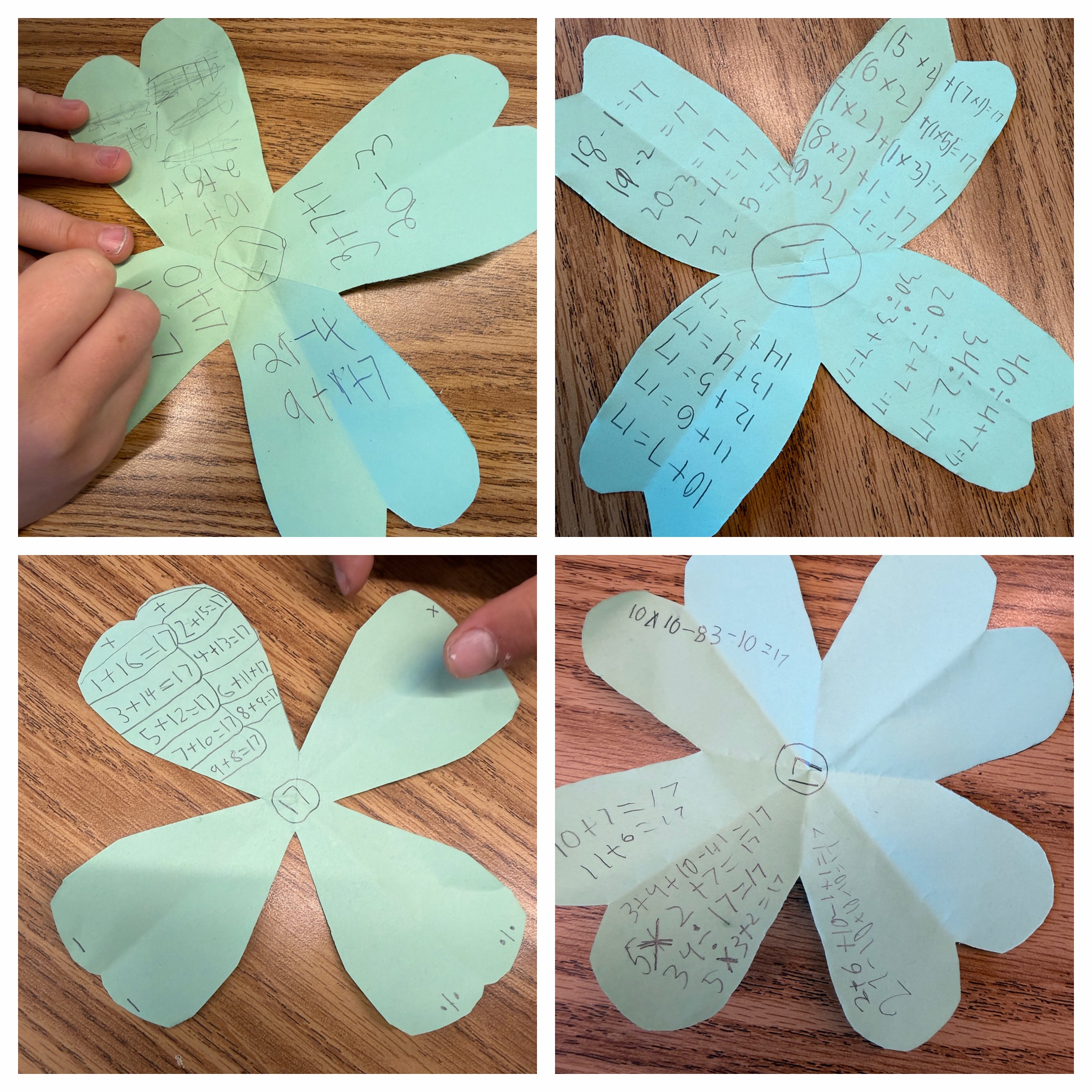
We did some folding and cutting to create some lucky 4-leaf clovers–after we talked about their magical qualities (many of the first graders said they had experienced finding these rare and magical items). Most students were successful right away, and those who weren’t got theirs to come out whole on their second attempt. Then we turned them into some fun math. They wrote the number 17 in the middle (after all, it is March 17th) and then wrote math problems that equaled 17. Another unexpectedly fun and successful activity.
I like when the unexpected makes my day easier and more interesting. I also like paying attention to what is unexpected and why I identify it that way. Is it too much to wish for the rest of the week to be as pleasingly unexpected?
Earlier this week I read the book, Be a Treeby Maria Gianferrari to my first grade students. I’m so fortunate to have an amazing librarian at my school who seems to know just what books I’d love to read before I’ve ever heard of them! Anyway, Be a Tree is a gorgeous book that is a blending of factual information about trees and metaphorical thinking and comparisons of humans and their communities to trees and their ecosystems. And the illustrations by Felicita Sala are worth just sitting and poring over.
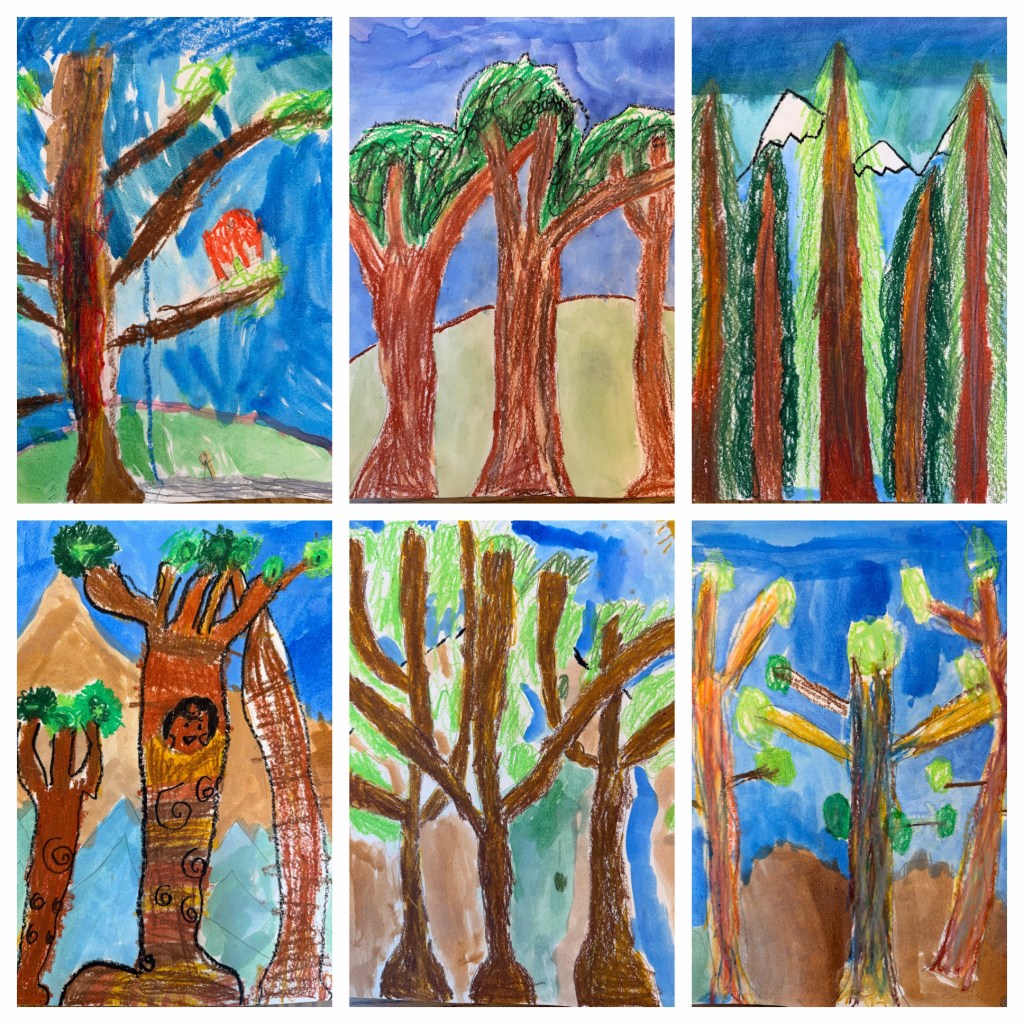
I mentioned last week that I had taught my students some photography techniques, one of which was the bug’s eye view. So after reading and examining the photos in Be a Tree, we took out our sketch books and practiced drawing a forest (okay, 2 or three trees) from a bug’s eye view…with a real focus on the trunk, looking up like a bug would from the ground. Then we also took some times to think and write a list of all the ways we need and use trees.
The next day we sketched our forest again, this time on larger watercolor paper and then used oil pastels to blend colors to create texture and depth on the trunks and branches. Today we pulled out our watercolor trays to paint in the backgrounds. Honestly, the results have exceeded my expectations.
First graders also tried their hand at writing some tree metaphors. Here’s a few:
The roots can be the tentacles of an octopus.
Trees shake their branches like hands waving.
Pine trees are as sharp as mountain tops.
Tree bark is as brown as chocolate ice cream.
I love watching students grasp a new technique and/or way of thinking. Their ability to identify a metaphor is currently much stronger than their ability to generate one of their own. But that’s all part of the learning process. and the beauty of giving space to try on new ideas.
And there’s nothing better than wrapping all this learning in an appreciation of nature and all that it offers. There’s so much to learn from trees…and kids.
For nearly 14 years I have been taking a photo (nearly) every day and posting it to social media, specifically to Instagram (you can find me @kd0602. In many ways it is a part of my writing practice. The camera helps me pay attention and when I pay attention words begin to flow. (I also started my blog at about the same time)
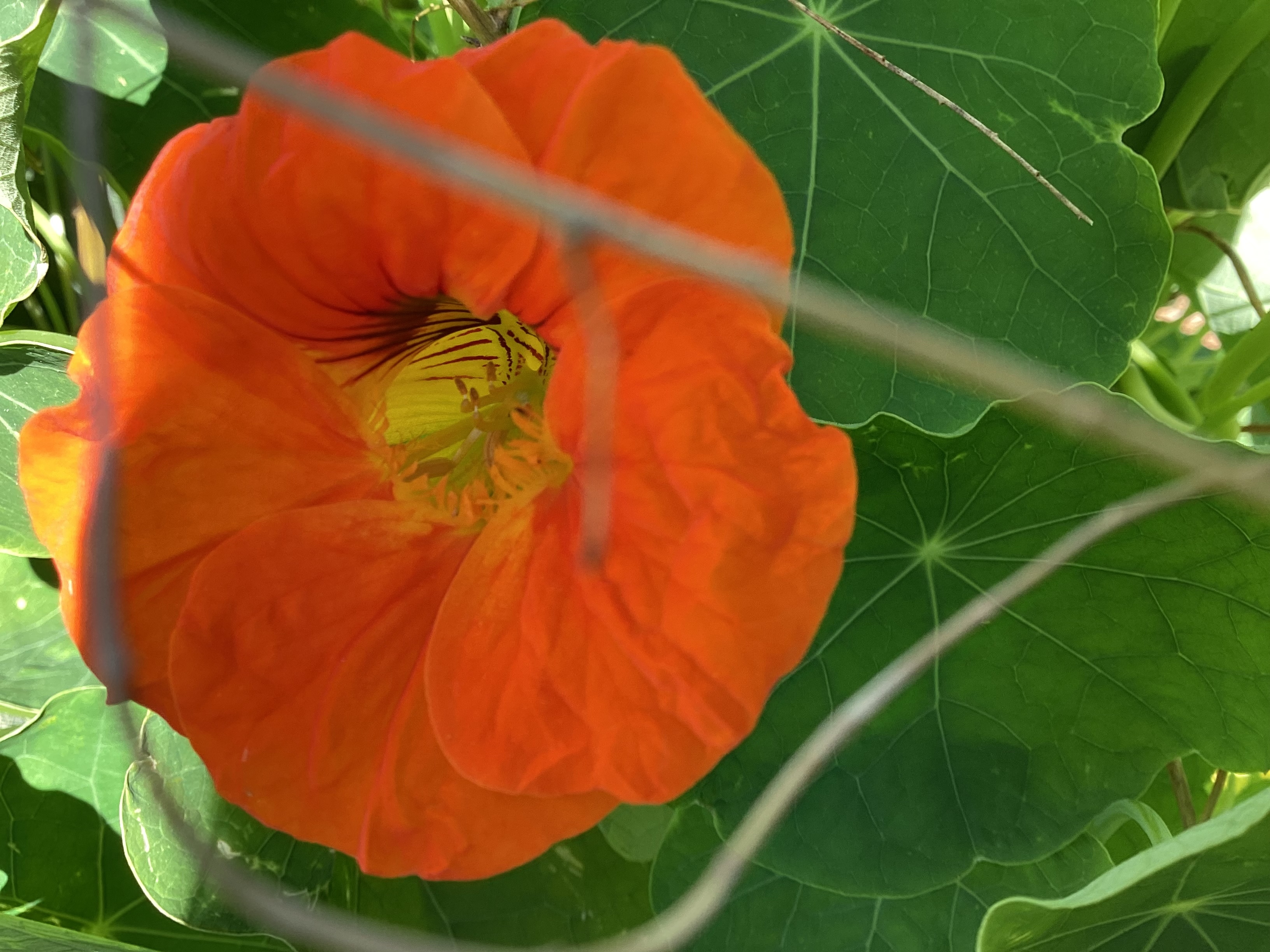
I’ve also gotten in the habit of sharing my photography practice with my students, specifically teaching them some techniques to try on in their photography. Last week I showed first graders examples of photos taken from a bug’s eye view, a bird’s a view, and using the rule of thirds. They were excited to try this out! We headed out to our school garden where students were to take three photos using each technique. (And to try not to all take the same photos!). We returned to the classroom to take a close look at the 9 photos and select the one that would then become the basis of the writing we would do.
I was pleased with these first grade photos. I can see the bug’s eye view, the rule of thirds, and the bird’s eye view (and my students were eager to explain their perspective to me!).
When I woke up this morning I discovered that today is World Kindness Day. I don’t teach on Thursdays, so I didn’t have any plans to engage students today–and to be honest, I didn’t even know it was World Kindness Day until I saw it pop up on social media.
The irony is that we have been celebrating kindness in our classroom–both last week and this week. Last week, after reading Brett Vogelsinger’s blog post on Moving Writers titled Poetry Pauses for Peace Day 2 I couldn’t wait to share the mentor poem, Peace: A Recipe, with my young students. My students have a sense of recipe–they make cookies and muffins with their parents–but making a recipe for something abstract like peace was new for them.
Even before reading Anna Grossnickle Hines’ poem, I had asked my students what ingredients they might include if they were making a recipe for kindness (Brett had suggested having students write a recipe for hope, but kindness felt like a concept my first grade students would have more ideas for). There was no hesitation as hands began to raise. Honesty was the first ingredient mentioned. How much would you include, I asked? A pound was the answer. Then students contributed other ideas: caring, sharing, and including others. Every time I asked for an amount, the response came back in pounds! Even when I suggested maybe a teaspoon or a pinch–the answer was no, 5 pounds or 3 pounds or some other number of pounds. Clearly students thought we needed a extra large batch of kindness!
Studying Hines’ poem, we noticed words that were about cooking, expanding their understanding of recipe components. We underlined those words and drew illustrations for the poem before heading out for lunch. Time got away before we had time to write–but I kept my plan for writing in the back of my head to come back to when I had time.
Monday was a strange day this week. We had school followed by a holiday on Tuesday (Veterans Day)–my students had two special classes on Monday, so my time with them was limited. But…I did have time to come back to the idea of writing a recipe for kindness. Before we began we brainstormed a variety of cooking words and then students got to the writing. They started with ingredients (that expanded past the ideas we had last week)…and they wanted to be done. But, I reminded them, you have to say what to do with the ingredients. And they did.
There was so much success, even from my more reluctant writers. In celebration of World Kindness Day, here’s one example:
Kindness: A Recipe
To make kindness
you put a pinch of honesty
And a spoonful of helping
And a handful of respect
And you mix it
And you spread it around the world
And that’s it.
Thanks Brett for the nudge and Anna for the inspiration. And to all the first graders in my class, I’m excited that you are the ones cooking up kindness to spread around the world!
I love children’s picture books. I might even fancy myself a connoisseur of sorts. I have old favorites, but I am always on the look out for new titles. Apparently I have a “type” when it comes to books. Our school librarian can pick a book for me…and most of the time, it is a perfect book for me.
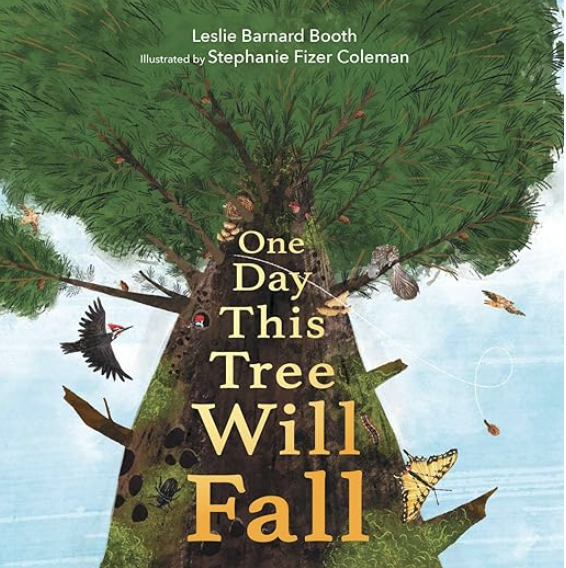
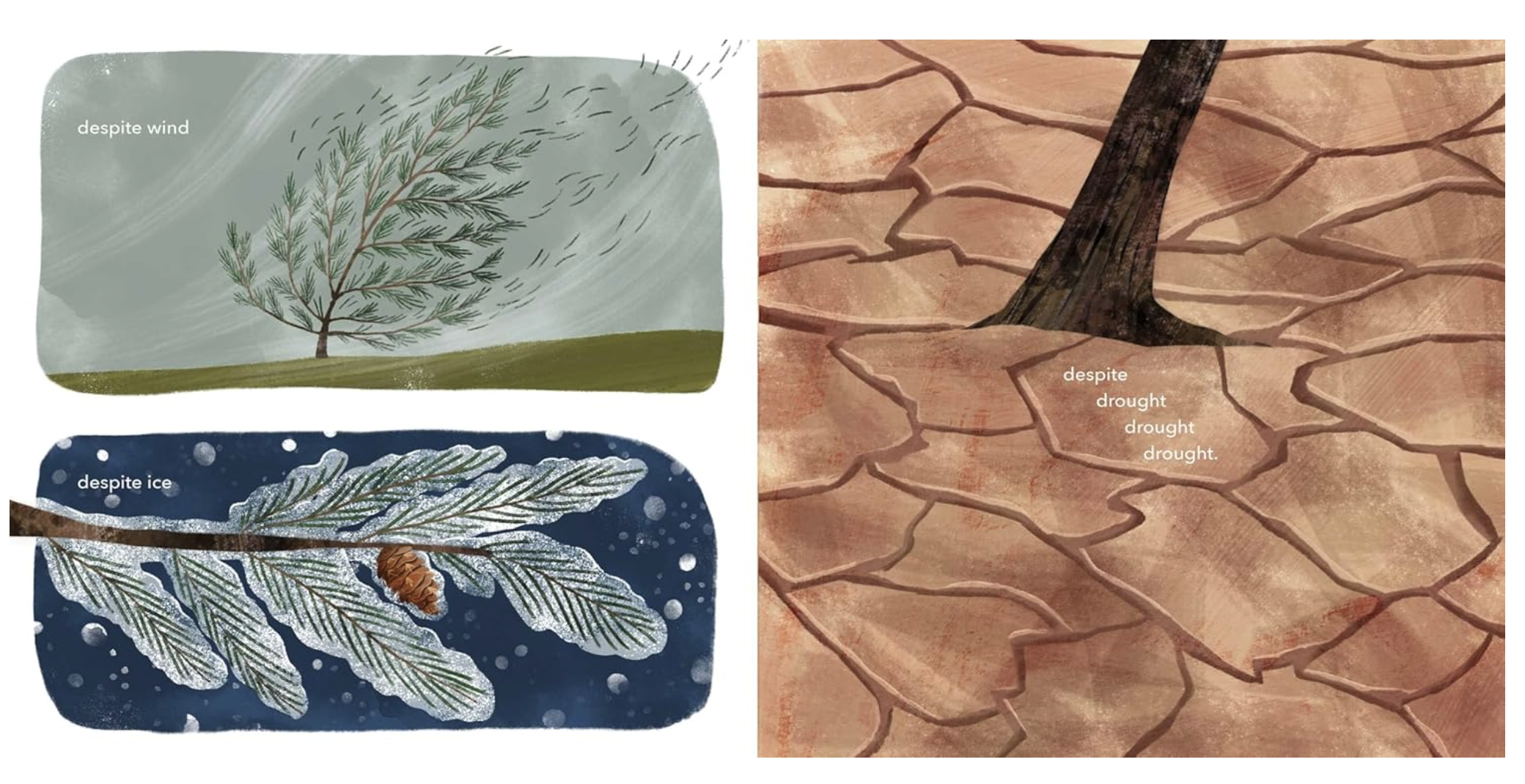
One Day This Tree Will Fall by Leslie Barnard Booth appeared in my book bag a week or so ago…and before I even opened the cover, I was pretty sure it was a book for me. When I opened it and read through it, I nodded to myself. Yes, I’ll be reading this to my students, I said to myself. But of course, the true test is reading it aloud to kids.
Ah…the language flowed. Rhymes mingled with repetition, questions jumped in creating a refrain like a long lost friend. And wrapped in this gorgeous package was an appreciation of nature and an acknowledgement of the resilience and fragility of this ecosystem along with the introduction of important concepts like drought and decomposition (we had quite a discussion about drought–something we deal with regularly in our Southern California community).
Honoring the value of scars and hardship is a river that runs along the story of the tree. It’s a story of ecology and of acceptance and inclusion. When I finished reading it I told my students I knew I would read it again.
And I did. Later that same day, before we headed into some writing under the influence of acorns, I read the book to my students again. They didn’t complain. They noticed more…and so did I. I’ll be reading this one again…probably even buying my own copy. If you love great non-fiction for children, written with attention to the beauty and purposefulness of language…you’ll love this book. I’ll probably read this book to my students again before the school year ends! It really is that good.
In my first grade classroom, we started #writeout way back in August. Our school garden is a perfect place for observation and writing. By the second week of school we were out in the garden with our clipboards looking closely, sketching carefully, and adding captions as well as considering what the object they were examining (a passion fruit, a ladybug, a yellow cherry tomato) reminded them of. (I start planting that seed of figurative language very early in the school year!). We continue to venture outside, at least monthly, with our sketchbooks in hand, sometimes on a color walk, sometimes in search of questions… You can check out a variety of past explorations through this year’s #WriteOut choice board. Let’s Take a Wonder Walk is my offering.
While sharing information about #WriteOut at a recent San Diego Area Writing Project conference, I overheard someone mention the book, Through Georgia’s Eyes, which reminded me of the powerful connection of Georgia O’Keeffe’s art and close observation in nature. I returned to my classroom, pulled that old favorite picture book out along with another Georgia O’Keeffe picture book, Georgia’s Bones and created a plan for introducing my students to this incredible artist, encouraging close observation, carefully enlarged sketching, and descriptive writing.
We’d been on a Wonder Walk the previous week, using nature collectors to pay attention to small natural items around our schoolyard. Students picked one and sketched it. They were small drawings, nicely done, and the perfect prelude to this introduction to Georgia O’Keeffe and her attention to detail. Knowing I had a bin of seashells stashed in a cabinet in my classroom, I pulled them out and picked out a selection of some of the most interesting–enough that every student would have variety to choose from and varied enough that the shells were mostly different from one another.
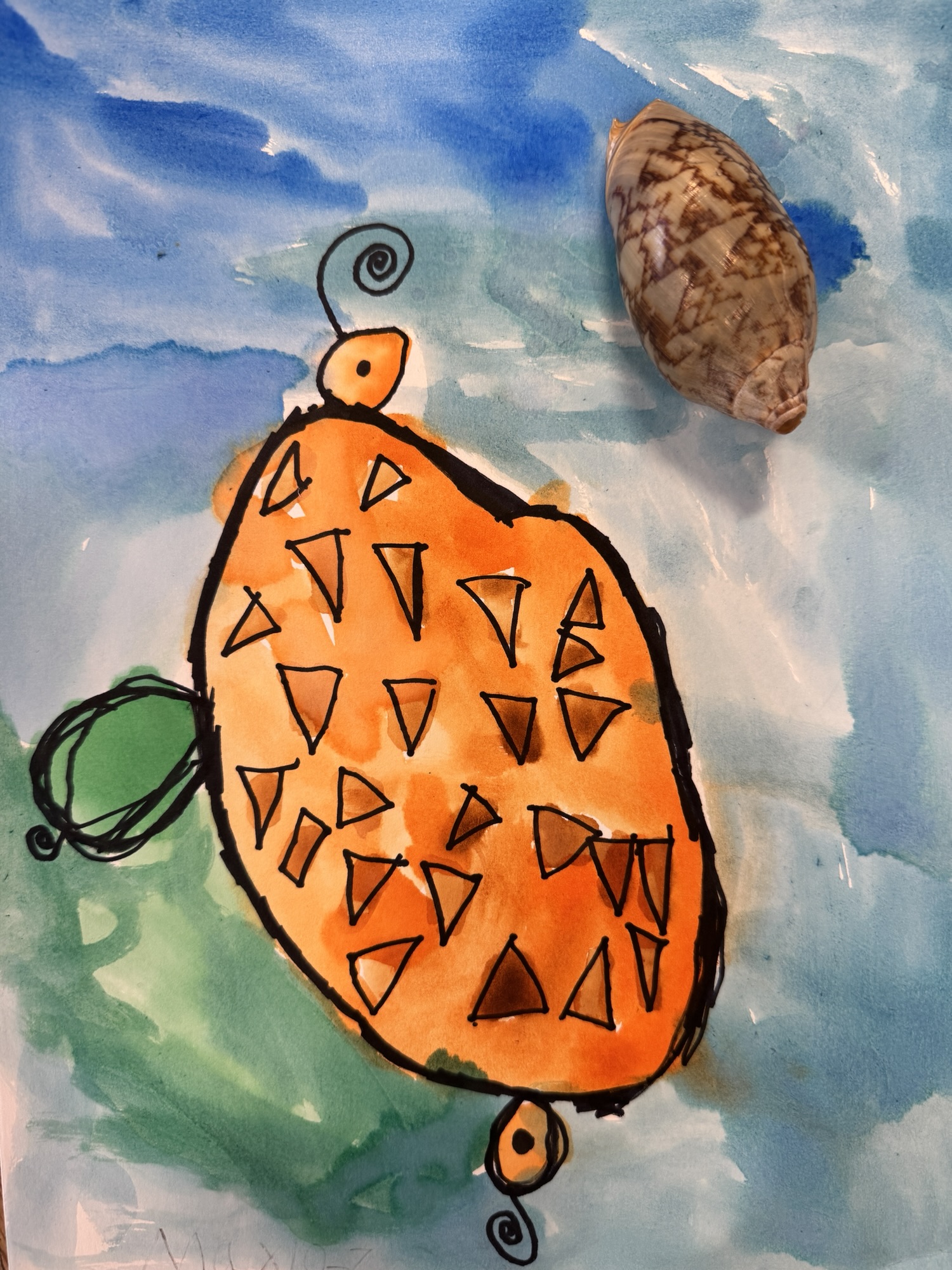
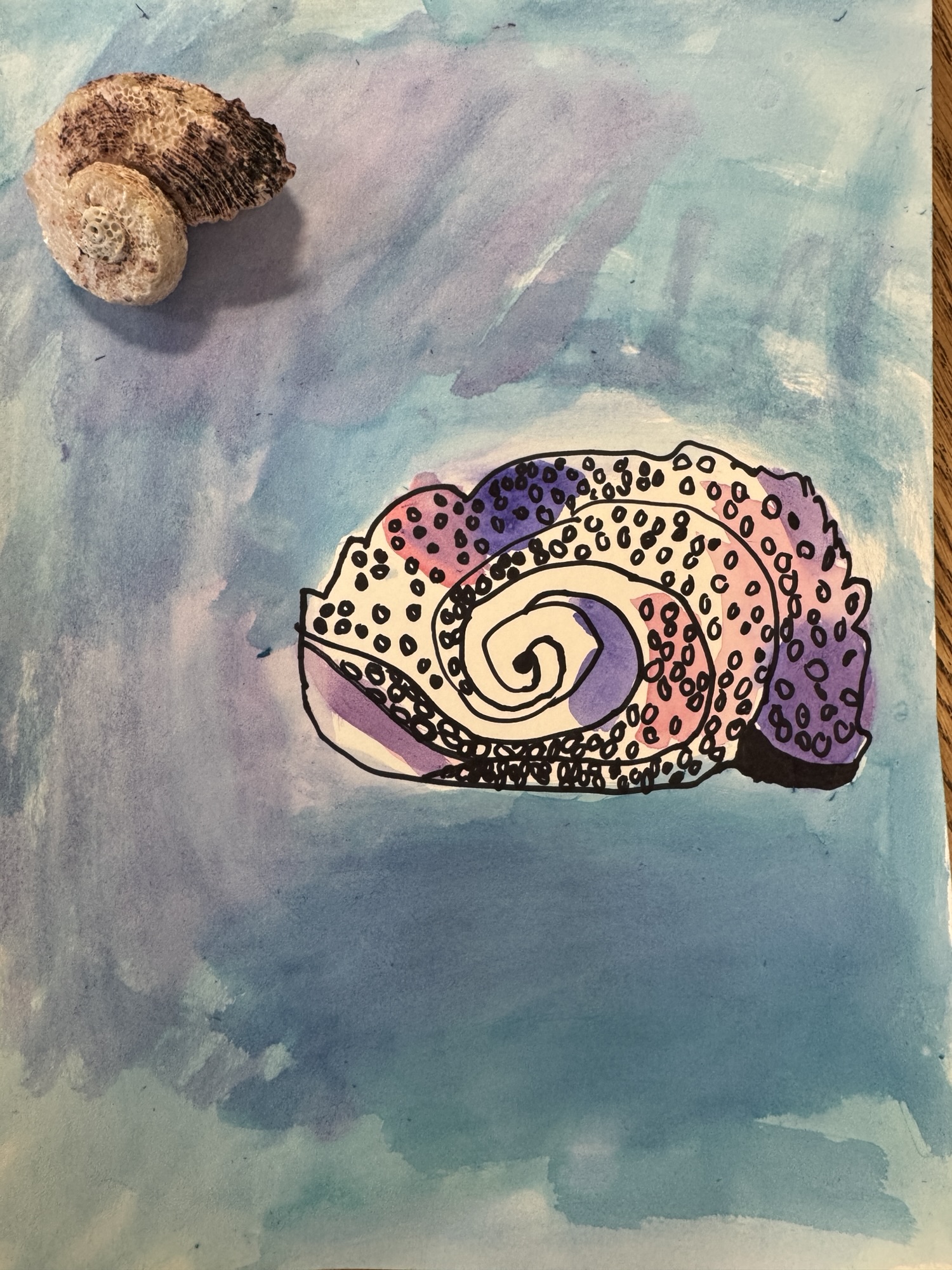
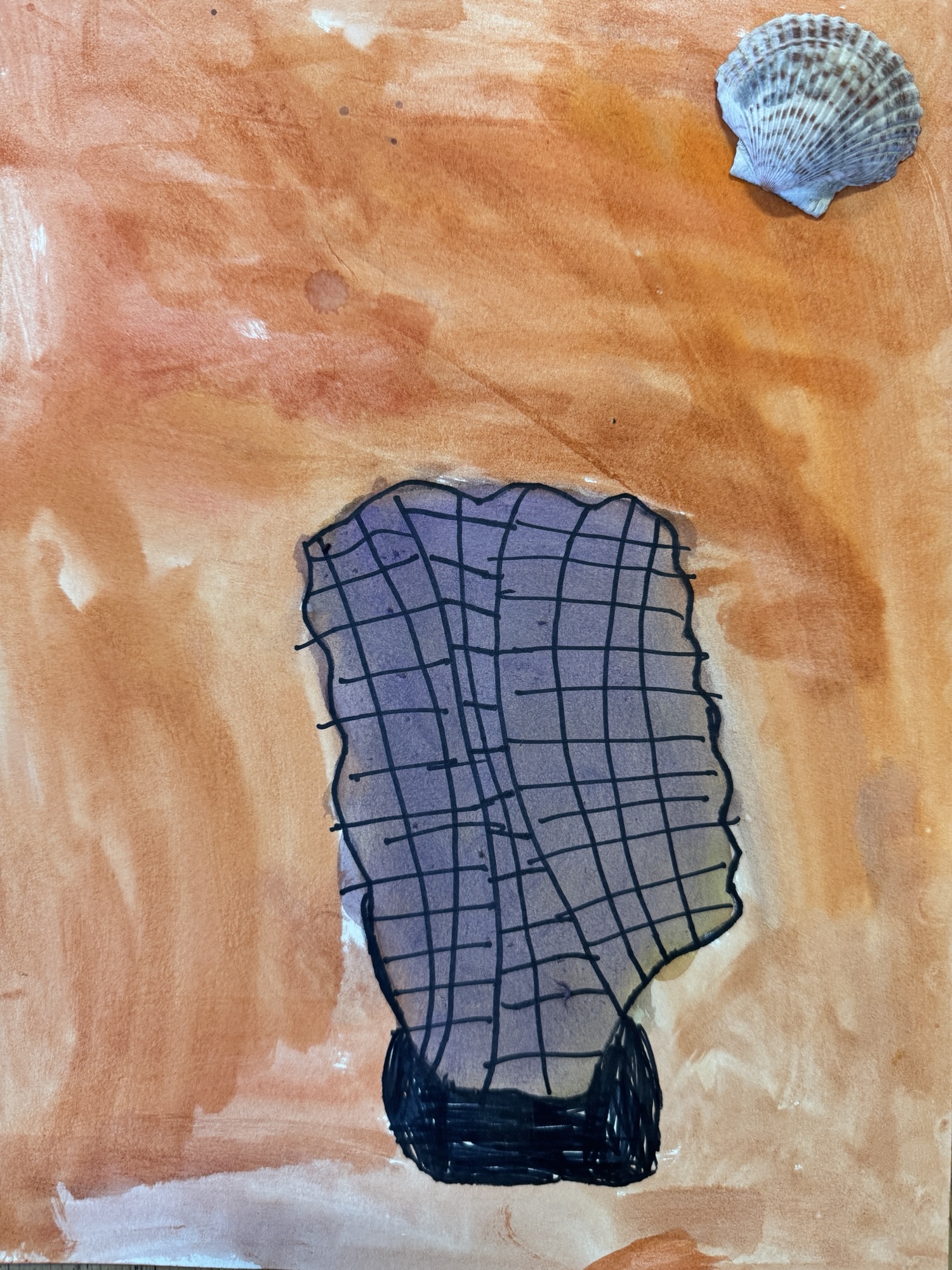
After reading Through Georgia’s Eyes, we talked about the way that O’Keeffe loved to make her paintings large, bringing attention to things others might otherwise miss. Students each picked a shell from my collection and studied it carefully. We took out our sketchpads. Students were encouraged to sketch the shell, filling the page with every detail they could. Drawing big is hard for young students, so practicing this technique is important. Then I gave them a larger piece of watercolor paper and a sharpie marker and asked them to draw their shell again, even larger!
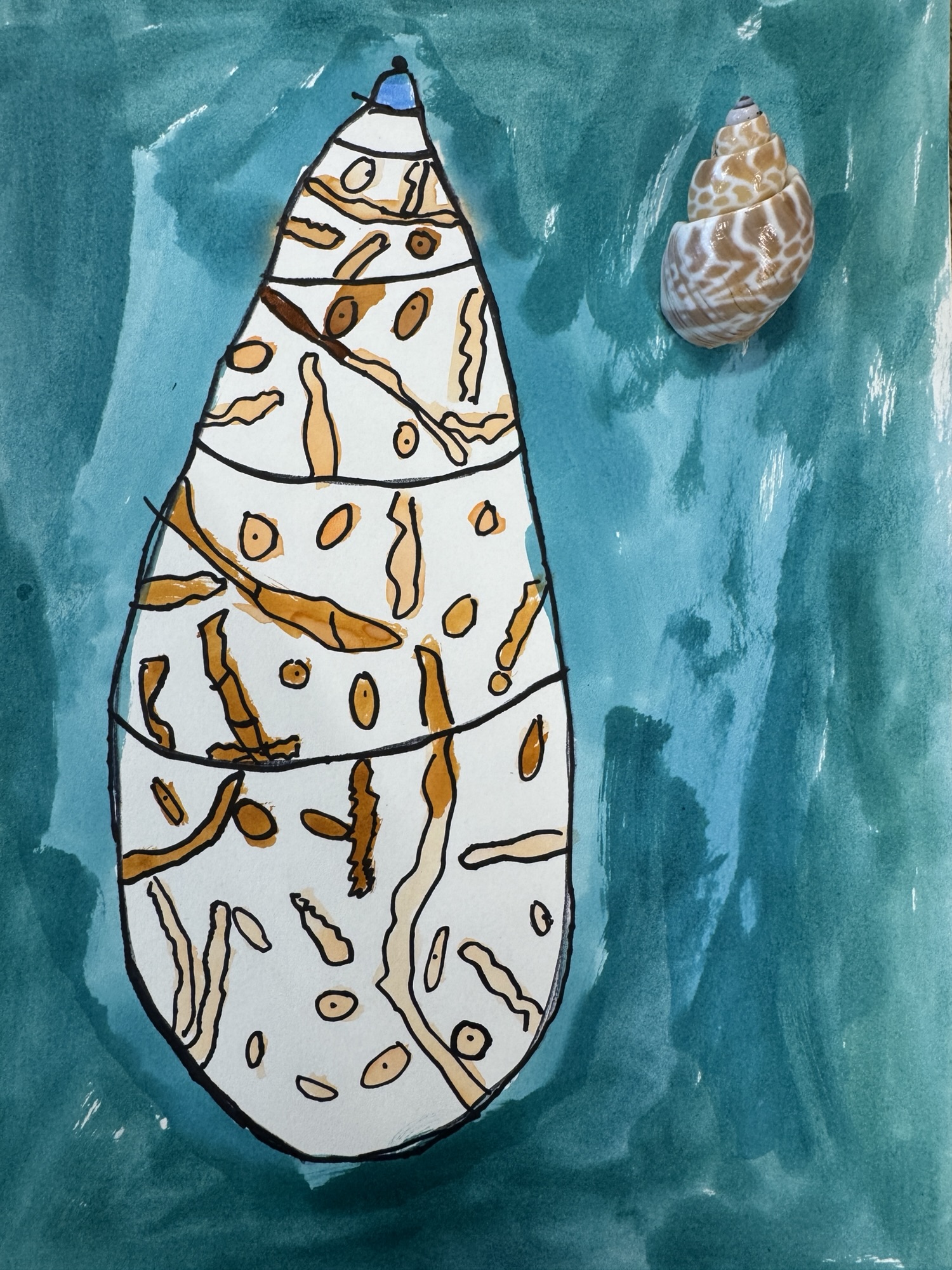
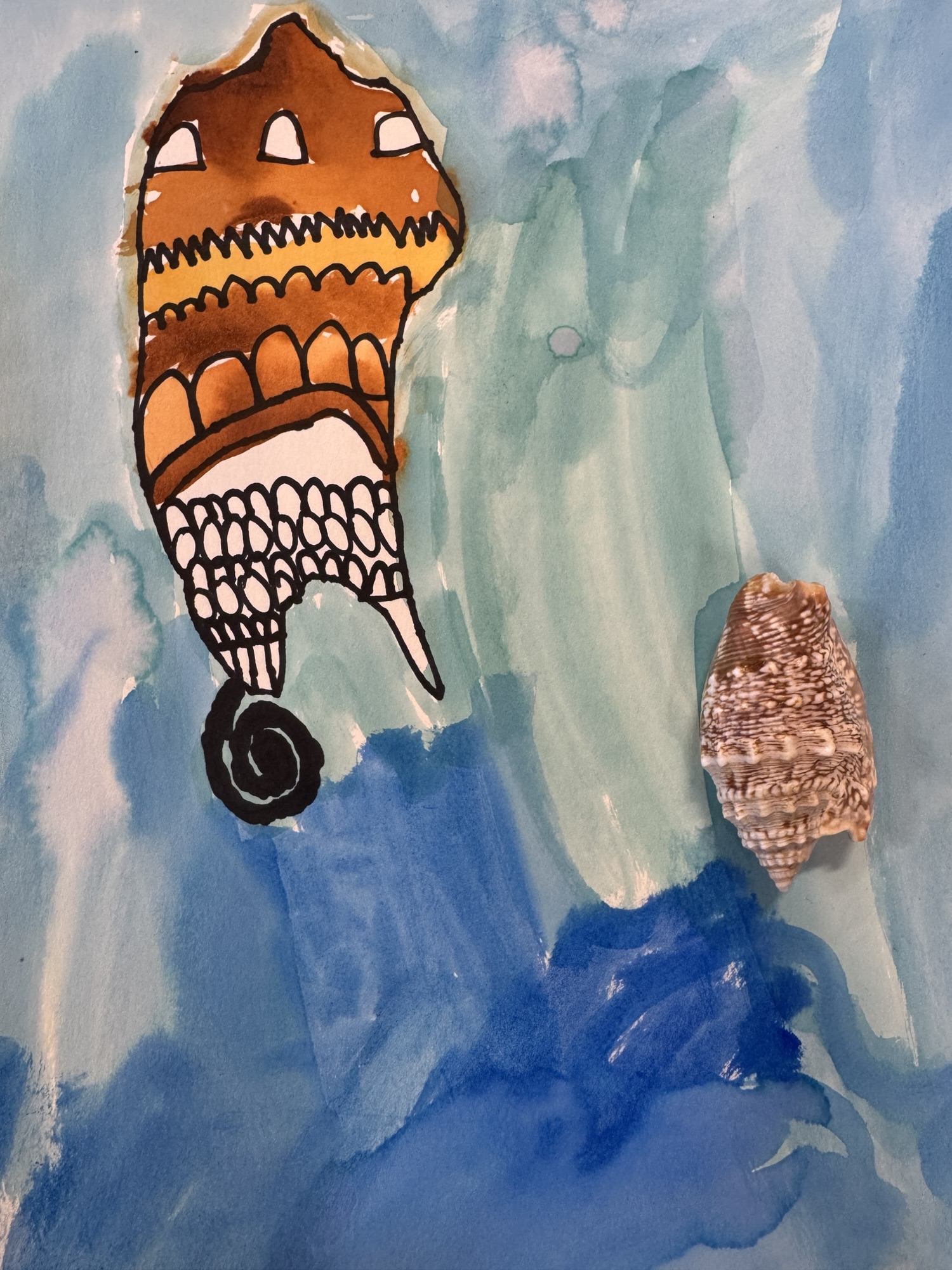
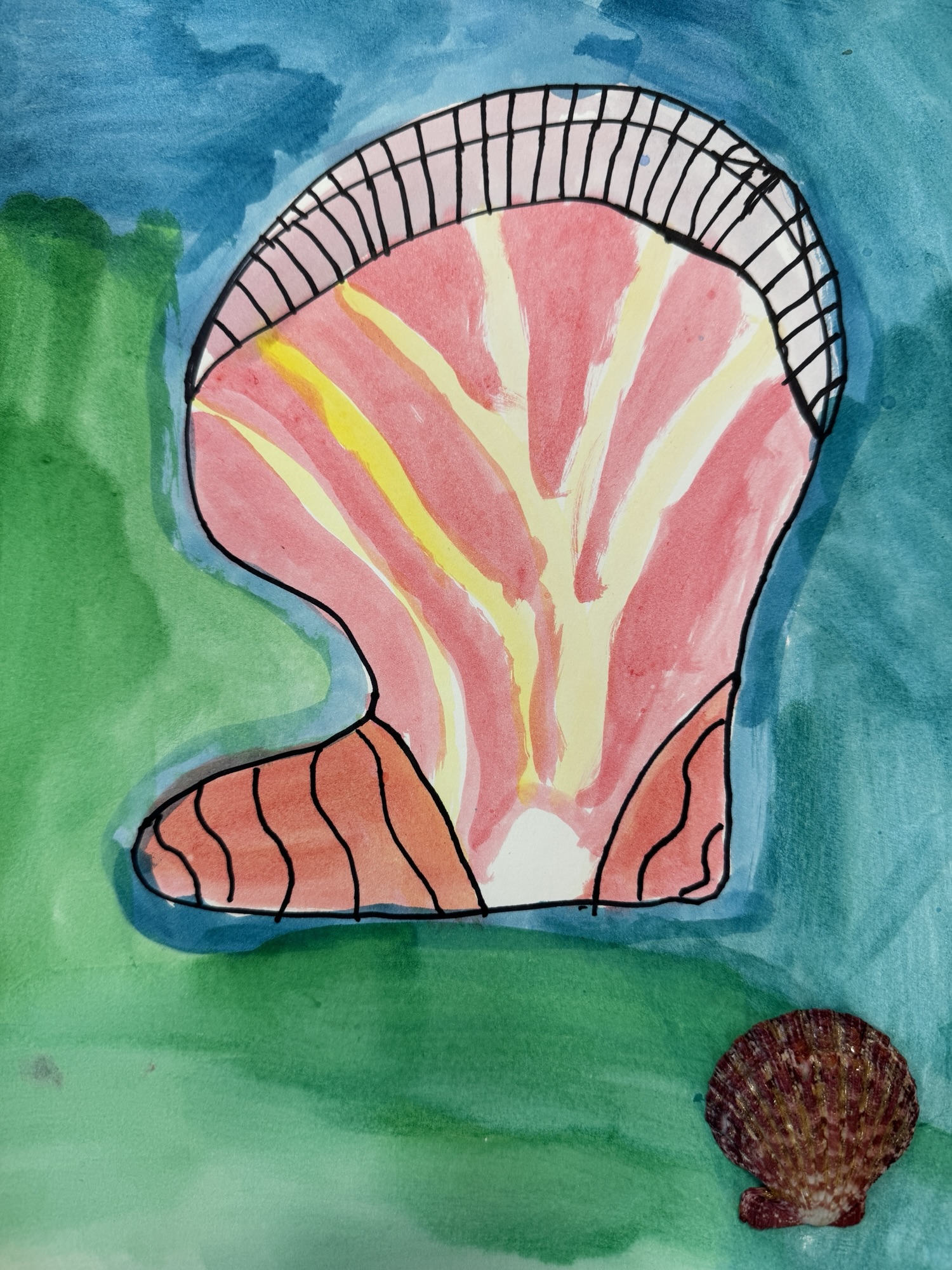
The following day, after reading the second picture book about Georgia O’Keeffe, we pulled out the trusty trays of crayola watercolor paints, mixing colors in the lids to capture the details of the shells. They looked carefully again, noticing nuance in coloring and shading, figuring out how to best capture the beauty of their shell. They also painted a background color to help their shell stand out. The results were stunning! (I decided to photograph them with the shell to show how much their study of the shell influenced the paintings.)
I was already excited about the work students were doing. These 6-year-olds were impressive with their attention to detail and care using watercolor paint–which can be unforgiving! My next request of them was something they initially found perplexing. I told them now we were going to paint our shells with words. What?!? I explained that our words were going to be the paint that helped others “see” the shell through our eyes. As is typical, I pulled my writer’s notebook out, took a close look at my teeny tiny shell, and started to think aloud about my shell. I wrote a few sentences, continuing to talk through my decisions. And then it was their turn.
You know that magic is happening when that hush falls over the room. First graders are not quiet writers so I get glimpses of their thinking as they work through words, help each other with spelling, ask questions about sounds, and speak the words they are putting on the page. I also knew something special was happening when no one was “done,” even when we had to stop for our reading groups and lunch. While my students were out of the classroom I walked around the room reading their words. Every single student was truly painting with words!
After lunch I gave students a few minutes to read through their writing and finish what they were working on. Then I pulled out the highlighters (first time this year!). I explained how I wanted them to use the highlighter–but first they had to pick a “golden line,” their favorite idea they had written about their shell. After highlighting we had a whip around where every student read their golden line out loud. My heart was full.
T wrote seriously, using all the time available to describe the shell.
My shell has a swirl in its window. Beige is the color that is the starting color but then white takes over. It has a pattern it goes purple to white. My shell has lines that curve to the end. My shell is very flat. In the inside there is white. If you touch its tip you would get poked on the finger. My shell has some green. It reminds me of a whale tail flaming in the ocean. My shell’s window is by the tip. It reminds me of a bucket of water filled. It’s my favorite shell.
M is an emergent reader and writer, working hard to capture sounds in words. This took effort and great perseverence to produce independently.
My shell has a triangle. My shell has a spiral inside. My shell has a window. My shell has pink.
Today marked 7 more school days until the end of year. It’s a bittersweet time of year. I can’t wait for summer, the way my schedule changes, spaces for some travel, time for family, warmer weather… And I will be saying good-bye to my students after 180 days of learning and growing together. We’ve become like family: getting on each other nerves, supporting one another when someone is feeling down, and depending on that comfortable atmosphere that comes from being home. My students have become confident almost-second-graders full of year-end bravado–nothing feels out of their reach!
I’ve written in the past about the power of pen pals and the reasons why I love it when the opportunity to exchange correspondence with another class presents itself. Again this year, the first graders in my class became pen pals with 5th graders in one of my colleague’s classes. After exchanging letters throughout the school year, today was our day to meet one another in person.
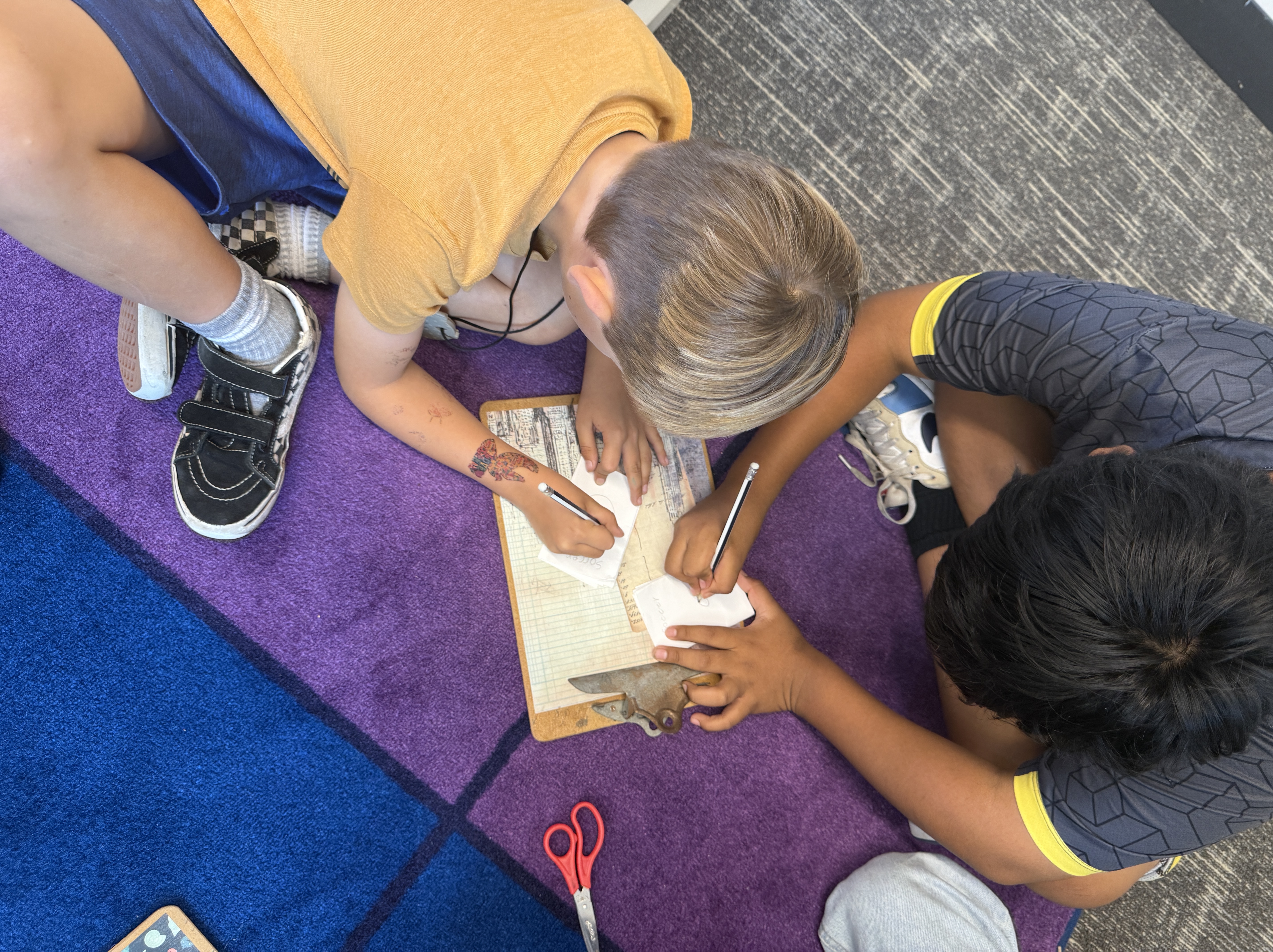
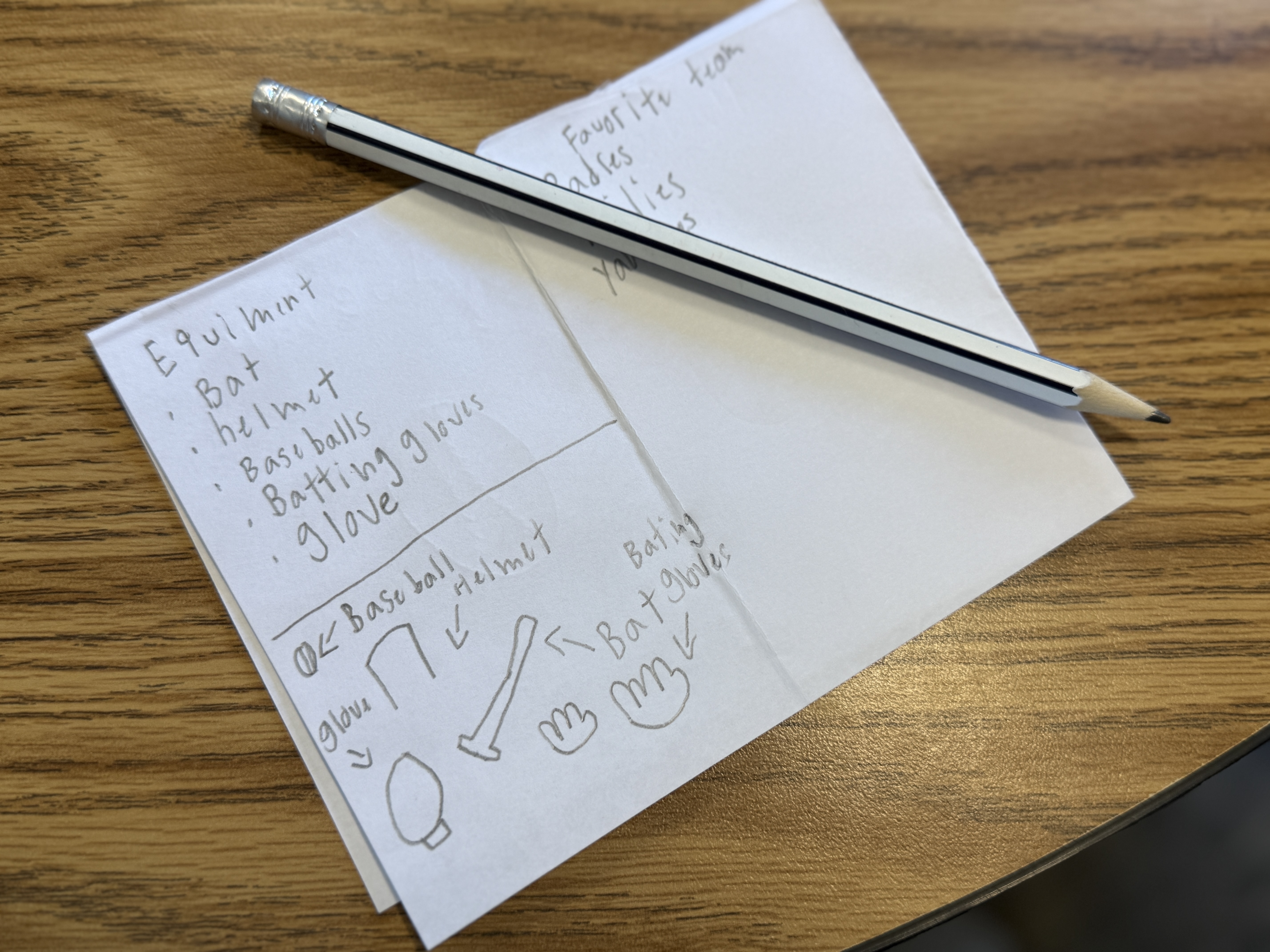
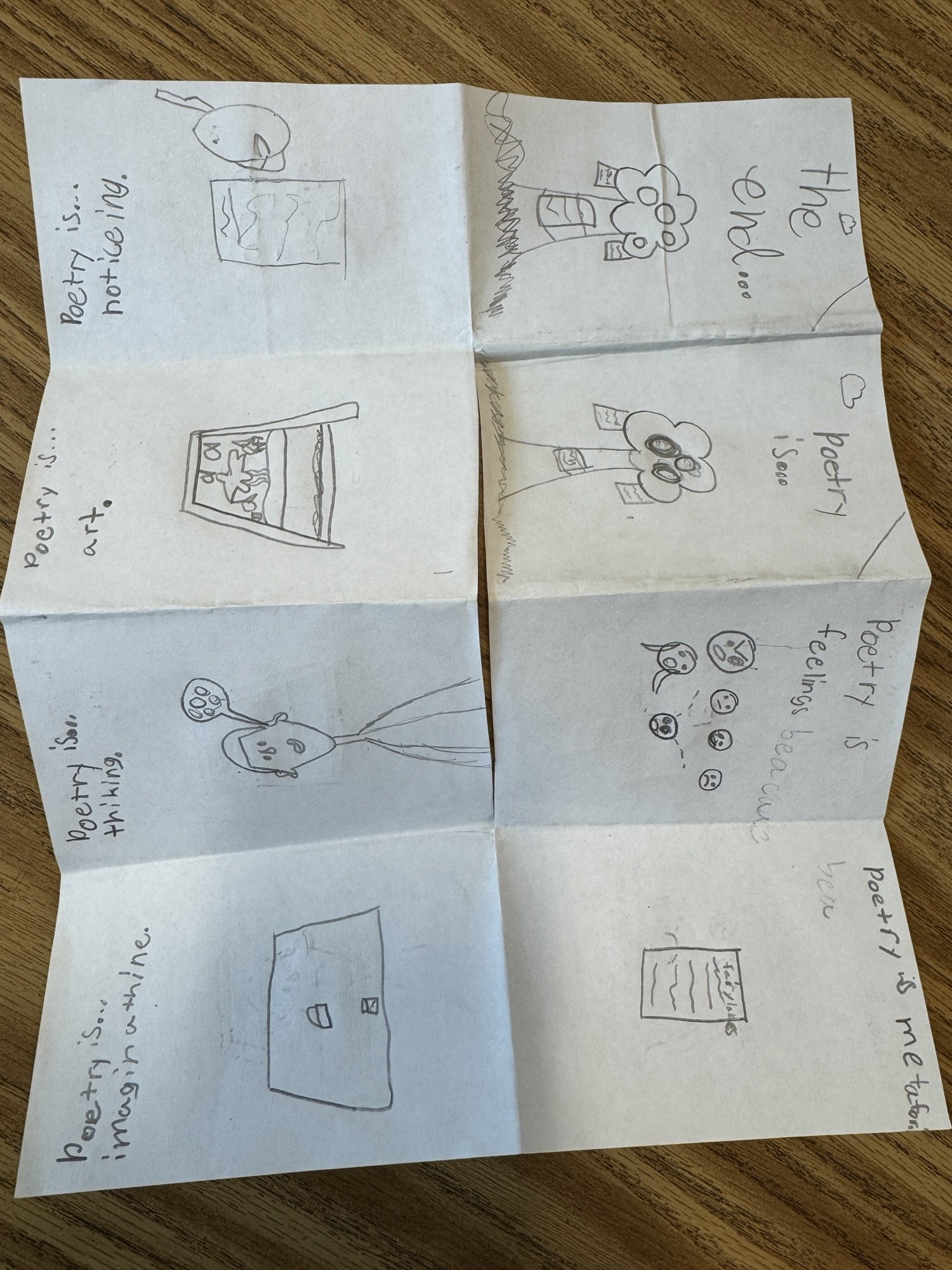
This year my colleague and I decided to have the first graders teach the fifth graders something when they met. Throughout the school year, my students have made zines–small books folded from a single sheet of paper. So today I reminded my students about the zines they have made (and many reminded me that they make zines at home since learning about them in class this year) and that they would be teaching their pen pal how to fold and write a zine of their own.
It was such fun to watch my suddenly shy seven-year-old students walk their much older pen pals through the folding and assembly of the zine and the older students coax their young teachers into choosing a topic. Some pairs wrote their zines about the same topics, collaborating on ideas while others chose to focus on an individual approach.
The classroom hummed with the 50+ bodies in the room, writing and chatting. Everyone was successful in the folding and writing, although there was no end product expected. Our gathering ended with a shared snack time and recess. For most of the fifth graders, it was a walk back in time reconnecting them with the school they attended when they were first graders. For the first graders, it was the excitement of hanging out with their new buddies–throwing basketballs with big kids, kicking soccer balls with big kids, reminding those big kids of the fun of just playing at recess.
Later, after the fifth graders returned to their school, I had the time to walk around the classroom, picking up and perusing some of the zines my students had created. I read the zine about playing hockey (step 3: wait for the zamboni to leave before getting on the ice), the one about mythical animals (clearly there are 7-year-olds who know way more about mythical beasts than I do!), and fell in love with the unexpected Poetry Is… zine written by a student who I would have expected to have written about sports!
I’m reminding myself not to waste these last 7 school days. This is the time when students revel in the possibility of choices, in exploring options, in exercising their creativity, in trying things that felt too scary just a few months ago. I’m also reminding myself to breathe through the hard parts of all that independence, to take a step back and enjoy this family the school year built.
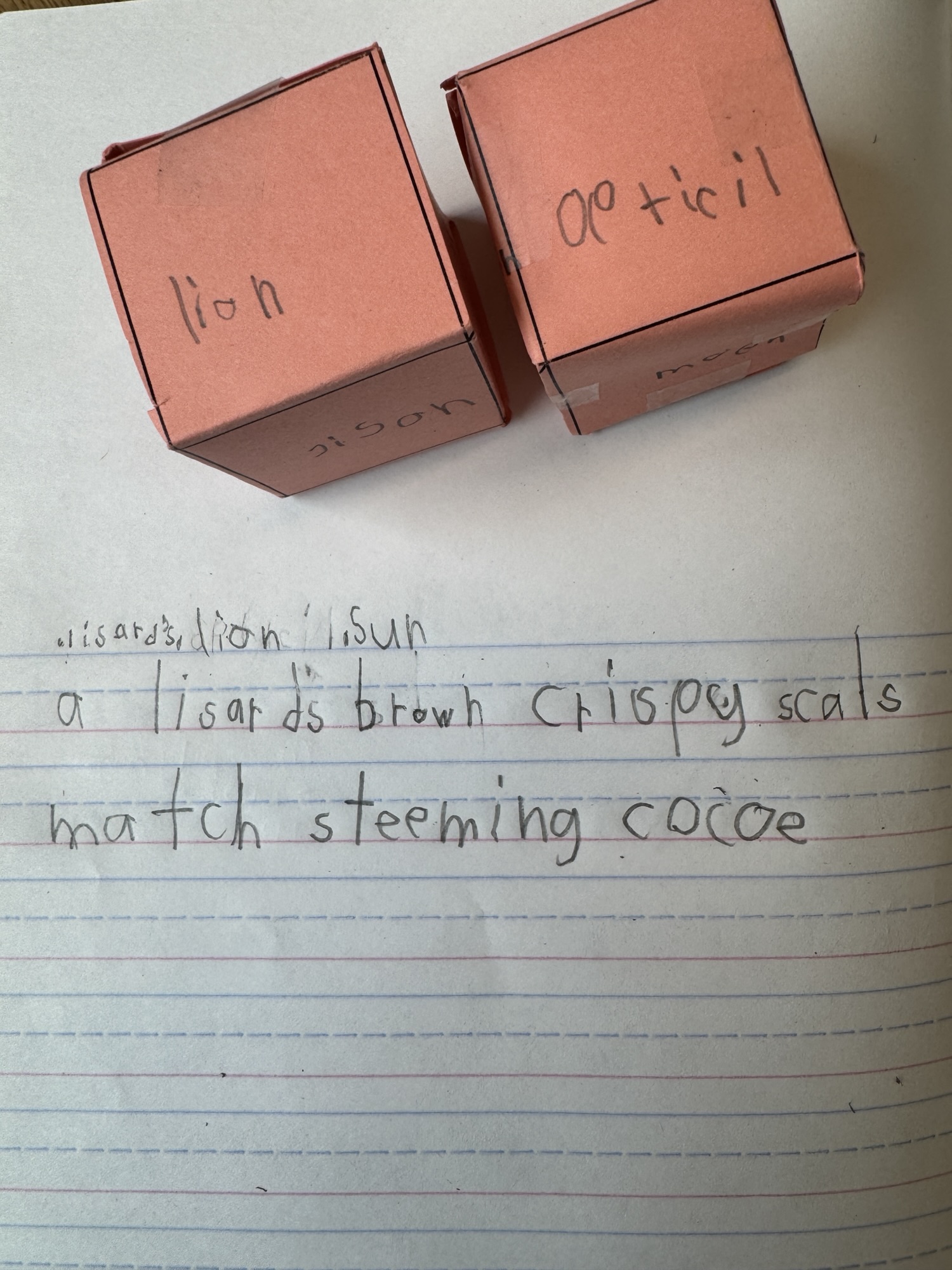
During the pandemic I accidentally discovered the power of poetry dice. Not the pre-made ones that you purchase. Those are great, but when my students weren’t in my classroom, I figured out a way they could make their own dice at home. At the time, I saw those homemade dice as a replacement for the ones I had used in the classroom. But I have learned after making our own dice in the classroom that they are so much more than that!
The prelude to making the dice is important. We began this week by reading Peter Reynold’s book The Word Collector. This book is rich with language and encourages a delight in words: short words, multi-syllabic words, words that sing…. The book is great on its own…and then as my students predicted–we would be making our own word collections!
To keep them from collecting only one kind of word, I gave them some categories…and a few restrictions. They collected nouns (but not people), verbs, describing words, and colors. They chatted as they wrote their words, sharing ideas with each other. Then we folded the collections, placed them in our notebooks, and left them for a while.
Today, we returned to our word collections. I suggested that they might want to trade out some of the words they had collected on Monday. I showed them on my list by crossing out a word that felt ordinary and adding another that I had thought about since then. Then I gave them some time to read over their words, trade them out, or just add to their list.
Then I pulled out the highlighters. (The magic of office supplies is real!). Since we were going to make poetry dice, students would need to narrow their collection down to 12 words (for a pair of dice). We talked about including words from different categories and again, I talked aloud about some of my decisions as I highlighted my list. Once the 12 words were highlighted, it was time to distribute the cube templates. I use colored card stock so that the dice will have some firmness.
Students wrote their words, one per face, onto their cube template. And at that point, it was time for the cutting. This can be a tricky step with first graders, but they persevered and were careful, even with the tight corners. We had time to fold before recess, but not time to tape, so we left our unfinished dice and headed out for a snack and some playtime.
When we returned I pulled out an old favorite of a poetry book, I am Writing a Poem About… edited by Myra Cohn Livingston. (This is one of those oldie but goodie books–and I think it might be out of print!) In the book, described as a poetry game, authors are challenged to write a poem using certain words. We read through quite a few poems that used 3 words: drum, blanket, and ring. Right away students tuned in to listening to hear those 3 words in each poem. They noticed that sometimes the poet used a different form of the word, like drumbeat instead of drum. After marinating in the poetry game, we headed back to our tables to tape our dice together.
Pulling the edges of the cube together and taping them was challenging for some of these young poets, but again, they were up for the challenge. And then it was time to start rolling the dice. They were directed to roll 3 or 4 words, write them in their notebook and then to write their own poem including the words, along with some action, metaphorical thinking, and maybe the use of some of their senses.
I’m convinced that the making of the dice creates fertile ground for poetry to grow. Time to think about words, to play around with words, to list words, to select words, to hear words, to consider the words of others, and then to roll dice and write…and then roll some more and write some more. In our last few minutes before going home, we took some time to read some of these pieces-in-progress out loud.
O, who doesn’t usually read, was ready to share today. Rolling robot, rainbow, and teal, O wrote:
A rainbow in the sunset
with a robot running through all the colors
with not a speck of teal
B seems to be using poetry to process feelings, rolled scared, blue, purple, and green. B wrote:
Making new friends
is scary
but blue, purple, and green
fill my heart
And J rolled three words, but ended up with just one of the words in the poem. J wrote:
A lizard’s brown crispy scales
match steaming cocoa
first smell
then blow
I rolled kaleidoscope, microscopic, collect, and singing and wrote alongside my students. Here’s my draft:
They collect words like gems
holding them up
to reflect the sun
A kaleidoscope of poems
emerge from this microscopic
piece of the universe
singing out a world
imagined by children
I’d love to hear your experiences making and playing around with poetry dice–either for yourself or with your students. Any variations to suggest?
Some days it’s the unplanned lessons that have the best results. A few weeks back I came across a picture book that looked interesting. I ordered it, it arrived, and I set it aside. Then yesterday, our first day back after spring break, I found myself with some unclaimed time and reading a book seemed like the perfect solution.
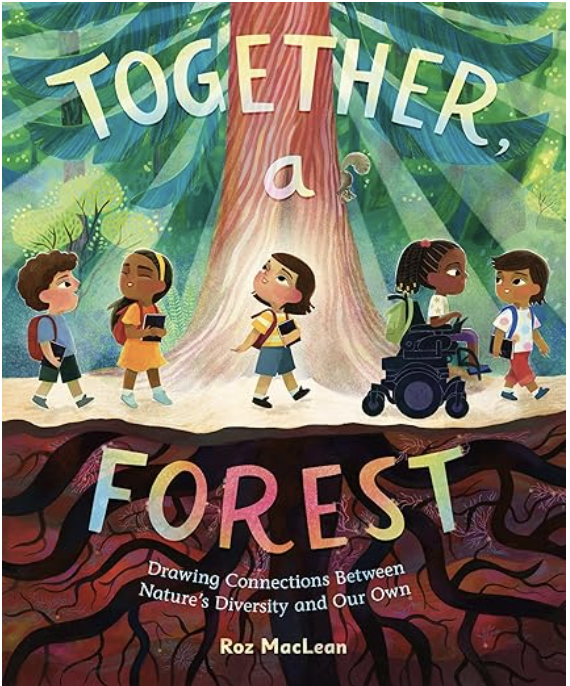
I walked over to the shelf where I stash the books I haven’t gotten to yet…and Together, a Forest: Drawing Connections Between Nature’s Diversity and Our Own called out to me. I started reading the book and those wiggling post-lunch students settled. We learned about different students in the book and their affinity to plants and animals in the forest. There was the student who was interested in everything–and forgetful–just like the squirrel who buried acorns and the ones it forgot later grew into trees.
We started to think about the plants and animals who were like us…and while we didn’t have enough time to finish the book, the seed was planted in the poetry ecosystem that is our classroom.
Today our planned ceramics project went well and we finished successfully before recess. That meant the time I had allowed for the completion of the project after recess was now open and free. So, we went back to Together, a Forest and completed the reading and discussion. And then we started thinking about that question from yesterday…what plant or animal are you like?
The first graders grabbed their notebooks and started to write. They asked the usual questions, “Does it have to be a plant?” (No) “Does it have to be a part of a forest?” (No) “Can I use metaphorical thinking?” (Yes). I wrote–and I made the rounds around the classroom peeking over shoulders, listening to ideas, watching these comparisons turn into small poems, taking root in this poetry ecosystem.
J wrote:
I am an army ant. My super power is strength and I work with people. I eat fruit and I get it at the store then bring it home. My strength is teamwork.
H wrote:
I am an octopus. I am smart. I act like I have eight hands and I am super fast and tricky and change colors.
B wrote:
I am moss. I am like moss because I soak up everything I hear. I remember everything and if it is something bad I can squeeze it out.
And I wrote:
I am an egret. I am quiet and still. Patience is my super power. Most of the time I am good at waiting and thinking. Other times I startle and fly off in a flurry of feathers. I am good at being alone without being lonely. I love to reconnect with my family at the end of the day.
These first drafts will be fodder for the writing we will continue to do, this month and into the future. Right now, my students are writing easily, adding details and elaboration, beginning to play around with language and ideas…and willing and eager to read their writing aloud to their classmates. We have truly built an ecosystem of poetry and writing in our classroom.
Some days in the first grade classroom chaos rules. It seems that everyone needs help at the same moment and a single word (think birthday, soccer, lunch…) makes every voice rise in frenzied simultaneous conversation.
But today was different. We had started a writing project on Friday, but ran out of time (and focus) before we got it completed. And since it is March and I had some time this morning after our class watched another first grade class perform a play, I gave my students a list of four things to do.
Reread the writing from Friday and finish, making sure all five senses are represented
Use voice to text (something we have done before) to type the writing into Pages
Meet with me for a quick review and a reminder of how to share the document with me
Go onto a particular app for independent math practice
When we started this, I wasn’t sure I would be able to meet with students with others working independently. But…my students proved their maturity today and that magical buzz settled over the room. Students focused on completing their writing. They helped each other navigate the iPad and reminded each other how to make the technology work. If I was working with a student, others waited patiently for their turn with me. And those on the app worked without needing reminders to stay focused. It wasn’t quiet, but the noise was productive. Most students were able to complete and share their writing and everyone had meaningful learning work to do.
I love when this breakthrough happens. Now I will stay alert for opportunities for students to exercise this independence and work as a team. That magical buzz is priceless!