
During the pandemic I accidentally discovered the power of poetry dice. Not the pre-made ones that you purchase. Those are great, but when my students weren’t in my classroom, I figured out a way they could make their own dice at home. At the time, I saw those homemade dice as a replacement for the ones I had used in the classroom. But I have learned after making our own dice in the classroom that they are so much more than that!
The prelude to making the dice is important. We began this week by reading Peter Reynold’s book The Word Collector. This book is rich with language and encourages a delight in words: short words, multi-syllabic words, words that sing…. The book is great on its own…and then as my students predicted–we would be making our own word collections!
To keep them from collecting only one kind of word, I gave them some categories…and a few restrictions. They collected nouns (but not people), verbs, describing words, and colors. They chatted as they wrote their words, sharing ideas with each other. Then we folded the collections, placed them in our notebooks, and left them for a while.
Today, we returned to our word collections. I suggested that they might want to trade out some of the words they had collected on Monday. I showed them on my list by crossing out a word that felt ordinary and adding another that I had thought about since then. Then I gave them some time to read over their words, trade them out, or just add to their list.
Then I pulled out the highlighters. (The magic of office supplies is real!). Since we were going to make poetry dice, students would need to narrow their collection down to 12 words (for a pair of dice). We talked about including words from different categories and again, I talked aloud about some of my decisions as I highlighted my list. Once the 12 words were highlighted, it was time to distribute the cube templates. I use colored card stock so that the dice will have some firmness.
Students wrote their words, one per face, onto their cube template. And at that point, it was time for the cutting. This can be a tricky step with first graders, but they persevered and were careful, even with the tight corners. We had time to fold before recess, but not time to tape, so we left our unfinished dice and headed out for a snack and some playtime.
When we returned I pulled out an old favorite of a poetry book, I am Writing a Poem About… edited by Myra Cohn Livingston. (This is one of those oldie but goodie books–and I think it might be out of print!) In the book, described as a poetry game, authors are challenged to write a poem using certain words. We read through quite a few poems that used 3 words: drum, blanket, and ring. Right away students tuned in to listening to hear those 3 words in each poem. They noticed that sometimes the poet used a different form of the word, like drumbeat instead of drum. After marinating in the poetry game, we headed back to our tables to tape our dice together.
Pulling the edges of the cube together and taping them was challenging for some of these young poets, but again, they were up for the challenge. And then it was time to start rolling the dice. They were directed to roll 3 or 4 words, write them in their notebook and then to write their own poem including the words, along with some action, metaphorical thinking, and maybe the use of some of their senses.
I’m convinced that the making of the dice creates fertile ground for poetry to grow. Time to think about words, to play around with words, to list words, to select words, to hear words, to consider the words of others, and then to roll dice and write…and then roll some more and write some more. In our last few minutes before going home, we took some time to read some of these pieces-in-progress out loud.
O, who doesn’t usually read, was ready to share today. Rolling robot, rainbow, and teal, O wrote:
A rainbow in the sunset
with a robot running through all the colors
with not a speck of teal
B seems to be using poetry to process feelings, rolled scared, blue, purple, and green. B wrote:
Making new friends
is scary
but blue, purple, and green
fill my heart
And J rolled three words, but ended up with just one of the words in the poem. J wrote:
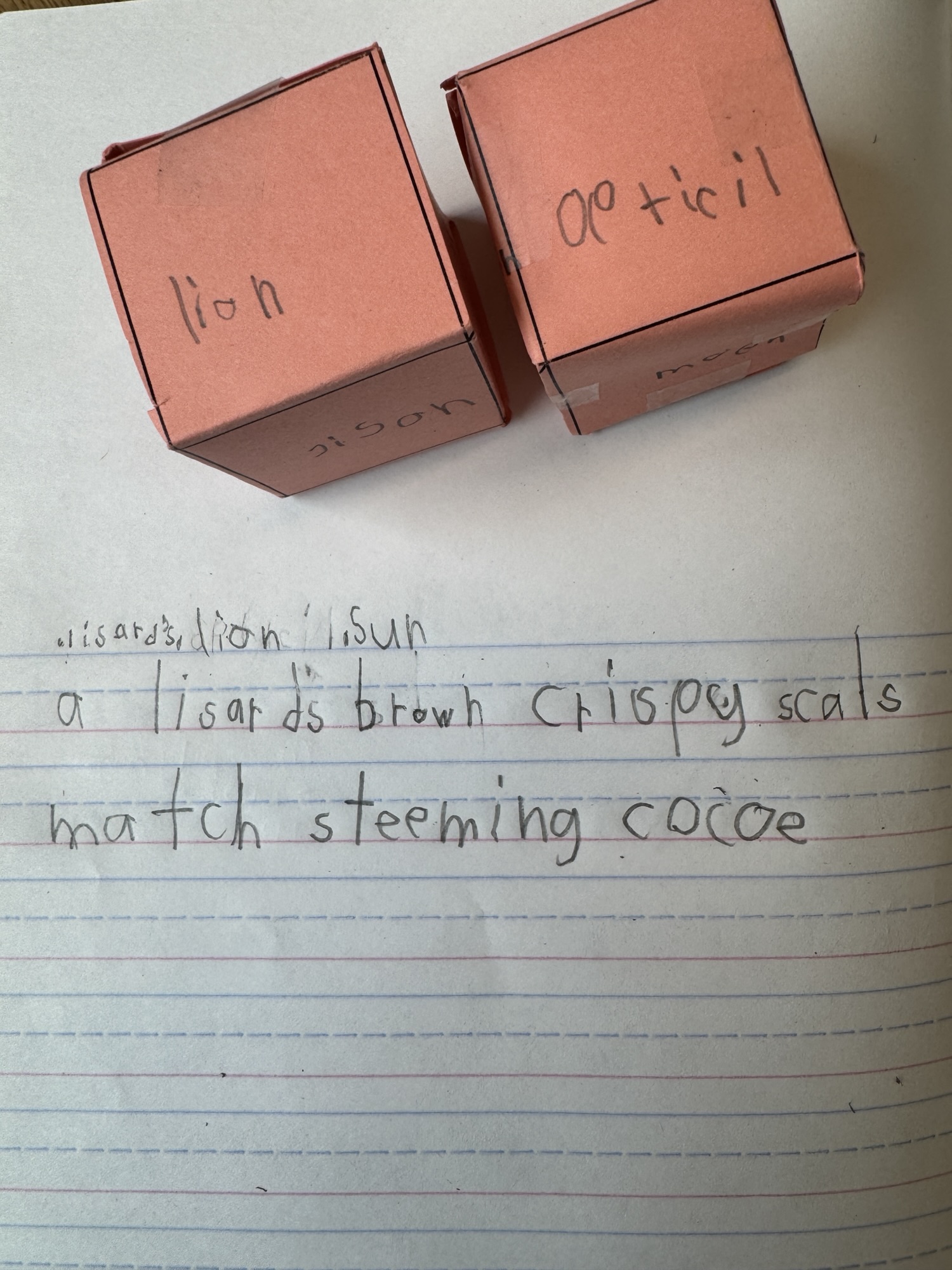
A lizard’s brown crispy scales
match steaming cocoa
first smell
then blow
I rolled kaleidoscope, microscopic, collect, and singing and wrote alongside my students. Here’s my draft:
They collect words like gems
holding them up
to reflect the sun
A kaleidoscope of poems
emerge from this microscopic
piece of the universe
singing out a world
imagined by children
I’d love to hear your experiences making and playing around with poetry dice–either for yourself or with your students. Any variations to suggest?


 Thinking Through My Lens