Tag Archives: writing

Enjoying the Clouds: SOLC #12

I think southern Californian’s may be obsessed with weather. Or maybe it’s just me. So much of the time we really pay no attention to it. A sweatshirt is the go-to jacket, flip flops are year-round foot wear, and that umbrella? It’s probably buried under the reusable grocery bags in the trunk of the car.

It’s been rainy this week–and I’m talking multiple days! It rained Wednesday night and last night, and there are still clouds that just might be holding some more rain hanging around. We can probably count a year’s worth of rainy days on two hands–and this year, rain has been scarce, even for us.

Luckier still, we’re getting much needed rain and it has been coming after we go to bed at night. That has left my afternoons available for those much-needed beach walks. Breathing in saline rich air while feeling the satisfaction of checking off exercise as done, calms my brain and is good for my body. And the bonus: the beach is never boring. The views change constantly, the terrain is varied from tide to tide, and no mask is needed on the wide-open shoreline.

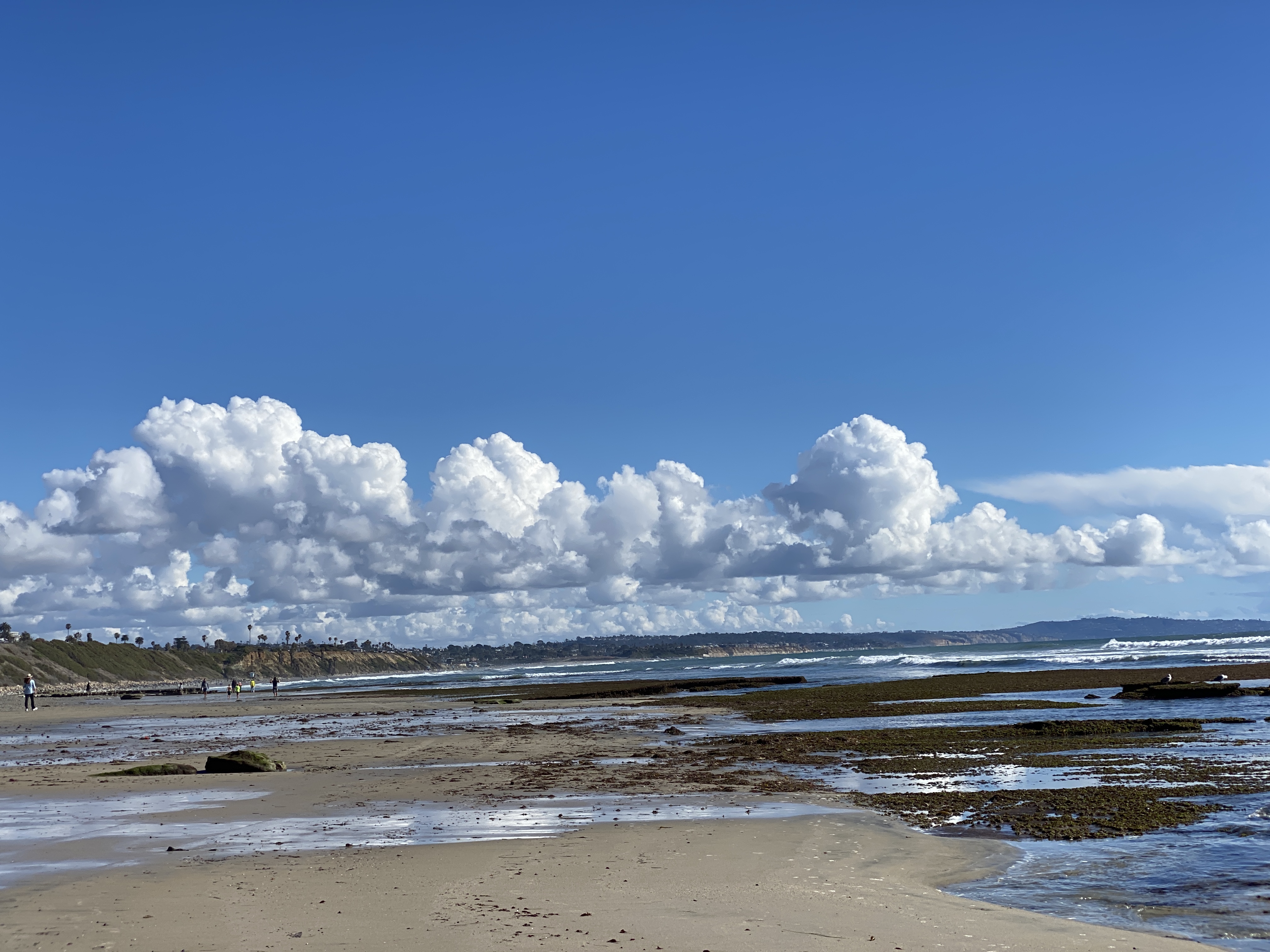
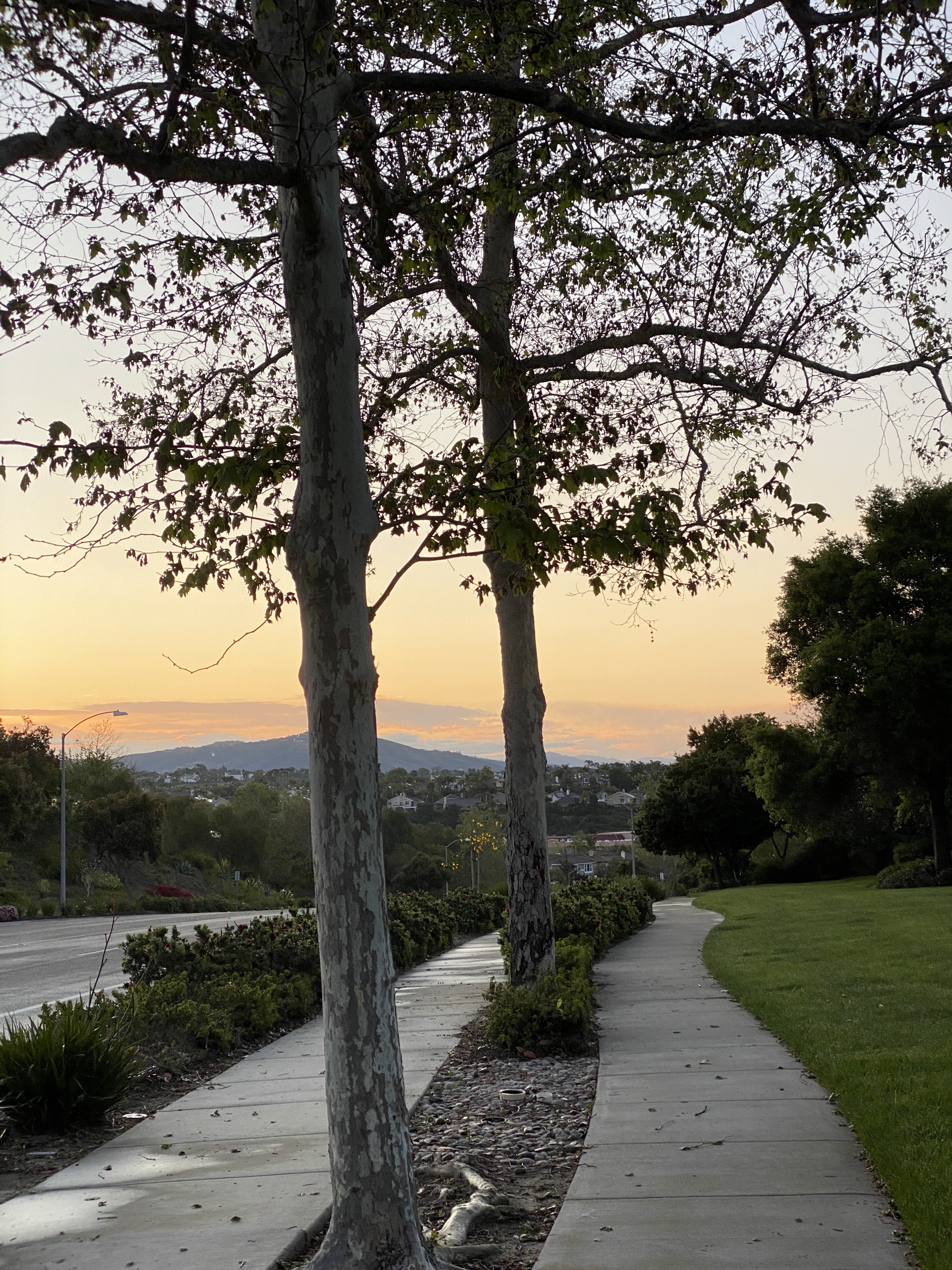
As I headed back toward the car, the towering clouds above the old Encina power plant tower (headed for demolition) caught my eye. I couldn’t quite capture it with my camera held in its usual position, so I turned it to try to capture the height of the clouds.

Maybe we’ll have a bit more weather in store before this storm system leaves. For now, I’ll just enjoy the clouds.

Outside the Box: SOLC #4

In a normal year–and we all know this is not a normal year–I commute about 16 miles south one day a week to the university where our writing project is housed. That commute, which doesn’t sound all that long, on the best of days takes about 30-40 minutes. On the worst of days, the hour mark comes and goes. But I haven’t made that commute in nearly a year–and I didn’t think I missed it. For the most part, my writing project work can be done remotely. Meetings now take place on Zoom, emails and phone calls replace the in-office interactions, my Google drive is starting to be well organized and easy to access (well–that may be stretching the truth a bit, but it is getting better), and I don’t have to stress over finding a parking place with a space that matches the color of my parking permit.

Today, I made that commute. Not because I needed to be in the office, but because I needed to have a COVID test to go to the university tomorrow to get keys and a tour of new offices! I have a long history with the university. I was an undergrad here, I met my husband during that time. I completed two additional degrees on this campus and have been a part of our writing project for decades now. So this morning, after a Zoom meeting to deal with some project business, my husband and I headed down the coast.

Traffic was light and parking was easy–a small positive in pandemic times. Bright blue skies, puffy white clouds, and bright sunshine greeted us as we emerged from the parking structure to find the testing center. The campus is strangely empty. There are people around, but the numbers are small compared to my past experiences here. And once the testing was done, we decided to take our daily walk exploring this place we both know. After all, this is a beautiful campus, filled with interesting art installations and memories, memories, memories.

As we walked, we noticed new construction. We commented on changes we have seen over the years on campus. We turned here and there, sometimes finding dead ends blocked by construction screens other times remembering a familiar building. We walked the snake path, spied Fallen Star in the distance, and took a side trek to find the giant stone teddy bear. There are large tents serving as outdoor classrooms, although no classes were in session as we walked by. But it was the large shipping container that caught my eye.

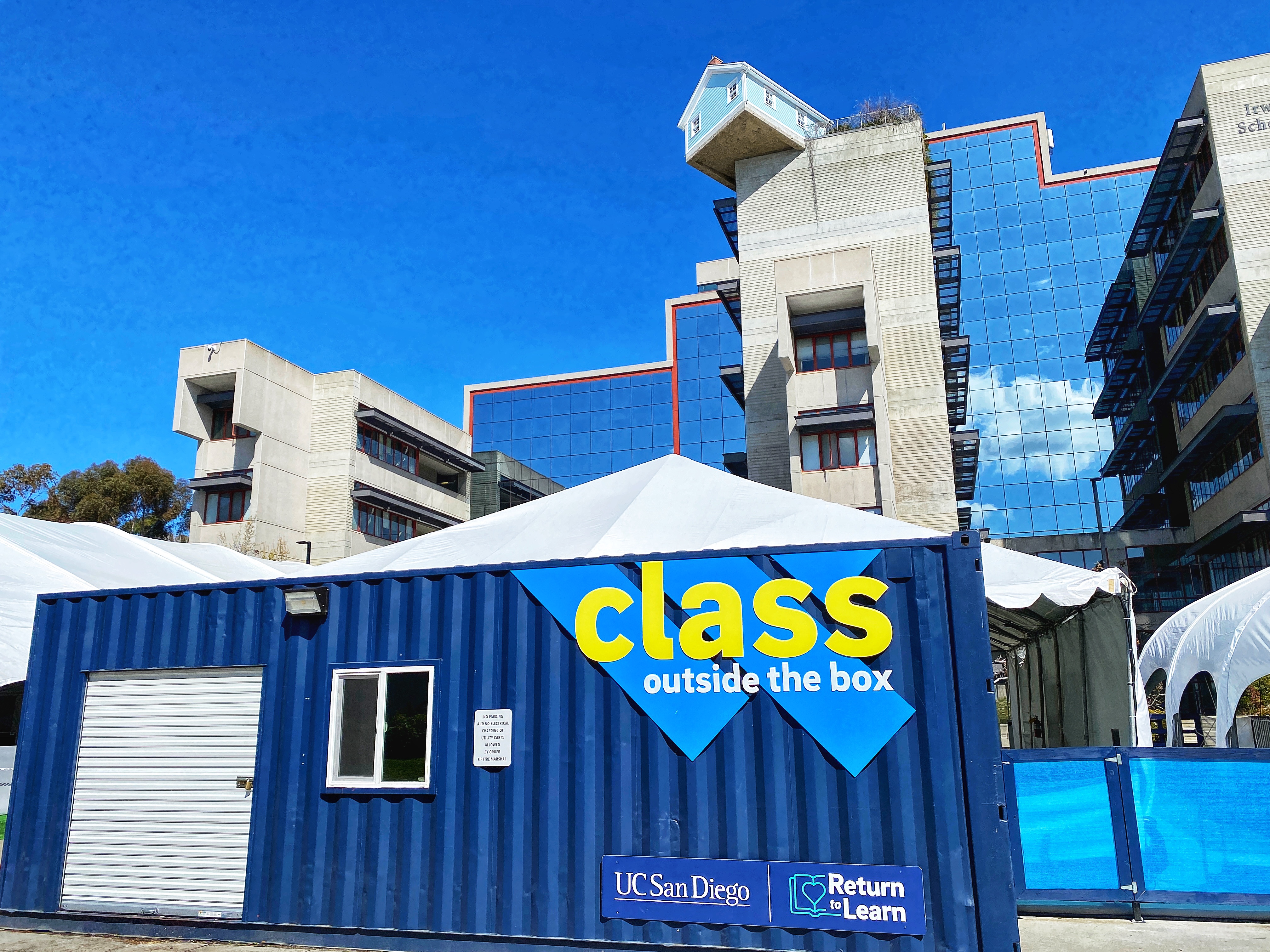
“Class outside the box” it says on the outside, but I wonder what is inside the box. You can see the tent classrooms just behind it. And you can see Fallen Star (the tiny house perched on the engineering building) above in the background. I love the clouds reflected in the glass walls of the building and the brilliant blues of it all.

I’m looking forward to a second trip to campus this week as I am introduced to our new offices tomorrow. I still will likely continue to conduct much of my work from home, but it will be good to reevaluate our office materials, to familiarize myself with the office layout, and begin to imagine what a new normal might be in the coming months. What might my work look like as I consider it “outside the box?”

Seeking Joy: SOLC #1

These days, I often find myself in search of joy. Sameness is numbing, isolation is suffocating, and uncertainty is paralyzing. And yet, we go on. My students show up in the classroom (on a limited, hybrid schedule), ready and eager to learn.

I realize, sometimes over and over again, that my restricted time with my students pushes me to rush things in the classroom. Instead of giving time and space to breathe, to engage, to explore…I find myself watching the clock, urging students on, never letting them get fully immersed, locked into that indescribable flow that I can’t explain, but I always recognize.

Joy, instead of being a constant classroom companion, has become a shadow that I catch sight of at the edge of my visual field. It flickers, momentarily in focus before it dissolves into the corners–just out of reach. If I can’t reach out and grab onto the joy, how can my students?

Somewhere along the way during this pandemic school year I lost sight of daily writing. The whimsy and playfulness of messing around with words and ideas in the low-stakes sandbox of the writer’s notebook had vanished. Students mistakenly believed that writing should be one and done rather than the messy, living, complex process that it is. I had to make a change.

So, at the end of January, I reworked students’ independent work–the stuff they do during the half the school day when they are not in the classroom with me–to include time for daily writing. I set up a routine–predictable but with lots of novelty and variety. One day students are invited to write to a photo prompt–often silly and far-fetched. Another day they write under the influence of our weekly poem study: they can use it as a mentor text, they can be inspired by the topic, they can grab a word and follow it–the choice is the writer’s. And on the third day, I offer an active sort of prompt. Last week, on our weekly Wednesday Zoom call, students participated in a short scavenger hunt. They were sent in search of 5 items, one at a time. Once found, they showed the item on the screen and wrote it in their notebook. That list then became the fodder for the daily writing. They could come up with a story connecting the items, use one and go in any direction, again…choice is key.

While the daily writing is not amazing, students are finding a rhythm. They are developing fluency. And they are having some fun with it–joy is beginning to creep in. We are paying more attention to language, examining what we like when we read. Just last week, students picked one of these daily writing pieces. They picked not the best one; the one they love so much they don’t want to make any changes. Not the worst one; the one that feels flat and uninspiring. They picked one they were willing to work on, to improve, to make better. They used a Praise Question Wish protocol to respond to the writing in pairs. We studied a couple of mentor text excerpts from familiar pieces we had read in class. And armed with these tools, students went off to revise.

Most of these revised pieces are still not where I want them to be, but they are moving in the right direction. And better yet, they are moving toward discovering the joy of writing and language, expression and choice.

I am actively seeking joy in the classroom. Joy that fills me with wonder and energy. Joy that brings a smile to my students’ masked lips–that is visible in their eyes and felt in the air. Joy that takes me back to what I know is important in teaching and learning, despite pandemic restrictions and schedules that squeeze time into unrecognizable shapes. And I want writing to be a part of that joy, for me and for them.

Puzzling Times

I don’t play games.  I’m a pretty reluctant participant to those ice breaking activities we all experience in professional development, the days we head back to school in the fall, and now even on the ever-constant Zoom meetings.  And I don’t own any jigzaw puzzles.

At least I didn’t.  Until last week when the constant sameness of the stay-at-home, work-at-home, play-at-home routine drove me in search of novelty–in the form of a jigsaw puzzle.

As a disclaimer, I did play games as a kid.  I did puzzles as a kid.  My own children played games and put puzzles together.  But game playing, as a family activity–as an adult activity is really not a part of my everyday life.

But there was a puzzle to purchasing a puzzle.  They are obviously in demand right now.  Amazon is delivering puzzles in July.  Target had none in stock.  But I did find one that I could order online at Barnes and Noble and pick up in the store near my house.  My husband thought I was crazy when I came home with the puzzle–but he’s a good sport so we cleared some space on the table (we each have a table as our home offices) and opened the box.

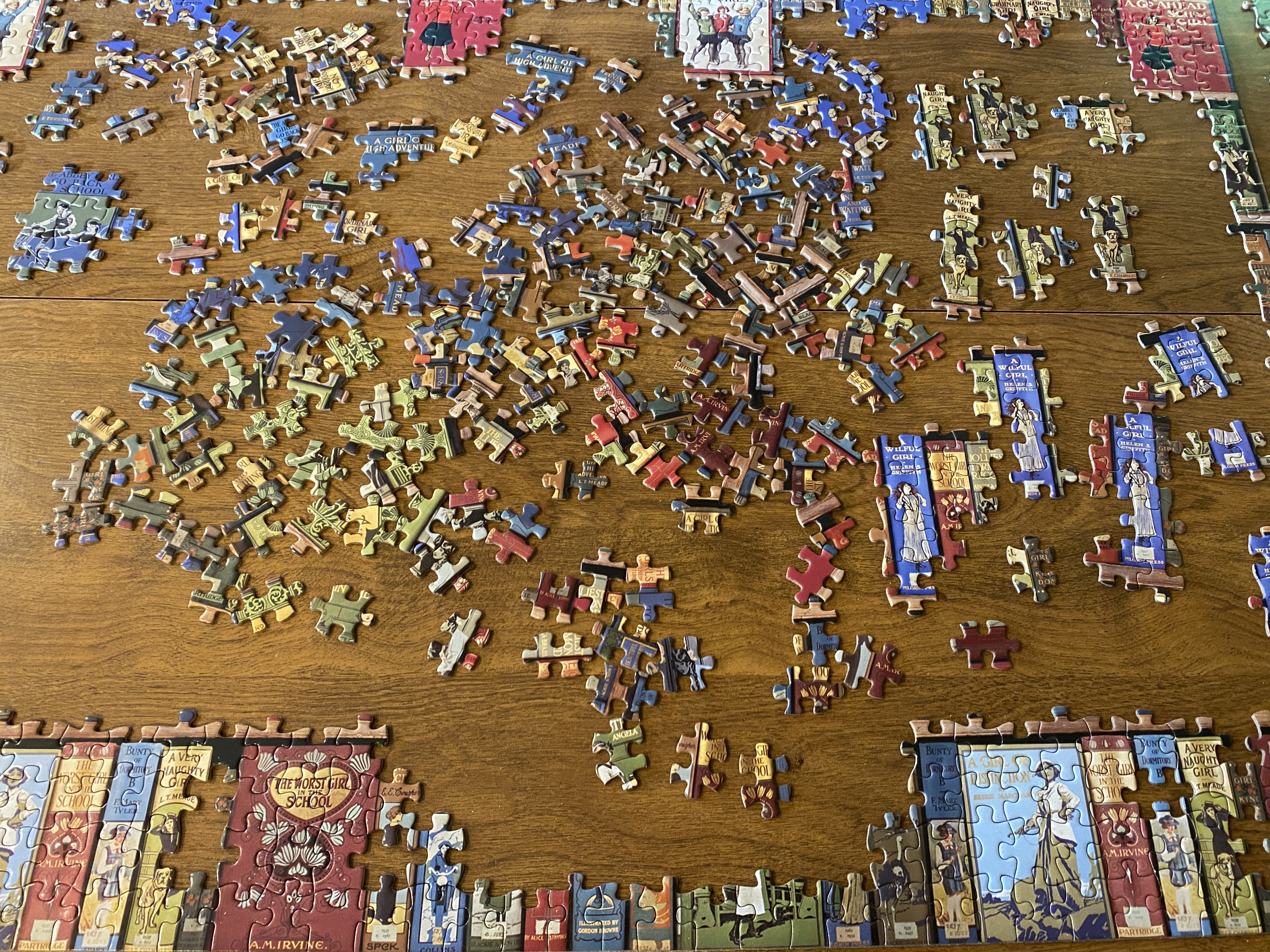
There’s something oddly soothing about looking through hundreds of tiny interlocking pieces in search of a straight edge.  It’s both mindless and intentional.  Stimulating and calming.  Purposeful and aimless.  We found ourselves shifting roles, one of us searching, one of us building and then trading.  Patterns began to emerge and all those bits of color, pieces of words, and abstract shapes began to take on meaning and become recognizable as parts of a bigger whole.

img_7099

I’m looking for that same sense of recognition to make sense of the disparate pieces that now constitute work and life during a global pandemic.  Shutting down and sheltering in place has been scary and stressful, but began with a sense of temporary.  As we stretch into the third month and looking to the future feels like looking into the brand new box of a 1000 random pieces, “normal” and whole feels so far away.

It was hard to grasp finishing the school year without being face to face with my students.  It’s harder still to imagine starting a new school year meeting my students through a computer screen.  Or teaching students in shifts and keeping them at arm’s length.  And maybe hardest of all, just not knowing what the next day, the next week, the next month will mean for all of us as we navigate so much unknown…with the threat of disease and death attached to all we don’t know.

So for now, I’m making sense of jigsaw puzzles while I am not able to make sense of the world.  We finished that first puzzle today, enjoying the satisfaction of setting those final pieces into place to complete the picture.

img_7126

New puzzles have been ordered and we’ll take this one apart tomorrow, careful to make sure that all the pieces get back into the box.  And we’ll offer it up to family and friends, giving someone else a chance to make sense of 1,000 pieces.

In these puzzling time, I’ll be doing some more puzzling.

Slant: NPM20 Day 24

Slant

It’s all on the slant

slippery and sliding

out of balance

out of whack


Vision limited

window views

front door views

only in the neighborhood views


Living small

the world in a box

screen eyes, screens eyed

encircled by a 6 foot bubble


Waiting to connect

reconnect, person-to-person

straightening slowly

until the slant

tips upright

into place

and balance

is restored.


®Douillard


img_6697


Haiku for Healing: NPM20 Day 23

My students and I are 23 days into our poem-a-day challenge.  While not all have stayed caught up…many have.  It’s such fun to watch their knowledge and skills with poetry and writing grow as they engage with written language  and ideas every day.

Yesterday I invited students to create some Haiku focused on gratitude–something I had experienced through #haikuforhealing a while back.  This seemed like a good time for some healing Haiku.

It was such fun to see what my student came up with.  They posted their Haiku along with a photo on our class padlet.  Here is a small collection of just the poetry–and notice how many students focused on family members as the subject of their poems.

And my own:

Neighborhood Nature
wind brushing my face
dappled light bouncing off trees
nature brings me peace
img_6233

With a Repeated Refrain: NPM20 Day 22

Today we used a poem by Julie Fogliano called When Green Becomes Tomatoes, from a book by the same name, as our mentor for poetry writing in our virtual classroom.  Two defining features of the poem are the repeated refrain of when green becomes tomatoes” and the use of parentheses to bring in some extra information.

My students came at this poem from some different directions, some picking up on the structural refrain, others on the description of a season or time, while others played with the use of parentheses.  Here are a couple of examples.

Max created this gorgeous piece of digital art and composed a science poem with the repeated refrain:

Screen Shot 2020-04-22 at 9.46.21 AM

E’s poem captures his (and our) sense of this moment when solitude and staying home are our current reality and “busy’ness” is starting to sound good!

Screen Shot 2020-04-22 at 6.57.23 PM

My own poem was inspired by watching some small birds on the tree in my front yard…and then borrowing from Julie Fogliano’s structure to make sense of my thoughts.

Spring’s Song

When chirps become spring’s song

sunlight will flood the sky

and energy will sprout

like greet shoots emerging from rich, damp soil

when chirps become spring’s song

days will stretch

and we will itch

for beaches, parks, and winding mountain paths

when chirps become spring’s song

gentle breezes

will tickle the tree tops

and leaves will dance with the colorful blossoms

when chirps become spring’s song

birds will perch

watching over nests of wide-open mouths

singing songs of promise:

there will be tomorrows

(more happy than sad)

(more future than past)

when the world reopens (even just a tiny bit)

and chirps become spring’s song


®Douillard

img_6670

Science Poems: NPM20 Day 17

Today my students revisited the poem, Go Fly a Kite by Laura Purdie Salas.  The poem combines kite flying and some science of flight.  After reading and studying the poem, students were challenged to write their own science-based poem.  And they did!

Here’s a couple of student examples.  The first is D’s poem about the egg drop experience that kids were working on before school closed.  They ended up completing this experiment at home.

Screen Shot 2020-04-17 at 5.08.11 PM

And I’m not surprised that P managed to get basketball into his science poem!  (Everything is about basketball in P’s mind!)

Screen Shot 2020-04-17 at 5.09.04 PM

You may notice that the mentor poem was both a rhyming poem and a concrete (shape) poem–and there is evidence of the concrete shape in D’s poem and the rhyme (even when it’s a stretch) in P’s.  It’s a good reminder to me to think those aspects through when I am selecting mentor poems for writing.

My own poem was inspired by the sky when I headed out for my walk this morning and was immediately drawn to look up at the sky.

img_6586

Read the Future


Look up

and read the future

in that freckled sky


blue skies veiled

by layers of stratus

where water molecules

gather and condense


will they release

the promised precipitation?

will raindrops

race down our already saturated hills?


Apply pressure

to keep the sky blue

pushing back against clouds

pressing

the rain away


Look up

that freckled sky

might be a crystal ball

predicting

weekend rain


®Douillard

What science concepts might you include in a poem today?

Time for Revision: NPM20 Day 15

On day 15 of our poem-a-day challenge I invited my students to revise.  In this remote learning environment my usual revision strategies–class brainstorming, working with peer partners, individual conferring–were not in play.

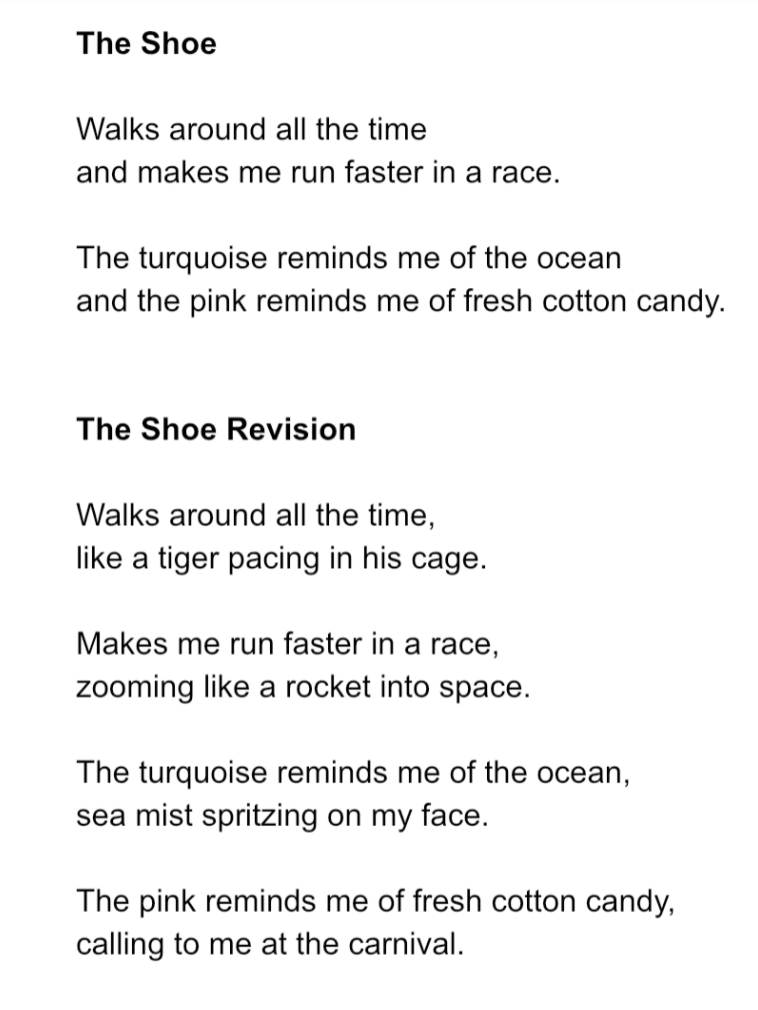
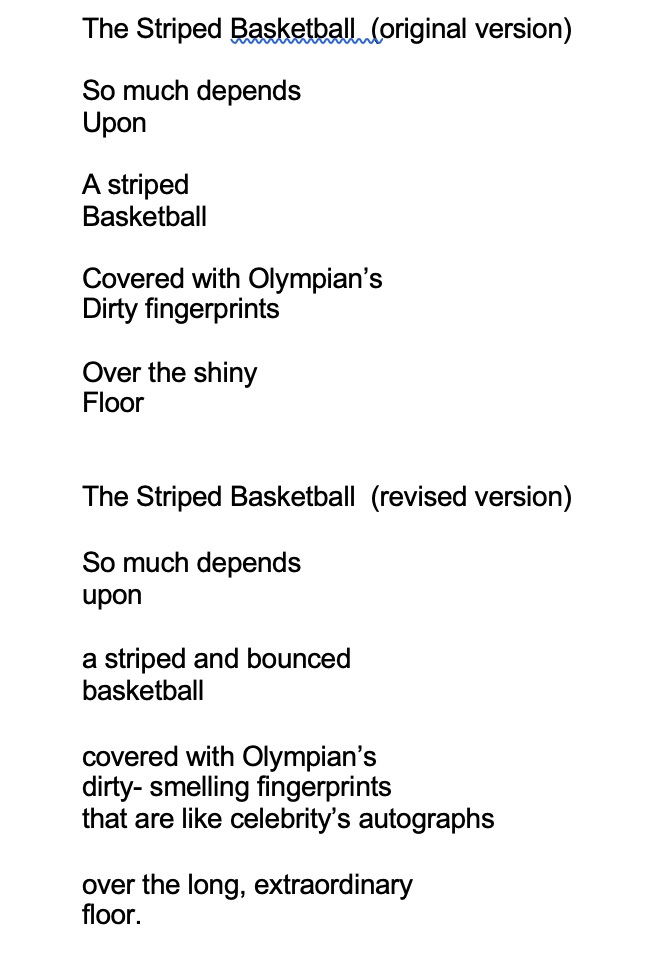
I spent some time thinking about ways to help my students understand HOW to revise, what concrete steps they might take to improve a poem written earlier this month.  So I started by thinking about some characteristics of effective poetry.  The use of simile and metaphor, sensory images, the use of vivid verbs and carefully selected details, personification, sound words…you get the idea.  I create a chart of these poetry elements for my students to select from as they considered a revision.  And I videotaped myself giving some directions…and thinking aloud about my own revision.

I reminded students to pick a poem they cared about–but not the one they love the best.  I wanted them to want to make changes!  Then I asked them to pick one or two elements from the chart to use for their revision.  I demonstrated with my own poem–stopping the video to do my own revisions–and then reading the new version at the end.  And because we revise when we have a reason, the point of this revision was to use the revised poem in our project…to make a narrated version of the revised poem using Adobe Spark Video.  I also asked for students to submit the “before” and “after” versions of the poem in our Google Classroom.

I selected my poem Waterworks to revise:

Waterworks

In this place where skies
are desert dry and sapphire blue

water pours
rushing down streets pooling on lawns

snails skate
down sidewalks worms
rise up
birds duck and cover

and I walk soaking up
sky tears breathing in water-saturated air

fully submerged in today’s
waterworks

®Douillard

I thought about how I might incorporate sound into my poem and a simile.  As I revised, I found that my ending wanted to change, making myself a part of the waterworks I was describing.  (I did have a student tell me he liked my original better than the revision!)

Waterworks (revision)

In this place
where skies are often
dry
and as blue as the jeans I wear walking in my neighborhood

water pours

sploosh-shushing down sloping streets

pooling like soup bowls on once dry lawns

snails skateboard
down slippery sidewalks
worms
rise up
bird—sensing danger—duck and cover

and I keep walking

soaking up sky tears

that mix with my own

and I become a part of today’s
waterworks

®Douillard


In our remote learning environment, my students worked at their own pace.  They decided when to work on revision, when to work on math…  After a while I started to notice the revisions coming in.

I love it when my students get it!  And even more so, when this complex task works out in this remote learning environment.  I picked a few to share with you.  Here is K’s revision:

Kylies revision

R’s revision resulted in a slightly new…and musical focus:

Remys revision

And P’s revision brings an interesting new simile into play:

Patricks revision

Now the challenge will be to keep both the poetry writing and the revision going as we continue through the month.  I’ll be thinking up some more reasons to revise…at least one poem each week to keep practicing revision, and hopefully internalize more poetry elements as well.

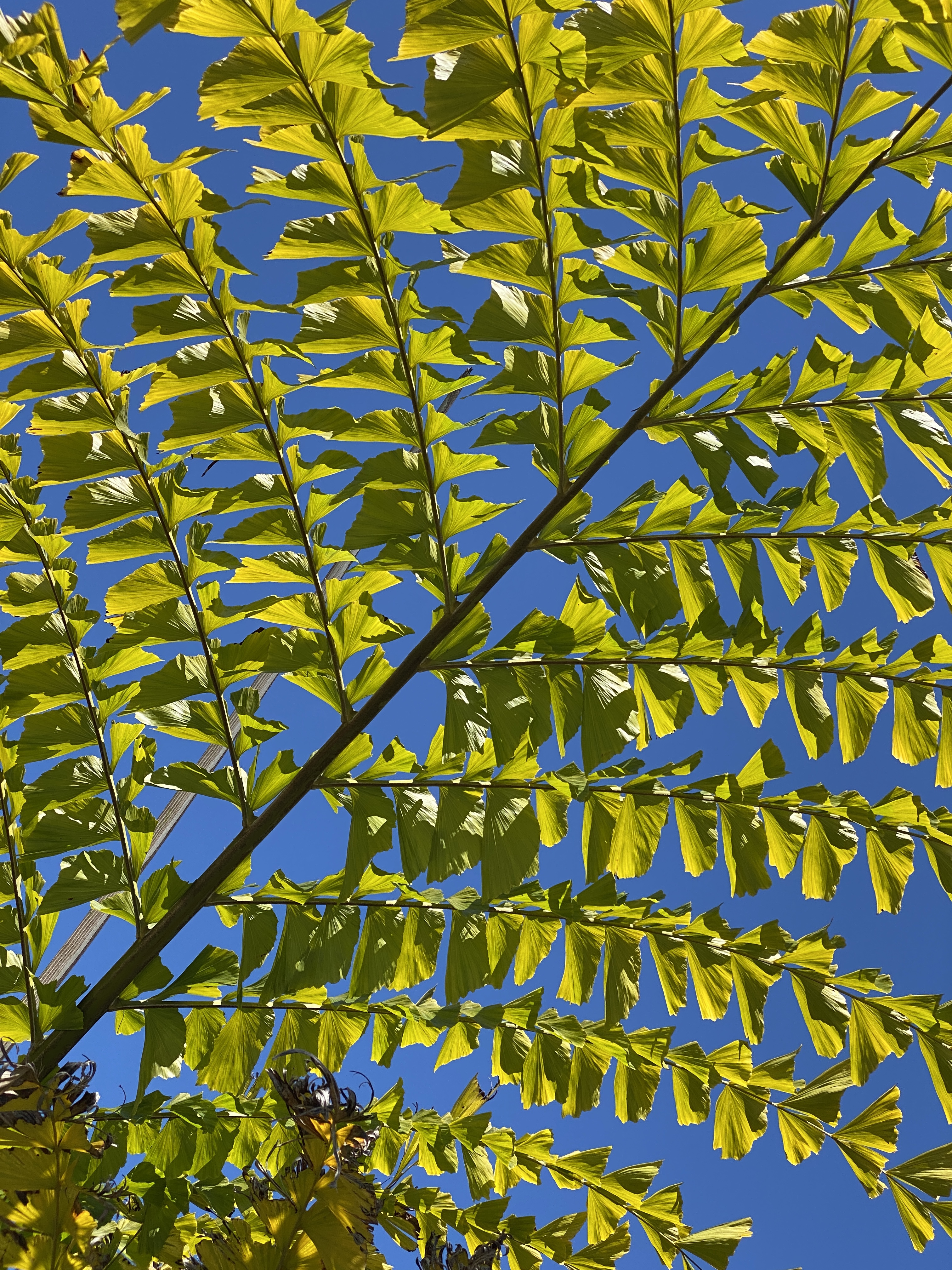
I’d love to hear your revision stories.  How does revision work in your classroom?  With your writing?  In this remote learning environment?  And the snail is to remind myself that writing can be a slow process…that you have to stick with it, stay on the path…and that you carry all you need on your back and in your heart!

img_0832