Tag Archives: writing

Ode to Decaf: NPM20 Day 14

I’m definitely feeling the poetic struggle as I reach mid-month.  My mind is on my students and figuring out how to support them in this distance learning emergency.  I’m housebound with little outside inspiration.  My neighborhood is nice–but it really isn’t evoking poetic thoughts right now.

So instead…I turn to thoughts of the coffee I drink every morning.  The coffee I crave…want…need…  And I know it’s not about a caffeine addiction, I switched to decaf more than a decade ago.  So today’s poem is an ode…to decaf.

Ode to my Decaf


I swim in its depths

the warm, dark steamy whirls

of decaffeinated comfort


earthy aroma

that spirals

from my mug directly

into my nostrils


steaming open my brain

loosening thoughts

opening the doors

to today


the whir of the bean grinder

echoes

the drip drip drip

a tympanic symphony

within the glass carafe


I come up for breath

wrapping my hands

around the ceramic

warming

from the inside out


for me

it’s not the caffeine

it’s the coffee


®Douillard

img_1423

A Poetry Game: NPM20 Day 13

Spring Break is over (sigh) and we’re back at our distance learning.  It’s still National Poetry Month and we’re deep into the poem-a-day challenge in my classroom.  To change things up a bit, today we played a poetry game.

At school I have some different versions of poetry dice (or writing dice).  You know, those cubes with words printed on them.  To create a virtual version of rolling word dice, I found a cube template online, pulled together a poetry word list, made a video of myself explaining how to make poetry dice…and then what to do with them once they had their own versions of the dice in front of them.
img_6546

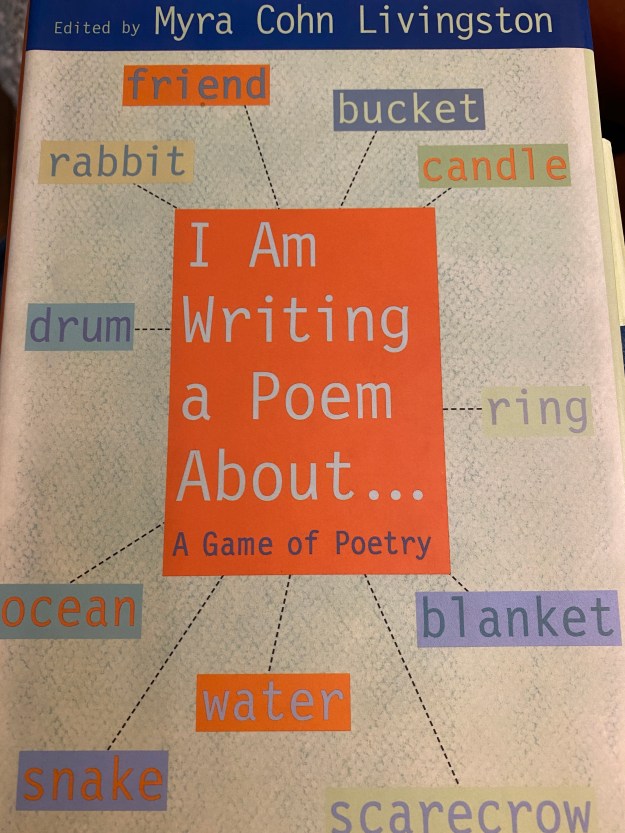
Using an old favorite, the poetry book I am Writing a Poem About…A Game of Poetry edited by Myra Cohn Livingston, I asked my students to roll their dice 3 times, collecting 3 words that they would craft into a poem.  (I used all nouns on the dice, trusting students would be able to come up with other words to create their poems…following the book’s lead.)

In the book, the 3-word version of the game uses the words: ring, drum, blanket.  I used the poem Grizzly by Madeleine Comora (from the book) as an example text.  Students could use the poem as a mentor poem or not.


I rolled the words purple, basket, and waves.  I was immediately drawn into my poem thinking about the song America the Beautiful…at first having purple waves of grain in my head.  After a bit of revision, I realized I had written an #USvsHate poem.

America


In this place we know

with purple mountains majesty

and amber waves of grain


there are some

who carry baskets

that are empty


let’s fill those spaces

with love and compassion

opportunity and freedom from oppression


when the gaps close

and all can thrive

that’s when

we’ll truly have

brotherhood

sisterhood

personhood

from sea to shining sea

#USvsHate


®Douillard

Here are a couple of early student examples:

E was excited to roll night, mountain and egret…he said it was the best combination ever.  (When I questioned the missing word mountain, he said that he thought volcano was a good substitution since mountains can be volcanos.)

 No Light On Dreadnaught Island


South West from Moon Island I’m told,

A haunted island lies.

No sailor roams there freely and bold,

No egrets fly in the skies,

From the volcanoes belching their lava out,

Evil creatures of magma come,

In one big lava spout.

With all their arrogance, they even defy the very Sun.

And ruling the island, throwing everything in sight, is the great Magma Golem,

He’s rude, impatient, and very solemn.

Here it always seems to be night,

And there’s not a thing that doesn’t bite.

R rolled cactus, stoplight, and rock

Desert


A desert

of thirsty

dry rocks

 goes tumbling 

down sand biomes.

The spiny cactus

as a bright 

stoplight reminding

the earth to stay still.

It’s your turn.  What can you do with 3 randomly rolled (or selected) words?  You’re welcome to borrow ours and try your hand at a poem or two!  We’d love to know what you come up with!

img_6549


Blackout Poetry: NPM20 Day 11

Thanks goodness for the National Writing Project…just when my inspiration was beginning to lag and a poem every day started to feel like a chore, this post arrived in my Twitter Feed. Blackout poetry–why hadn’t I thought of that?

So I grabbed the newspaper that arrives only on the weekend and was immediately drawn into an article about the only school in California that has not closed due to the coronavirus. I selected words that drew my attention, not really paying much attention to anything other than the fact that they called to me.

I started to arrange the words, grabbing one here, another there, combining others into phrases until I had a poem in front of me. And then I wondered…had I broken the rules of blackout poetry by rearranged the words rather than taking them in the order they appeared?

So I tried again–this time only using space as my poetic license. I haven’t taken the time to actually black out the rest of the text as I’ve seen done before…and I did doodle a laptop…a connection to the now of schooling with no schools.

So here’s the photo of the blackout process…and both versions of the poetry. Does one speak to you louder than the other? What meaning emerges from these selected words?

Holdout  (version 1)

Virus accelerates

U.S. now closed


10,520 schools

shuttered education

disinfected

sanitized

students stay home


Essential

social distancing

tangled clusters

walnut trees


generations

shelter-in-place

Civil War


None of us knows when

school will resume

®Douillard


10,520 Holdout (version 2)

accelerates

stay home

essential schools

students shuttered


Civil War

walnut trees

education


generations

shelter-in-place


virus

disinfected

sanitized


social distancing

tangled clusters


none of us knows when

U.S.

now closed


school will resume

®Douillard


Raindrop Rooms: NPM20 Day 8

In these parts we’re known for being fickle about the weather. We want some–until we have it–and then we complain that it arrived. A heavy downpour delayed my walk this morning, but also inspired me later, when the sun peeked from behind the clouds so I could head out into the backyard in search of water drop photos…and a poem.


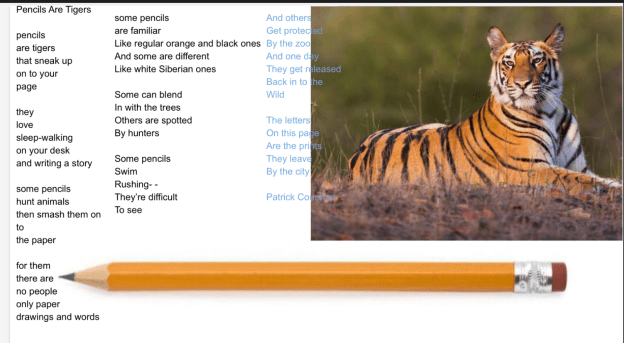
The mentor poem I left for my students today was Pencils by Barbara Esbensen. We studied this poem earlier in the year and I wrote about it here. And here are some examples of their poems as videos written in October.

Midway through our spring break, I haven’t seen what my students have come up with as they encountered this poem again. But I am looking forward to seeing their writing as their poetic skills continue to evolve.

So with raindrops on my mind, I wrote again with Pencils as my mentor text.

Raindrops

The rooms in a raindrop

are round

filled with reverses

upside downs

mirror image

reflections

of the world outside

In a raindrop

molecules hold hands

gripping tightly

to the moisture within

How do they balance

on the tip of a leaf?

Who wipes their tears

when they fall?

From a drop of water

gardens of color emerge

blossoming into stories

of hope and possibility

Raindrops, teardrops, skydrops

wash down the page

blurring and

brightening

making space

for new beginnings

®Douillard

In the Rain: NPM20 Day 6

Even though today is technically spring break for me and my students, I found evidence of poetry writing in our Google Classroom. I scheduled a mentor poem for each day this week to inspire and support my young poets–all poems we had studied earlier this school year. Today’s poem was The Blue Between by Kristine O’Connell George.

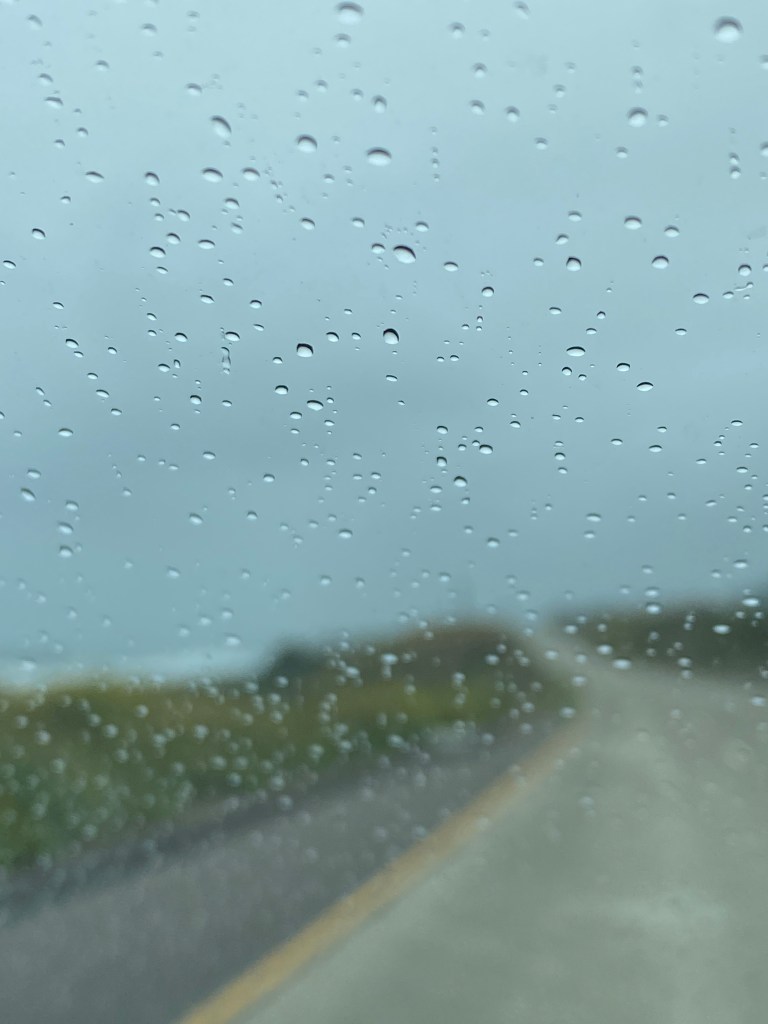
The steady downpour of rain was another influence evident in my poem and my students’ poems. I’m trying to appreciate the much-needed rain and to find ways to make this week feel like a break. Instead I’m feeling cooped up, without the escape of neighborhood walks. I tried to duck out early this morning, thinking I would beat the rain–just to pull the door open to the skies opening up! I rode that stationary bike…but it’s just not the same for me.

For escape, we took a drive up the coast in the pouring rain. The sight of the stormy ocean was a refreshing change from the walls of the house–even if viewed only through the car window.

My poem:

Raindrops

Raindrops fall

dripping dropping

teardrops

across sky cheeks

Gray on gray

blotting out color

a palette

of monochrome

And yet

precious moisture

dampens fire risk

feeds parched

creeks

ponds

rivers

lakes

reservoirs

Look closely at each

raindrop

and find the hope

reflected

inside

®Douillard

And a student poem by E–also inspired by the rain:

Rain

Everyone hates the rain, sulking in their raincoats, 

Hiding themselves under their umbrellas.

I see rain differently,

I see the fun between—

The water to run and splash in

The fun trails to dash across,

Arching up across puddles..

The rain dancing down,

Making gallons of fun,

A river of joy,

Slithering around every house.

In those cloudy days,

I see a different scene.

In those rainy times,

I see the fun between.

And by M (not inspired by rain):

The Gaps Between

Many people see one whole 

I see the gaps between 

               The face standing there

                with only one eye.

                The pigeon flying by

                 The trees in a band 

                 The concrete is Atlas

                holding up the Stones. 

Those rough dark places

I see a different picture

I see the gaps between

What I Keep Learning: NPM20 Day 4

This piece in progress was inspired by What I Learned this Week by Angela Narcisco Torres. While it doesn’t yet feel finished to me, it does have some ideas that I am happy to have captured.

What have you been learning as we all do our best to shelter-in-place? Those of you who are teachers, what are you learning as you work to support students through some kind of remote learning?

What I Keep Learning

What matters when your students are names on a screen

Rather than physical beings that you see and interact with each day?

When you hear the echoes of their voices 

Through typed comments

That pop up continuously throughout what used to be the school day.

Quiet students are still quiet

Rarely leaving a trail of their thoughts or needs

And body language is no longer

A text to be read

The chatterers still chat

Loud and long, filling my inbox

With every possible question, ‘sup, and emoji 

They tap their chat to me, to each other, to themselves

Filling empty ears with imagined sounds of school

Assignments matter now more than ever

I see the ways the mundane

Assignment-for-assignment-sake

Deflates, dissipating energy

Leaving us all unsatisfied and wrung out

Like that washcloth left on the edge of the sink

We need learning opportunities that connect us

Build on experiences and passions

Each student holds close

Allowing ideas to soar and words to take flight

Writing matters, that’s what I keep learning

®Douillard

An Invitation to Connect and Make Poetry: NPM20 Day 2

Last night on our National Writing Project connecting the network zoom call, my colleague and I were asked to facilitate a “making” session–a place for a small group to make something together. And since writing is making, we thought about some way to have our group engage in a small writing piece that collectively made something bigger.

Inspired by the Springtime in Washington Haiku Contest: Poems on a Pandemic article another colleague shared with me earlier in the week, we decided to create a shareable slide deck of our own version of Coronavirus Haiku. We invited participants in our breakout session to create a Haiku (short poem, 17 syllables, 5-7-5 pattern), and then add the poem and an image to a slide in the collaborative deck.

I offered my own as example:

So this post serves as an invitation to all of you. Take a few minutes to write a Haiku or other short poem about some aspect of your coronavirus experience. It can be funny, somber, documentary, whimsical, sad, angry…

You can access the slide deck here: Coronavirus Haiku: Short Poems Documenting Life During a Pandemic. Writing is not only making, it is also connecting. And can be healing as well. A few years back I wrote a post about my response to another blogger and colleague’s invitation to write #haikuforHealing–a balm for the tired spirit. So let’s connect and heal as we write together.

Let the Poetry Begin! #npm20

It’s April 1st–the “official” start of National Poetry Month. But really, do we only “do” poetry in April? Poetry plays a role all year in my classroom, but I love to ratchet up the poetry volume in April by getting my students to participate in the poem-a-day challenge. We warmed up Monday and Tuesday, pretending April had already begun, starting with shorter, accessible poems. You can see day1 and day 2 here.

Today our mentor poem was Words are Birds by Francisco X. Alarcon. The first responses (in the comments on our Google Classroom site) were, oh no! This looks hard! Do I have to write something this long? Had I overestimated what my students could do, especially since they are all learning at a distance from me?

I was working on my own poem at the same time–I’ve been adding my poem to the Google Classroom site around mid-morning, to support those who need an extra example, but not offering mine up as the only possibility. And I had scheduled a Google Meet this morning as an Open Mic opportunity–instructing students to be prepared to read one of the poems they have written this week. I wondered if students would still want this video meeting if they had to read a poem and not just have a social check in.

At 10am student faces started to pop into my camera screen. At first I couldn’t hear them–but they could hear me (and apparently each other too). After a restart, both faces and voices came into range, a cacophony of sound. With their mute buttons in place we began our Open Mic. 14 students read their poems this morning, some reading an extra just because. I can see their poetry confidence growing and their skills growing too. And it’s only day 1! (Or day 3 if you count our pre-start!)

Here are a couple of student drafts from today:


And here is my poem for today:

Poems are Clouds

Poems

are clouds

that arrive unscheduled

they love

readers

writers

thinkers

lovers

kids

some poems gather

dark and tall

casting shadows

forcing thoughts

to fear

uncertainty

some poems

are light as the shine

of the sun

on the wet sand

reflecting

joy

    contemplation

                    gratitude

and others

clear the sky

leaving the blue

to stand

alone

freeing writers

to create 

their own clouds

cumulous

stratus

cirrus

billowing, stretching, towering

leaving behind

the weather of feelings and

lightning strikes

of

inspiration

Kim Douillard

4/1/20


Will you celebrate poetry in April? Use poetry as a way to calm frayed nerves, express fears, find comfort in words? I hope so…and I hope I will get to read some of your poems too this month.

SOLC Day 29: Tasting the Nurturing

I don’t cook. Lucky for me, I married someone who does…and does it well. And he not only cooks, but uses food preparation as a way of nurturing, a way of showing his love.

Most days, breakfast is a grab your own system. He makes coffee, I grab my yogurt from the fridge, dress it up with granola or fruit or not and eat as I check those early morning emails before I leave the house (back when I left the house). That routine is still in place on the weekdays. But on the weekends, breakfast is always something more special.

This morning was homemade buttermilk biscuits.

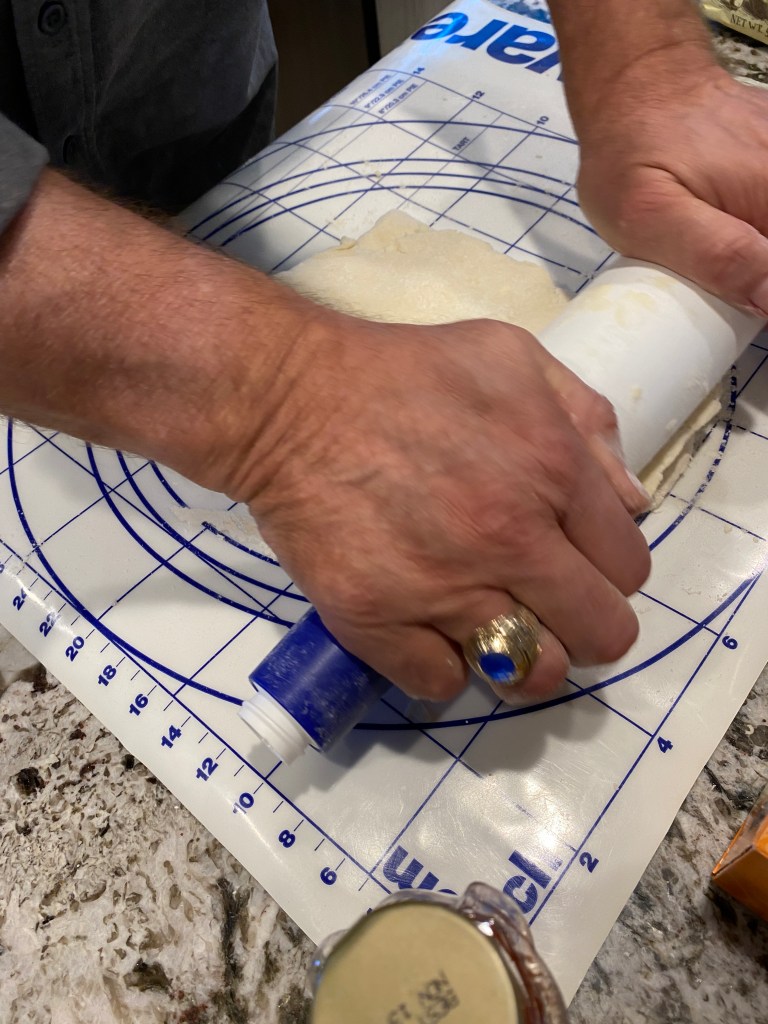
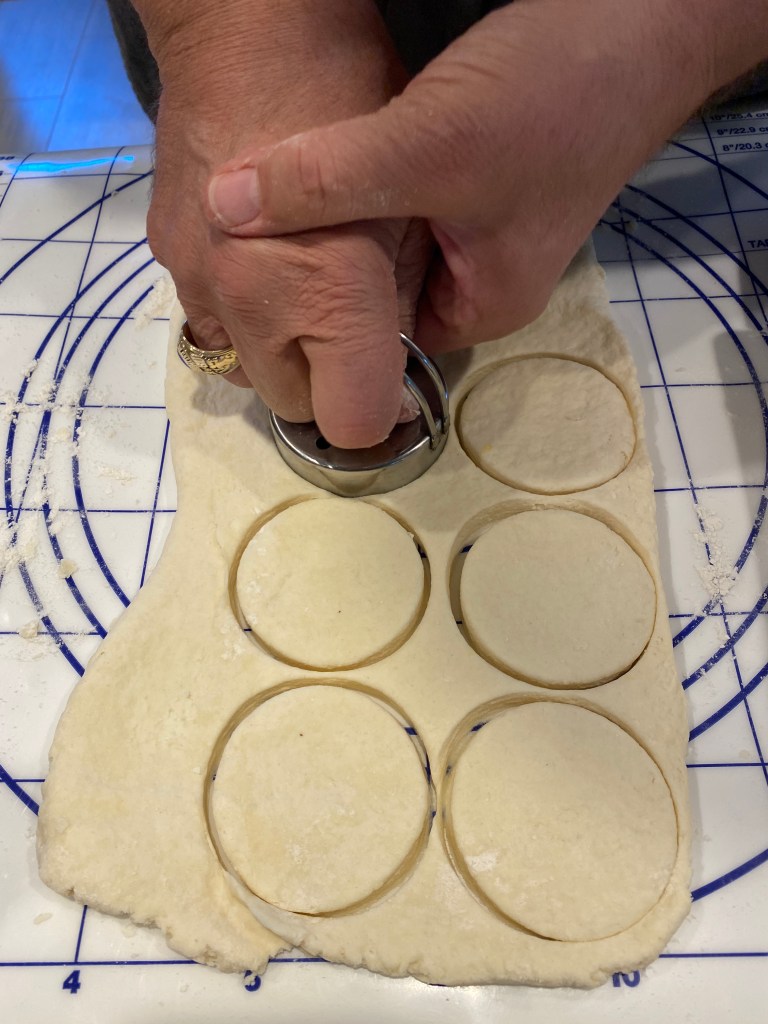
I love biscuits. Light and fluffy with a slight crunch, slathered with butter and honey. Perfection. And it takes some work. He starts with a fork and butter into flour, eventually adding wet ingredients until it is ready to roll.

He’s learned this folding and rolling technique that creates space between the layers of the biscuit that contributes to the light and flaky texture. When it is rolled just right, he starts the cutting. with the biscuit cutter we bought on a trip to Nashville (where the biscuits are good)!

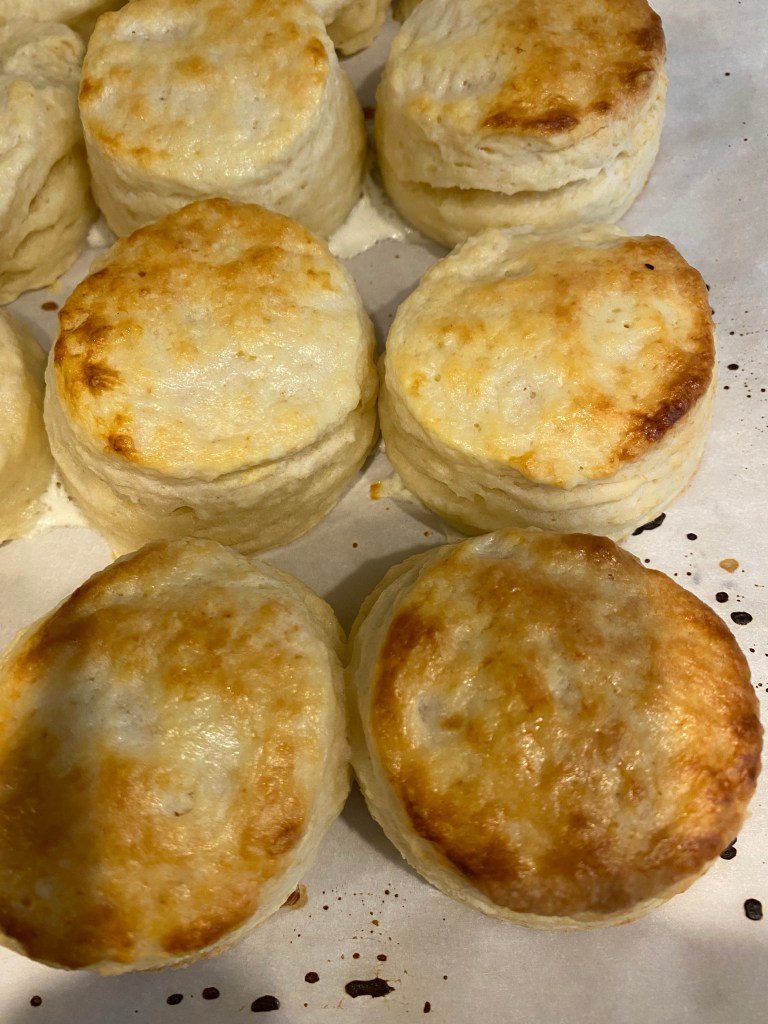
Transfer to the pan and into the oven they go until they come our golden brown with just the right crunch on the outer layer.

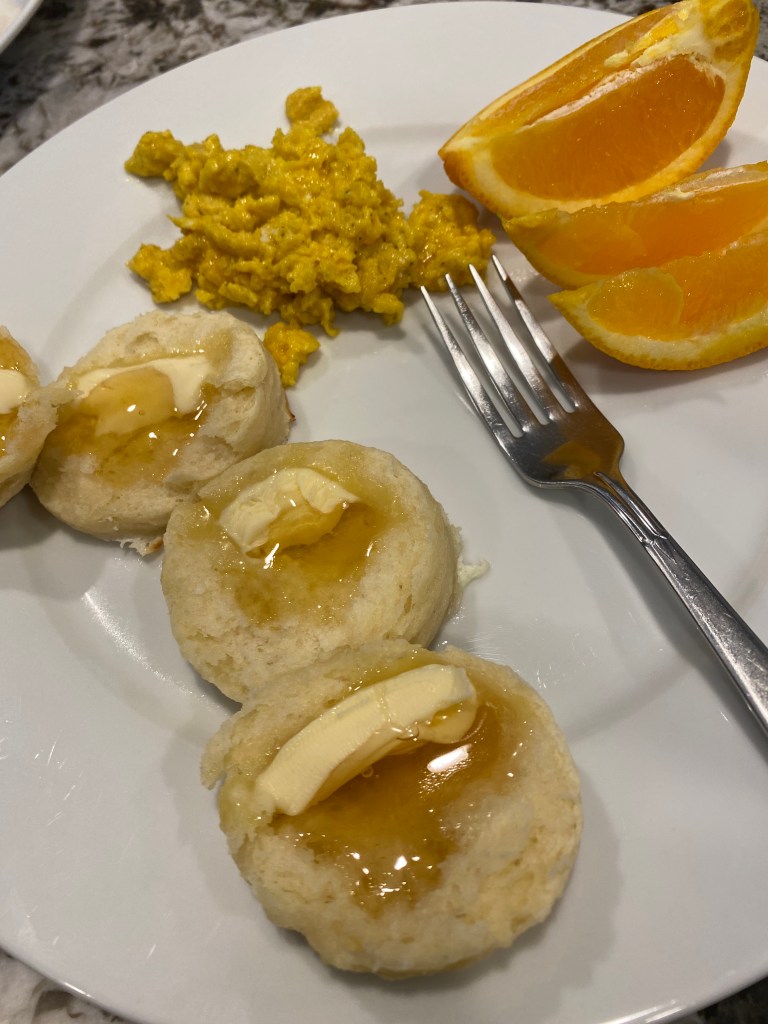
And to balance out this decadence, scrambled eggs with cheese and turmeric and some orange slices round out the breakfast plate.

In each and every bite, I can feel my husband’s love and care. I hope my students can feel that kind of nurturing in the work I ask them to do. Especially during these remote learning days, when I am not able to teach my lessons through my voice, my body, through the interactions of students with me and with each other, I am carefully constructing and deconstructing my own plans and planning process to convey energy, motivation, and reasons to engage to my students. I want them to taste the sweetness in the writing I ask them to do. I look for ways for us to connect–through video, through images, through words, through text. I want them to taste the love and nurturing just like I did this morning when I bit into that homemade biscuit…with honey dripping down their chins, hungering for more.

SOLC Day 25: Coronavirus Status

I came across a post about Jimmy Fallon the other day–where he asked people to describe their quarantine experience in 6 words. Now his was a Twitter thing…and with adults, so the results were funny. At the same time, I was thinking about ways to give my young students (8 and 9 year olds) space to express their experiences now that school is happening at home and they are mostly quarantined in their homes. So I took the loose idea from Jimmy Fallon and combined it with some ways of working that are familiar to my students.

Here was my assignment to them today:

On our 8th day of doing school from home because of the coronavirus, think about either something you are missing or something you are finding wonderful.

1. Take a photo to represent that thing. Be sure to use a photo technique. You may use minor editing on your photo.
2. Write a 6-word update. These are 6 carefully chosen words to express your feelings and communicate what you’re experience. (You can see my example) Only 6 words…try to avoid words like the, and, it… Type your 6-word update in Docs.
3. Click on the link to access the slide deck. Choose the next slide in the deck and insert your photo and copy your 6 words (you will need to insert a text box to paste) onto the slide. Be sure to include your name on the slide.
4. You may change the font if you like. Make sure it is big enough and clear enough to be easily read by others.
5. You may change the background color of your slide if you like. Please select a color from the theme (choices along the bottom)
6. Once you are done with your slide, please attach your poem and photo in Google Classroom to submit your work.
7. I can’t wait to see our slide deck develop! Be sure to be thoughtful and do quality work!
8. My slide is included so you can better understand what I am asking you to do.

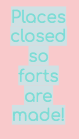
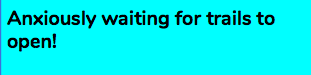
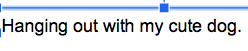
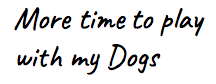
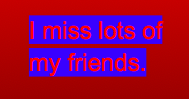
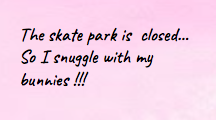
And here are some of the results:

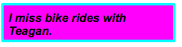
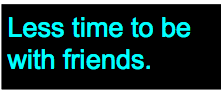
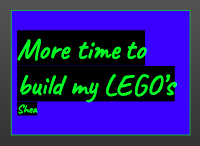
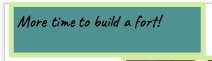
As you can see, the kids can see both the benefits and the drawbacks of their time at home. The biggest loss they are feeling is the social aspects of going to school. They miss their friends…and their teachers. And we definitely miss them too.

So my students’ 6-word coronavirus status updates are not funny, but they are honest and sweet, hopeful and very much all kid! I’ll be looking for more ways to allow for expression without being too heavy-handed.

What have you been doing to document your experience as we journey through this global pandemic? Have you done anything to facilitate the process for the young people in your lives? I’d love to borrow more ideas!