Tag Archives: writing

Stamina for Writing

Over at the NWP iAnthology, Janet Ilko has invited teachers to consider, “How do you build writers with stamina?”  As a middle school teacher, she talks about how daily journaling is a way to build stamina in her young writers.  (She works to build her own writing stamina through her blog, Writing in My Hand, as well.)

Stamina and fluency are important characteristics of writers.  Fluency allows for the words to flow onto the page and stamina means working through the hard parts of writing to keep on writing, to rework writing, to improve writing, to understand the importance of writing to learning and thinking and communicating.

One of the ways we build stamina in our classroom is by creating a culture where writing is the norm.  It’s no big deal…we write all the time.  We write to explain our mathematical thinking as we explore math concepts.  We write to describe what we are learning through our science labs.  We write to learn about spelling patterns and grammatical concepts.  We write stories, poems, arguments, and to share information with others.  We write to plan, to remember, and we write to reflect.

This week we asked students to do some reflective writing in preparation for student-led conferences next week.  We asked them to think about their learning in math, reading, writing, science, and with our iPads.  And what I notice is that these students have stamina for writing.  They know that writing gives voice to their learning.  It matters to them, to us as their teachers, to their parents…and to each other.

We are a community of writers.  And writers write.  They write because writing helps them think, and remember, and communicate.  And sometimes they publish too.  But mostly they write because writing matters in our community of learners.

photo-7

I hope it lasts a lifetime.  How do you build stamina in your writers?  How do you build your own writing stamina?

Introducing…

Beginnings and endings often confound writers.  And yet they are critical to the success of a piece of writing.  Many of the young writers I work with simply dive into their content…regardless of genre or text type.

We recently gave our students a writing performance task to inform our teaching of informational writing.  Students watched a short video about animal defenses and either read a short article on the same topic or listened to a picture book on that topic.  After reading, watching, taking notes, and answering a few questions, they were prompted to write an article describing and comparing animal defenses.  Our students were immediately engaged in the task, eagerly taking notes and excitedly writing about the animals.  It was clear that they understood the material and wrote effectively about the content.

But…many of our students dove directly into the body of their writing without any kind of introduction at all.  They started with sentences like, “The porcupine has sharp quills…” or “Puffer fish blow their bodies up so other animals can’t eat them.”

I’ve often wondered why this lack of introduction is so noticeable (not just in my class) in prompted writing and less evident in classroom products that make their way through the writing process, including the use of mentor texts and mini lessons along the way.  Does the written prompt encourage students to see the writing as an answer to a question rather than writing that stands alone?  Or is the missing step the writing response group or individual teacher conference?  Or maybe it’s a combination of all of the above.

My teaching partner and I have thought long and hard about this phenomenon and decided that we would use our students’ prompted writing, and our analysis of it, as an opportunity to teach our students about introductions and conclusions.

In planning our introductions mini lessons, we took a careful look at non-fiction/informational texts we had read in our classroom recently.  We ended up using both texts from the performance task…a picture book and a short article.  We also used an article about pumpkins from Scholastic News that we had read as a class, a book about rock collecting, and then an unrelated book about rain forests that we had not read.  We chose all of these because they demonstrated different approaches to introductions.  With our students we noticed a “preview” introduction, one that set the stage with a context and overarching idea, an anecdote that took us right into a place, and one that used a list to get started.

We sent students off to try our a new beginning for their animal defenses piece…with varying success.  Some of our younger students actually started rewriting the same information they had already provided!  As a class, we looked at a couple of student examples and noticed what they had tried out.

Today we returned to our introduction mentor texts and reminded ourselves about the purpose of the beginning.  And then we asked students to write a short piece about the fruit trees we had been out photographing and studying yesterday.

photo_1-3

With beginnings fresh in mind, students began to write.  We limited the time…giving them 7 minutes of “power writing” to write their beginning and whatever else they had learned about fruit trees.

Here are a few examples;

photo_1-2

So here’s a second grader’s attempt, “Hey, want to know about trees?”  I’m not that crazy about the “Hey” or the simple rhetorical question…but it is an attempt at at a beginning.

photo_3-2

This first grader took a very formal approach, “This article is about trees.”  She made a very definite attempt to set the context and expectations for her writing.

photo_2-2

This third grader attempted the more complex and creative anecdote approach, “Walk carefully through the big apple orchard.  Notice everything that has happened in the trees. Sketch it out in your notebook and take a minute to write about it–hope you have fun!”

photo_4

And this second grader tried out a broad overarching idea, “Trees are amazing parts of Mother Earth.”

I feel like our students are getting the idea of the importance and variety of introductions. Tomorrow we will take another look at introductions–both from our mentor texts and from some student examples.  And then we will ask students to write another short informational piece about another topic they are familiar with…with an emphasis on the introduction.

And then next week we will shift our focus to endings…and continue to explore ways to support our students’ development of writing that includes beginnings and endings as well as rich content!

Writing is complex…and we can always work to make our writing better.  How do you support student writers?

photo_2-3

One Photo, Three Ways

When daylight savings time ended early Sunday morning, our daylight hours also shrunk. Instead of getting home with some daylight left, it is now dark.

As I left the university this evening, it was already dark.  Looking into the dark, evening sky I noticed the beautiful fingernail of a moon.  Even knowing that my iPhone doesn’t take great pictures of the moon, I couldn’t resist pausing to take a shot.

photo_3

When I got home I thought I would play with this image (which was better than I anticipated) using the app Tadaa.  It has some interesting filters that work particularly well with playing with light and shadow.

Here’s a dark version:

photo_1

I like the way the trees frame the moon in the distance and the reds and oranges are nested in the foreground.  I couldn’t resist trying one of my favorite filters, otherland, and was surprised when it turned my dark, nighttime image to white.  I love the way the moon is silhouetted in the white sky.

photo_2

The filters dramatically change the mood and setting of this photo.  Each tells a different story by a simple change of the filter.

What stories do you see in these images?  I hope you’ll take a few minutes to write your ideas in the comments here!

Working from the Why

Everyone loves a field trip…right?  Or maybe not…  As a teacher I like the way that field trips give my students a shared experience and helps to make abstract science or social studies concepts more concrete.  I also like to give my students access to experts in the field and help them imagine professions where this content learning is applied.  But…to get these outcomes, teachers have to plan carefully and connect classroom learning to the resources of the field trip destination.

The San Diego Area Writing Project (SDAWP), along with the San Diego Natural History Museum (SDNHM) and the Reuben H. Fleet Science Center (Fleet) are partnering in a National Writing Project (NWP) and Association of Science and Technology Centers (ASTC) initiative investigating the intersections of science (or STEM) and literacy (with an emphasis on writing).  Yesterday we launched our work  with ten formal educators (who work in public schools) and ten informal educators (who work in the museums mentioned above), with a particular focus on field trips.

photo-7

The facilitation team (of which I am a part) decided to launch our work by focusing on the why of the work.  Why is it important to re-examine field trips and consider ways to improve the experience for students and to create supportive structures for teachers and other adults who accompany young people to museums and other field trip sites?

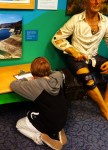
Inspired by a TED Talk by Simon Sinek entitled How Great Leaders Inspire Actionwe spent our first (of 5) sessions focused not on the what or how of our project.  We sent teams of educators out into the museums to observe and experience an exhibit through a set of prompts that invited them to look and try through a variety of different lenses, and write about their experiences.  They critiqued the exhibit–not to find fault with it–but as a way to consider what structures might support learners’ interest, inquiry, and pique curiosity.

photo-6

Our short, but intense day left us with a desire to take action…to figure out how to make field trips amazing learning experiences, with students at the center.  One comment from the end of the day reflections is still bouncing in my head,

…the “why”has the power to transform educational practices.  From field trips to worksheets to projects, I wonder how many educators push past the “what.”

Our goal with this project is to do just that–to push past the what and consider the why. The why is where the action sits…and we want to take action toward improving field trip experiences for students by supporting the adults who facilitate them: teachers, museums educators, chaperones, and parents.

I can’t wait to see where this project takes us…  If only I had a window into the future to get a hint at just what the possibilities might be!

photo-8

What do you love about field trips?  What does your ideal experience look like, feel like, leave you thinking about?

Outside

I spied this gorgeous hawk sitting in a tree not far from me as I was walking today.  I slowed and carefully positioned my camera, trying to capture this image.

photo-1

And as I watched and then continued my walk, a short 25 word story (or maybe the beginning of something more) was brewing in my head.

Tucked in behind the gas station and across the street from the McDonalds, hawk oversees wild space…what is left of what used to be.

I took a minute at the stop light and jotted notes down in my phone to remember this thought when I got back home.  Thinking about what used to be interests me.  What caused developers to leave this wild space untouched?

Last week a parent in our class sent us this article about going outside to write when you feel stuck or uninspired with your writing, saying that it reminded her of us and our classroom.  (Such a great compliment!)  I’ve shared it with many others…and was thinking about it this morning as I headed outside for a long walk.

I knew I had lots of writing to do today (beyond my blog post) and told myself I needed to get outside and be active before settling down to work.  To make the prospect more appealing, I planned my walk with a mid-walk stop at the local Starbucks and had my iPhone handy for any interesting photo opportunities.

As I started my walk I noticed that my “monkey mind,” as Natalie Goldberg calls it, took over.  I could feel my attention pulled in a million directions as I noticed sounds (cars, birds, breeze, leaves crunching, bicycles whizzing by…), smells (the smell of water in the curb drains, car exhaust, the damp of foggy air…), sights (the lone purple flower in a sea of ground cover, scraps of paper interwoven in the brush, leaves blowing…), and physical feelings (the sheen of sweat building on my shoulders, the push of air as cars rushed past, the uneven sidewalk under my feet…).  Before I started my walk, I had thought I might continue on a theme of water photos started yesterday with a walk on the beach, but the first half of my walk didn’t offer any interesting possibilities.

And then I noticed the hawk.  It literally stopped me in my tracks as I looked closely, noticing the beauty of this bird.  Crows and pigeons are pretty commonplace on my walks…and hawks are mostly noticed from a distance, flying high above.  I loved the opportunity to look closely as I angled my lens.  He watched me as I watched him.  And then he spread his magnificent wings and took to the sky.  I only wish I could describe the sound of those large, powerful wings as they lifted the bird from the branch.

As much as people complain about “screen time” and lament that devices are keeping our young people indoors, inactive, and uninspired, I find that it is my device that gets me moving, heading outdoors, and paying attention to my surroundings.  As always, we need balance in our lives.  Opportunities for solitude and times to interact.  Playtime and sustained work.  Time in nature to notice and question and wonder and time with our screens to produce, write and connect.  It doesn’t have to be either/or…can’t it be both?

How does your device (or devices) impact the ways you interact with the outdoors?

Structures

I treated myself to a walk on the beach today after a writing project meeting at the university.  So instead of walking on the beach near where I live, I walked on the beach down the hill from the university.  It was foggy and cool, a perfect day for thinking and reflecting.

As I was walking I was thinking about the meeting…a follow up to the Invitational Summer Institute (a 4-week intensive leadership institute in the teaching of writing)…and the structures that we need as learners to move along the continuum from novice to expert (with the endpoint constantly moving) and from follower to leader.

The structure of the Summer Institute (SI) is designed to immerse teachers in writing, researching, reflecting on their practice, and critical conversations about teaching and learning.  The structure is strong and well built, based on the 40-year-old model developed by National Writing Project founder, Jim Gray.

photo_1

This pier is also a carefully designed, well built structure made to withstand the battering waves of the Pacific Ocean and the relentless wind and sun.  I love the way when you look through the pier it narrows and provides a window through the corridor of surf out to sea just like the SI helps teachers look carefully at policy and practice and then focus on instruction that best supports the students in front of them.

And some of the structures we depend on are organic like these cliffs.

photo_3

They are shaped by the natural environment.  I watched our SI participants create their own structures as well.  They gathered this morning, organically, catching up with each other as we, as facilitators, finalized our last minute plans.

And then there are structures that are light and flexible, like this feather on the beach.

photo_2

It makes me think of our Twitter Fellow of the Week.  This playful use of social media supports more weight than you might imagine.  While we originally saw this program as a way to connect to one another within our project by giving each other a glimpse into a week in the life of an SDAWP educator, it has proven to do more.  When teachers use Twitter as a professional learning network, their interactions begin to impact their practice.  Suddenly they are reading more professional articles about education, “listening in” to debates about policy and practice, getting and sharing ideas from others (within our site and beyond our site), and making their own classroom practice more visible.

Today we asked our SI 2013 cohort to sign up as Twitter Fellows…and starting tomorrow we will begin to get a glimpse into their lives.  (You can follow @SDAWP_Fellow on Twitter) Those who are more confident on Twitter signed up first…but others are willing to dip a toe into this unfamiliar world of tweets and hashtags and mentions.  And they have the rest of the SDAWP community who are happy to help…and the others in their cohort will also be “listening” on Twitter, ready to respond and retweet and favorite…so they won’t be hollering into the dark.

My beach walk today was quiet and introspective as I thought about all the structures I noticed…and those we use to support learners.  Structures can help us stretch and reach and connect as we learn and grow.  What structures support you?  What structures support your students?

Making…and Learning

Making…a powerful venue for learning.

Our students have been doing a lot of making…and learning lately.  Sometimes that making looks and feels a lot like play.  And that’s a good thing.

This week we were lucky enough to have the Lux Art Institute come to our classroom with The Story Box from their Valise Project.  On Tuesday our students spent an hour examining the wood carving, block prints, and sculptures of Jim Lawrence based on fairy tales…and were invited to either write their own fairy tale or pick a favorite to create a block print image today.

Our students were excited to think about fairy tales…and write their own.  The creativity of children is amazing…their stories sometimes meander a bit, but there is no shortage of imagination and wonder.

And today they had the opportunity to create their own “blocks” for printing.  Using styrofoam sheets, they used pencils to etch indentations of their image…and even learned some techniques for writing their names and other words backwards so they would print forwards.  (They made a few mistakes…but that, too, is part of the learning process.)

Using a brayer and paint, they smoothed paint onto the surface of their etching and then pressed it onto colored paper to create their prints.

photo_1

They created beautiful images…whimsical, cute, fanciful, scary…and everything in between.

For more than an hour, my students were happily engaged with drawing, etching, painting, and writing.  They had to think critically and problem solve.  They had to practice patience as they waited their turn to paint.  They focused and produced.  They were making.  Making art.  Making stories.  Making memories.  Making connections.  Making understanding.  And they were learning.

What have you made lately?

A Writing Kind of Day

Today was a writing kind of day.

On Friday we began celebrating the National Day on Writing with a field trip and a puzzle piece that I wrote about here.

But today was the cherry on top of the writing sundae.

Our morning began with a version of a chalk talk.  My teaching partner taped white butcher paper to the wall ball court and posted a few questions for students at our school to respond to: How do you use writing to connect?  Where do you like to write? and Who are your favorite authors or what are you favorite books?

With markers in hand, our students started writing.

They wrote about places they love to write: writing on couches, on the beach, and in libraries.  They love Shel Silverstein, Beverly Cleary, Roald Dahl, and J.K. Rowling.  They write letters, texts, emails, books, notes and more.

They wrote and wrote and wrote.  And when they weren’t writing, they were reading the writing of their classmates on the wall.

Our school-wide puzzle was also on display in the wall ball court today.

photo-1

And students enjoyed reading what other classes at our school wrote for their puzzle piece (and finding their own and reading it again!).

photo-2

And then we went on with our regular classroom activities…and more writing!  Our students have been drafting a just-for-fun piece of writing about an animal of their choice. And they were applying what they have been learning about using figurative language (similes), specific and interesting verbs, and sensory imagery (sound, movement) to write a “moment” featuring their animal.  Today they took some time to give their writing a “check up” (you know like the doctor does to make sure you are healthy).  They reread their writing and looked for the features mentioned above…and then went back to their writing to make it even better.

And the best part of the day was that these writers enjoyed writing, sharing writing about their writing on Twitter, and even revising their writing…because they are writers.  And today was all about writing.

Write2Connect!

People all over the nation are celebrating the power of writing this week and next.  October 20th is the National Day on Writing…and with it falling on a Sunday, there are even more days to celebrate writing.

We’ve planned for multiple parts to our celebration of writing…in our classroom, at our school, in our district…and beyond.  And with the theme, write2connect, we’ve focused on how writing connects.

In our district every class has worked to create a puzzle piece highlighting student writing…that interconnects with the other puzzle pieces to create a collage of writing at each school site.  For our pieces (we have two since our class has two teachers and twice as many students) each student has a puzzle piece that interconnects to create the larger puzzle piece.  In their individual puzzle piece each student answers the question, how does writing connect us?  They included answers like writing letters to grandparents, sending emails, writing books and notes, and connecting with teachers in their Homework Writer’s Notebooks.

puzzle

Our school-wide puzzle will be unveiled on Monday…stay tuned!

Today we also physically connected with older students at our other school to write together.  Nearly 100 students in grades one through five spent the morning playing with writing.  Using the Common Core text types as broad categories, they explored writing about the same topic in three different ways.  This whirlwind of writing was such fun…and successful.  Students wrote an amazing amount–and such variety, they wrote about soccer and horses and books and clubs and so much more.  In our last few minutes at the end of our allotted time, a few students read their writing aloud while the others guessed whether the writing was primarily narrative, informational, or opinion in nature.

I love watching writers at work!  They were so focused and engaged as they scribbled ideas into their writer’s notebooks.  They all wrote and wrote and wrote…and we didn’t have nearly enough time to hear all who wanted to share!

photo-5

And we have more in store on Monday!  We will be participating in a large-scale “chalk talk” posted in our wall ball courts…and admiring our puzzles of connected writing.  We also plan to initiate our class twitter account and share some of the amazing and thoughtful ideas students are writing!  Check out the #write2connect hashtag on twitter!

How are you celebrating the National Day on Writing?

Remixing and the Cardiff Kook

Tomorrow my class is traveling up the hill (a mile or so) to the other school in our district to write with the older students in the other multiage class (many of whom were in our class a year or two ago).  We’re doing this to celebrate writing and the National Day on Writing and this year’s theme: write2connect.

In the spirit of connection and Jim Gray (the founder of the National Writing Project) and even the Common Core State Standards (CCSS), we will “try on” writing about the same topic in three different ways.  While the CCSS text types (narrative, informational, opinion/argument) will constitute our broad categories, students will be able to fuse and mold the writing to fit their own interests and purposes.

So…to get students started thinking about opinion/argument, this post will be my attempt to create an opinion piece focused on the Cardiff Kook.  The Cardiff Kook, a piece of public sculpture officially named “Magic Carpet Ride,” has been the center of mischief and controversy in the small coastal town where I teach.

photo-3

So here I go:

Love it or hate it, the Cardiff Kook has become an iconic image in the seaside town of Cardiff-by-the-Sea.  Guerrilla artists creep up to the statue originally named “Magic Carpet Ride” in the dark of night to creatively adorn the controversial surfer in any number of theatrical props.  It has been transformed into Oprah in celebration of the last Oprah show, engulfed in the jaws of a great white shark, and carried off by a prehistoric flying creature.  I love the Cardiff Kook. It’s a great ambassador for Cardiff, bringing in tourists from all over and creating opportunities for community building within the town.

photo_2

It’s fun to see the kook all dressed up.  There is never a time when I drive by the statue at the intersection of 101 and Chesterfield Drive when I don’t slow down to take a look to see if there is a new creation.  For a while, a couple of years ago, the kook was transformed regularly and extravagantly. Lately that has slowed down and most days it looks like it did today when I took the photo in this post.  I love to take out-of-town guests and family members by to take a look at the statue…always hoping that it might be dressed up in some interesting way.

I recently read that images of the kook are now copyrighted and will be licensed to fund the upkeep of a public garden across the train tracks from the statue.  I’m guessing that was the thinking behind the Cardiff Kook calendar and maybe even the annual Cardiff Kook Run. These kinds of products and events can bring a community together as we all connect through our experiences with the kook.

Mostly, though, I just think the kook is fun.  I think the point of public art is to create conversation.  Some people will like some pieces and some won’t. But the conversations and arguments and conflict make us all think and engage and pay attention.  Not liking the original surfer sculpture resulted in creative and playful ways to re-envision this piece of public art.  And most of the time it remains unadorned as the sculptor created it…but every once in a while others add their own spin to the art, remixing the original artist’s vision with their own to create something new, different, interesting…and create a new conversation.  And for me, that is much more valuable than looking at a static,  unchanging piece of art day after day, year after year.  The Cardiff Kook reminds us to be playful, to have fun…and to connect with each other.

What do you think?

20131017-204042.jpg