Monthly Archives: August 2013

Beach Curves: A Photo Essay

Summers are always busy for me…but this summer has been busy in extreme!  Between Geoff’s schedule and mine, we haven’t found time for a traditional, go someplace, kind of vacation.  Instead, we have had to grab vacation time wherever we could find it.  Today was one of those kinds of days…and we squeezed in a fun and relaxing one-hour vacation at the beach.

It was sunny and warm today…and the ocean water was on the warm side too…perfect conditions for a summer beach walk.  The marine layer stayed off the coast and we got there early enough that parking was easy!  We had just had a lovely breakfast at one of our favorite local haunts and were ready to walk and talk (or not)…and as always is true of me these days, take a few photos along the way.  This week’s #sdawpphotovoices theme has been curves, so I was on the lookout for curves on the beach.

When we parked, the very first thing I noticed was this giant pipe on the street and immediately headed over to take a picture.  I got Geoff to stand at the other end so its size would be noticeable–and I love the way the curve also becomes a frame for the portrait.
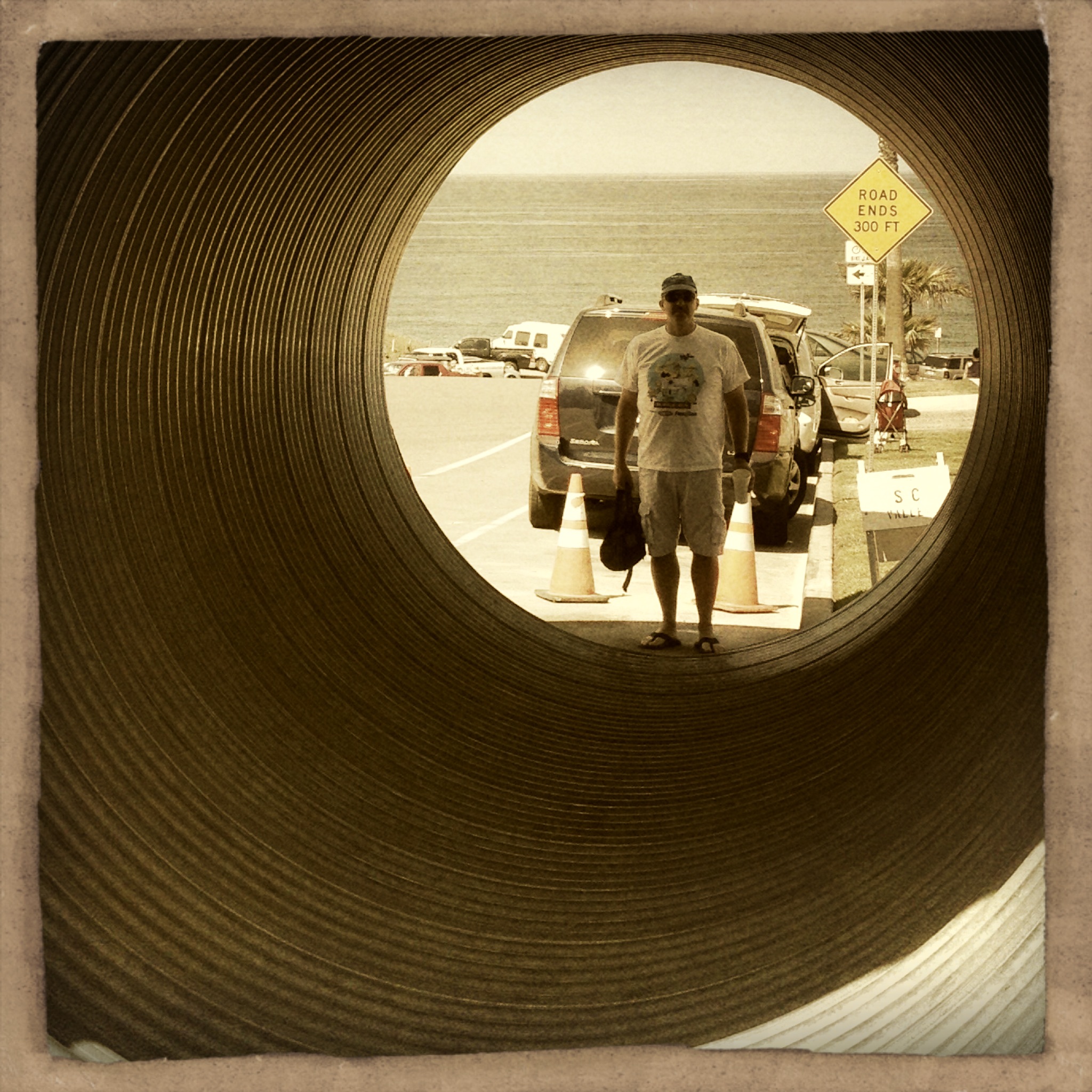
pipe

As we headed down to the shoreline, the tide was approaching high.  This can be a limiting factor for how far we can go, so today we headed north.  The waves were small, but the surfers and boogie boarders seemed to be having great success catching the curves and enjoying their rides.

waves

Curves seemed to be everywhere.  Erosion is a major issue along our local shoreline.  The northern walk takes us below expensive homes that seem precariously perched above the beach.  One section was still barricaded with yellow caution tape…and the crack we had seen a month ago seemed more pronounced today as it curves along the layers of sediment that make up the sea cliffs.

crack

Giant kelp, which my students know by it’s scientific name Macrocystis Pyrifera, is a constant on our local beaches.  Piles are evident as it washes up along the shore.  Holdfasts, the rootlike structure that hold onto rocks in the water, are home to many fascinating sea creatures and we often see locals rummaging in these wet piles and finding brittle stars and tiny sea urchins hiding within and enjoying a close look before returning them to their wet and salty homes. The long stipes frequently form tangled webs although this one reached out in a gentle curve away from the rest of the pile on the sand.

kelp

Sand castle makers have been hard at work this summer.  I passed this creation and just had to stop and get close for a photo.

turtle

I love this turtle version of a sand castle with its curved head, shell and limbs…and the extra touch of bucket-molded sand on the top.  Ocean washed rocks became eyes and the proximity of the kelp seems like a perfect touch!

I was surprised to find this coconut laying in the surf.  It had clearly spent some time being washed and worn by the sea, not quite round but definitely curved.  Had me thinking of Tom Hanks in Cast Away.

coconut

There were quite a few holes dug with curved banks that began to hold pools of seawater as the tide continued to rise.  I took a few pictures of the water in the holes and then stopped to wait to see if I could capture the waves coming over the bank to fill the hole.  I love the sense of movement this still photo captured.
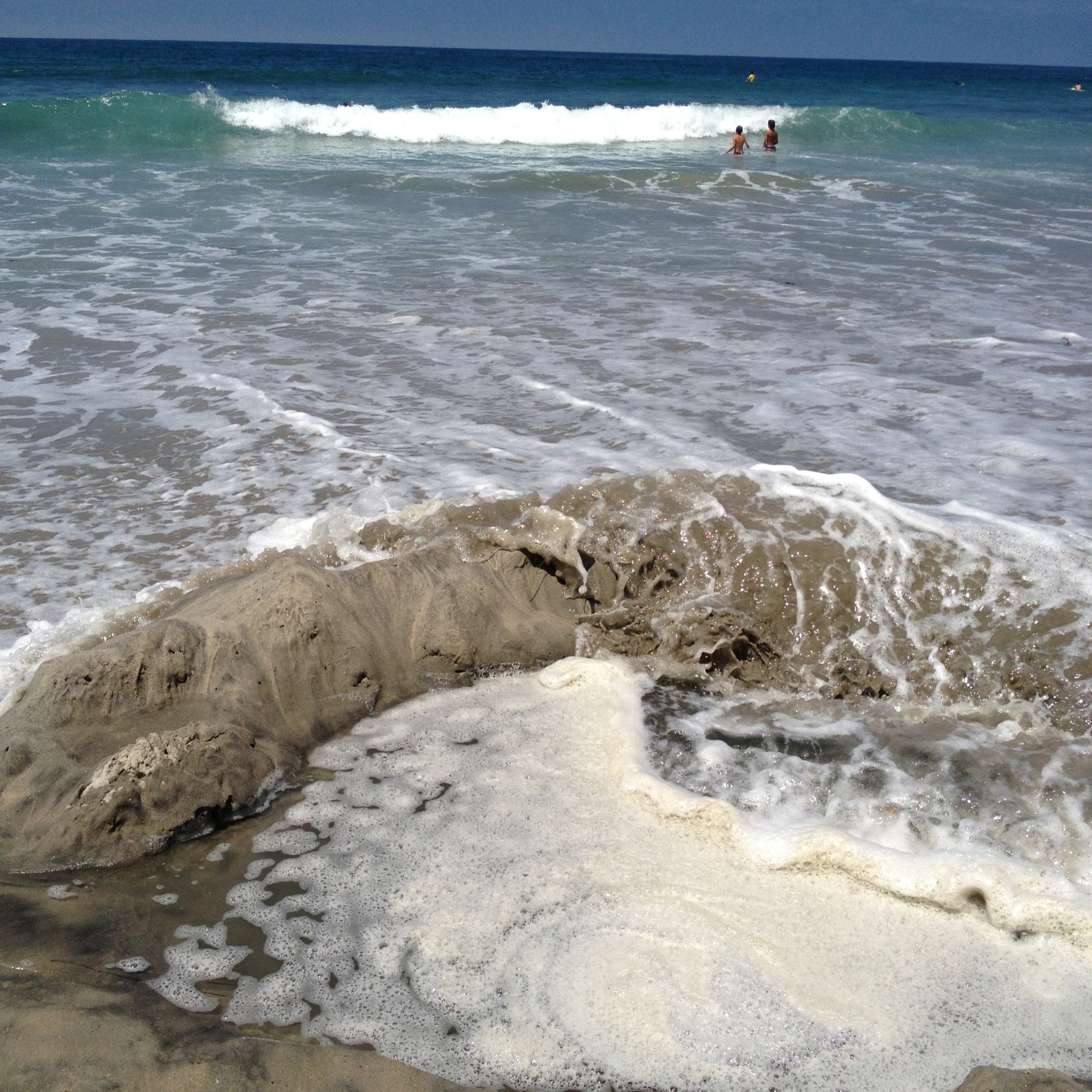
hole

And then before finishing my walk, I came across another yet another sand castle.  This one in more classic style with a moat, some bridges and curved turrets, and stones and shells for decoration.

castle

I love the way #sdawpphotovoices themes focuses my attention and helps me see familiar places in new ways.  My one-hour vacation was relaxing and exotic!  The photos represent only a fraction of the curves I saw at the beach…and yet give a glimpse at the variety of curves along the shore.  Tomorrow begins angles…I can only imagine what I will find as I look at the world through that lens.

10 Picture Books on August 10th

I’ve done a couple of recent posts about mentor texts I use in my classroom and recently I noticed a challenge by some other teachers about a Picture Book 10 for 10 Challenge.  #pb10for10  Their invitation is to share ten picture books you can’t live without on August 10th.  So today is August 10th…and my picture books are all in my classroom.

I had almost abandoned the idea of sharing my picture book favorites since I don’t have easy access to them today.  But then I spent the morning with my SDAWP colleagues at UCSD thinking about complex texts–both reading and writing–which led me to think about the ways I use texts in combination in the classroom.  So I started thinking about some of favorite picture books for the classroom…and how I often layer books to create more complexity and deeper meaning with my students.  These books come from the top of head (with the help of the web to sort out the actual titles and authors)…you don’t get pictures or excerpts…just what I can remember!

photo

I’ll start with a few that I used with my students to examine abstract concepts.  Most of them use the idea of color in different and interesting ways.

1.  The Other Way to Listen by Byrd Baylor:  This book is a gem (like most of the others by this author).  I love the way she describes colors using senses other than sight.  I wish I had my book handy to include an excerpt!  Read it — you won’t be disappointed!

2.  The Black Book of Colors by Menena Cottin:  This book, all in black in white, is gorgeous!  The use of texture and Braille add a fresh dimension to this book…and reinforces the need to use powerful sensory language in descriptions.

3.  The Sound of Colors by Jimmy Liao:  This book describes the experience of a blind girl as she travels in the New York subway system.  Imagination takes the girl on a powerful journey. What do you experience when you aren’t able to see?

4.  The Colors of Us by Karen Katz:  This books offers way to describe the colors of our skin in beautiful and appreciative ways.

5.  What Does Peace Feel Like? by Vladimir Rudunsky:  This book is a collection of similes and metaphors from students describing peace–helping to bring some concreteness to this big and abstract concept.

6.  If… by Sarah Perry:  This books takes a fanciful journey into the imagination and invites students to imagine if worms had wheels and other fanciful and surrealistic ideas.

And I also love books that are about math and nature.  Two more favorites that I used this past year to support my students’ understanding of the Fibonacci sequence and its appearance in the natural world.

7.  Wild Fibonacci: Nature’s Secret Code Revealed by Joy N. Hulme:  This book explores the appearance of Fibonacci numbers in the natural world–mostly focusing on the spiral.

8.  Swirl by Swirl: Spirals in Nature by  Joyce Sidman:  This book is another look at Fibonacci’s sequence and spirals using spectacular illustrations.

And to round out my ten, two other books I purchased this summer and intend to use with students this year.

9.  One Hen by Katie Smith Milway:  A book about micro loans and how small investments can make a huge difference in someone’s life.

And one more math and science focused book

10.  Dave’s Down-to-Earth Rock Shop by Stuart J. Murphy;  This book combines geology and classification as the characters devise new ways to sort and display their rock collection.

I look forward to seeing what picture books other people love.  I’m always looking for new books to inspire my students’ thinking and to help them understand complex concepts.  I’m especially interested in those hidden treasures that somehow don’t get the attention of the large bookstore chains…and yet have wonderful content, language, and illustrations.  What picture books do you love?

Condor’s Egg: #113texts

Jonathan London is probably best known in children’s book circles as the author of the Froggy books, but he has many wonderful books that are varied in content and well written.  I mentioned Dream Weaver a couple of days ago as my contribution to the #113texts Mentor Text Challenge.  Today I want to tell you a bit about Condor’s Egg by Jonathan London.

photo

Condor’s Egg is a realistic story about a family of California Condors in the wild.  As is typical with London, the language is lyrical and carefully chosen.  His use of verbs evokes movement and creates a sense of action.  And as an added bonus, there is factual information about California Condors at the end of the book as well as a guide to using the book with children.

During the 2012-13 school year, after reading the book as part of our study of birds, we used a number of sentences from this book as mentor sentences for our students to study and then to replicate with their own content.

Here’s one sentence we studied: Circling, he rides the warm air, higher than the tops of the clouds. This is a tricky construction with the main part of the sentence between the parentheses where extra information is often deposited.

T (a second grader) created this sentence–a close approximation:  Roaring, they start their engines, then the drivers shoot off the starting line.

J (another second grader) came up with this one:  Building, Steve builds a square house, nice and safe!

Here’s one from a first grader (Okay–I know it’s not fair–this is a talented writer!): Running, she goes through the house as fast as she can, trying to get away from the pretend monster.

And here’s one more second grader: Diving, she is determined to catch it, landing on the dusty floor of the canyon.

We used many sentences from this book and explored creating our own sentences following the pattern of London’s sentences.  By doing this my students had opportunities to try out new sentence structures, which later showed up in their own writing.

I was thinking about the Jonathan London titles that I use…here’s a few:

  • Dream Weaver
  • Condor’s Egg
  • Puddles
  • The Waterfall
  • Like Butter on Pancakes

How have you used London’s books?  What titles do you like?

A Summer of Making: Reflections on CLMOOC

If you’ve been reading my blog at all you know that I participated in something called the CLMOOC this summer.  The Connected Learning Massive Open Online Collaboration was an opportunity to experiment with the principles that underlie Connected Learning.  This short video gives some more information or check the link above.

http://vimeo.com/49645115

When I originally signed up to participate in the MOOC I thought I would stay on the fringes, read what others posted, and think about how the participants interacted.  I knew I would be time challenged, after all I would be facilitating the SDAWP Summer Institute during the bulk of the MOOC.  But somehow, I was quickly drawn into action.  I used my photo-a-day work as my introduction and posted a couple of photos.  Immediately I began to get feedback, comments, and links to others’ work with a similar focus…I was hooked!  Then came the #vineoffmonday. I was already playing with Vine and with Instagram video, so it was fun to see what others were doing.  I loved Kevin’s invitation to make a seven second story and even though I wasn’t particularly successful, the challenge was valuable–and it’s something I can see having my students try (even if they don’t use a social media platform like Vine to do it).

I’d been thinking about starting a blog for a couple of years…and have had a couple of false starts where I posted once or twice and then never returned.  With the CLMOOC community around me, I decided to create a new blog AND to challenge myself to posting 30 days in a row. Remember, this was not a “summer’s off” undertaking–with this community around me, I made my decision to blog right in the middle of the SI I talked about earlier.  (And if you know writing projects at all, you know that it is an intense and focused time of meaningful, challenging work–even as a facilitator.)

My blog became my space for “makes.”  I explored my photography in a variety of ways, thought about learning and spaces for learning, considered my own classroom and how I might approach my teaching differently, and wrote and wrote and posted and posted…today is my 34th consecutive post!

And…I earned my first badge!

badge_be1ee794-764e-4739-981e-69a447770c74

To earn the badge I had to submit one of my makes, reflecting on its significance.  I chose my Spaces for Learning post that I wrote in response to an invitation from Terry to respond to a Washington Post article about teachers and teaching.

I am strangely proud of my badge.  It represents a summer of exploration and of putting myself “out there.”  It has been about writing every day even when I am busy and tired and would rather just hang out or watch some mindless TV.  It has been about being public with my learning process and trying things beyond my comfort zone.  And I still see lots of spaces for my learning to grow.  I definitely have a better understanding of the Connected Learning principles and how they support my own learning and risk taking.  I plan to create more spaces for this kind of learning for my students…and for the teachers I come in contact with.  It has definitely been a summer of making and connected learning for me…and I don’t want it to stop!

Carousel Horses: What Stories Do They Tell?

With my photography this week, I have been focusing on curves.  And somehow, when I am out taking pictures that concept/word “curves” keeps getting translated in my head to “round.” Now I know that round and curves are related–that curved surfaces often result in roundness. So yesterday when I parked for a meeting in Balboa Park–our city’s urban park–the carousel immediately drew my attention.  I could hear the festive music as the merry-go-round started its trip around and around.  I took a few pictures as I thought about this curved trajectory and the combination of movement around and up and down.

horse

I like the way this photo (with no filters applied) shows the movement of the carousel horse.  I can also see the curved lines above.  The people riding–adults and children–were energetic, giving off that feeling of summertime fun.  I decided to move to my hipstamatic app–and dialed a couple of film types and lenses.  One of them, this gangsta lens creates a round frame.

photo

And while the curved frame works for my photo-a-day theme, what I love about this picture–and I knew it when I tapped to take the picture–is that somehow I had caught the guy with the while cowboy hat in the frame.  In some ways this particular picture feels timeless–the “tough” guy in the white cowboy hat (doesn’t that make him a hero?) with the white t-shirt and jeans on a carousel horse with the young woman nearby.  He’s on the outside so he can reach out for the brass ring, showing everyone his skills on this classic summertime ride.

photo-3

This third photo is another hipstamatic photo using Americana film and lens that gives a retro feel to the picture.  It also gives the sense of movement–but doesn’t have the same feel of summer as the other more colorful photos.

I’m wondering how photos like these might prompt my students’ writing and storytelling.  How does the visual invoke the powers of imagination?  What evidence is contained in these photos that leads to character development?  An advertisement?  An argument of some sort?  Where would you go with one of these photos as a prompt?

Dream Weaver: a Mentor Text

Sometimes it is the simplest books that pack a powerful punch.  When I started to consider a recommendation for the #113texts Mentor Text Challenge so many books came to mind.  I expect to add more than one!

dream weaver

Dream Weaver by Jonathan London is one of those simple books with beautiful language.  The verbs create an orchestra of sound and movement.

A sudden wind, and the trees hum, the branches creak, and Yellow Spider’s web shimmers, like wind across a pond.  But she hangs on and you stay with her.  The whole world is in these leaves.

Besides the language, there are two other features of the book that I love.  One is the way the books uses the space on the page and draws you in close to feel the insect view and then pulls back to give a human perspective.  I also love that the back of the book includes facts about spiders.  (The fiction/non-fiction mix is one of my favorites!)

This year we used this book as one of several to teach beginnings.  Here’s the text of the first page:

Nestled in the soft earth beside the path, you see a little yellow spider.

This beginning takes the reader directly to the “place” in the book.  Our students wrote a piece where they highlighted the qualities of our local community–exploring ways to share their opinions with evidence from their own experience.  But like most young writers, they are still working to build effective beginnings.  So they studied this beginning from Jonathan London and many tried their hand at making this structure work in their own writing.  (Nestled did become a favorite word in our class!)

Here’s a couple of examples from students:

“B” , a second grader wrote this opening

Nestled between the blue beach and the desert there’s a small town called Cardiff-by-the Sea

Okay–I’m not sure that the beach and desert are quite close enough to “nestle” this little town, but she definitely got the idea!

“K”, a third grader tried this version where the setting is revealed in a similar way without using the word “nestled.”

A little town called Cardiff lies between two other towns in Southern California: Encinitas and Del Mar.

There are many ways to use this book as a mentor text.  I highly recommend it, especially for students in grades K-3.  I’d love to know how you’ve used this book (or others like it)!

Neverwhere and more: a book(s) review

In the last few weeks I read two books written by Neil Gaiman.  I finished Neverwhere last night and read The Ocean at the End of the Lane a few weeks before that.  I read Coraline a few years ago…and remembering some picture books I bought last year, I reread The Wolves in the Walls and The Day I Swapped My Dad for Two Goldfish today.  In some ways I’m surprised that I like these books, they are a little bit fantasy with some parable-type qualities woven in.

photo

So what do I read, you might ask?  That question seems to become more and more complicated.  If you follow me on Goodreads you may notice that I have binged on several YA series.  I’ve read the Hunger Games series followed by a number of dystopian novels including Blood Red RoadDivergent and InsurgentThe Water Wars, and the Maze Runner series (that was not my favorite series).  I’ve also read some series more in the fantasy category including The Secrets of the Immortal Nicholas FlamelThe Mortal Instruments (City of Bones…), The Infernal Devices, and Graceling Realm.  Interspersed were murder mysteries by Gillian Flynn and Danish author Jussi Adler-Olsen…and then there were the 4000+ pages of The Game of Thrones (haven’t gotten to A Dance with Dragons yet).  I’ve also read other odds and ends, novels and plenty of books for kids, especially graphic novels for the younger crowd.

But back to Neverwhere.  I read a lot.  Fiction and non-fiction, fantasy, mystery, realistic fiction, historical fiction and everything in between.  And some books stay with me longer than others. I liked Neverwhere.  Some reviewer described it as an urban fairytale.  In some ways I think that most of Gaiman’s books are fairytales of sort…maybe in the Grimm tradition.  When I think of Richard (of Neverwhere) and the unnamed narrator in The Ocean at the End of the Lane, they are both those anti-heroes who learn powerful life lessons as they interact with supernatural beings from somewhere other than the world of humans that you and I live most of our lives in. They are flawed, often seen as weak pushover types as the story begins.  They find their strength in unusual ways.

These are stories about overcoming difficulties…in many cases difficulties that the adults around them just don’t get.  When I think about Gaiman’s books I find myself thinking about the qualities of grit and resilience that we look to cultivate in our students…and that teachers need too in our current educational climate.   Neverwhere is a story about trusting your gut, learning from close observation, and hanging in there even when the going gets tough and things are scary.  It’s about feeling invisible and doing what is right anyway and finally about realizing that what you thought you needed and wanted for your life might not really be what you were looking for.

Gaiman’s books are richly layered, both readable and complex.  There are books for kids (The Wolves in the Walls and The Day I Swapped My Dad for Two Goldfish), for older kids (Coraline) and stories for adults.  And I haven’t read them all yet.  I think The Graveyard Book is up next for me.  What’s your favorite Gaiman book?  What else do you recommend?

On Symmetry

I teach symmetry to my young students each year.  As a math concept it’s about those lines, you know, the ones that if you fold a shape along lines of symmetry the shape will be the same on each side.  But in practice, in life, symmetry is more than that.

Here’s my collection of #symmetry photos for the first four days of August:

The pure mathematician might argue with the validity of my symmetry photos.  But what I love most about looking for symmetry is that I am also noticing other interesting design elements…and the places where symmetry falls apart, and the places where symmetry is intentionally absent.

Sometimes I think symmetry gets confused with balance.  You know, like the scales where you have to have equal weight on each side to make the buckets hang at exactly the same level. Sometimes I love symmetry…two sides that perfectly mirror one another.  And other times I love the impact of asymmetry, purposeful disruption of that mirror image.

Exploring symmetry makes me think about choices we make in our lives.  I think balance may be overrated.  Sometimes we simply need to go overboard–and follow our passions to the extreme.  That is where creativity lives, pushing the limits and following whims without regard to the rules of design or achieving balance.  And that’s the beauty of iteration, revision, or even failure…it gives us the opportunity to look again, try again, and see what we might do differently the next time around.  Learning is like that.

A Walk on the Beach

Today I spent time doing one of my favorite things in the world.  I took an extended walk on the beach at low tide.  I’m lucky that I live close enough to the beach that I can go without making it an all day outing, but I do live far enough away to have to deal with the lack of parking that is the hallmark of summer in a beach community.  And I love my beach walks…today was one of those beautiful summer days just perfect for a walk.

I love these walks!  At the beginning of my walk I do a lot of people watching as I navigate the families and tourists enjoying the sand and the ocean.  There are pails and shovels, boogie boards and water wings, sunscreen and snacks.  Frisbees sail overhead, paddle balls bounce and roll, footballs splash into the water, and there’s always someone trying to fly a kite above it all.  Babies squeal, teenagers preen, and surfers tend to ignore it all as they paddle out beyond all the ruckus of summer beach.

As I continue down the beach, the crowd thins and the constant and soothing sound of the surf washes over me.  The sun warms my face and shoulders, the briny breeze tickles my hair, and the cool surf plays hide and seek with my toes.  I came across this abandoned sand castle today.  Carefully crafted, yet temporary.

photo-7

As I pass the fishermen (or in today’s case a fisherboy) I start to see more shells and stop to photograph a couple that are particularly beautiful…and have me thinking mathematically as I consider symmetry (my focus for #sdawpphotovoices this week) and Fibonacci spirals.

photo-6

As the beach turns a corner I notice a seagull holding a plastic bag in his mouth.  This makes me think about how clean the beach has been on my walks this summer, and I approach the seagull with my camera both to take a photo and to get it to drop the bag so I can throw it away.  As I come closer, the seagull hops away, staying well beyond where I seem to be a threat.  I never could get it to drop the bag…

photo-5

On my way back up the beach I noticed the paddle boarders off the point we call Swamis. They each stand on a big longboard with a paddle for navigation.  Today there was a group of four out there.  From the shore it almost looks like they are just standing on top of the water!  The best of them are able to catch an occasional wave, although mostly they seem to just paddle around beyond the break where the waves start to form.  I also caught a different seagull resting on a rock, posing perfectly for me to capture with my camera lens.

photo-4

There is nothing like a relaxing walk on the beach on a sunny Saturday afternoon.  This has been a busy summer for me without much time for vacation.  I’m lucky to live where a two-hour staycation is the perfect way to refresh, relax, and reflect.

Teaching to See: The Value of Iteration

Yesterday began our August photo-a-day challenge at #sdawpphotovoices with a focus on design elements…beginning with symmetry.  Anna over at #clmooc posted this video about Inge Druckrey, a graphic designer and teacher, saying she thought I would appreciate it.  And she’s right.  It is about 40 minutes long (a pretty long video for me to watch!), but interesting on many levels.

<p><a href=”http://vimeo.com/45232468″>Inge Druckrey: Teaching to See</a> from <a href=”http://vimeo.com/et”>Edward Tufte</a> on <a href=”https://vimeo.com”>Vimeo</a&gt;.</p>

The idea of teaching to see seems to be a theme of mine since I began this blog almost a month ago.  Photography has proven to be a tool that has helped me see and look at my world in some more intentional ways.

A focus on symmetry has been challenging for the past two days.  Neither of my pictures

photo-3

photo-2

quite captures symmetry to my liking…although I’m not sure I know what that picture will be. The beauty of exploring a concept over a week is that I begin to see it differently as I continue to look for opportunities to capture that idea in my photos.

While Inge didn’t use these precise words, the focus on iteration (which we call revision in the writing world) as a way to improve your craft continues to leave me thinking about my classroom and my own learning.  It also takes me back to Malcolm Gladwell’s 10,000 hours as the time needed to gain mastery of something.  And whether that number is right or not, I do believe that we get better at things as we practice them.  But don’t get me wrong…I don’t think we need to drudge through rote and boring practice to achieve our learning goals.  For me, passion is key–finding ways to get excited about learning something new, and to make the practice interesting and motivating–iteration for authentic and meaningful reasons.  One of Inge’s students (now a professional artist) described his weekly practice of figural drawing for three hours every Friday.  He talked about it still being hard, but worthwhile–said he didn’t go to church, but he continues to keep up his practice of weekly drawing practice.

Both my photography and blogging are like that.  They are practices that require effort and time…and I enjoy the practice and the effort because I can feel myself learning and growing.  I want this for my students too–for them to develop practices that support their own learning goals.  I’ll be thinking about this as the new school year begins.  What learning practices are you considering for yourself and your students as the new school year begins?