How many meeting is
too many meetings?
20 parent-teacher conferences
7 other meetings
1 incidental meeting
In the last 4 days
All relevant
All meaningful
But
How many meetings is
too many meetings?

How many meeting is
too many meetings?
20 parent-teacher conferences
7 other meetings
1 incidental meeting
In the last 4 days
All relevant
All meaningful
But
How many meetings is
too many meetings?
I got a text from a colleague last night with a photo of Amanda Gorman’s new book, Something, Someday. In the text she said it reminded her of the project I had done with my students creating iMovie PSAs about something that needed attention at our school. (You can read more about it here and here.)
So this morning as I headed back to the classroom with my students like ducklings behind me, she saw me, darted into her classroom and came out with the book in her hand.

After taking attendance, I did a quick read of the book while my students were doing some math practice. Yes! This is definitely a perfect book for the project we had done. It is all about making change, finding solutions, working together, and the power of small actions to add up to big change. And in the moment, I rearranged my teaching day in a way that allowed me to read it to my students.
Earlier in the week we read The Watcher: Jane Goodall’s Life with the Chimps by Jeanette Winter, learning about her lifelong work to protect wildlife and our planet. We talked about how both Jane Goodall and Amanda Gorman are living activists working to care for our planet.
Today we also studied the poem, Things to do if you are RAIN by Elaine Magliaro, noticing all the ways she described what rain does…”Polka dot sidewalks. Freckle Windowpanes. … Tap dance on the roof. …” Little did my students know that this would soon become a mentor text for a collaborative poem inspired by the books we’ve read and this poem!
As we got ready to write I asked students for a topic for a Things to do poem. (I had an idea in my back pocket, but hands shot up right away.). O suggested, Things to do if the World is Filled with Problems. Okay–a much heavier topic than I had in mind, but not surprising given our recent project and the books we’ve been reading.
So we did some brainstorming, focusing on the list like qualities of Magliaro’s poem. It took some work getting to some ideas to start and end the poem. And who doesn’t love the student who says, I have some metaphorical thinking to add, and says, “Treat the world like a rainbow.” Okay. So here’s what we came up with:
Things to do if the World is filled with Problems
by Room 3 First Graders
Don’t Give up!
Solve it! Fix it!
We can do this together.
Clean up trash. Don’t pollute.
Put the balls away. Sit up straight.
Water plants. Don’t waste water.
Be kind to your old grandfather
AND everyone else.
Eat your snack. Share with others. Include everyone.
Only take what you need.
Have fun. Smile at a stranger.
Treat the world like a rainbow.
Together we can brighten and color the world.
In a couple of spare moments between parent-teacher conferences today this email heading caught my eye: Significance of the Seemingly Ordinary. It was a Daily Good article, which always begin with a quote. Here was the one from today:

As I read through the teaser paragraph I became even more intrigued. It describes a movie where the character takes a photograph of the store across the street every morning at 8 o”clock. He has 4000 photos meticulously labeled and mounted in albums. Photos that are the same…and not the same. When he shows them to a blocked writer, the writer flips through the photos quickly, not knowing what to say, says, “They’re all the same.” The photographer replies to him, “You’ll never get it if you don’t slow down, my friend.” You can read more of the story here.
I found myself connecting on two different levels. The photographer in me is intrigued. Why take the same photo every day? But then again, I do find myself taking the same photos over and over again. Maybe the light is different, or the angles…or even my mood. I frequently take photos of this iconic palm tree–here’s a small sampling of my many photos of this one tree.


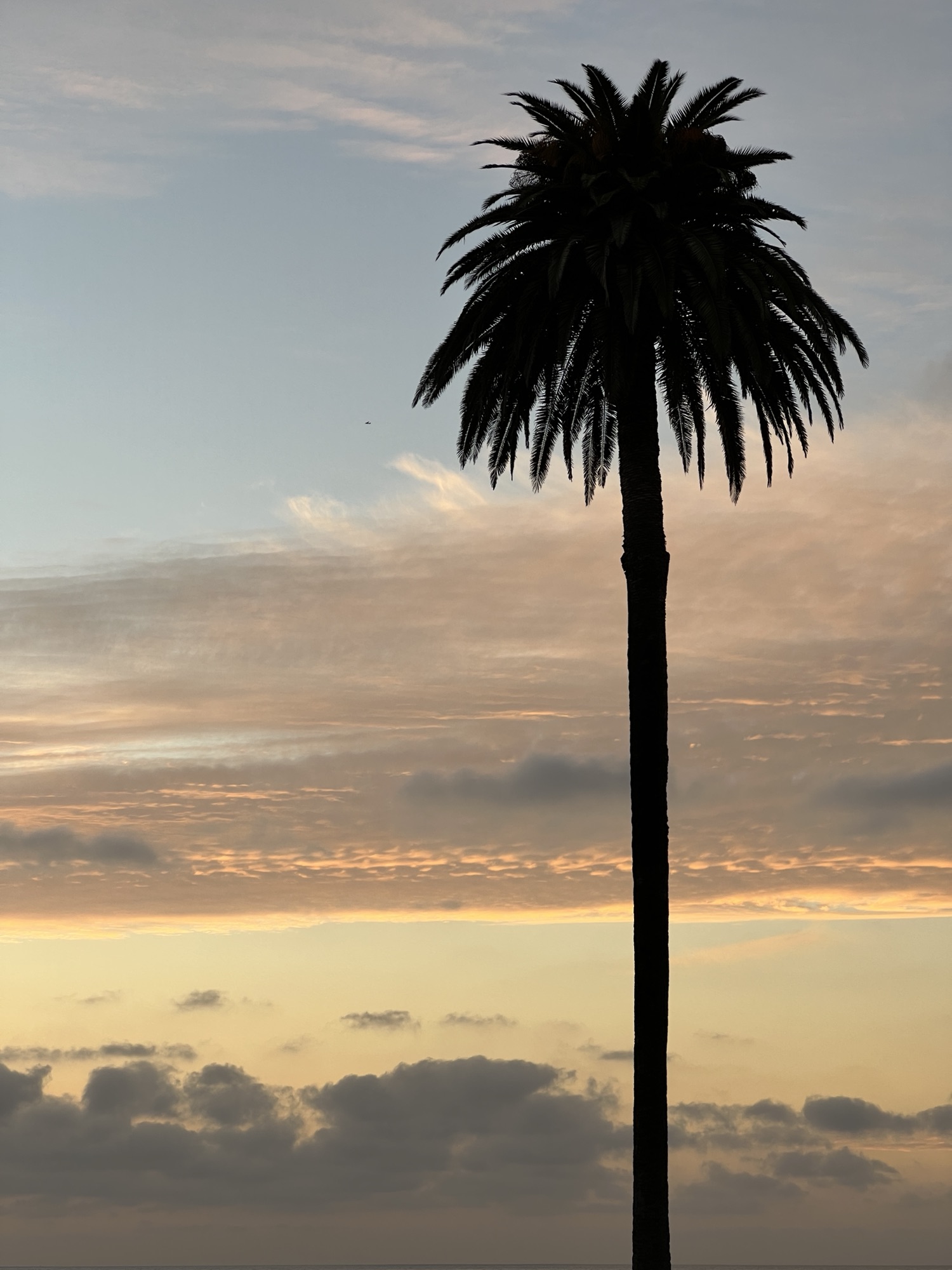
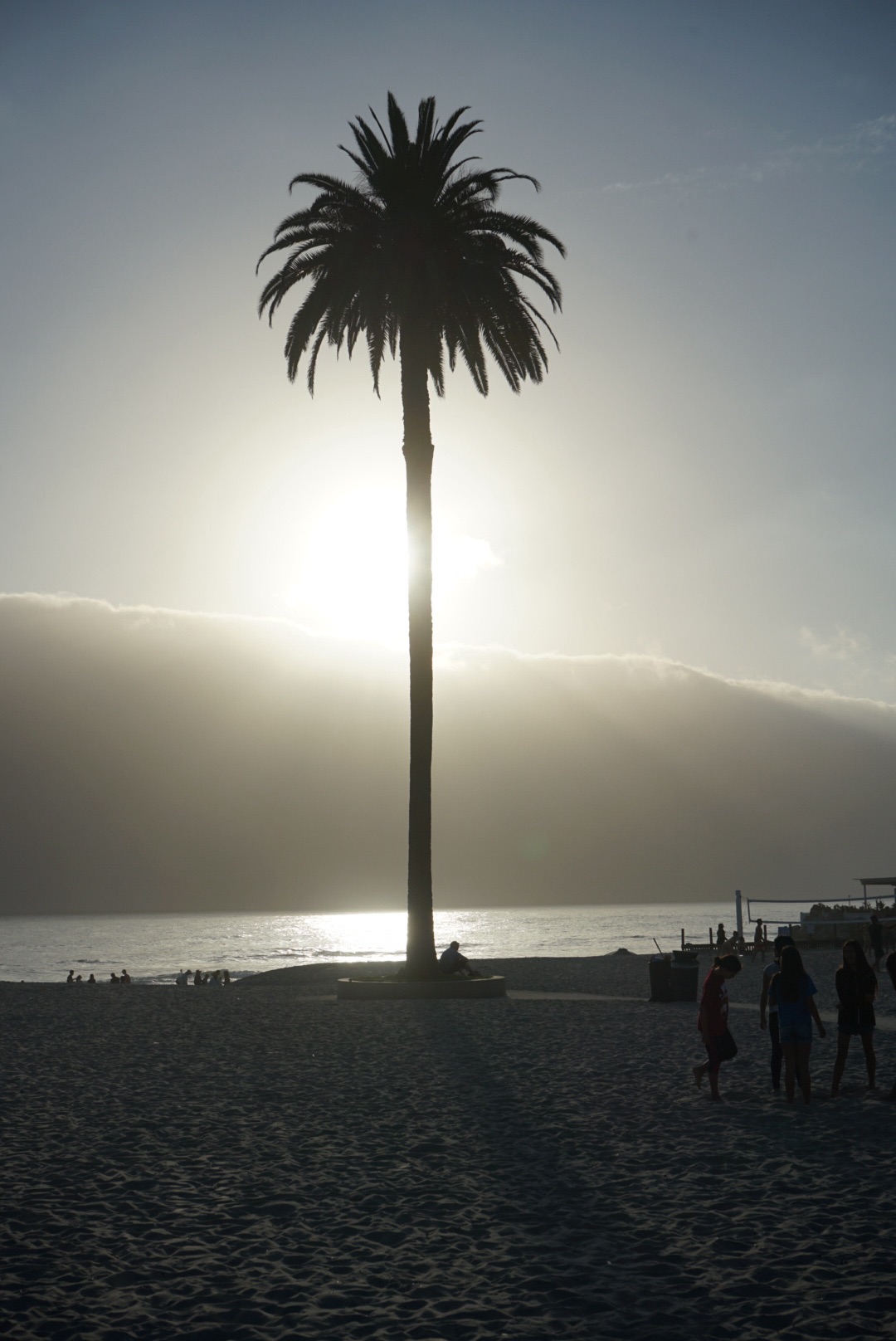
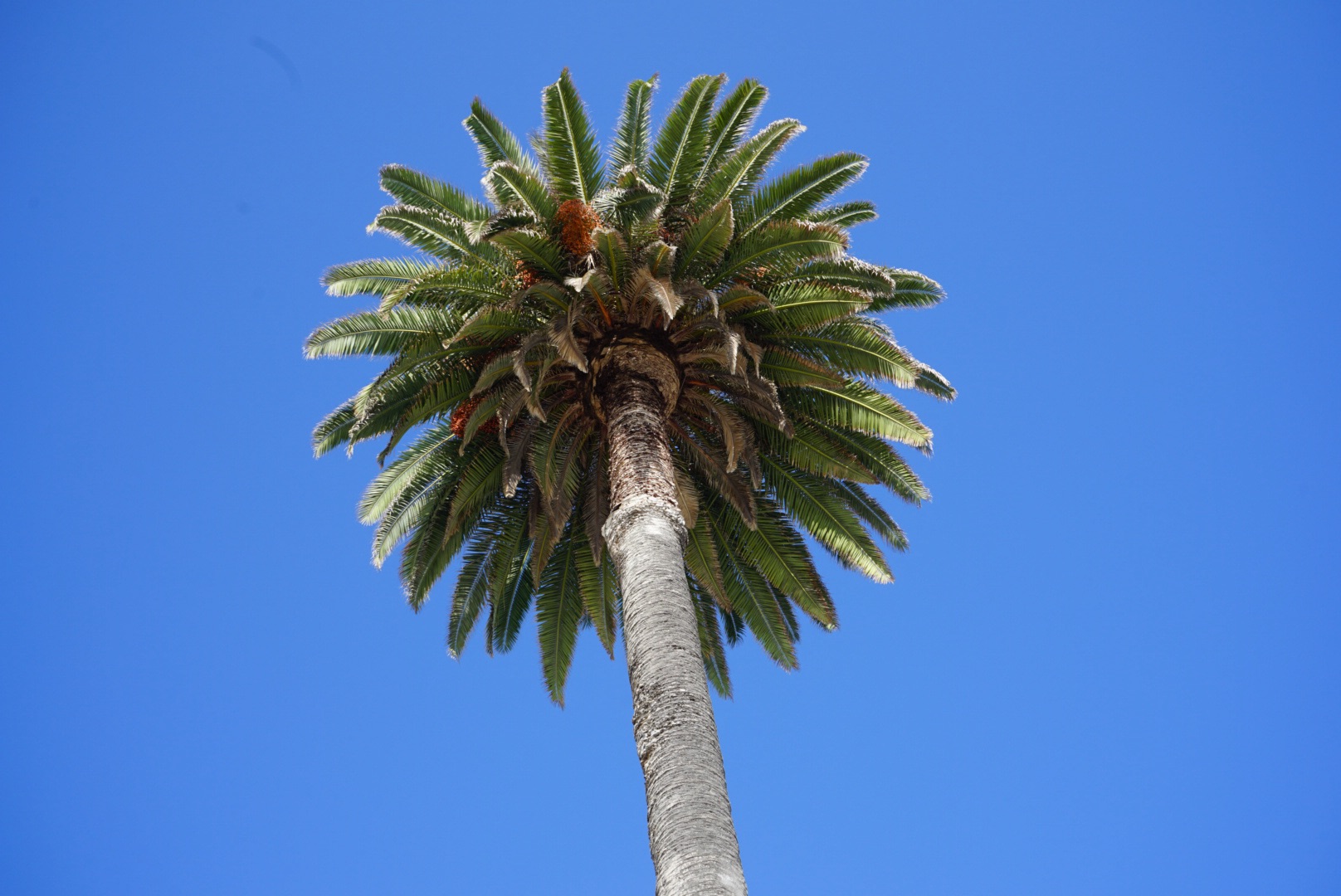
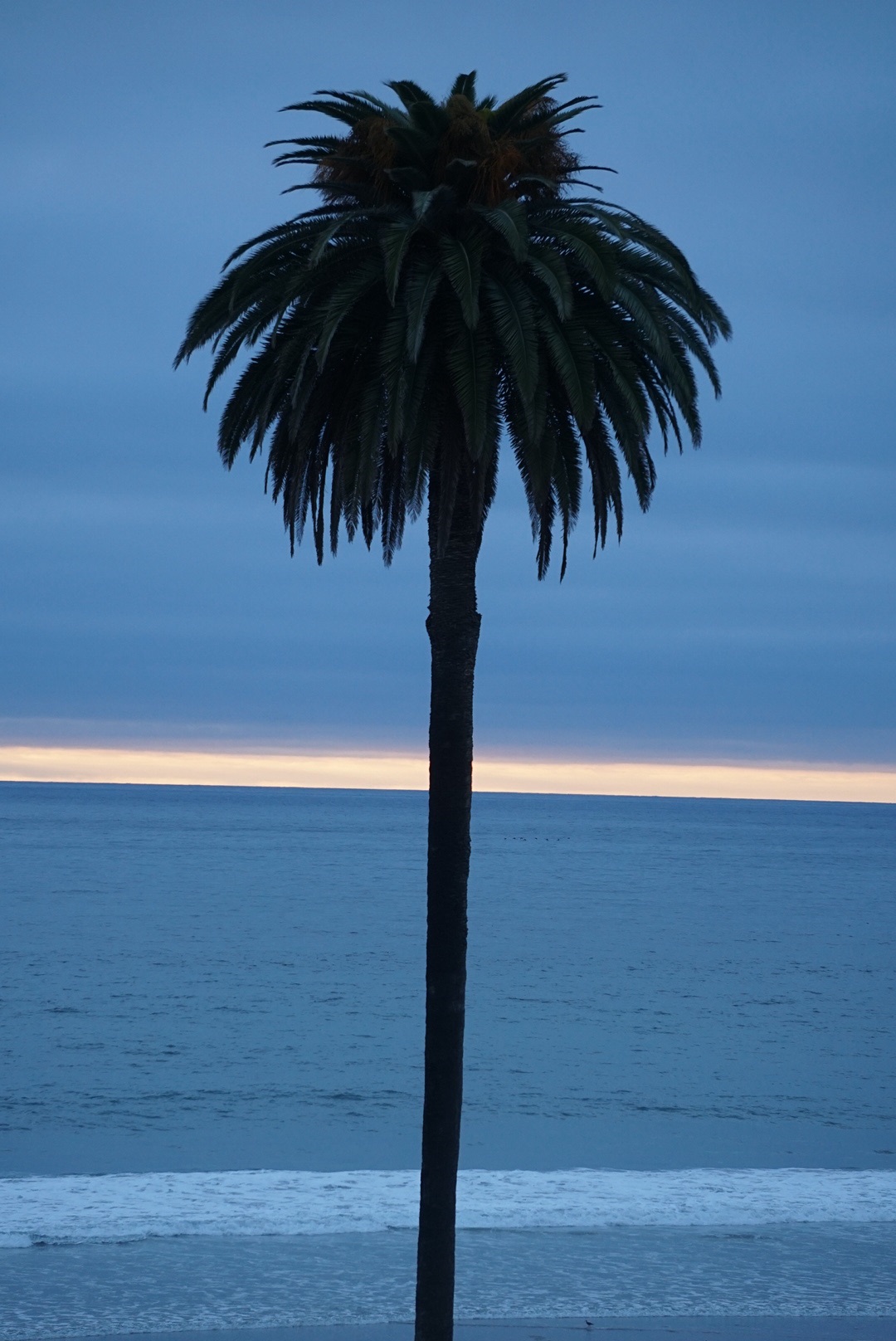


“One has to be in the same place every day, watch the dawn from the same house, hear the same birds awake each morning, to realize how inexhaustibly rich and different is sameness.”
The experience of taking the same photo over and over echoes what it means to be a teacher. Each day is filled with sameness. I greet the same faces, the same small humans for nearly a year. And yet, no two days are the same. At my best, I take hundreds of mental photos of my students every day as I strive to pay attention to the nuances of their individual learning processes. I need to know them–when the sun is shining, when the fog hides their features, in a tight close up, as the sun sets.
To be a teacher is to learn to appreciate the richness and difference of sameness. And as I navigate the sometimes groundhog’s day-ness of parent-teacher conferences I find myself thinking about sameness in a different way. During each conference I am taking stock of those thousands of mental images, knowing that supporting learners (and their parents) is in the small moments. It’s in the slowing down even when the world keeps urging us to speed up. When I got behind in my conference schedule today I was tempted to cut things short, to “catch up.” But the conversations were meaningful, adding new images to my store of mental photos of my students, their families, and their learning and I know I’ll be perusing them in the weeks to come.
And now I think I’ll be looking back over my photographs to see what else I can learn–from them and about myself.
Who decided that parent conference week should follow springing ahead to Daylight Saving Time? I’m feeling the loss of the hour, the compressed teaching day, and hours spent talking…
So today’s slice is a 6 word photo essay…a portion of my teaching day.
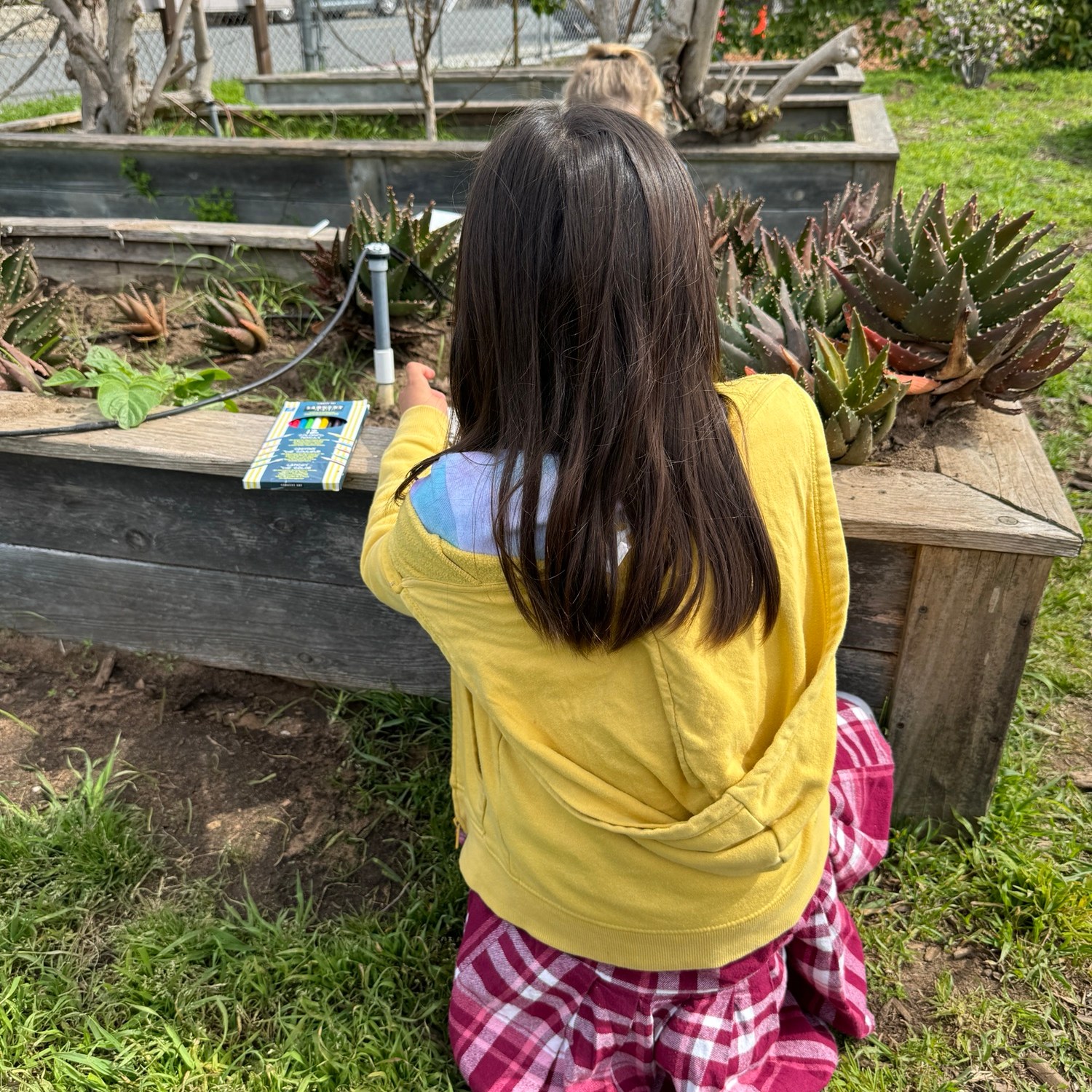
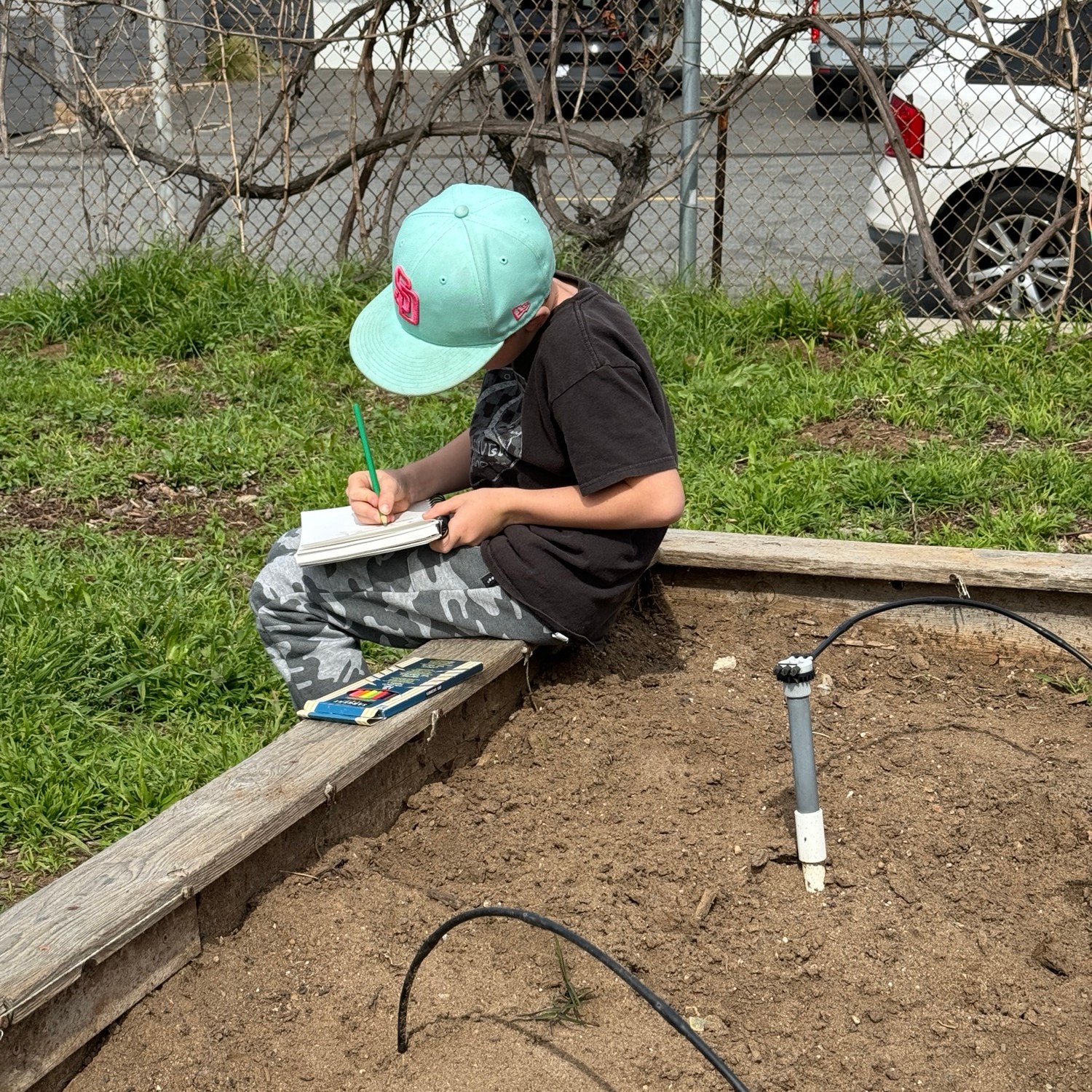
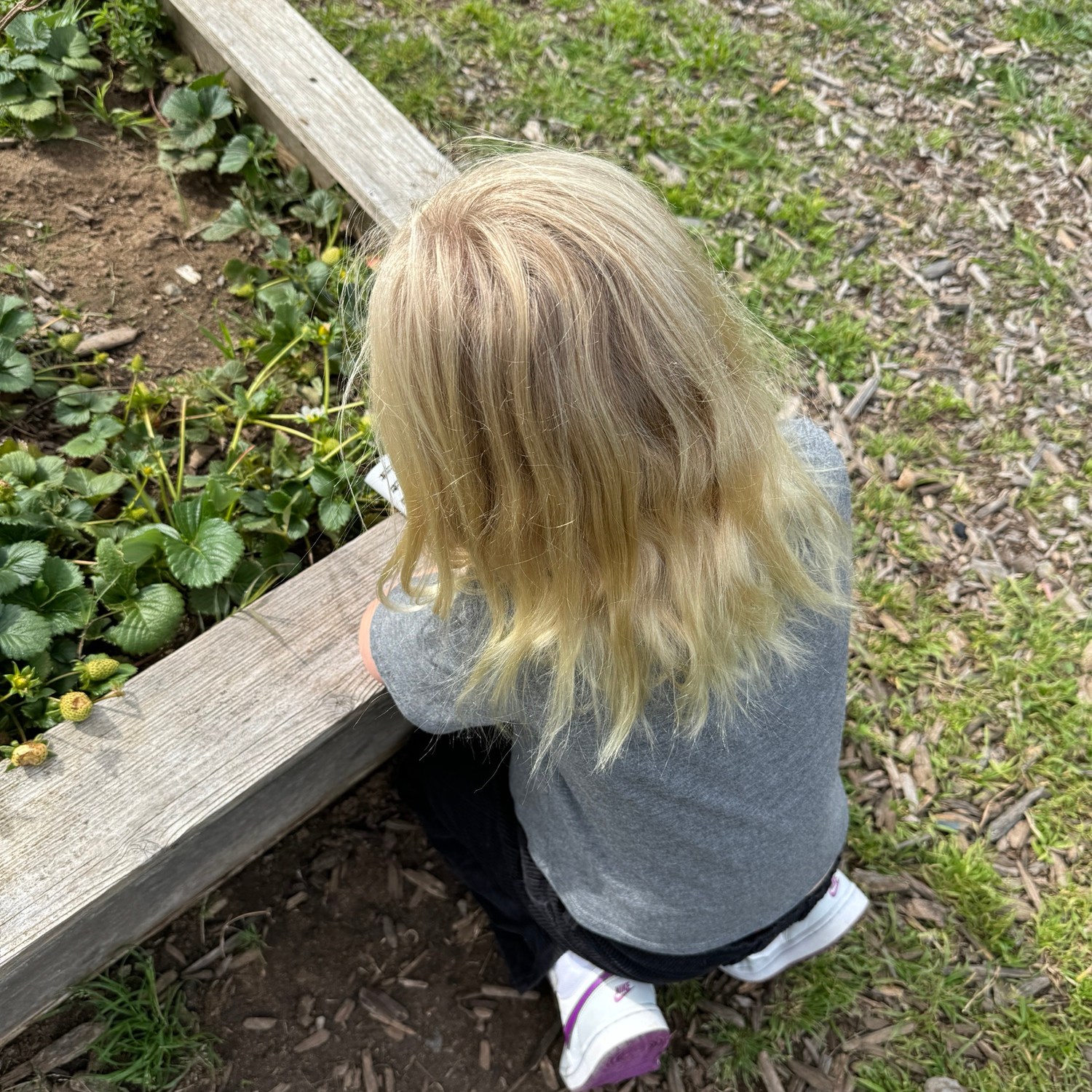
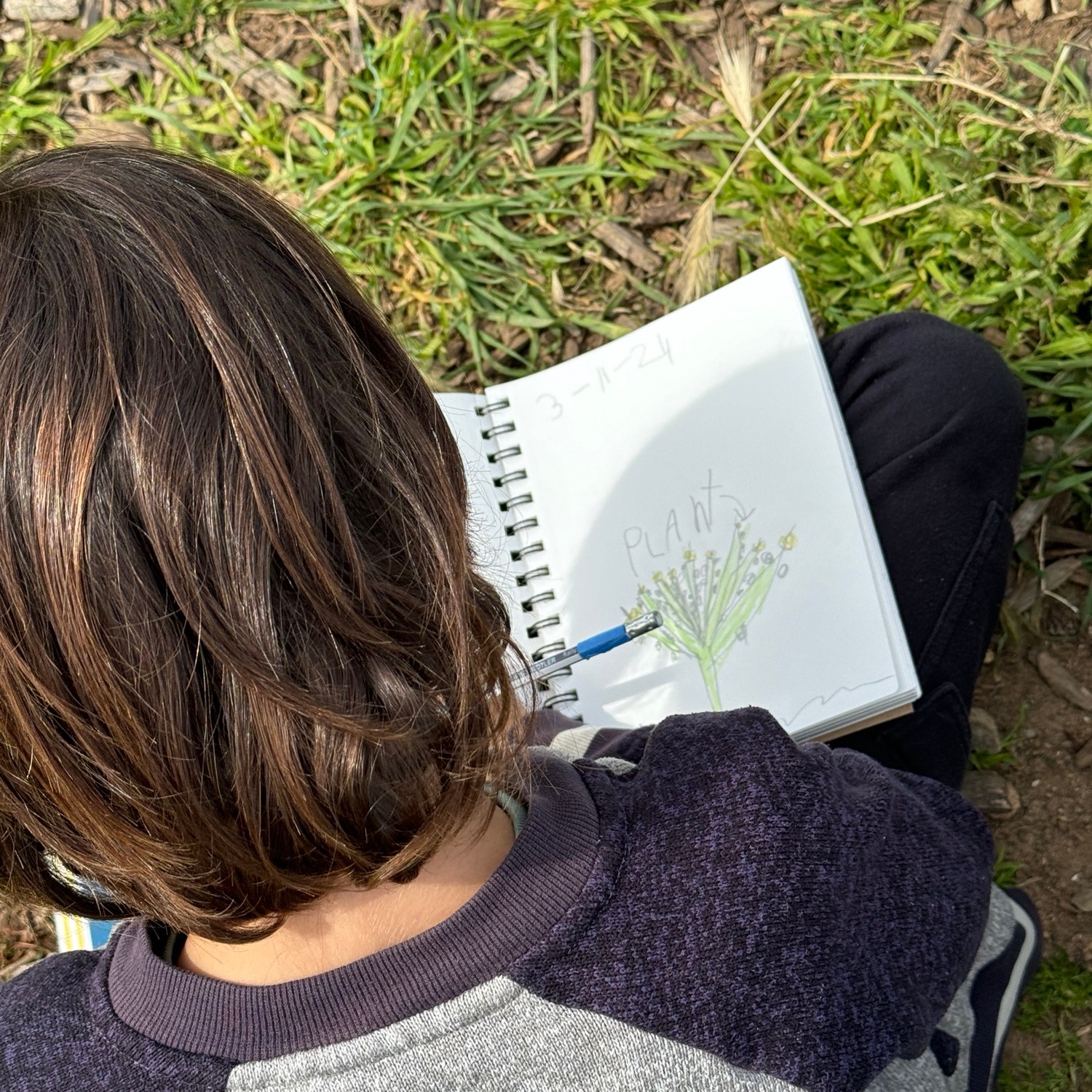
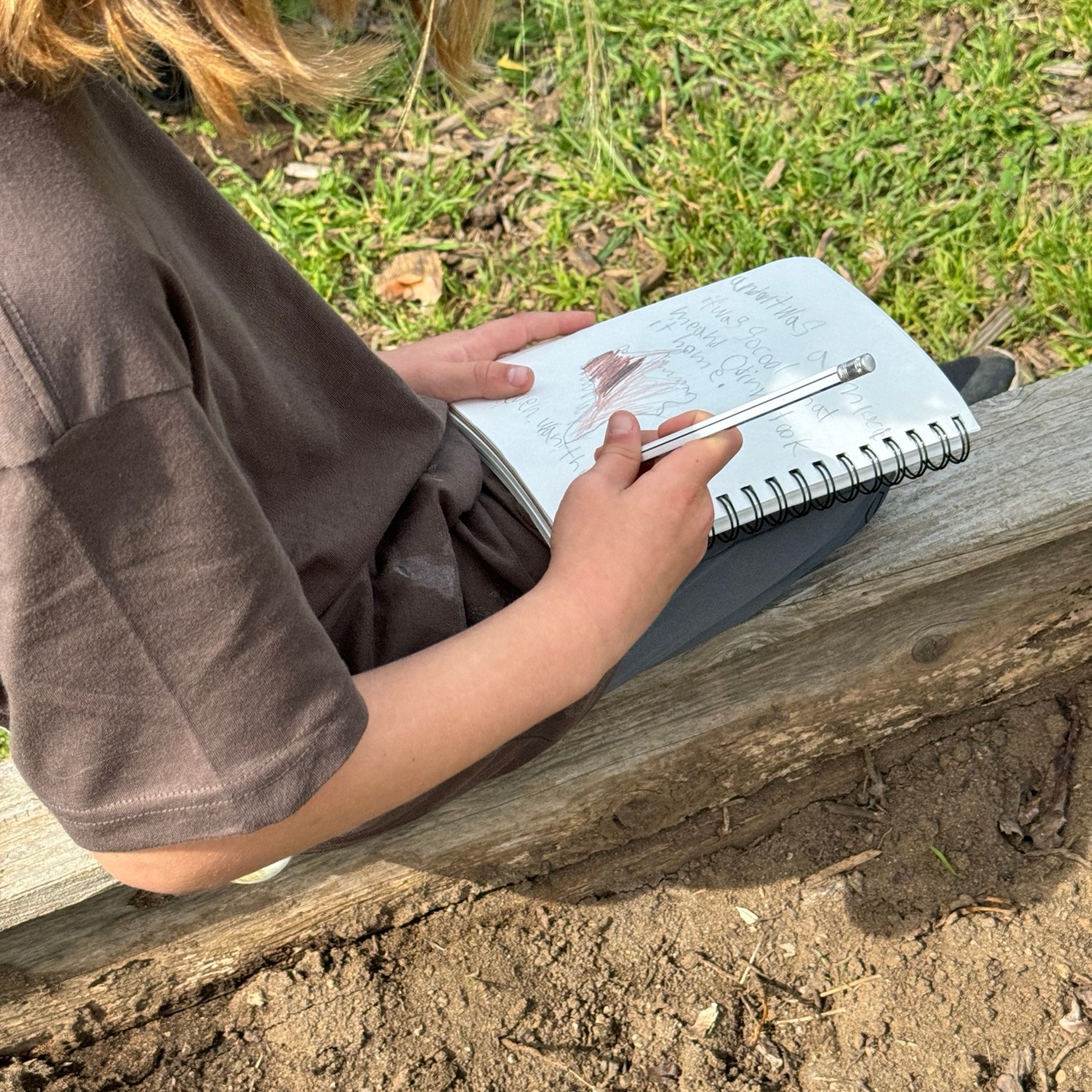
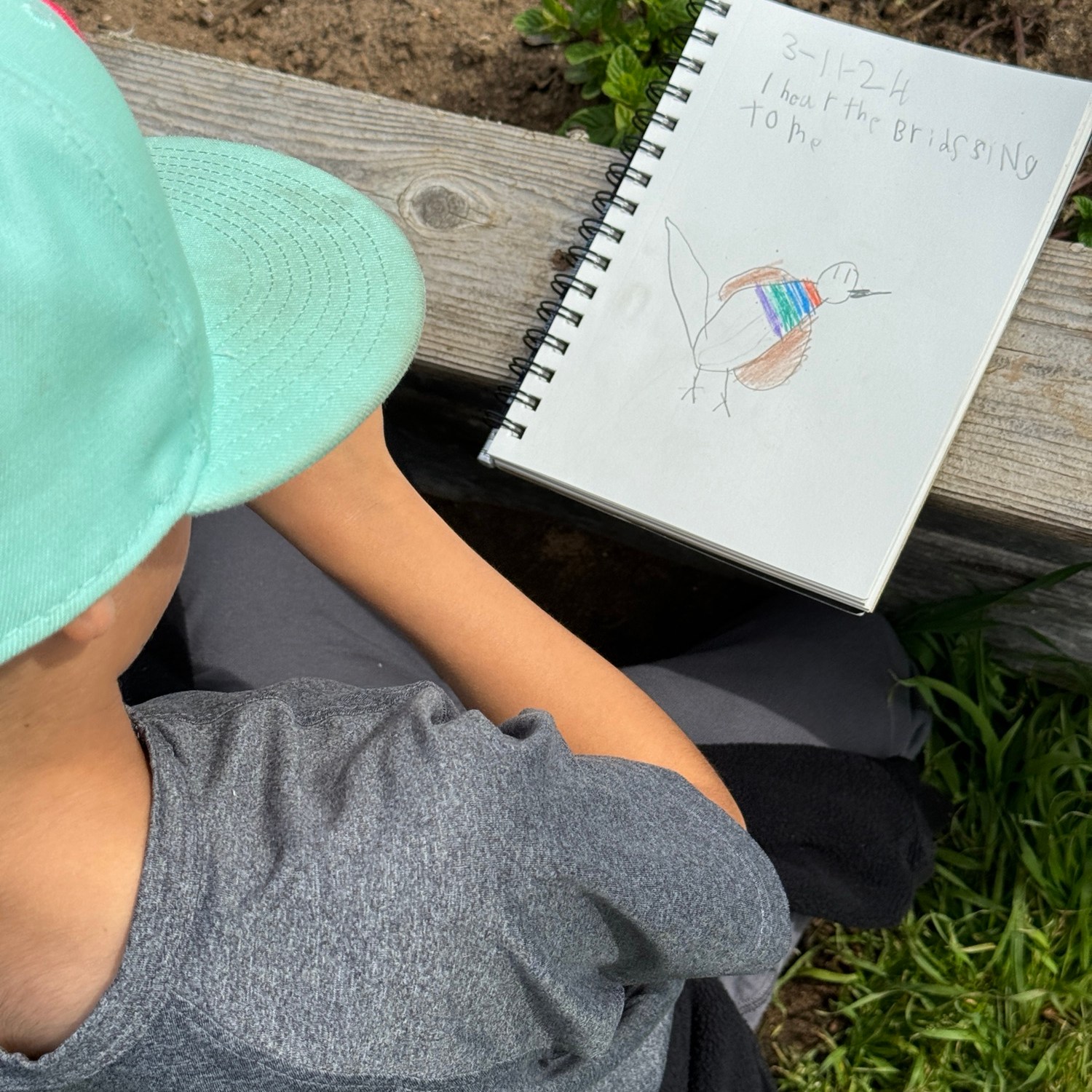
Under Goodall’s influence: noticing, wondering, writing
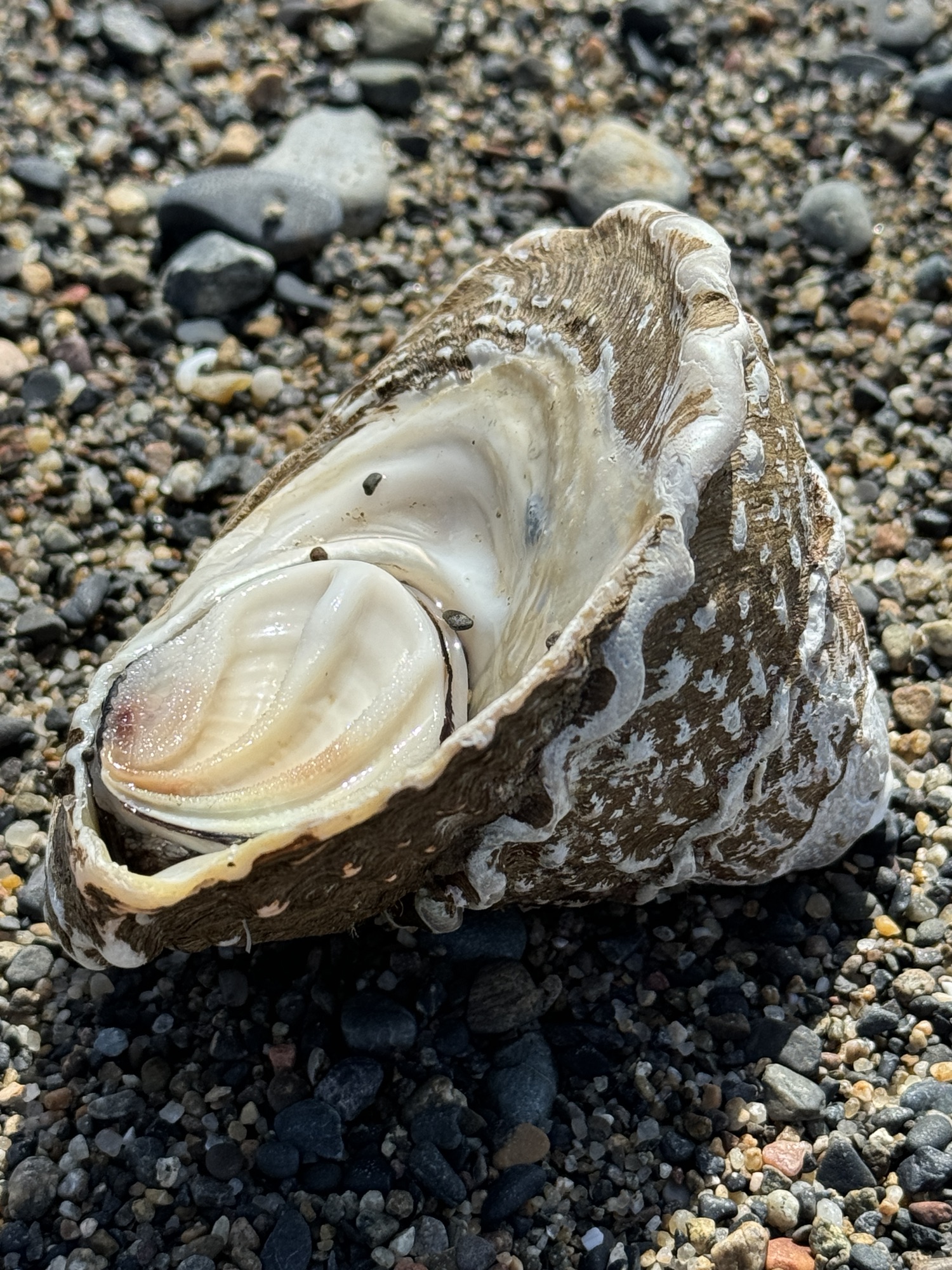
Sand is both wonderful and annoying, but trust me when I say our beaches are better with it. Over the last decades, sand has been disappearing from our local beaches, shrinking the actual size of the beach that is not covered with water, eroding and undermining the structural integrity of the cliffs, and making our sandy beaches into tempermental rocky beaches that can only be accessed at low tide.
Over the years there have been some attempts to add sand to the beaches, bringing in big hoses to squirt large amounts of sand in very specific areas of local beaches. That effort seemed to fall in the category of too little to do much good. But recently a huge sand restoration project began on one of our local beaches. Orchestrated by the US Army Corps of Engineers, more than 700,000 cubic yards of sand was dredged from the lagoon, transported by boat, and then deposited via an enormous metal pipeline onto the beach–and according to a recent news article, doubled the size of the beach (for the price of $16 million).
Parts of beach have been closed over the last couple of months while enormous construction equipment pushed sand around, seemingly fighting against wave energy and the tides. The extra large boat became a familiar sight anchored off the coastline, and sand began to pile up.
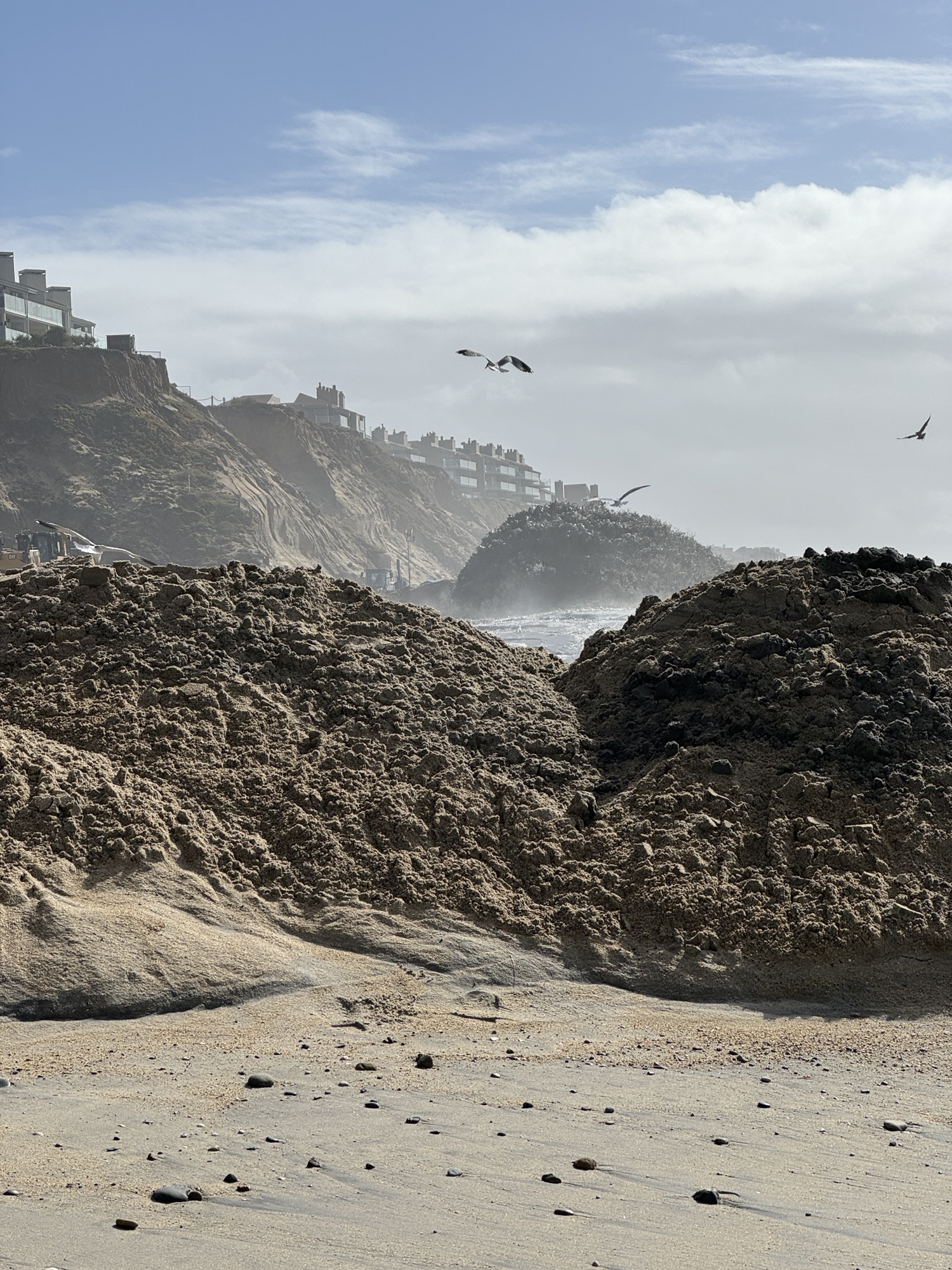
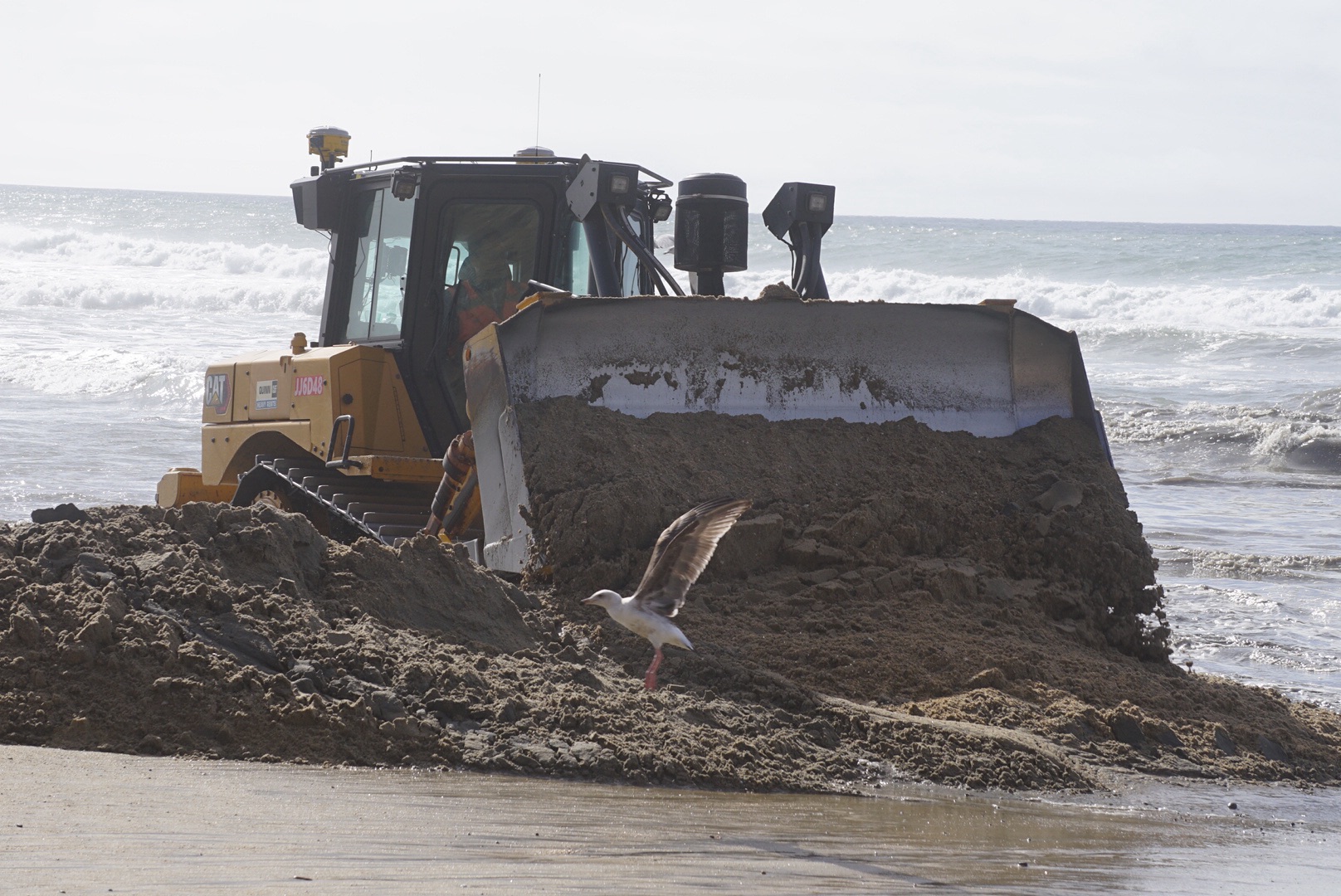
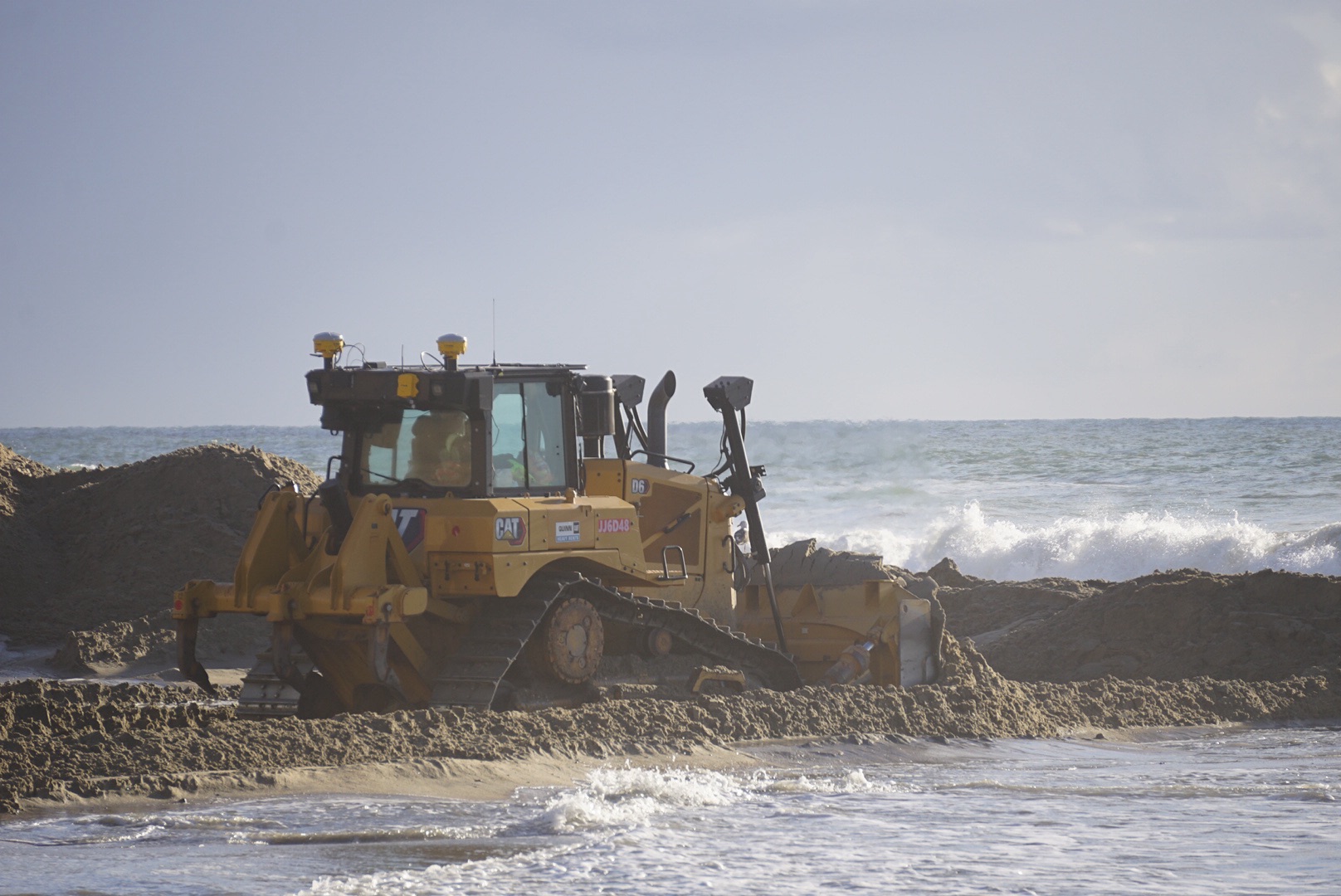
A week ago we noticed that most of the beach was open, so we walked the new and improved beach. But the sand was deep and the angle of the beach was severe. Walking felt both hard and painful! How long would it take for the beach to get back to feeling walkable?
But on Friday when we walked again, the beach had changed again. Big trucks were flattening parts of the beach and spreading the sand further. The area near the water was much less steep and much more walkable.
Today as we walked again, I could really noticed how much larger the beach was. In early January, even at low tide we walked relatively close to the crumbling cliffs (with multi-million dollar homes perched precariously at the top). Today we walked a good distance from the cliffs and the water seems like it is not reaching them, even at high tide.
The most dramatic illustration for me was noticing the permanent lifeguard tower that I often photograph. Here’s a photo I took shortly before the sand restoration project began. Notice the rocks below the land the tower is perched on. Those rocks were always covered by water at high tide and were meant to protect the tower.
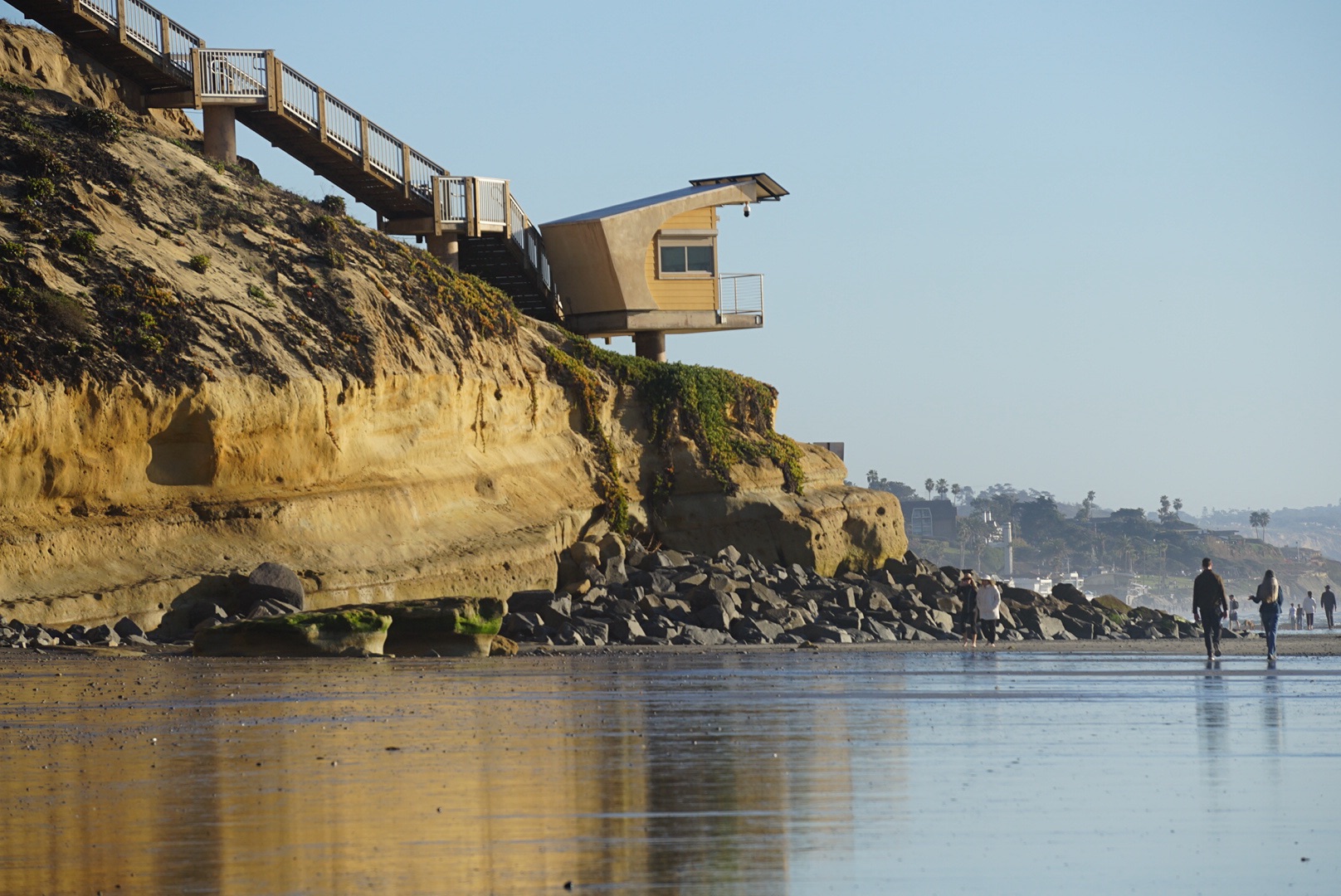
Today I realized that the water is quite far…and that the sand fully covers those rocks. I had to climb up quite a distance of sand to get where I could take this photo.
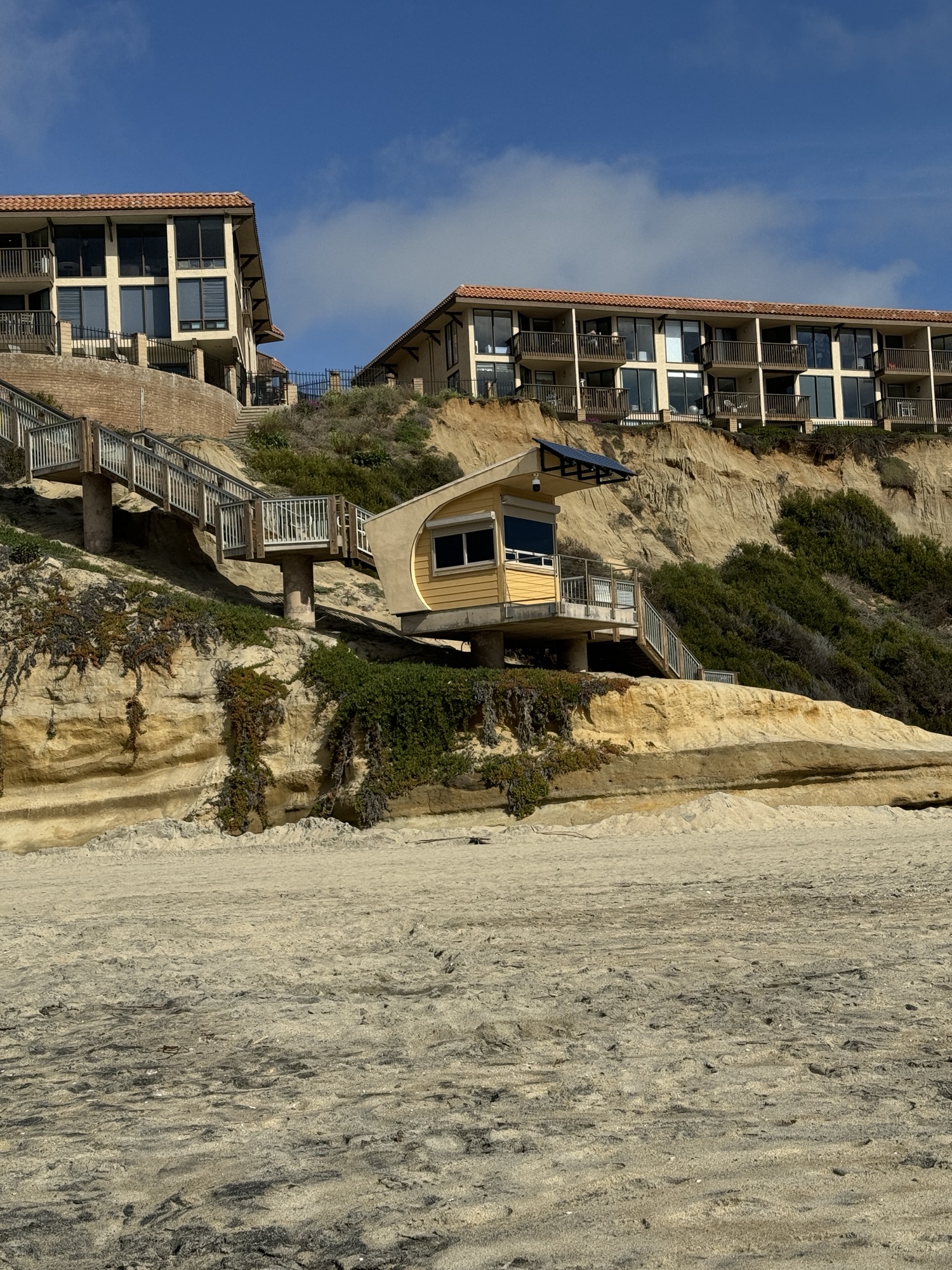
This sand restoration is supposed to last for a decade and be repeated then if funds are available. They just started this project at another local beach last week…and boy does that beach need it! We’ve been avoiding that beach lately because it is so rocky!
So, even though the sand can be annoying, clinging to every part of my body and depositing itself in my house despite my most careful efforts to mitigate it, I love it on the beach. The beach is definitely changed and I’m sure that not everybody is happy about that…but here’s hoping it helps with the severe erosion problems and gives us a bit more walking beach when the tides are not super low.
About a week ago I wrote about the work we were doing in my first grade classroom to prepare to create PSAs about things that needed more attention at our school. (You can read those details here.)
I thought long and hard about how to best teach my students to learn iMovie. The first thing I did was to create my own PSA using the same process I had taken my students through. I was definitely a bit rusty knowing the ins and outs of the iMovie app. I had to experiment and fiddle around—giving me valuable experience to share with my students. Finally I decided that I would start by showing my students in real time how to make an iMovie by making another right in front of them — and in fact having kids come up and do some of the processes for me.
We did the easy part first, and students got their photos into iMovie and created a title slide. Then we headed out to recess. I’ve learned over the years that doing complicated things around both sides of a recess is magical. You can get started…take a much needed break before things get too hairy and then return refreshed, but before things are forgotten.
After recess I showed students how to write a script and then record a voice over for their movie and then set them off to work. The classroom transformed before my eyes, becoming a workshop where students were focused on their movies. They helped each other, giving advice and support to their classmates as needed. I was on my feet, moving and listening, reminding how to edit, how to delete. I spent a lot of my time borrowing student headphones as I listened to their works in progress. My biggest challenge was our less-than-stellar headphones. Some crackled when they recorded. Some refused to play back. Over the next couple of work periods I learned to have those with the most problematic headphones go outside and record without using headphones.
It was so exciting to see the finished products–especially knowing that these first graders were able to create these iMovie PSAs on their own. Here is a student PSA created by a first grader last week and the plan he worked from.
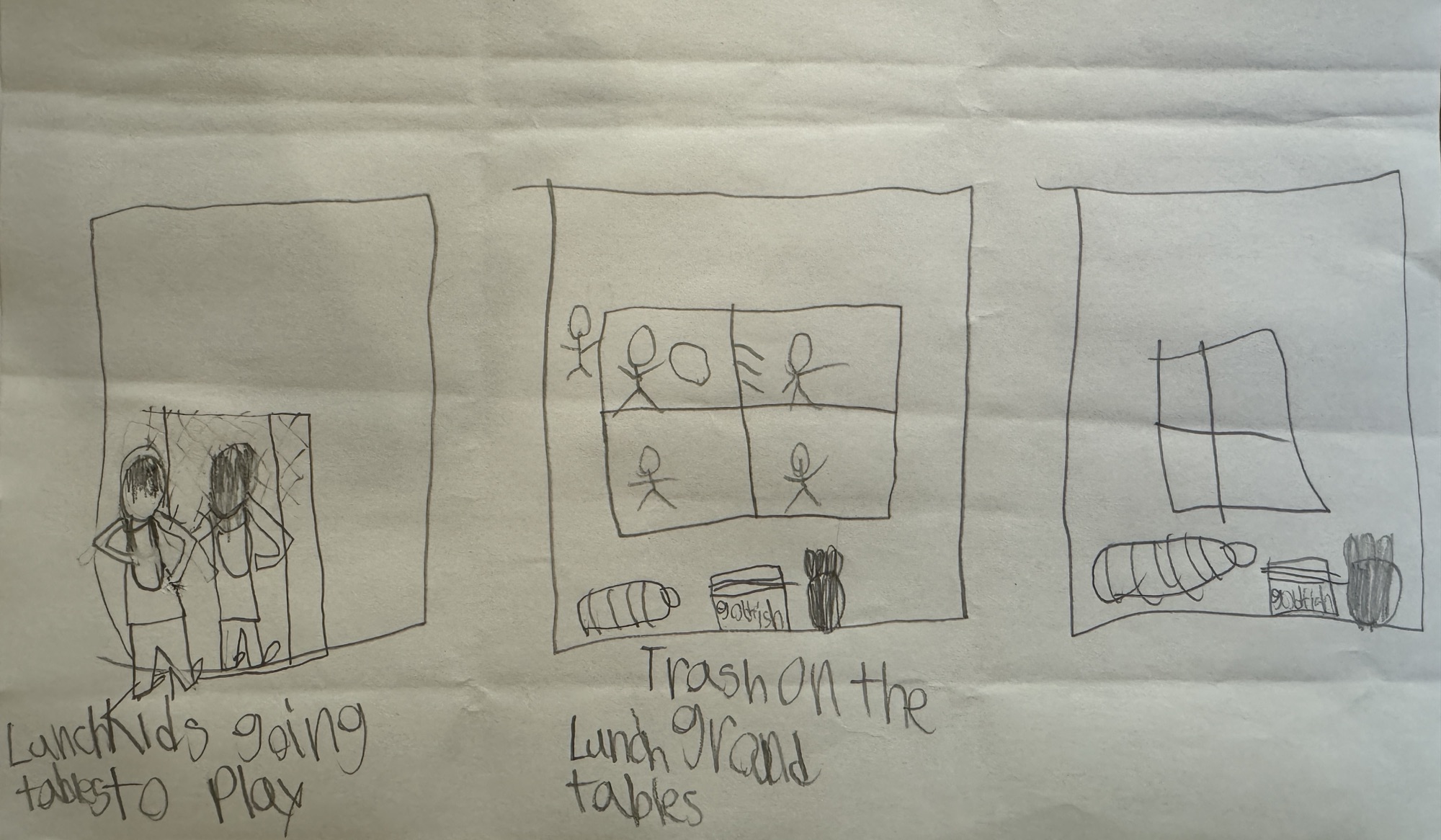
But the best part of this whole process is when students started telling me that they were going home and making iMovies. They followed the same procedure we did in class: they took photos, planned something to say, and recorded their voices. I loved when a parent emailed me one of these creations! Students are now not only consuming digital content, they are also creating digital content!
Now to think about the next project… Any suggestions?
Whenever the tide and my schedule cooperate, I head to the beach for my daily walk. I knew the tide would be low enough today if I got out of my classroom as soon as I plugged the kids’ iPad in and cleaned up for the day. The ocean cooperated and there was plenty of beach for walking and the sun was shining, creating perfect conditions for breathing out the work week and breathing in the weekend.
There was a lot going on today. We noticed the bathing suit photoshoot right away, beautiful young models posed as assistants held light reflectors and photographers shot both still photos and video. Every kind of ball play was going on: volleyballs bouncing high, soccer balls rolling and spinning along the ground, and footballs spiraling in the air. Surfers paddled out, swimmers in bathing suits squealed as they played in the cold water, while beach combers like my husband picked up trash washing up on the shoreline. Seagulls chatted among themselves while other shorebirds poked the sand for an afternoon snack.
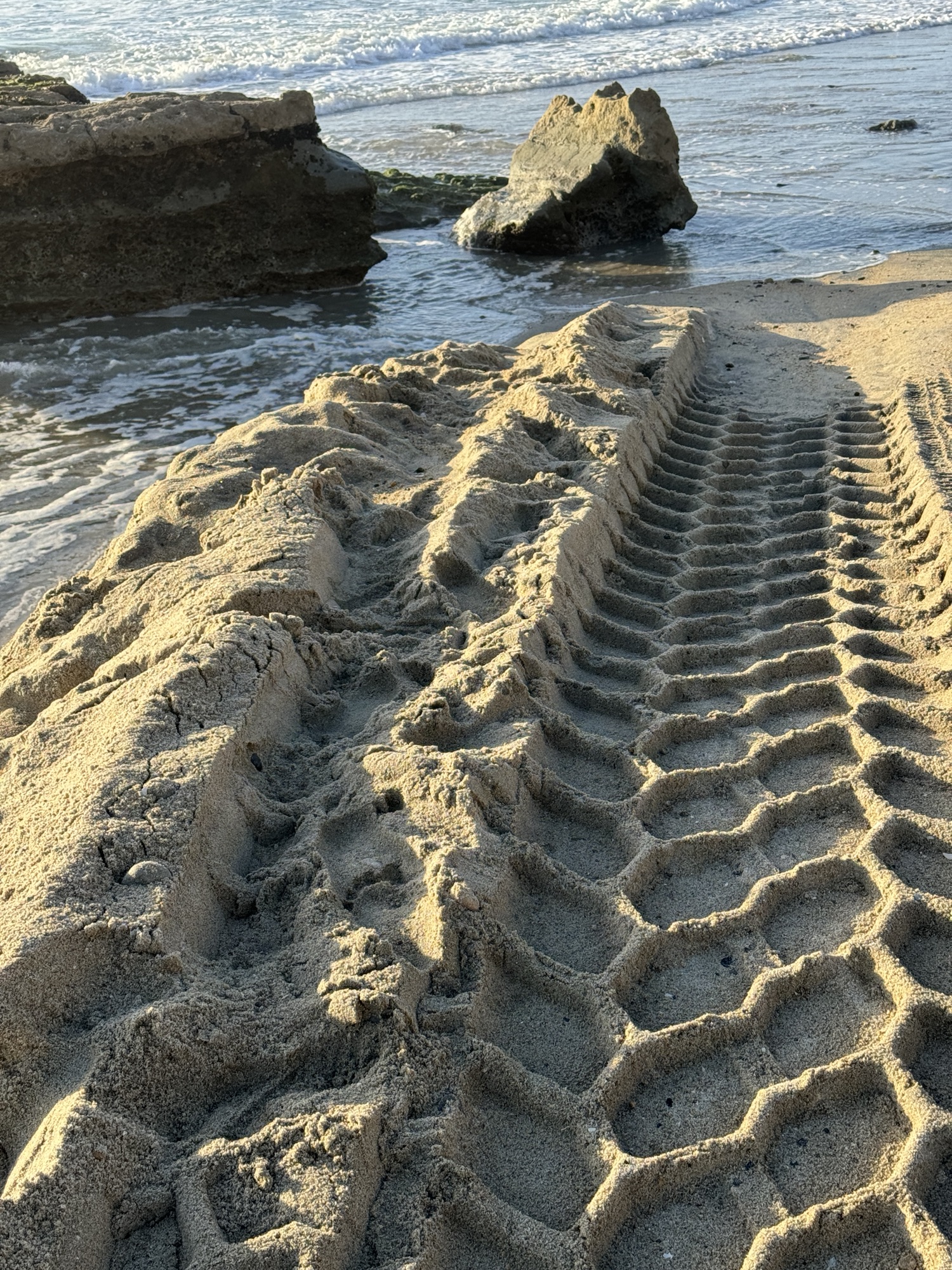
There’s been lots of sand work going on so I wasn’t surprised to see some pretty substantial tire tracks and big equipment in the distance.
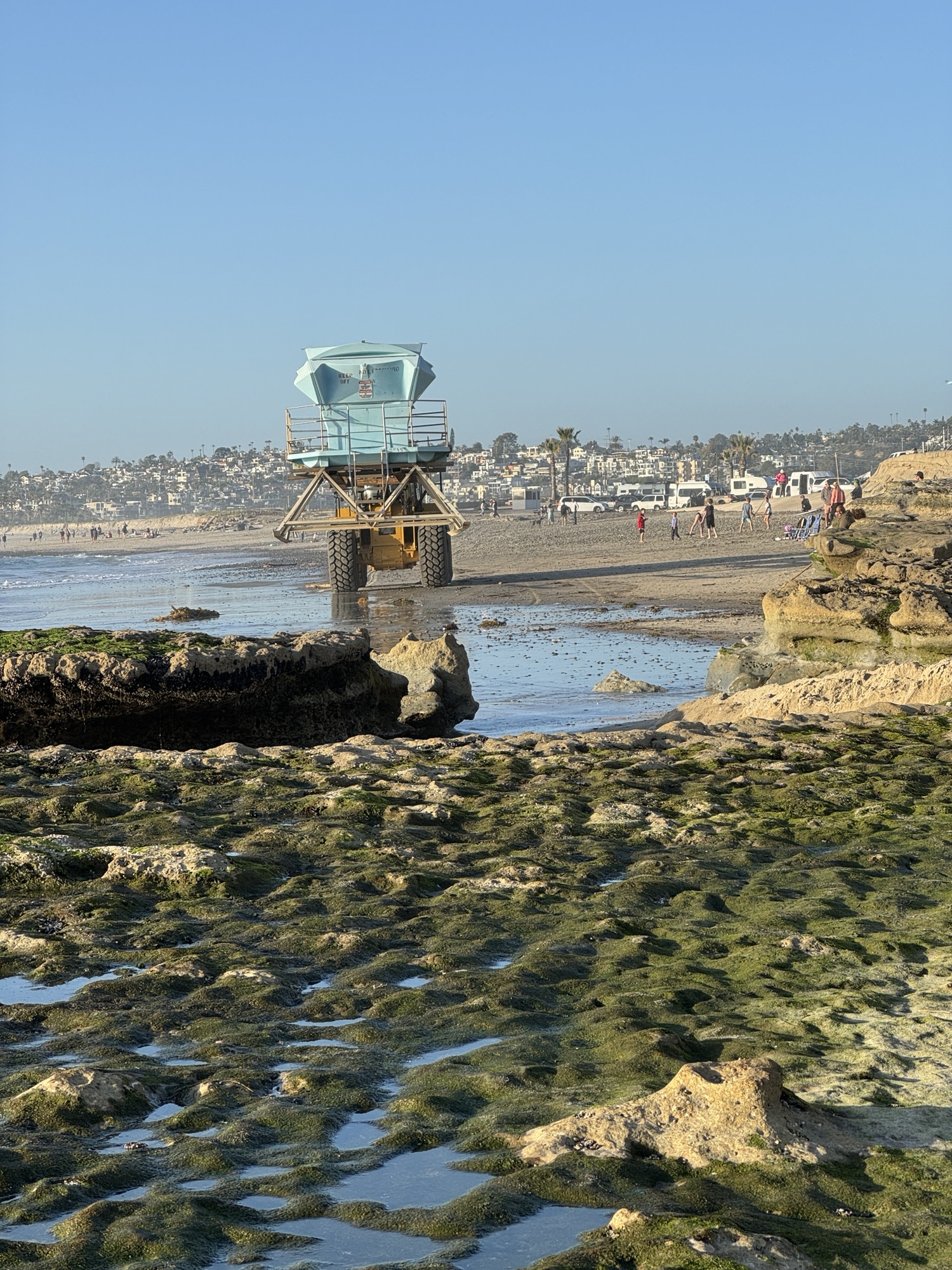
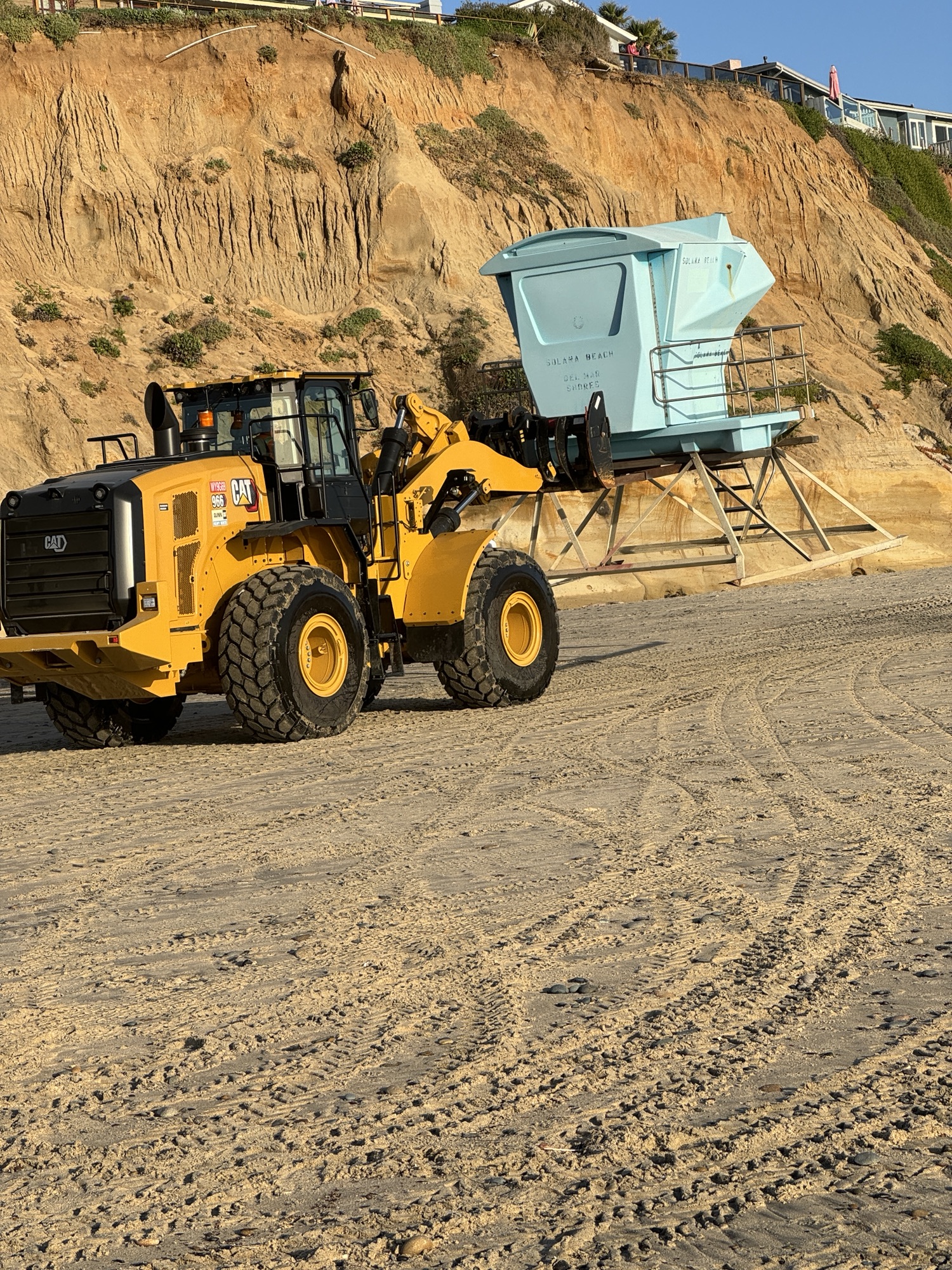
But I was surprised when I noticed the lifeguard truck with lights flashing followed by the big truck carefully balancing the lifeguard tower. Wait–it’s not summer yet! They’re already putting the towers back out on the beach? Then my husband reminded me: spring breaks are beginning. And even though we are not a tropical location, and in my opinion the weather will not be bathing suit warm, we find that we are a spring break location.
There is never a dull moment on a San Diego beach. And that was certainly true this afternoon. I’m a little worried that spring breaks will mean more crowds–and I certainly know it will mean more skin! I might be walking in jeans and a puffer jacket and look across the sand and see someone in a bikini heading down to take a dip in the (too cold) water. But it does make me happy that there are lots of ways for people to enjoy the beach–it is truly a treasure in our community.
It never rains in Southern California… So the song says. And for many years in the last decade that has been true. But in the last couple of years, rain has become a regular feature of winter weather. I’m quick to acknowledge that we need the rain (and that a lot of rain may seem like a small amount to others given that average rainfall for San Diego is under ten inches per year).
And to top things off, the rain seems so unpredictable lately. Yesterday, for example dawned sunny and bright. The day was beautiful and warm, but weather forecasters promised rain by afternoon commute time. And they were right. It actually rained on me during my after work walk…pretty much on schedule. We had rain all evening and some overnight. But the rain stopped by the time my alarm rang, and the day was supposed to be dry.
So, given that forecast, I didn’t dress for rain. I even looked at my umbrella (I had taken it on Saturday to our conference) and told my husband that I wouldn’t need it and then headed out for the university. As I pulled off the freeway to make my way to the parking structure I spied a rainbow…and a very dark cloud. Raindrops began to splatter on my windshield. Oh no, I thought, my umbrella is sitting at home. And the walk from the parking structure to the office is not a short one.
I pulled into the covered parking structure and remembered the conversation my husband and i had last weekend. He was telling me there was an umbrella in my car. Really? I asked. I sure didn’t know about any umbrella in my car. It’s way in the back, in that supply bag I keep in there, he explains.
I’m feeling hopeful as I zip up my jacket, pull my backpack onto my shoulders, and open the back hatch of my car. Sure enough, a small green umbrella is tucked in with the roll of toilet paper, a roll of paper towels, and some other odds and ends.
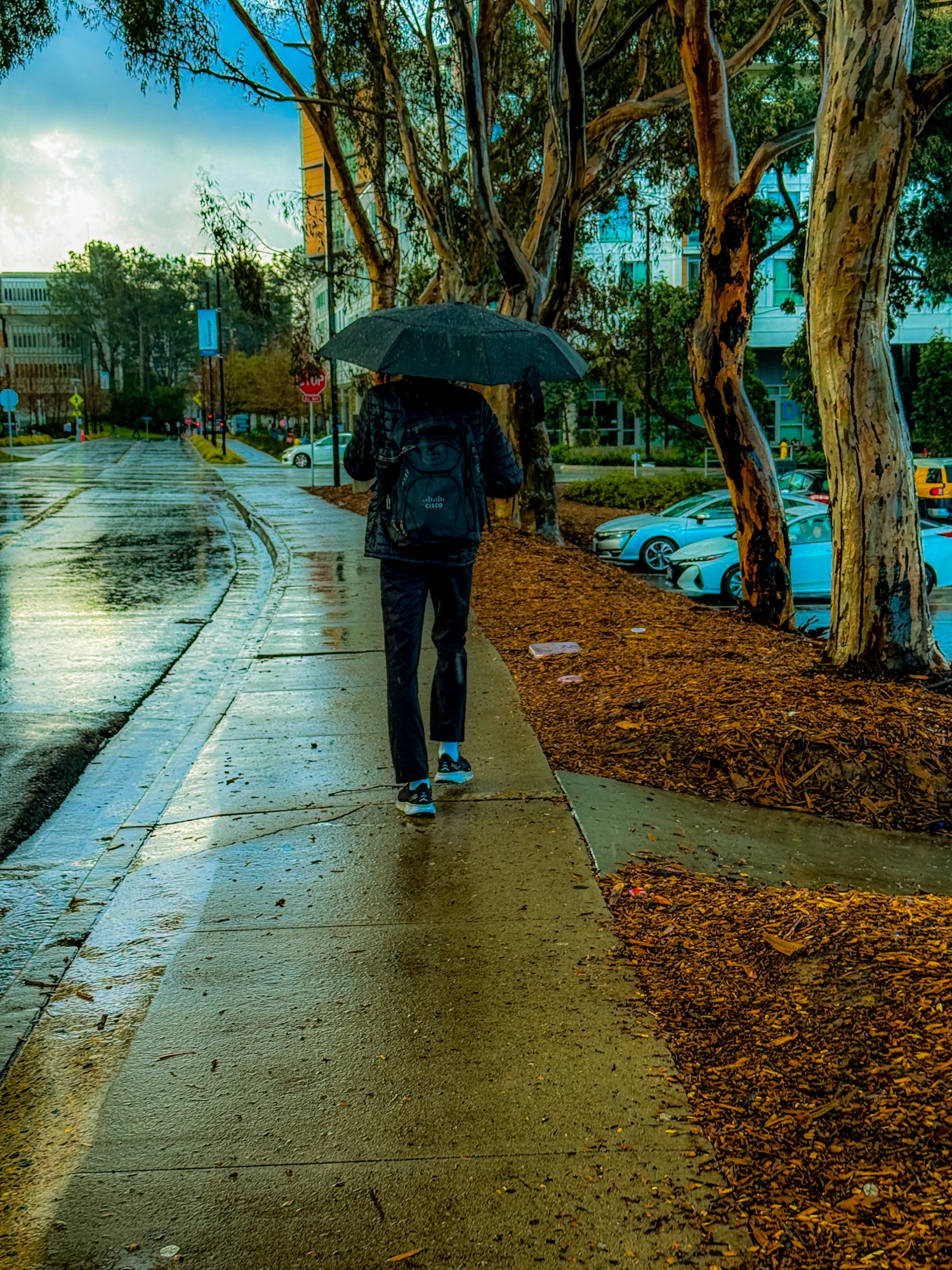
Today it was a lucky green umbrella, keeping me and my stuff dry as I walked from the parking structure to the office with raindrops tapping a rhythm on the umbrella above my head.
I love picture books. I do have some old favorites, but I am passionate about reading my students newer books, especially those that represent positions and characters that haven’t historically gotten enough attention. In some years I look for stories that help my students see themselves, in other years I look for ways for my students to see beyond themselves.
We have an amazing school librarian who has been making an effort to make sure the teachers know about new books–especially those that represent diverse experiences and address issues of equity and inclusion. Big by Vashti Harrison was a book I had been hearing some buzz about, but I hadn’t yet come across it in person. So when I saw it in the basket of books in the teacher’s lounge, I had to pick it up. As I began to read it, surrounded by my colleagues chatting and eating, I felt drawn into a quiet place. It was just me and the words and images. My breathing slowed, my heart raced, and I could feel tears welling. The careful selection of words and the powerful, beautiful pictures grabbed hold of my heart. I needed to read this book to my first grade students, even though not a single one of them can be described as “big” in these terms. Maybe that’s why this book seemed perfect for them.

My class tends to run on the chatty side. They have a lot to say about everything. As I opened this book and started to read I heard a few comments about the baby, but as I got a few pages in a hush settled over the classroom. I watched students lean in, faces serious. When we got to the pages with no words (a powerful series of images), it was almost as if they were holding their breath. They stayed quiet and seemed to have a communal exhale as the book ended. After a breath or two, they had some things to say. They felt sad for the girl in the story and they were thinking hard about how the words had hurt her.
I read this book for a second time this week (I read it for the first time to students on Monday) because this book has so much to say. Again, my students settled into quiet attention. They paid close attention to the illustrations, noticing the use of color and space…and the ways that words were also part of the illustrations. We talked a bit about my favorite page…the one where the girl has a hand full of their hateful words and says, “These are yours. They hurt me.” as she hands them back to the people who used them.

This book won the Caldecott award and is a Coretta Scott King honor title and I can see why. I highly recommend this book not just for younger children, but for people of all ages. Bias–both implicit and explicit is something we can all learn more about and pay attention to in our daily interactions, especially as educators. And don’t miss the author’s note at the end! Add Big to your TBR pile today!
 Thinking Through My Lens