Category Archives: clmooc

With My Head in the Clouds: SOLC 2019 Day 18

Some days I find myself with my head in the clouds, my mind floating on thoughts of projects to be done, problems to solve, reflections on what happened before.  Like a helium balloon, I float on the air currents, directed by my inner monologue.  When my head is in the clouds I risk missing what is right in front of me.

Like most Mondays, today was a day for laying groundwork for the rest of the week.  The hours pass like minutes, the minutes like seconds and time rushes through my fingers like a waterfall…not stopping to pool at my feet as it disappears, just out of reach.  I get into the hurry up mode, chasing time ideals set in my plan book.  I get impatient with my students, wanting more from them as I feel the pinch of time.  Trying to find the perfect ratio of time to learning.

When the bell rang ending our afternoon recess, I headed out the classroom door to pick up my students from the playground.  My head was already running through all we would accomplish while still leaving time to clean up, pack up, and gather before dispersing at the dismissal bell.  Out of the corner of my eye I noticed a lizard, sitting on the sidewalk, soaking up the energy and warmth of this amazing almost-spring day.  I almost rushed by–feeling the tug of time.  But instead, I stopped.  I watched and noticed.  I crept closer, wondering if I would capture an image of this grounded creature.  I snapped from afar, then crept closer.  The lizard seemed to keep an eye on me, unwilling to relinquish the warmth coming up from the sidewalk and down from the sun.

img_9935

That lizard reminded me to take a breath and appreciate the moment.  And also to remember to appreciate all those moments that students need…to tell the seemingly unrelated story in the middle of my lesson, to ask question after question–and then the same question again, to need directions…again…and my patience and encouragement, even when I feel like my own well has been emptied.  I need to spread my toes and grip the ground, feel the earth beneath me grounding me, giving energy and reminding me to use those roots to connect and grow and to support my students as they connect and grow too.

I guess I have another ratio to work out…the ratio of head in the clouds to feet on the ground!


Silent Sunday: March 17, 2019 and SOLC 2019 Day 17

For a number of years now I have participated in something called Silent Sunday.  On Silent Sunday (every Sunday for me), I post a photo that I’ve taken in the past week that tells a story through the image.  I include no words, hoping that others take a close look at the photo, letting a story emerge in their own minds.

Sometimes the image provokes a conversation on my blog or social media.  Other times I’m not sure how the photo is received.  I can imagine using Silent Sunday photos as writing prompts for my students (although I haven’t up to this point).

So for this Slice of Life entry, I submit my Silent Sunday photo.  Although I’ve included all these words to explain the process, I will not provide words to accompany the image…I will leave that up to you to interpret!  (I’m happy to engage further through blog comments or social media if the image provokes that response.)

Here’s my Silent Sunday and Slice of Life Challenge entry for today:

lrg_dsc02259-1

When is it Worth it? SOLC 2019 Day 16

When is it worth it to fly halfway across the state for a Saturday meeting?  Up at 3:45am, driving before the sun has even begun to think about peeking over the horizon, at the airport waiting for a flight before my regular wake up time.

Arriving well before the meeting time–because airlines work on their schedules, not yours.  Searching for coffee on a sleepy college campus, a futile exercise on a Saturday morning.

img_9903

(Luckily a Philz was right off campus…a pour over experience to fuel the day to come.)

img_9909

When is it worth it to meet face-to-face?  Our hunch was right.  We needed to be human, to be real, to not only see and hear one another, but to feel each other too. We were in need of an opportunity for a shared experience AND spaces for those small, informal conversations that build relationships and enhance the more public and formal interactions.

A network is a network when we are connected.  Today’s long day that spanned hundreds of miles of travel for our group was definitely worth it.

img_9906

I’m filled with information, inspiration, and hope…for the network, for the work, for the future.  And I feel the warmth and comfort of relationships reinforced, bonds renewed, and the tingle that will lead to growth and new ideas.

And the cherry on the top?  I was able to change to the earlier flight home!

img_9915

Team Bird: SOLC 2019 Day 15

Today’s walk had me watching pelicans.  And as I observed their precision maneuvers, I started to think about how birds compare to sports and their athletes.  Pelicans are like synchronized swimmers, matching their moves and depending on the precise movements of each to create the desired formations as a group.  I sometimes see one peel off, slowing down or heading off in a different direction, but most of the time they are working the V, adjusting position and speed to ensure that the entire group gets where it is going with speed and efficiency.

lrg_dsc02232

Seagulls are more like that pick up game of basketball or soccer.  They have shared interests, but there is always plenty of squabbling and trash talk.  There are definitely leaders and followers and lots of jockeying for position (and food).  Seagulls seem to laugh a lot (at least in my mind), they love to play in the wind currents and hang out together on the beach.

lrg_dsc00735

Osprey are those elite individual athletes–the Mikaela Shiffrins or Serena Williams of the bird world.  They are strong and independent and ferociously focused on their goals.  Osprey are beauty in motion, each muscle toned, each movement made with grace that makes the nearly impossible seem easy.

img_9729

Egrets are steady, patient and observant.  They wait for the perfect opportunity, a lot like the utility players in football or basketball.  They have that grace of movement, but they don’t draw your attention until you look away from the shining stars of the game.  But when you do look…oh la la, they are poetry in motion!

lrg_dsc09977

Sandpipers are team players all the way.  They move together, eat together, and watch out for each other.  Like a finely honed World Cup soccer team, they seem to read each others’ minds, moving separately almost like one.

lrg_dsc03164

I’m always encouraging my students to be a team, reminding them that we need to support each other and create a space where we all can learn.  But after watching the birds, I’m wondering if I need to refine my language.  What kind of team do I want them to be?

What Does it Take to Thrive? SOLC 2019 Day 14

I walk below these cliffs all the time, noticing the canyons and wrinkles wind and water carve along their faces.  I see evidence of human interference, the places where lawns and ice plant hasten the natural erosion of sandstone along the beach.  I’m mindful of walking too close to the cliffs, remembering days when huge chunks let loose and fall to the shore.  I wonder about the multimillion dollar homes perched on the edge–the ones with the incredible views of the Pacific Ocean–that are in danger of dropping into the sea during the next big storm.  Are those homeowners insured for cliff erosion?

Today’s blue was intense, blues that need words like cerulean, azure, and cyan to begin to describe the richness of the color.  And the blue was punctuated with thousands of small orange butterflies…on a mission headed north.  It was almost as they were emerging from the sea, flying straight for the cliffs, then up, up , up.

lrg_dsc02210

Oddly, though, my eyes were drawn to a small bunch of yellow flowers high on the wind-blown cliff, a tiny patch of blossoms flourishing in hardscrabble sandstone.  I’m reminded that some of us make the best of where we are planted and take advantage of whatever resources are available…not dependent on soil amendments, special fertilizers, and protection from wind and other elements.  What does it take to thrive in sandy soil and harsh conditions?  Sometimes the blue skies, mild temperatures, and more plentiful than average rainfall is enough.

lrg_dsc02218


Reflection as Archeology: SOLC 2019 Day 13

Sometimes I feel like an archeologist as I sift through artifacts, looking for the story that history has missed.  Okay, so that history is pretty recent…and I better admit that it’s almost report card time in my classroom.

I’m trying to get my students to think about their own learning.  I want them to know themselves as learners, recognizing what it feels like when they “get it,” and also when things are not making sense at all.  Over the years I have tried lots of different ways to have students reflect…in fact, I wrote my master’s thesis about reflection in my multiage (first, second, and third grade) classroom.  For the last couple of years, I’ve been playing around with the idea of “artifacts” as the provocation for reflection on learning.

I know what artifacts do for me.  They jog my memory and get me thinking.  (If you are an actual archeologist, please excuse my broad and inaccurate use of the word artifact.)  My camera is my tool of choice for documenting my experiences and seeing the world. Through my lens I find myself searching for meaning as I look closely.  A couple of days ago on a rainy beach walk, I noticed these shells up near the cliff.  I know they didn’t get their on their own, so I started wondering about the story behind them.  Who picked them up, why did they leave them behind? I recognized the familiar bits of shells native to this beach, and found myself reflecting on how much I have learned about these creatures from my frequent walks.  After taking a photo or noticing something new or unusual through my lens, I often find myself researching, adding to what I know, thinking about what I want to know, and then looking more closely.

img_9828

I want my students to experience some of that with their learning in the classroom. Sometimes I give students a broad topic–find an artifact of a success or struggle with math and then send them to sort through projects and papers, books we’ve read and tools we’ve used.  Photograph the artifact and load it into a slide show, then reflect on that success or struggle.

Today I decided was the perfect day to have all my students reflect on what they have learned about geometry.  I thought Flipgrid would be the perfect tool–they could videotape their reflection while showing the artifact(s) of their learning.  Flipgrid lets you download your video to your device…and limits your video to 90 seconds!  (Plenty of time for this purpose!)  I gave directions and showed kids the ins and outs of the app on their iPads and set them off on their reflection.  Energy was high, students were interested (novelty through a new app helps with that) and they eagerly gathered their materials, ready to get started.

But wait…I heard the murmuring, “We don’t have Flipgrid on our iPads.”  What?  How can that be?  Ugh…now what is plan B?  How do I take advantage of the momentum and not waste this precious time?  I grabbed a student iPad and saw Clips on there.  I did a quick scan of how it worked, decided it was close enough and quickly got them going again.  I also emailed our tech support, could they get Flipgrid loaded?  As students were videotaping themselves and reflecting, they also reported that Flipgrid was loading on their iPads.

After much thought, I decided that I would have students go back to their artifacts and recreate their reflections in Flipgrid.  Their Clips experience would serve as a practice round, maybe even improving their reflection.  I had less than 30 minutes for students to get this accomplished and we wouldn’t get to the second part–actually getting the reflection video into the slide with some written goal setting attached to it.  But all my students did get the video reflection completed.

img_9855

I’ve listened to most of them, and they do convince me that the artifacts help with reflection.  I like that many of my students included artifacts of their learning that I didn’t suggest and all at least summarized the basics.  I like that the individual videotaping lets me hear my quieter students and those who are reticent to risk speaking up in front of more confident peers.

My goal is to have students create a reflective slide each week…in under 30 minutes. I’m already way over time for this week…but I’m hopeful that it will get more efficient as we become more familiar with the tools and process.  But I also want to remember to keep it fresh, offer lots of choices, and allow for creativity.  Can my students become archaeologists and uncover the artifacts that will help them understand how and when they are learning?  Will their reflections help me and others hear their stories, appreciate their individual learning paths, and be better able to support their learning?


Tiny Snails and Butterflies: SOLC 2019 Day 12

Kids have a way of seeing the smallest of details in the world.  While they often miss some big picture items, they never miss the puncture mark in the shared eraser, the cloud shaped like a volcano erupting, or the perfect rock that most of us would never give a second look.

We had another unexpected rainy morning today, pushing me back upstairs to change from my suede booties to my cowboy boots before heading out the door for work.  By the time I was out on the blacktop for before school recess duty, the rain had stopped, but the ground was still wet and shiny.  The time change has kids straggling in later than usual, giving me plenty of time for mental meanderings as I watched the few early kids play on the blacktop.

img_9841

After recess duty, I spent a few minutes back in the classroom chatting with a few of my third graders, listening to their stories of the previous evening.  When the bell rang, we headed out together to pick up the other students where we line up on the blacktop.  We barely made it out the door when one my students noticed an incredibly tiny snail on the sidewalk in front of our classroom.  Smaller than the fingernail on my pinkie, this snail was a perfect miniature model of those pesky snails often found in the garden. We all knelt low, noticing its perfect features, spiral shell, and gooey slime on the wet sidewalk. After taking a few photos, one of the students offered to carefully “save” it and move it from the sidewalk where it risked getting stepped on by the many students who would walk that hallway to a safer location on the nearby dirt.  Carefully picking it up by holding the shell, the snail was relocated without incident.

img_9845

Later in the day, the sun shone brightly and most students had shed their jackets to bask in the warmth of the almost spring sun.  During lunch the kids had noticed that our school seemed to be in the flight path of a butterfly migration.  Monarchs are familiar friends to our schoolyard where milkweed grows tall, so the kids thought the smaller butterflies they were seeing were baby monarchs.  We walked out to the pollinator garden to see if we could get a closer look, but butterflies flittered by in twos or threes, staying above our heads rather than alighting on any plants.  I’m pretty sure these were actually painted ladies…the same butterflies I had just seen in profusion in the desert over the weekend.

lrg_dsc02067

It always surprises me that these same students who never miss a tiny snail or the beauty of butterflies migrating overhead don’t seem to notice that they are standing on a classmate’s jacket with muddy shoes or that they just jumped in front of ten other children patiently waiting for supplies for a project.

They are perfectly self-centered and exquisitely altruistic, obnoxious and incredibly kind, thoughtful and infuriatingly rude…all rolled into one.  Tiny snails and butterflies remind me to look closely and find those sometimes hidden endearing qualities rather than focusing on what so often is the most obvious to notice in the classroom.  And I’m lucky, those same confounding small humans are also the reason I find myself paying attention to the smallest of details, appreciating the world through the eyes of children.

California Poppies: SOLC 2019 Day 11

The golden poppy is California’s state flower.  We often see this cheery orange flower growing along the side of the freeway, in roadside medians, and in the landscaping of public buildings.  It’s both delicate and hearty.

lrg_dsc02193

As a California native, I’ve seen these poppies my whole life, but I’ve never seen them like I did over the weekend.  Drought has become a way of life in southern California where I live.  Our average rainfall is only 10 inches per year, so those years when the rainfall falls well below (I know we’ve had recent years with only 5 inches–for the entire year!) are devastating for plants and animals (and humans too)!  This year we are already well above average for rainfall, and the season doesn’t end for a few more months.  That means our landscape is greener than usual…and flowers are everywhere!

On our way home from Saturday’s adventures (you can read more about those here and here), we decided we would stop by to get a glimpse of some poppy fields at the peak of their blossom.  As we headed back from the desert, we swung through a part of Riverside county called Lake Elsinore.  Even before we got to our destination, we could see hillsides in full bloom!

lrg_dsc02162

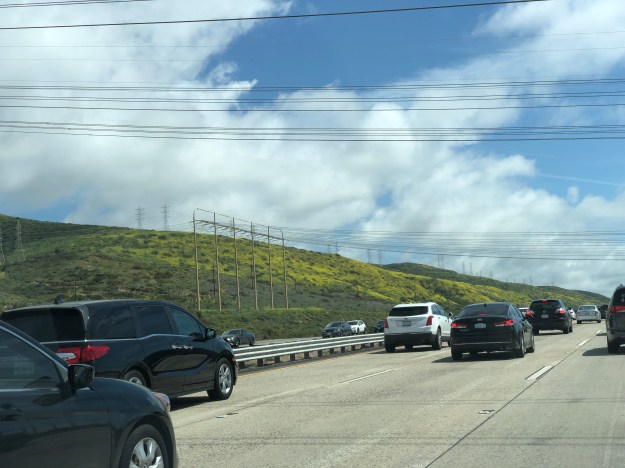
We weren’t the only people who wanted to see these beauties, traffic snarled as we got close.  We saw the highway patrol ticketing cars that folks had parked on the shoulder of the freeway to try to circumvent the traffic to photograph poppies!

Our patience paid off with the opportunity for some close up views of these massive fields of poppies.  Unfortunately, we were late in the day as the sun was dipping below the clouds and the temperatures were dropping, so many blossoms were beginning to wrap up tight for the night.

lrg_dsc02180

img_2388

In spite of the challenges, I enjoyed my poppy experience.  I’ve been noticing more poppies in my own community as well.  I passed several small patched of poppies along the roadside on my way home from work today.  And I’ve seen many people I know posting pictures of poppies…from Lake Elsinore and many other hillsides around the state!  They are beautiful…and a cheery indicator of a wet winter and spring’s arrival.

Saturday Adventures Continued: SOLC 2019 Day 10

Our Saturday adventures didn’t stop with the Super Bloom.  As we hiked back toward our car, still admiring the seemingly never ending beauty of the desert in full color, we started a bit of a “what if” conversation.  We knew we were done hiking for the day…but it was still before noon, why not continue exploring?

lrg_dsc02051

We’d seen signs for the Salton Sea as we drove towards Borrego Springs.  What if we just went further and explored the Salton Sea?  We checked out the distance on Google maps…it seemed a reasonable option, so we plugged it in, pushed start, and headed east.

We drove through more patches of the desert in full bloom, watching carefully for those drivers and folks with cameras who pull off the road suddenly, flipping car doors open without remembering that they are stopped on the side of highway.  We continued to drive, the view changing until it seemed we had found landscapes that time had forgotten.  Sparse vegetation, windswept columns and deep valleys reminiscent of the Grand Canyon surrounded us, I almost expected to see a giant dinosaur pop its head up and look me in the eye.  As we continued on, we found the hideaways of weekend RVers and their myriad dune buggies racing up and down self-made roadways.  Unexpectedly, the landscape changed again.  Were we seeing a mirage?  The blue on the horizon looked like we were seeing the ocean in front of us.  The Salton Sea is called an accidental lake, though apparently at one time it was a naturally occurring fresh water lake.  It is located directly over the San Andreas fault and is known as one of the largest and saltiest inland bodies of water.  (I cannot even begin to do justice to its history in this post, so if you’re interested, I encourage you to do some research–it’s super interesting!)

lrg_dsc02152

As we got closer, we realized that our navigation led us to the community of Salton Sea City.  We drove as close to the shoreline as we could and got close enough to take it its immensity.  We wanted to get closer–close enough to walk along the shoreline.  We tried Google again, this time trying the search word “beach.”  We had a couple of choices–one closer than the other.  We headed toward the closest one…Salton Sea Beach.  As we drove, we were hoping for beach access.  We were surprised when we drove into a small community and the navigation told us we had arrived.  Driving around a bit, we followed a road toward a shoreline where we found “No Trespassing” signs.  We realized we had not driven to the beach, we had driven to the community named Salton Sea Beach!  Frustration was building–surely somewhere there was access to the shoreline of the Salton Sea!  Consulting Google once again, we chose that other option and headed off toward the Salton Sea State Recreation Area.  Luckily, it took us mostly in the direction we would eventually head to return home.  But we were surprised when the exit looped us back in the direction we started from and were even more surprised when we realized we were on the opposite shore of the Salton Sea!

But we finally got that beach access we were looking for.  A short walk gave us a view of black necked stilts along with some familiar gulls.  Apparently the Salton Sea has become a migratory flyway for many birds–one that is in danger.  California’s water wars are most evident when it comes to the Salton Sea…the topic for yet another blog post.

lrg_dsc02151

My photos of this sea are not spectacular–the light was all wrong, the birds too far away. But the experience was worth the frustration and the strange driving routes through unfamiliar desert areas…definitely a Saturday adventure!

Super Bloom: SOLC 2019 Day 9

The desert is usually subtle.  Many shades of brown often characterize the plants and animals that live there.  Blending in is necessary for survival and adaptations for preserving water often mean staying small and skinny to prevent evaporation.  But when there is abundant rain in the winter, the desert can be a bit showy.  Super Bloom 2019 is underway!

We planned a desert hike for today, knowing that hiking would give us glimpses of the blooming desert while taking us away from more of the bloom tourists.  We got up and left the house early…appreciating the beauty of the sunrise as we drove toward the east.

img_9731

One of the perks of living in San Diego is that you can get to the ocean, mountains, and deserts in about two hours or less (if traffic cooperates).  We arrived in Borrego Springs before 8am and easily found parking near the Hellhole Canyon trailhead.

Many of the flowers were still asleep, tightly closed against the cool of the night.  As we walked, the desert slowly woke, stretching and unfolding in the gentle light of morning. Starting early meant having the desert mostly to ourselves, allowing the desert soundscape to fill our ears.  The caw of a bird called my attention to the hillside where I spotted a mama big horned sheep and her baby.  We watched and listened as they click clacked their way down the hillside.  I definitely envy their surefootedness!  A buzzing nearby had me turn my head where I spotted a beautiful tiny hummingbird sitting in a leafless tree. Painted lady butterflies played tag as they flitted from flower to flower to flower to flower. The trickle of water tinkled in the distance, growing to a burbling stream as we got closer to the oasis framed in native fan palms.  The outcome of abundant winter rain was in full view as we finally got to the maidenhead falls where water poured from over our heads into the running streams below.

The desert is carpeted in wildflowers right now.  Yellows and whites stand near purples and pinks.  Splashes of red and brilliant white blossoms punctuate the view.  Ocotillos are just started to bloom, along with the barrel cactus.  The prickly pears will be ready in a couple of week, judging from the emerging buds.

lrg_dsc02060

The super bloom is just beginning and there is nothing like seeing the desert in its full color glory!  As the temperatures gently rise, the blossoms will continue to emerge.  If it doesn’t get too hot, the bloom may last through mid-April!  Today’s hike was perfect: a just-right physical challenge as we gradually climbed, scrambling up rocks as we approached the falls, like the sheep we saw earlier.  The weather was sunny, with coolish temperatures in the 60’s, and everywhere we looked, it was simply gorgeous!  It was a perfect Saturday adventure.

lrg_dsc02049