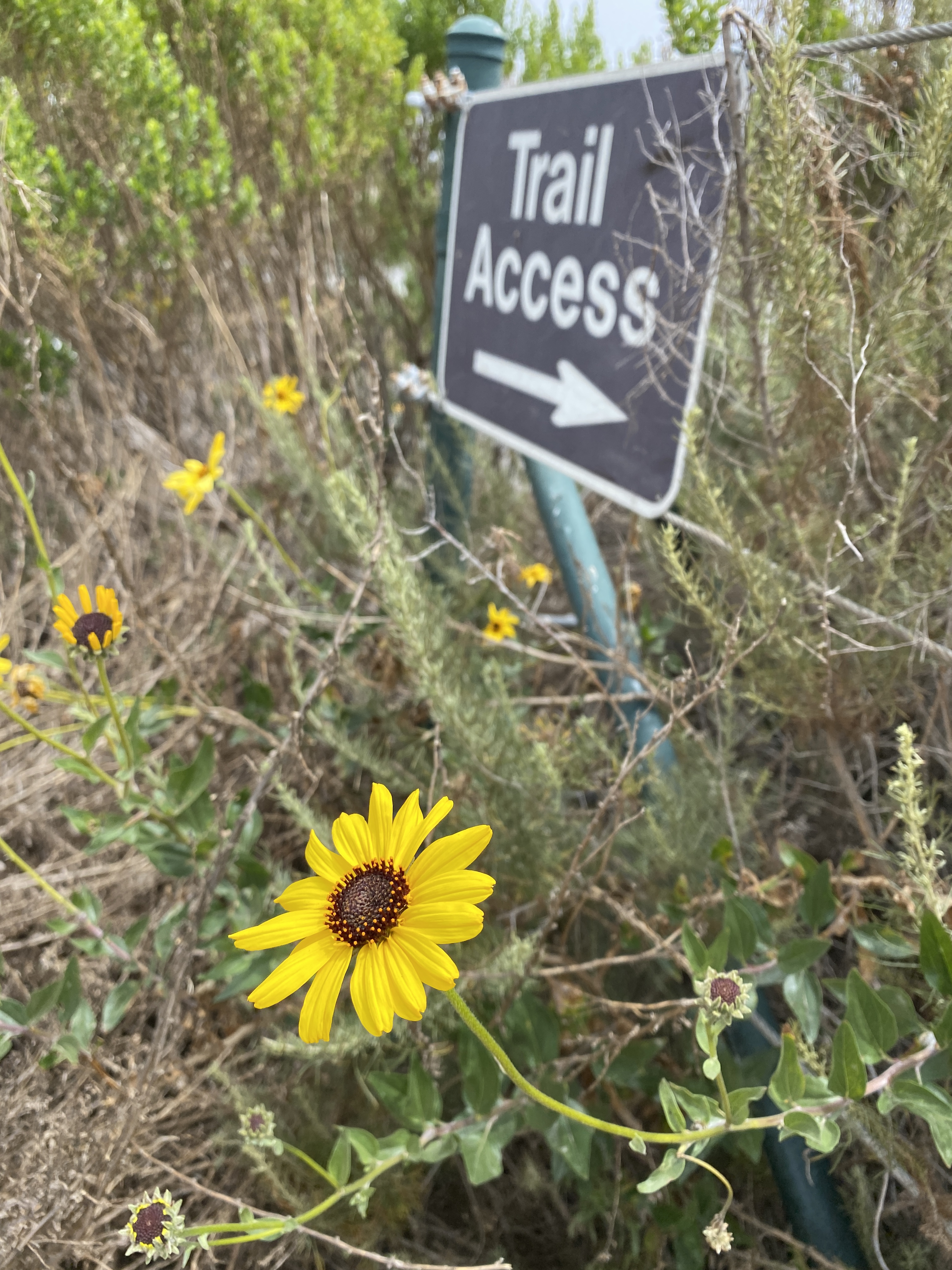
Today’s prompt for #verselove on Ethical ELA is to craft a 4×4 poem: 4 lines, 4 syllables per line, 4 stanzas, and a repeating refrain that moves from line 1 to 4 through the poem. As I hiked San Jacinto today, I found myself thinking about words and ideas that might fit this new-to-me poetic structure. Here’s my draft:
Once again I took my poetry inspiration from #verselove at Ethical ELA where I found seeds left by Jennifer. I found myself thinking about photography and exploration and identity and the ways that words are intertwined with all of those.
On this third day of National Poetry Month, #verselove via Ethical ELA focused on the idea of collaborative inspiration. I love the way that Gae and Lori inspired each other by “poeming” each other and then using the poem as a starting point for their own writing. I definitely felt poemed this morning as I read through the poems already scattered by the participants in this month-long poetry fest. It’s interesting to me that I’m not sure exactly what triggered my own piece…and idea, a word, a comment left by someone on one of the poems…
I’m Not a Music Person
I’m not a music person says the one
who keeps the radio set on talk
Until…
the first strains of Fur Elise transport her back to childhood
and the roommate–the stocky second (or third) hand upright
where her hands learned to make music
Until…
rifs from Take the A Train and other classic jazz
set her toes to tapping and fingers snapping
and she remembers listening to them move from noise to music
and that unexpected Christmas morning duet,
a gift from the heart
Until…she bursts into song (off key of course)
when The Sound of Music comes on TV
and her sons are dumbfounded that she knows
all the words
Until…
grandbabies come and she croons to them
the lullabies from her childhood and their fathers’ childhoods
Imagine my surprise this morning when the post by Ethical ELA was hosted by friend and colleague Emily Yamasaki! I was immediately drawn into both the mentor poem, things I have memorized by Maria Giesbrecht and Emily’s poem, Things I Know. I dove deeply into the cool pool of poems that emerged from Emily’s provocation, reading and feeling, admiring and analyzing as I began to think about my own writing for this second day of National Poetry Month.
Things I Know by Heart
The sleek curve of the egret’s neck
in the tidepool at low tide
The smells of love that fill our home
emanating from the kitchen
The silence of his last breath
matching the empty space in our family
My daily commute, etched in the recesses of my mind,
requiring no conscious thought
My childhood phone number
but not my passwords–they continue to elude me
The sweetness of little boys
now into the second generation
Fear of fire, seared into my memory
brought back by ashes that rain down like snowflakes
Fog’s gray blanket
an indicator that spring has arrived
Each of the traffic spots on the 5 between our house and theirs
no matter how long it takes, every trip is worth it
It’s April! And it’s the first day of National Poetry Month. I don’t profess to be a great poet–but I am able to share my love of words and poetry with my students–especially when I do the things I ask them to do.
So even though this is not a teaching day for me and even though Spring Break begins tomorrow and I won’t see my students until April 11th, I will write a poem each day. I know that I will be better able to coach and guide them if I am doing the poetry writing I want them to try.
I plan to use Eve Merriam’s Peeling an Orange with them when we get back to school after Spring Break, so why not experiment with it as a mentor text today? One of the techniques I notice in this poem is her use of the contrasting words carelessly and meticulously. So, since photos tend to inspire my writing, I took a peek through my camera roll and spotted this one of a snail from a neighborhood walk earlier this week. And here is the poem it inspired:
Why commit to writing and posting for 61 days in a row? Trust me, I asked myself that question many times during the past two months. During March’s Slice of Life Challenge, once I began the challenge, it was the writing community that kept me accountable. There is something about hundreds of people writing and sharing and commenting that keeps the urgency up. And since so many are writing every day, reading their posts also creates topic possibilities and keeps the momentum moving.
Writing and posting a poem a day, especially without that dedicated writing community, is a bit more challenging. But I know me, without telling myself I will write AND POST a poem each day I simply would get lazy and not write each day. So why did I want to write a poem each day? Because I wanted my students to write a poem each day–and I know that if I am writing along with them, not only do I have more credibility, but I am also looking for ways to support them and their writing when those doldrums inevitably sneak in.
So after writing for 61 consecutive days (62 if you count today), here are some things I have learned and/or am thinking about:
Writing every day breeds more writing. When I am committed to daily writing, I write more and more often. I am in a constant search for topics, for inspiration, for meaning making.
I find myself coming up with strategies to keep myself writing. I take photographs, I pick up objects, I collect words, I listen to what others are saying. I’ve learned to put words on a page, even when i’m not sure where they are going.
I can post even when I don’t love my writing that day. This is especially true with poetry writing where I spend a of time judging myself. I tell my students that the most important part about writing is to get started, we can always make our writing better. So that commitment to write and post the poem each day means that I have to get all the way through a draft and get something that I deem post-able.
It’s okay to write short. Sometimes when I’m really stuck, I pull out a Haiku (17 syllables) or a 6-word story. Even if it’s short, I’m still writing (and posting).
Revision is important. I keep looking for ways to help my students understand the possibilities for revision–like signs along the hiking trail–pointing to techniques to try, reminding them of things that other writers do, giving them access to the power of revision.
Writing more gets me reading more and my reading changes when I am writing. I find myself looking behind the stories and poems to examine how the writer is putting their words together. I look for more variety in my reading, searching for writers who are doing fresh and interesting things and who represent viewpoints different from my own. And I find myself sharing what I am learning from my reading with my students, pointing out sentences, ideas, and strategies that I notice as I read.
And as April turns to May, for the last several years I find myself facing the same dilemma, do I continue my daily writing and posting? Will I write daily if I don’t post? I don’t know the answers to those questions for this year. What I do know is that over the previous two years when I didn’t commit to the daily writing and posting, my writing decreased (I still always write with my students) and my posting became infrequent. I’d love to be the person who can commit to posting 2 posts a week, writing daily with that goal in mind. Maybe this is the year.
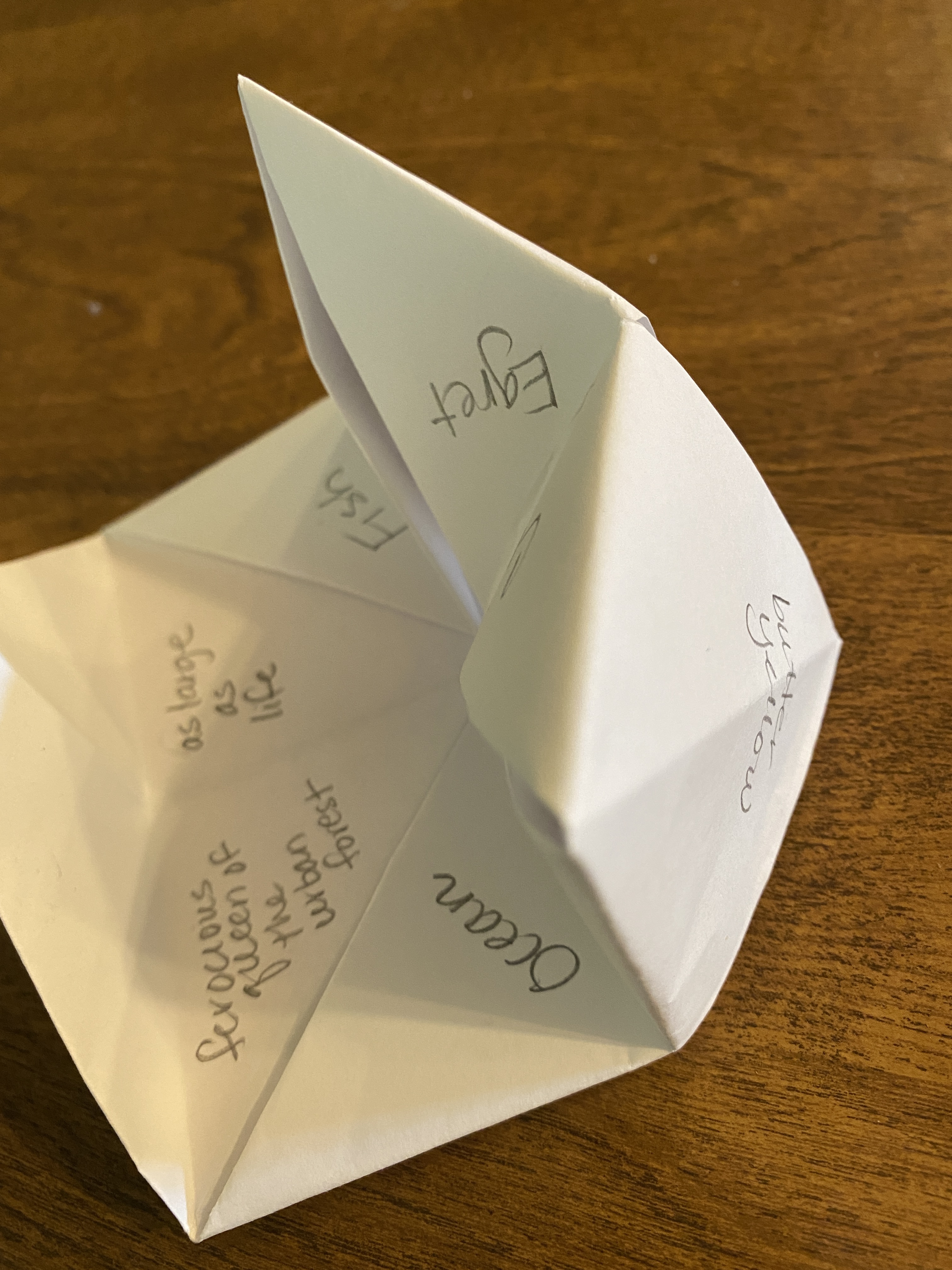
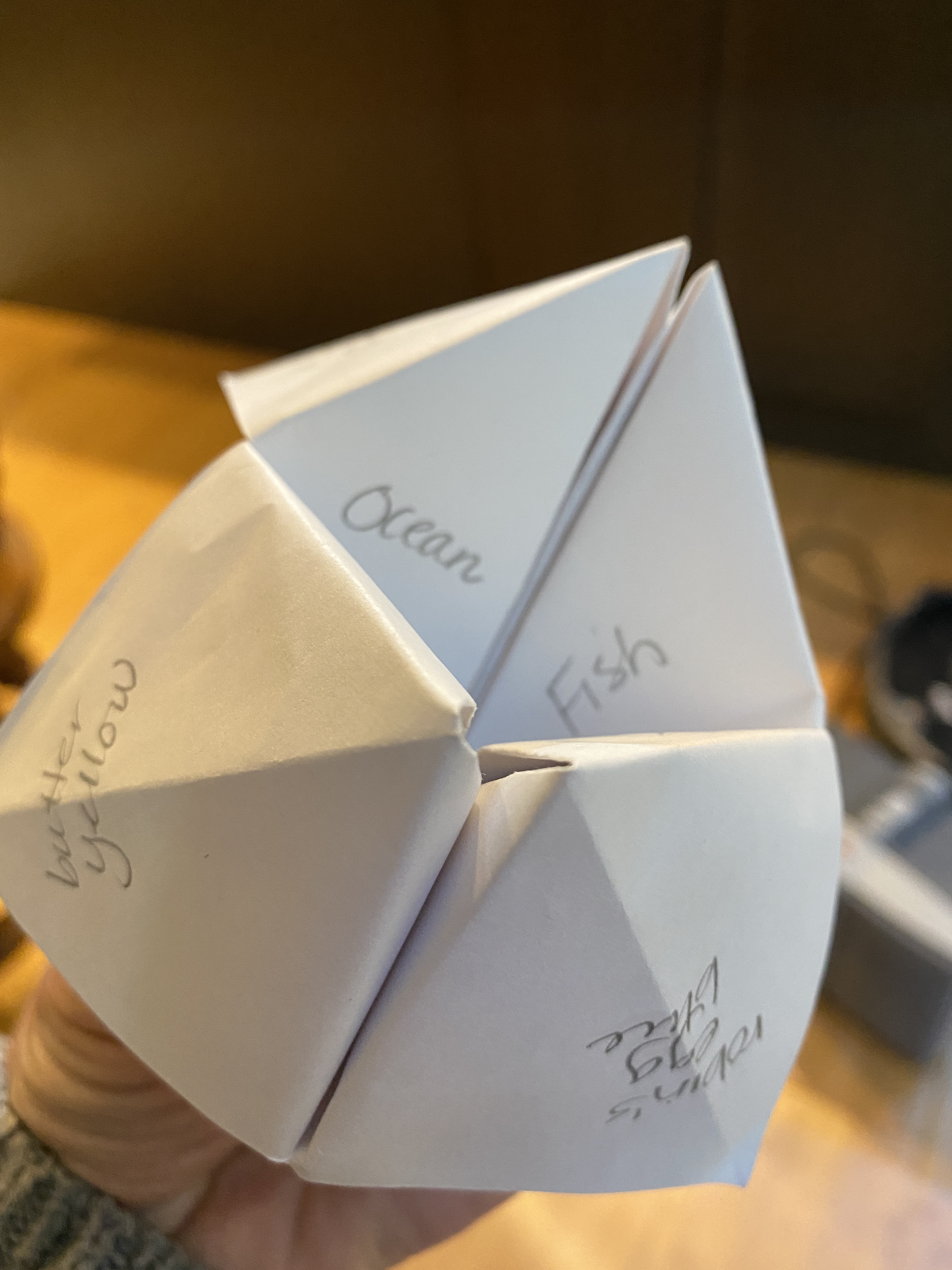
Earlier this week I read a post by a virtual friend, NomadWarMachine, who described her path to transforming the origami fortune teller of our youth into what she called a line of thought-une teller. I immediately knew that this would be a great activity to modify for my students as a culmination of our month of poetry writing.
My idea is to have my students mine their month of poetry, pulling colors, words, and poetic phrases to construct a poetry teller. Once constructed, I see it as a game where partners play the poetry teller to collect a set of words and phrases that they will then use to compose a version of a found poem that includes their words and those of their partner.
I experimented with my own poetry teller, playing this game with myself. I collected two phrases, two colors, and four nouns from my poetry. Then I worked to arrange and rearrange them into a new poem.
You can see my prototype poetry teller and resulting poem below.
I look forward to trying this out with students next week, I hope they find this to be a fun and generative way to look back at their own poems, collect some language from their peers, and have a meaningful activity to remix the two as they create new poetic compositions.
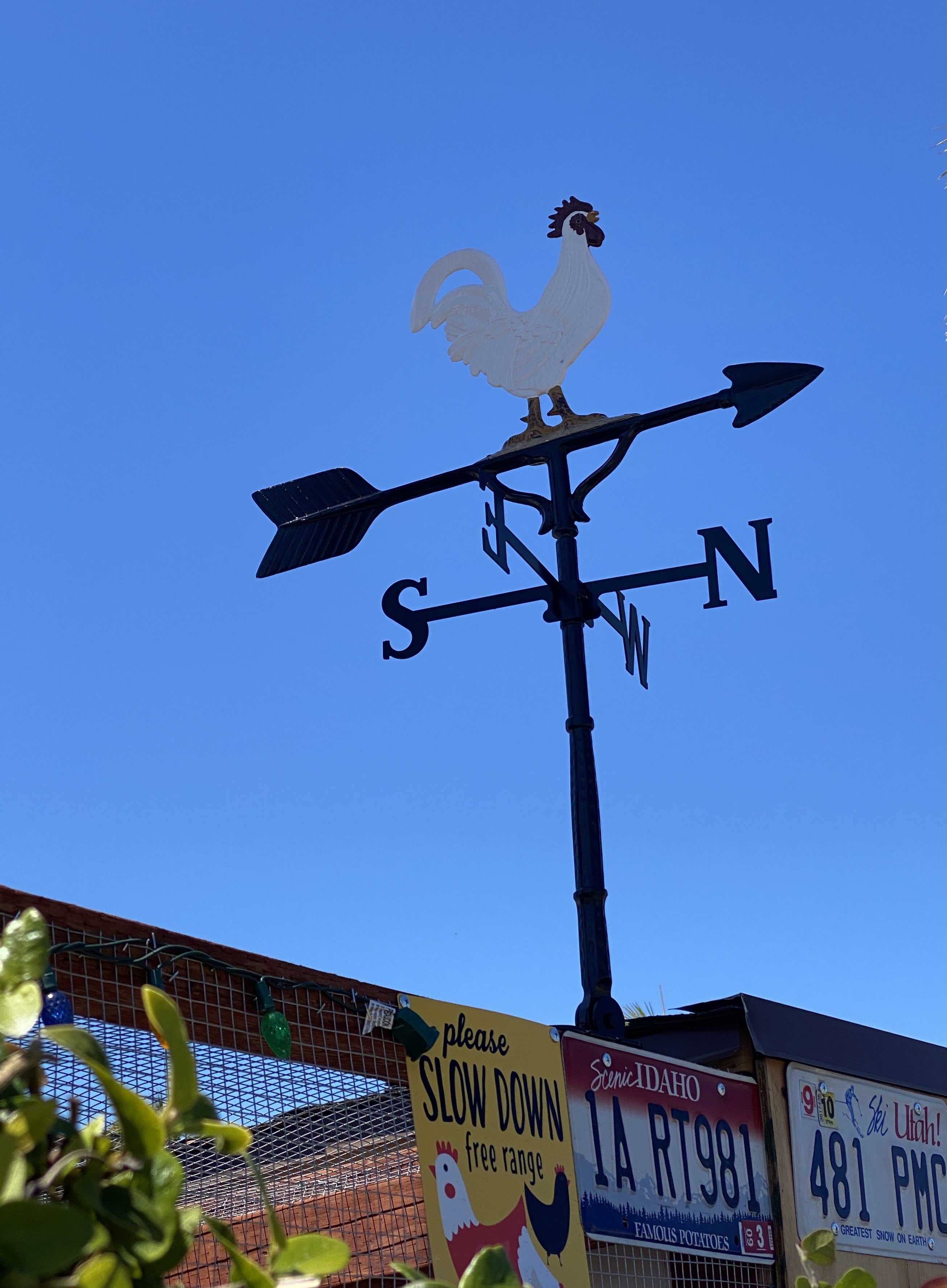
Back in March I wrote a slice of life about a new structure I had noticed behind a fence and hedge in my neighborhood. Today I noticed something new, which also became the subject for poem #29 (one day to go!).
Today we studied Francisco X Alarcon’s poem: Words are Bird as our mentor text. My students noticed that way words were described as birds, something that was new for them to think about. It took a bit of work and experimentation for the kids to find their own metaphors. Some that they came up with included: hand sanitizer is a warrior, trees are magical, and words are gum in your hair. I was a bit skeptical about that last one–and expressed that while I wouldn’t rule it out, it seemed like a difficult one to write for a word lover like me (and this student happens to be a word lover). While I don’t have the text in front of me to share with you all, let me tell you that she did manage it…in some interesting ways!
I may have taken the easy way out, writing my poem about poetry. Here’s the draft I wrote with my students today:
We continued our work with color and poetry today using Marilyn Singer’s poem Watercolors as our mentor text. Students loved the way she described black in such detail. I offered paint chips again today–some kids used them, some went in other directions.
My paint chips were the yellow tones of chamomile tea and the green of cabbage patch. Students had just been out in the garden when they came in to write. You can see that influence in my poem for today.





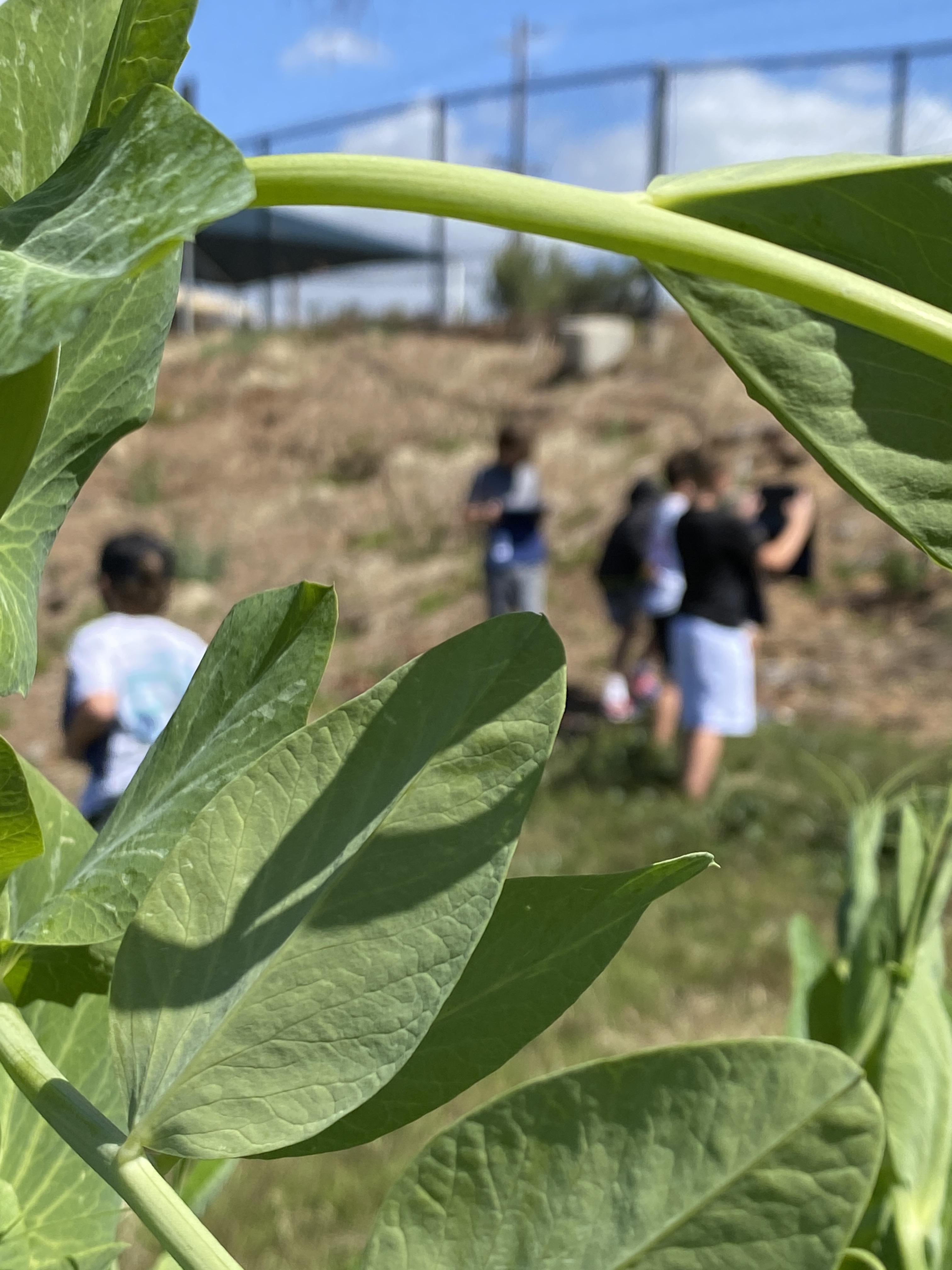
 Thinking Through My Lens