Playing with Postcards

It’s CLMOOC time…in fact it’s the break/brake week, meaning that without specific prompts or even general guidelines, I have been thinking about ways to make and connect.

There’s been lots of talk about the postcard project in the CLMOOC community (and by the way, if you haven’t stopped by yet, everyone is invited!) and I’ve been tempted to join the fun to send and receive (through snail mail) postcards to CLMOOC friends.  I knew I wanted to incorporate my photography into the process but hadn’t really worked that out yet. And then I saw a post on Teachers Write, a Facebook group focused on getting teachers writing in the summer, where Madelyn Rosenberg offered her version of a quick write called Postcards!

Earlier today I broke down and gave into my impulse to try out Prisma, a photo app that turns your photos into art (some of the effects are really cool!).  And then I buckled down and tried on Madelyn Rosenberg’s Postcards quick write strategy.  With words and an image, I headed over to Canva to combine the words and images.

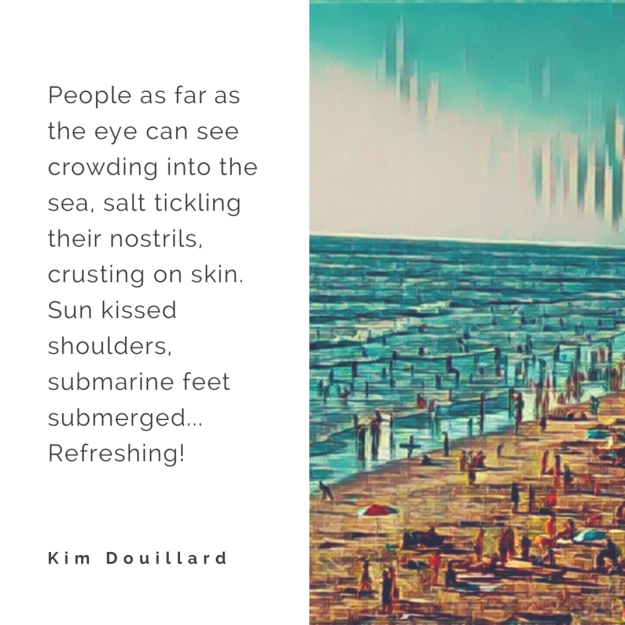
On Sunday my husband and I stopped by the beach around 6:30pm for a pre-sunset walk and I was amazed at how many people were in the water…still.  I took a photo from above the beach to try to capture the numbers of people in the water.

Combining my words with my photo, here’s my postcard:

img_2481

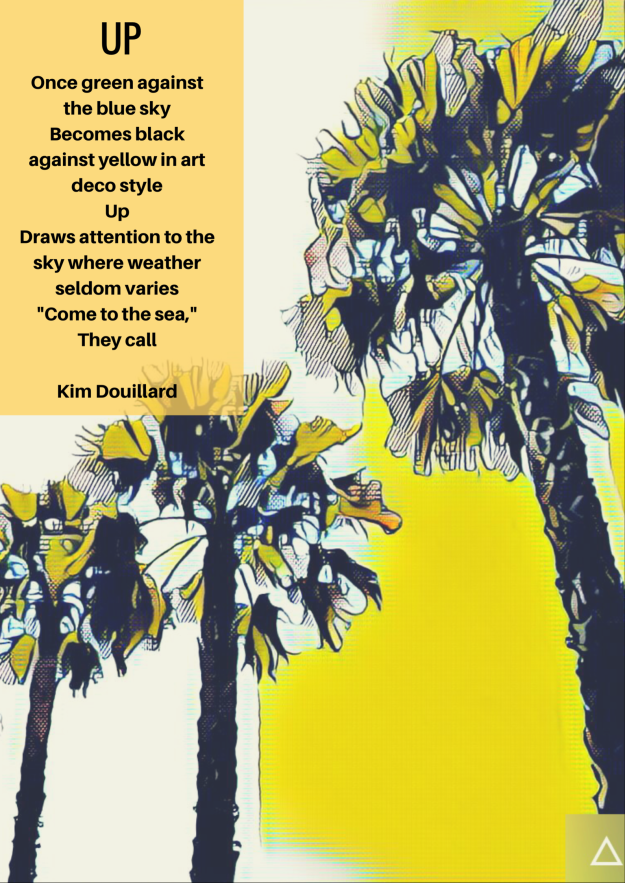
And who can resist beautiful, stately palm trees?  Of course I have taken many photos of them, so it was fun to transform my photo into something that looks kind of art deco to me (also in Prisma)…here’s my palm tree postcard:

img_2482

I think the re-imagined photographs and short form writing work well as postcards, so my next step will be to transform these digital postcards into analog postcards to address and slip into the mail…to surprise…someone!


Stories in Glass: Reflections on Making and Learning

Intense heat and human breath give shape to these vessels. Twirling, pinching, another breath, back into the fire, working and reworking until art emerges from what was once sand and rock. Is this what makes us human? The ability, the desire, the necessity to make…to create from the materials around us?

Evidence abounds, from cave paintings to stained glass creations, super-sized cloth installations that line valleys and islands and spray-painted graphics on the sides of railroad trestles and freeway overpasses. They all suggest a need to make and mark our world.

A visit to the Chihuly glass museum in Seattle served to pique my interest in this question of making and art. I love an art museum and had heard from others that this was a museum worth visiting. I had seen photos of glass art and had already visited a glass studio, just down the street from our favorite donut shop in Seattle. Yet, I was prepared to be underwhelmed, to see beautiful bowls and other vessels, delicate blown glass creations too pricey for my budget.

Instead, I walked into the first display and was mesmerized. My eyes were drawn to the white: shiny glass lighting up a dark room. Long stalks of lighted glass protruding like shoots from irregularly shaped bulbs. As in nature, the irregularities were an essential part of the beauty as this stalk curved, that bulb leaned. It was impossible to see where one piece ended and the reflection from the shiny black floor began, creating a sense of infinity that stretched the exhibit well beyond its actual size. This wasn’t a piece of blown glass that I was enticed to purchase, this was an installation of many glass pieces arranged and lit to create an effect. I was drawn to the description “…created by simultaneously blowing and pouring molten glass from a stepladder to the floor below…electrically charged by argon and mercury…” I stopped to take a picture or two, knowing that I would want to look at it and think about it again and again.
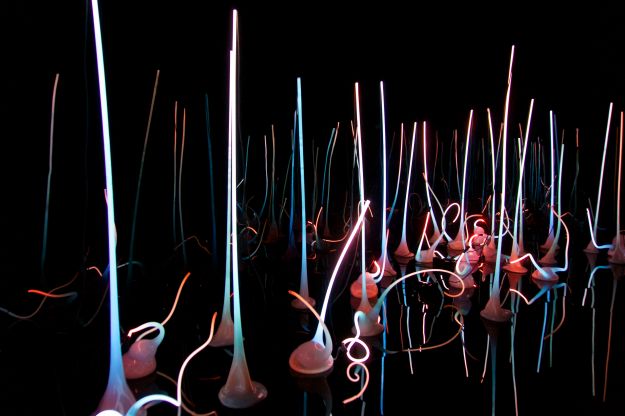
glass_white

I moved from space to space, now intensely curious about what each turn would offer. In one room an enormous sculpture twisted and curled to the ceiling; fish, octopi, and other sea creatures nestled within it. In another, the room was bare…until I looked up and found a glass ceiling filled with individual pieces that together created a stained-glass effect of intense color and variation. When did glass bowls and balls morph into something more: stories in glass, sweat, heat and breath?

I find myself thinking not just about the exhibits and sculptures, but about the maker and making behind the art. I’m a maker too. As a writer and blogger I use words to pull ideas closer so that I can think about them, poke and prod at them, turn them over and look under them, and invite others to look along with me. As a photographer, light becomes my medium to inscribe meaning through my camera lens. And I know that ideas in my head often don’t come out through my words or my lens in the ways I intend. But that, for me, is part of the allure…the seduction of making. I surprise myself with new understandings born from moving my fingers on the keyboard or ducking under the bench to get closer to the weed growing along the crack in the sidewalk.

I’m reminded of Seymore Papert and his theory of constructionism. In this theory, different from constructivism, learning happens when the learner is engaged in a personally meaningful activity outside of their head that makes the learning real and shareable. The activity could be making something tangible like a robot, a puppet, or a model bridge—or it can be something less concrete like a poem, a conversation, or a new hypothesis. What’s important is that the making come from the learner rather than being strictly imposed and directed from the outside (from a teacher or an employer). This element of choice and ownership often propels the maker to tinker and improve their make to meet their own criteria for better, allowing for reflection and reworking based on that reflection. This self-directed making can be a challenge in the classroom.

Traditionally it is teachers who direct and make decisions about student learning. So it’s important to create spaces that allow students to see possibilities beyond their own experiences, yet still offer choice and opportunity for experimentation and iteration. Chihuly’s first experience with glass blowing came from a college classroom assignment that required him to incorporate a nontraditional, non fabric material into a weaving. He wasn’t directed to use glass, but may not have experimented with glass without the constraints and possibilities of the assignment.

Making is about transformation. Transformation of materials, like glass or words, or images through a lens. It is also about transformation of thinking and ideas. And it begins in playfulness. Mitch Resnick of the MIT media lab describes a cycle of learning (and making) based on his observation of young children. Beginning with imagination and spiraling out to creating, children make and learn based on their ideas. As they play with their creations and share the ideas and creations with others, they have opportunities for iteration and reflection on their experiences, which leads them back again to imagine new ideas and new projects to work on or ways to improve their original idea.

I could see this in Chihuly’s glass creations. Elements of one sculpture showed up in new ways in another, chandeliers hanging from ceilings in one display turned into bigger and more elaborate free standing sculptural elements in another. And yet, each also showed new thinking—about color, about translucence and light, about placement and size, about cultural references and interactions with the larger world. I watched a few videos that included Chihuly’s reflection on his work where he talked about how his experience with a particular exhibit gives him vision for the next. I was particularly interested in the garden beneath the Space Needle in Seattle and its origins. I learned that this space, formerly a parking lot, was a blank canvas for Chihuly, something he—in collaboration with the landscape architect—could transform to allow others to see the beauty of his hometown in new ways, to expand their experience beyond the glass into the fairyland where light and glass and flowers and bees play with the backdrop of Mount Ranier and the Space Needle. Chihuly’s reflective videos helped me see and understand the spiral of experience and design and how it propeled him to new ideas and new thinking about his chosen media.

Photography is like that for me. I find myself looking at my world through the lens of my camera, and instead of limiting my view, the lens draws my attention to details of light and shadow. I see the variation of blues in the ocean waves and the foamy white of the lacey breakwaters. The white head of the bald eagle catches my attention and I watch, rapt, as it dives and swoops and then soars into the trees. I have many photos that are not taken, where I’ve missed the moment because I moved too slowly, had the wrong lens in place, or simply had to stop and wait and watch. But those missed photos become inspiration and information for tomorrow’s attempts. As I imagine, make, share and reflect, new thinking emerges and my understandings transform.

I want this for my students too. Opportunities to make and create new understandings, to transform the world as we know it. Learning, like blowing glass, needs to nestle close to the flame—the flame of needing and wanting to know and understand—and then the learner takes a breath and blows out and maybe even includes the breath of another to add dimension, depth, and diversity. Learning needs to be shaped by the learner, to expand beyond basic facts and figures and matter in the world, and in the world of the learner. Learning needs space for reflection and nudging from co-learners and outsiders—and teachers and employers—to expand the realm of the possible. Maybe we need a museum for visitors so they can walk through the breathtaking beauty of learning at the hands of those who learn best: children.

Rather than pushing children to think more like adults, we might do better to remember that they are great learners and to try harder to be more like them. –Seymore Papert

Weekly Photo Challenge: Staycation

Sometimes I long for exotic vacations, opportunities to explore places I have never been.  I imagine wandering through iconic museums, looking up at skylines made familiar through movies and artwork, and a peek at a way of life different from my own.  And then I remember that I live in a pretty special place–one that is exotic for others!

Today I had a rare day off and set off with my mother, my sister and my niece to enjoy a wonderful staycation day.  We headed off to Coronado–best known for the Hotel Del Coronado (a historic, high-priced beachside hotel), a naval station (North Island), and miles of exquisite beaches.  Locals call it an island and mostly access it by driving across the iconic Coronado Bay Bridge, a curving stretch with breathtaking views of the bay and the San Diego skyline, but it is actually a peninsula.

We walked and walked, feet in the cool water while the sun (even pretty early in the morning) warmed our shoulders.  We noticed some posts in the distance and found the fence that separates the public beach from the Naval Air Station.

img_2425

We also found that this far end of the beach was designated as a dog beach and the dogs were loving the water today.  They chased and retrieved balls and chased and played with each other. There were dogs of all shapes and sizes, and like people, they seemed relaxed and happy as they played along the shore.  They were obviously enjoying their own staycation!

img_2427

After lunch at El Indio, a favorite San Diego Mexican restaurant, we decided to head to Old Town.  I can’t remember the last time I explored this part of our city.  It was HOT today, so the cool greens of the beautiful botanical art sculptures were soothing to the eye.  I love the way the plants were a growing changing part of the art piece.  (This is a full body, taller than me piece…but I was drawn to the face and the juxtaposition of light and shadow.)

img_2436

Earlier in the week, as a part of our Summer Institute, we took folks out around the UCSD campus for a writing marathon.  This University of California campus is a jewel, filled with natural beauty and with interesting art installations called the Stuart Collection.  As we visited different parts of the campus, we took time to study the art, consider it in relation to our own thinking after nearly four weeks together, and wrote.  We started with this piece by Michael Asher.  As often as I have been on this campus (weekly for years) and have walked past this piece, I never knew it was an art installation.  This ordinary looking water fountain is made of polished granite to look (and function) exactly like the metal ones we are used to seeing.  I find myself still thinking about its placement, its ordinariness, and wondering how it ended up in the UCSD collection–and I know I will never look at it in the same way as I did in the past.

img_2405

And then we headed off to another piece in the Stuart Collection–the whimsical, enormous engineering feat that is Bear by Tim Hawkinson. Made of local boulders, this bear stands more than 23 feet tall in a courtyard formed by three engineering buildings. This piece is a favorite of our young writers, an enormous reminder of childhood.

snapseed

So consider a staycation in your place.  What sights and sounds will capture your imagination?  What might others see as exotic?  Or how might you see your local place in new ways?

You can post your photo alone or along with some words: commentary, a story, a poem…maybe even a song! I love to study the photographs that others’ take and think about how I can use a technique, an angle, or their inspiration to try something new in my own photography. (I love a great mentor text…or mentor photo, in this case!) I share my photography and writing on social media. You can find me on Instagram and Twitter using @kd0602. If you share your photos and writing on social media too, please let me know so I can follow and see what you are doing. To help our Weekly Photo community find each other, use the hashtag #staycation for this week and include @nwpianthology in your post.

Share your place with us this week, taking us on a #staycation journey with you.  What hidden treasures will you uncover when you vacation (even for a few minutes) right at home?

Making Writers

Sometimes writing feels like standing all alone in the fog–shivering in the damp–uncomfortable and vulnerable, waiting for the worst.

img_2284-1

But it doesn’t have to be that way.

Writers write best in a supportive community, in a place where attempts are celebrated and seeds are planted–some intentionally and carefully like those meticulously cultivated gardens and some flung far and wide like dandelion seeds floating in the wind.

dandelion seed

And writers also need to play and break the rules, find their own voice in the cacophony of others.  Occasionally they need a nudge to take those carefully stacked plates and push them over, flinging the words here and there, then gathering them again to make meaning of the shards of ideas uncovered in the process.

IMG_7754

Sometimes writers need to lean in close, breathe in the sweet scent of what it means to create new life as ideas emerge from words rubbed together.

img_9905

At other times, writers need to step back and take in the long view.  What new understandings reveal themselves when you look from the heights, from places you hadn’t dare stand before? Writing can be a process of discovery, exploring new territory or old territory from new perspectives.

DSC06678

Writers need inspiration, sparks that send them on wild chases and deep digs.  And to be inspired, writers must open themselves–listen carefully, look widely, pay attention to the mundane, and seek out the ordinary. Nothing is too lowly to inspire words and ideas. Consider even the cat, asleep, with its head in a box.

img_1895

But mostly, writers need to trust that they have something to say–to themselves, to their neighbors, to readers and other writers.  They have to trust that words matter, thoughts matter, and the world matters.  They must want to write, and need to writer, but most of all, they actually have to do that thing that so many resist, and WRITE!

IMG_7306

If you want to make a writer.

***Note:  This piece was inspired by the article Hey Matt by Molly Toussant where she writes about her beliefs about teaching writing.  This piece was created as a “found photo essay” inspired by a peek at my media library as a way to think about writing and writing instruction.


Poetry Play

We challenged the SDAWP SI folks to transmediate their own writing by adding sound and/or animation.  And that meant that I had to figure it out too!  I know I am most comfortable with still photographs and words, so this pushed me out of my comfort zone.  After some frustrating attempts at other applications, I turned to iMovie for my make.  I used my original photos along with a couple others had taken of our group, added a poem I wrote on yesterday’s writing marathon around the UCSD campus, and then recorded my voice.

Here’s my first attempt:

I am wishing that I had taken some video on the writing marathon to add some other texture to the piece. What suggestions would you make to improve this piece?

Weekly Photo Challenge: Sound

I tend to be drawn to silence, those quiet spaces where my mind can wander while my feet move. But it’s summer in San Diego, crowds gather and space becomes a premium.  The sounds of the waves are dwarfed by the screams of delight as kids rush into the cool, salty waves, families laughing and talking over chips and sandwiches, and the loudspeaker of the lifeguards reminding swimmers to stay in the zones deemed safe from the dangerous rip currents.

img_2287

But early in the morning, the quiet remains. The beach is mostly empty, wide open for exploration and introspection. Damp morning air kisses my cheeks as my feet delight in the almost warm summer surf.  (I did say almost–probably not warmer than 68 degrees!)

img_2253

I notice others who revel in the sounds of the morning beach too. A seagull tucks his head as I appreciate the mirror-like effect of the wet sand.

img_2284-1

I wonder about the sounds the surfers hear as they ride the waves.  Are their ears filled with the whoosh and roar of waves and water?  Or is there an exquisite quiet that happens when the waves wash away sounds from the shore?

img_2266

img_2261

And what is the sound of dilemma?  Rock or surf or smile?  You pick which direction to head!

snapseed-1

I can hear the sounds of conversation in these windows, fun artistic silhouettes I found in these warehouse buildings.

img_2323

So…take a look around for sounds.  Sounds of silence, of delight, of pain, of loneliness, of summer–you decide.

You can post your photo alone or along with some words: commentary, a story, a poem…maybe even a song! I love to study the photographs that others’ take and think about how I can use a technique, an angle, or their inspiration to try something new in my own photography. (I love a great mentor text…or mentor photo, in this case!) I share my photography and writing on social media. You can find me on Instagram and Twitter using @kd0602. If you share your photos and writing on social media too, please let me know so I can follow and see what you are doing. To help our Weekly Photo community find each other, use the hashtag #sound for this week and include @nwpianthology in your post.

Listen with your eyes this week–what sounds do you hear and how will you represent them in your photographs?  Be sure to share…I can’t wait to hear your sounds with my eyes!

Weekly Photo Challenge: Appreciating the Ordinary

Some weeks just don’t lend themselves to extraordinary photography. Now I’m not complaining about my week–it’s been fun and busy, with lots of writing and thinking as we complete week two of our 4-week SDAWP Summer Institute.

Sunsets are not always a sure thing here on the coast–night and morning low clouds can interfere with sun sightings.  Last weekend, we decided to risk it and headed to the beach near sunset.  We were treated to some pretty orange as the sun dipped low.  If you look closely you might noticed the pelicans in the upper left corner flying through the frame.

img_2190

It’s not unusual to see these flying billboards–banners attached to small planes that buzz the coastline mostly advertising alcoholic beverages.  I noticed these two different planes flying by and saw that they would cross paths right overhead.  They were not dangerously close, but I’m glad they were paying attention to each other!

img_2200

We’re pretty fortunate that the beach we frequent is mostly free of garbage in spite of the heavy usage, especially in the summer.  Balloon trash is pervasive though.  This balloon looks to have been around for awhile–with most of the words worn off.  The #Litterati movement (and my friend Janis) reminds us to pick up trash where we find it and dispose of it properly.  I love the sky and the sea in this unfiltered photo, there’s something about the clouds and the sea foam of the waves that creates a texture and an echo.

img_2196

The walk from the parking lot to the building where the SI takes place each day can be both ordinary and interesting.  I noticed these two small orange birds as they perched on the sign near the sidewalk where I walk. Using the app Colorsplash, I turned the photo to black and white and then allowed the bird color to remain in my hopes of highlighting them.

img_2216

I was reminded of the power of nature…even just a tree in a parking lot…to affect my mood.  Rachel Carson’s quote captures the jolt of strength and sense of oasis that I experience when I look up through the leaves of the tree.

“Those who contemplate the beauty of the earth find reserves of strength that will endure as long as life lasts. There is something infinitely healing in the repeated refrains of nature—the assurance that dawn comes after night, and spring after winter.”
— Rachel Carson

img_2228

The practice of noticing makes an incredible difference in my life.  The photos I take capture only a fraction of what I notice, and noticing helps me appreciate the little things in the ordinariness of my life. So take a look around, how might you view the ordinary in new and more appreciative ways?

You can post your photo alone or along with some words: commentary, a story, a poem…maybe even a song! I love to study the photographs that others’ take and think about how I can use a technique, an angle, or their inspiration to try something new in my own photography. (I love a great mentor text…or mentor photo, in this case!) I share my photography and writing on social media. You can find me on Instagram and Twitter using @kd0602. If you share your photos and writing on social media too, please let me know so I can follow and see what you are doing. To help our Weekly Photo community find each other, use the hashtag #ordinary for this week and include @nwpianthology in your post.

What will you find when you pause to appreciate the ordinary?  I can’t wait to find out!