Some Thoughts on Digital Learning: #Leadership Day 2013

Scott McLeod over at Dangerously ! Irrelevant is celebrating the 7th anniversary of his blog today and inviting educators to share views on effective school technology leadership on what he calls Leadership Day 2013.

In lots of way I have been fortunate in my district with technology–our administrators employ a person to provide tech support to troubleshoot problems, send me to trainings if I ask to go, and trust me to figure out what is best for my students.  But I would say that those conditions are not enough to ensure participation of teachers who feel less confident with digital literacy and need more direction and support to implement robust technology use in their classrooms.

But instead of saying just how to support these teachers, in this post I will talk about the pieces of technology leadership that I feel are most often overlooked.  They are two very different but very important aspects of digital literacy:

  • Consideration of the impact of technology on student learning
  • Leadership by example by being a user of digital tools

Consideration of the Impact of Technology on Student Learning

There seems to be lots of attention to hardware decisions in education–Macs or PCs, tablets or chrome books, smart boards, document cameras…  The list goes on.  And there’s lots of attention to software and applications and how technology supports teachers–ease of grading, presentation tools, record keeping…  What is missing for me are meaningful conversations about the ways technology and digital literacy impact student learning.  Instead of asking each other what apps to use on classroom iPads, I think we need to ask how digital tools support student learning.  How can students transform information in ways that make it relevant and meaningful–and accessible in novel situations?  Instead of deciding between Evernote and Notability, we need to have conversations about how and why students will use this type of application–and it probably doesn’t matter which you choose if you have reasons that support student learning.

Leadership by Example by Being a User of Digital Tools

What I notice from my own Professional Learning Network (PLN) on Twitter is that educators who are thinking about the ways digital tools impact student learning are also actively using digital tools for their own learning.  They are blogging about their professional learning, tweeting articles and links about research and thinking about digital tools, they are experimenting with new ways to represent their own learning with video, digital photography, infographics, and other digital tools, and they are actively learning with and from other educators trying similar tools.   I do see a few administrators and district leaders joining in this effort–and it seems that those who do have a bigger impact on the implementation of technology in their districts. The more district leaders use digital tools themselves, the better positioned they are to understand the benefits and challenges of them–and the potential implementation possibilities for use with students.

Our students will be using digital tools–they are pervasive in our lives.  Our question as educators is how do we use these tools to support our students’ learning…and help our students (and ourselves) see and use these technologies in ways that make us all more thoughtful, efficient, and productive?  Leadership is essential to successful implementation.  I hope my suggestions give some food for thought for those in leadership positions for the implementation of technology in education.

Poster Poems, Found Poetry: Remixed

One of my fellow #clmooc-ers, Vanessa Vaile, posted this invitation in the G+ community to remix, hack, create found poetry…and it’s been sitting in the back of my mind, waiting for the opportunity to find its place on my blog.

This morning the twittersphere handed my this poem and it has stayed with me all day, begging me to think about ways to remix and recreate and combine it with my photography.

The World Is in Pencil

BY TODD BOSS

—not pen. It’s got
that same silken
dust about it, doesn’t it,
that same sense of
having been roughed
onto paper even
as it was planned.
It had to be a labor
of love. It must’ve
taken its author some
time, some shove.
I’ll bet it felt good
in the hand—the o

of the ocean, and

the and and the and

of the land.

Source: Poetry (November 2011).

And so, here is my remixed version:
The World Is in Pencil: Remixed
Pencil in the ocean
and the land
Authored with labor
roughed by silken dust.
Love it
shove it
take time
to feel, to handle
Until you can see
as if it was planned
the world 
inked on paper.
A map of your life.
photo
This photo was also remixed.  Taking a photo I took earlier this week,
I wanted to create a sense of pencil and sketch, roughed and labored.
I used the app Sketch on my iPhone to create this effect.
Here is the original:
photo-1
Try your hand at found poetry…I invite you to remix mine or find
something that speaks to you.  How might you remix a photo or
other image to go with it?  Be sure to share!

One Shot, Two Ways…Revision, Photo Style

One of the benefits of blogging is that other people like and follow my blog…and when they do that I often take a glimpse at what they are blogging about–it’s a lot like my experience with the CLMOOC.  Yesterday shotwithmyphone.com liked my blog post and I spent some time perusing the photos he posts…all shot with his iPhone (like me!).  One of his posts was titled One Shot, Two Ways and is part of a challenge posted here.  The challenge invites photographers to take two photos of the same shot–one with a vertical orientation and one with a horizontal orientation and to post them side by side.

Inspired by those ideas (and looking at a few photos) I decided to try a variation on that theme and show two views of the same photo–one original and one with some editing and filters applied.  In some ways the editing process I apply to my photos feels a lot like revision in the writing process.  It’s the part of the process where I zoom in (or out), crop out distracting details, brighten up the setting, or change the mood.  In many cases, revision in writing and editing in photography transforms the end product and helps the reader/viewer see it differently.

Here’s are a couple from my beach walk on Sunday:

photo-12pipe

photo-10turtle

And here’s a couple from yesterday’s excursion to the Living Coast Discovery Center:

photo-13photo-14

photo-11photo-1

There are times when I post my photos without editing, but I like experimenting with how to take a photo and work with it to convey the message I have in mind–or one that emerges as I play with it.

What do you think?  How does the editing change the way you see the photo?  How does it change the message of the image?  How does this relate to writing and writing instruction?  I’d love to know your thoughts!

A #Macro View of San Diego Natives

I’m lucky to live in a beautiful city–a place where I don’t even have to say the name of my state for people to know where I’m from.  Many people I meet have either visited or know someone (often a relative) who lives here.  But despite that familiarity, there are many misconceptions about San Diego.  So many people expect it to be tropical–like Hawaii or Tahiti–and are surprised when they come in contact with our pervasive marine layer, moderate temperatures (low 60’s in the winter to mid 70’s in the summer with occasional higher and lower temps), and low humidity (we average about 10 inches of rain annually).

San Diego skyline from the Coronado Bay Bridge

San Diego skyline from the Coronado Bay Bridge

Our beautiful skyline and beaches are often framed with tall swaying palms (not native) and colorful hibiscus flowers (also not native).  Many species of plants grow well here–especially when supported by providing extra water.  Today I vacationed in my own city, taking a trip to Chula Vista to visit the Living Coast Discovery Center (formerly the Chula Vista Nature Center). Located in the wetlands along the San Diego Bay, the center boasts a rich history.  Once the domain of the local Kumeyaay people, around the turn of the century this location became a kelp processing plant run by the Hercules Powder Company extracting potash and acetone from the kelp to make cordite–an explosive used for fuses during World War I.  After the war, abandoned buildings were taken over by the San Diego Oil Products Corporation and became the largest cottonseed warehouse in the United States.  Later it became farmland and after that a site of illegal dumping.  In 1980’s the city of Chula Vista helped develop the site into the Chula Vista Nature Center.

As you can see appreciation of our local habitats has not always been a given, even among the local population.  We love our beaches and our mild climate, but haven’t always taken the time to understand how to best care for or learn about them.  Today, with the help of my macro lens on my iPhone, I spent time looking closely at some of the native plants of San Diego.

The coastal sage scrub community, which grows around our wetlands near the coast, is filled with hearty, drought resistant plants.  In the summer many of them look dry and brown.  Some might even conclude that they are dead…but just wait until some rain falls…

I noticed today that some of the most beautiful blooms are tiny…often unnoticed unless you take the time to bend down and really look closely.  Here’s some of the beauties I uncovered today, all taken with my iPhone and macro lens with no filters applied.

I wish I knew the names of all of these plants.  I admire the resilience and adaptations of these hearty natives and know that I will continue to learn about them.  It’s so easy to overlook these plants and be mesmerized by the exotic beauty of other more colorful species.  I hope you’ll see what I saw when I took the time to look closely–that there is much to appreciate about these natives, you just have to come close and notice what is right in front of you!  (Yet another lesson for my classroom…look for the talents and expertise that are not immediately obvious, but there nevertheless!)

Beach Curves: A Photo Essay

Summers are always busy for me…but this summer has been busy in extreme!  Between Geoff’s schedule and mine, we haven’t found time for a traditional, go someplace, kind of vacation.  Instead, we have had to grab vacation time wherever we could find it.  Today was one of those kinds of days…and we squeezed in a fun and relaxing one-hour vacation at the beach.

It was sunny and warm today…and the ocean water was on the warm side too…perfect conditions for a summer beach walk.  The marine layer stayed off the coast and we got there early enough that parking was easy!  We had just had a lovely breakfast at one of our favorite local haunts and were ready to walk and talk (or not)…and as always is true of me these days, take a few photos along the way.  This week’s #sdawpphotovoices theme has been curves, so I was on the lookout for curves on the beach.

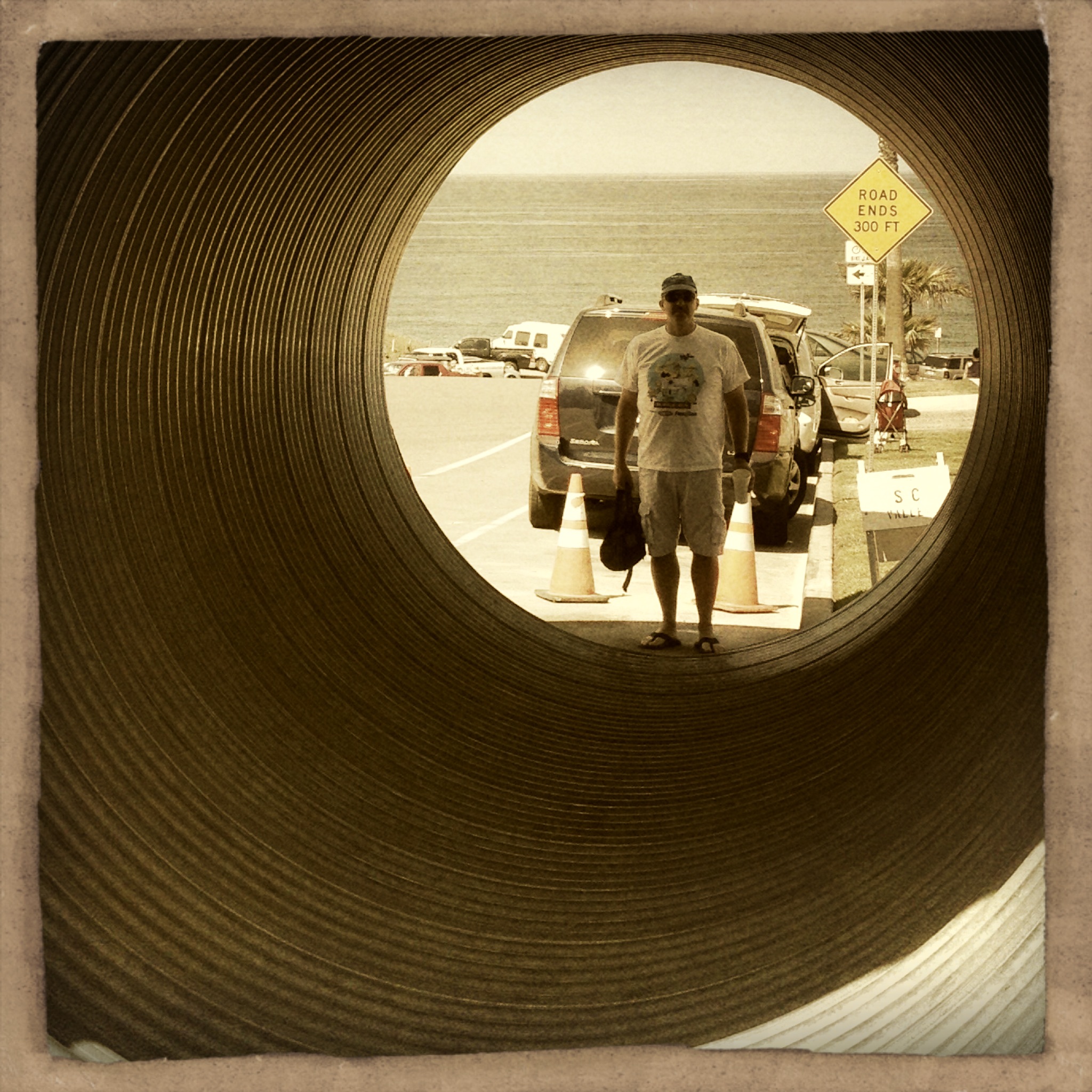
When we parked, the very first thing I noticed was this giant pipe on the street and immediately headed over to take a picture.  I got Geoff to stand at the other end so its size would be noticeable–and I love the way the curve also becomes a frame for the portrait.

pipe

As we headed down to the shoreline, the tide was approaching high.  This can be a limiting factor for how far we can go, so today we headed north.  The waves were small, but the surfers and boogie boarders seemed to be having great success catching the curves and enjoying their rides.

waves

Curves seemed to be everywhere.  Erosion is a major issue along our local shoreline.  The northern walk takes us below expensive homes that seem precariously perched above the beach.  One section was still barricaded with yellow caution tape…and the crack we had seen a month ago seemed more pronounced today as it curves along the layers of sediment that make up the sea cliffs.

crack

Giant kelp, which my students know by it’s scientific name Macrocystis Pyrifera, is a constant on our local beaches.  Piles are evident as it washes up along the shore.  Holdfasts, the rootlike structure that hold onto rocks in the water, are home to many fascinating sea creatures and we often see locals rummaging in these wet piles and finding brittle stars and tiny sea urchins hiding within and enjoying a close look before returning them to their wet and salty homes. The long stipes frequently form tangled webs although this one reached out in a gentle curve away from the rest of the pile on the sand.

kelp

Sand castle makers have been hard at work this summer.  I passed this creation and just had to stop and get close for a photo.

turtle

I love this turtle version of a sand castle with its curved head, shell and limbs…and the extra touch of bucket-molded sand on the top.  Ocean washed rocks became eyes and the proximity of the kelp seems like a perfect touch!

I was surprised to find this coconut laying in the surf.  It had clearly spent some time being washed and worn by the sea, not quite round but definitely curved.  Had me thinking of Tom Hanks in Cast Away.

coconut

There were quite a few holes dug with curved banks that began to hold pools of seawater as the tide continued to rise.  I took a few pictures of the water in the holes and then stopped to wait to see if I could capture the waves coming over the bank to fill the hole.  I love the sense of movement this still photo captured.

hole

And then before finishing my walk, I came across another yet another sand castle.  This one in more classic style with a moat, some bridges and curved turrets, and stones and shells for decoration.

castle

I love the way #sdawpphotovoices themes focuses my attention and helps me see familiar places in new ways.  My one-hour vacation was relaxing and exotic!  The photos represent only a fraction of the curves I saw at the beach…and yet give a glimpse at the variety of curves along the shore.  Tomorrow begins angles…I can only imagine what I will find as I look at the world through that lens.

10 Picture Books on August 10th

I’ve done a couple of recent posts about mentor texts I use in my classroom and recently I noticed a challenge by some other teachers about a Picture Book 10 for 10 Challenge.  #pb10for10  Their invitation is to share ten picture books you can’t live without on August 10th.  So today is August 10th…and my picture books are all in my classroom.

I had almost abandoned the idea of sharing my picture book favorites since I don’t have easy access to them today.  But then I spent the morning with my SDAWP colleagues at UCSD thinking about complex texts–both reading and writing–which led me to think about the ways I use texts in combination in the classroom.  So I started thinking about some of favorite picture books for the classroom…and how I often layer books to create more complexity and deeper meaning with my students.  These books come from the top of head (with the help of the web to sort out the actual titles and authors)…you don’t get pictures or excerpts…just what I can remember!

photo

I’ll start with a few that I used with my students to examine abstract concepts.  Most of them use the idea of color in different and interesting ways.

1.  The Other Way to Listen by Byrd Baylor:  This book is a gem (like most of the others by this author).  I love the way she describes colors using senses other than sight.  I wish I had my book handy to include an excerpt!  Read it — you won’t be disappointed!

2.  The Black Book of Colors by Menena Cottin:  This book, all in black in white, is gorgeous!  The use of texture and Braille add a fresh dimension to this book…and reinforces the need to use powerful sensory language in descriptions.

3.  The Sound of Colors by Jimmy Liao:  This book describes the experience of a blind girl as she travels in the New York subway system.  Imagination takes the girl on a powerful journey. What do you experience when you aren’t able to see?

4.  The Colors of Us by Karen Katz:  This books offers way to describe the colors of our skin in beautiful and appreciative ways.

5.  What Does Peace Feel Like? by Vladimir Rudunsky:  This book is a collection of similes and metaphors from students describing peace–helping to bring some concreteness to this big and abstract concept.

6.  If… by Sarah Perry:  This books takes a fanciful journey into the imagination and invites students to imagine if worms had wheels and other fanciful and surrealistic ideas.

And I also love books that are about math and nature.  Two more favorites that I used this past year to support my students’ understanding of the Fibonacci sequence and its appearance in the natural world.

7.  Wild Fibonacci: Nature’s Secret Code Revealed by Joy N. Hulme:  This book explores the appearance of Fibonacci numbers in the natural world–mostly focusing on the spiral.

8.  Swirl by Swirl: Spirals in Nature by  Joyce Sidman:  This book is another look at Fibonacci’s sequence and spirals using spectacular illustrations.

And to round out my ten, two other books I purchased this summer and intend to use with students this year.

9.  One Hen by Katie Smith Milway:  A book about micro loans and how small investments can make a huge difference in someone’s life.

And one more math and science focused book

10.  Dave’s Down-to-Earth Rock Shop by Stuart J. Murphy;  This book combines geology and classification as the characters devise new ways to sort and display their rock collection.

I look forward to seeing what picture books other people love.  I’m always looking for new books to inspire my students’ thinking and to help them understand complex concepts.  I’m especially interested in those hidden treasures that somehow don’t get the attention of the large bookstore chains…and yet have wonderful content, language, and illustrations.  What picture books do you love?

Condor’s Egg: #113texts

Jonathan London is probably best known in children’s book circles as the author of the Froggy books, but he has many wonderful books that are varied in content and well written.  I mentioned Dream Weaver a couple of days ago as my contribution to the #113texts Mentor Text Challenge.  Today I want to tell you a bit about Condor’s Egg by Jonathan London.

photo

Condor’s Egg is a realistic story about a family of California Condors in the wild.  As is typical with London, the language is lyrical and carefully chosen.  His use of verbs evokes movement and creates a sense of action.  And as an added bonus, there is factual information about California Condors at the end of the book as well as a guide to using the book with children.

During the 2012-13 school year, after reading the book as part of our study of birds, we used a number of sentences from this book as mentor sentences for our students to study and then to replicate with their own content.

Here’s one sentence we studied: Circling, he rides the warm air, higher than the tops of the clouds. This is a tricky construction with the main part of the sentence between the parentheses where extra information is often deposited.

T (a second grader) created this sentence–a close approximation:  Roaring, they start their engines, then the drivers shoot off the starting line.

J (another second grader) came up with this one:  Building, Steve builds a square house, nice and safe!

Here’s one from a first grader (Okay–I know it’s not fair–this is a talented writer!): Running, she goes through the house as fast as she can, trying to get away from the pretend monster.

And here’s one more second grader: Diving, she is determined to catch it, landing on the dusty floor of the canyon.

We used many sentences from this book and explored creating our own sentences following the pattern of London’s sentences.  By doing this my students had opportunities to try out new sentence structures, which later showed up in their own writing.

I was thinking about the Jonathan London titles that I use…here’s a few:

  • Dream Weaver
  • Condor’s Egg
  • Puddles
  • The Waterfall
  • Like Butter on Pancakes

How have you used London’s books?  What titles do you like?

A Summer of Making: Reflections on CLMOOC

If you’ve been reading my blog at all you know that I participated in something called the CLMOOC this summer.  The Connected Learning Massive Open Online Collaboration was an opportunity to experiment with the principles that underlie Connected Learning.  This short video gives some more information or check the link above.

http://vimeo.com/49645115

When I originally signed up to participate in the MOOC I thought I would stay on the fringes, read what others posted, and think about how the participants interacted.  I knew I would be time challenged, after all I would be facilitating the SDAWP Summer Institute during the bulk of the MOOC.  But somehow, I was quickly drawn into action.  I used my photo-a-day work as my introduction and posted a couple of photos.  Immediately I began to get feedback, comments, and links to others’ work with a similar focus…I was hooked!  Then came the #vineoffmonday. I was already playing with Vine and with Instagram video, so it was fun to see what others were doing.  I loved Kevin’s invitation to make a seven second story and even though I wasn’t particularly successful, the challenge was valuable–and it’s something I can see having my students try (even if they don’t use a social media platform like Vine to do it).

I’d been thinking about starting a blog for a couple of years…and have had a couple of false starts where I posted once or twice and then never returned.  With the CLMOOC community around me, I decided to create a new blog AND to challenge myself to posting 30 days in a row. Remember, this was not a “summer’s off” undertaking–with this community around me, I made my decision to blog right in the middle of the SI I talked about earlier.  (And if you know writing projects at all, you know that it is an intense and focused time of meaningful, challenging work–even as a facilitator.)

My blog became my space for “makes.”  I explored my photography in a variety of ways, thought about learning and spaces for learning, considered my own classroom and how I might approach my teaching differently, and wrote and wrote and posted and posted…today is my 34th consecutive post!

And…I earned my first badge!

badge_be1ee794-764e-4739-981e-69a447770c74

To earn the badge I had to submit one of my makes, reflecting on its significance.  I chose my Spaces for Learning post that I wrote in response to an invitation from Terry to respond to a Washington Post article about teachers and teaching.

I am strangely proud of my badge.  It represents a summer of exploration and of putting myself “out there.”  It has been about writing every day even when I am busy and tired and would rather just hang out or watch some mindless TV.  It has been about being public with my learning process and trying things beyond my comfort zone.  And I still see lots of spaces for my learning to grow.  I definitely have a better understanding of the Connected Learning principles and how they support my own learning and risk taking.  I plan to create more spaces for this kind of learning for my students…and for the teachers I come in contact with.  It has definitely been a summer of making and connected learning for me…and I don’t want it to stop!

Carousel Horses: What Stories Do They Tell?

With my photography this week, I have been focusing on curves.  And somehow, when I am out taking pictures that concept/word “curves” keeps getting translated in my head to “round.” Now I know that round and curves are related–that curved surfaces often result in roundness. So yesterday when I parked for a meeting in Balboa Park–our city’s urban park–the carousel immediately drew my attention.  I could hear the festive music as the merry-go-round started its trip around and around.  I took a few pictures as I thought about this curved trajectory and the combination of movement around and up and down.

horse

I like the way this photo (with no filters applied) shows the movement of the carousel horse.  I can also see the curved lines above.  The people riding–adults and children–were energetic, giving off that feeling of summertime fun.  I decided to move to my hipstamatic app–and dialed a couple of film types and lenses.  One of them, this gangsta lens creates a round frame.

photo

And while the curved frame works for my photo-a-day theme, what I love about this picture–and I knew it when I tapped to take the picture–is that somehow I had caught the guy with the while cowboy hat in the frame.  In some ways this particular picture feels timeless–the “tough” guy in the white cowboy hat (doesn’t that make him a hero?) with the white t-shirt and jeans on a carousel horse with the young woman nearby.  He’s on the outside so he can reach out for the brass ring, showing everyone his skills on this classic summertime ride.

photo-3

This third photo is another hipstamatic photo using Americana film and lens that gives a retro feel to the picture.  It also gives the sense of movement–but doesn’t have the same feel of summer as the other more colorful photos.

I’m wondering how photos like these might prompt my students’ writing and storytelling.  How does the visual invoke the powers of imagination?  What evidence is contained in these photos that leads to character development?  An advertisement?  An argument of some sort?  Where would you go with one of these photos as a prompt?

Dream Weaver: a Mentor Text

Sometimes it is the simplest books that pack a powerful punch.  When I started to consider a recommendation for the #113texts Mentor Text Challenge so many books came to mind.  I expect to add more than one!

dream weaver

Dream Weaver by Jonathan London is one of those simple books with beautiful language.  The verbs create an orchestra of sound and movement.

A sudden wind, and the trees hum, the branches creak, and Yellow Spider’s web shimmers, like wind across a pond.  But she hangs on and you stay with her.  The whole world is in these leaves.

Besides the language, there are two other features of the book that I love.  One is the way the books uses the space on the page and draws you in close to feel the insect view and then pulls back to give a human perspective.  I also love that the back of the book includes facts about spiders.  (The fiction/non-fiction mix is one of my favorites!)

This year we used this book as one of several to teach beginnings.  Here’s the text of the first page:

Nestled in the soft earth beside the path, you see a little yellow spider.

This beginning takes the reader directly to the “place” in the book.  Our students wrote a piece where they highlighted the qualities of our local community–exploring ways to share their opinions with evidence from their own experience.  But like most young writers, they are still working to build effective beginnings.  So they studied this beginning from Jonathan London and many tried their hand at making this structure work in their own writing.  (Nestled did become a favorite word in our class!)

Here’s a couple of examples from students:

“B” , a second grader wrote this opening

Nestled between the blue beach and the desert there’s a small town called Cardiff-by-the Sea

Okay–I’m not sure that the beach and desert are quite close enough to “nestle” this little town, but she definitely got the idea!

“K”, a third grader tried this version where the setting is revealed in a similar way without using the word “nestled.”

A little town called Cardiff lies between two other towns in Southern California: Encinitas and Del Mar.

There are many ways to use this book as a mentor text.  I highly recommend it, especially for students in grades K-3.  I’d love to know how you’ve used this book (or others like it)!