Hollywood icon
looming larger than life, still
seeking perfect light


Hollywood icon
looming larger than life, still
seeking perfect light
Back on Saturday at the SDAWP Spring Conference (I wrote a bit about it here. ), I attended a session called Seeing with Wonder: Cultivating a Deep Understanding and Appreciation for Nature Through a Creative Lens. The presenters, Wendy and Alice, encouraged us to slow down and participate in long and leisurely observation. During the session they asked us to adopt a tree–and since it wasn’t reasonable to be outside finding trees in the short time frame of the conference session, they had a collection of photos blown up, framed, and posted around the room.

I selected a moss-covered tree that reminded me of my time in Olympic National Park’s Hall of Mosses. I engaged in that leisurely observation, sketching and writing about the details I noticed. Wendy and Alice then led us through a different definition of Haiku. Instead of focusing on the 5-7-5 syllable structure, they gave us seven rules of Haiku. But most importantly, they encouraged us to compose a three line poem in the spirit of Haiku that was a single breath.

I’m not so sure I achieved all the goals of this one breath Haiku, but here is my Haiku from Saturday.
How many greens can you count
on this tree tapestry woven through the ages
a portal to dinosaur time
@kd0602
It’s October 20th…and that means it’s the National Day on Writing! We started our day by talking about the reasons we write during our morning meeting. It warms my heart that most of my students mentioned either that writing is fun or one of our recent writing activities (writing letters or making zines) as their reasons for writing. I do feel like we are building a wonderful writing community in our first grade classroom. It’s a place to take risks, a place to express ourselves, and a place to build our knowledge and skills related to writing.
So after recess today, I read my students Kiyoshi’s Walk by Mark Karlin. In this lovely story, Kiyoshi is asking his grandpa where poems come from. On each stop along the walk, Eto (Kiyoshi’s grandpa) writes a short three-line poem about something they see, hear, imagine, or feel…each adding to Kiyoshi’s understanding of where poems come from. At the end, Kiyoshi asks his grandfather if he can write a poem…and writes a beautiful three-line composition for his grandfather. While technically the poems in this book are Haiku, I talked about them as three-line poems rather than engage in syllable counts for my students today.
With this as inspiration, we grabbed our sketchbooks and headed out on our own walk, ending up in our school garden where we wrote our own three-line poems inspired by our walk and our time writing in the garden.
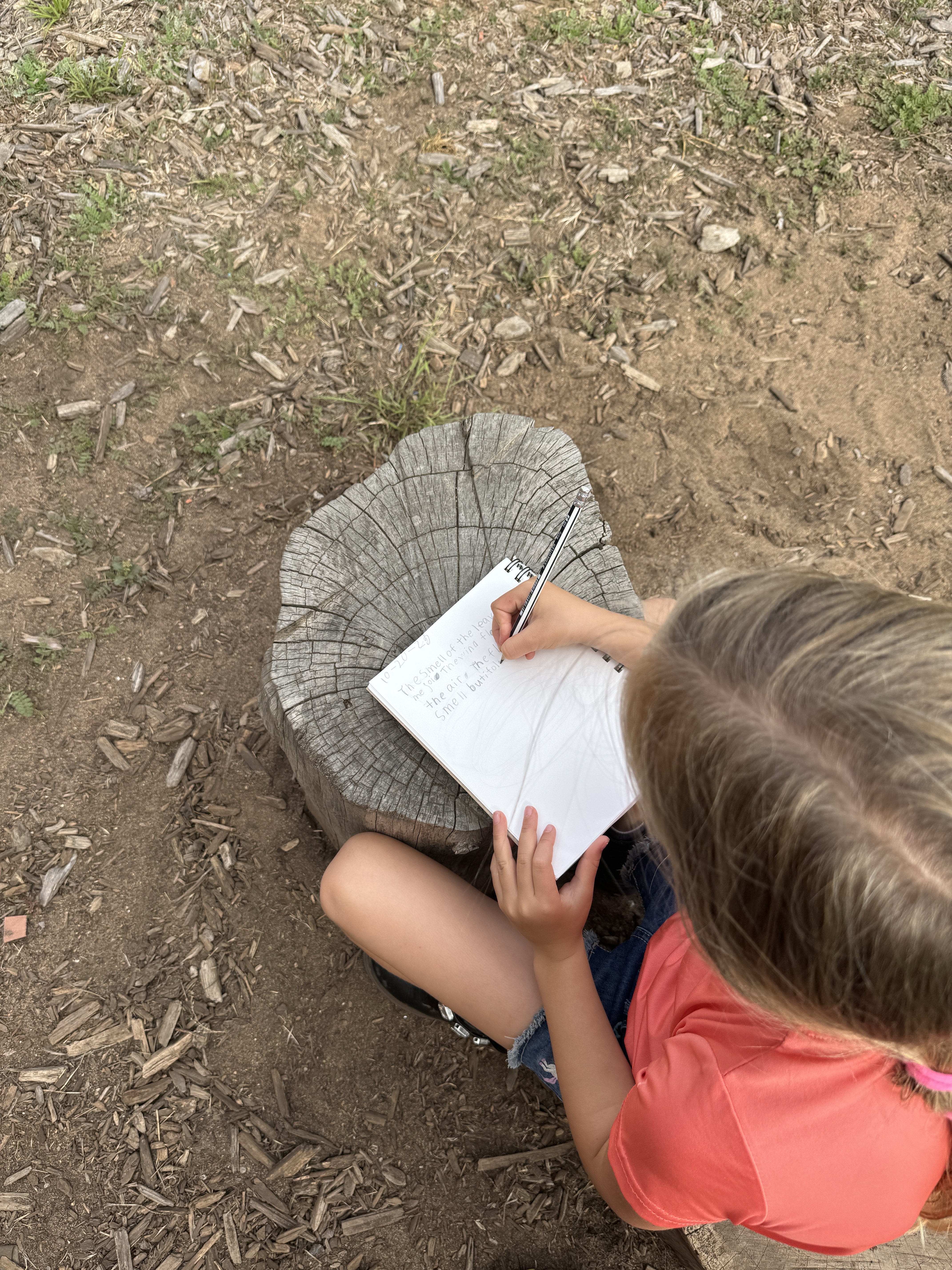
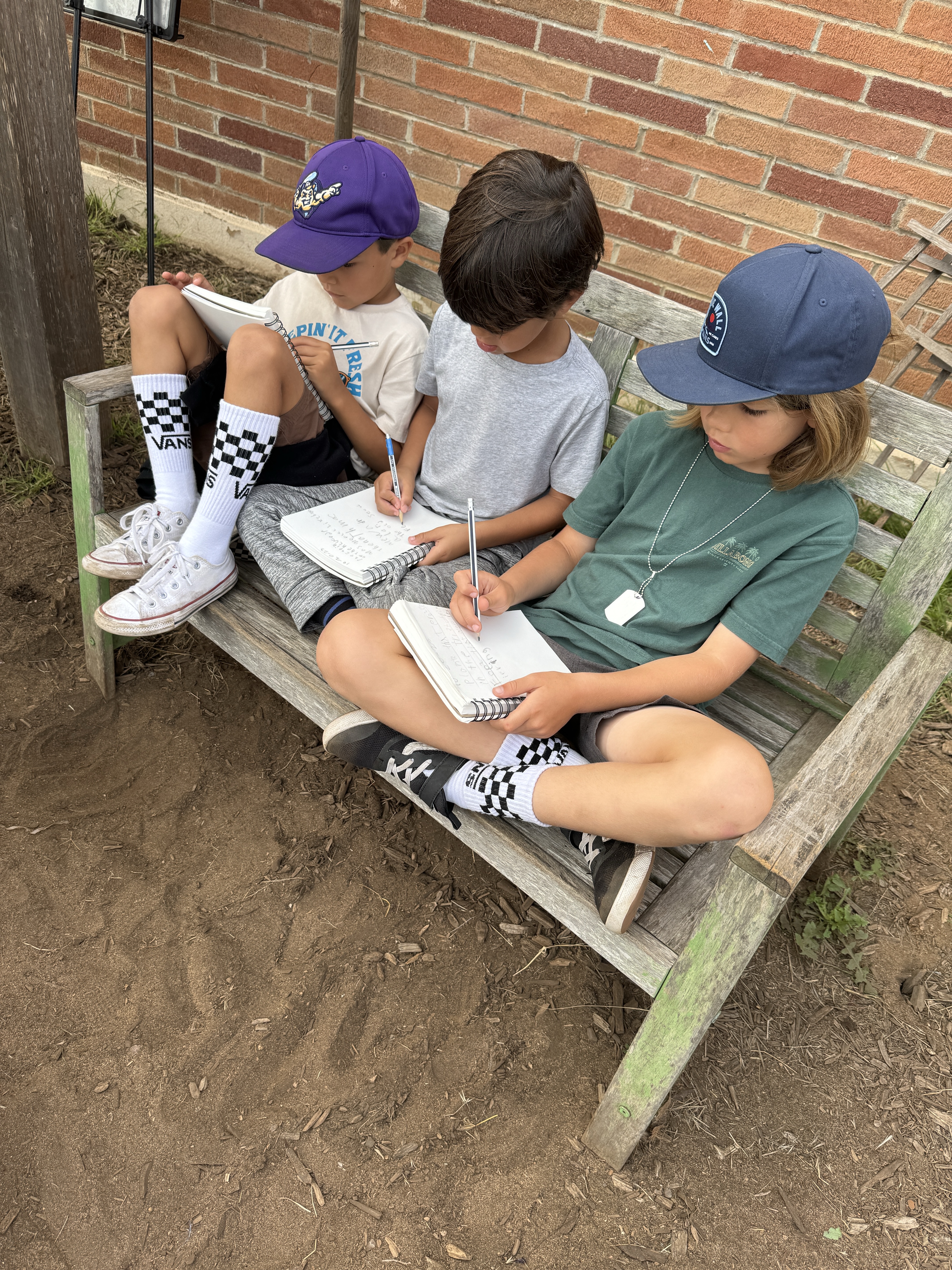
These first graders wrote as many three-lines poems as they could during the time we were in the garden. They wrote about the fog that wafted across the playground, the rollie pollies that they love to rescue from the sidewalks, ladybugs, passion fruit, the sky, tomatoes, potatoes, and so much more.
When we returned to the classroom, writers shared a few of their compositions and then picked their favorite to copy onto another sheet of paper and illustrate. While their poems are still developing, they are beginning to get the idea that there are many different reasons and inspirations for writing. Here are a couple:
I See a Butterfly by C
A butterfly flying
In the garden with yellow wings
Pollinating the garden flowers.
The Blowing Fog by M
The fog is blowing
The rollie pollies are crawling
The flowers are blooming.
I also know that being outdoors is a powerful motivation for writing for the first graders I teach. Changing our writing venue, writing in a sketchbook rather than a notebook, and writing under the influence of nature all keep writing fresh and novel. And my writing with them also matters. I hope they are learning that writing is not just for school, but that it is a lifetime pursuit that can serve many different purposes.
And I know that I don’t need #writeout or the National Day on Writing to keep writing at the forefront of the classroom–but it’s fun to know that there are educators all over taking their students outdoors, playfully approaching writing tasks, and making writing something students love…for so many different reasons.
So I leave this post with the NDOW question, Why do you write?
On this last day of National Poetry Month the weather dawned gray and damp–not unusual for May and June, but less usual for April (seems to have been re-named “gray-pril” by local meteorologists lately). But gray doesn’t keep us indoors–and to be honest, it’s not miserably cold–just gives out the “blah” vibes.
One of the things that I discovered about my own poetry by writing a poem each day this month is that I like to write nature poetry, science-focused poetry, eco-poetry. And on this last day of April that remains true. Kelp beds are a feature of our coast, a forest under the sea. I took this photo of Macrocystis Pyrifera, also known as giant kelp, looking down from a pier into the ocean below and let it inspire my Haiku.
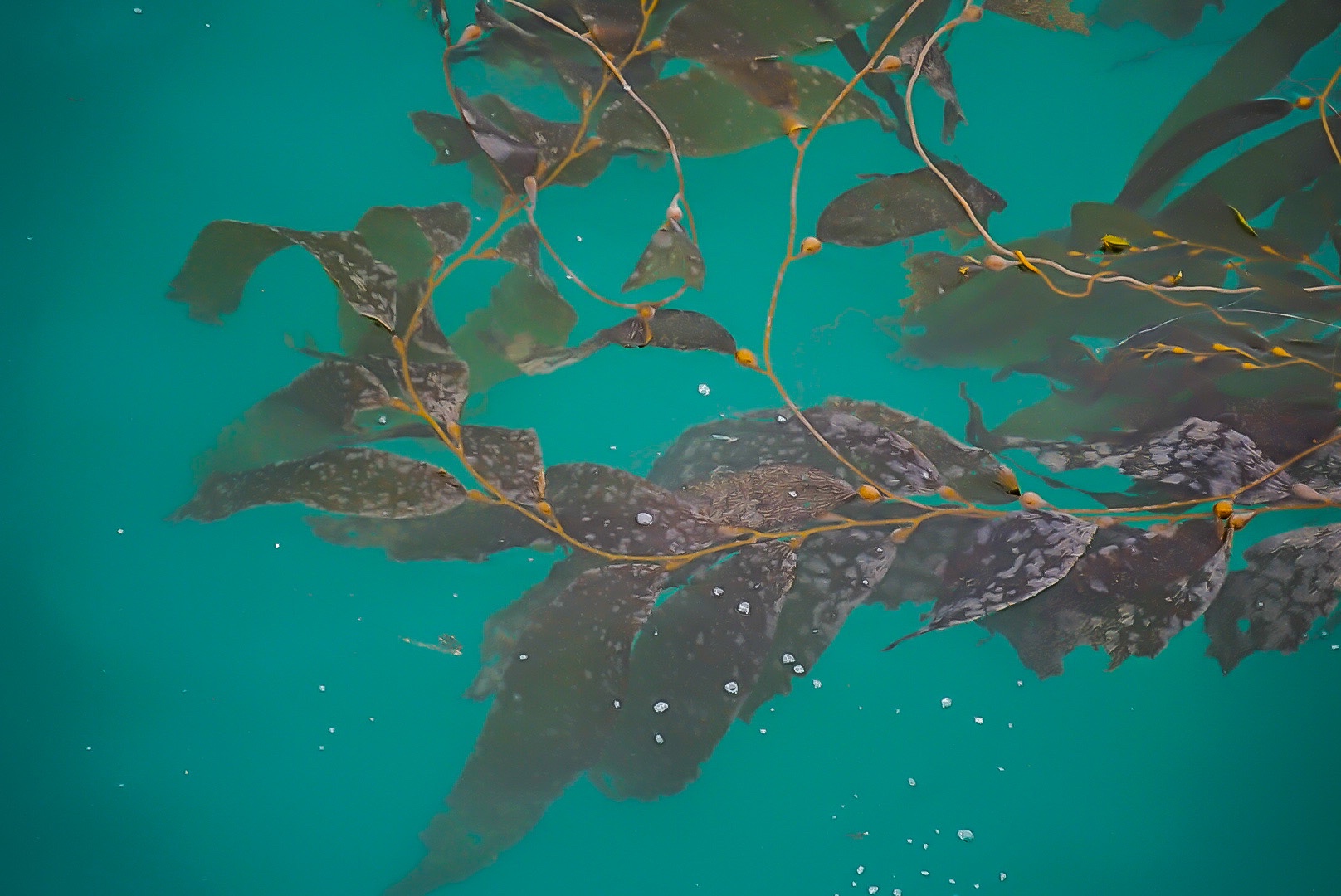
Seeking Light: Macrocystis pyrifera
Floating undisturbed
While photosynthesizing
Famished by spring’s gray
Somedays shorter is better–and this wings-spread ladybug I saw on the beach today inspired the 17 syllables of a Haiku.

Sandy ladybug
Wings spread open, sunbathing?
Or just Lady Luck?
The #verselove prompt at Ethical ELA today is All Things Cheese. But, although I like cheese…I don’t love cheese. So today I decided to write my poem about something I do love: ice cream. Just a Haiku to ease into the weekend.
Ice Cream
Ice cold and creamy
dreamy caramel choco-
late. Dinner tonight?
@kd0602

Today’s #verselove prompt was about choices…and I made a choice that was different from the intended direction (I think). So, today I decided to write a #smallpoem (close to Haiku) to go with a photograph–where I wrote with light.
Photography
Today I write with light
images speak my words
exposing sea treasures
@kd0602

Today’s #verselove prompt over at Ethical ELA gives explicit directions to break rules! Stacey introduced the idea of a Gogyohka poem–a liberated version of a Tanka–a 5 line poem without the restraint of syllable counts. Strangely enough, I had introduced Haiku to my young students yesterday, inviting them to write 3 line poems without strictly adhering to the traditional 5-7-5 format.
To inspire their writing, we headed outside again today, this time with iPads in hand in search of tiny perfect things. (We had read the book by the same name before heading out–looking for tiny treasures so often overlooked.) When you’re 6 or 7, nearly everything is a treasure. They love the poppies that grow along the fenceline, the spiral of the succulents with their variegated greens, and even the gas meter–a metal contraption–that they don’t recognize as having a particular function.
And their joy inspired my Gogyohka today.
Creative Joy
Released from classroom restraint
they search the school grounds
for tiny perfect things
subjects for child-fresh photography
inspiration for unrestrained Haiku
@kd0602

One of the things my colleague Wendy talked about yesterday during her conference session was how Haiku doesn’t have to be all about syllable count (our American school version)–instead, she talked about Haiku being a poem in one breath.
I love that idea! So I thought I would try it out–inspired by the wavy turban snail shell I saw on the beach this afternoon. I picked it up to see if the snail was inside, but it was empty–just the shell resting on the shore.
On the sandy shore
a castle spirals upward
but no one is home
@kd0602
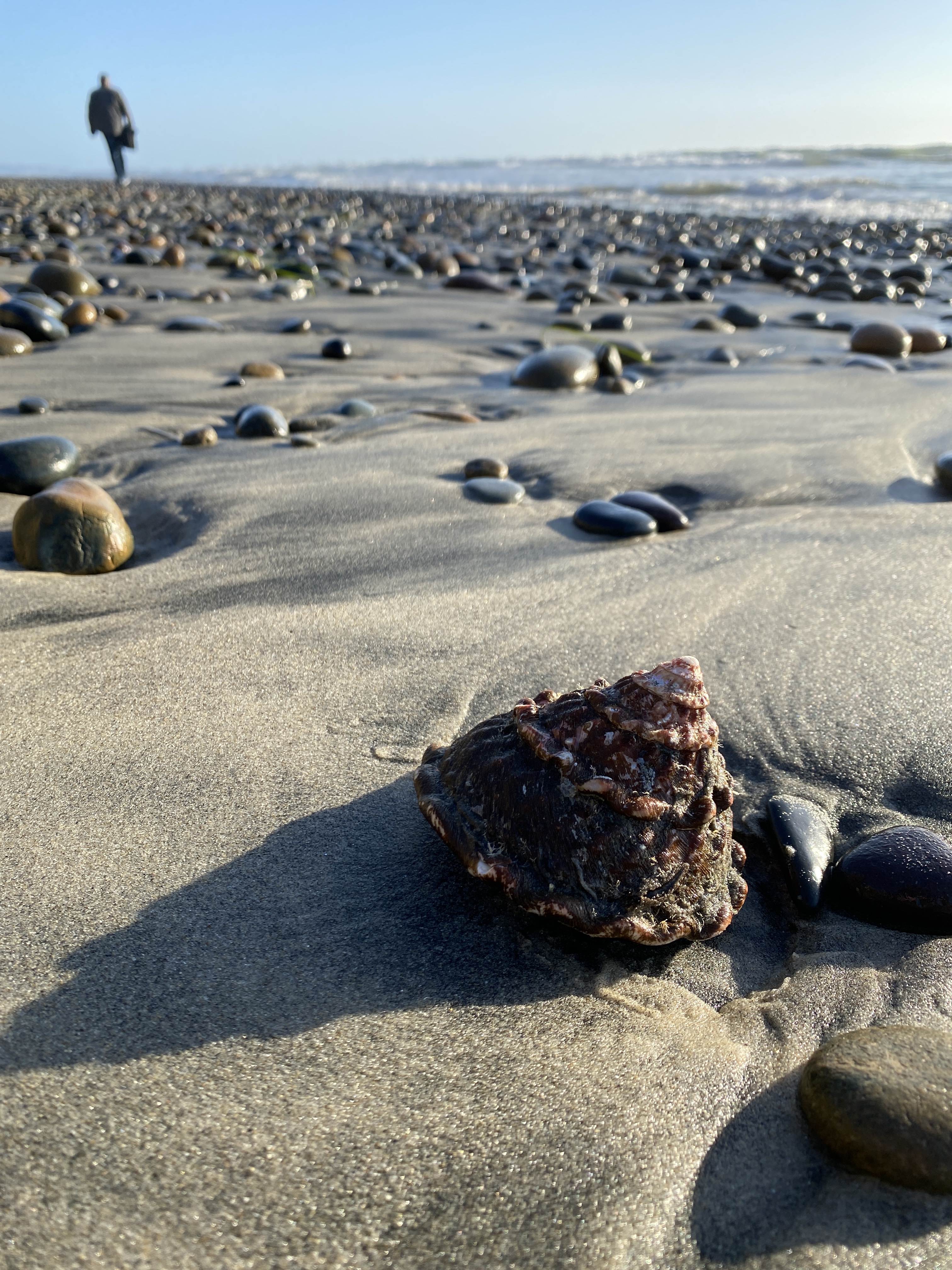
Ironically, this one fits the 5-7-5 syllable format without even trying! I’d love for you to try one–with or without counting syllables, but aiming for a single breath. Feel free to leave your Haiku as a comment.
I so appreciate the community of writers and makers that take the time to read my posts and provide supportive feedback. And it’s because of them that I took the time to write this lazy Sunday. It was dreary and gray today, the perfect weather for staying inside to read and relax. Luckily, before we even realized it was damp and chilly, we headed to the beach for a low-tide walk. The mist dampened my cheeks and hair, but not my spirits as I explored the familiar shoreline. And the reward: breakfast out at the local diner just a short walk from the beach!
And thanks to Ronald who encouraged me to use the daily create suggestion as inspiration…I actually went back a day, inspired by “create a collage of a loved one,” I created a photo collage of lifeguard tower 19–the landmark I frequently walk to as my turn around point. I realize I frequently take a photo of tower 19: on gray days, on cloudy days, on brilliant blue sky days, looking up at the steps, facing north, facing east… And thanks for Margaret who offered a #poemsofpresence challenge in May, which today I took as an invitation to write a Haiku expressing an appreciation of Tower 19.
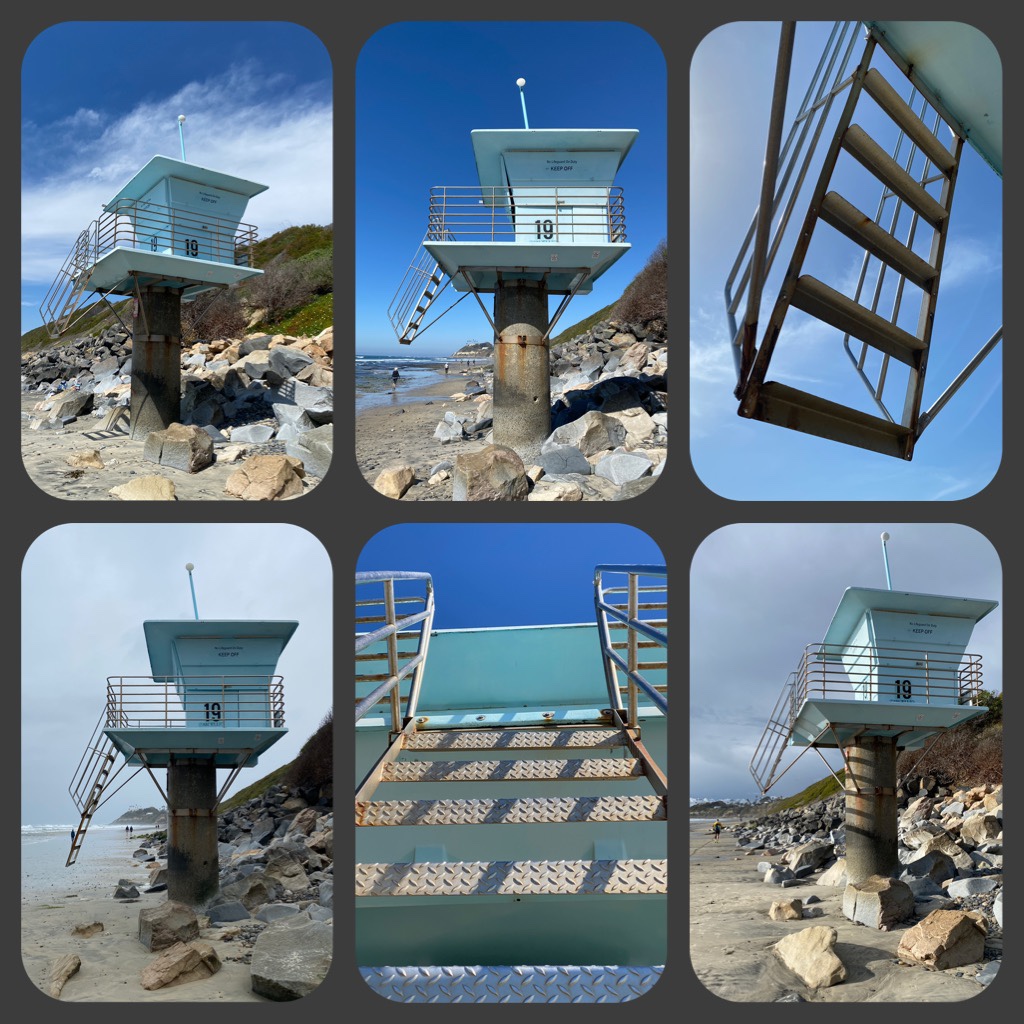
Tower 19
Beacon of safety
blue of ocean, sky, and dreams
comforting way point
®Douillard

