Earlier this week I read the book, Be a Treeby Maria Gianferrari to my first grade students. I’m so fortunate to have an amazing librarian at my school who seems to know just what books I’d love to read before I’ve ever heard of them! Anyway, Be a Tree is a gorgeous book that is a blending of factual information about trees and metaphorical thinking and comparisons of humans and their communities to trees and their ecosystems. And the illustrations by Felicita Sala are worth just sitting and poring over.
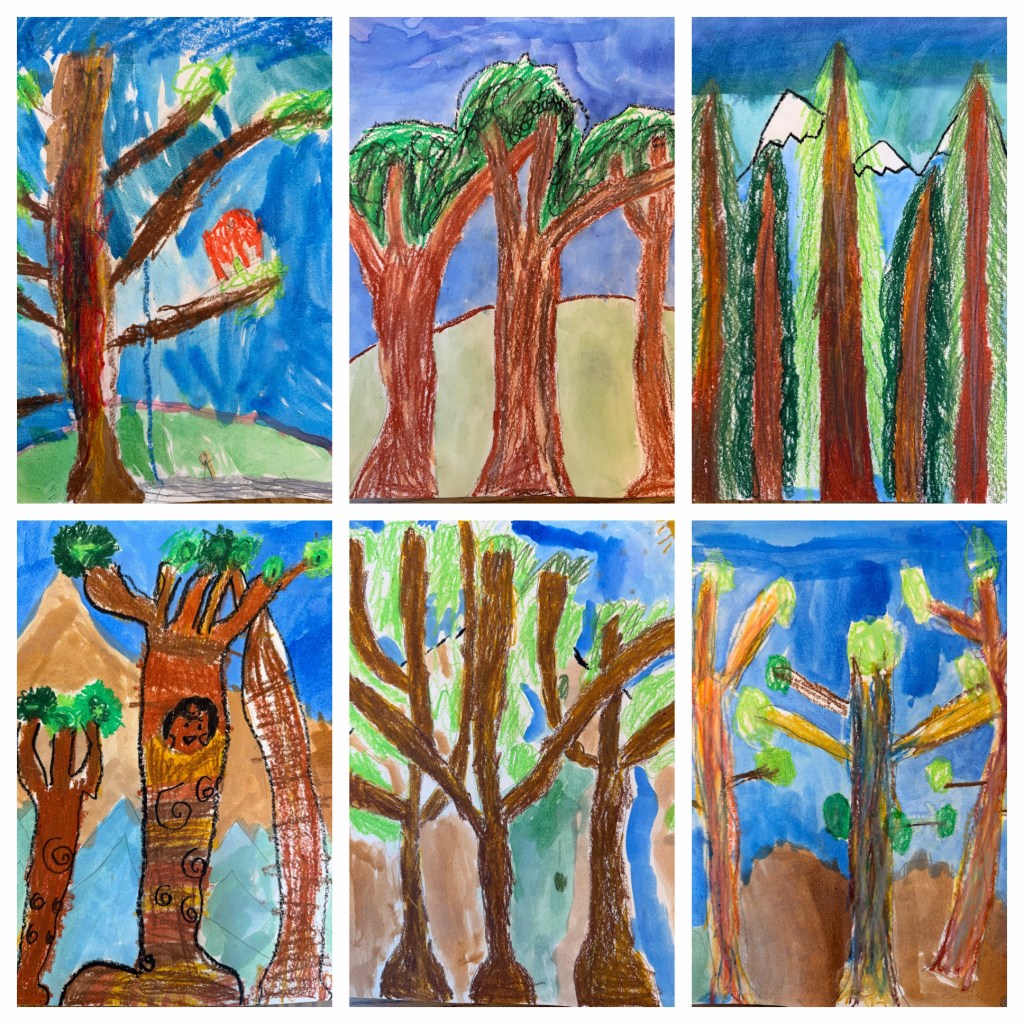
I mentioned last week that I had taught my students some photography techniques, one of which was the bug’s eye view. So after reading and examining the photos in Be a Tree, we took out our sketch books and practiced drawing a forest (okay, 2 or three trees) from a bug’s eye view…with a real focus on the trunk, looking up like a bug would from the ground. Then we also took some times to think and write a list of all the ways we need and use trees.
The next day we sketched our forest again, this time on larger watercolor paper and then used oil pastels to blend colors to create texture and depth on the trunks and branches. Today we pulled out our watercolor trays to paint in the backgrounds. Honestly, the results have exceeded my expectations.
First graders also tried their hand at writing some tree metaphors. Here’s a few:
The roots can be the tentacles of an octopus.
Trees shake their branches like hands waving.
Pine trees are as sharp as mountain tops.
Tree bark is as brown as chocolate ice cream.
I love watching students grasp a new technique and/or way of thinking. Their ability to identify a metaphor is currently much stronger than their ability to generate one of their own. But that’s all part of the learning process. and the beauty of giving space to try on new ideas.
And there’s nothing better than wrapping all this learning in an appreciation of nature and all that it offers. There’s so much to learn from trees…and kids.
Earlier this week my social media feed introduced me to the picture book, Goldfinches by Mary Oliver, illustrated by Melissa Sweet, published this week. I was immediately drawn in, quick to look up this Mary Oliver poem. I absolutely love Melissa Sweet’s art–and have many books she has illustrated. I resisted purchasing the book for a few hours, then relented and pushed the “buy” button. It arrived on my front porch this evening.
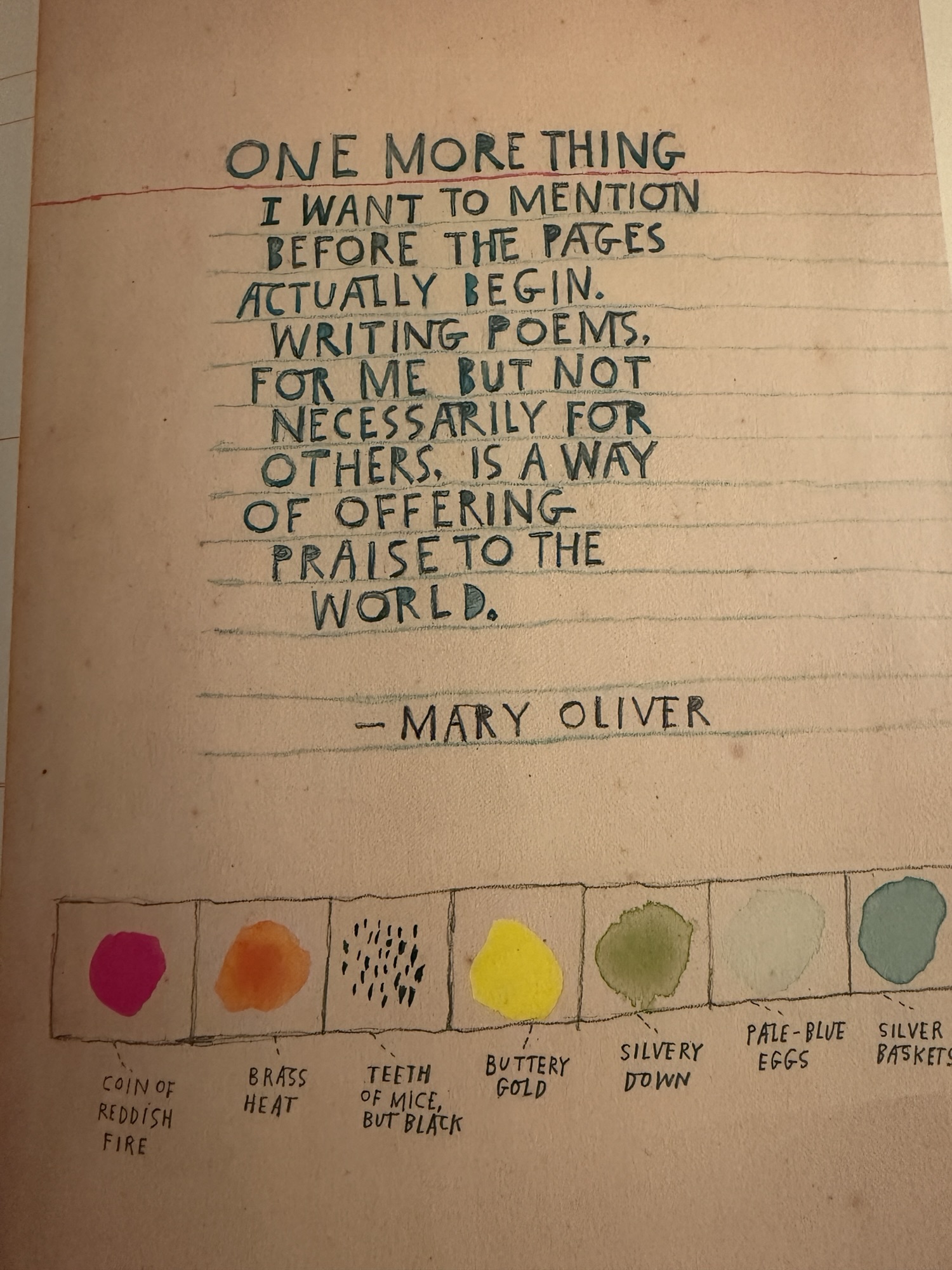
The brilliant pink of the cover along with the word Goldfinches embossed in gold had me swooning. As I open the cover I am greeted with a quote from Mary Oliver (I did check, she died in 2019) that resonates. Writing poems as a way of offering praise to the world…yes. Of encouraging close observation in the natural world. Of paying attention and appreciating what is in front of you. I know I will be using this book with my students soon.
If you asked me about a favorite poet, I might not mention Mary Oliver. I would probably say Naomi Shihab Nye (I love Valentine for Ernest Mann). I might mention Pablo Neruda (Ode to my socks or Ode to an Onion come to mind). I do love many Mary Oliver poems…and I have been discovering so many more since one of the families in my class this year gave me a copy of her collected works. I was not familiar with Goldfinches until this week. If asked my about my favorite poet today, I might just answer, Mary Oliver.
In addition to the gorgeous illustrated poem, this book also includes back pages. It includes Mary Oliver’s poem written in its standard way along with a copy of a bird list written by her. There is also a note from Melissa Sweet that begins with the Mary Oliver quote:
No poem is about one of us, or some of us, but it is about all of us.
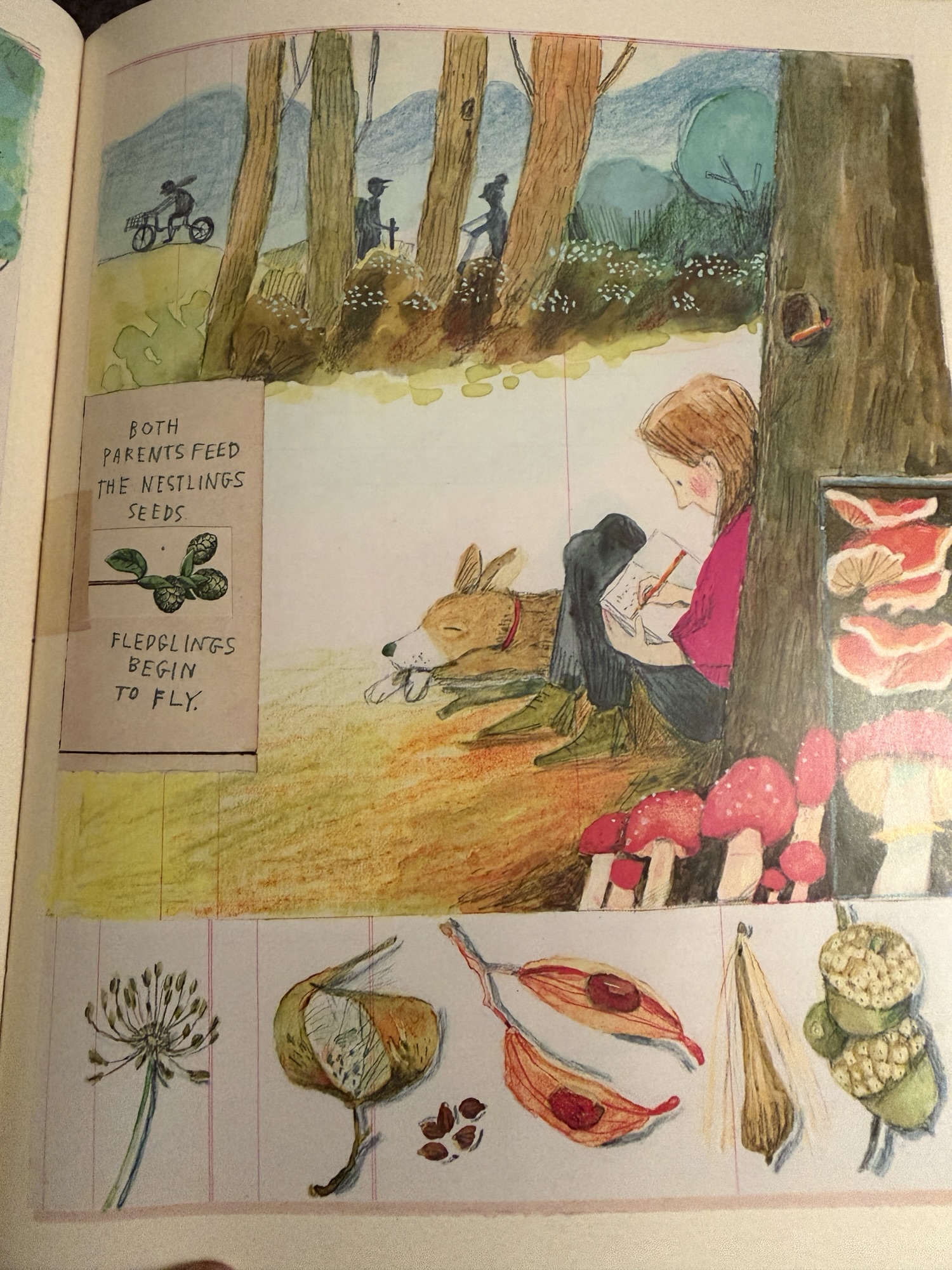
The note includes Melissa’s process of research and learning about goldfinches so she could effectively illustrate the poem along with descriptions of Mary’s forays into the woods as a child–even stashing pencils in trees so she would always have one to write things down when inspiration struck. I love that Melissa Sweet creates pages that are like a nature notebook, including notes about the birds along with illustrations of plants.
It was love at first sight for me with this book. I know I will continue to pore over it, studying both the art and words (and the birds I see outside my own place) so I can use it effectively with my students. I can only hope they will love it as much as I do…and connect to Mary Oliver’s beautiful poem and Melissa Sweet’s amazing artwork.
For nearly 14 years I have been taking a photo (nearly) every day and posting it to social media, specifically to Instagram (you can find me @kd0602). In many ways it is a part of my writing practice. The camera helps me pay attention and when I pay attention words begin to flow. (I also started my blog at about the same time)
I’ve gotten in the habit of sharing my photography practice with my students, specifically teaching them some techniques to try on in their photography. Last week I showed first graders examples of photos taken from a bug’s eye view, a bird’s a view, and using the rule of thirds. They were excited to try this out! We headed out to our school garden where students were to take three photos using each technique. (And to try not to all take the same photos!). We returned to the classroom to take a close look at the 9 photos and select the one that would then become the basis of the writing we would do.
I was pleased with these photos taken my 6 and 7-year olds. I can see the bug’s eye view, the rule of thirds, and the bird’s eye view (and my students were eager to explain their perspective to me!). We are so fortunate to have such an amazing space to practice our photography.
Before we began writing, I read Kwame Alexander’s How to Sing a Song,a beautiful book filled with figurative language. We’ve been working to add metaphorical thinking to our writing (similes and metaphors). After reading and talking about the book, we began thinking about how to write about the photo we had taken.
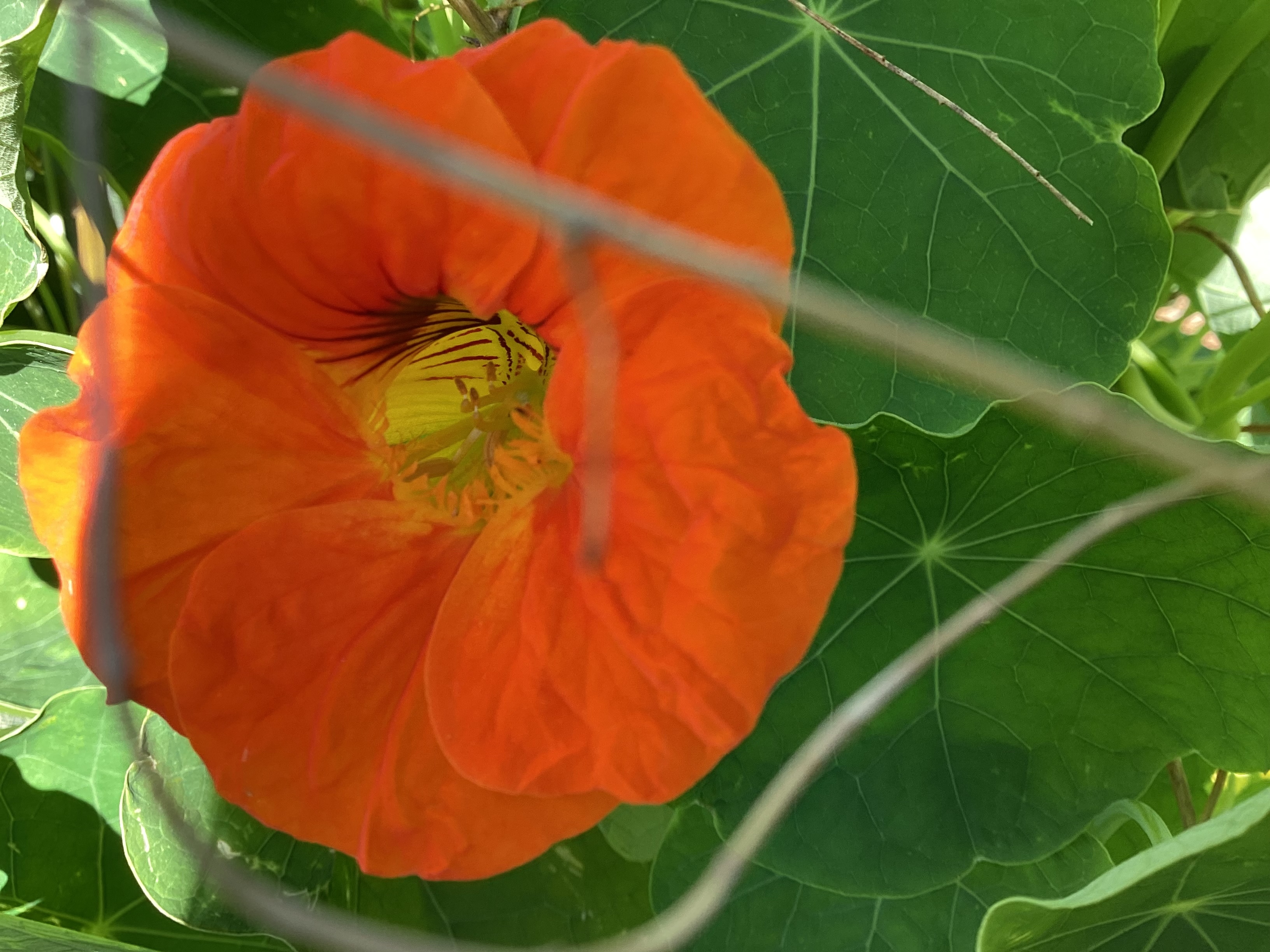
The student who took the photo of the orange nasturtium wrote:
How to Grow a Garden
First you put a seed in a ground like putting a baby in its crib. Then you water it with care and let it grow for a little while. Now you have an orange flower. Inside there is yellow, black, and very light green. The petals are crinkly and bumpy. It has little yellow gold flaky things inside like crumbs from crackers.
The student who took the photo of the sky wrote:
How to Love the Sky
Look up and listen. Hear the birds, don’t just listen to them, listen to them from your heart. Then hear the sky talking to you. See the blue of the sky and the white of the clouds and love.
My own photo was of our cherry tree with the sun peeking through.
I only managed a sentence before students were calling me over to read their developing drafts. I borrowed the first word from How to Sing a Song.
How to Grow a Cherry Tree
Hush! Focus your eyes on the softest pink, gently dancing in the light afternoon breeze.
Maybe I’ll continue the piece one of these days, but for now I’m excited to watch my students become confident and accomplished writers…with a metaphorical flair!
When I woke up this morning I discovered that today is World Kindness Day. I don’t teach on Thursdays, so I didn’t have any plans to engage students today–and to be honest, I didn’t even know it was World Kindness Day until I saw it pop up on social media.
The irony is that we have been celebrating kindness in our classroom–both last week and this week. Last week, after reading Brett Vogelsinger’s blog post on Moving Writers titled Poetry Pauses for Peace Day 2 I couldn’t wait to share the mentor poem, Peace: A Recipe, with my young students. My students have a sense of recipe–they make cookies and muffins with their parents–but making a recipe for something abstract like peace was new for them.
Even before reading Anna Grossnickle Hines’ poem, I had asked my students what ingredients they might include if they were making a recipe for kindness (Brett had suggested having students write a recipe for hope, but kindness felt like a concept my first grade students would have more ideas for). There was no hesitation as hands began to raise. Honesty was the first ingredient mentioned. How much would you include, I asked? A pound was the answer. Then students contributed other ideas: caring, sharing, and including others. Every time I asked for an amount, the response came back in pounds! Even when I suggested maybe a teaspoon or a pinch–the answer was no, 5 pounds or 3 pounds or some other number of pounds. Clearly students thought we needed a extra large batch of kindness!
Studying Hines’ poem, we noticed words that were about cooking, expanding their understanding of recipe components. We underlined those words and drew illustrations for the poem before heading out for lunch. Time got away before we had time to write–but I kept my plan for writing in the back of my head to come back to when I had time.
Monday was a strange day this week. We had school followed by a holiday on Tuesday (Veterans Day)–my students had two special classes on Monday, so my time with them was limited. But…I did have time to come back to the idea of writing a recipe for kindness. Before we began we brainstormed a variety of cooking words and then students got to the writing. They started with ingredients (that expanded past the ideas we had last week)…and they wanted to be done. But, I reminded them, you have to say what to do with the ingredients. And they did.
There was so much success, even from my more reluctant writers. In celebration of World Kindness Day, here’s one example:
Kindness: A Recipe
To make kindness
you put a pinch of honesty
And a spoonful of helping
And a handful of respect
And you mix it
And you spread it around the world
And that’s it.
Thanks Brett for the nudge and Anna for the inspiration. And to all the first graders in my class, I’m excited that you are the ones cooking up kindness to spread around the world!
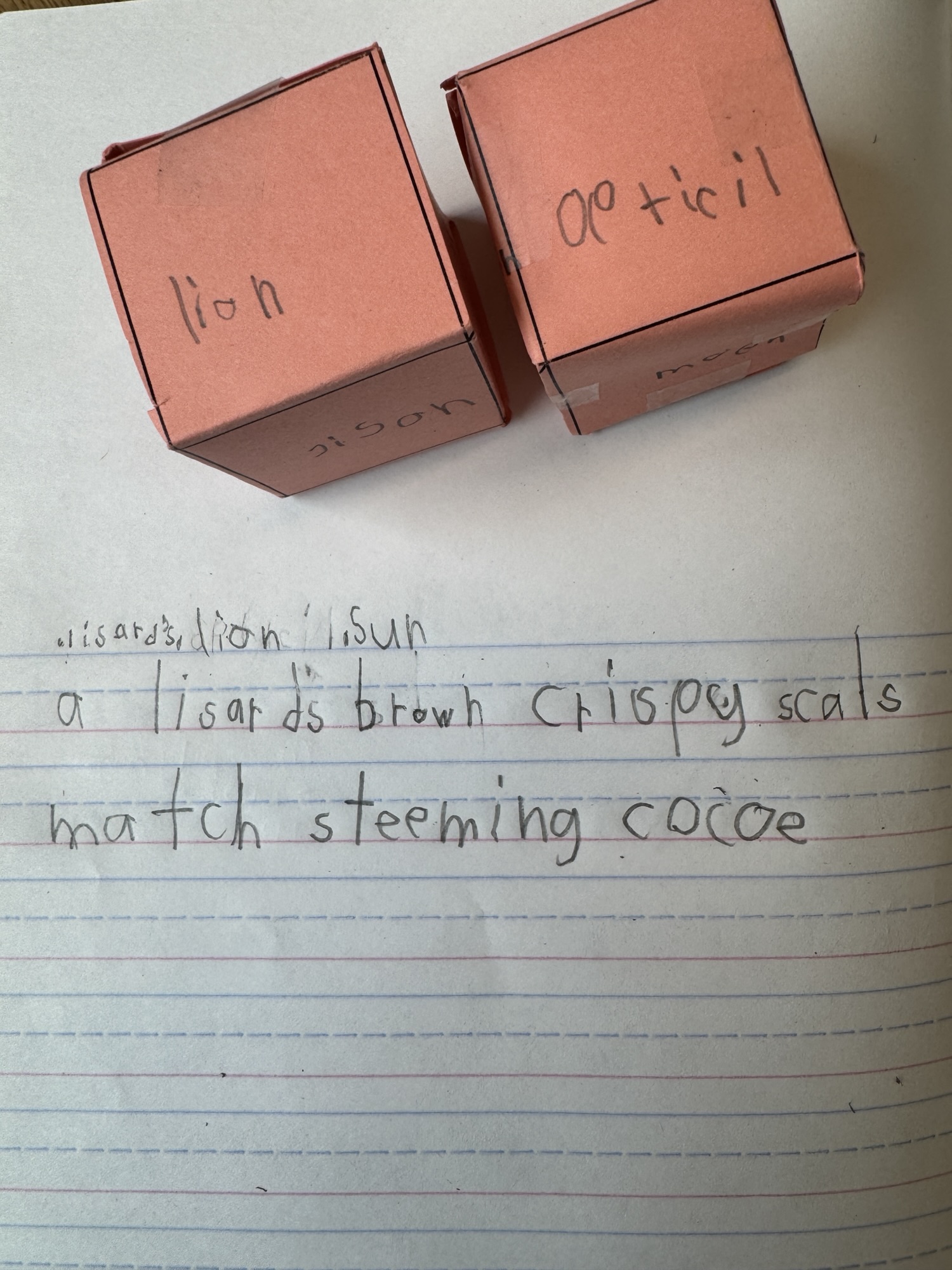
During the pandemic I accidentally discovered the power of poetry dice. Not the pre-made ones that you purchase. Those are great, but when my students weren’t in my classroom, I figured out a way they could make their own dice at home. At the time, I saw those homemade dice as a replacement for the ones I had used in the classroom. But I have learned after making our own dice in the classroom that they are so much more than that!
The prelude to making the dice is important. We began this week by reading Peter Reynold’s book The Word Collector. This book is rich with language and encourages a delight in words: short words, multi-syllabic words, words that sing…. The book is great on its own…and then as my students predicted–we would be making our own word collections!
To keep them from collecting only one kind of word, I gave them some categories…and a few restrictions. They collected nouns (but not people), verbs, describing words, and colors. They chatted as they wrote their words, sharing ideas with each other. Then we folded the collections, placed them in our notebooks, and left them for a while.
Today, we returned to our word collections. I suggested that they might want to trade out some of the words they had collected on Monday. I showed them on my list by crossing out a word that felt ordinary and adding another that I had thought about since then. Then I gave them some time to read over their words, trade them out, or just add to their list.
Then I pulled out the highlighters. (The magic of office supplies is real!). Since we were going to make poetry dice, students would need to narrow their collection down to 12 words (for a pair of dice). We talked about including words from different categories and again, I talked aloud about some of my decisions as I highlighted my list. Once the 12 words were highlighted, it was time to distribute the cube templates. I use colored card stock so that the dice will have some firmness.
Students wrote their words, one per face, onto their cube template. And at that point, it was time for the cutting. This can be a tricky step with first graders, but they persevered and were careful, even with the tight corners. We had time to fold before recess, but not time to tape, so we left our unfinished dice and headed out for a snack and some playtime.
When we returned I pulled out an old favorite of a poetry book, I am Writing a Poem About… edited by Myra Cohn Livingston. (This is one of those oldie but goodie books–and I think it might be out of print!) In the book, described as a poetry game, authors are challenged to write a poem using certain words. We read through quite a few poems that used 3 words: drum, blanket, and ring. Right away students tuned in to listening to hear those 3 words in each poem. They noticed that sometimes the poet used a different form of the word, like drumbeat instead of drum. After marinating in the poetry game, we headed back to our tables to tape our dice together.
Pulling the edges of the cube together and taping them was challenging for some of these young poets, but again, they were up for the challenge. And then it was time to start rolling the dice. They were directed to roll 3 or 4 words, write them in their notebook and then to write their own poem including the words, along with some action, metaphorical thinking, and maybe the use of some of their senses.
I’m convinced that the making of the dice creates fertile ground for poetry to grow. Time to think about words, to play around with words, to list words, to select words, to hear words, to consider the words of others, and then to roll dice and write…and then roll some more and write some more. In our last few minutes before going home, we took some time to read some of these pieces-in-progress out loud.
O, who doesn’t usually read, was ready to share today. Rolling robot, rainbow, and teal, O wrote:
A rainbow in the sunset
with a robot running through all the colors
with not a speck of teal
B seems to be using poetry to process feelings, rolled scared, blue, purple, and green. B wrote:
Making new friends
is scary
but blue, purple, and green
fill my heart
And J rolled three words, but ended up with just one of the words in the poem. J wrote:
A lizard’s brown crispy scales
match steaming cocoa
first smell
then blow
I rolled kaleidoscope, microscopic, collect, and singing and wrote alongside my students. Here’s my draft:
They collect words like gems
holding them up
to reflect the sun
A kaleidoscope of poems
emerge from this microscopic
piece of the universe
singing out a world
imagined by children
I’d love to hear your experiences making and playing around with poetry dice–either for yourself or with your students. Any variations to suggest?
“What is it that you feel you have the need to have 13 ways of looking at?” That was the question posed by Poetry Unbound’s Padraig O’Tuama in a recent post. A question that got me thinking this morning…and also had me rereading Wallace Stevens’ Thirteen Ways of Looking at a Blackbird. My mind went to the beach–a place I spend lots of time for lots of different reasons.
Thirteen Ways of Knowing the Beach
I
I match my breath with the ins and outs of the waves. Salty water molecules swirl around me, seasoning my skin. I fall into perfect sinus rhythm.
II
Seagulls shout. Bossy voices command attention as they probe the shore for handouts and scout out their next heist. Don’t turn your back on the sea or the seagull.
III
Curled toes, deep in the wet and squishy sand. Ankle deep, knee deep, splash! Cool or downright cold. Goosebumps form and squeals of childhood echo. A time machine.
IV
Sun’s out, skin’s out. Memories of baby oil and sunburn mix with realities of skin damage, SPF, and UV index. Trickster sun makes its mark even when hiding behind the clouds.
V
Wind whips and whirls sending sand in sinuous swirls. Waves in white caps wash, breaking barriers, reclaiming all within reach.
VI
Cliffs crumble uncovering geologic stories in layer upon layer, shells on mountain tops where lands rose and sea retreated. History in sediment, conglomerate, sandstone until time, pressure, and heat works its metamorphic magic. Change is constant.
VII
Ospreys hunt, eagle of the sea. Fishing claws grabbing dinner from the deep, no poles or lines. Transported by talons for treetop dining. A creature of sea and sky.
VIII
Squadrons of pelicans in perfect Vs oversee hoards of beachgoers. Gliding on gusts, flapping in formation, surfing the swells, their bellies nearly touching the waves when they rise. Pause and dive. Pouch first approach to prey retrieval. Dramatic drops for seaside lunch.
IX
Artists with rakes trace circles, designs larger than life with perfect symmetry, perfect Pi. Fleeting beauty etched in the sand, hangs in the gallery of your mind’s eye.
X
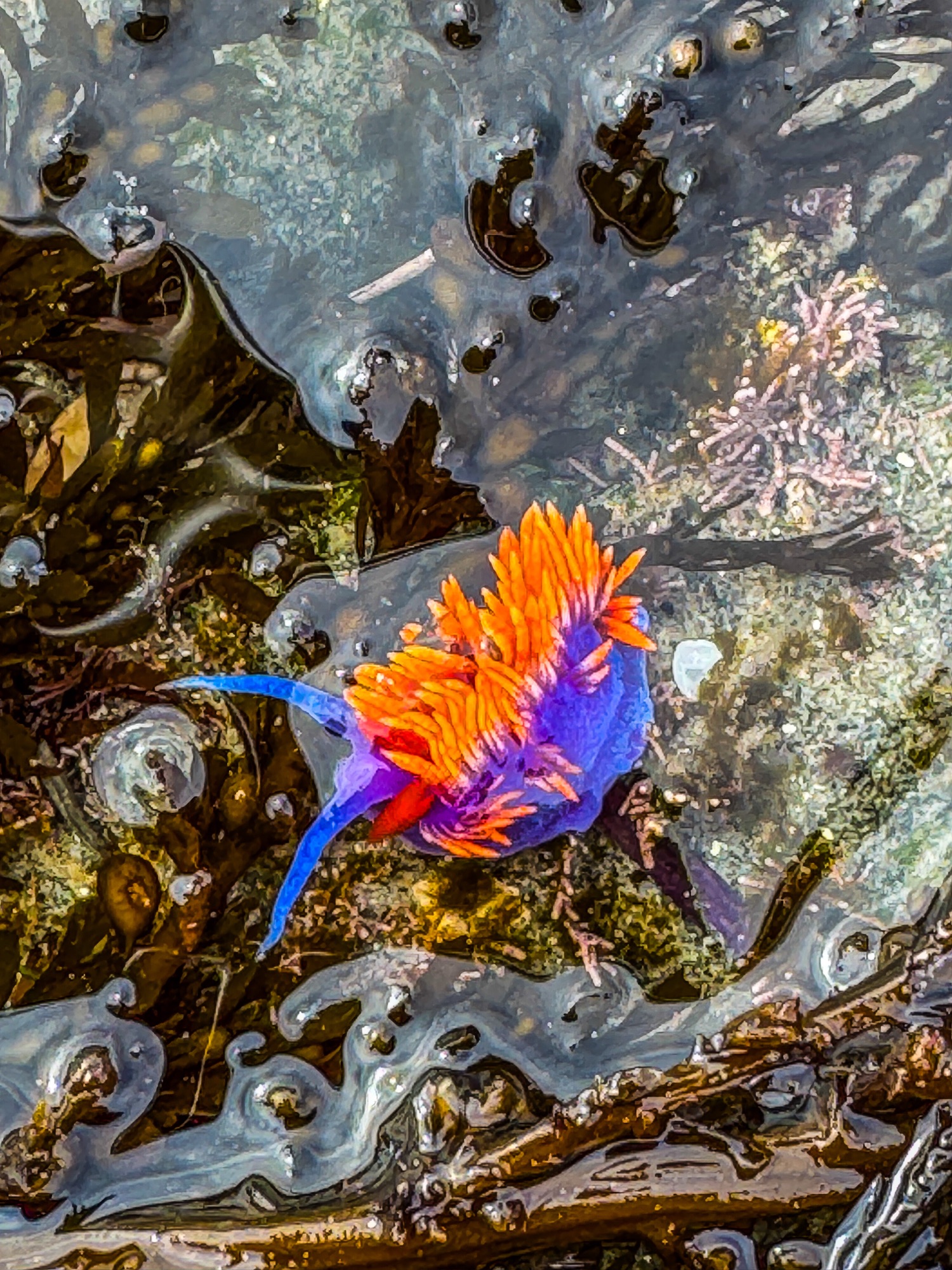
Tide pools hold secret worlds that live in the in-between. Sometimes completely covered, other times exposed. Life teems under the kelp, sea grass, algae. Sea stars creep on tube-feet, nudibranchs with psychedelic seventies colors strike a pose, pudgy squirting sea cucumbers move only at the sea’s whim. Hermit crabs seek new homes, dwellings abandoned by their former residents.
XI
Snowy egrets with their bright yellow socks stomp the pools at low tide. Lunch counter is open. Neck with an S-curve, stretched out or curled in, dancers in fluid motion.
XII
Beach combing, treasure hunting, shore sweeping. Colored glass roughed and smoothed by the sea, bits and pieces of green, white, amber, sometimes even blue. Sea diamonds. Picking up plastics, multiplying by mitosis, never ending source of damage, destruction. Pollution of our precious life source.
XIII
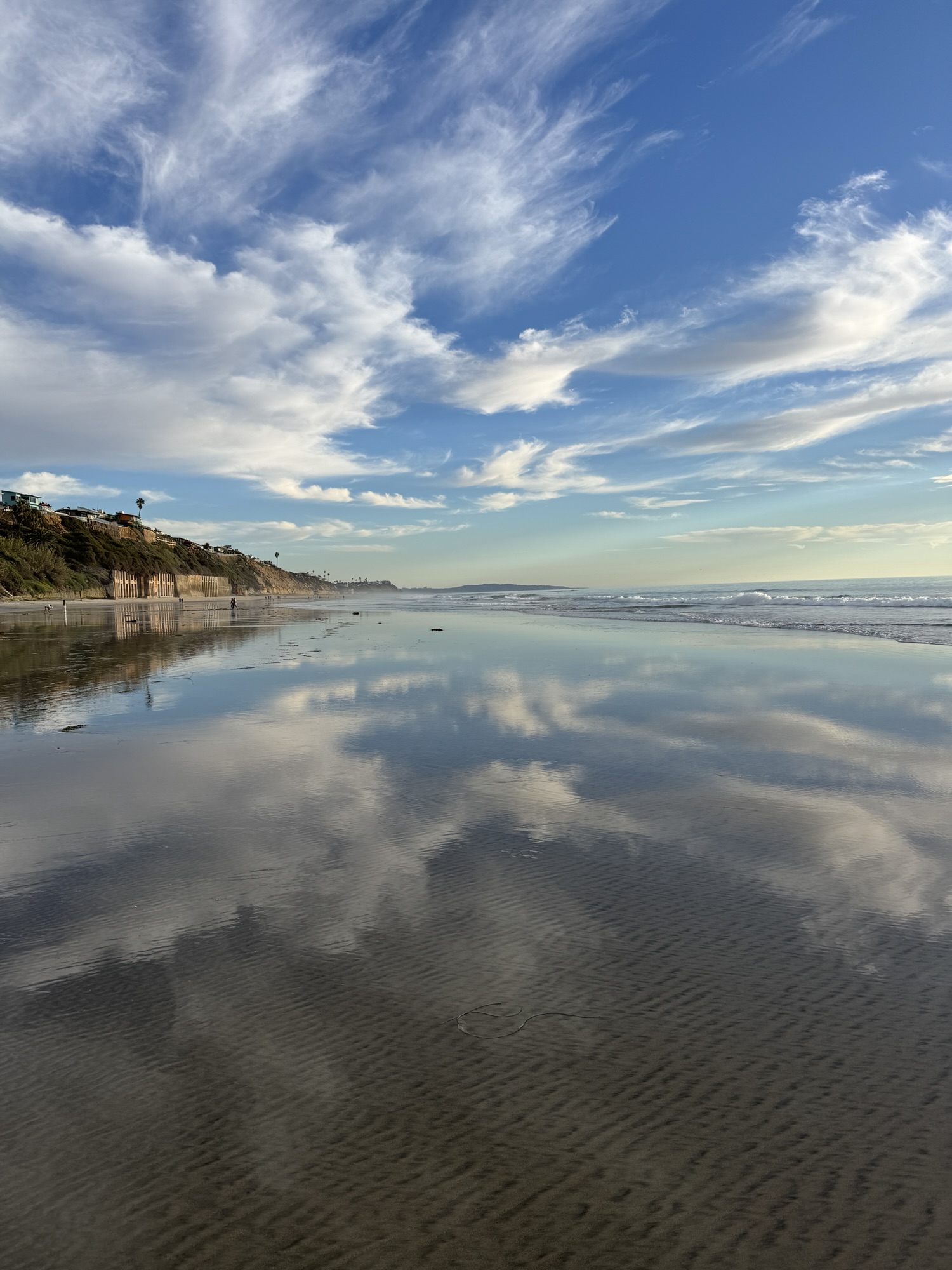
My playground, location of endless possibility. I walk on water, I walk on clouds. My ears fill with the soothing sounds of whispering waves. I can taste the salt on my lips and feel the release as stress runs down my shoulders and swims out to sea. My heart matches the rhythm of my breath, the rhythm of the sea.
It’s Monday and it’s St. Patrick’s Day and I teach 6 and 7 year olds and I’m wearing my pesto-green vans and completed 8 parent conferences today before 3pm.
Like most days I come home knowing I have a blog post to write and still have absolutely no idea what I will write about. And then, in the few minutes I had to check my ever-multiplying email inbox (that tripled–at least–in volume while I taught and conferenced today), I came across a wonderful recommendation from a colleague. My fellow writing project directors share their newsletters — so inspiration can find me with just a click.
She shared a blog post in her newsletter called A List of Things I Love, a wonderful rambling poetic meander through time and the little so-called ordinary things that make life extraordinary. I knew it was special when it began with the 2-word sentence: I love. (Do you hear the strike of inspiration hitting?) I could do that! Although I have no illusions of mine list matching the breadth and whimsy. But here’s an early draft that I hope to come back to later.
I love. I love a Monday afternoon when I come into the house and the smell of freshly baked chocolate chip cooks wraps me in a warm and chocolaty hug after teaching and complicated and rewarding conversations with eight families. I love a blue-sky day after a week of rain, when my jacket hangs on the back of my chair and the sun feels warm when I walk outside. I love tulips in a vase, a whisper of spring color and a reminder of the beauty of daring to blossom, even knowing that these cut flowers will soon droop, dancing as they drop their petals.
I love the beach in all seasons, but especially when the tide is low and the beach is wide. I love the egrets and the pelicans and the tiny sandpipers that move in unison with the breath of the sea. I love the treasure hunt of the tidepool and the excitement when orange sea stars appear…a constellation of wonder and hope. I love learning about nudibranchs and finally seeing one in all its colorful glory in its home habitat.
I love books that invite a deep dive and force you underwater in the silence of words, immersing you in an experience so real that laughter and tears are necessary expressions of a heart touched. I love songs that curl into the corners of my ears, bringing long lost memories forward for remembering again and again.
I love when writing pushes time away making room for ideas to explore and expand as fingers and neurons intertwine. I love the mystery of a readers’ response, will my loves resonate and spark ideas and loves in another. What loves emerge for you?
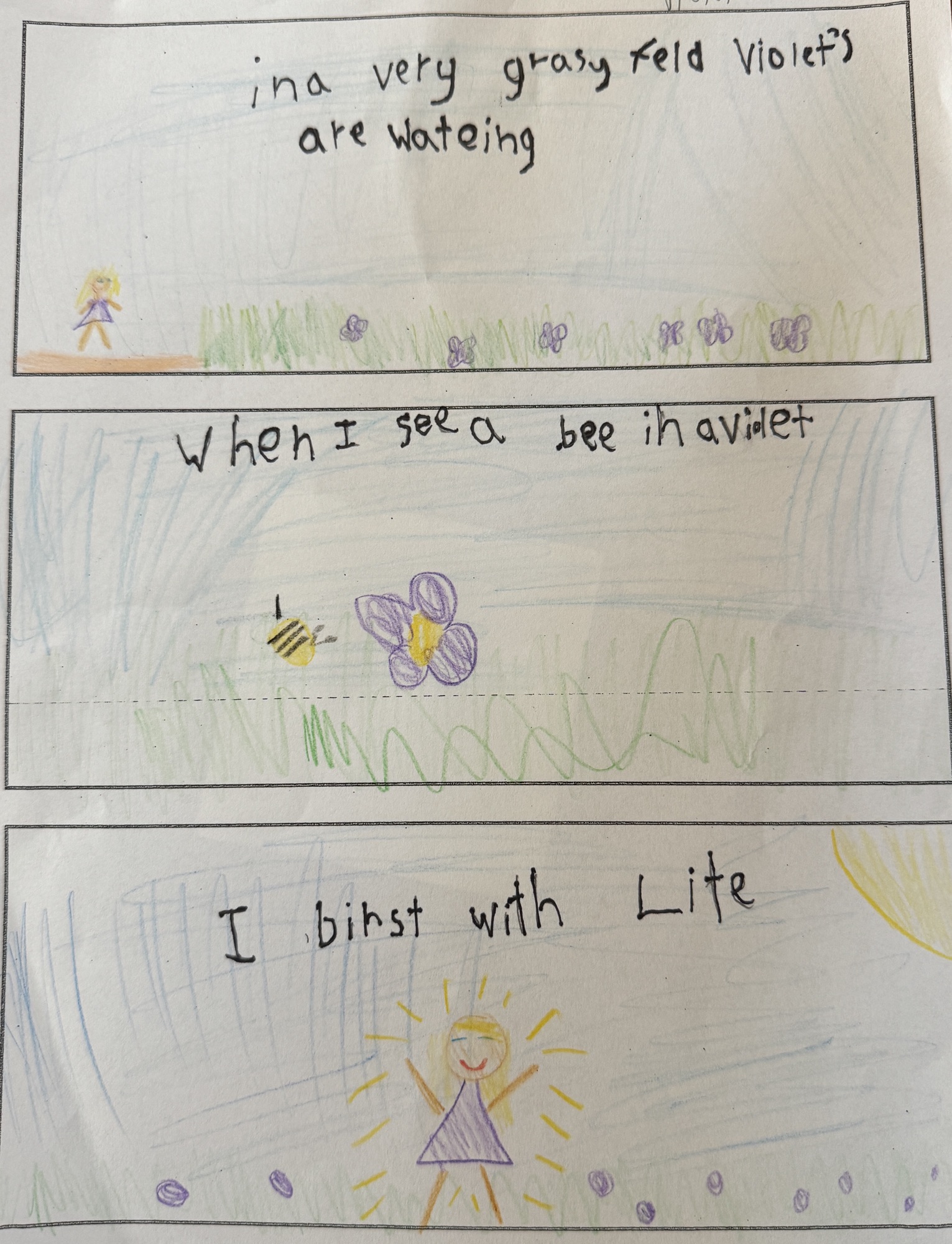
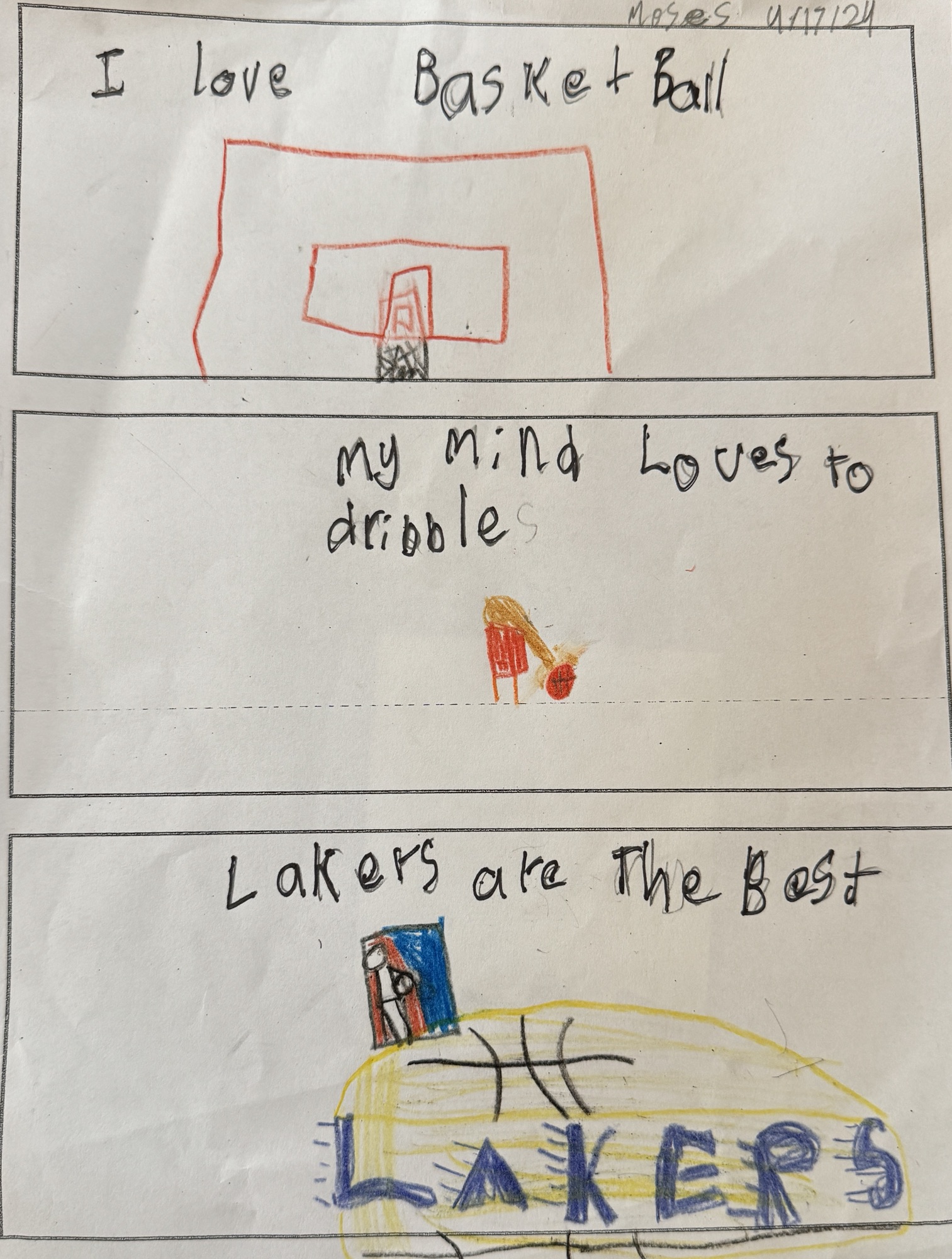
I’ve been inspired by Grant Snider’s comics for a while now and was super excited when I learned about his book Poetry Comics published at the end of March. (I wrote a mini review here). I knew I would be doing something inspired by his poetry comics with my first grade students this month. When I saw he had done a Haiku comic style, I knew this would be a perfect format for my students.
We’ve written Haiku this year–well, mostly 3-line poems without much attention to the syllable count. So when we took a look at Grant’s Haikomic this morning, students immediately understood (and recognized the metaphorical thinking in his last line).
I’ve learned when teaching first graders that sometimes a novel paper use can propel young writers forward, somehow tricking that treacherous writer’s block into disappearing. So instead of writing in their notebooks or on lined paper, I handed each student a 3″ square post-it note to draft their Haiku. It didn’t take long for students to have their Haiku ready to be transformed by the comic making process.
I distributed the comic paper–in this case, a page with three horizontal rectangular panels. Students wrote one line of their Haiku in each panel and added their comic drawing with colored pencil. As a final last step, they traced over the writing with a Sharpie marker.
Here are a few examples:
V can never help writing about violets!
M is obsessed with basketball!
In her piece, “I” decided to add speech bubbles.
And O celebrated flowers and springtime
While I wrote my Haiku about egrets with my students and drew along with them, later this afternoon with a group of Writing Project colleagues we crafted our Haikomics using photos instead of drawing (mostly due to severe time constraints). I then used Canva to write my Haiku directly onto my photo.
Maybe you’ll want to try your hand at a Haikomic too. I’d love to see what you come up with!
Some days writing feels hard. Even when there is an interesting prompt, there are days when the words seem to be hiding. This has been one of those days for me.
With Angie’s invitation at #verselove, I used Clint Smith’s poem, No More Elegies Today to frame my poem, to get me started. Maybe this is one of those pieces I will return to on another day and find my way to another place with it.
Today I will Write a Poem
Today I will write a poem about writing
It will not dwell in the challenges of deciding on a topic
or the many chores that suddenly need my attention (instead of writing)
It will not illuminate the scribbled out words
or the dead end paths started but not followed
Instead
It will be a poem about how writing can be
the rainbow that colored my way to work this morning
reframing a Monday with scarlets, tangerines, indigos, and violets
It will use words as shovels and hoes
digging up the rich loam of meaning
sowing the possibility of a seed taking root
It will take me out of my writing funk long enough
Last week we returned to school after our two-week winter break. The first graders in my class were eager to talk, telling each other about all the things that had happened while they were apart. Knowing that students would be chatty, I planned lessons that would allow interaction and conversation on our first day back in class.
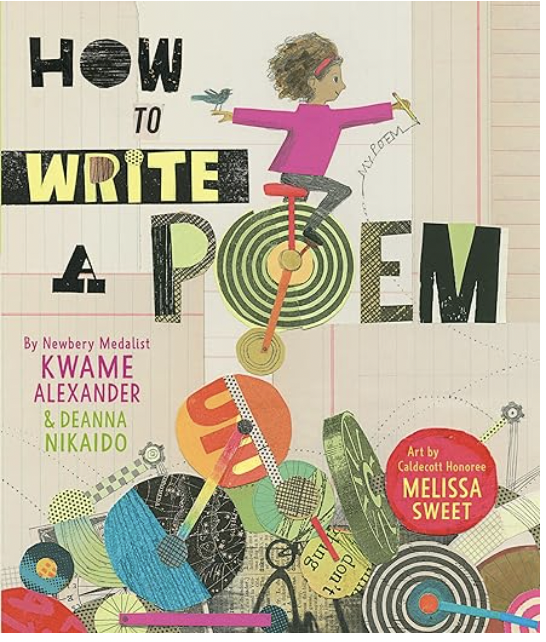
I’d been thinking about having students craft a collaborative poem for a while now. We’ve been studying poems and writing some of our own all school year, but still, it seemed that the time was ripe for something more. I began our lesson with Kwame Alexander’s delightful picture book, How to Write a Poem, illustrated brilliantly by Melissa Sweet. We read and noticed first, with students intrigued by the use of collage, the lyrical language, and colorful images. Before I began reading, I had asked my students what they knew about metaphorical thinking. What? That was their response. So after reading and talking about the book, we went back through the book so I could point out examples of metaphor…and just about then, my principal walked in. She comes in from time to time, pulls up a chair and sits and listens. She doesn’t interact and her poker face is nearly unreadable. I just went on with the lesson, feeling students pulled in as we talked about words falling from the sky like rain. We imagined ourselves outside, heads tipped, tongues out, ready to catch those words. As we became the metaphors we were studying, we talked about how metaphor lets us use ideas from our imaginations to make our writing become more clear…and more fun! When my principal left, I still had my students full attention as they grappled with this abstract idea of metaphorical thinking.
Now, we needed to try it on for ourselves. I decided on having students create a collaborative poem by having each student contribute one line to a “winter is…” poem. So I asked them, how might you use metaphorical thinking to describe what winter is? The first responses had them leaning back on what they already knew. Winter is cold, winter is when trees lose their leaves. In some ways, this was the perfect next step. We talked about how those are facts about winter…now we needed to think about how to make comparisons that were surprising. When one of my students got to snow was white cotton candy, I knew we were heading in the right direction! I had them try a few “winter is…” lines, and just when they were running out of steam, I pulled out the colorful sticky note sentence strips for each student to write their favorite “winter is…” line on. I could feel the motivation lift and even my most reluctant student eagerly chose a color and started writing his line (although there were none written in the notebook at this point). Once they had written, they stuck their post it on the white board.
I wasn’t quite sure where we were at this point. I let the post its sit over night and pulled them off the next morning with the intention of typing up their lines to form a poem. As I typed I divided the ideas into 3-line stanzas, that seemed to help give the poem shape. I was pleasantly surprised when the ideas seemed to come together into a poem that I felt we could all appreciate.
Winter Is…
Winter is white puffy cotton candy
A time for snowflakes that look like crystals
When snow foxes dig holes to keep their cubs warm
Winter is a cold hug in your heart
The wind at the beach
Time for hot chocolate
Winter is snowflakes blowing
Clouds melting
A freezing tree giving words to my pencil to write down
Winter is a snowflake full of thoughts
A snowflake falling down as fast a rocket
Pine trees covered with snow
Winter is a cold place to relax and slide your pencil to write down your mind
Snow soft and crunchy like people walking on the snow
Full of puffy snow like white cotton candy
Winter is a frozen lake waiting for spring
Holidays in your mind
A snow of thoughts flying through the air
Winter is a chilly place where it snows
Winter is so fun because you can play
Winter is a time for joy!
By Room 3 First Graders
1-8-24
I can see where students were inspired by their classmates and where some students are still not quite there when it comes to moving away from facts as they craft a line about winter, but I am pleased with this as a starting point. And even better, my principal saw me eating lunch on Wednesday and commented on the book and lesson–in a very positive way. She loved that I was introducing metaphorical thinking to first graders.
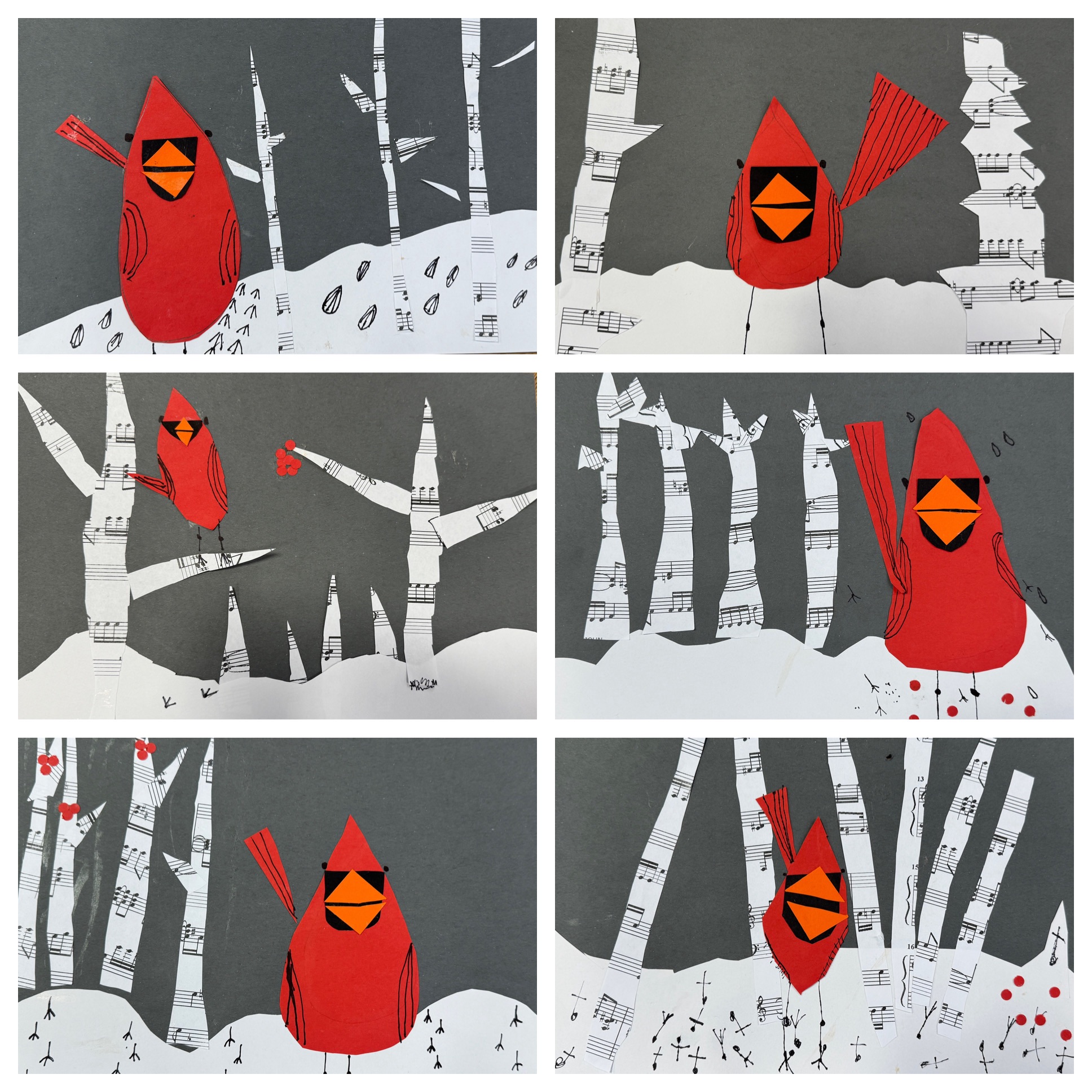
But honestly, the real payoff started to emerge in small moments as the week went on. My students started to point out metaphorical thinking throughout the school day, and in their own speech. On Tuesday, we returned to the book, Kiyoshi’s Walk by Mark Karlins as we embarked on writing 3-line poems about the cardinals we had created in the style of Charley Harper the day before.
As I read the Haiku in Kiyoshi’s Walk, they pointed out the metaphors…a pile of oranges described as a “hill of orange suns.” Again, not every student is yet ready to employ metaphor effectively…yet, but the seeds are planted. So we wrote 3-line poems on Tuesday (I try not to have these poems be about syllable counts–trying instead to focus on ideas and word choice) and then on Wednesday, I asked students to go back to their poems and improve them by changing a word or two or adding another detail (revision!). Here’s a student who was clearly influenced by Eto’s poem in Kiyoshi’s Walk.
Cardinals
Champ 1964 St. Louis Wins
Cardinals fly to win
Trophy of suns
By J
When J read the poem to me, he pointed out that since trophies are golden, they are shiny like golden suns–something he changed from his first draft the day before. And I know, clearly his mind was on the St. Louis Cardinals (a favorite team) rather than on the bird we crafted the day before. But the win is in the poem–three lines, metaphor, revision…and pride in writing! I’ll take it! Another student wrote this to describe his cardinal.
The Red Cardinal
The red poinsettia feathers
keep me warm
and they fill the forest with love
By F
And there were also more subtle attempts like this.
Flying in the Wind
I see that cardinal
flying in the tree
just like the wind
By O
What I see is students experimenting, playing with ideas, playing with words…and growing as writers and poets (as well as readers and thinkers). I love that something as deceptively simple as reading How to Write a Poem resulted in our writing community learning together, composing together, and risking trying on some new techniques together. I am reminded once again of the power of poetry…so yes, I will continue to say, “More poetry please.”




 Thinking Through My Lens