Tag Archives: metaphor

Poetry Ecosystem: NPM25 Day 8

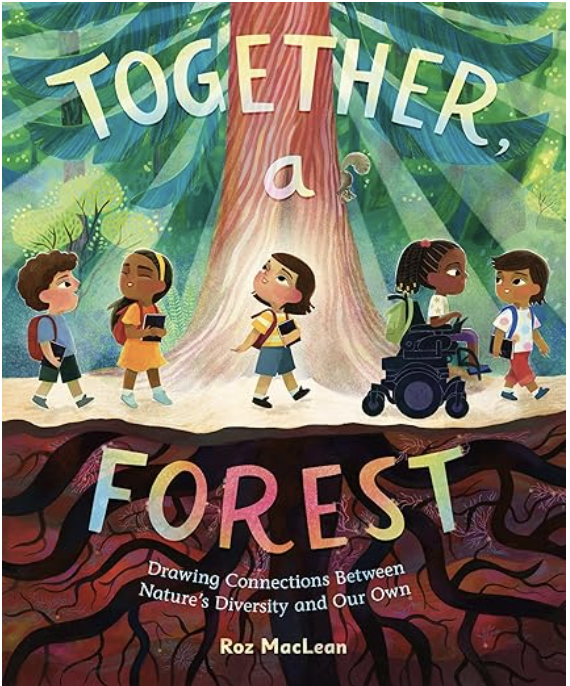
Some days it’s the unplanned lessons that have the best results. A few weeks back I came across a picture book that looked interesting. I ordered it, it arrived, and I set it aside. Then yesterday, our first day back after spring break, I found myself with some unclaimed time and reading a book seemed like the perfect solution.

I walked over to the shelf where I stash the books I haven’t gotten to yet…and Together, a Forest: Drawing Connections Between Nature’s Diversity and Our Own called out to me. I started reading the book and those wiggling post-lunch students settled. We learned about different students in the book and their affinity to plants and animals in the forest. There was the student who was interested in everything–and forgetful–just like the squirrel who buried acorns and the ones it forgot later grew into trees.

We started to think about the plants and animals who were like us…and while we didn’t have enough time to finish the book, the seed was planted in the poetry ecosystem that is our classroom.

Today our planned ceramics project went well and we finished successfully before recess. That meant the time I had allowed for the completion of the project after recess was now open and free. So, we went back to Together, a Forest and completed the reading and discussion. And then we started thinking about that question from yesterday…what plant or animal are you like?

The first graders grabbed their notebooks and started to write. They asked the usual questions, “Does it have to be a plant?” (No) “Does it have to be a part of a forest?” (No) “Can I use metaphorical thinking?” (Yes). I wrote–and I made the rounds around the classroom peeking over shoulders, listening to ideas, watching these comparisons turn into small poems, taking root in this poetry ecosystem.

J wrote:

I am an army ant. My super power is strength and I work with people. I eat fruit and I get it at the store then bring it home. My strength is teamwork.

H wrote:

I am an octopus. I am smart. I act like I have eight hands and I am super fast and tricky and change colors.

B wrote:

I am moss. I am like moss because I soak up everything I hear. I remember everything and if it is something bad I can squeeze it out.

And I wrote:

I am an egret. I am quiet and still. Patience is my super power. Most of the time I am good at waiting and thinking. Other times I startle and fly off in a flurry of feathers. I am good at being alone without being lonely. I love to reconnect with my family at the end of the day.

These first drafts will be fodder for the writing we will continue to do, this month and into the future. Right now, my students are writing easily, adding details and elaboration, beginning to play around with language and ideas…and willing and eager to read their writing aloud to their classmates. We have truly built an ecosystem of poetry and writing in our classroom.

Quirky Birds: SOL25 Day 7

For the first time in my teaching career, this year we have been allotted two days (we get a sub to cover our class) to write report cards. We do write report cards three times a year, but two days is better than none since report card writing always falls to “do it at home in the evening or weekends” time. So today was a report card writing time for me since parent-teacher conferences begin soon.

As I was writing report card comments, I found myself thinking about the joy of quirky kids. You know, the one who has a million questions even after I have carefully explained what we are doing. Or the student who can’t resist singing in full voice while everyone else is quietly working. There’s the student who wears the chunky gold chain–an aspiring rapper? Or the one with the cat ear headband (when did those become so popular?).

I think I may be drawn to the quirky birds. I know when I am walking on the beach, I notice the birds that stand out in some way. It might be that shore bird that hops along on one leg with the other tucked up tight against its body. Or the osprey that swoops down and then rises up with a fish firmly clutched in its tremendous talons. But more than likely it’s a snowy egret.

I love snowy egrets. There’s something about these tallish birds with long graceful necks and long beaks…and wait for it…bright yellow feet–that always make me smile.

Just last week I saw this character.

And fell in love!

That wind ruffled hair…and that foot! A bright yellow foot in action. Snowy egrets use those quirky feet of theirs to stomp around and stir up fish and shrimp and other seafood delicacies from the tide pools. I’ve learned to creep up quietly with my camera in hand to take photos of these beautiful and often quirky birds. I love to capture them in action…somehow freezing the movement into a still that still shows their liveliness.

So here’s to quirky birds and quirky kids…celebrating all the differences that make life lively and interesting.

How to Take a Photograph: SOL25 Day 2

Have you read Kwame Alexander’s picture books? I love How to Write a Poem and use it with my first graders to help them understand metaphor and metaphorical thinking. Last week I read How to Sing a Song first to remind my students about metaphor and its power in writing and then again a few days later to use a mentor text.

I had taught my students some photography techniques (bird’s eye view, bug’s eye view, and rule of thirds) and then we all headed out to our fairy garden (as they kids call it–adults know it as the pollinator garden) and the playground to try out the techniques. Once back in the classroom, each student picked a favorite photo and studied it carefully.

That’s when that second reading of How to Sing a Song came in. We looked at the text carefully, noticing how the writing was working to describe music. Then came the challenge. Students (yes, first graders) set out to write a How to Take a Photograph version of these books we love. I also suggested that my students consider using their senses to help them come up with their metaphors.

Here are just a few of my students’ works in progress:

First, make a target then decide if you like or not, then take a deep sniff of the blazing violet flowers.

The snap of my iPad is like thunder in the forest, the sound of birds chirping as if they are instruments.

The wispy chews on the leaves look like they got beaten up by a caterpillar.  It sounds like the green leaves are talking to me.

I took this photo on our playground.

And alongside my students I wrote this draft with them as my audience:

How to Take a Photograph

Step out. Breathe in everything you see like a cool breeze. Zoom in close like a magnifying glass. Tilt and find the perfect diagonal where the palm tree overlaps with the climbing structure. Taste the cool of the silvery metal and frame it in the lower third. Listen with your eyes and hear the sounds of children playing, hanging from the braided ropes. Push the button….slowly, carefully, purposefully. Your photo will sing for others to hear and sing along.

If you haven’t had a chance to read these books (there’s another called How to Read a Book), I highly recommend them–even if you don’t have a class of children to read them to! What are your favorite picture books that every adult should know?

Poetry is Sunshine: NPM #28

Today we studied Francisco X Alarcon’s poem: Words are Bird as our mentor text. My students noticed that way words were described as birds, something that was new for them to think about. It took a bit of work and experimentation for the kids to find their own metaphors. Some that they came up with included: hand sanitizer is a warrior, trees are magical, and words are gum in your hair. I was a bit skeptical about that last one–and expressed that while I wouldn’t rule it out, it seemed like a difficult one to write for a word lover like me (and this student happens to be a word lover). While I don’t have the text in front of me to share with you all, let me tell you that she did manage it…in some interesting ways!

I may have taken the easy way out, writing my poem about poetry. Here’s the draft I wrote with my students today:

Poetry is Sunshine

Poetry is sunshine

that brightens each day

shining its light

on words

emotions

new ways to think

about the world.

Some poems reach deep

burning a little

touching on something

tender and sore.

Sometimes poetry

warms us from the outside in

when we’re struggling

to warm ourselves from the inside out.

Poetry blazes

even when we don’t see it.

Covered by clouds

it waits,

until we’re ready

finally burning its way through

the thick marine layer.

It’s the center

of our solar system

the gravitational pull of words

that express

our humanity.

®Douillard

What Does it Take to Thrive? SOLC 2019 Day 14

I walk below these cliffs all the time, noticing the canyons and wrinkles wind and water carve along their faces.  I see evidence of human interference, the places where lawns and ice plant hasten the natural erosion of sandstone along the beach.  I’m mindful of walking too close to the cliffs, remembering days when huge chunks let loose and fall to the shore.  I wonder about the multimillion dollar homes perched on the edge–the ones with the incredible views of the Pacific Ocean–that are in danger of dropping into the sea during the next big storm.  Are those homeowners insured for cliff erosion?

Today’s blue was intense, blues that need words like cerulean, azure, and cyan to begin to describe the richness of the color.  And the blue was punctuated with thousands of small orange butterflies…on a mission headed north.  It was almost as they were emerging from the sea, flying straight for the cliffs, then up, up , up.

lrg_dsc02210

Oddly, though, my eyes were drawn to a small bunch of yellow flowers high on the wind-blown cliff, a tiny patch of blossoms flourishing in hardscrabble sandstone.  I’m reminded that some of us make the best of where we are planted and take advantage of whatever resources are available…not dependent on soil amendments, special fertilizers, and protection from wind and other elements.  What does it take to thrive in sandy soil and harsh conditions?  Sometimes the blue skies, mild temperatures, and more plentiful than average rainfall is enough.

lrg_dsc02218