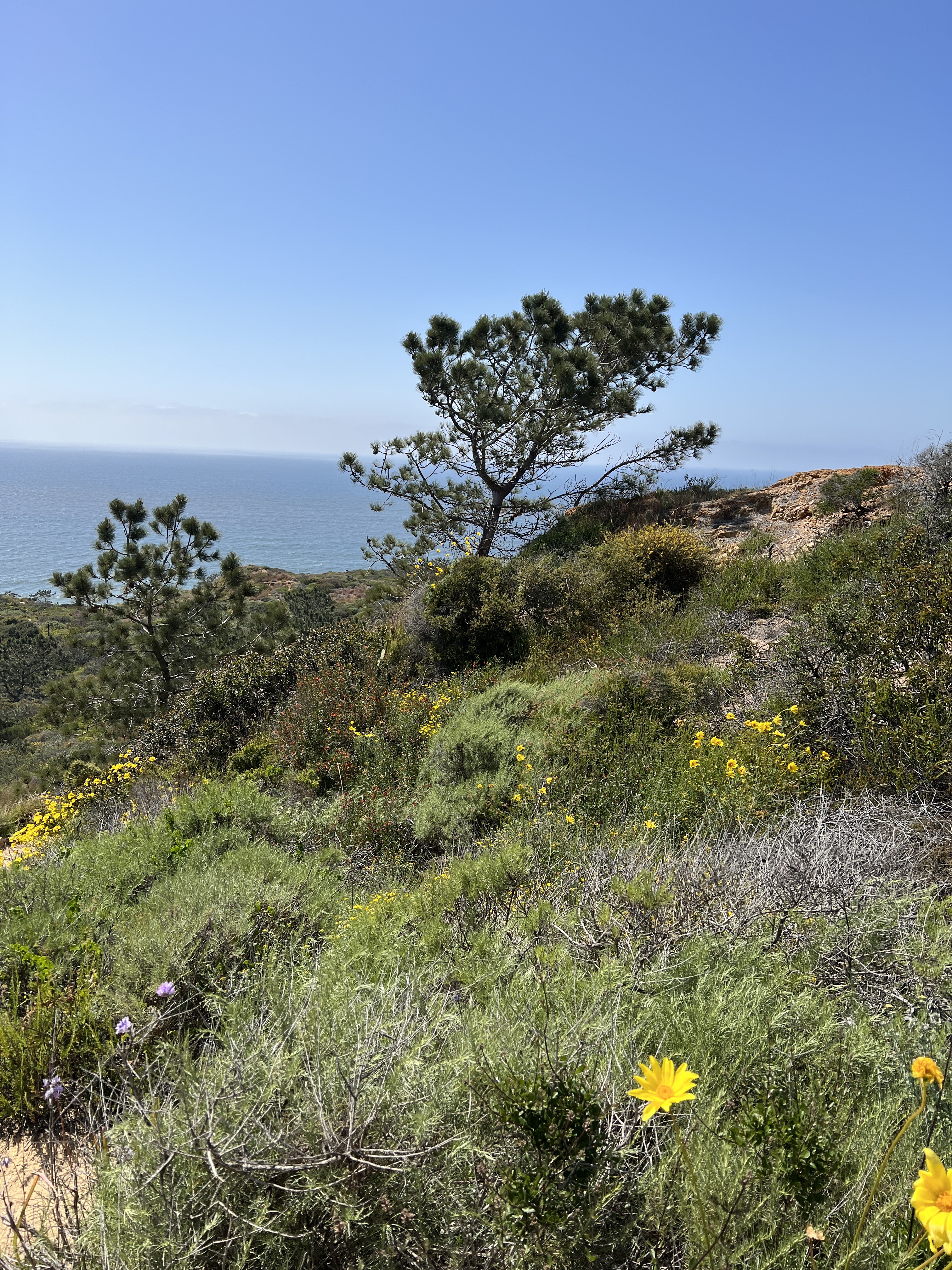
Yesterday we drove to the far reaches of our county to see and appreciate the diverse natural beauty San Diego is known for. Today we went local and visited a place nearby–Torrey Pines State Nature Reserve. We frequently walk the beach there, but today we decided to hike the trails of Torrey Pine groves and cliffs above the beach. Drought and beetles have devastated these special trees that only grow here on the cliffs above the beach and on Santa Rosa Island (one of the Channel Islands). Today, after the abundant rains we had, the trees looked happier than I’ve seen them in a long while–and the native wildflowers were in full bloom. The #verselove prompt for today was to bring a historical figure to life in a poem. Instead, I chose to focus on the Torrey Pine tree in an etheree-ish form (a poem that grows from one to ten syllables). We’re lucky to have this Reserve that is focused on protecting natural places so that future generations can also enjoy them. Maybe a poem and photo can help too.
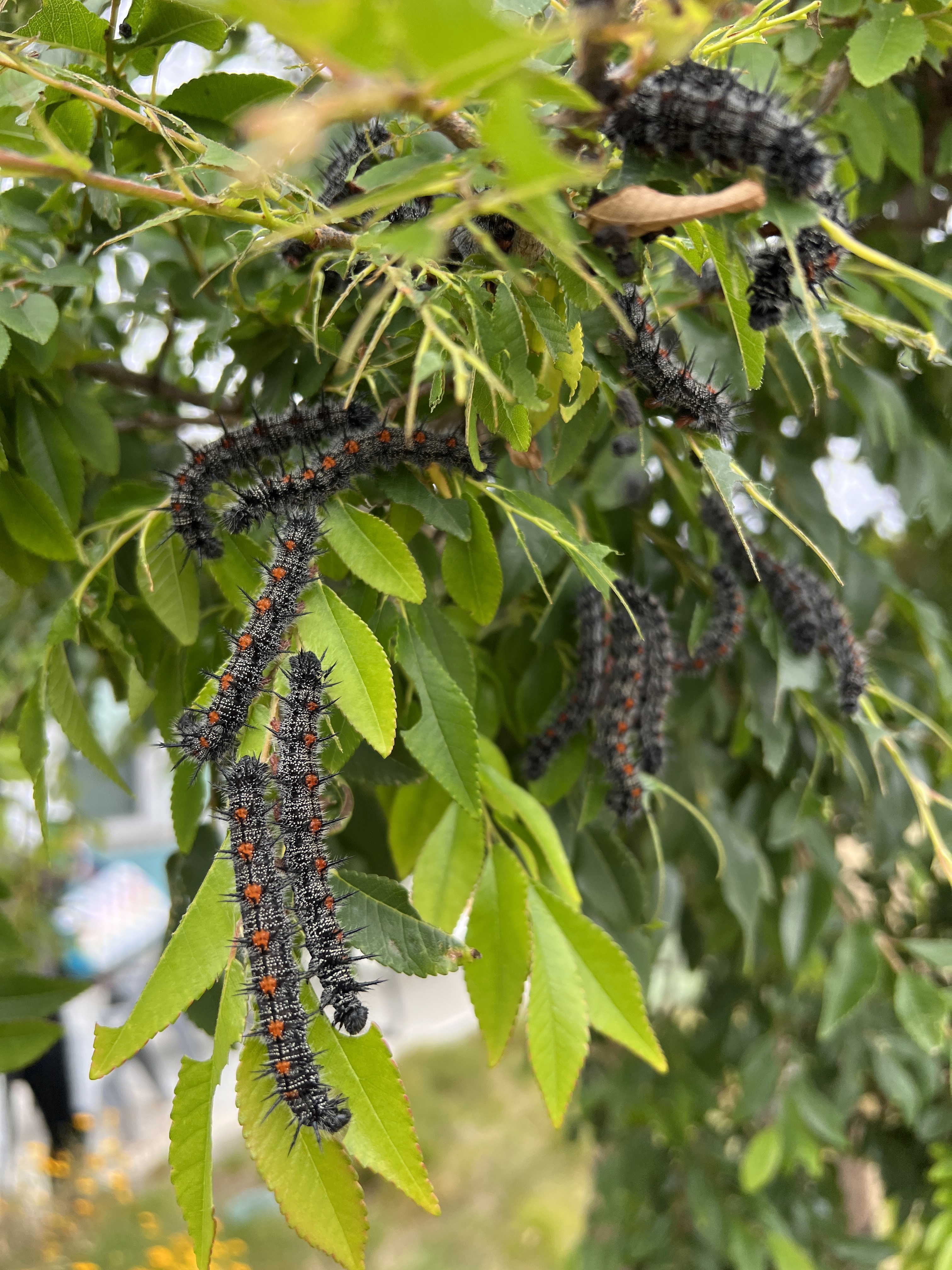
An invitation to write a science poem–yes please! And the serendipity of our caterpillar sighting at school today made the perfect topic for the “whimsical science poems” at #verselove that Brittany prompted.
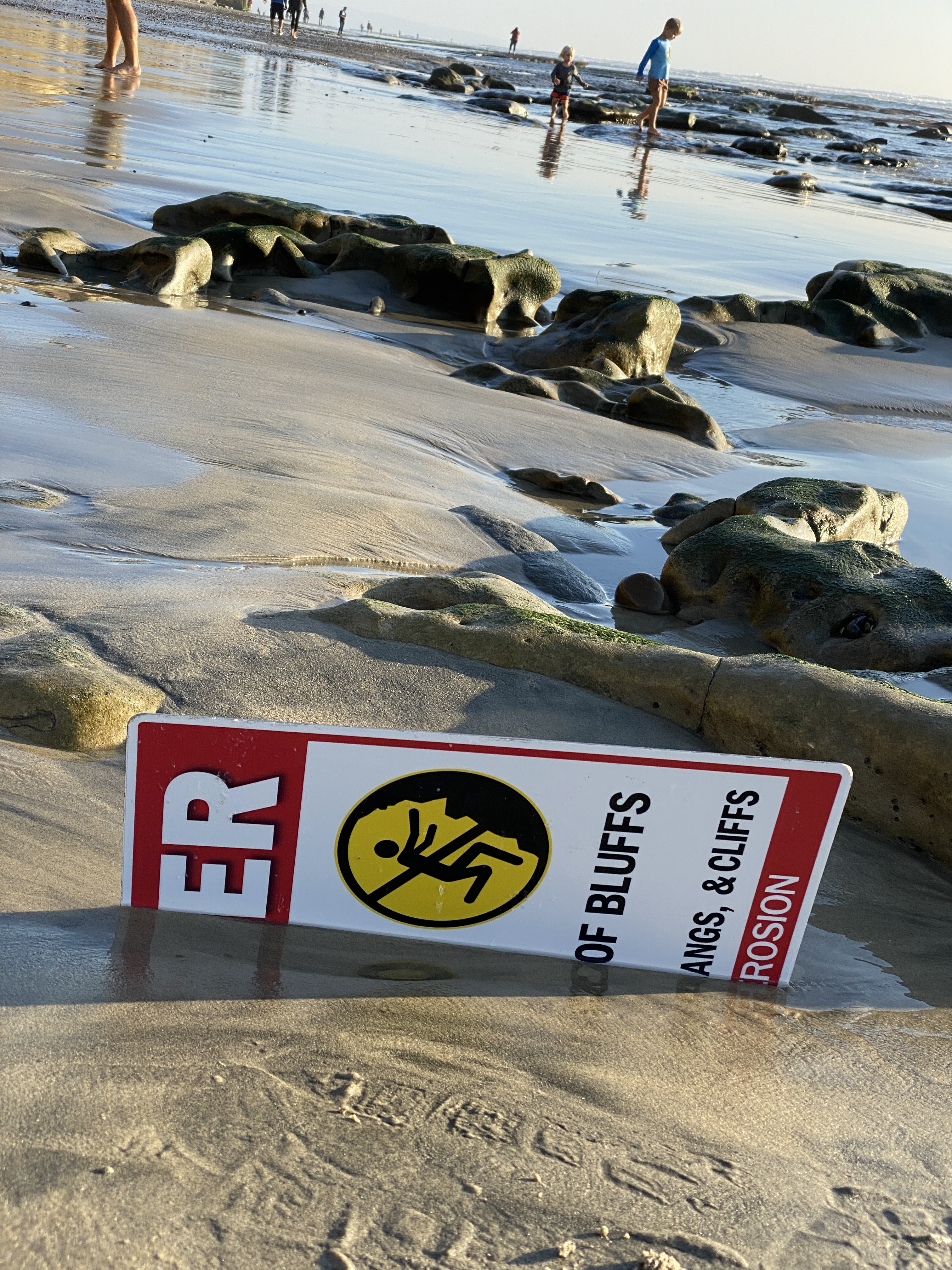
Today’s #verselove prompt was “death in a poem” and I struggled. My mind searched for ways to weave the theme of death into something I could handle on this last weekday of spring break. You’ll not be surprised that I turned to nature. I was thinking about the difference in the way we describe landslides (or in our parlance, cliff failures) on the southern CA coastline as compared to the way that landslides were described in Zion National Park. There, the landslide was an expected way that nature sculpts the landscape. Of course, there were also not multimillion dollar homes perched along the rim that crumbled. So, I’m not so sure that this qualifies as death in a poem, maybe instead it is life in a poem. I chose to use an etheree–a 10-line form that begins with a single syllable and build, adding a syllable to each line until you reach the tenth line with ten syllables.
On day two of National Poetry Month the #verselove prompt was to write a coffee share poem…a way to connect and introduce yourself. But after spending my day exploring Death Valley National Park, the coffee shop metaphor didn’t feel quite right. so instead, just come walk with me!
Come walk with me
I’ll tell you about the power of my friend camera
And how it’s changed the way I see the world
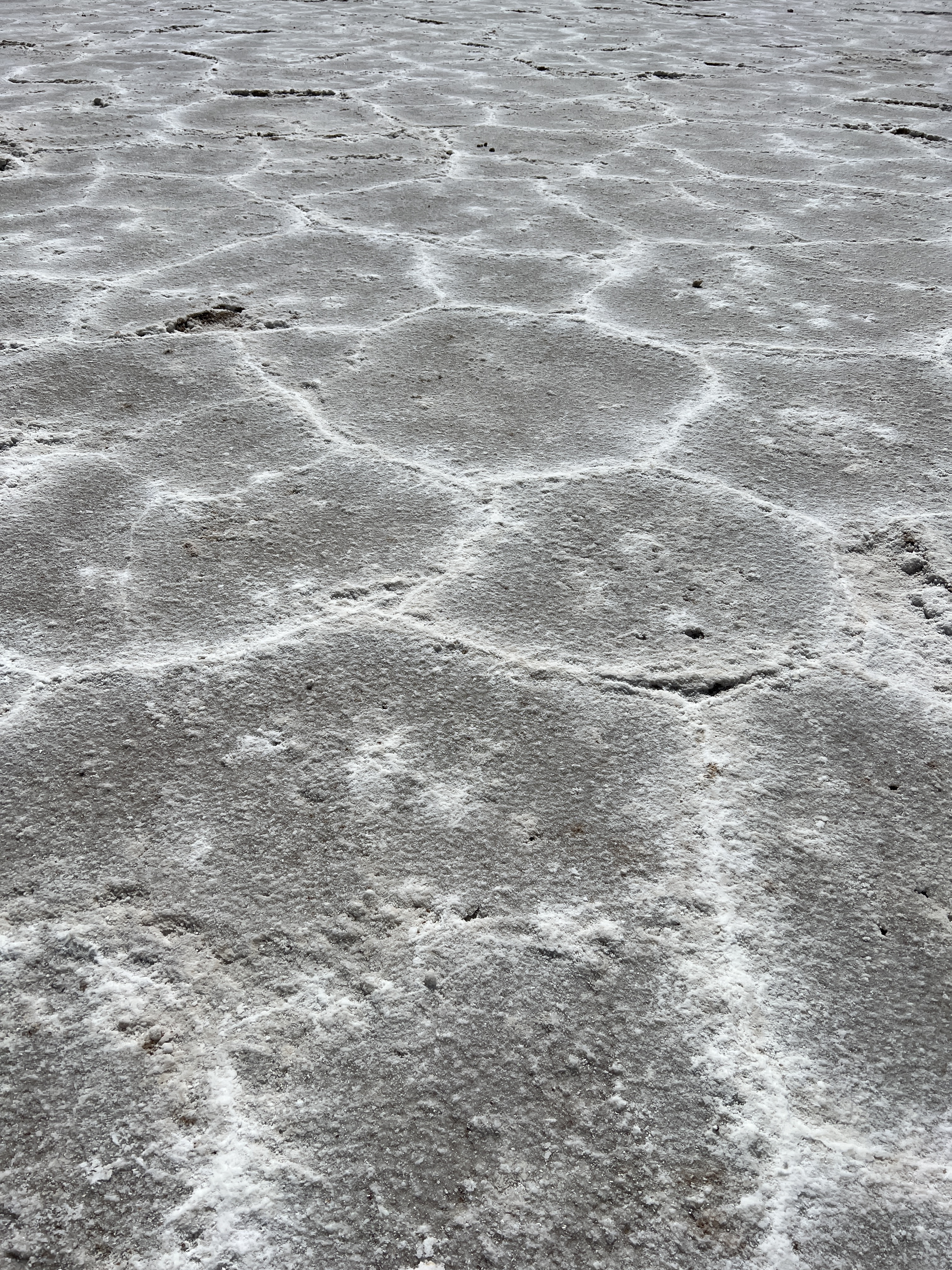
Noticing details of salt flats
Almost hexagonal frames surrounding minerals dried in the hotter than hot desert sun
Salt Flats at Badwater Basin in Death Valley National Park
Come walk with me
I’ll tell you how walking helps me explore
Taking me out of my head and into nature, even the nearby nature of my backyard
To hear the wind and birdsong and the steady beat of my own heart and feet
Come walk with me
I’ll tell you about the inhale
of hope and possibility that comes with time immersed looking, thinking, breathing
Don’t forget the exhale, breathe out stress and negativity
First graders are slow, especially when you want them to speed up. Today we were running late to get out to the line of cars picking students up after school. I was hustling along, trying not to tie up the line that sometimes snakes out of the parking lot, down the street, and then threatens to spill out onto the busy street around the corner. I turn around and I have only one student with me. The rest have stopped back inside the gate where they are crouched down, faces peering closely at the rain-wet sidewalk. Parents are peering in, probably wondering just what is holding their children up in there. But I knew. My students are nature lovers with the softest, kindest hearts and no regard for time as we adults know it. And sure enough, they were saving a slug from the potential trample of the oncoming feet of other classes.
On so many occasions, my students seem to slither forward, maybe an inch at a time. Putting away headphones and iPad–that seems to take an eternity. Zip up the backpack (if you have managed to cram the items actually into its belly instead of having them slip out in all directions), another lifetime. Put your name on your paper, along with the date…still waiting.
But head down to recess…wait, don’t run me over! Where did this speed come from? These slow-as-snail kids can go from 0-50 in no time when the word recess is associated!
I love art. The kinds in museums like the MOMA and MOCA as well as many other smaller and less well known museums. I love the kind of art that kids make in school, especially the versions that allow space for individuality and creativity.
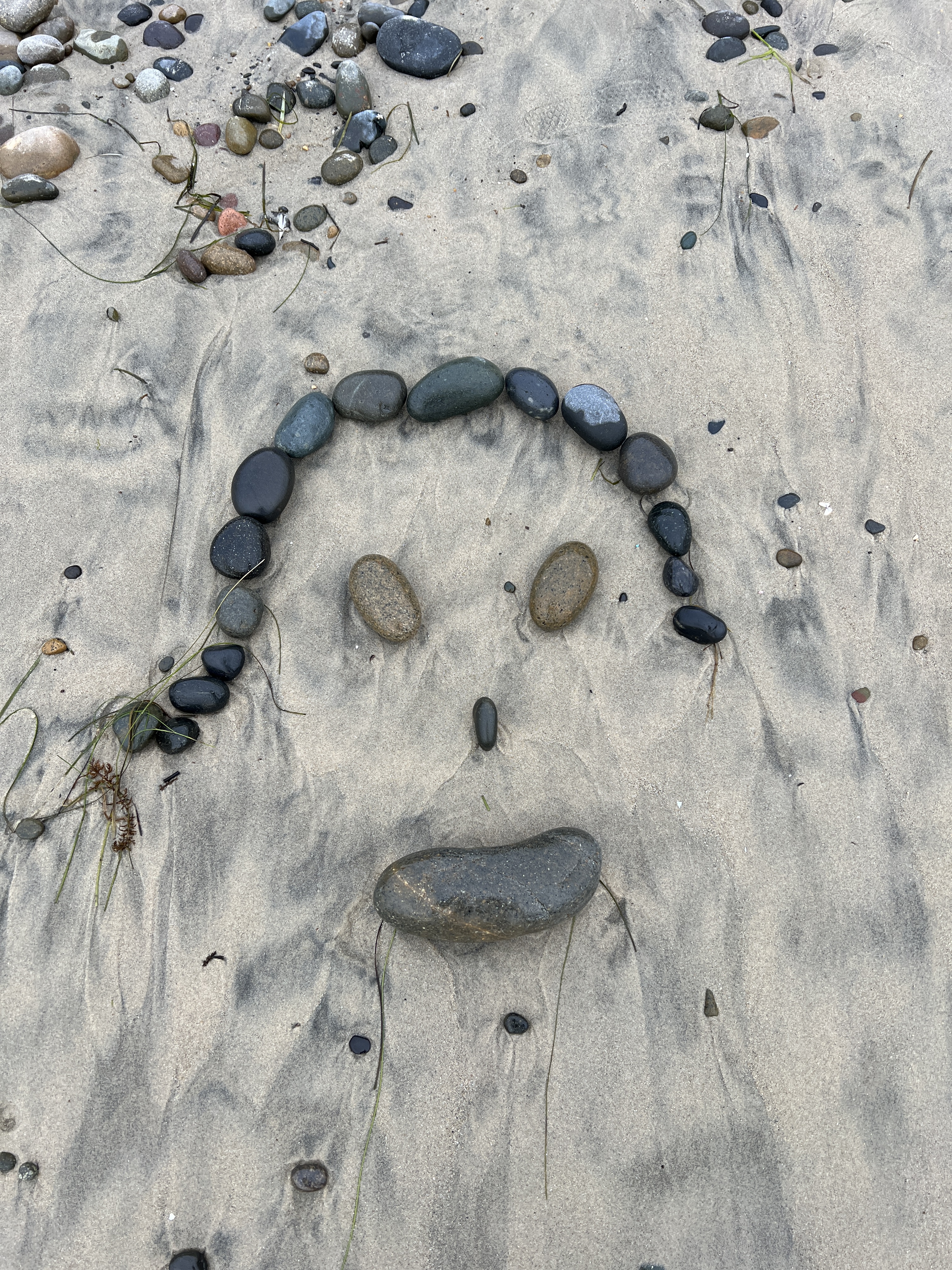
And I love the kind of art that shows up unexpectedly. Like a face peering up out of the sand, a small array of rocks, perfectly arranged to show the flip of the hair, monochromatic and striking in its simplicity.
Then there is the abandoned collection, carefully selected and arranged. Tiny shells and shiny rocks, bits and pieces of sea life laid out to be appreciated.
I love the art that is composed, either by human or by nature, with attention to an out-of-place detail that draws the eye and says, “look at me!” A single delicate blossom, maybe swirled in the briny breeze until it landed, planted in contrast to the worn edges of the sea-tossed rocks.
And the abstract composition that can only be crafted by nature’s hand, reminiscent of the polka dots Yayoi Kusama is known for, carved by wind and water. Is it art or an apartment building for sea creatures, algae, and insects?
I love that art is both made and found, and that it is open to the interpretation of the maker and the viewer. As the mom of an artist, I recognize that art emerges, oftentimes without a fully formed narrative that explains its creation, meaning, and significance. It emerges from materials, from a spark, from a moment…or from struggle, wrestling to free itself to find the light and maybe a new audience.
What art have you made, found, or supported today?
Today we read The Keeper of Wild Words by Brooke Smith. My students were immediately drawn into this story about a grandma (Mimi) and her granddaughter (Brook). Mimi is worried that important “wild” words will disappear if we don’t use them, know them, write them, and care about them. Mimi and Brook have a list of wild words and set off into the outdoors near Mimi’s house to find the words (natural things) on the list. From wrens to dandelions, minnows to drakes, Mimi and Brook identify and appreciate all of the words on the list. In the author’s note at the end, Brooke Smith tells about her inspiration–an article about removing over 100 natural words from a children’s dictionary to make room for words like vandalism and MP3 player.
After we read and talked, we started our own lists of wild words. We had talked about how some people were already being keepers of wild words, noticing one of our students with the name River is keeping a wild word from disappearing. Of course, we had to add River to our list. You might not be surprised to learn that these southern California first graders were quick to add ocean and sunset to their lists of wild words. I had to add egret to my list–my students know I am obsessed with this quirky shore birds with the bright yellow feet.
These young naturalists were inclined to add general words–trees, sky, and clouds, so I encouraged them to be more specific. One student started writing phrases to capture her ideas more fully (she definitely wanted constellations on her list after some sky gazing over the weekend with her family).
Words matter and paying attention to wild words is another way of focusing attention on our natural world. Appreciate for and knowledge of nature and our environment is essential. I’m hopeful that the next generation will reclaim wild knowledge as they work to regenerate the resources that are on the verge of disappearing, just like the wild words Brooke Smith brought to our attention.
This week in my first grade class, we have been learning about Jane Goodall. My students love that, just like they do, she loves animals. I love that they recognize patience is a tool she used in her research, that building relationships takes time and effort–and sometimes that effort means just being present until trust is built. Showing up, paying attention, and caring are key.
Jane Goodall, according to her picture book biography The Watcher by Jeannette Winter, was always curious and a supreme observer from an early age. She watched bugs and chickens, recognizing that careful observation was a rich source of information.
To try on Jane’s observational skills, we headed outside with notebooks and pencils in hand to use our senses in the school pollinator garden (better known by the students as the fairy garden). The directions were simple: find something interesting, watch and notice using all your senses (we acknowledged we wouldn’t be tasting anything before we headed out), make a sketch of whatever you are observing, include writing to add details about what you are noticing.
The synergy of observing under the influence of Jane Goodall and writing outside resulted in a magical writing experience. Students were focused and engaged–there is nothing like watching a formerly struggling writer putting words independently on the page and then asking for more time because he had more to say. And the unexpected, “thank you for teaching me today,” from the high performing student–who had experienced joy writing outdoors. This experience with ordinary nature, the ants, the sticks, the fallen leaves, some lavender, a few bees, the sun on our shoulders and pencils in hand inspired us. We wrote and learned and shared under the influence of Jane Goodall and her indomitable spirit and the magic of being outside, in nature.
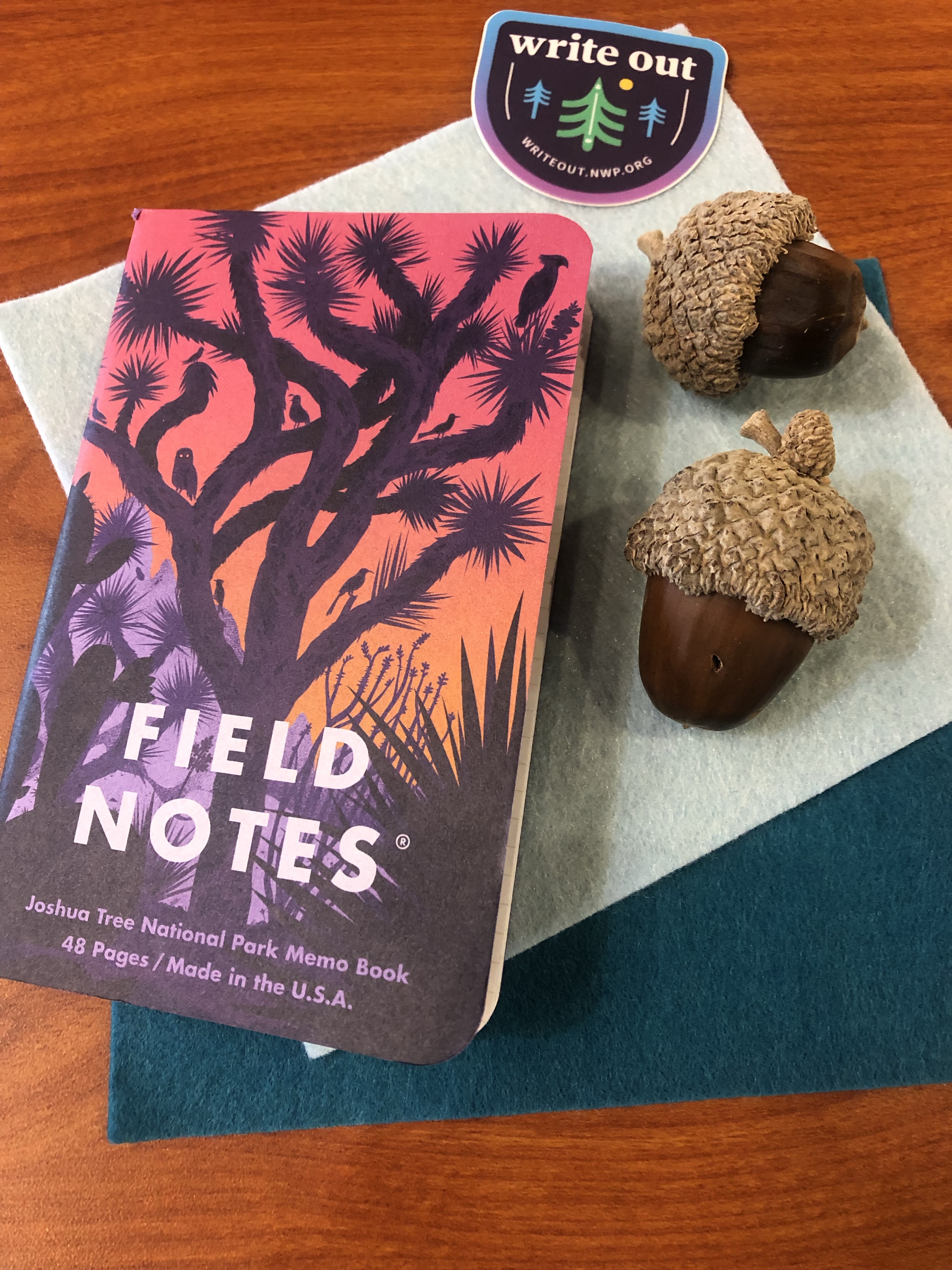
When life gives you acorns…turn it into a #writeout inspiration!
On Saturday I found myself at UC Davis meeting with an incredible group of writing project teachers from all over the state as we launched year 2 of our CWP Environmental Literacy and Justice Collaborative. In that space we imagined all the ways to support our students as they learn about the earth and its systems, grow their appreciation of the natural world and resources we share, and use writing to think, to reflect, to question, and to advocate for the world we need and want for ourselves and for our future.
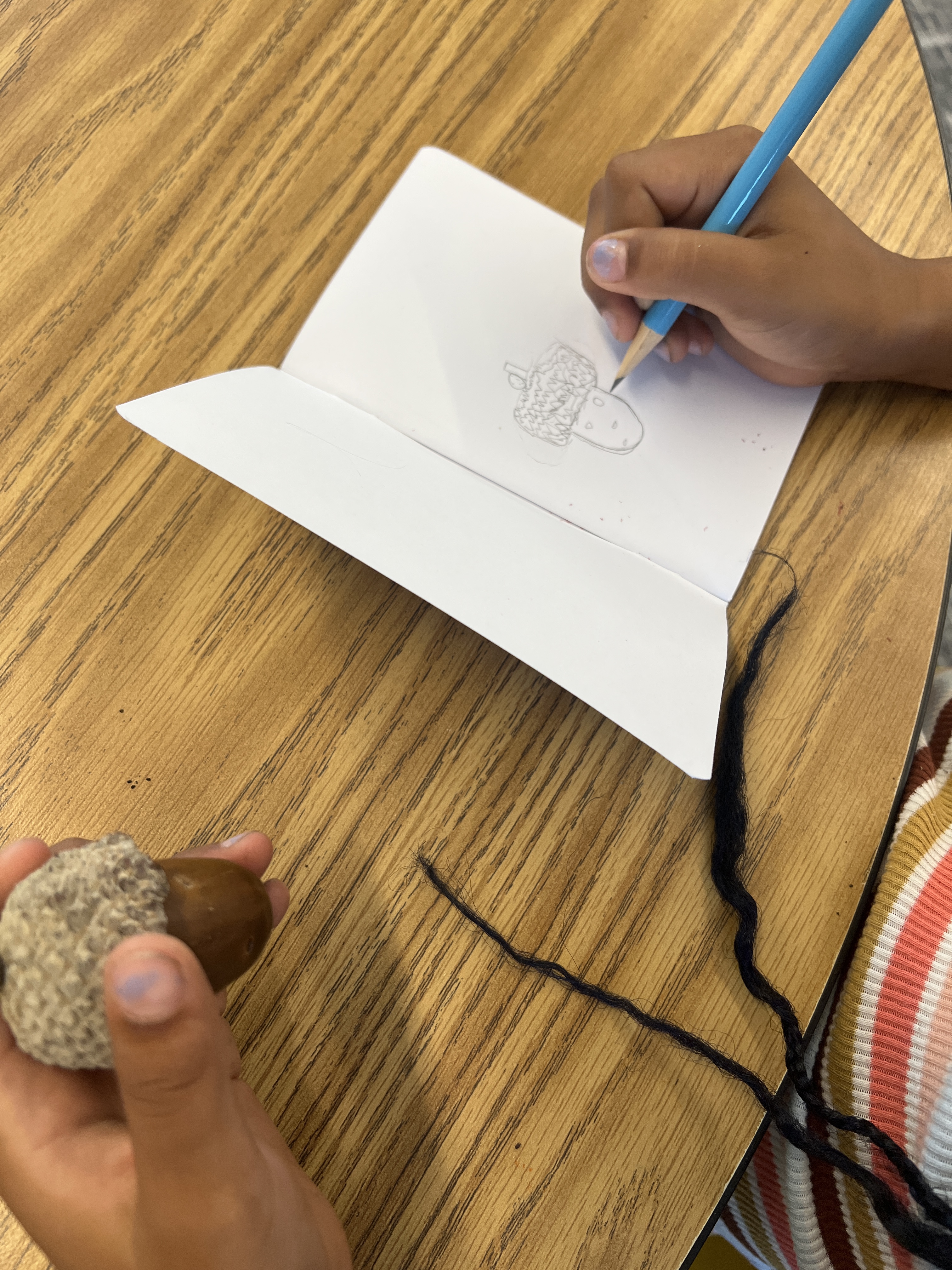
My colleague Carol brought some wonderful acorns she found in her neighborhood as inspiration for a making project…and lucky me, I ended up taking the extras home with me to use in my classroom. These acorns are bigger than the ones I am familiar with…and so beautiful!
And they were perfect for the book I had already borrowed from the library to read this week–Because of an Acorn by Lola Schaefer. After reading and studying this deceptively simple text, we talked about what they noticed in the book. They were quick to notice that it included aspects of life cycles…and they loved the cutouts on the first and last pages. Serendipitously the NWP Write Out newsletter included a link to a video about acorns by a park ranger at the Sequoia and Kings Canyon National Park. My students loved learning more about acorns–and the ways that trees communicate with each other.
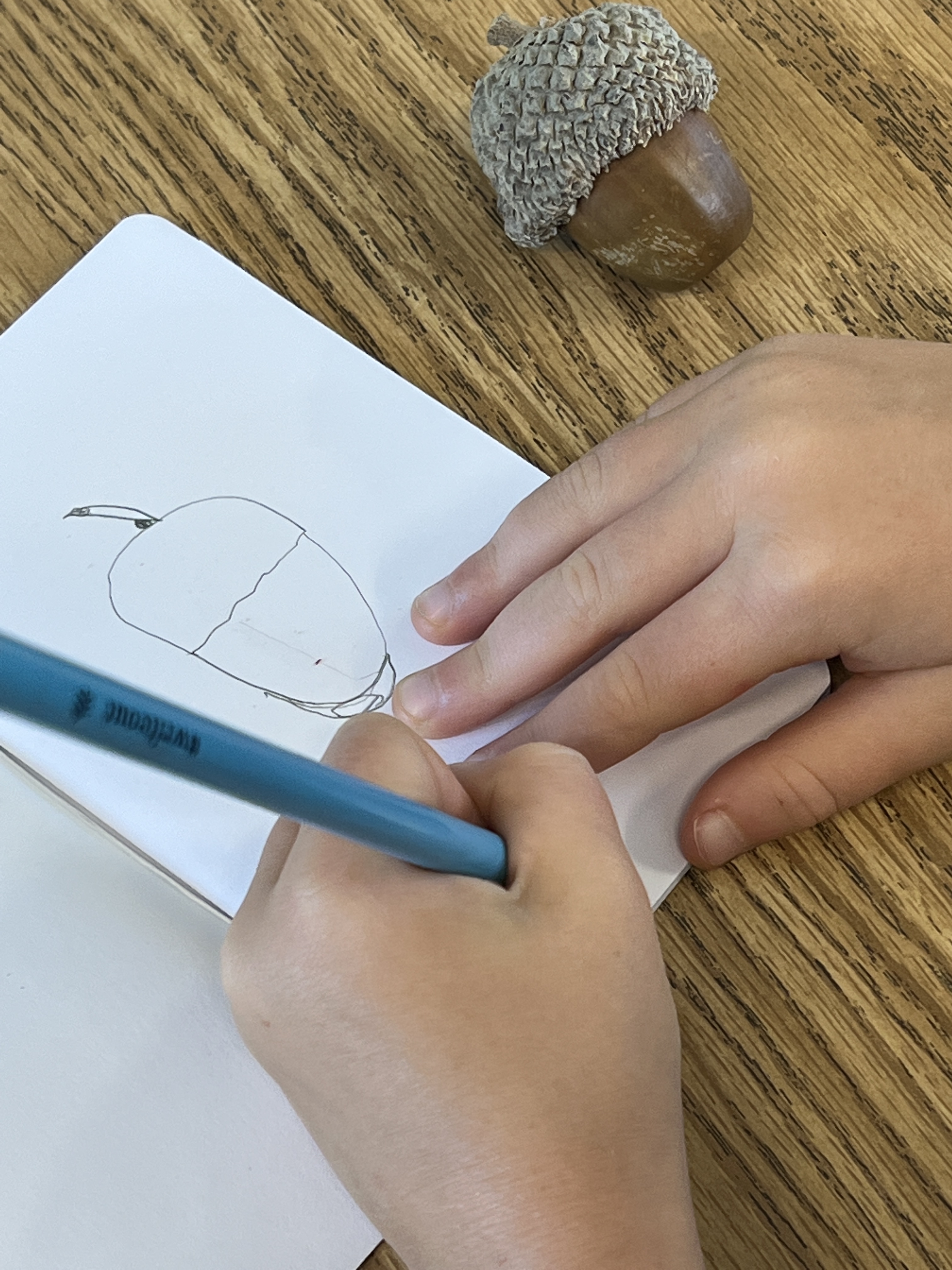
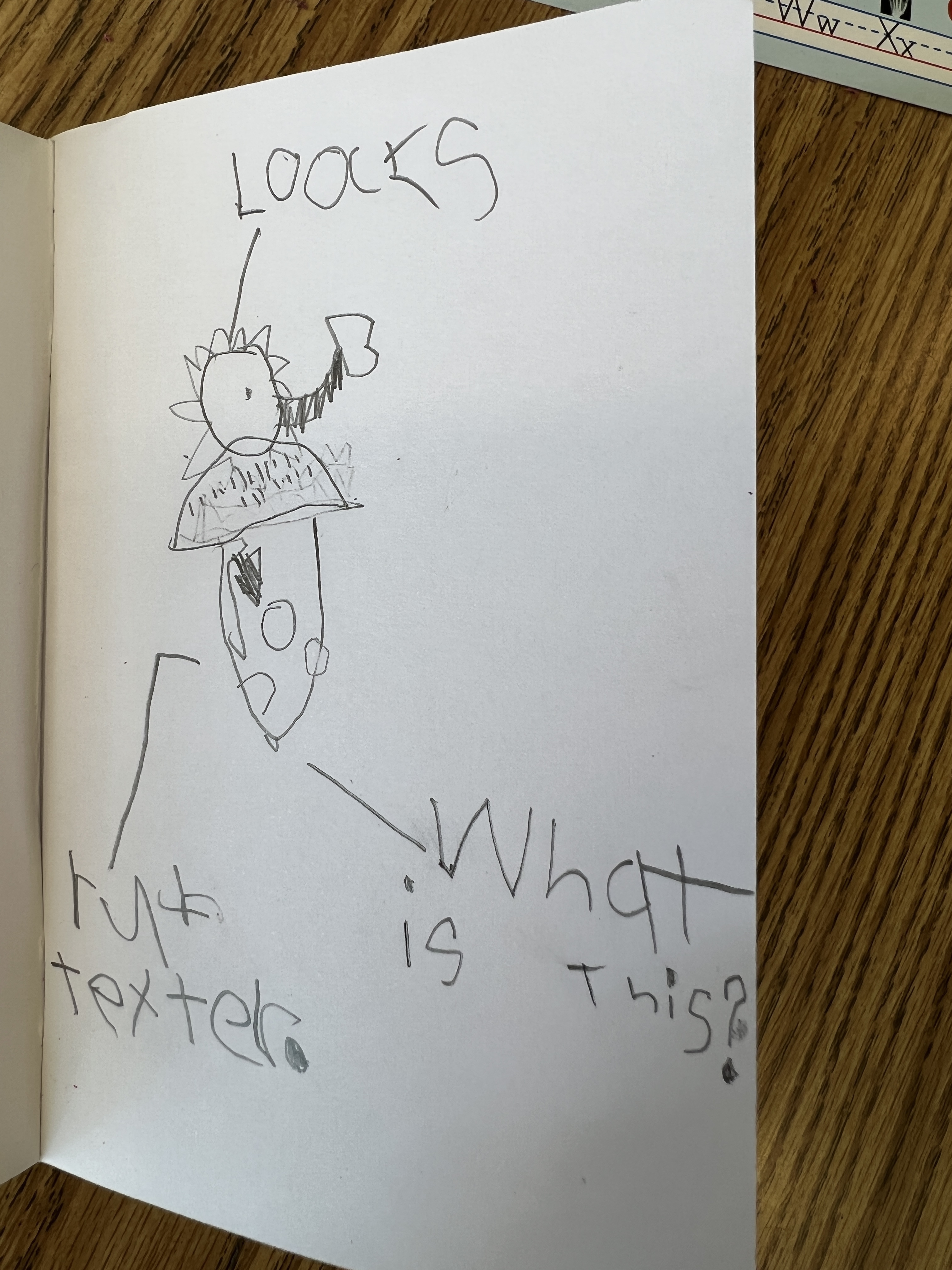
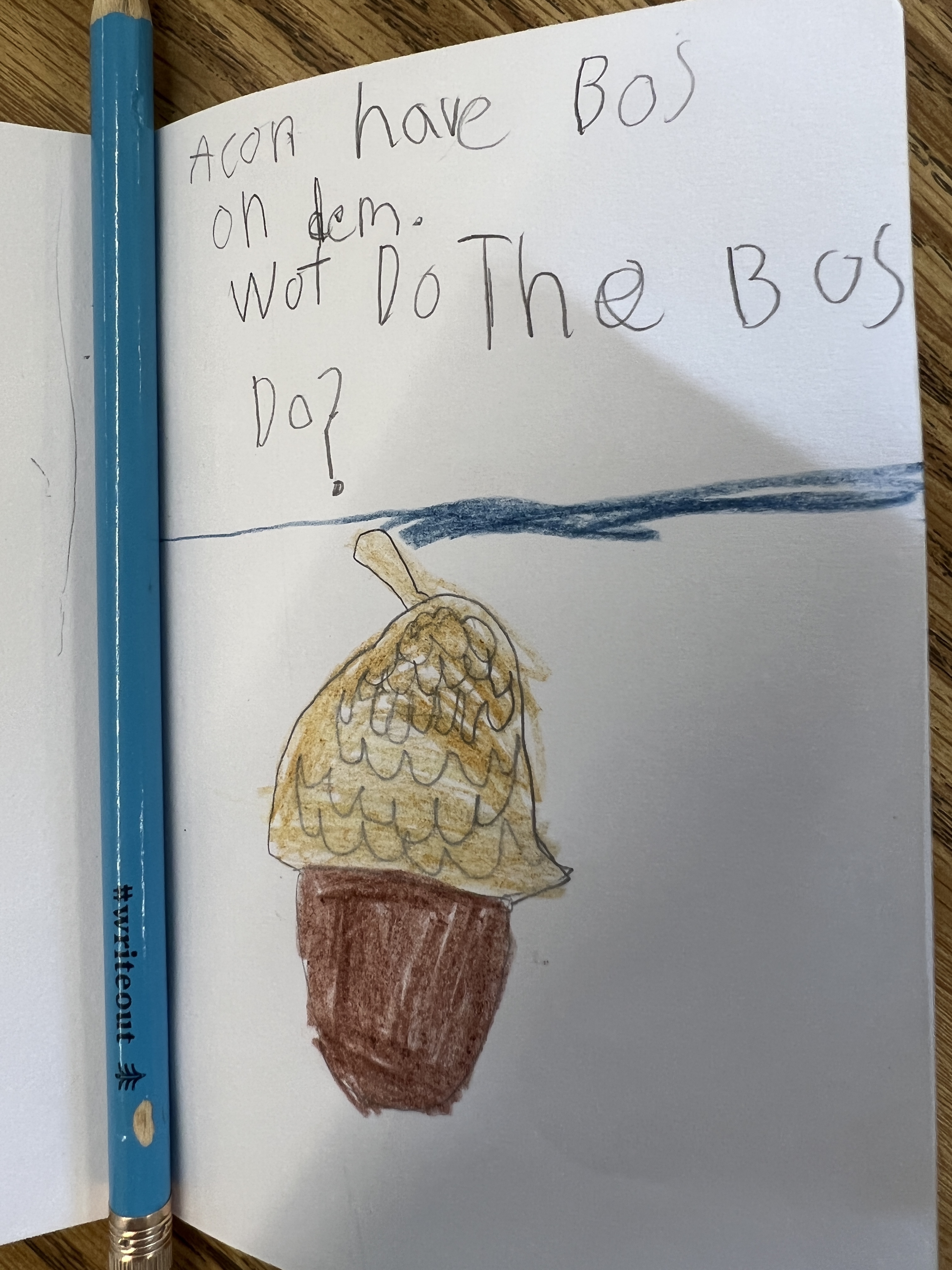
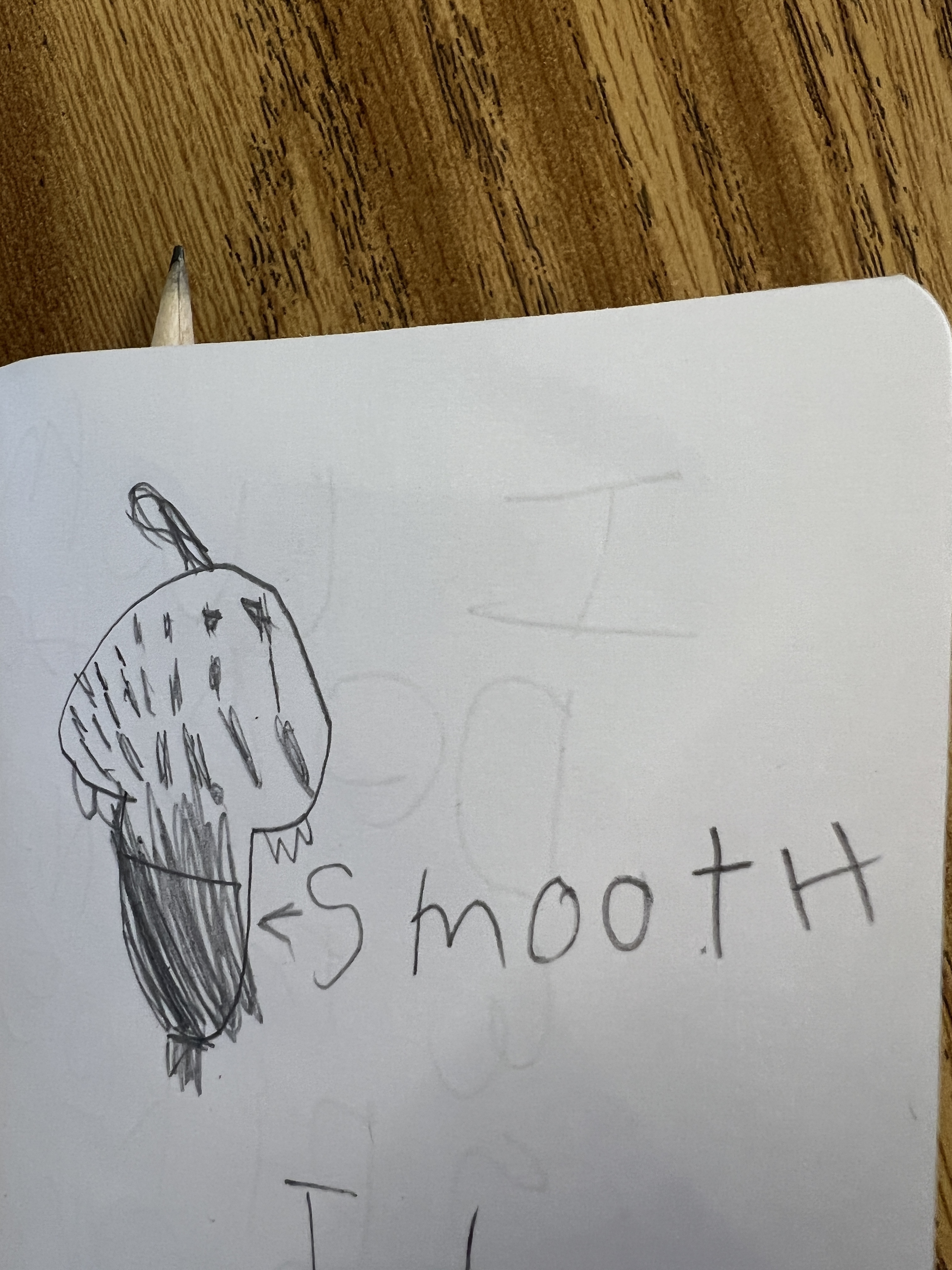
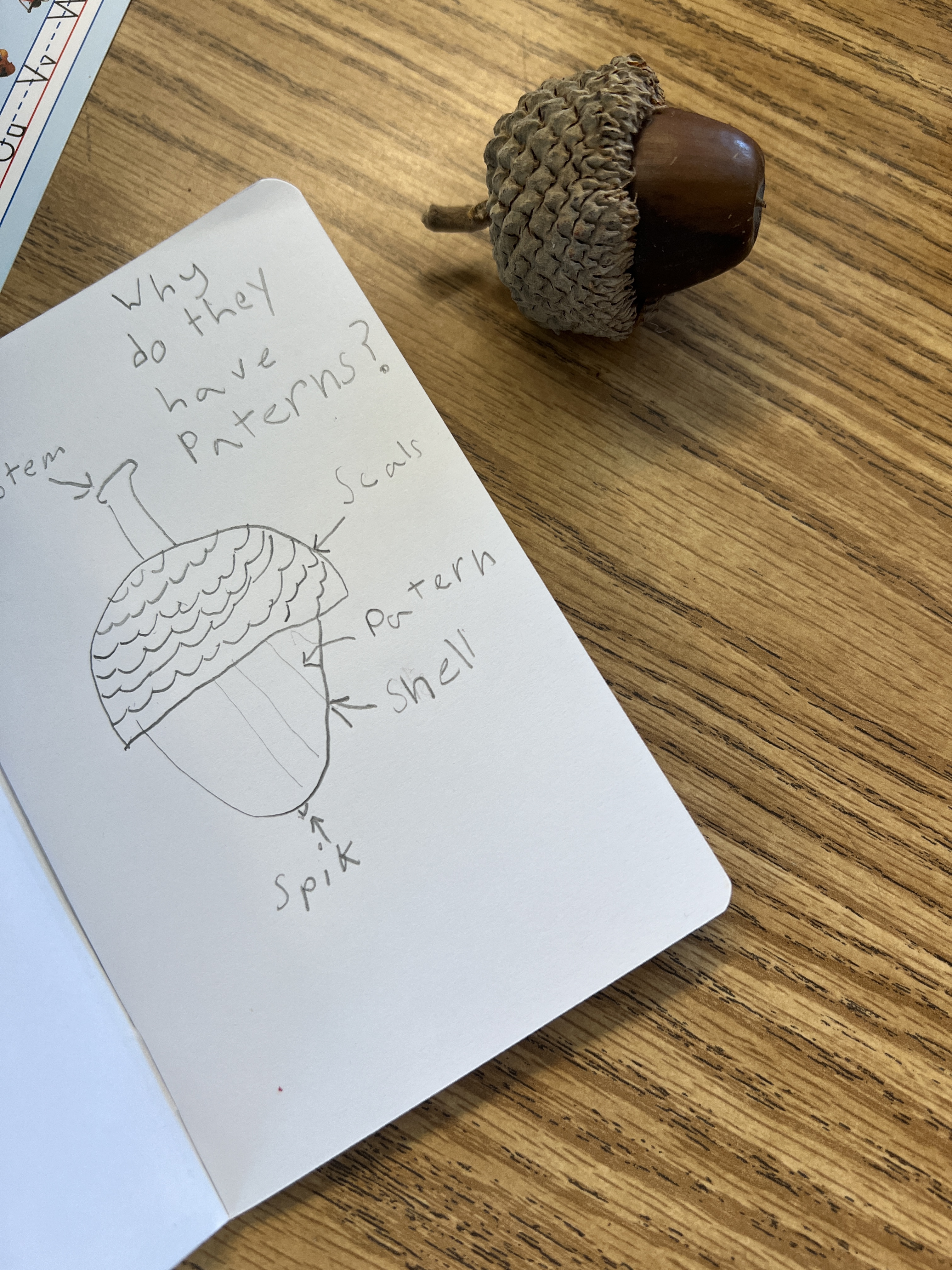
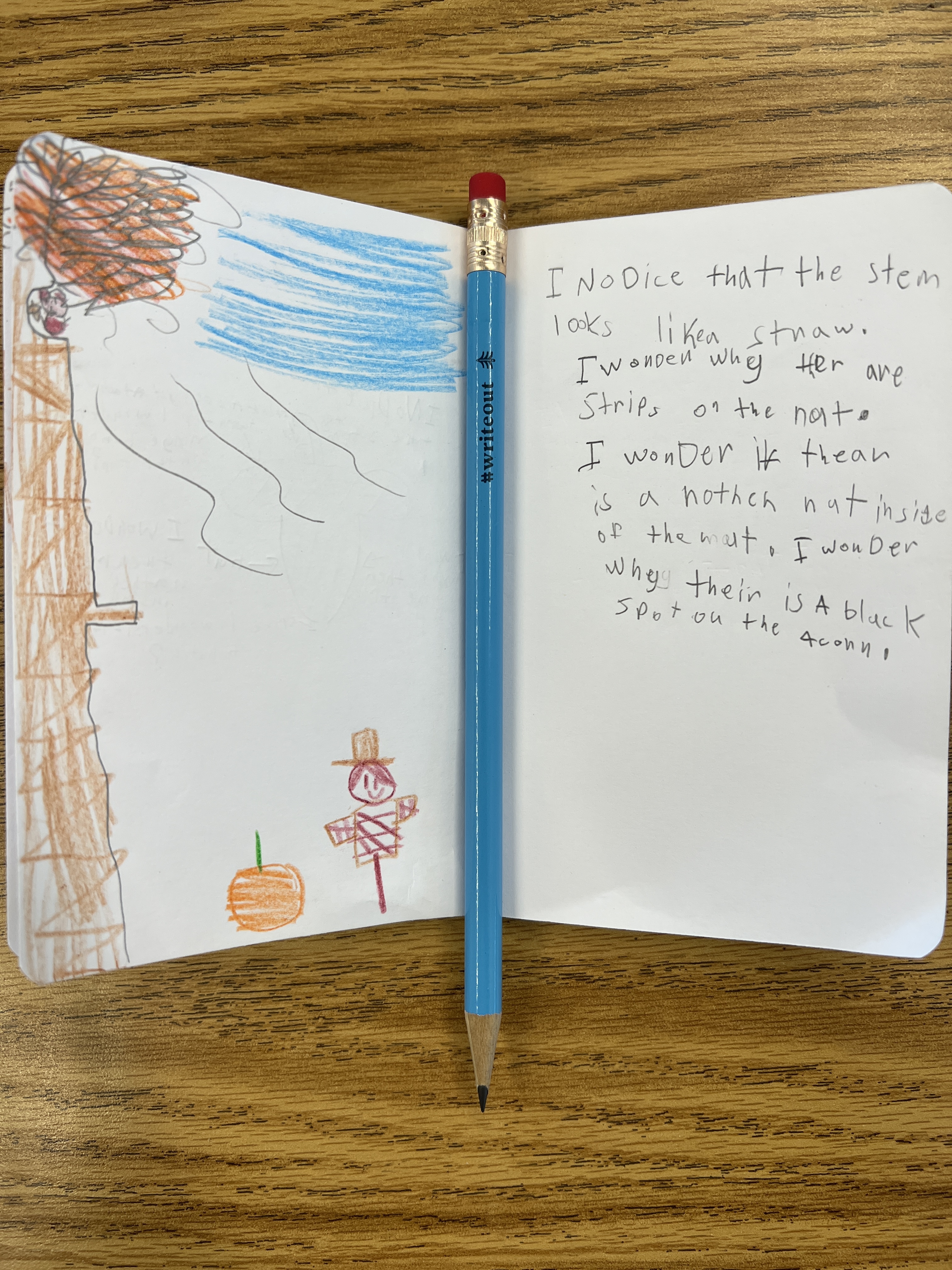
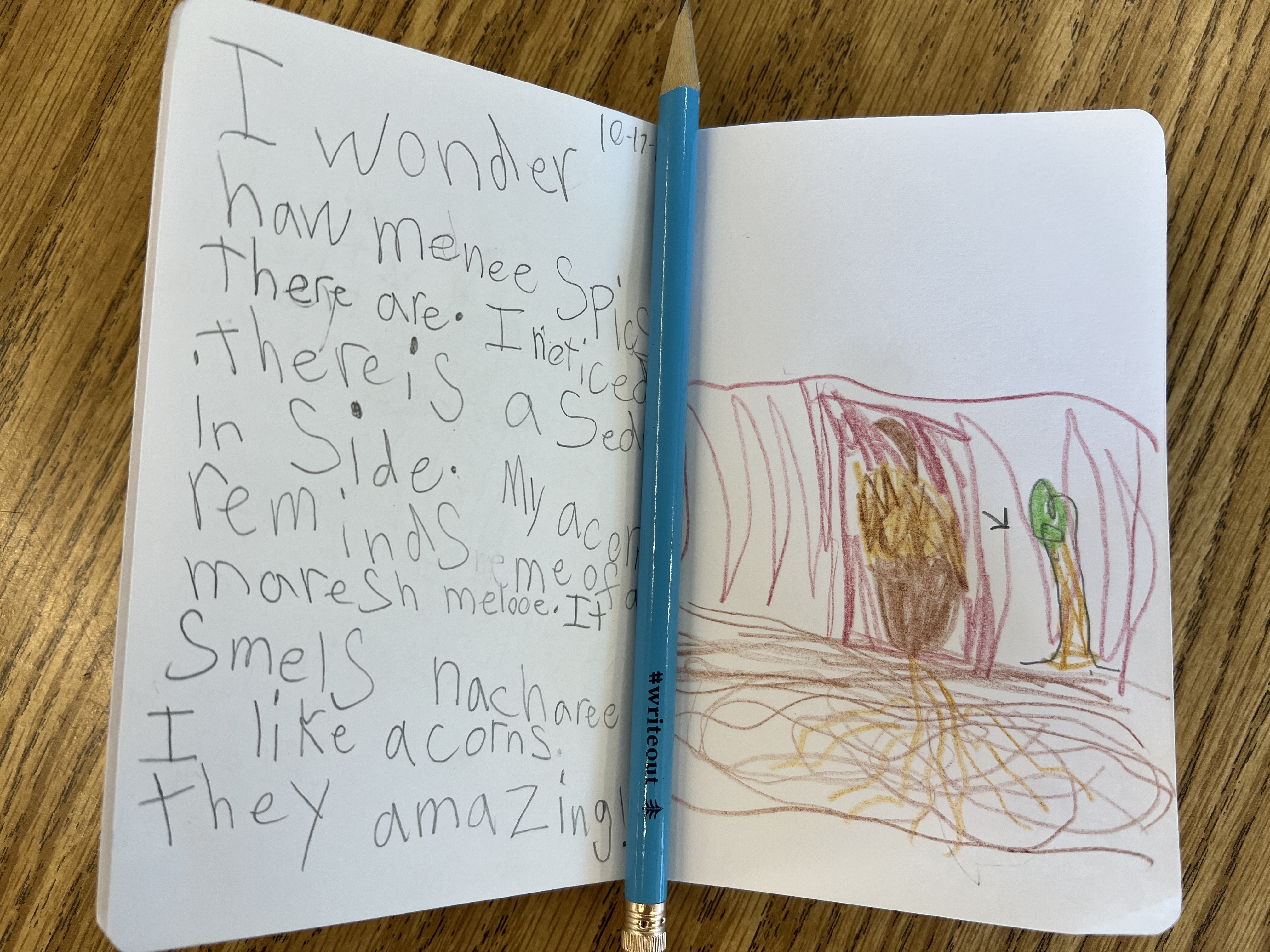
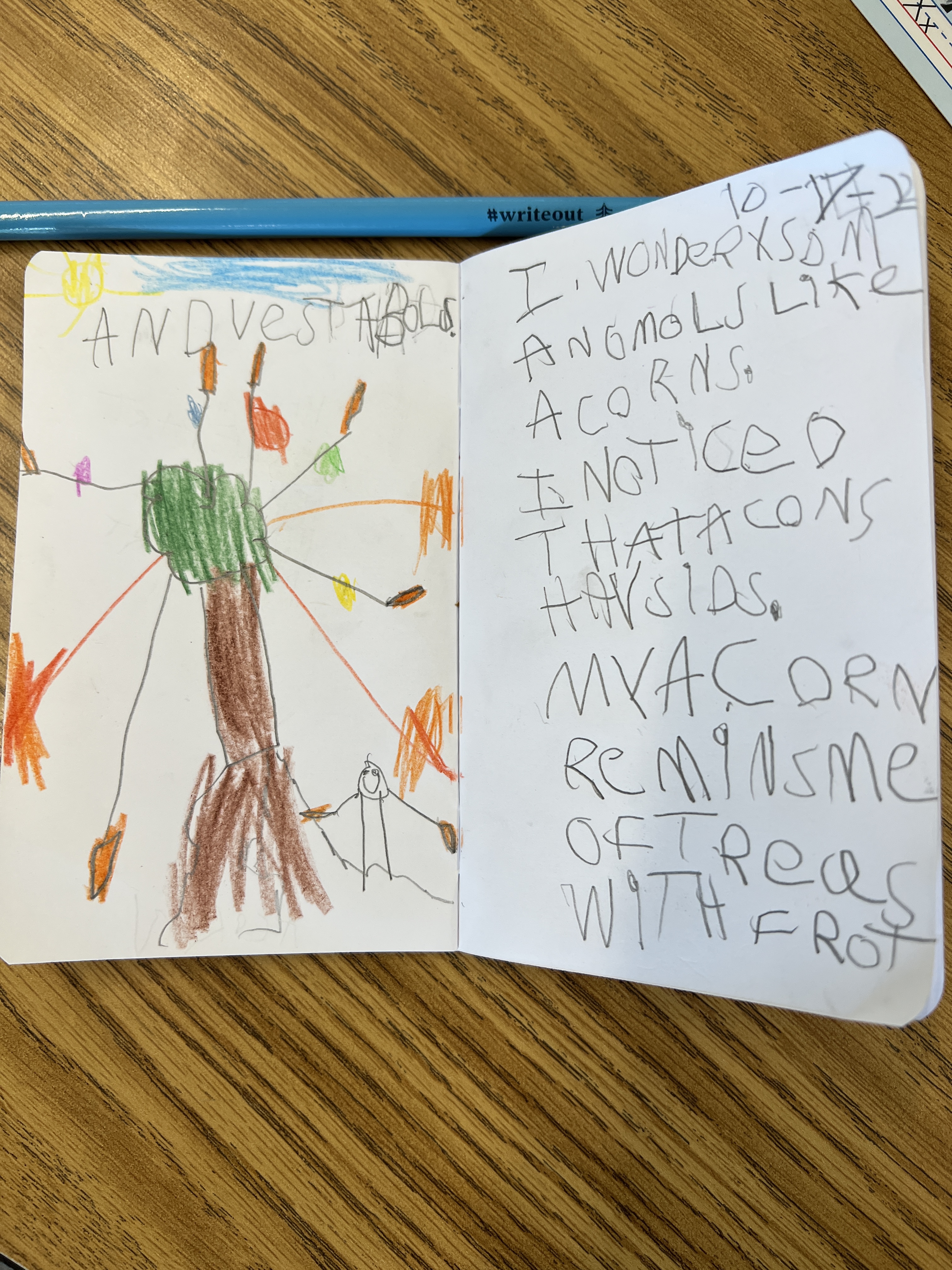
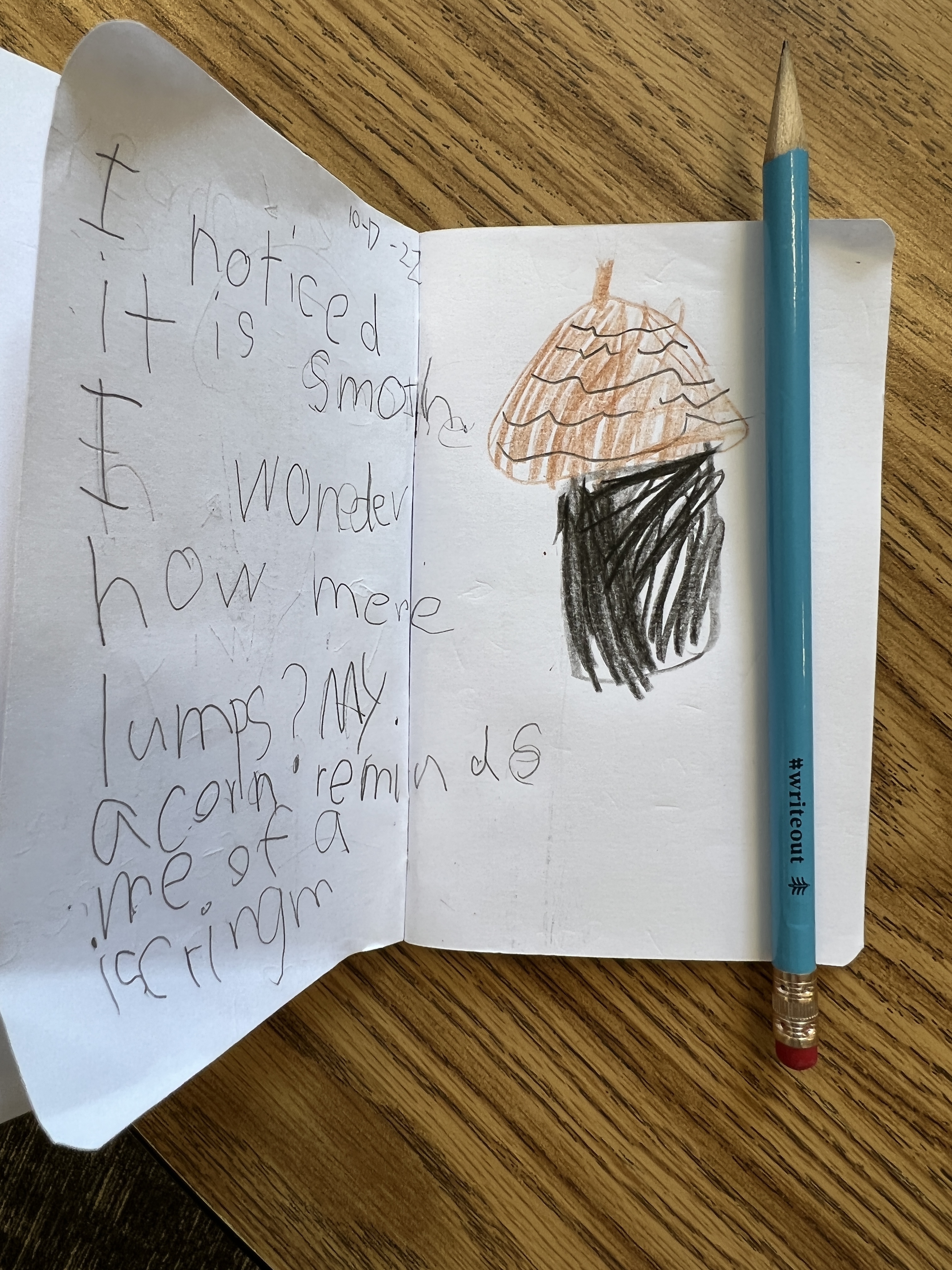
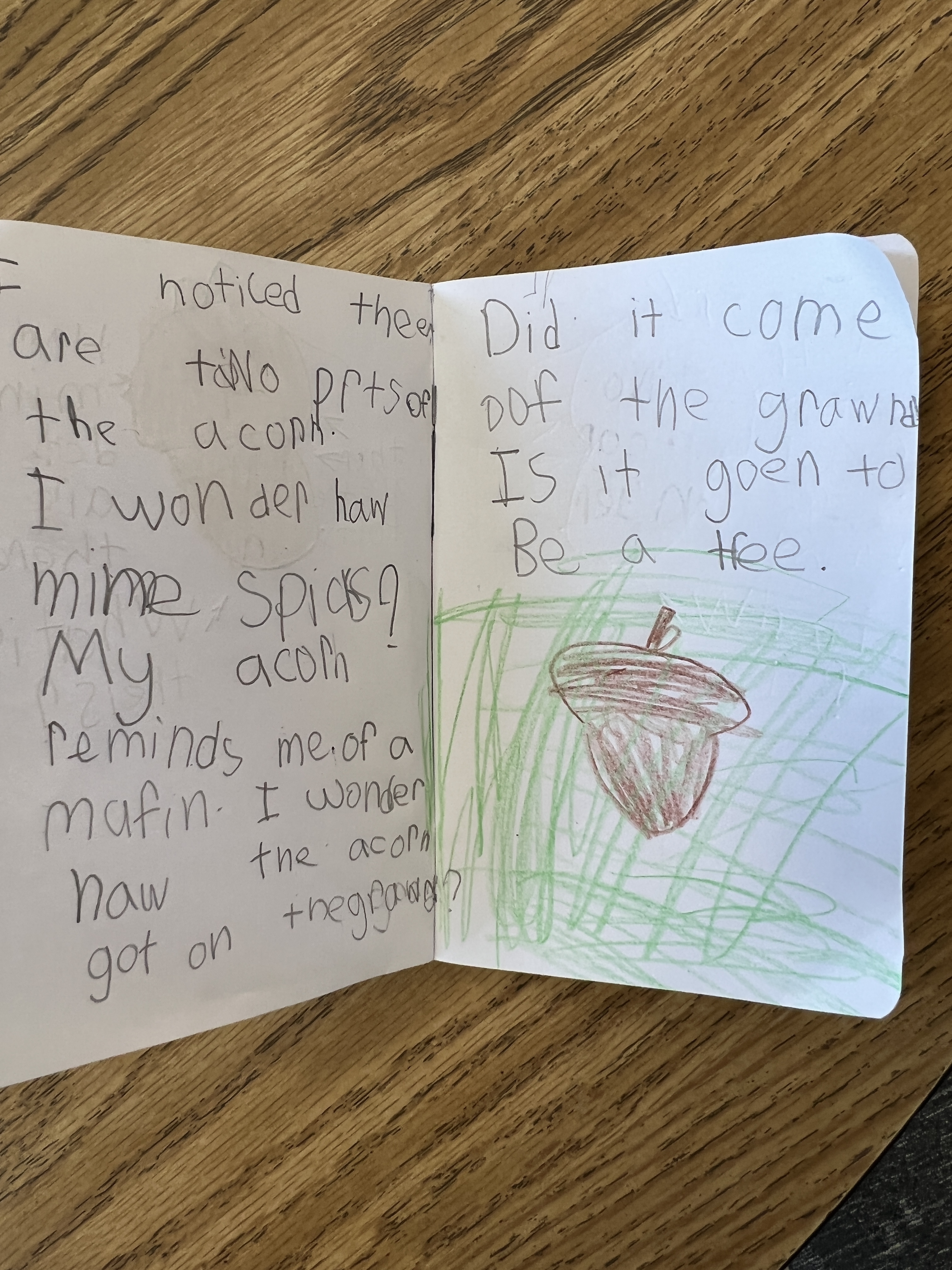
Then it was time to pull out our #writeout pencils and notebooks. We took time to look carefully at the acorns and sketch them in detail. Students were encouraged to use numbers and words in addition to their sketch to capture information about their acorn.
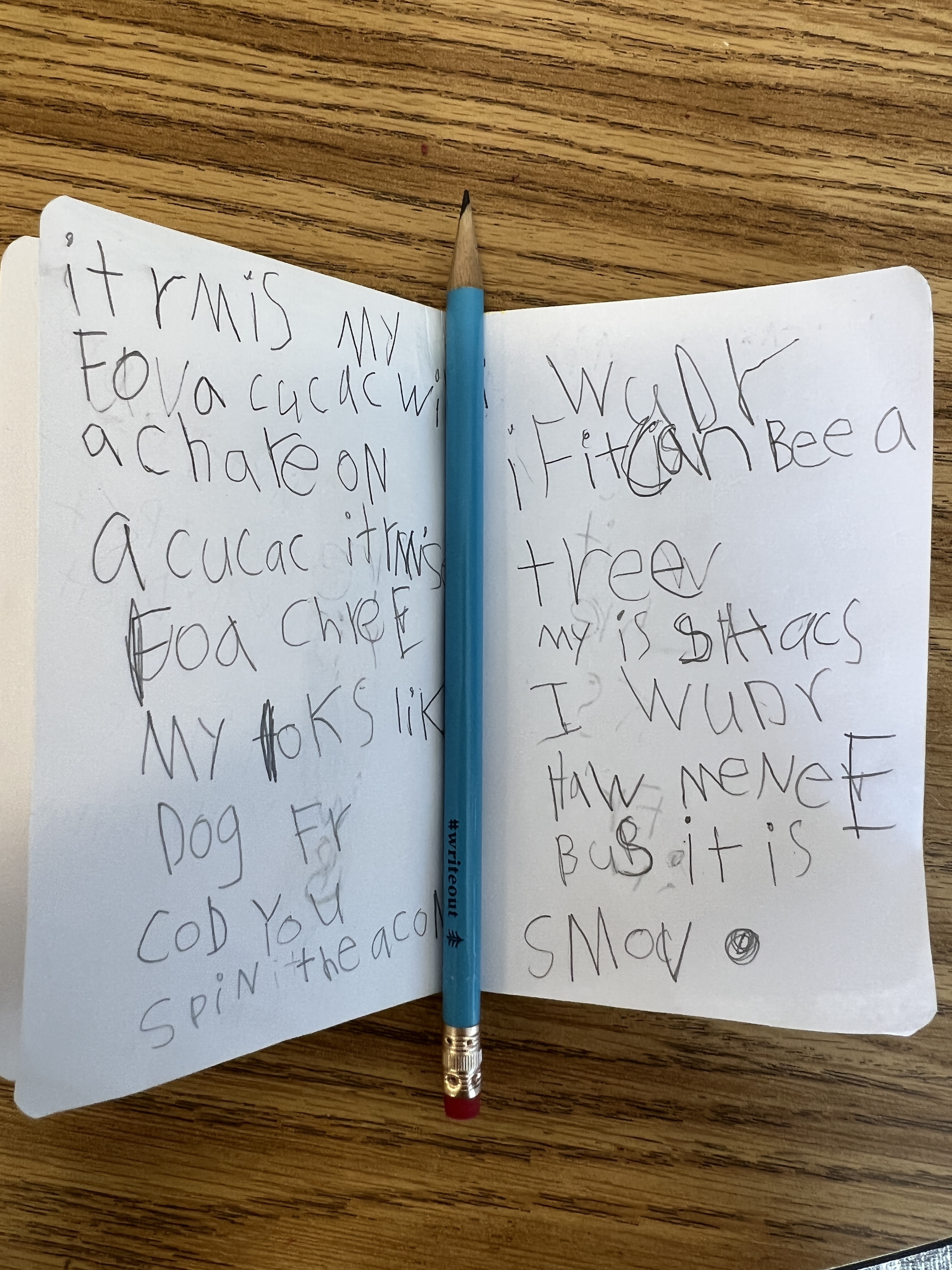
After a break for their music class and recess, we returned to our notebooks for some writing. To push students’ thinking, we used the prompts: I noticed…, I wonder…, and It reminds me of to describe the acorn we had studied and sketched. These first graders had no hesitation. They had plenty to write about and were eager to get started! To keep the words flowing, students were encouraged to use their best “kid writing” (or phonetic spelling), prioritizing ideas over correctness.
Best of all, my students are paying attention to the environment and appreciating all that it has to offer. It is my goal that this immersion in nature will lead us toward advocacy as we consider the ways all of us, as community members–young and old(er), can be a catalyst for change to make the world a better place.
First graders are naturally filled with wonder. It doesn’t take much to get them to look closely, to pay attention to details that many others miss.
Our school has the most amazing librarian. Last week I asked her about a book–a book I know I own, but cannot find in my classroom. And she not only found me a copy of that book, but she also suggested another that was new to me…and just what I needed today when I found it in my mailbox.
#writeout is a collaboration between the National Writing Project and the National Park Service that urges all of us to get outside and find inspiration in whatever nature is around us. We started #writeout yesterday with time in the school garden. Students learned about weeds, donned child-sized gardening gloves, and dug and pulled and delighted in seeing roots break free of the dry soil.
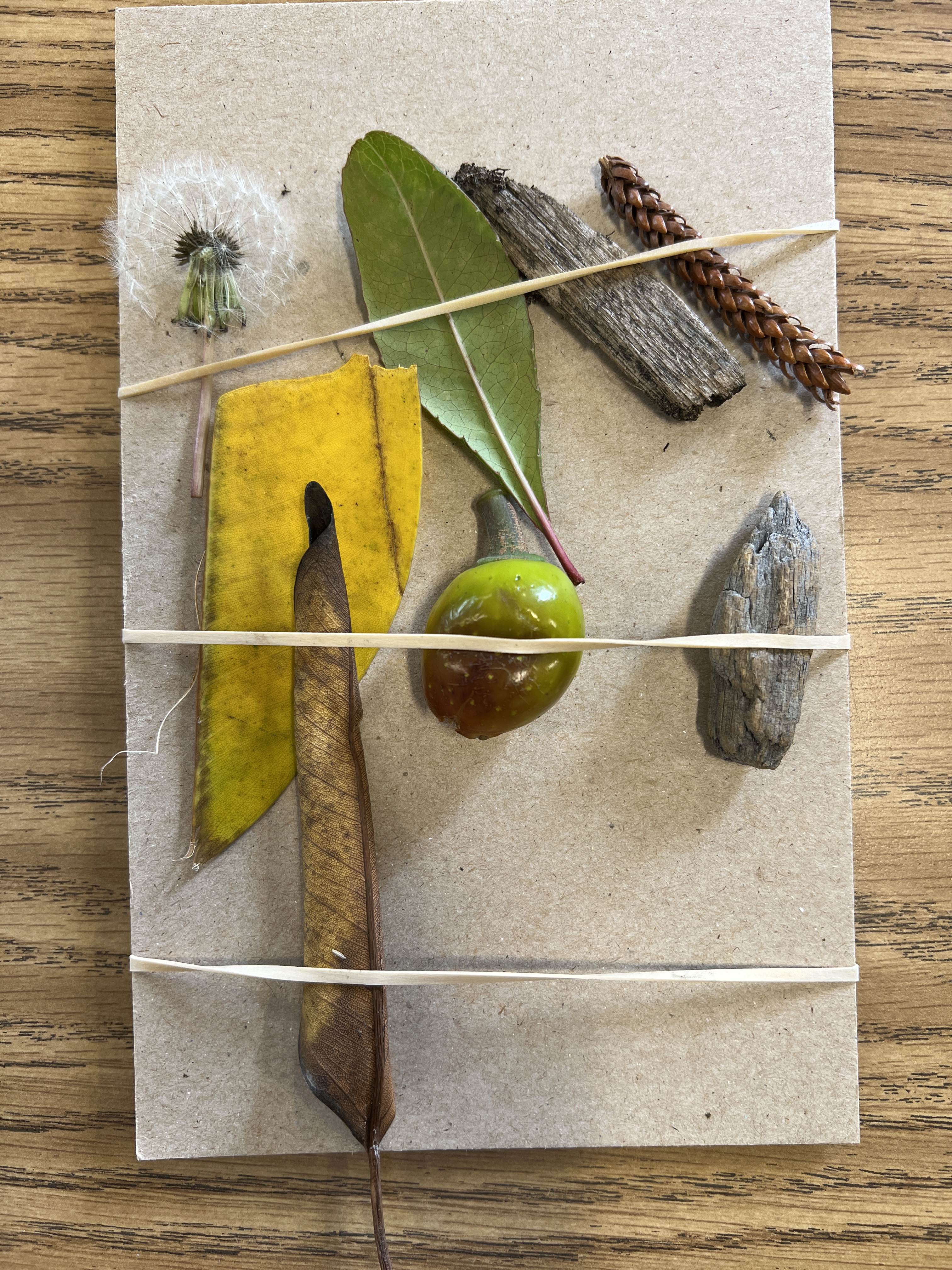
Today we read Wonder Walkers, that book our school librarian left in my mailbox. It was perfect for setting the stage for a wonder walk, time on our school grounds looking for interesting things (think leaves, seed pods, sticks, etc.) from nature that we collected using our collection tool (shout out to Little Pine Learners). Before we headed out we talked about what items we could collect and what we should not (living bugs, picking flowers and plants)–and students were excited to get started.
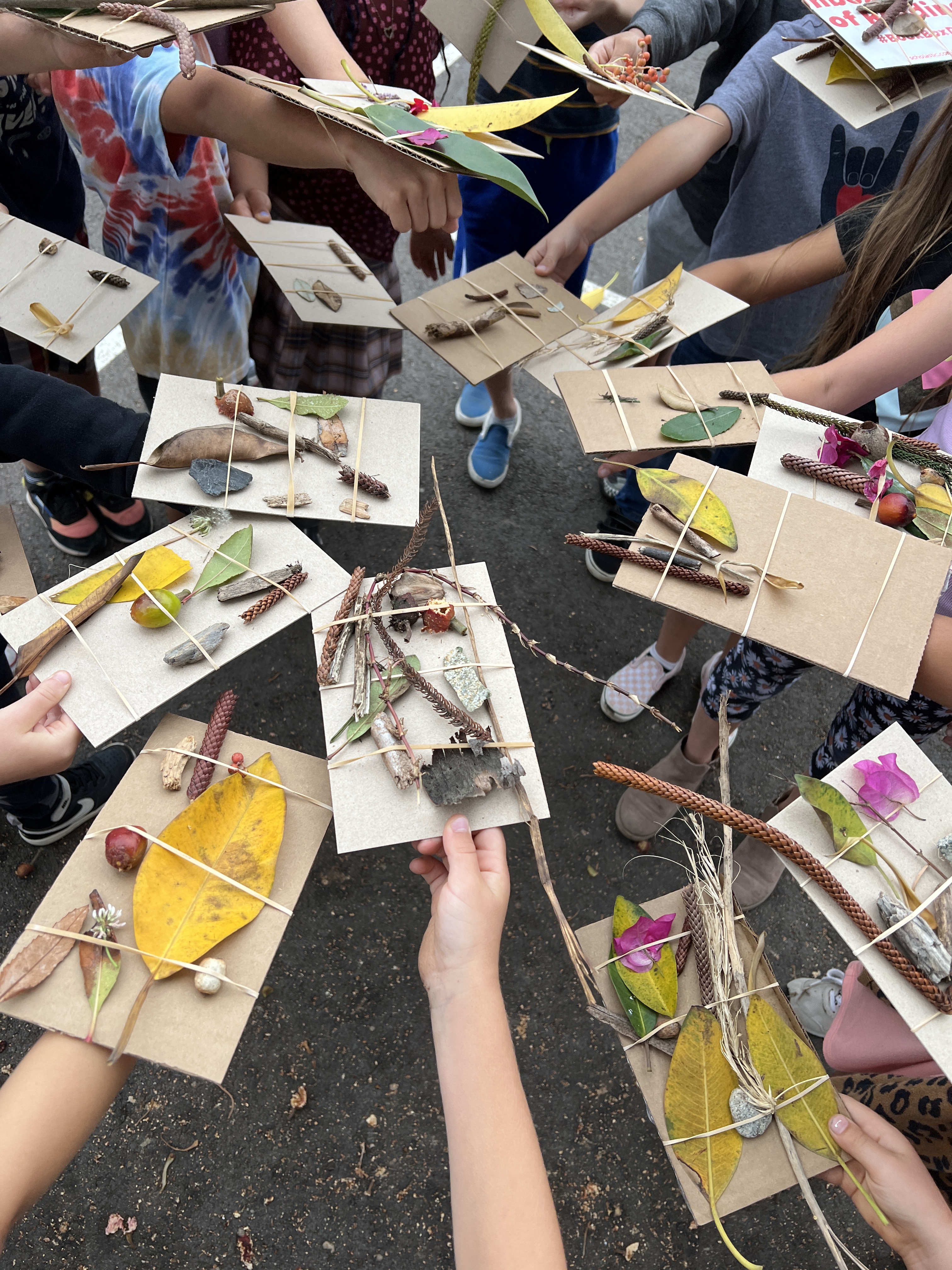
They looked carefully and their collectors began to fill. Some were exuberant and filled their spaces quickly, crowding dried roots and pine droppings with sticks and crunchy leaves. Others were more selective, leaving more spaces between the items collected. A child with sharp eyes found a dandelion puff that didn’t have to be picked, truly a treasure that her classmates envied!
Before we headed back into the classroom, I gathered students close and encouraged them to hold out the collectors so they could see each other’s collections and also so I could take a few pictures.
Once back in the classroom, students used their iPads to take a photo of their collector for future use. Then we settled to read another book. An old favorite, Weeds Find a Way by Cindy Jenson-Elliott, is a wonderful mentor text for students to use as a structure or frame for their writing. I loved the gasp when students realized that this book was non-fiction, yet so accessible with beautiful illustrations. They also remembered their experience with weeds from yesterday and the conversation with the garden teacher about how weeds are not “bad,” they are just not the plants you want in a particular space.
After comments and observations about the book, we tried on using the Weeds find a way… frame with objects from our collectors. “A red leaf finds a way to swish and swoosh through the air,” was one example that got us started.
We ended the day by starting a Zine to showcase our nature items through writing and drawing. We used a single sheet of copy paper to fold a small booklet (with a single cut and no tape or staples) that will soon become tiny treasures worthy of #writeout. More about that in another post!








 Thinking Through My Lens