Tag Archives: photography

Chasing Ladybugs: SOLC #30

Today was the last day for students to attend school in our hybrid AM/PM schedule. They will be remote for the rest of the week to allow time for parent conferences and then after a week off for spring break, the class will unite and become one whole class that attends school all 5 days together. I look forward to this coming together–and hope that the two halves of my class will complement each other.

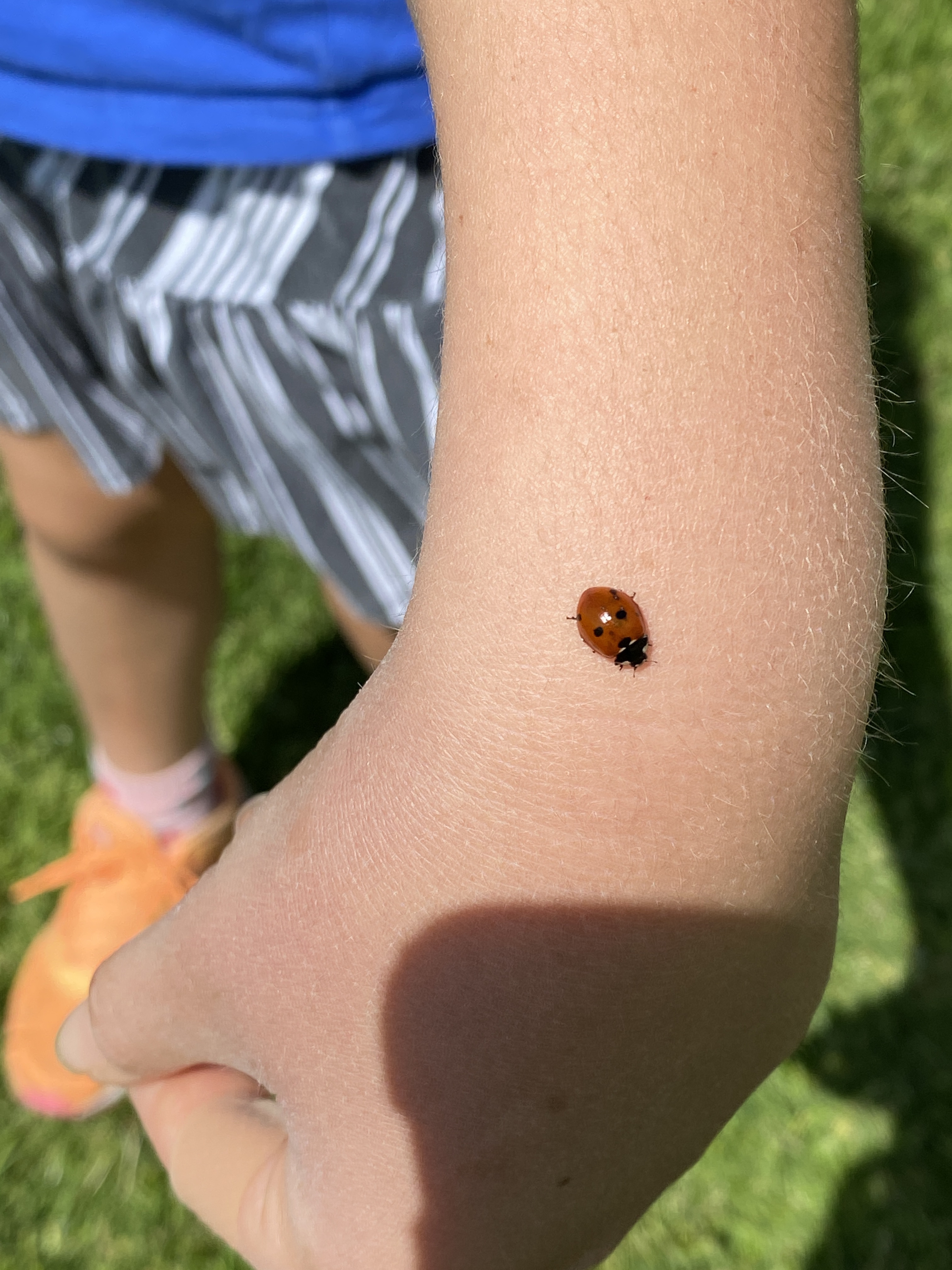
The PM group is the half that NEEDS their fresh air break. They burst from the classroom doors when it is time, unleashing the energy that they have tried (not always successfully) to contain in the classroom. Today started no different. Most of the kids skipped eating a snack and headed straight for the playground equipment. But a couple sat on the grass to eat a bite…and before I knew it, they were chasing ladybugs.

And catching them.

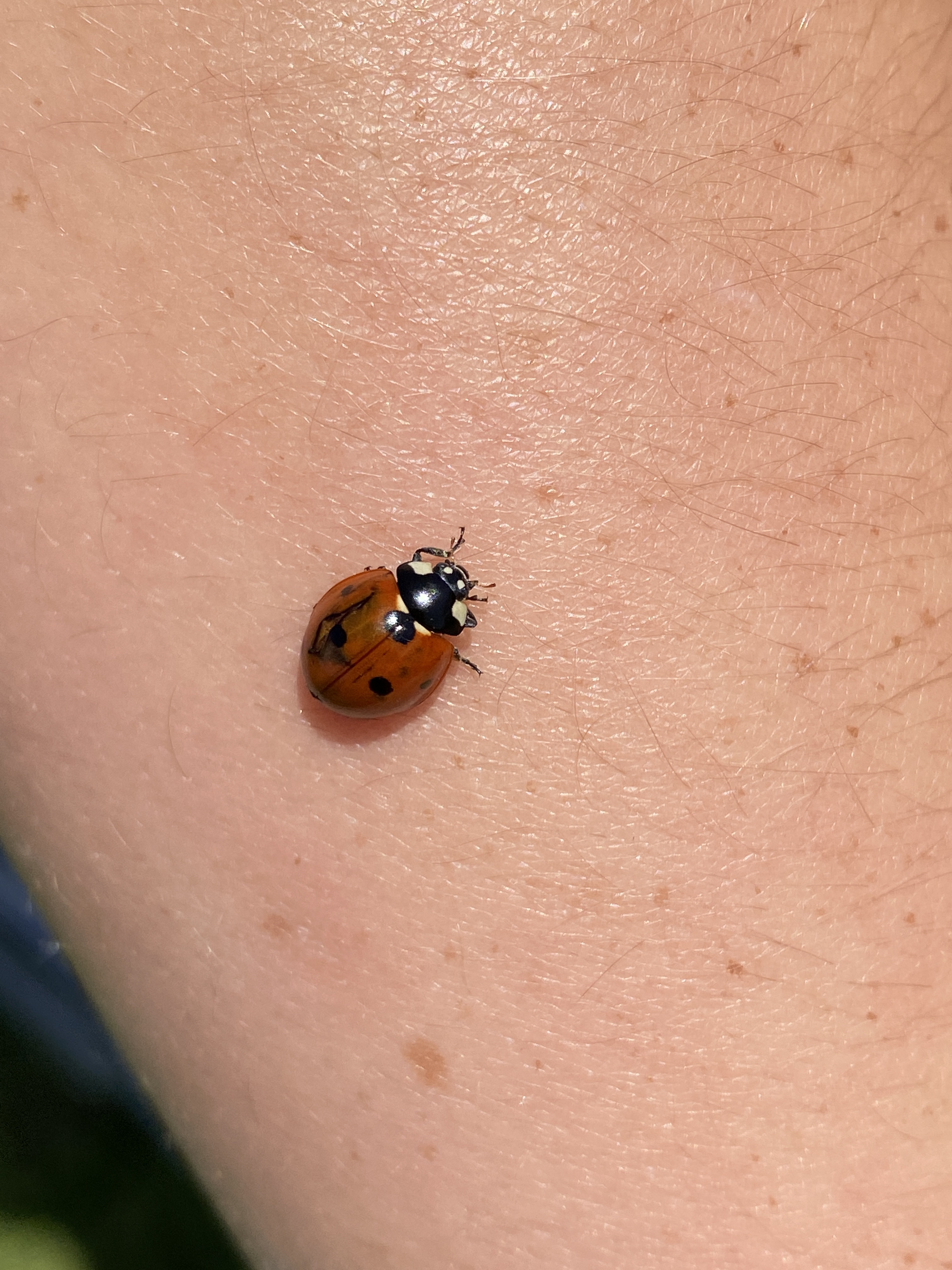
Gently cupping them, they lifted them from the grass to bring them to me to photograph. (I love that they know that I will want to take photos!) They transferred these brilliant red polka-dotted beauties from the cupped palm to rest on the arm so I could get close for a clear, close up photo with my phone. Somehow they could find these tiny gems when they were not visible to others. Like jewelry, they wore these insects as they danced around the field. Sometimes the ladybugs rested patiently on the arm, other times they spread and fluttered their tiny wings in a blur of red.

These kids never stop talking. They kept up a torrent of descriptions and theories as they ran and collected these friendly insects. One theory they floated was that the number of dots was equal to the age of the bug. (Were they thinking days? Insects don’t tend to live very long lives!) Luckily I had just read an article on ladybug varieties, complete with gorgeous photos (who knew that would come in handy!), so I was able to talk to them about the large number of varieties of ladybugs that exist.

An impromptu break chasing ladybugs was the just right way to end this current mode of teaching. Moments like these remind me how much I enjoy the exuberance and energy of children–and the ways they fuel my teaching and my own learning.

Planting Seeds: SOLC #29

We’ve been writing in 7 minute intervals. Every day. Sometimes several times a day. There’s something about the timer that seems to help my students focus intently on the writing. And when the timer sounds, someone always wants to share.

Of course, that 7 minutes is only the smallest part of what it means to write. That timer-influenced writing usually follows a stimulus of some kind (often a picture book or poem), conversation as a group and in partners, studying a mentor text and the moves that writers make, and sometimes drawing or some other kind of art.

Today we wrote about a place we love. But first, last week we read My Papi Has a Motorcycle by Isabel Quintero. We noticed how she focused on places she loved in her community and on her dad and family. We studied her writing. We marked the action words she used: zigzagged, cruised, revs, and roars. We notice the way she uses senses, including sounds and smells and textures, in her descriptions. We paid attention to her comparison of the experience of riding the motorcycle to a comet in the sky. Then we started to name places we love: Tennessee, Legoland, grandma’s house, the kitchen… We sketched a map of this place. And finally, after a quick demonstration of how I might use the mentor text to get started with my writing, I set the timer.

A hush fell over the room. Pencils raced across the page. And when the timer rang, hands started going up. Unfortunately, there was no time to share today. We’ll have to start there tomorrow. I can’t wait to hear how these much-loved places will be transformed into words on the page.

Writing with students is all about planting seeds. I can’t wait to see what blossoms.

Lines: SOLC #28

Exploring with my camera is a way to clear my head, to relax, and to pay attention to the world. But I have to admit, the monotony of a lockdown year has taken its toll. I’ve had to work to find new ways to look at the things I have seen over and over again.

For a change of pace, today we headed up the coast to a seaside town about 30 miles north of here. We did a bit of shopping and then, of course, headed out to the beach to walk and take photos.

I know, I know…I take beach photos regularly. But a different place offers a different vantage. Today I found myself focused on lines. We parked near the train station and right away my eye was drawn to the parallel levels of lines…the train tracks, the fence line, and the horizon line of the ocean behind. (And the blues were magnificent today!)

As I stepped up closer to the fence to peer over at the ocean, a series of horizontal lines came into view.

We had intended to walk the seaside trail parallel to the shore, but on the east side of the train tracks. Unless the tide is low, there isn’t much beach to walk on this beach. We started off–but the summer-like weather brought out the crowds–and the trail was feeling pretty uncomfortable with a combination of runners and walkers, dogs on leashes, and bikes (both electric and pedal-powered) whizzing past. At the first staircase access to the beach, we headed to the sand, realized the tide was low and getting lower, so decided that the shoreline was out best walking choice. There were still people, but they were much more spread out–in the water and laying in the sun–giving us a wide, unencumbered walking space.

As we passed the pier, I could hear aircraft. Helicopters are pretty usual. We have military bases nearby, coast guard copters, and of course people out to see the sights from above. But when I looked up I noticed a small plane cruising by…right over the pier. More lines.

Every time I visit a pier I feel compelled to take a few shots from beneath. There is something about the view of the ocean through the elaborate under structure that fascinates. Each pier is a bit different–some have a specific “door” to look through. This one does not, but it does have lots and lots of different lines to look at.

Even the pigeons managed to get in on the line action today. They were hanging out not far from the fishing people on the pier. Just waiting.

So is there anything significant about all these lines? This would be the time for the pithy conclusion to give meaning to a series of photos featuring lines. Instead, I appreciate a day slightly different from the ones that preceded it. And a perspective that took my eye in some different directions. Hope you also enjoy these lines, in all their insignificance.

Jacaranda Season: SOLC #25

It’s jacaranda season. The time of year when the trees burst into purple flower, spreading cheer and news of springtime.

While the trees are not native to our area, they are iconic in our area. I even just read that they are the official (non-native) tree of San Diego (as of 2000). Apparently it was Kate Sessions (the tree lady) who brought these beauties here and made sure they were planted all over the city.

In full bloom, these trees are beautiful. They are fragrant and their color ranges from bluish purple to these in my neighborhood of the more pinkish purple variety. My eye is always drawn to them as I turn the corner to drive into our neighborhood.

They’re messy…but such a beautiful harbinger of spring in our area. There are places in our city where the ground will be covered in these purple flowers as the blooms begin to drop.

Cue music: imagine Prince and Purple Rain. The city becomes carpeted in purple, like our own version of the yellow brick road. Raining down from above, purple blossoms are everywhere. They fall into your hair, stick to the bottom of your shoes, and cast a magical hue as spring begins to shift to summer.

It’s jacaranda season! Spring is here!

A Treasure Hunt: SOLC #23

I like to think of each day a treasure hunt. I look for those hidden gems–sometimes only unseeable because of my own shortsightedness.

On those days when everything seems unbearably humdrum, monotonous, with sameness coloring my every thought, I have to stretch myself to find something, anything at all, that I can classify as treasure.

I was finding myself in the humdrum doldrums on a recent walk at the beach. Impossible, you say! The beach couldn’t possibly be boring or mundane. Except when my brain fills with negative thoughts…all the I want-tos that just can’t happen…yet.

Time for a treasure hunt.

Winter tides bring lots of rock onto the shore. And sometimes, when the light is right and I look at just the right angle, I’ll notice the glint of buried treasure. Sea glass comes in a variety of colors, sizes, shapes, and degrees of ocean sanding. It’s always such a treat to come across a piece during a walk along the shore.

Sometimes the treasure is all about just how you look at something. There’s a place along the beach that we call “the corner.” The cliff juts out a bit, making it tricky to get around when the tide is high. But when you look at that corner, the cliff itself, just right, a face appears. Another treasure. Judge for yourself.

You never know when you’ll come across the remains of someone’s work of art. It might be a stack of stones: a beach cairn. It might be an image raked into the sand. And sometimes it’s a sand castle. This treasure caught my eye because of its creative use of algae. Even in its tumbledown ruin, you can see the brilliance of the design…and the cloudy light also brings a certain feeling of low-key ambiance that whispers treasure in my ear.

Reliving this treasure hunt brightens my day. Remember that treasure is in the eye of the beholder–that the littlest of bright spots can make all the difference in the way you feel at the end of the day. Make time for a little treasure hunt. I’d love to see what treasures you find!

Tiny Perfect Things: SOLC #22

Today students continued their work with photography after we read Tiny Perfect Things. We took the iPads and headed out onto the track around the field to uncover our own tiny (or not so tiny) perfect things. We then used Elaine Magliaro’s poem Things to do if you are a Pencil as a mentor text to get started on a poem to accompany the photo each student selected.

We didn’t get to any sort of publication today, so I don’t have student texts to share with you. That will have to come later.

But, I did write with my students, inspired by this photo and our mentor text.

Popover Memories: SOLC #21

If you’ve read this blog over the years, you know a couple of things about me and food.

Today, my husband decided, would be the perfect morning for popovers. Unlike biscuits, popovers are not a food I grew up eating. In fact, I first had popovers a few years ago: at Acadia National Park in Maine.

I listened to the mixer whirl as Geoff prepared the ingredients to pour into the special popover pan that we purchased upon returning from our Maine exploration. It’s one of those pans that is specially made for just this purpose–so most of the time, the pan is buried in a lower drawer that we don’t frequently access.

While they baked in the oven we had a quick conversation with our 5-year-old twin grandsons, who love to see what grandpa is up to in the kitchen. After saying goodbye to their special friends (those special much-loved items that are always close by when they are at home), I heard the timer ring. When the oven opened, a warm eggy smell filled the air, mixing with the smell of coffee freshly brewed.

And as I bit into one of these tasty treats, smothered in butter and jam, my mind revisited that moment when I was introduced to this comforting snack on a cool summer day not far from Jordan Pond in Acadia National Park.

We had walked and walked, following a hiking trail that circled the pond.

My camera ever in hand, I couldn’t resist take photos of all the mushrooms. There were so many varieties and they were such bright colors! (So different from mushroom life here in Southern California!)

And we ended our adventure in a National Park restaurant–known for its popovers. So when in popover territory–and after hiking all day–try some popovers.

Today’s popover breakfast took me back to that wonderful Maine exploration. What a wonderful way to take a mini-vacation through my memories (and some photos) in the midst of this mind-numbing pandemic. I look forward to my next trip to Maine and some more popovers…sooner rather than later!

Fog: SOLC #20

I walked into a cloud, experiencing it now from the inside out. Water drops too small to see kiss my cheeks as they swirl and dance all around me. My vision is soft-edged, everything ahead of me in vignette. Cocooned in light as the sun’s rays, wrapped in cotton balls, bounce and reflect. The world feels close and small in the cloud. I can’t see too far ahead or too far behind, I’m forced into the here and now, noticing what is right here.

Slowly, almost imperceptibly, the cloud lifts and opens wide, like a deep breathe and the blue appears. The world expands and the view shifts. I walk out of the fog.

Photos and Small Poems: SOLC #16

I love the garden as an outdoor learning space for students. As you may have read yesterday, we began the process of experimenting with some photography techniques in preparation for some writing today. The PM group was rained out of the garden yesterday, but today was bright and sunny so they were able to catch up and try their hand at using the photography techniques.

Today students selected a photo from the garden, and in the spirit of Ansel Adams, transformed the photo to black and white using a filter in the iPad. This photo along with Eve Merriam’s poem, Peeling an Orange, became the inspiration and mentor text for their own original small poems. Before starting our own poems, we took the time to study Peeling an Orange carefully. We named what we noticed: the use of comparisons (similes and metaphors), the opposition of the words carelessly and meticulously (serendipitously, meticulous had been a vocabulary word earlier this year), the inclusion of sensory use (smell). Then I set a timer (something that I find focuses these third grade writers) for 7 minutes and off they wrote!

We shared a few, noticing the interesting comparisons, the use of strong verbs and other vocabulary and moved to the next step: creating a shared Google slide deck to display the photos and poems. While not everyone finished today, I did ask if students were okay with me sharing some of their writing on my blog. They were excited by the prospect.

Here’s a couple of student examples:

And one of mine (since I always write with students):

I’ve been intentionally prioritizing time for writing–from start to finish–in the classroom, in spite of the short time we have in our hybrid schedule. It is totally worth the time spent–and I am seeing the writing improve when students write in community. I look forward to more time for writing as my students return to the classroom for full days, in one group, beginning in mid-April.

Purple Beans: SOLC #15

With rain in the forecast (again!), I was thankful to be able to get my morning group of students out into the garden with their iPads. (No such luck with my PM group–but that is another blog post.)

In the fall, we had spent time in the garden clearing out overgrown beds, pulling weeds and enormous carrots that hadn’t been harvested because of our pandemic shutdown. We groomed the soil, sowed some seeds, made sure the irrigation was working–and then my attention turned to other instructional priorities, neglecting the garden.

This is the time of the year when I like to use photography as a tool to teach my students about perspective, about “seeing” the world in different ways, and about the role photos have played as advocacy. We’ve learned a bit about Dorothea Lange and her photographs during the depression and World War II and also about Ansel Adams and his photos of National Parks and Japanese internment camps.

So we headed into the garden to try on a few photography techniques: a bug’s eye view, leading lines, natural frames, and the rule of thirds. A lot had changed since our last visit to the garden before the winter holidays! We were greeted by 4 foot tall dandelions, beets bigger than a your head, and plenty of other surprises.

My students happily explored with their iPads in search of photographs. They laid on the ground seeking that bug’s eye view, looking up and under the masses of plants. They sought frames and lines, hopefully holding their devices still enough to prevent the inevitable blur that so many experience. They used those helpful grid lines to define the focus of their subject and carefully place it for their rule of thirds photos.

And they pointed out all the wonders they found. There was the little girl who worked diligently to photograph the roly poly that was trying to make a quick get away and the one who dug around in the garden bed and discovered that giant beet (above). They photographed flowers and beans, pinecones and weeds…and who knows what all else.

I found myself captivated by the purple beans. Lots and lots of purple beans and the mass of curlicues reaching up and around.

Tomorrow we will examine our photos, evaluating how well the photography techniques work in helping us look carefully. We’ll also do some writing, using the photos as inspiration and subject matter. And maybe we’ll also get back to some gardening. Weed those beds again, harvest our overgrown bounty, and start again with seeds. Seeds that will also help us grow–as photographers, writers, and advocates too!