Tag Archives: writing

Change in View: #writeout

I walked out of school with the sun shining brightly on my shoulders.  I peeled my lightweight jacket off before getting into the car to head down the hill toward the beach for my after school walk.

In the less than two miles from school to the beach, the sun dimmed, shuttered by a thick veil of fog.  Palm trees became shadowy pillars as I steered toward the beach parking lot. As I walked down the long steep ramp to the sandy beach, it was like walking into another world. Colors were swallowed by the damp blanket, the view disappeared,  I could see only 20 or 30 yards in front of me.
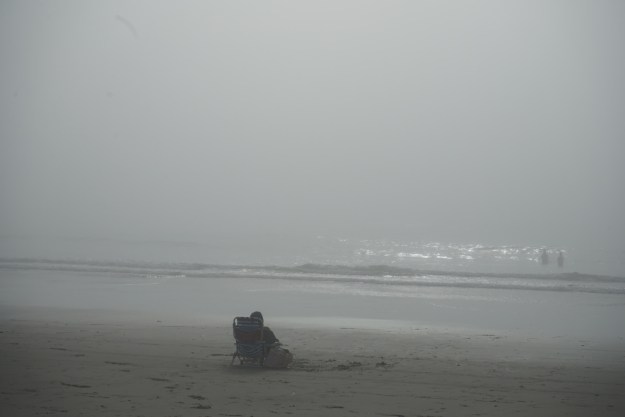
dsc06999

My mind filled with stories, the stuff of Halloween and horror movies.  What was around the corner? What evil might that shadowy figure in front of me bring? What about the sea itself, was the tide actually as low as I expected?
dsc07000

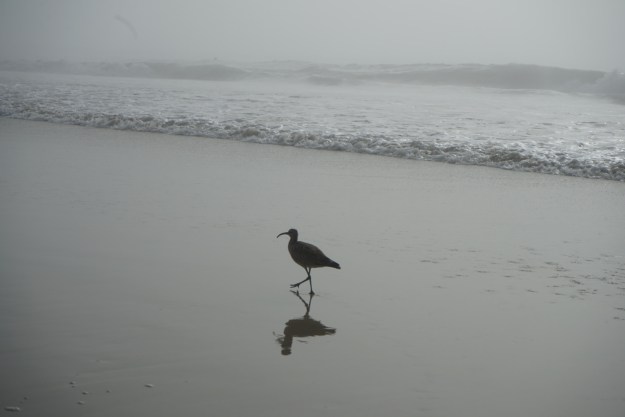
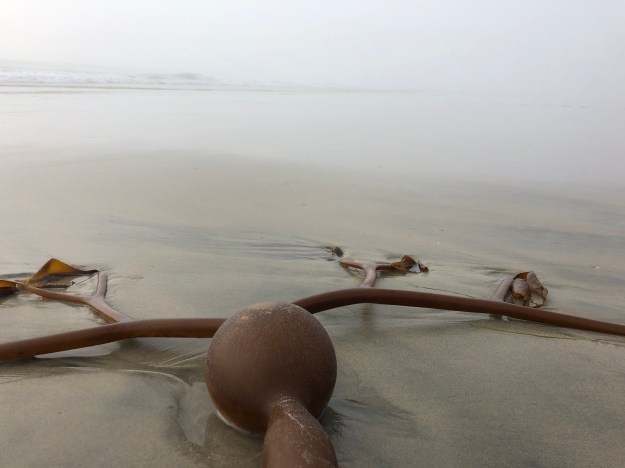
Luckily, my feet know this beach.  They followed the path worn by my frequent walks, recognizing the curve of the beach, the squish of the sand under my soles.  Familiar birds whistled hello, giant kelp caressed my toes and a huge piece of bull kelp appeared from the shadows.
img_3581

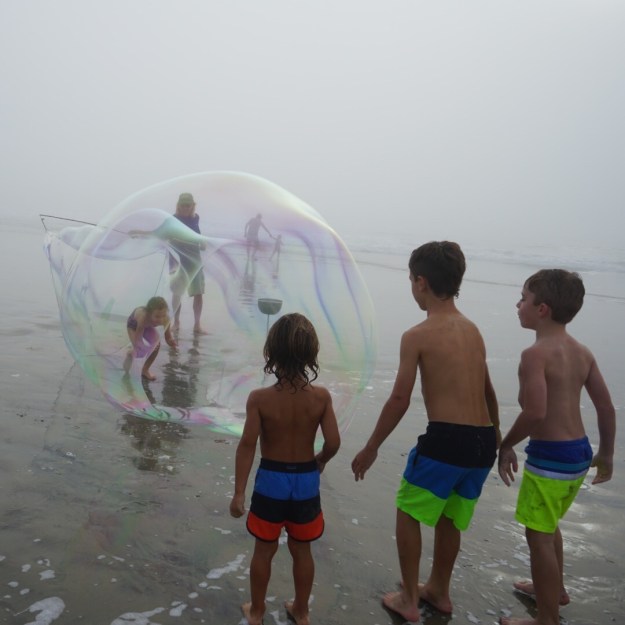
As I neared the end of my walk, a crowd of children appeared from the mist.  And with them, the bubble man, the pied piper of the beach, casting a spell with his magic wand.  The thick mist didn’t dampen their spirits, instead the dampness of the air helped them catch bubbles–holding them in their hands and allowing them to slip into the bubble tunnels the bubble man created.
dsc07049

Stories continue to swirl, wrapping me in their damp, shadowy chapters.  My imagination is already hard at work, making connections, creating movies in my mind.  I can only hope they don’t become the stuff of nightmares as I drift off to sleep.



Inanimate Objects: Students #writeout

Some days in the classroom are just right.  Students are productive, interesting learning is visible, and it seems that we all grow closer as a result.  Today was one of those days.

As promised in a previous post, my students used the poem Pencils by Barbara Esbensen to inspire their writing about an inanimate object.  They picked topics as varied as ropes/knots, french toast and pancakes.  (There are also poems about gravestones, oil pastels, basketballs, and erasers…they are just not quite all the way finished yet!)  And then, to take the writing just another step further, we explored the Adobe Spark Video app to make a video to amplify their voices and extend their ideas.  Spark video is friendly for my students, offering a number of high quality photos for them to use in their videos.

So…here’s a few of the videos.  (I’ve included a screen shot of the video with a link to view/listen to the poem.)

Khloe’s pancake poem

Screen Shot 2019-10-15 at 6.13.05 PM

Shea’s french toast poem

Screen Shot 2019-10-15 at 6.16.37 PM

and Bodhi’s rope/knots poem

Screen Shot 2019-10-15 at 6.18.54 PM.png

As always, my students would love comments.  And I’d love to know what you are doing to celebrate writing this month with your students!  #writeout


What Students Love: #writeout

As promised, here are some of my students’ poetry inspired by Lee Bennett Hopkins’ City I Love.  (For more details, check out this previous post.)

Even before pulling out City I Love, I launched the idea of writing about place by reading All the Places to Love by Patricia MacLachlan and Where Am I From by Yamile Saied Mendez.  Students then created heart maps of the places they love (ala Georgia Heard).  By this time students were excited about the places they love, eager to tell each other and me all about them.  But instead of diving right into the writing, I asked students to “map” themselves.  I tried to keep this direction pretty broad, letting students take it in any direction they wanted.  These watercolor and black sharpie marker masterpieces are the result!

This map is a wonderful map creature by H.

img_3344

And his poem:

Morro Rock I love

Looking at the dormant volcano 

The fish swarm in the water 

The sound of the sea gulls

The smell of the salty sea.

Casting a line

Getting the bait 

catching the fish.

It’s just sitting in place

Day after day

Year after year

For hundred of years.

Walking on the beach

looking at the fish and crabs

and looking at the ocean scenery

Sitting on a dock waiting for a fish

like waiting for a train.


And a pineapple map by I.

img_3341

And her poem about a very special bench that honors her grandmother:

The Bench I Love

 On the bench I sit at

      Bench I love 

I watch the flowers flowers flow 

As the birds glide slow as they pass by their home

Through the palm tree garden I go 

Past the great sun’s glow

On the bench I sit at

Bench I love 

I sit down and watch the tide curl 

Up & down it will go 

On the bench I sit at 

bench I love

The breeze flies past my hair 

And chases the ocean’s salty waves

On the bench I sit at

 bench I love

I sit down and inhale

Look up and exhale

And a horse map by S.

img_3567

Accompanied by a barn poem:

Barn I Love

Barn I go to

barn I love.

Horse smelling wonder beyond city.

Gallops of emotion. Races of hearts.

Barn I go to 

barn I love.

Each morning a sweet smell of hay .

Each night a thankful nay.

Barn I go to 

barn I love.

Morning wet covers the arena.

Full of playful horses running.

Barn I go to 

barn I love.

Stardust black mares galloping in the cold moon.

 Sunset colored  butterflies leave at the end of the day.

I told my students that I would use my blog to amplify their voices (our vocabulary word from last week!).  I know they will appreciate your comments.  And know that these are just a glimpse of what my students created as they thought about the places and activities that matter to them.

How are you celebrating writing in your classroom, in your home, in your life?  #writeout


Things and Places: #writeout

An email subscription led me to a podcast called Everything is Alivewhere inanimate objects are interviewed.  (Full disclosure, I only listened to a few minutes of one podcast–but did read the transcript linked above.)  But, this idea of the personality and alive-ness of inanimate objects got me thinking about inspiration for writing.  And, in the serendipity sort of way I often experience when thinking and writing and lesson planning, I came across an old favorite poem I have used with students called Pencils by Barbara Esbensen.  (You can read Esbensen’s poem linked above.)

I have this idea that students will pick an object that matters to them and create their own inanimate object poetry inspired by Pencils.  Should I have them write about pencils?  No…let them choose something that matters to each of them.  What would I pick? My camera, of course.  So, here’s my try:

Cameras

The rooms in a camera

are a tight fit

but forests seascapes classrooms

crowd right in


In a camera

nature’s colors riot, drawing your eye

and dim light shifts the world

to black and white


From a photographer (experienced or not)

an unexplained photo may emerge

framed by the untold story

living in the stillness, frozen in time


Every image in your camera

is ready to

dance on rays of light

ready

to focus and expose

ready to come right out

and save that moment

so that you can explore

and experience it again and again

®Douillard

Will my third graders be able to animate their inanimate objects?  I think so…and I also think that the objects will connect them to places they love and spend time at…so #writeout it is!  I’ll share the results later in the week!

Here are some of my favorite places that crowd right into the rooms in my camera!

sand art

img_2944

img_3139


A Place I Love: #writeout

When I learned that the National Day on Writing, the National Park Service, and the National Writing Project would join forces to celebrate writing through #writeout in October, I was all in.  #writeout is meant to help writers focus on stories of place…particularly if there is a national park nearby.  I don’t happen to live near a national park, but I do live by spectacular outdoor spaces where I spend lots of time walking…and that inspire my writing.

As October began, students read and studied the poem, City I Love by Lee Bennett Hopkins.  The rhythms and patterns of the poem were friendly to students, they were able to notice many techniques Hopkins employed.  And better yet, they were eager and ready to write their own versions using this poem as their mentor text.

City I Love by Lee Bennett Hopkins


In the city

I live in—

city I love—

mornings wake

to swishes, swashes,

sputters

of sweepers

swooshing litter

from gutters.


In the city

I live in—

city I love—

afternoons pulse

with people hurrying,

scurrying—

races of faces

pacing to

must-get-there

places.


In the city

I live in—

city I love—

nights shimmer

with lights

competing

with stars

above

unknown heights.


In the city

I live in—

city I love—

as dreams

start to creep

my city

of senses

lulls

me

to

sleep.

With this poem as a mentor text, I wrote my own version, focusing on a favorite place of mine.  Of course, I had to write about walking on the beach!

img_2614

Beach I Love


At the beach

I walk on

The beach I love

Seagulls hover

Squawking and flapping

Searching for treats

In unattended 

Beach bags. 


At the beach 

I walk on

The beach I love

Salty waves

Curl and break

Tossing swimmers 

And tempting surfers

Into the cool, refreshing

Depths. 


At the beach 

I walk on

The beach I love

Squishy sand

Sucks at my toes

Tiny grains sanding 

My soles smooth

And sheltering 

Tiny frisky crabs and 

Multitudes of bean clams. 


At the beach 

I walk on

The beach I love

Rhythmic seas

Slow my breath

Warm my heart

And clear my mind. 


Kim Douillard 

So in honor of the National Day on Writing and #writeout, I let the outdoors inspire my writing.  I will include my students’ writing in days to come!


#USvsHate: Going National!

How do you deal with hate in the classroom?  As teachers, I know we all work on building safe and productive learning communities–places where the young people entrusted to our care can thrive.  But sometimes the world creeps in. Kids hear hurtful comments and see hurtful actions–on media, from adults or others in the community, then bring them to school to test out their impact on their classmates and peers.  

And frankly, for whatever reasons, we live in a society where hate has become normalized.  So what do we do about it?

USvsHate screen shot

This is where #USvsHate comes in.  Mica Pollock and a small team of teachers in San Diego decided to take advantage of the many anti-hate lessons freely available through a variety of organizations (Teaching Tolerance, Facing History and Ourselves, the Anti-Defamation League, Rethinking Schools, the Bully Project and more) to open up spaces for students (kindergarten through college) to learn about the origins of hate, to explore their own experiences with hate, and to create messaging to publicly refuse hate.  

Last year, I was fortunate to join the leadership of this effort as director of the San Diego Area Writing Project (SDAWP) along with a team of SDAWP teacher leaders.  We piloted lessons–some directly from the organizations listed above, and some we had created or adapted for our own contexts and academic requirements–and had our students create anti-hate messaging.  I had a front row seat to the empathy and creativity of San Diego students as I helped judge entries from the #UsvsHate contests in November, February, and April. (And of course as I implemented #USvsHate into my own classroom!)

I traveled to the Southern Poverty Law Center in Montgomery, Alabama in July with our team as we presented #USvsHate to the team at Teaching Tolerance.  And it made its national debut this week!  

Join us in the effort to refuse hate and to amplify student anti-hate messaging.  Read the article in Teaching Tolerance for more background information and check out usvshate.org for lessons to use with students, examples of winners and finalists, and protocols and supports for opening up potentially difficult conversations in the classroom..  Our collective action can and will make a difference!

What Would You Hold?

During our first Make Cycle of the  SDAWP Invitational Summer Institute, we are each answering the question, “What would you hold?”  The make requires that we represent the answer to that questions with a photo of something precious held in our hands.

After too much thought and second guessing, here is my photo.

img_1261

I’m sure that a photo of me holding my camera isn’t surprising to many of you.  But I want to press beyond the camera as a tool to make pretty pictures.  It isn’t the camera itself that is precious.  In fact, sometimes it isn’t even my camera that I use for photography…sometimes my phone works just as well (or even better).  But the camera represents a practice that I value.  Taking photos encourages me to slow down, to pay attention, to notice the value and beauty in the ordinary…and it gets me writing.

I try to get out with my camera every day: walking, breathing deeply, letting my thoughts roam.  With my feet moving and under the influence of fresh air, I can let my worries float away and use my senses to tune into the world outside of my head.  I seldom take photos of people, instead I try to capture moments that capture my attention.  (The exception would be the many photos I take of my grandsons–none of which I post on social media to protect their privacy.)  I often find that the photos I take become metaphors to express ideas I am thinking about.

img_1097

With my camera I get low, checking out the vantage from the bug’s perspective.  I find myself thinking about times when teaching and mothering and living feels like pushing the world up a very steep hill.  Images of mythology fill my head and the strains and stresses of the day unkink, letting those tight muscles that run across my shoulders begin to relax.

img_1083

Out on the playground with my students I get to bring my passions to my students.  Photography also helps my students look in new ways, and like it does for me, that looking generates ideas and language for writing.  This photo was an example of looking for natural frames for photos–a composition technique I wanted my students to explore.

img_0990

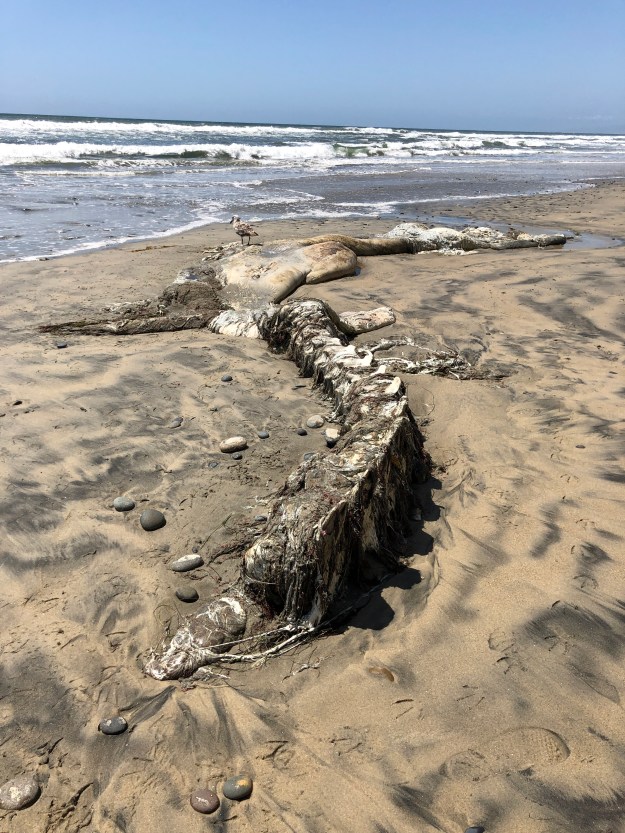
With camera in hand, I learn…and sometimes I mourn.  Regular walks on the beach bring the realities of environmental damage front and center.  I see the daily human impact, the excesses of our disposable lifestyle, and get up close and personal with death and destruction. I am forced to pay attention to the lessons nature is teaching and encouraged to learn more as I walk with the rhythms of the tides and the seasons, appreciating the beauty and noticing the destruction.

img_1123

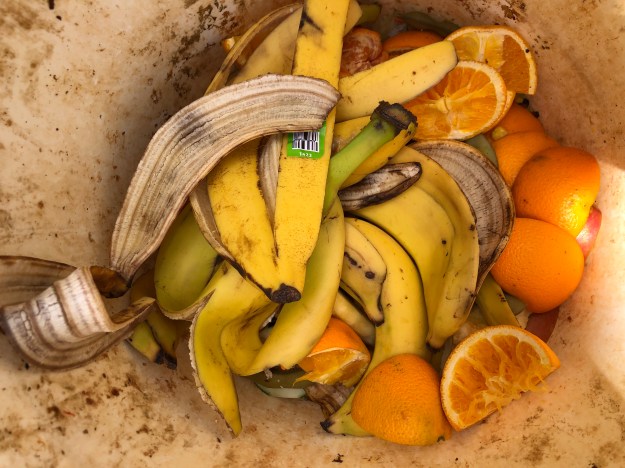
And I see the power of small children making a difference.  Little efforts, like teaching students to compost their leftovers from lunch will help them make the world a better place. (My students thought this photo was gross–but when I explained what it represented to me, they found it more interesting.)

img_1204

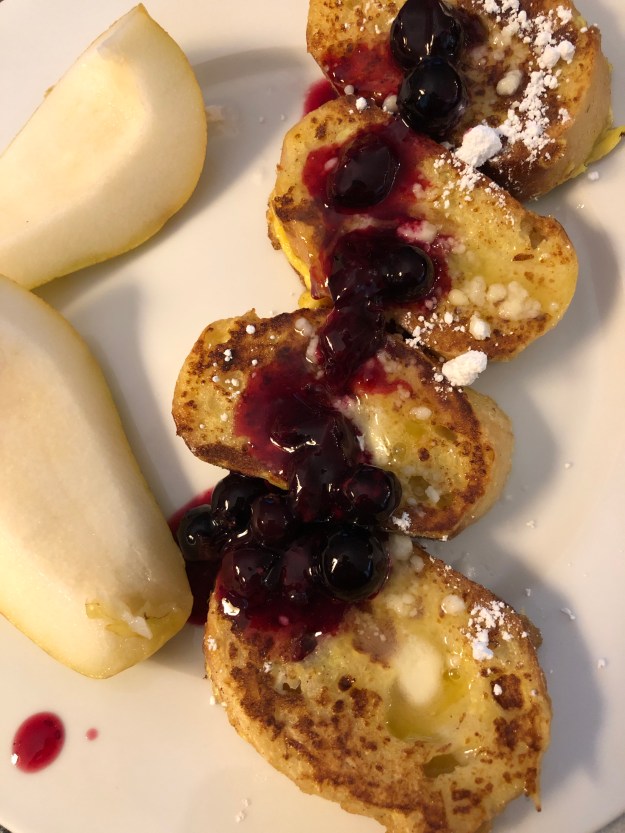
My camera also lets me celebrate life’s pleasures and express my gratitude.  My husband is an amazing cook and nurturer.  Some days result in food that doubles as works of art!

Mostly, though my camera helps me make space in my life.  Space for observation, space for an exploration of the senses, space for listening and learning, and space for making and creativity.  It gets me outside and keeps me moving.  It helps me connect with others–in person and online.  It reminds me to play, to take action, and to appreciate all that life has to offer.


At a Snail’s Pace

In my profession, May roars, leaving me windblown and mud spattered in the wake of the urgency to squeeze in every last bit of learning, every memorable project, and all the performances, displays, meetings, and endless, but somehow necessary, paperwork before school ends in mid June.

lrg_dsc03276

And May is rich.  Students have blossomed into their most curious, creative, innovative, and independents selves.  They seem to peak as the rains ease and the skies warm, classroom routines providing the inner rhythm, the back beat, that allows imaginations and a year’s worth of learning to come together in perfect synergy.  The classroom is busy in May, with students leading the charge…both eager for school to end and reticent leave the comfortable place the classroom has become.

But there is a week in May where time crawls to a snails’ pace.  State testing, mandated in public schools, demands that my students spend hours demonstrating their learning.  During those times I hear each click of the clock reverberate against my eardrums.  The room is unnaturally quiet as students work through question after question designed to test their mastery of third grade.  The work is not too hard for my students, but it is too long…and requires them to operate very differently from our typical classroom routine.

It seems almost from birth, our students were encouraged to collaborate.  They’ve learned to work in groups, sort out misunderstandings through discussion and conversations, negotiate roles and responsibilities, turn to each other for support and critical feedback…until it’s time for the test.  Then they are asked to be quiet, to read and understand complex questions independently, write and revise without feedback, and sit for long stretches of time.

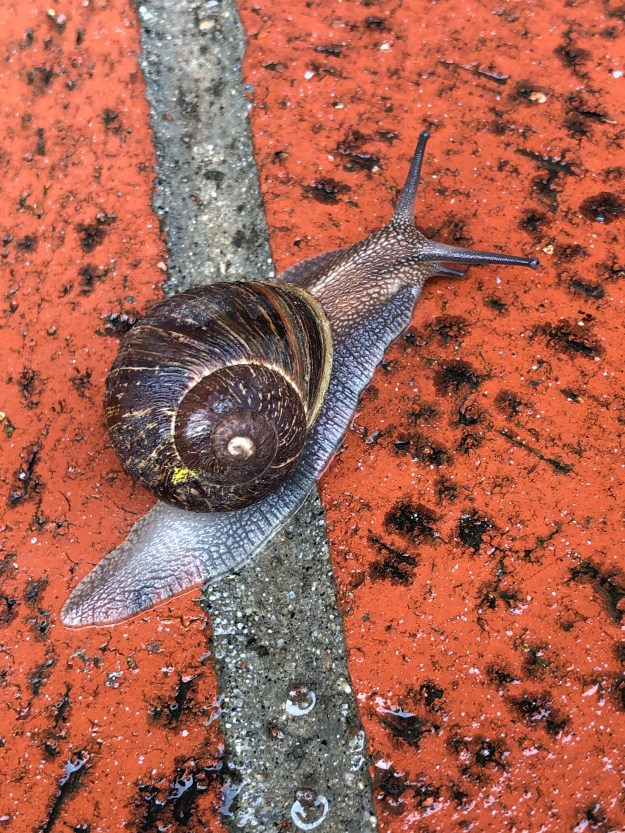
The minutes drag as I roam the room.  I check to make sure these first time test takers are progressing through their tests rather than spending inordinate amounts of time on any one question.  I search their faces, ready to intervene when signs suggest they are ready to crumble.  I remind them to use their tools, to take a breath, to stretch, and to check their work. That clock slows to a snail’s pace, each click requiring the coil of the snail’s body to snap forward, oozing its slimy self toward its destination.

img_0832

After the second day of testing I can feel the mood shift.  Novelty got us through day one and two, but day three feels heavy.  The hands of the clock are now mired in sludge.  Students need more encouragement to keep moving forward.  I need to summon some super powers to settle the boiling tummy, churning with uncertainty.  A walk and a talk helps, we are able to settle in again.

I’m proud of my students.  They did it.  All persisted, all persevered, all finished the tests in front of them.  And honestly, that is accomplishment enough at this stage of the game.  Now we can get back to the real learning–the noisy, messy, complex, interactive projects that bring joy to the classroom.  I’ll be the one who is windblown and mud spattered and reveling in the mess.

Into Negative Spaces

The paths we follow through life seem to be self-determined, crafted from deep thought and consideration.  Carefully groomed and plotted, they take use from where we are to the next destination.  We know where we are going and the most effective and efficient way to get there. Except when we don’t.

Negative space is art terminology that describes the spaces not filled in with color or design. They are the open spaces that often define those more deliberate lines, brushstrokes, carvings.

What happens when you lean into the negatives spaces?  When the spaces between become the path you follow?

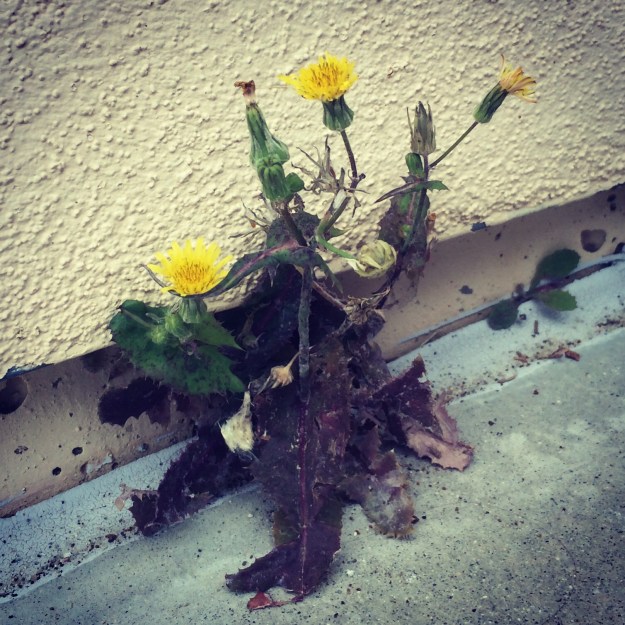
I think about the ways that dandelions find the cracks in the walls, in the sidewalks, along the sides of the road, plant themselves deeply and blossom–spreading both their roots and their seeds to ensure that they thrive.

img_0407

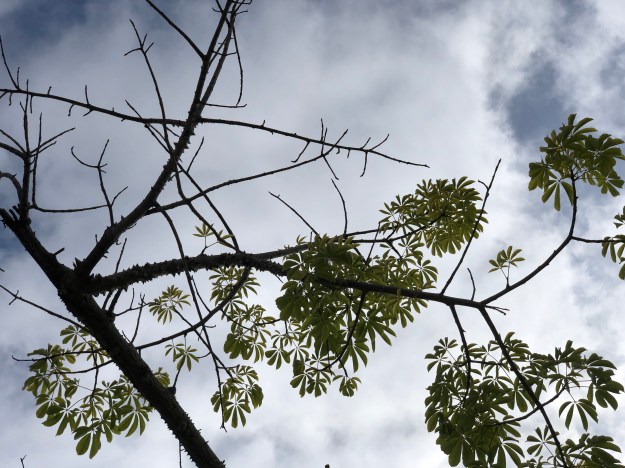
I think about the blue that is visible through the openings in the clouds, where the sun seeps through and warms our shoulders and relaxes our minds.

img_0766

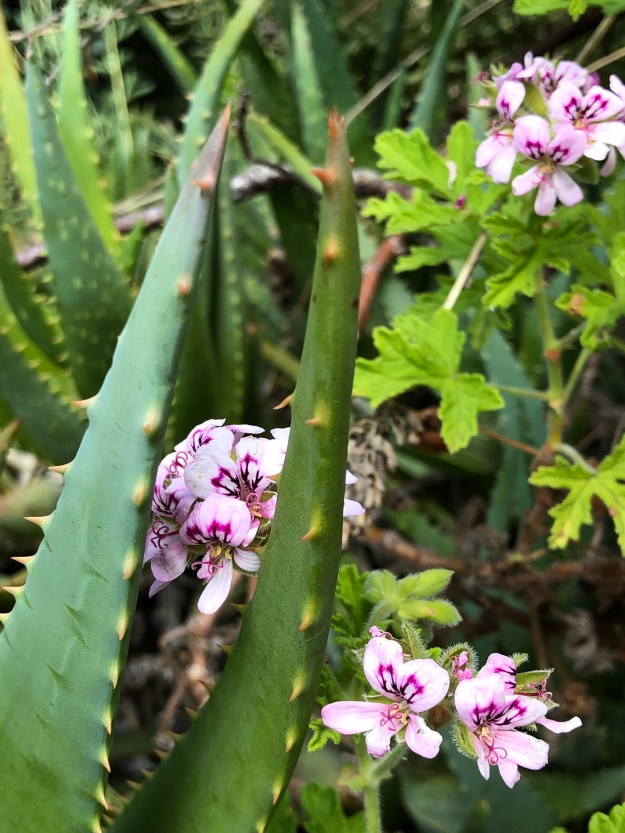
I spy the scented geraniums hiding between the spiky arms of the aloe vera, soft pink flowers intertwined with the sharp spines of the succulent.

img_0792

I notice the children who lay low, distinguishing themselves by the ways they blend in, quietly doing what they need to while others stand out, spreading their brilliant plumage like colorful peacocks.

But I know that these negative spaces are not negative, not less than, not inferior.  These are spaces waiting to be defined by the traveler, marked as the feet step on this road less traveled.  There are many paths that lead to fulfilling and successful lives…so why do so many insist that we all follow a single pre-determined path?

Let’s remember that sometimes the right path is the one that is yet to be discovered.

Influences: The Power of Audience

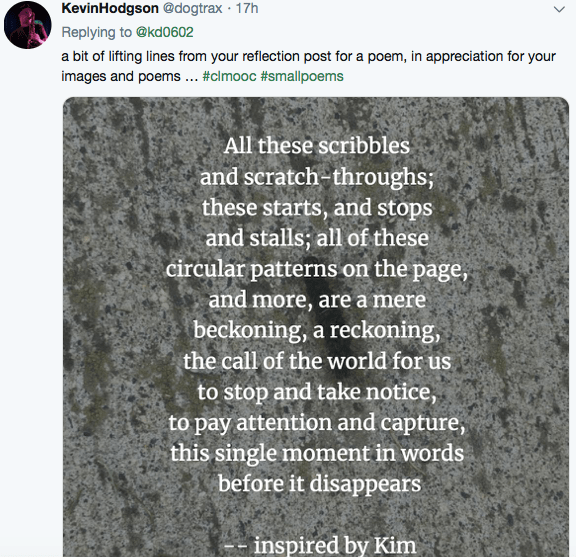
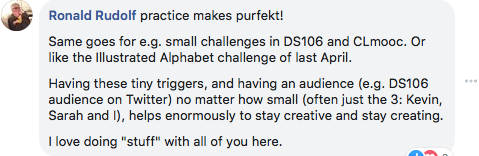
I wasn’t going to post today.  After 61 consecutive posts I was going to take the day off.  But today I found myself reminded of the influence and power that comes with having an audience, no matter how small.

I started the day with a twitter post from Kevin…

Screen Shot 2019-05-02 at 7.51.32 PM

And then a response on Facebook from Ronald…

Screen Shot 2019-05-02 at 7.53.37 PM

When I got home tonight, I came across a blog post from Sheri where she highlights parts of my reflections on writing (from yesterday’s post) that resonated with her.

As I think about those responses I realize another important aspect of writing that I forgot to include in yesterday’s reflection:  the importance of writing in a community of writers.  In addition to Kevin, Ronald, and Sheri, there are myriad others who influence my writing and thinking–some who respond to my writing, some who post their own writing, and some who read my writing and don’t respond but make a passing comment to make me realize they read what I write.  Some of these people I only know from our digital connections, some I know both from in-person encounters and digital forums, and others I see in person on a regular basis.

Knowing that others will read my writing helps to keep me accountable…not only to others but also to myself.  And reading the writing (and other kinds of creating) of others, inspires my writing.  This mutuality of being in a community bring sunshine, water, oxygen, and fertilizer to my thinking and my writing creating the perfect conditions for blossoming.

img_0729