Tag Archives: writing

En Plein Air: Beach Photography

As a writer, I’m trying to pay attention to the stuff the people aren’t paying attention to.
JONATHAN FRANZEN

When this quote came across my Twitter feed today, I found myself thinking about how it applies to photography too.  And establishing a habit of taking photos every day…with the express purpose of posting at least one…pushes me to consider new ways of paying attention to the potential images around me.  It’s not that I don’t see what others see…I do, and I often see that others around me take photos and post photos that are similar to mine.  So that means I need to pay attention to the details of composition, lighting, angles…

I realize that I use photography for a variety of purposes.  Sometimes I am documenting events in my life, sometimes I am teaching myself some new techniques, sometimes I am relaxing and enjoying the outdoors…and sometimes I am working to create art.

Some photos turn out just the way I want them to, with the colors and focus and frame all in perfect harmony.  And some pictures benefit from some editing…cropping, light adjustments, filters and such.

When I saw the Daily Post’s weekly photo challenge today was “work of art,” I knew I would focus on photos taken at the beach.  I headed to the beach today as a break from worrying about the wildfires in our community.  School was canceled, the weather was still hot, and the sand, waves, and briny sea air called to me.  As I got closer to the shore I noticed the juxtaposition of the bright blue sky to the west and south and dark smoke rising from the north.  The fires on Camp Pendleton had flared this morning, and firefighters were hard at work knocking it back down.  As I walked in the cool salt water I aimed for the shot that would capture the brightness of the blue sky and also capture the dark, ominous smoke in the distance.

beach with smoke

The carefree playfulness of the children on the beach was contagious!  Even though the water is still cool…in the mid 60’s, it seemed that everyone was enjoying the water.  I saw this group of kids heading into the surf and wanted to get a sense of the activity.  It’s interesting to me that the photo looks like the beach is empty, just by the framing of the shot, when in reality there were lots of people on the beach today.  I also played with a filter in Snapseed, creating a bit of a vignette effect, highlighting the children at play.

beach play

I ended up back at the beach later this evening when my husband came home from work.  It was still quite warm out and I had enjoyed the beach so much earlier in the day that I wanted him to have the opportunity to feel the relaxation and the cool of the ocean.  As I walked down the ramp toward the shore I noticed this gull on the roof of the  beach building.  With this post in mind, I decided to play around with the image a bit, cropping to bring the bird closer and then using a black and white filter.  I’ve noticed that black and white is great for some photos…and terrible on others.  I like it on this one.

Gull on roof

It wasn’t yet sunset as our walk came to an end, but the sun was low in the sky and created a shiny reflection on the water below it.  As we sat on some benches on the hill above the beach at the end of our walk, I was drawn to the silhouette of the palm tree in the distance.  I’ve photographed this tree before, but not quite at this same angle or at this same time of day.  It’s funny that this filter is called redscale, it seems to give the photo a yellowish, sunset kind of glow.

sunsetting yellow filter

As a photographer, even an amateur, there is a lot to pay attention to.  And the more I practice my craft, the more I find that I am able to pay attention to the stuff other people aren’t paying attention to, resulting in some interesting works of art…or alternatively, some interesting prompts for writing.  The beach is a rich resource to draw from, a source of inspiration, renewal, relaxation and fun.  And for me, today, it was also a welcome distraction.

Weekly Photo Challenge: Going Places

Enjoy taking photos? Love to share them with others? Welcome to this week’s photo challenge! (I post a new challenge every week…check in each week and join the fun!)

As I think about a photo challenge for this week, my mind is also on the horrendous fires burning in my community.  (If you are interested you can read more about it in yesterday’s blog post.)  Schools were closed today and most, including mine, are also closed tomorrow.  The firefighters are amazing and the flames are fierce.  At one point yesterday we had at least 9 separate fires burning in San Diego county.  And while there is still danger and fear around…it’s time to think about a photo challenge for the week.  I had one all ready to go…and then changed my mind and decided to go in a different direction–literally and figuratively.

Seeing the sky fill with smoke creates an urge to move…to check on your home and neighborhood, to see what is going on, to make sure children and animals are safe.  This photo was my “going” photo yesterday…as fires moved into my area.

smoke over cardiff

But earlier in the week, I had done some other versions of “going places” as  I headed up to the Bay Area to attend a conference and visit my son…and took advantage of the opportunity to ride the BART (Bay Area Rapid Transit).

bart station

Sometimes going places is as simple as taking the dog out for a walk around the neighborhood.  (You can see I fell a bit behind as I stopped along the way to take photos of other interesting things in the neighborhood!)

walking Roscoe

And then there’s this little guy who is genetically programmed (I think) to determine his travels based on eating his way through all available milkweed.  I love how the butterflies who lay the eggs seem to be always going places and somehow know how to find milkweed…this particular box of milkweed is outside my classroom.

caterpillar

So this week’s photo challenge is to capture an image or images that show someone or something going places.  As always, you are welcome to interpret “going places” in ways that suit you best! Post either the photo alone or along with writing inspired by the photo. I also invite you to use others’ photos as inspiration for your own writing and photography. I often use another photographer’s image as “mentor text” for my own photography, trying to capture some element in my own way.

I like to share my images and writing on social media…and I invite you to share yours widely too. (You might consider Twitter, Instagram, Facebook, Google+) Use the hashtag #goingplaces and include @nwpianthology to make it easy for us to find and enjoy. You can find me on Twitter and Instagram @kd0602. I’d love to follow you if you share your handle.

You can also share your photos and writing by linking to this blog post or sharing in the comment section below. How will you show going places through your lens?  I can’t wait to find out!


Weekly Photo Challenge: Chasing Shadows

Enjoy taking photos? Love to share them with others? Welcome to this week’s photo challenge! (I post a new challenge every week…check in each week and join the fun!)

Inspired by the Daily Create (and a little nudge from Kevin), I’ve been chasing shadows today. Actually, when I first saw the daily create prompt for today, shadow guessing, my thoughts immediately went to a photo I took over the weekend.

litterati shadow

I’m sure you know by now that I love to walk on the beach.  Something you might not know is that my husband (who often accompanies me on my walks) loves to walk with a trash bag in hand to pick up trash from the beach.  About a year or so ago I discovered the #litterati movement–people taking and posting photos of trash they come across, especially in nature, and then throw away.  By posting these photos on social media using the #litterati hashtag, they hope to bring more attention to the importance of taking care of our world.  This shadow is my husband as #litterati.

And then I remembered this photo of a sign in Ocean Beach that projected a wonderful shadow of itself…perfectly positioned for a picture!

ocean beach shadow

But I wanted to find photos to take today…hence, the shadow chasing rather than shadow guessing prompt.  Luckily we had some sun this afternoon, and as I headed to my car after work I came across some interesting shadows.

hydrant shadow

bicycle shadow

eucalyptus tree shadow

And I love that the light stays out longer these days.  The sun was still present even when I got home this evening.  I captured this interesting shadow playing with the railing on the stairs in my house.

light fixture on bannister shadow

So this week’s photo challenge is to chase some shadows…or create some shadows.  You can play shadow guessing or chase some interesting shadows that you just can’t resist snapping up with your lens. Post either the photo alone or along with writing inspired by the photo. I also invite you to use others’ photos as inspiration for your own writing and photography. I often use another photographer’s image as “mentor text” for my own photography, trying to capture some element in my own way.

I like to share my images and writing on social media…and I invite you to share yours widely too. (You might consider Twitter, Instagram, Facebook, Google+) Use the hashtag #shadow and include @nwpianthology to make it easy for us to find and enjoy. You can find me on Twitter and Instagram @kd0602. I’d love to follow you if you share your handle.

You can also share your photos and writing by linking to this blog post or sharing in the comment section below. Go out and chase some shadows…who knows what interesting images the shadows will help you create!


Lighting Up Writing and Art: a Design Challenge

My students love a project!  Project communicates to them that they will be doing some making, some designing, some problem solving, and probably a good bit of collaborating.  They also know that projects are about sustained time to create something they will value…and likely, others will too.

The project they did last week comes from 21st Century Notebooking: work I have done in collaboration with Paul Oh of the National Writing Project, Jennifer Dick of Nexmap, and David Cole of CV2.   I’ve had a few opportunities to explore the possibilities of “lighting up” my writing and art–and knew right away that my students would both love the opportunity and learn a lot from working with circuits and writing and art.  I feel fortunate to have the chance to pilot the use of LED stickers with my students and explore the ways a project like this works with young students (grades 1, 2, and 3).

On Monday we started with a pre-assessment to document what my students already knew about circuits and electricity (not much) and then to read a picture book to give them a bit of background knowledge about how electricity and circuits work.  We read Switch On, Switch Off by Melvin Berger to give students an overview of electricity and circuits.  And while the book is a bit dated, it did pique students’ interest and generated lots and lots of questions.  “Breaks” in circuits in conjunction with switches created lots of confusion!

On Tuesday we began talking about how light might impact a piece of writing and art.  I showed students examples that I had created and then they began to brainstorm other possibilities…focusing on topics and things they cared about.  They were invited to come up with at least four possibilities and began sketching them in their writer’s notebooks.

Just this small selection shows the variety of ideas…and students were eagerly discussing not only what they would draw, but also what they would write.  And in typical fashion they were already questioning whether they had to write in the format I had written (I had written a Haiku as my example) or if they could write in some other way.  For me, this was a demonstration of the ownership they were already feeling as the creative juices flowed.

On Wednesday, students were asked to commit to a design and draw it on their folded booklet. Then I showed them how to draw a circuit diagram on the inside of their booklet that would allow them to put the light(s) where they wanted them to shine through.

circuit diagram

series diagram

Thursday was the day that the kids got their hands on the copper tape and LED light stickers. Before they tackled creating their own circuits, I showed them how to work with the materials, how to make turns with the tape, how to use the stickers to measure how far to run their tape…and then they set off to work.

working with led stickers

guiding copper tape

The room hummed with the 43 six through nine-year-olds all focused on getting their circuits constructed with the tape and lights.  Many worked with a basic one-light circuit and a few brave students tackled a parallel circuit that included two lights.  When the first circuit worked, the entire room lit up with the students’ excited energy.

circuit success

But as you might imagine, every student was not successful on their first attempt.  We suspected we might have to deal with a few tears of frustration during the course of the project…but, although there was frustration, everyone kept at it, and the spirit of collaboration and encouragement could be felt across the room.  Some students became expert debuggers–and helped their classmates figure out why their circuit wasn’t working.  And my teaching partner and I also became experts, giving recommendations and helping those little hands that had trouble keeping their copper tape smooth and getting their battery lined up and clipped on.  Even before everyone finished, it was time to clean up…and we reassured them that we would return to the project the next day.

On Friday we were fortunate to have our school’s science teacher design a lab to complement our project.  She had students work in groups of four to attach components to make a circuit with an AA battery and battery holder, a light holder and a small incandescent light.  Because of their experience with the circuits in their project, this was a fun review for them…and they loved that they were able to get their circuits to work!

science lab with circuits

light

light with Joe

As part of the lab, they also explored conductors and insulators and noticed which materials allowed the light to light up and which interfered.  All of this was useful information as they returned to their circuit/notebooking project to problem solve circuit issues and continue with their art and writing.  By the end of the work period on Friday every student had successfully gotten their circuit constructed and their light(s) to work.  And we learned some important lessons along the way.  The stickers are pretty easy to work with, but grubby little hands can cause interference with the conductivity of the adhesive.  We had a few instances where we needed to pull the adhesive off and use tape to secure the sticker.  And sometimes our best approach was to peel the copper off and begin again.

Here are few examples of student projects:

circuit project-CJ

circuit project sophie

circuit project-elke

circuit project_Eva

We still have some final details to complete…including some writing about the science learning that took place during the project. And students are anxious to get a closer look at everyone else’s projects too!  So this week we will take some time to concentrate on the finishing details and already have a gallery walk planned for students to get a close look at all the projects.  The kids can’t wait to take these projects home…but they will have to wait until after Open House later this month.  We just have to have them on display on that night to allow families to experience the “wow” factor in the classroom.
With all the work we have done with the power of iteration this year, I am wishing for some more LED stickers to allow my students a second chance to use these materials.  I am wondering what they can do and would do now that they understand the possibilities.  Maybe I can talk Jen and David into scrounging up a few more just to see what my students would come up with…

Weekly Photo Challenge: Unexpected

Enjoy taking photos? Love to share them with others? Welcome to this week’s photo challenge! (I post a new challenge every week…check in each week and join the fun!)
As I go through my daily life, there are lots of things, places, and people I see every day.  And while they are not the same from day to day, they are quite often as I expect.  But this week as I looked through my pictures to decide on the weekly challenge, I realized that instead of seeing what I usually see, this week I had opportunities to catch glimpses of the unexpected.

On Sunday I headed off to the lagoon for a walk.  My husband usually pushes for the gym, but I am much happier out walking in nature than on the treadmill.  The lagoon is filled with native plants and there were lots of lizards scurrying about in the mild sun.  I’m used to seeing plants that thrive in a low water environment like the prickly pear cactus.  But it was unexpected to see these cactus in full bloom!  And what beauty these scaly, spiny plants displayed.

prickly pear in bloom

After work on Monday I was trying to convince myself to head the gym (you might notice a theme here–the exercise habit is a hard one for me to establish consistency with!) when I remembered that the tide would be low at the time I was leaving.  I rolled up my pant legs and walked along the shore, convincing myself that this would count as exercise.  As I left the beach to drive home, I took a look in my mirror and was hypnotized by the beauty of the ocean in the mirror.  While this photo doesn’t quite do it justice…you get the idea of my feelings of the unexpected.

ocean in the mirror

Tuesday I had a few minutes before an appointment, so parked and decided to squeeze a quick photo walk and an iced coffee into my schedule.  I took photos of some interesting buildings, a mineral water place (unexpected, but not a great photo!), and then I noticed this beautifully painted fire hydrant.

scenic fire hydrant

Last night I had a late meeting at school, an information night for my multiage program.  We’ve also had a heat wave, complete with scary Santa Ana winds, so when I headed out the door to head home it was still quite warm.  I teach in a place where when I walk out my classroom door and head down the hall I have an amazing view of the ocean.  But yesterday as I headed toward my car, the sky was painted in oranges and reds as the flaming sun dipped into the Pacific Ocean, creating this gorgeous and unexpected sunset.

sunset from school

And today my students reached the point in a project we are doing that they got to plan and construct the circuits that would light up their art design and writing.  I knew the circuits would be tricky for little hands, and while optimistic, I wasn’t sure how successful they would be, at least on their first try with these materials.  The first, “It worked!” was both unexpected and amazing…and gives me confidence that this project is within reach for my young students.

circuit success

So this week’s photo challenge is to pay attention as you go through your daily life and be on the lookout for the unexpected.  Or you might look through older photographs with an eye for the unexpected.  Post either the photo alone or along with writing inspired by the photo. I also invite you to use others’ photos as inspiration for your own writing and photography. I often use another photographer’s image as “mentor text” for my own photography, trying to capture some element in my own way.

I like to share my images and writing on social media…and I invite you to share yours widely too. (You might consider Twitter, Instagram, Facebook, Google+) Use the hashtag #unexpected and include @nwpianthology to make it easy for us to find and enjoy. You can find me on Twitter and Instagram @kd0602. I’d love to follow you if you share your handle.

You can also share your photos and writing by linking to this blog post or sharing in the comment section below. Be on the lookout for the unexpected…who knows what this week’s challenge will bring!


The Moods of May: An SDAWPphotovoices Photo-A-Day Challenge

In spite of being known for our mild, temperate climate and outdoor lifestyle, May is one of those months that can become monochromatic. Terms like “May Gray” and “June Gloom” describe those days when we are wishing for summer and sunshine, but plagued by a persistent gray, chilling marine layer along our coast here in San Diego. And with all that gray in mind, I’m thinking May be the perfect month to play with changing our moods. And thinking about weather and our attitudes toward it, I am reminded of a quote describing the teacher’s role in the classroom related to the climate.

I’ve come to a frightening conclusion that I am the decisive element in the classroom. It’s my personal approach that creates the climate. It’s my daily mood that makes the weather… Haim G. Ginott

As a photographer, I also make choices about the mood in my images. The ways I frame the subjects, how the light touches them, the composition within, all impact the mood portrayed. And with mood in mind, can we find interesting photos to capture that reflect a particular feeling? So for May, our challenge is to capture a mood through a daily photograph.  I’ve listed suggestions for each day by letter of the alphabet, with a few extras thrown in to add up to 31, the number of days in the month.  You get to decide how to portray the mood.  You can experiment with lighting, use apps to change the appearance, try different ways of cropping, shoot from different angles…the interpretation is totally up to you!  You can be literal or take liberties with the definition, let your inner artist play! After you shoot, post a photo each day with the hashtag #sdawpphotovoices to Twiiter, Instagram, Flicker, Google+ and/or Facebook (the more the better!), so that we can all enjoy the posts. If you are game for some extra action, compose a blog post about a photo, a week’s worth of photos, write a photo essay, try a learning walk, or write some poetry or even a song! You are invited to create a pingback by linking to this url or post your blog address in the comment section. It’s fun for me to see what others are doing with the same prompts I am using! Here’s a couple of my experiments with mood. Vibrant: vibrant ranunculus Tense: pirate's lair-tense Optimistic (maybe only Jack…Phil seems indifferent or defeated): begging cats Hopeful: hopeful- tidepools Tranquil: tranquil So now it’s your turn, here’s our list for May: 1. Anxious 2. Buoyant 3. Calm 4. Drained 5. Effervescent 6. Frustrated 7. Grumpy 8. Hopeful 9. Indifferent 10. Incredulous 11. Jubilant 12. Kind 13. Listless 14. Mellow 15. Narcissistic 16. Optimistic 17. Pensive 18. Playful 19. Quiet 20. Reflective 21. Solemn 22. Sad 23. Tense 24. Tranquil 25. Uneasy 26. Vibrant 27. Wistful 28. Whimsical 29. E(x)cited 30. Yearning 31. Zealous Let moods get your creative juices flowing as you explore through your lens during May.  Have fun, experiment, play with the limits of your photography…May is the perfect time for testing just how far you can go in controlling the climate through your images. You can post every day, once a week, or even sporadically throughout the month…whatever works in your life. Be sure to share and tag your photos with #sdawpphotovoices so we can find them!

Sometimes Process is the Product

It was quiet when I arrived, the coffee maker was percolating, the snake stretching up to explore its glassed-in space, and the empty exhibits waiting to be filled with the curiosity of children. There’s something magical about an empty museum…an experience I have come to love through our Intersections work, a partnership between the San Diego Area Writing Project, the Reuben H. Fleet Science Center, and the San Diego Natural History Museum (the NAT).  We, classroom teachers and museums educators, have been learning and working together throughout this school year to improve the field trip experience for students, and to explore the relationships between science and writing. And yesterday was our second field trip pilot, an opportunity to observe students, their teacher, and chaperones in action as they implemented the tools we developed to support the experience.  These tools: a chaperone orientation video, exhibit guides, and questions to invite student inquiry; a hands-free field kit, question card, and exhibit booklet for students; and all the experiences the teacher–one of our participants–had through our year together, were meant to support student inquiry and encourage exploration.  They were meant to support the parent volunteers/chaperones, helping them to facilitate student-driven conversations about their observations.  And in many ways, these tools did help to support these goals.

Student Field Bag...(Don't you love the sparkly pink leggings?)

Student Field Bag…(Don’t you love the sparkly pink leggings?)

My favorite part of the field trip happened at the very beginning when students were treated to a behind-the-scenes tour of the Nature to You loan library at the NAT, a room filled with taxidermy animals, insect specimens, and a geologic collection that are available for teachers to check out and take to their classrooms.  As we piled into the small space lined with glass cases of bobcats, birds, bats, possums, insects, and more, you could feel the energy.  Students spontaneously began asking questions, “Are they real?” “Are they alive?” “How did they die?” After a brief explanation that in fact, all these animals are real, but no longer alive…and that they either died of natural causes or were found dead and then preserved through taxidermy, students were invited to explore the collection and to consider which animals they might like to have visit their classroom.  The children and their chaperones spread throughout the room, eager to uncover the treasures within. looking closely interesections Student knelt down and bent in close to the glass, carefully observing the animals of interest. They told stories of animals they recognized…and their adult chaperones also told stories and pointed out animals of interest.  Everyone seemed to find favorites and called their friends over to see their finds. With Doretta Intersections This little girl was fascinated by the butterflies and desperately wanted this specimen to come to her classroom.  She asked if she could make a list of animals she wanted to bring back to school…and of course, she was encouraged to do so.  Students spontaneously took paper out of the field bags and used all available surfaces: shelfs, carts, the floor… to write lists and other information they wanted to remember about these animals. writing to remember intersections As they exited from the loan library, students gathered into their small groups and headed off to the museum exhibits.  They were free to explore in whatever order they decided, and our team of educator-researchers followed along, taking notes, listening in on conversations, documenting the museum experience. We noted the places where students lingered, where they seemed eager to spend more time and explore, and captured their questions and conversations where we could.  I found myself interested in the structures and spaces of the museum, thinking about the strategic placement of benches and stools and the height of information boards.  I loved watching students at this chalkboard that invited students to draw skulls that they had observed throughout the exhibit. skulls on a chalkboard intersections And I noticed students sketching and writing in their booklets–a space intended to invite student observations and deepen their thinking.  Unfortunately, in many cases students and chaperones seemed to view the booklet as a duty, often filling in spaces as quickly as possible with little thought and attention.  I did notice a student or two take some time…this little guy made himself quite comfortable in the middle of the floor, as he sketched and completed a page in his booklet. drawing my hand intersectionsBefore lunch, students had the opportunity to get close to a couple of snakes…and even touch them.  They moved in close, asking questions of the the docent as they reached toward the snakes. snake petting intersections After lunch, students headed off to the Fleet with the researchers in tow.  We continued our documentation and observations.  As the field trip wound to an end, the educator-researchers gathered in a conference room to debrief the process.  Reviewing our notes, we thought about the positives of the field trip experience and the places we still felt a need for change and improvement.  And then we gathered in groups and discussed our observations.  The conversations were rich and dynamic, noting the places where we observed students engaged and inspired and still finding missed opportunities for students to be self-directed and to delve more deeply into the questions the exhibits provoked. This process of designing field trip tools, testing them in an authentic field trip experience, and then reflecting on the implications of our observations in order to iterate and innovate has been a powerful one.  And while there has been frustration in our group that we haven’t yet produced a product that captures the depth and intensity of our work together, we have learned a tremendous amount and come to some startling ahas about the intersections of informal and formal learning opportunities.  As much as we’ve tried to support chaperones to facilitate inquiry, the reality is many of our well-intended parent volunteers are not prepared for that role…and our “crash course” in juicy and probing questions isn’t enough to make them feel comfortable and confident in that capacity.  Mostly, they do just what we asked them to do, they keep track of students, redirect them when needed, and deal with the safety and personal well-being needs that come with groups of children.  So, we are rethinking our tools…again.  And maybe we will never have the perfect product we wish for…and then again, maybe this process is the product we are searching for, an occasion to really see students in action and consider the roles we might play in supporting their curiosity, deepening their learning opportunities, and opening up time and place for playful exploration and inspiration both inside the classroom and in those wonderful spaces beyond the classroom walls.

Weekly Photo Challenge: Rule of Thirds

Enjoy taking photos? Love to share them with others? Welcome to this week’s photo challenge! (I post a new challenge every week…check in each week and join the fun!)

Taking and posting a photo every day is the perfect opportunity for me to not only pay attention to interesting things in the world, but also to  work on my skills as a photographer and to improve my craft.  There’s lots of factors that influence the outcome of a photo including lighting, angles, backgrounds…and composition.  One photography technique that I find helpful is the rule of thirds. (Here’s a short video that explains the technique.)  Here are a few examples that I think follow the rule of thirds.

When I headed out to work this morning, this dandelion along the curb near my house shouted for my attention.  (Yeah, I know, dandelions are becoming a obsession for me!) I actually took a couple of shots, but I like this one where the dandelion sits along the right third of the photo with my neighbor’s house along the upper horizon.

dandelion-thirds

Last week I was out in my backyard with my macro lens investigating the new growth.  I noticed this shrub budding and moved in close.  Both the lighting and the green of the bud lay along the lines of thirds, creating an interesting composition.

leaf bud-thirds

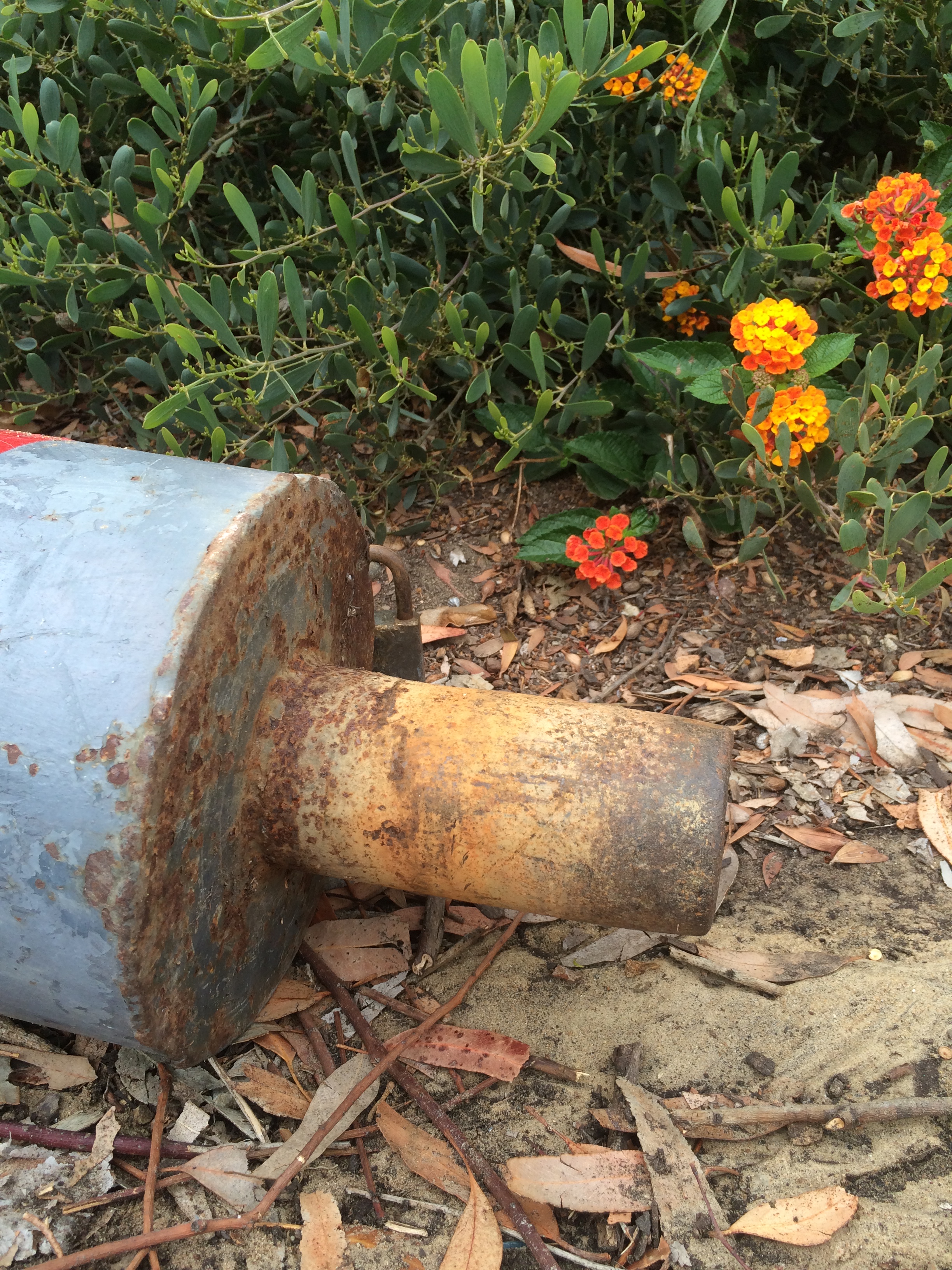
This odd rusty pipe-like structure at the beach attracted my attention.  I shot it from different angles and perspectives, but like this image the best.

pipe-thirds

And a few weeks ago I was down at Mission Bay watching my nephew’s crew team rowing.  I like the way the light lays in the left hand upper third of the photo.  I think one of the reasons I enjoy playing with the rule of thirds is because it offers so many options…and produces interesting results.

rowing-thirds

So this week’s photo challenge is to play around with composition using the rule of thirds.  Try one image a few different ways and then post the image you like best.  Or sort through some photos you’ve taken recently and see if you can find one that fits the rule of thirds.  Any subject you find interesting will work for this week’s challenge.  Post either the photo alone or along with writing inspired by the photo. I also invite you to use others’ photos as inspiration for your own writing and photography. I often use another photographer’s image as “mentor text” for my own photography, trying to capture some element in my own way.

I like to share my images and writing on social media…and I invite you to share yours widely too. (You might consider Twitter, Instagram, Facebook, Google+) Use the hashtag #ruleofthirds and include @nwpianthology to make it easy for us to find and enjoy. You can find me on Twitter and Instagram @kd0602. I’d love to follow you if you share your handle.

You can also share your photos and writing by linking to this blog post or sharing in the comment section below. Have fun playing with the rule of thirds–I can’t wait to see your compositions!


Weekly Photo Challenge: Small

Enjoy taking photos?  Love to share them with others?  Welcome to this week’s photo challenge! (I post a new challenge every week…check in each week and join the fun!)

Small things are often underestimated in our biggest, strongest, fastest focused world.  Too often, small gets overlooked or trivialized as merely cute.  And yet, when you look closely, small can reveal so much more.

I was out with my macro lens in my backyard yesterday and noticed these tiny weed buds neighboring up to a potted plant.  I love the gentle curve of its stem, like a dancer in motion rising from its leafy brethren below.

tiny weed bud

And then there’s the energy and inquisitiveness that comes through this small hand…the hand of a child who just discovered this bean growing in the school garden.  She was excited to taste this morsel, exploring the bounty students planted and nurtured.

hands with bean

And how often do we dismiss or turn in disgust from these small, slimy creatures?  I came across this slug on my sidewalk as I ventured out to take a peek at the moon the other night.  I nearly missed the small brown creature…or worse, nearly stepped on it!

slug

And sometimes something small is revealed by something larger.  This hearty, healthy dandelion emerged from a small crack between the sidewalk and wall.  Weeds don’t need much space to grow–they grow where they can, making use of small, often unused spaces.

weed in the crack

So this week’s photo challenge is to look for and capture small. Interpret small in ways that work in your context.  Small might mean smaller than your palm, or small in relation to something larger than life.  Use a macro lens, lean in closely, or maybe even pose your small next to something large.  Post either the photo alone or along with writing inspired by the photo. I also invite you to use others’ photos as inspiration for your own writing and photography. I often use another photographer’s image as “mentor text” for my own photography, trying to capture some element in my own way.

I like to share my images and writing on social media…and I invite you to share yours widely too. (You might consider Twitter, Instagram, Facebook, Google+) Use the hashtag #small and include @nwpianthology to make it easy for us to find and enjoy. You can find me on Twitter and Instagram @kd0602. I’d love to follow you if you share your handle.

You can also share your photos and writing by linking to this blog post or sharing in the comment section below. I’m looking forward to seeing small through your lens!

Spring Break: In 25 Words

Sometimes in writing (as in life), less is more.  Coming back from our spring break, we asked our students to zoom into some aspect of their spring break activities and compose a 25-word story to capture the experience.  25 words is short…and it’s not as easy as you might think to come up with a “story” in only 25 words.  But our first, second, and third graders gave it a try. Here’s a couple of examples (the links are to their published blogs–they would love comments if you have time!):

There is new growth in my family garden! Carrots are growing in nice soil (getting sunshine, too!) Making me want to eat the delicious vegetables!  (E.F.)

My brother fell out of a tree, he was in pain! He got crutches, he screamed a lot! Hopefully he didn’t break a bone! (M.B.)

My friends and I went to my Gramma’s house, we had tons of pure fun. We got lost sometimes but it was still extremely fun. (N.B.)

Biosphere two is an amazing place where the scientists are in Arizona, the desert and survived 2 years trapped, researching plant life in threemile greenhouse. (A.R.)

And then there is the student who writes the 25 word story…but can’t resist expanding on the story in her blog post!  (A girl after my own heart!)  Here is the 25 word version…you can click on it for her blog post.

Suddenly a foul ball comes hurling our way. It bounces, jiggles, is everywhere. It happens quickly but suddenly the ball’s in my brother’s sweaty palms. (M.O.)

And of course, I had to try to my hand at a 25-word story about my spring break.  It took me a number of tries to come up with this one…and I might have to try another dozen or so to really craft a story.  And I will include a few photos to enhance my words!

nashville mural

Toes tapping and fingers snapping, she explored the city along the banks of the Cumberland in her new cowboy boots. Her camera captured the details.

Nashville downtown

Cumberland river