Some Macro Play

I love using my macro lens on my iPhone…but it’s not easy.  I have to take my case off and attach the lens to the magnetic ring…so I don’t take macro shots spontaneously, I have to think about using this lens and make the necessary preparations.

I definitely have days when I feel at a loss for what to photograph.  Things feel ordinary…or I feel like I have already taken those same shots some other day.  Today I headed out to my backyard with plans to sit in the shade and read for a while.  But when I headed out there, I noticed the aloe plant that has gone crazy!  It started as a small house plant…and now is obviously loving the growing conditions in the back yard!  This week on #sdawpphotovoices our photo-a-day focus is #scratchy…and what could be scratchier than aloe spines?  I took a photo with my regular lens…and then headed inside to attach my macro lens.

I love the way the sun behind the plant makes the spine tips glow!

In the same big pot with the aloe there is also a cactus that outgrew its tiny indoor pot and ended up in the backyard.  The long, thin, needle-like spines create interesting flower-like patterns.  I love that the top spines are a brilliant yellow, creating a beautiful sunburst!

These ordinary cactus almost look like exotic sea creatures when you get close!  My attention turned to the lavender plant–the one I wrote about here–that was almost killed due to neglect! The plant continues to improve, although it is not in full bloom right now. There are a couple of beautiful blossoms…and some buds developing.

And I wasn’t quite done…I noticed a “volunteer” plant–one that planted itself in a pot of dirt on the edge of the patio.  It was green, but in the last week it has turned to a rusty red-orange color.  I’m not sure if it is dying…or if it is a natural cycle of growth for this plant.

All of these photos are unedited…and I love the colors and the way the sun creates glow.

I decided to take one last photo…of a spiderweb down in a hole where my husband is fixing the sprinkler.  As I moved my lens in close, the web began to glow, catching the sun.

photo

Playing with my macro lens today helped me see the ordinary things in my backyard in a new way.  The colors popped, the patterns emerged, and the light created beauty that’s hard to see without looking closely.  And, as I always notice, opportunities to play and make help me find my creativity and the fun that is so often right in front of me.  And best of all, all this noticing piques my curiosity and wonder at the world around me.

Have you taken time to play today?

Looking Beneath the Surface

I suspect my neighbors thought I was crazy as I crawled around the lawn in my skirt when I got home from work today.  I had spotted some new mushrooms growing this morning and noticed that one had a hole where you can see through to the inside.

After unloading my work bag and feeding my cats, I attached the macro lens to my iphone and set out to get a closer look at the underside of the mushrooms.  One had been kicked over and lay with the underside exposed.  It was already turning brown on the exposed texture that is in such contrast to the smooth outside surface.

photo

And then I got down on my hands and knees to look through the hole along the edge of the mushroom top.  I peered through first with my eye…and then with the lens of my camera trying to capture the interesting layers I spied beneath the surface.

photo-2

These mushrooms remind me that what I see on the surface doesn’t always capture the complexity of what lies beneath.  My classroom is like that too.  There is so much about each of my students that isn’t visible unless I take the time to bend down and look carefully beneath the surface.  And sometimes I need a special tool, like my macro lens, to bring those interesting layers into focus.  Sometimes that tool is those informal conversations that I have with the students near me as we walk in lines.  Other times it is the opportunity to listen into a discussion a small group is having about a math concept or a story we have read.  Oftentimes it is through my students’ writing that I learn the most.  Their stories reveal their interests and their experiences…and show me what they know about reading and writing and science and sometimes even math and social studies.  Looking at a piece of student writing is like looking at the underside of a mushroom.  When you take the time to get beyond the surface, there are layers and layers that unfold and reveal new information that helps me know my students and helps me help them learn.

What have you learned from a student lately?

Wilfred Gordon McDonald Partridge: #113texts

When we select books to read in our classroom we begin with well-written books about topics we want to address as part of our instruction.  Wilfred Gordon McDonald Partridge by Mem Fox is a lovely, well-written book that has been around for a long time.  (Published in 1989)

519KFKCRACL._SX260_

This book is about a young boy who lives next door to an old folks home and has made friends with the old people who live there.  One of his best friends–Miss Nancy, who has four names just like him, seems to be losing her memory.  When Wilfred Gordon hears this he goes to the other residents asking what a memory is.  Their responses:  something warm, as precious as gold, makes you laugh, makes you cry…prompt Wilfred Gordon to go home and find these for Miss Nancy.  He collects his interpretation of these things called memories into a basket to share with Miss Nancy.  When Miss Nancy unpacks the hen’s egg, seashells, puppet, and football she begins to tell the stories she remembers when she examines each object.

We started the school year a few weeks ago reading this book as a way of demonstrating the power of things to elicit stories and memories.  We asked students to bring in an object or artifact that represented something important or special to them and/or their families.

In addition to using this book to teach the concept of object-based thinking and writing, we also used it this week as a mentor text for writing.  We like to “mine” the books we have read for interesting sentences to help our students broaden their understanding of sentences, grammar, and conventions.  As our first mentor sentence of the school year we looked for a sentence that was accessible to our first graders and still “meaty” enough for our more accomplished writers.

We decided on this sentence:

He admired Mr. Drysdale who had a voice like a giant.

Asking our students what they noticed, we were able to identify the use of the simile (a voice like a giant), proper nouns (names), and pronouns (he).  We also talked about the verb admired as well as the basics like the use of a capital letter at the beginning of the sentence and period at the end.  After a couple of examples of how we might follow the pattern of this sentence from Mem Fox, students set off to write their own sentence following the pattern.

photo-1

Here are a couple of examples:

First grader, E, wrote: I love my bunnies because they love me.

Second grader, B, wrote: He loved his dog Milo even though he shedded on him if he brushed onto him.

Third grader, C, wrote: I admire LEGO makers who have a way of making awesome sets.

And another third grader, M, wrote: The people love to watch Emily who surfed the waves that were as tall as mountains.

You can see that not all students were including the simile…yet.  But all were able to expand a sentence similar to the way Mem Fox did in her sentence.

There are many other ways to use Wilfred Gordon McDonald Partridge as a mentor text.  Mentor texts are all around us, as close as those classroom bookshelves.  Take a close looks at some of your old favorite read alouds, you’ll be surprised at all the opportunities to use them as writing mentors!

Planting Seeds

I love the opportunities to spend informal, conversational time with my students.  I often find that time on our walk to the garden.  It’s a longish walk and away from the classrooms, so some conversation doesn’t disturb anyone.  I made the walk with students four times today…twice going there and twice coming back (with my class split in half–the other half was in the classroom with my co-teacher).

photo

On my final walk back to the classroom I was bringing up the rear with some second grade girls in my class.  As I listened in to their conversation, I noticed that they were talking about math and creating math stories that included elements of the garden.  When they noticed me listening they let me know that they were planning a “math playdate.”  A math playdate!  What an amazing idea!  They had made a case to their parents that they needed this playdate…with a math focus.  They had planned that the mom at the house they were going to would write up some math problems for them to solve and they would create their own math story problems (like the one I overheard).  We talked about whether they would include some of the other strategies we use in the classroom–like the way I pose problems, “If the answer is 15, what is the question?”

Honestly, this conversation surprised me.  These are not my confident, competitive math students (yes, I have a few of those!).  These are my pretty quiet, but definitely competent girls.  I work hard to make math fun in the classroom.  We play around with numbers and math concepts daily, with an emphasis on explaining thinking and problem solving.  We look for multiple approaches to solving problems and take time to learn from our mistakes.  Learning that these students see math as a fun way to spend their time together delights me!

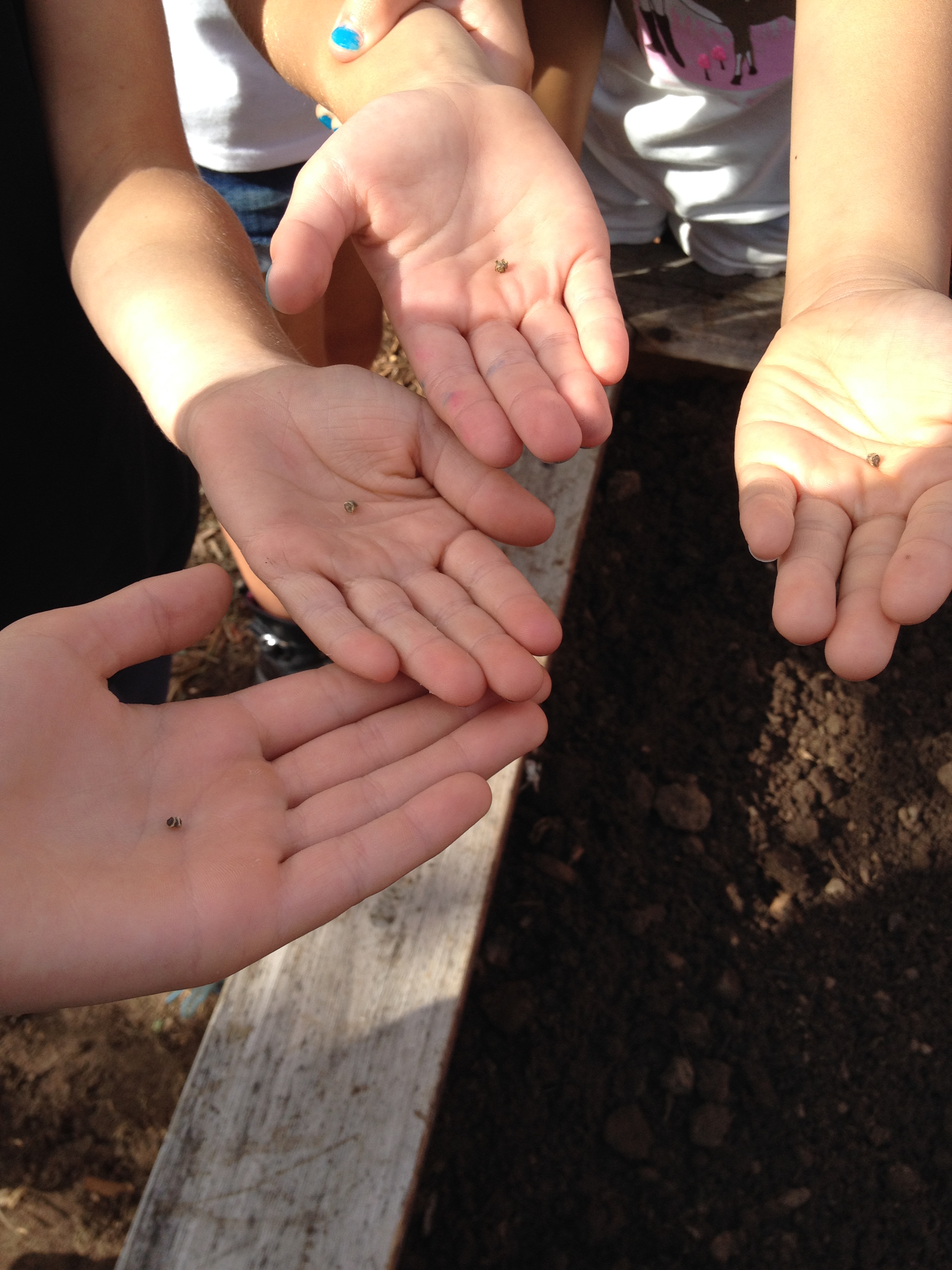
I got to harvest more than pumpkins today!  As teachers, we never know when those seeds will germinate and grow and blossom.  What seeds did you plant to today?

Who Are Your Mentors?

“Children want to write.”  These words written by Donald Graves before I even began my teaching career echo in my head and push me to improve my teaching…and my own writing.  Each and every day.

Donald Graves also influenced my view of myself as a teacher researcher early in my career. Through his writing and conference presentations, I learned to view my teaching as a work in progress responsive to the needs of the students in front of me.  Through his work I learned to pay close attention to my students and to listen carefully.

Children will continually surprise us if we let them.  This is what happens when we slow down, listen, and let the children lead.  That is the joy of both research and teaching.” Donald Graves

Some days teaching writing is hard.  I have students who resist and say, “I don’t know what to write.”  And I know exactly how they feel.  Some days I don’t know what to say in my writing either.  But I strive to struggle through…and I ask them to do that too.  In the Writing Project we say that the best teacher of writing is a writer his/herself.  And I know this is true, because I know what makes writing hard because I write.  And I know that writing is the answer to that struggle to write.  Some days I have to write through the struggle just to find out what I have to say.

“Write yourself. Invite children to do something you’re already doing. If you’re not doing it, ‘Hey,’ the kids say, ‘I can’t wait to grow up and not have to write, like you.’ They know. And for the short term and the long term, you’ll be doing yourself a favor by writing. All of us need it as a survival tool in a very complex world. The wonderful thing about writing is that it separates the meaningless and the trivial from what is really important. So we need it for ourselves and then we need to invite children to do what we’re doing. You can’t ask someone to sing a duet with you until you know the tune yourself.”

We all need mentors in our lives.  Donald Graves was one of mine, and his writing remains to continue to guide my thinking.  And those he mentored continue his work and provide guidance for the next generation of teachers and writers.  My students also mentor me.  They continually remind me to have high expectations and limitless patience.  And they prove Donald Graves right, “Children want to write.”

Who are your mentors?  How do you continue their work?

student reflection

September Smooth

The first week of September at #sdawpphotovoices had us looking for texture…specifically taking photos that focused on #smooth.  And while I could find photo subjects that were smooth, I found myself pushing to create more interesting photographic images.

I played with frames and framing and with cropping and the effects of filters using photography apps.  Here’s a fun one from yesterday that has nothing to do with smooth.

photo-1

This bride and her groom were being photographed on the beach…and this guy on his bicycle rode by at the perfect time to get him in the shot.  I love the juxtaposition of these people in my shot.

I think my favorite image of smoothness is this picture of a smooth rock swirling in the smoothness of the surf.  It’s funny because I had bent down to capture this smooth rock and my sunglasses fell onto the ground before I snapped the shot.  When I grabbed them and reset myself to take the shot I nearly landed in the water–the surf had come back up without me noticing and surprised me as I remained low to the ground to get my shot.  Sometimes happy accidents make the best photos!

photo-2

I was obviously not at my smoothest, but I like this #smooth shot!

A Question of Luxury

Just what is a luxury?  The word tends to bring to mind those things you buy: fancy cars, expensive homes, designer clothes…

As I mulled the idea of a luxury I wouldn’t want to live without, I found myself thinking instead of just how fortunate I am.  My basic needs are met…and more.  I live in a beautiful city…a place that others choose for vacations.

The natives have been restless this week, our weather has been hot (for us) and we’ve had unusually high humidity too.  Weather has been the topic of conversation for everyone.  Most coastal dwellers don’t have air conditioning–we’re all much more used to carrying a sweatshirt at all times since it’s more likely to be chilly (for us) rather than too hot.  So we’re all whining and complaining about discomfort and wishing for greener (and more temperate) pastures.

As I headed off to the beach this evening for relaxation and relief from the heat (it’s starting to become a habit), I realized that it is our proximity to the ocean that is the luxury that I would prefer not to live without.  I love seeing the ocean in the distance as I sit in traffic on the freeway.  I love knowing which direction west is as I watch the sun set.  I love the briny smell of foggy mornings and the woody smell of bonfires along the shore.  I love the quirky behaviors of seabirds, watching them run along the shore with bills specially adapted for the food source they seek.  I love the piles of amber kelp that wash up and become jump ropes and sandcastle decorations and fun poppers exploding under my bare feet.

I love long walks, especially at low tide, with the white noise of the surf soothing my soul and relaxing that tight knot that often forms between my shoulder blades.  The beach is definitely a luxury–and I wouldn’t want to live without it.

photo

What luxury would you not want to do without?

An Unusual Point of View

Yesterday I wrote a post about playing with frames where I was looking for different ways to photograph the ordinary in my life.  This evening I headed off to the beach (again) to cool off and enjoy the sunset.  And with my iPhone camera in hand I was again looking for new ways to explore the beach photographically.

When I sat down to write this post, I wondered about my topic.  Would I write about my school day?  Would I participate in Five Minute Friday and write about red?  I took a quick look at my blog reader and saw today’s Friday Weekly Photo Challenge on The Daily Post…and discovered that this week’s challenge is just what I have been working at!  The challenge is titled, “An Unusual Point of View” and talks about trying new ways to take photos of ordinary (or popular) views.

Back to the beach.  The tide was ultra low when we arrived and the seabirds were feasting in the wet sand.  I love sandpipers and their gently curved beaks that poke deep in the wet sand pulling up tiny shellfish and crabs.  I was stalking this pair as they searched the shore and shot this photo, capturing the reflection of the cliffs in the wet sand.  Can you spot my pair of sandpipers?

photo-2

As the sun moved lower on the horizon, I took a few shots and then felt that they were too much like the sunset photos I took last week.  How could I frame them differently?  I noticed that through my sunglasses the view looks different than it does when I look without them.  I decided to use my sunglasses as both a frame and filter for a picture of the setting sun.

photo-3

And then as the sun sat down into the water, I tried using the people in the water as features of my photos.  I tried some fishermen, some surfers…and then captured this pair which I am titling, Into the Sunset.

photo-1

I love stretching and trying out new strategies.  The experimentation adds a new dimension to my view of the world and has me alert to novel opportunities for photos.  I look forward to seeing what others produce with their unusual points of view.  What does an unusual point of view do to your craft?

Playing With Frames

Some days finding something interesting to photograph feels impossible!  When my days are filled with working and my photography is squeezed into stolen moments, inspiration can be hard to find.  I was feeling that way today.

So…instead of looking for something new and different to photograph, I decided to play around with a new way to photograph something ordinary.  While I was on playground duty this morning (don’t feel sorry for me, our playground has a beautiful view of the ocean!) and chatting with kids playing on the equipment, I was also scoping out new ways to look at my surroundings.  I noticed that the playground structure created some interesting frames.  With a little editing I came up with this photo from this morning’s efforts.

photo

As I was editing this photo I also remembered some other shots when I played around with natural frames in the environment.  Here are a few…

photo

pipe

San Diego skyline from the Coronado Bay Bridge

San Diego skyline from the Coronado Bay Bridge

There are so many ways to think about frames and how to use them.  Back in my first blog post I was thinking about how frames shape experience and provide a focus.  Today I found myself thinking about how a frame adds dimension and interest to a photograph.  Sometimes I want a visible, decorative frame.  Other times I want the framing to be invisible, letting the photo speak for itself.  And in both cases, the framing and frame are intentional.

I reframed my photography experience today by playing with the natural frames in my environment…creating the opportunity to make something more interesting through my camera lens and changing the way I viewed my surroundings.

What do you learn when you reframe your experiences?  How can you make the ordinary extraordinary?