It feels like tying things is becoming a lost art. The majority of the first graders in my class don’t know how to tie their shoes, most opting for Velcro or slip-ons as alternatives to the dreaded shoe tying.
Bows on packages are often premade. You can just peel off the paper and stick them directly on the wrapping paper. Maybe I’m showing my age, but tying used to feel like a rite of passage rather than an avoidable annoyance.
We recently sent our grandsons knot tying kits — kind of in the same genre of the Swiss Army knives we got them for their birthdays (and I wrote about here). And I’m wondering if they will take up the challenge of learning to tie a variety of knots. I think the kit includes directions for 23 essential knots. (What knots are essential? And for who?)
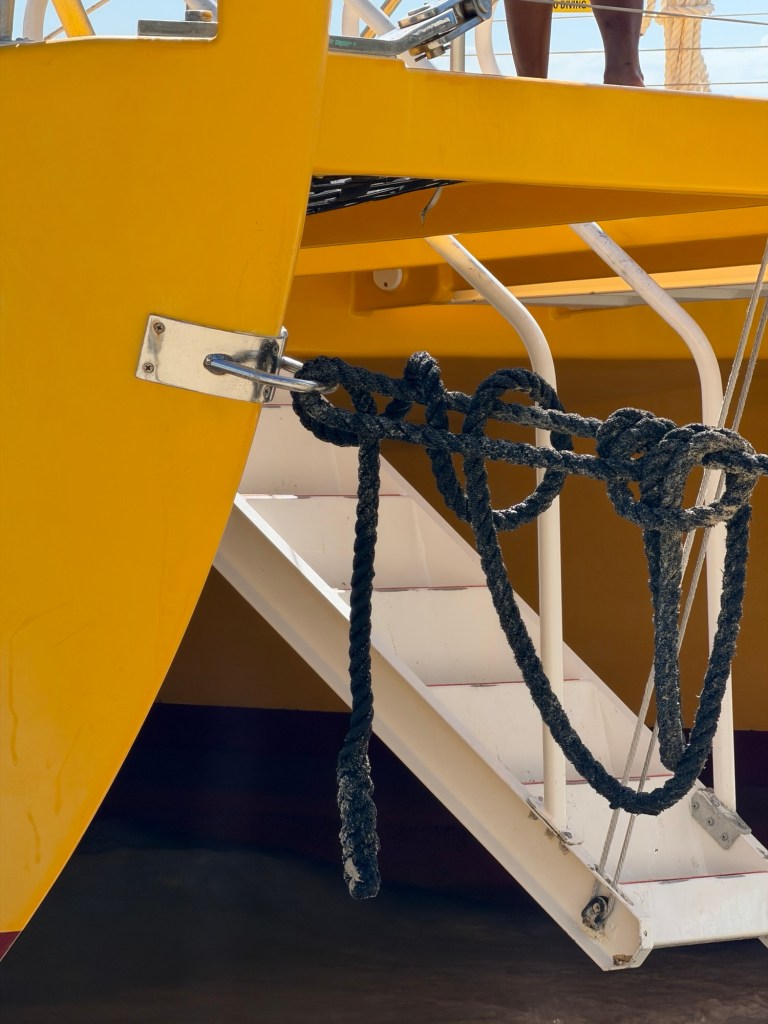
Sitting in a beach chair, reading a novel, I heard the horn of a catamaran alerting people to move so they could land on the beach. And probably about 10 yards from me the boat landed on the sand and two young women ran down the stairs, hopped off, each grabbing a long and thick rope that they then looped through a metal ring and tied with confidence. I have no idea what kind of knot it is, but I’m guessing if you work on that catamaran, that knot is essential.
What other professions and hobbies depend on knots? How do we get our children and students interested in these lost arts? How many knots do you know how to tie?
Earlier this week I read the book, Be a Treeby Maria Gianferrari to my first grade students. I’m so fortunate to have an amazing librarian at my school who seems to know just what books I’d love to read before I’ve ever heard of them! Anyway, Be a Tree is a gorgeous book that is a blending of factual information about trees and metaphorical thinking and comparisons of humans and their communities to trees and their ecosystems. And the illustrations by Felicita Sala are worth just sitting and poring over.
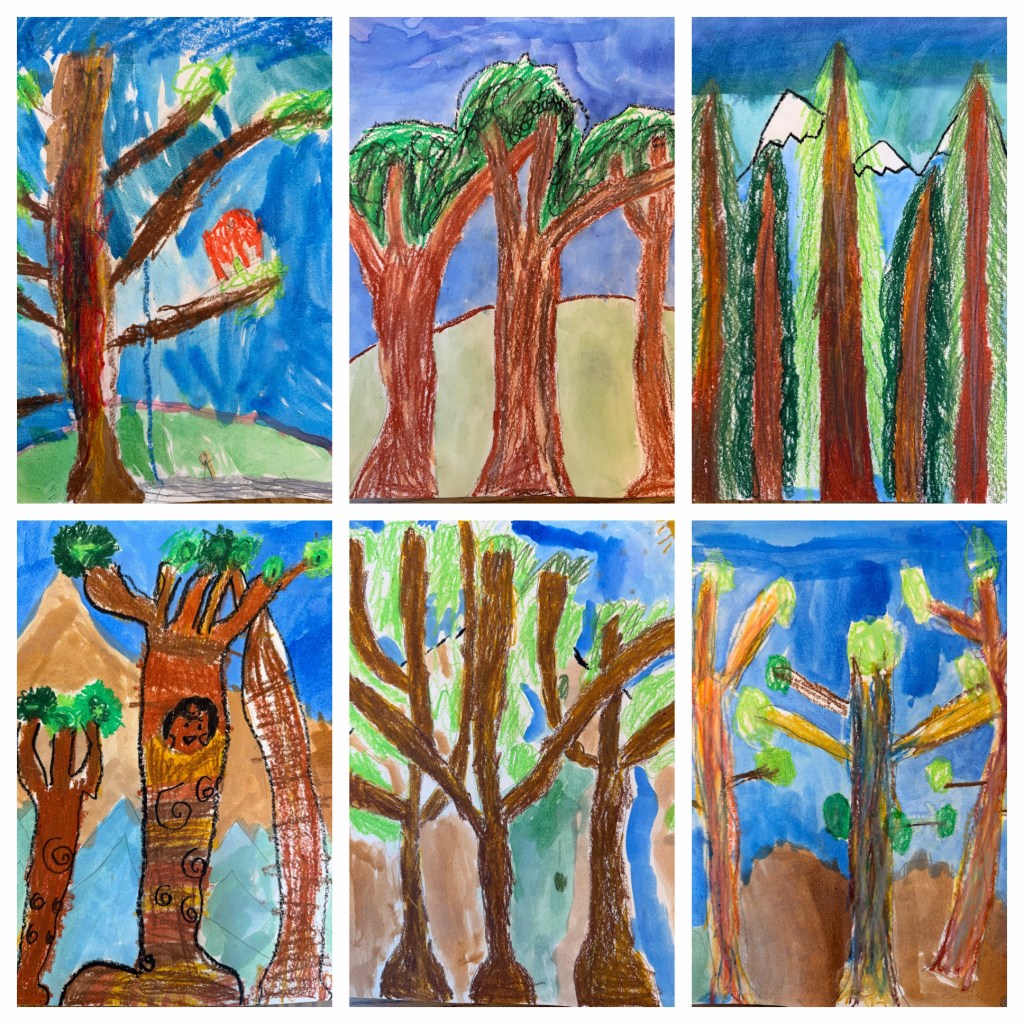
I mentioned last week that I had taught my students some photography techniques, one of which was the bug’s eye view. So after reading and examining the photos in Be a Tree, we took out our sketch books and practiced drawing a forest (okay, 2 or three trees) from a bug’s eye view…with a real focus on the trunk, looking up like a bug would from the ground. Then we also took some times to think and write a list of all the ways we need and use trees.
The next day we sketched our forest again, this time on larger watercolor paper and then used oil pastels to blend colors to create texture and depth on the trunks and branches. Today we pulled out our watercolor trays to paint in the backgrounds. Honestly, the results have exceeded my expectations.
First graders also tried their hand at writing some tree metaphors. Here’s a few:
The roots can be the tentacles of an octopus.
Trees shake their branches like hands waving.
Pine trees are as sharp as mountain tops.
Tree bark is as brown as chocolate ice cream.
I love watching students grasp a new technique and/or way of thinking. Their ability to identify a metaphor is currently much stronger than their ability to generate one of their own. But that’s all part of the learning process. and the beauty of giving space to try on new ideas.
And there’s nothing better than wrapping all this learning in an appreciation of nature and all that it offers. There’s so much to learn from trees…and kids.
In my first grade classroom, we started #writeout way back in August. Our school garden is a perfect place for observation and writing. By the second week of school we were out in the garden with our clipboards looking closely, sketching carefully, and adding captions as well as considering what the object they were examining (a passion fruit, a ladybug, a yellow cherry tomato) reminded them of. (I start planting that seed of figurative language very early in the school year!). We continue to venture outside, at least monthly, with our sketchbooks in hand, sometimes on a color walk, sometimes in search of questions… You can check out a variety of past explorations through this year’s #WriteOut choice board. Let’s Take a Wonder Walk is my offering.
While sharing information about #WriteOut at a recent San Diego Area Writing Project conference, I overheard someone mention the book, Through Georgia’s Eyes, which reminded me of the powerful connection of Georgia O’Keeffe’s art and close observation in nature. I returned to my classroom, pulled that old favorite picture book out along with another Georgia O’Keeffe picture book, Georgia’s Bones and created a plan for introducing my students to this incredible artist, encouraging close observation, carefully enlarged sketching, and descriptive writing.
We’d been on a Wonder Walk the previous week, using nature collectors to pay attention to small natural items around our schoolyard. Students picked one and sketched it. They were small drawings, nicely done, and the perfect prelude to this introduction to Georgia O’Keeffe and her attention to detail. Knowing I had a bin of seashells stashed in a cabinet in my classroom, I pulled them out and picked out a selection of some of the most interesting–enough that every student would have variety to choose from and varied enough that the shells were mostly different from one another.
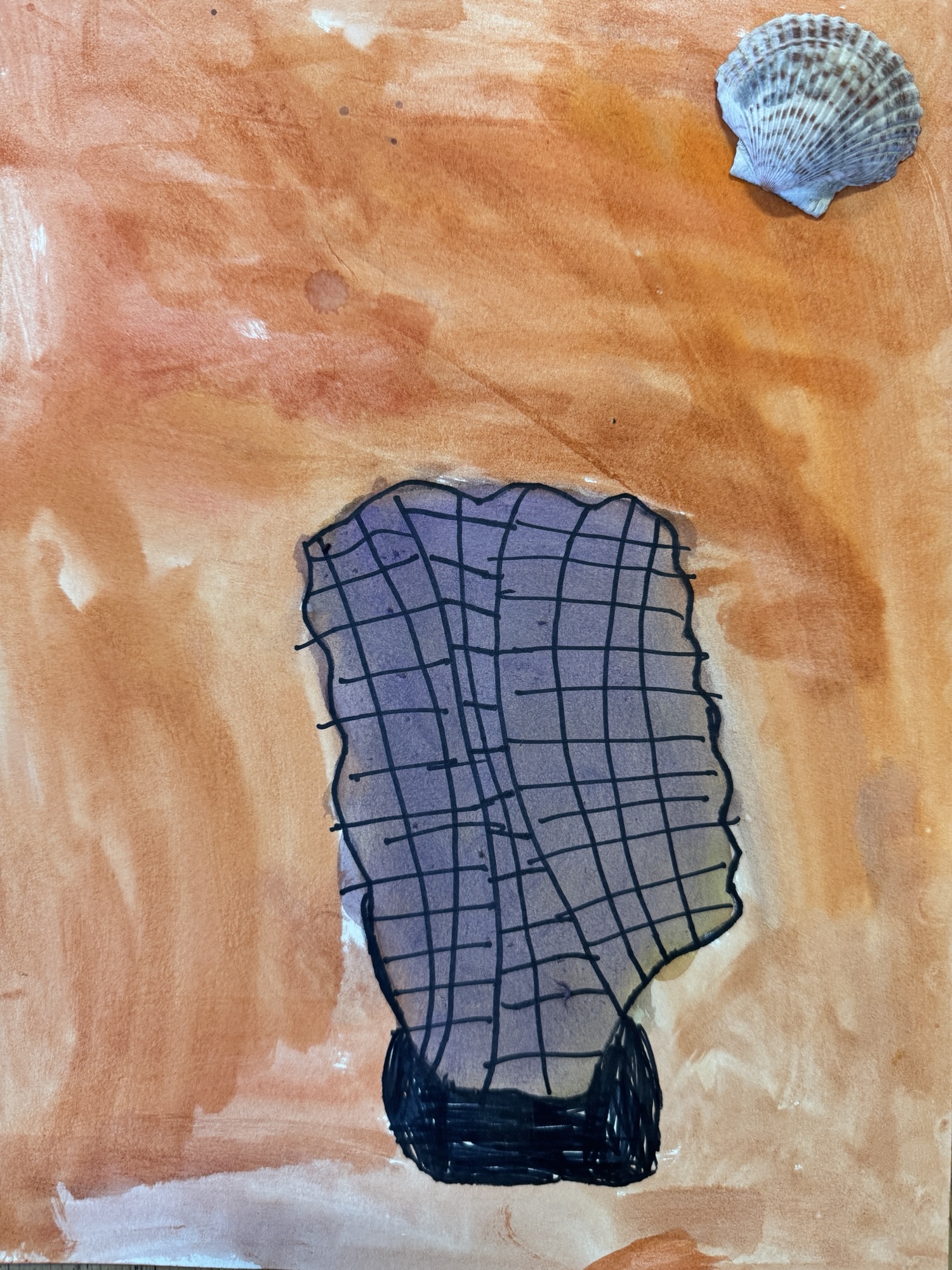
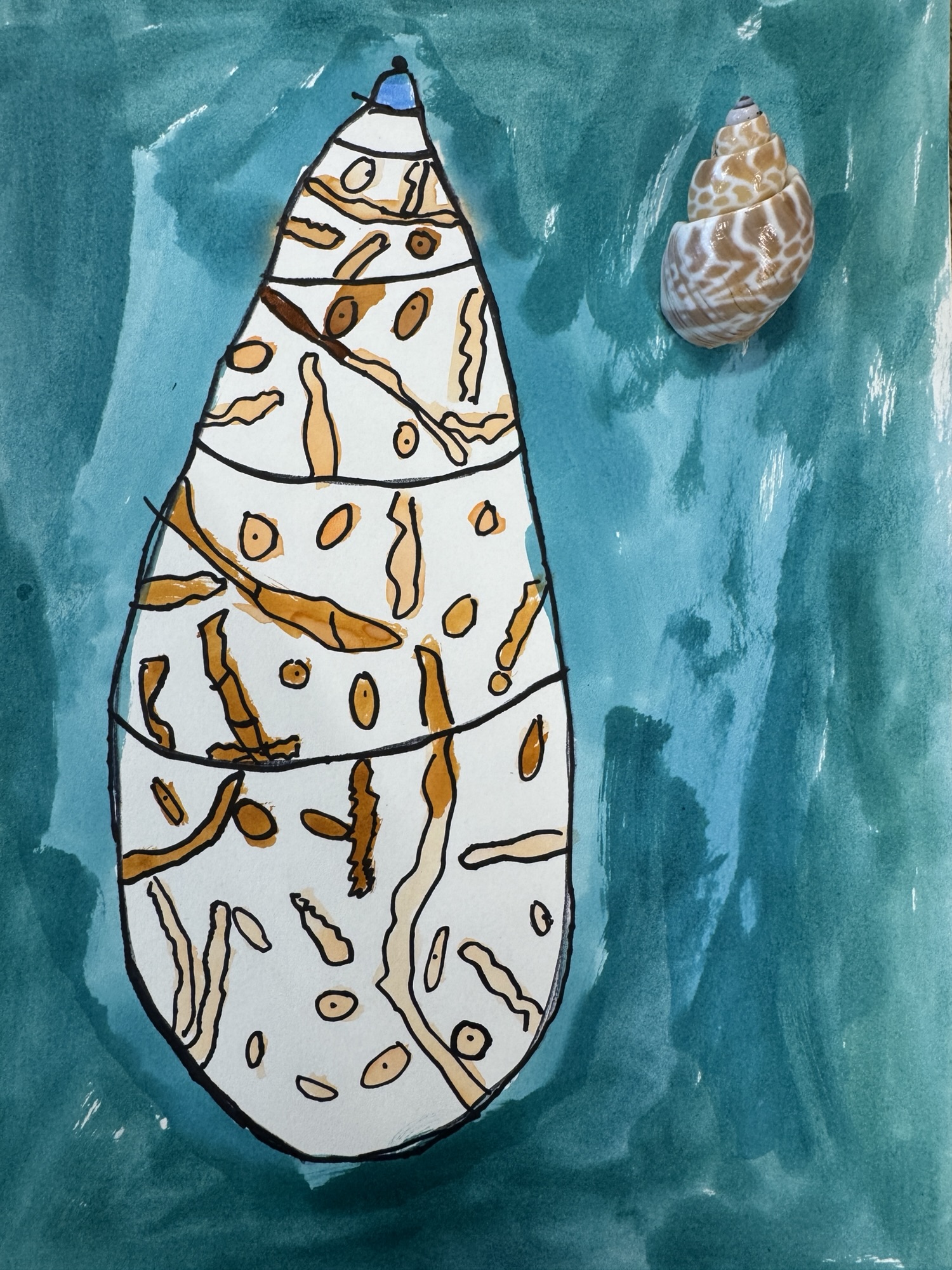
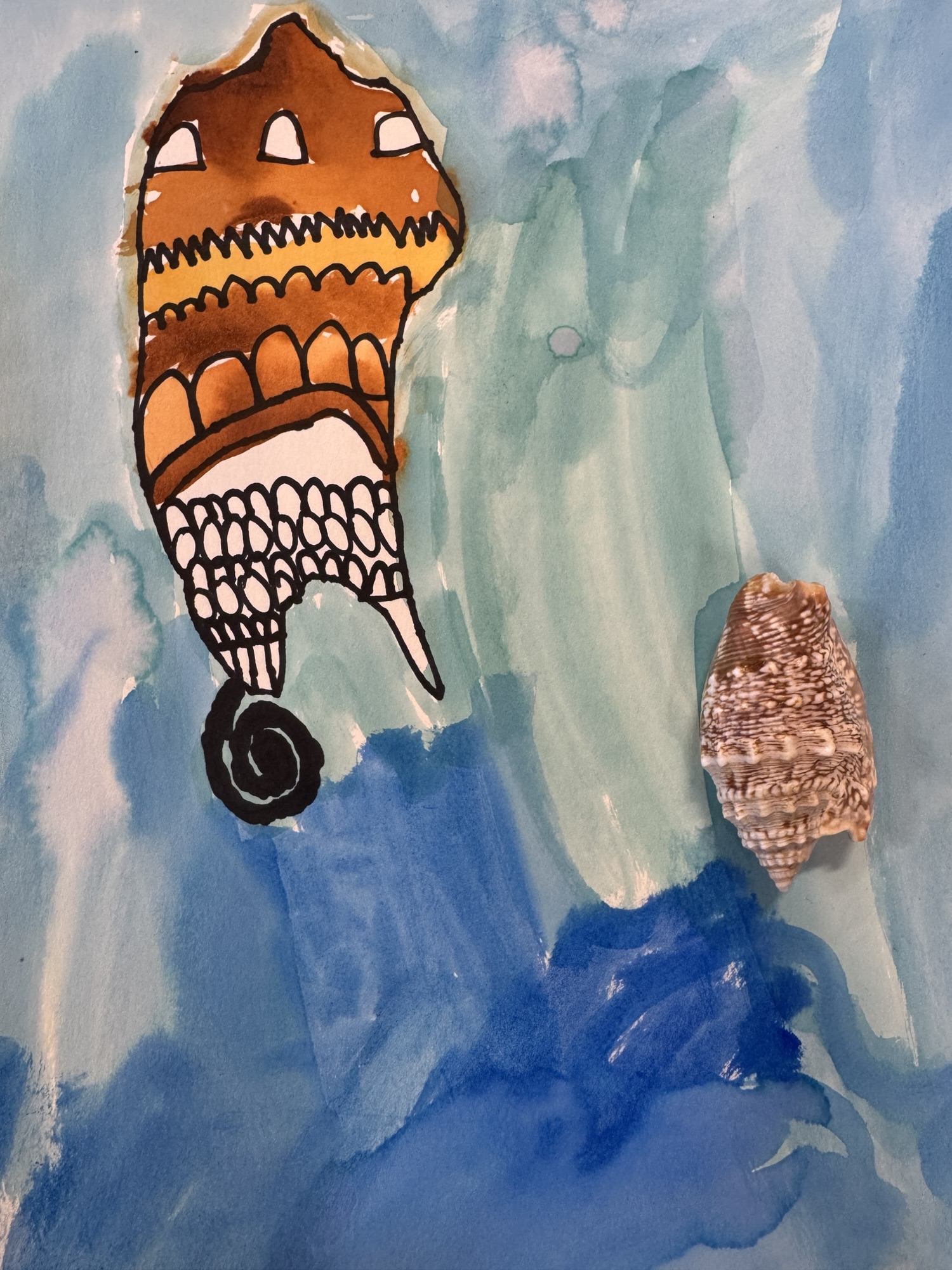
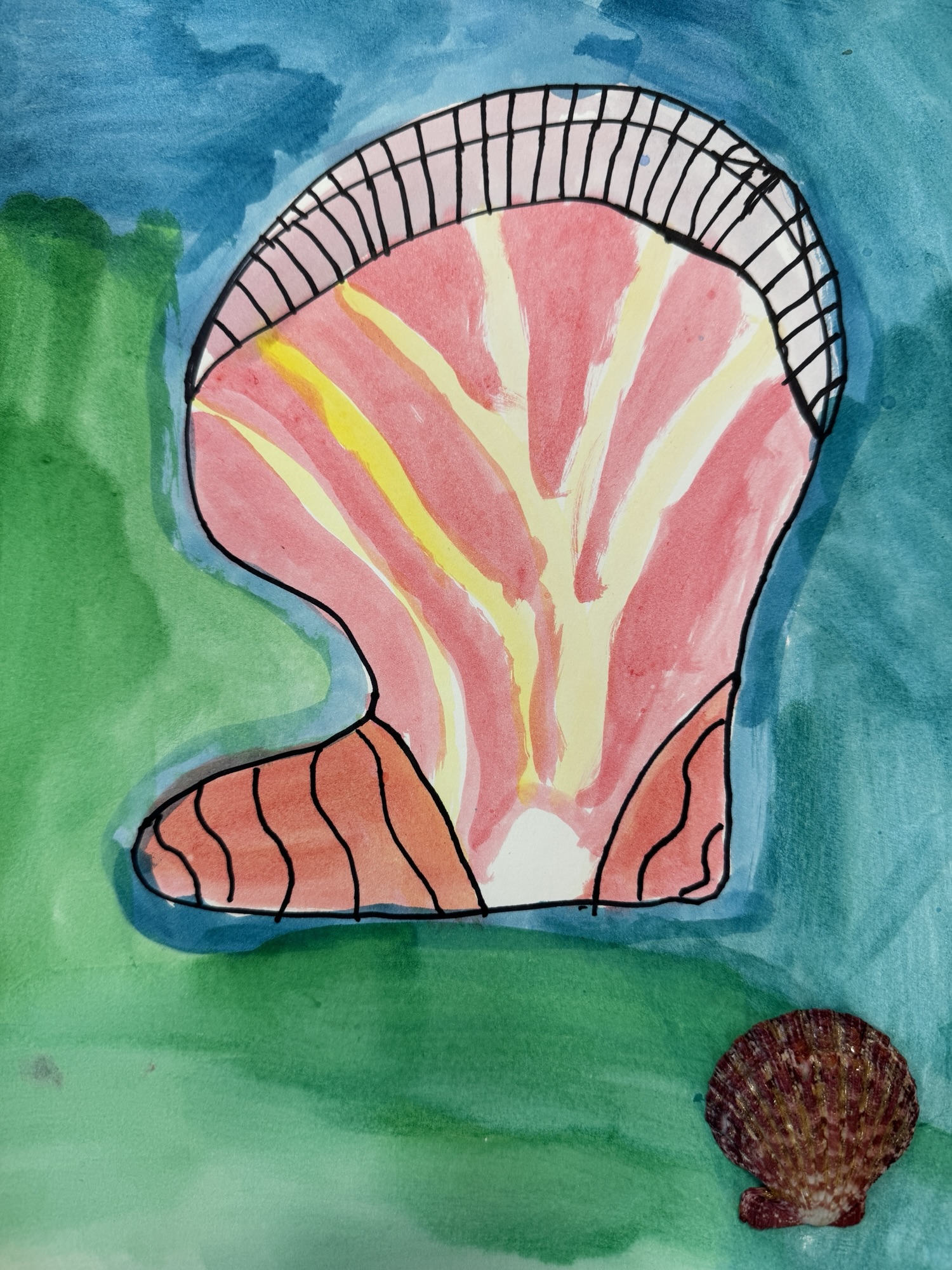
After reading Through Georgia’s Eyes, we talked about the way that O’Keeffe loved to make her paintings large, bringing attention to things others might otherwise miss. Students each picked a shell from my collection and studied it carefully. We took out our sketchpads. Students were encouraged to sketch the shell, filling the page with every detail they could. Drawing big is hard for young students, so practicing this technique is important. Then I gave them a larger piece of watercolor paper and a sharpie marker and asked them to draw their shell again, even larger!
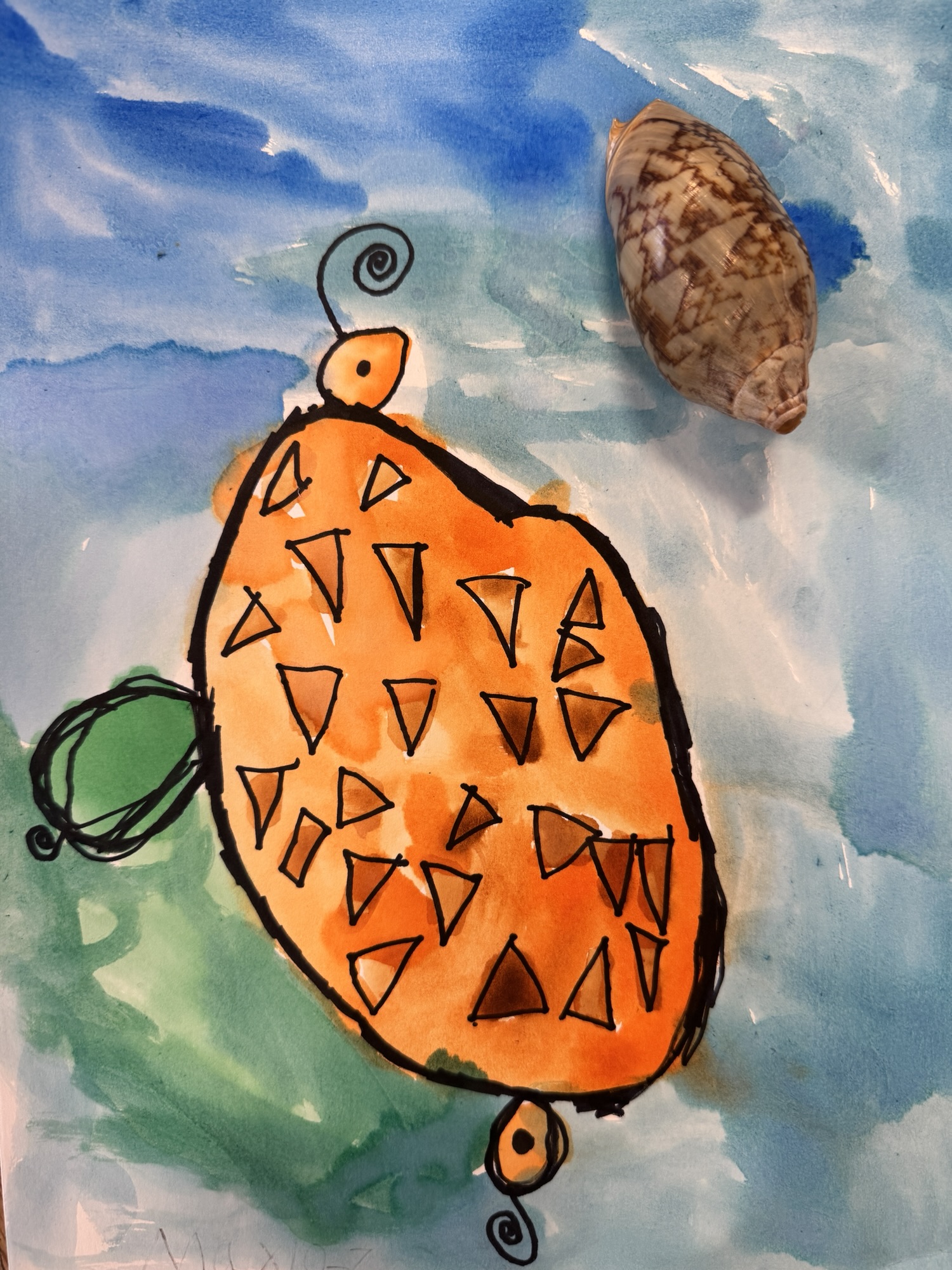
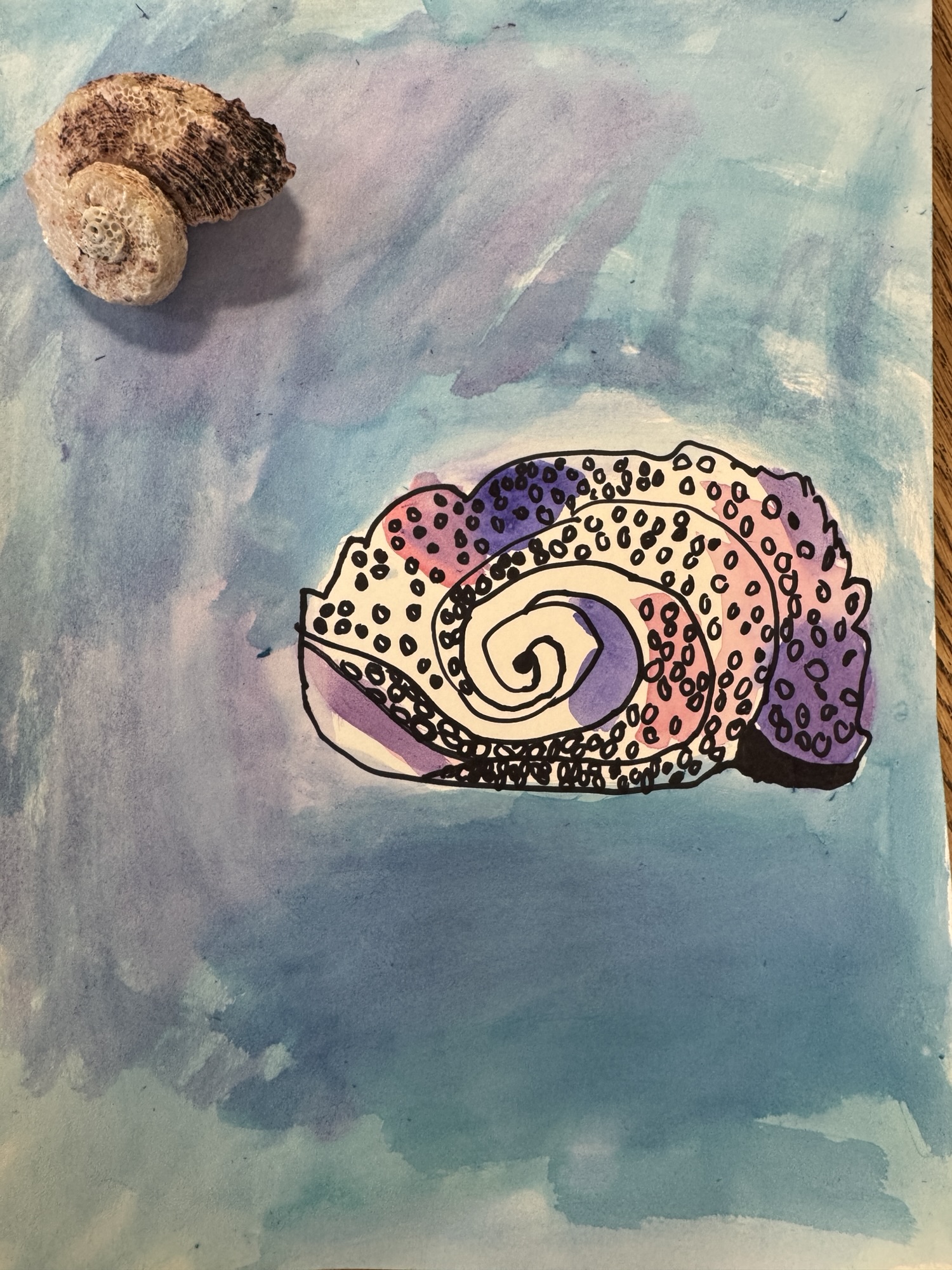
The following day, after reading the second picture book about Georgia O’Keeffe, we pulled out the trusty trays of crayola watercolor paints, mixing colors in the lids to capture the details of the shells. They looked carefully again, noticing nuance in coloring and shading, figuring out how to best capture the beauty of their shell. They also painted a background color to help their shell stand out. The results were stunning! (I decided to photograph them with the shell to show how much their study of the shell influenced the paintings.)
I was already excited about the work students were doing. These 6-year-olds were impressive with their attention to detail and care using watercolor paint–which can be unforgiving! My next request of them was something they initially found perplexing. I told them now we were going to paint our shells with words. What?!? I explained that our words were going to be the paint that helped others “see” the shell through our eyes. As is typical, I pulled my writer’s notebook out, took a close look at my teeny tiny shell, and started to think aloud about my shell. I wrote a few sentences, continuing to talk through my decisions. And then it was their turn.
You know that magic is happening when that hush falls over the room. First graders are not quiet writers so I get glimpses of their thinking as they work through words, help each other with spelling, ask questions about sounds, and speak the words they are putting on the page. I also knew something special was happening when no one was “done,” even when we had to stop for our reading groups and lunch. While my students were out of the classroom I walked around the room reading their words. Every single student was truly painting with words!
After lunch I gave students a few minutes to read through their writing and finish what they were working on. Then I pulled out the highlighters (first time this year!). I explained how I wanted them to use the highlighter–but first they had to pick a “golden line,” their favorite idea they had written about their shell. After highlighting we had a whip around where every student read their golden line out loud. My heart was full.
T wrote seriously, using all the time available to describe the shell.
My shell has a swirl in its window. Beige is the color that is the starting color but then white takes over. It has a pattern it goes purple to white. My shell has lines that curve to the end. My shell is very flat. In the inside there is white. If you touch its tip you would get poked on the finger. My shell has some green. It reminds me of a whale tail flaming in the ocean. My shell’s window is by the tip. It reminds me of a bucket of water filled. It’s my favorite shell.
M is an emergent reader and writer, working hard to capture sounds in words. This took effort and great perseverence to produce independently.
My shell has a triangle. My shell has a spiral inside. My shell has a window. My shell has pink.
It’s National Poetry Month (no joke!). My intention was to use the Verselove prompt to launch my daily poem post…but today’s prompt didn’t quite work for me.
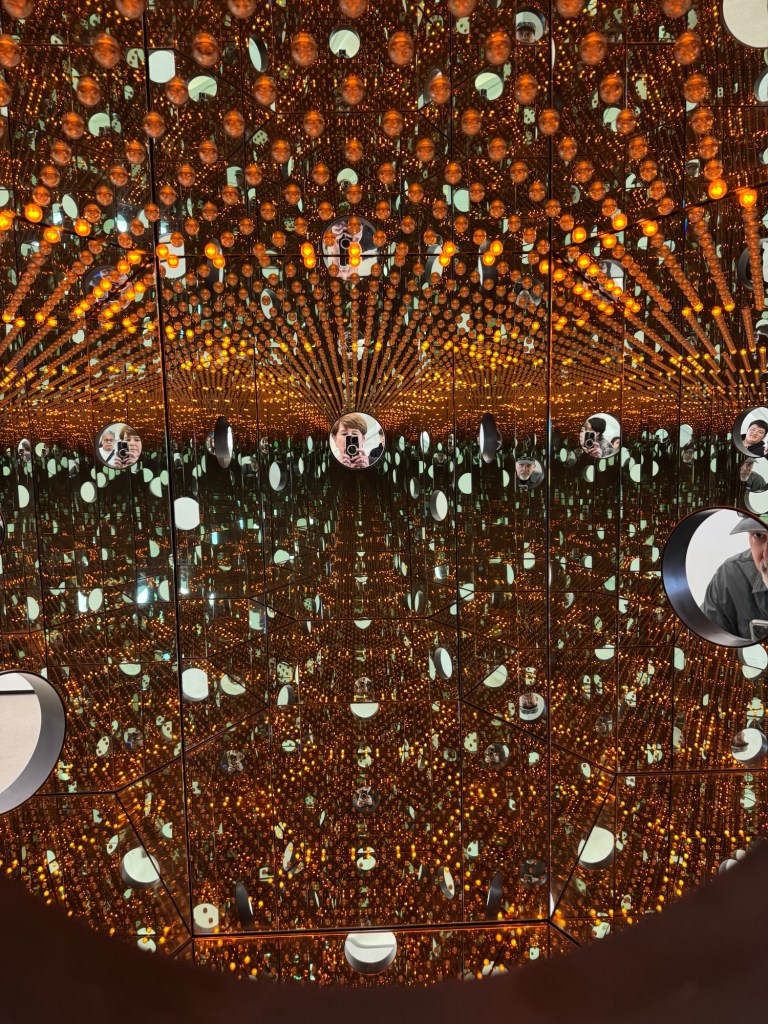
A morning in traffic (typical) followed by art museum exploration–a perfect stage for a first day of daily poetry.
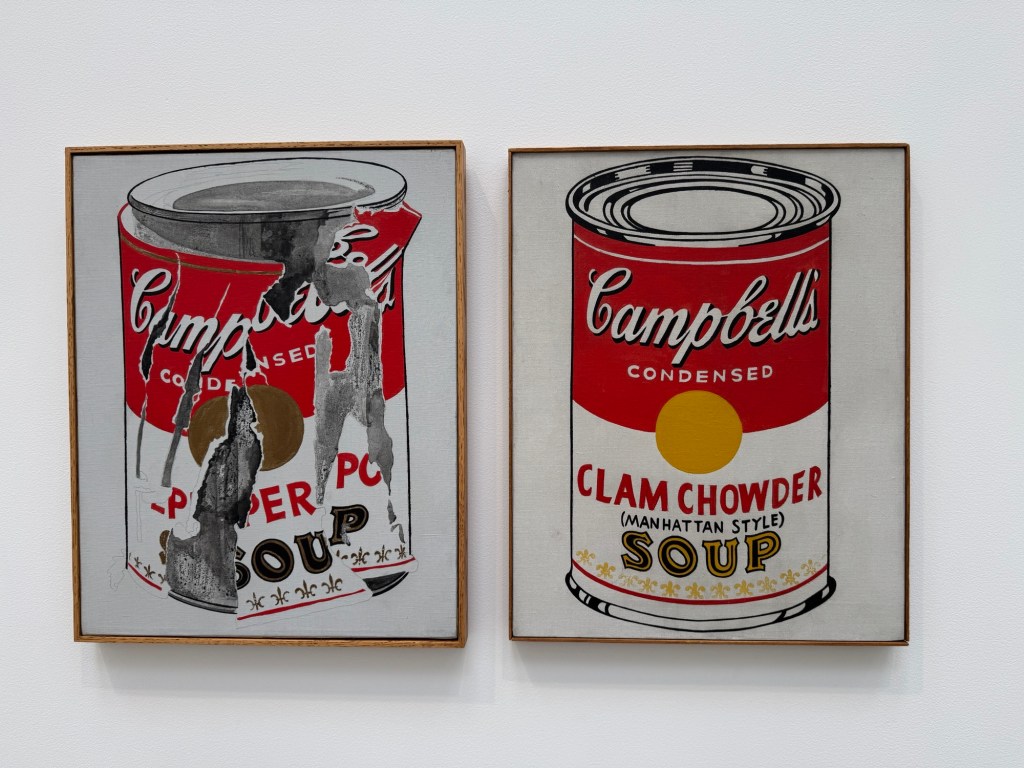
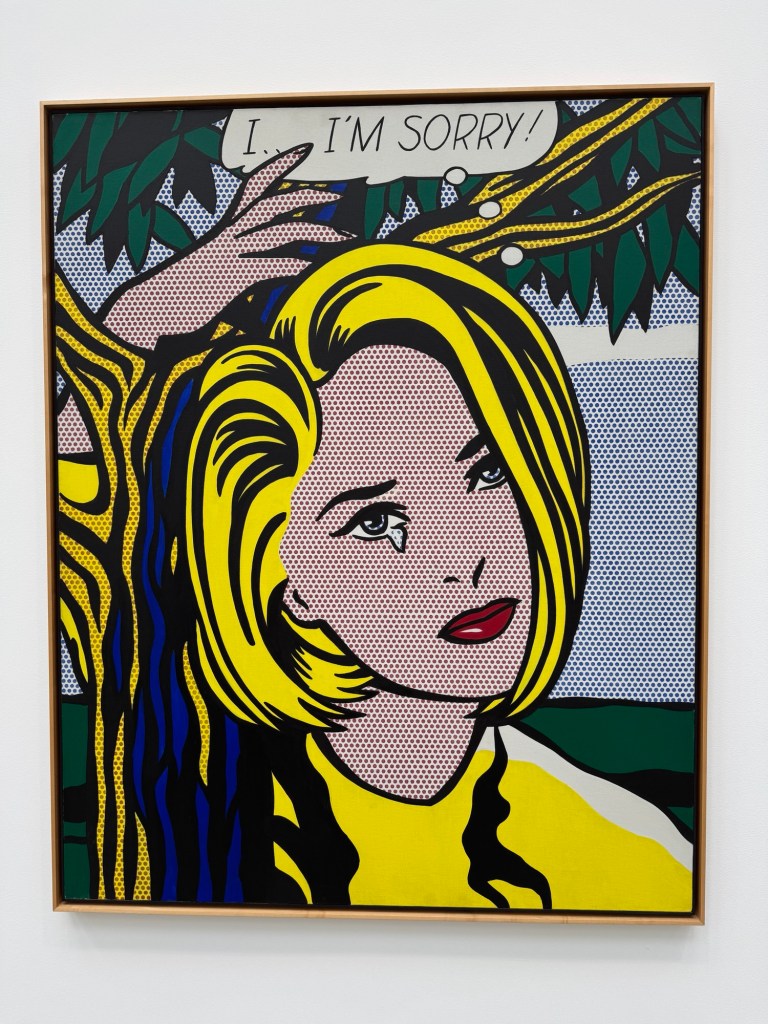
So instead of exploring a collection of verses for today, my post is a poem that explores repeating dots, colors, and patterns inspired by Yayoi Kusama, Andy Warhol, and Roy Lichtenstein and a visit to The Broad in LA.
Part I
Each car a dot, nestled against another
dot to dot to dot until the entire freeway is miles of dots
Most people see the beach as a playground, a gym, an opportunity to commune with nature, a place to get away from stresses and routines of the work week. Sometimes, though, I notice artists at work.
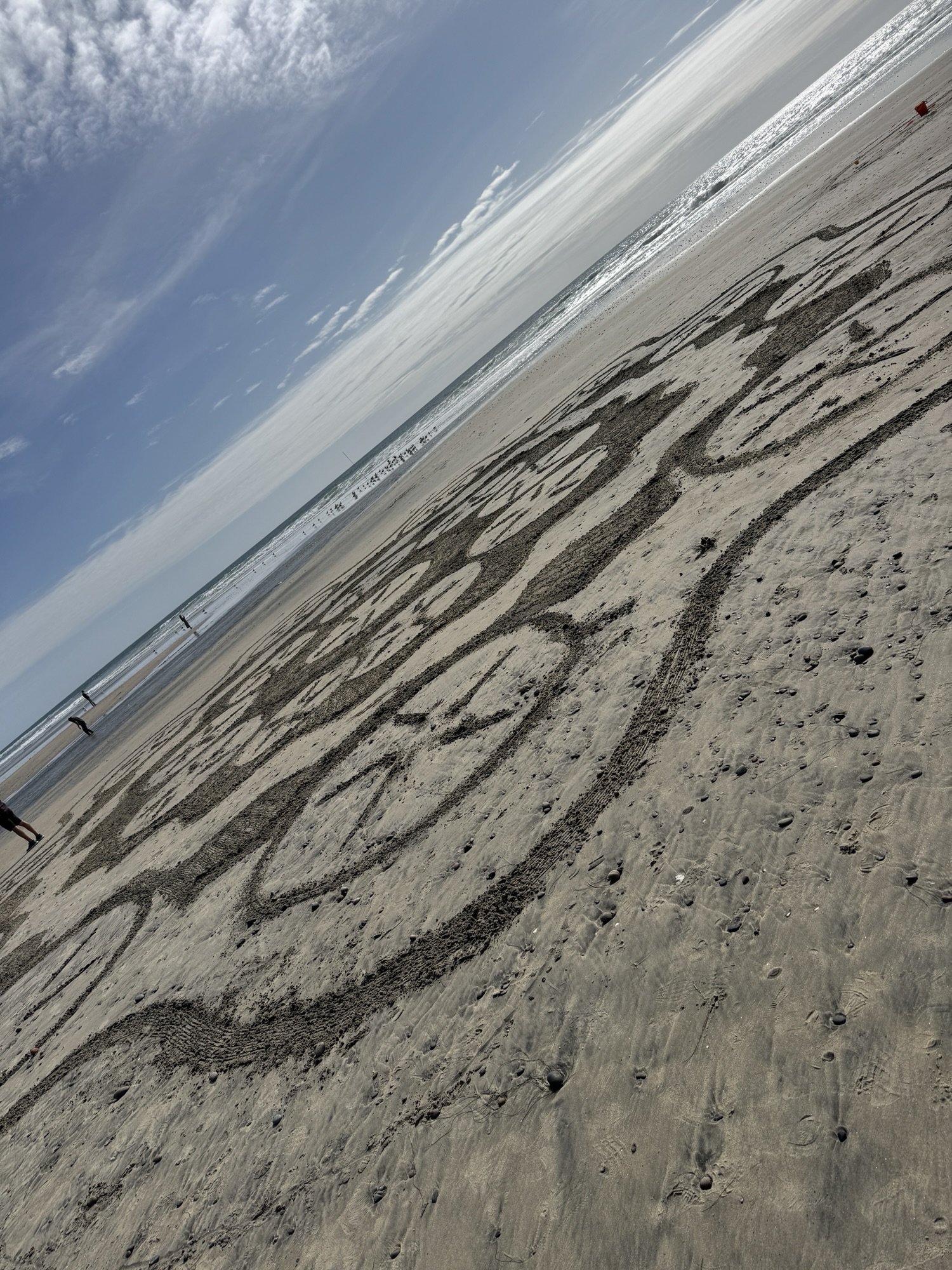
There are artists who are inspired by the natural beauty of the beach and drag their easels, paints, and canvases to the shore and set up to work en plein air trying to capture what they see in front of them. Today’s artist used the sand as both canvas and paint and a rake as his brush.
When my walk began, he was just getting started and had traced some circles on a large flat spot near where I walked onto the beach. I paused long enough to watch his technique for creating even circles–although I doubt I could replicate his motions. I walked some miles, stopping to watch egrets and other shore birds. I noticed some places where the cliffs have crumbled since my last visit to this beach. I took photos of sand dollars, sea birds, and the piling remnants of a structure that existed on this beach about a hundred years ago.
As I returned back to where I began, I noticed the completed art raked into the sand. As the mom of an artist, I’m fascinated by artists’ processes. I see the compulsion to create, the need to express, and how artists find their own tools of choice. When I see the scale of a piece like this in the sand, I have so many questions!
Is the work pre-planned? Does the size relate to the size of the rake? The size of the artist? Are the measurements a felt sense that the artist intuitively knows as the pole end of the rake traces circles and then the rake is turned to brush in the texture?
What is it about temporary art that is so question-invoking? I’ve seen other sand artists who place their art strategically where they can stand above it and photograph their work. Did the artist take a photo before he left his art for beachgoers to admire?
I did notice others like me taking the time to photograph this piece of temporary art, admiring its scale and shape. And there is something spectacular about art with the Pacific Ocean as its backdrop.
What found art have you come across? What surprised you? What wonderings did you have?
I love a great postcard. Anywhere and anytime I travel, I make an effort to find postcards, write them, and mail them (preferably from the place where I got them). I like the scarcity of space, the need to be succinct…maybe even pithy in my composition. I mostly send postcards to my grandsons. I want them to feel the pleasure of getting mail, of knowing that I am thinking of them, and sharing a tiny glimpse of my travel experience with them.
I encourage my students to write and send postcards to our class anytime they travel. I want them to feel the pleasures of snail mail, understand the connections their words can help forge, and to delight our class as we get to study the postcard, notice the stamp and postmark, and read the message written especially for us. We have quite a collection growing! When school ended last year, I sent each of my students a postcard (Target had National Parks postcards in their dollar bins) with a “would you rather” type of question on it. As school began this year, many of those students were eager to tell me how much they loved their postcard!
My youngest son is an artist. Over the years postcards have been a part of his art process. In the past there were times when he bought a postcard and used it as his canvas for creating art. The fun part of this medium is that the artwork then shows up in your mailbox. Here’s a couple of examples.
Nick’s most recent art has been the creation of blob sculptures. He posts a daily reel of his creation on Instagram @nickdouillard to the delight of nearly a million followers who sometimes watch his reels millions of times. Just last week he offered a sale at his site, which included a variety of one-of-a-kind handmade blobs as well as packs of blob postcards drawn by him. His sculptures sold out in no time–he has quite a fan base for these quirky, adorable pieces. I knew I would be ordering some of his postcards–and they come with sticker hats (another feature of his blob sculptures) to mix and match the blobs’ looks. My order came in the mail today!
Now the big decision…who do I sent my brand new postcards to? My grandsons are definitely on my list of sendees… I’m thinking I’ll also write an unexpected postcard to a friend or two I haven’t seen in a while and maybe a colleague who won’t be expecting it. I have ten…it will be fun to pick out people to send them off to!
Who would you send a postcard to?
(Shameless plug: cute blob postcards are still available, just visit Nick’s Instagram site. He’ll even send a postcard for you to the addressee of your choice!)
Phew! It has been quite the day. This blustery, rainy day began with an early morning mammogram (just routine). I love the mammographer at our local Kaiser–that woman is efficient! I was in and out before my official appointment time and arrived at the university at my usual time. Thursday is my work with adults day–and there was much to accomplish today. But right in the middle of a meeting this morning the fire alarm went off in our building. Ugh! For someone who is only there one day a week, I have had more than my share of fire alarm evacuations in the last couple of months! So after milling around in the chilly windiness around our building (no rain at this time), we got the all clear from the firemen and were able to head back in to resume our work.
I struggle a bit with an office day. My usual work is wrangling first graders–which means that I seldom sit. Instead I am constantly moving, crouching, leaning in, keeping life in the classroom on an even keel. On my office days with too much sitting, I feel called to head outside and walk the campus just to keep my head clear and my body in motion. I think so much better on my feet! So after some work, I bundled up and headed down the stairs for that much-needed walk!
UCSD is a beautiful campus with a very special feature: The Stuart Collection. The Stuart Collection is public outdoor art installations located throughout the campus. I often walk by Nikki de Saint Phall’s Sun God, the Snake Path that leads up to the iconic Geisel Library, and stop to photograph Fallen Star, a house perched atop the engineering building. But today I felt pulled to go in search of the Red Shoe. I headed in the direction I thought I would find it, enjoying the smell and color of the purple black sage in bloom along the way. As I got closer, I pulled out the navigation on my phone and found myself wandering through the Theatre District and into a stand of eucalyptus trees. The trees called me closer until I glimpsed the bright red of the sculpture of an enormous red, high-heeled shoe.
As I headed back to the office I remembered that the Sound Garden was nearby so I made a short detour and soon heard the music of the wind through the trees. Here’s how it was described in an article about the installation.
Thirty-two eucalyptus trees have been fitted with motion and light sensors that translate varying forces of wind and changing light patterns into sound instantaneously using sophisticated software. Speakers high in the canopy above project the sound, louder during strong gusts and sunny, summer weather; while subwoofers at ground level emanate more subtle, deep tones as darkness descends and winter prevails.
I stood and listened, feeling the wind on my cheeks and my ears filled with the symphony of a eucalyptus grove in full and beautiful voice. Calmness settled over me, I took a few photos and then made my way back to the office feeling refreshed and ready for work.
I wish I could say that the rest of the day proceeded without a glitch and that I was productive and settled. Unfortunately, in the midst of a working session on Zoom, the UCSD wifi failed, cutting off my video conference, dropping my connection on the Google slide deck we were working on and I was forced to use my phone to complete the meeting as a phone call…and to head home afterward to have internet access to get my work done!
In spite of the fire alarm and the wifi failure, my walk was uplifting and energizing. It is probably why I ended my day feeling productive in spite of losing so much work time! Note to self: take more time to listen to trees!
Most weeks I work with my friend and colleague Carol over Zoom since we live in different parts of the state. So when we got to meet in person a few weeks ago, I was delighted to be gifted with a bag of acorns to explore with my students. The acorns where Carol lives are huge…and they have the caps that look like knitted beanies.
So, in honor of #writeout, a collaboration between the National Writing Project and the National Park Service, we got out the acorns and the hand lenses AND our sketchbooks to really study them carefully. We also read two wonderful picture books: Because of an Acorn by Lola Schaefer–a book about the interdependence of the ecosystem where acorns thrive–and Acorn Was a Little Wild by Jen Arena–a fanciful book about an adventurous acorn who after an encounter with a hungry squirrel preparing for winter, ended up as an adventurous oak tree.
And…we had to watch the wonderful video with Ranger McKenzie from Sequoia National Park about how oak trees drop tremendous numbers of acorns every few years…all at the same time in a process called masting, and that scientists have figured out that trees “talk” to each other through their root systems.
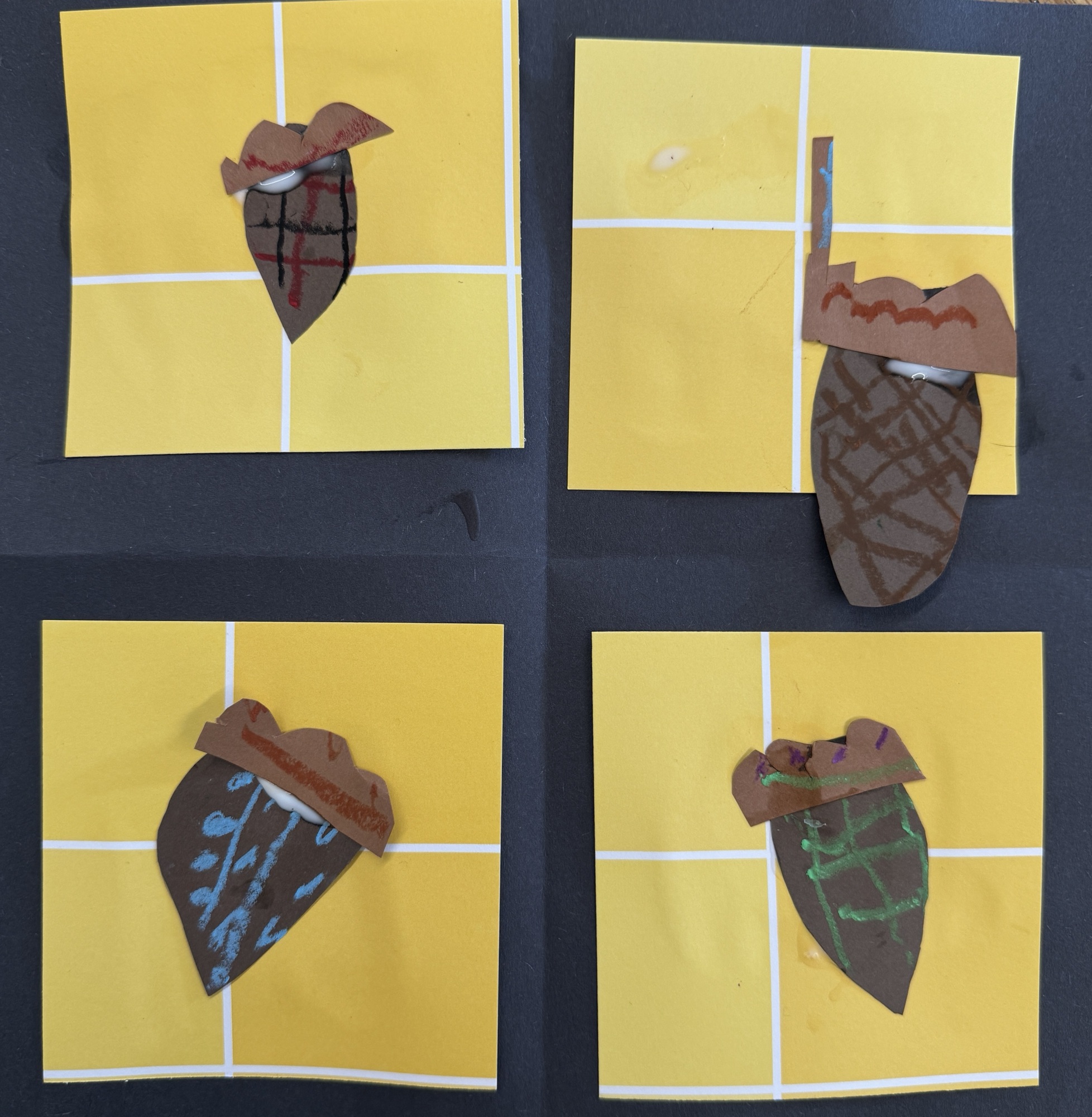
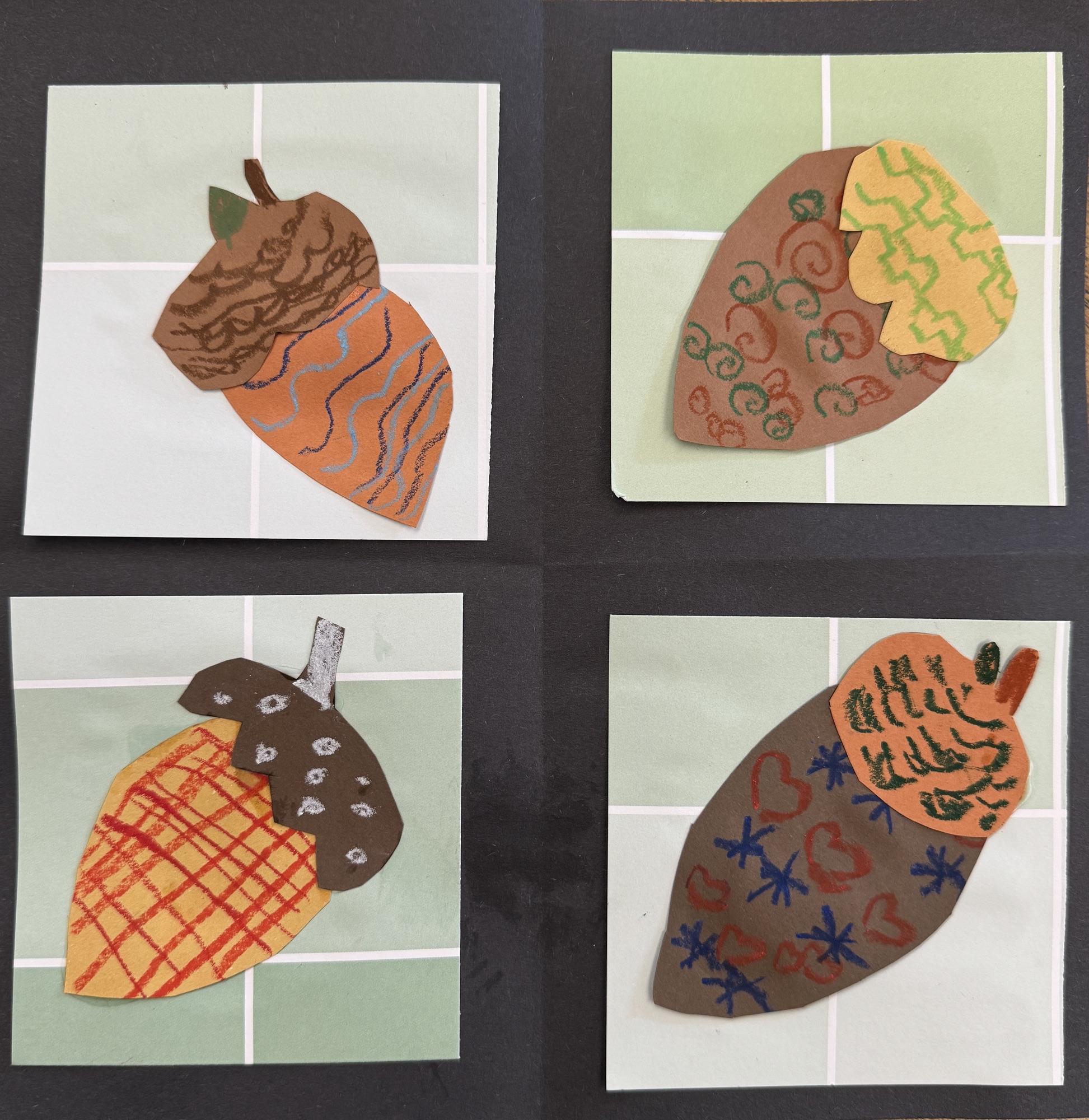
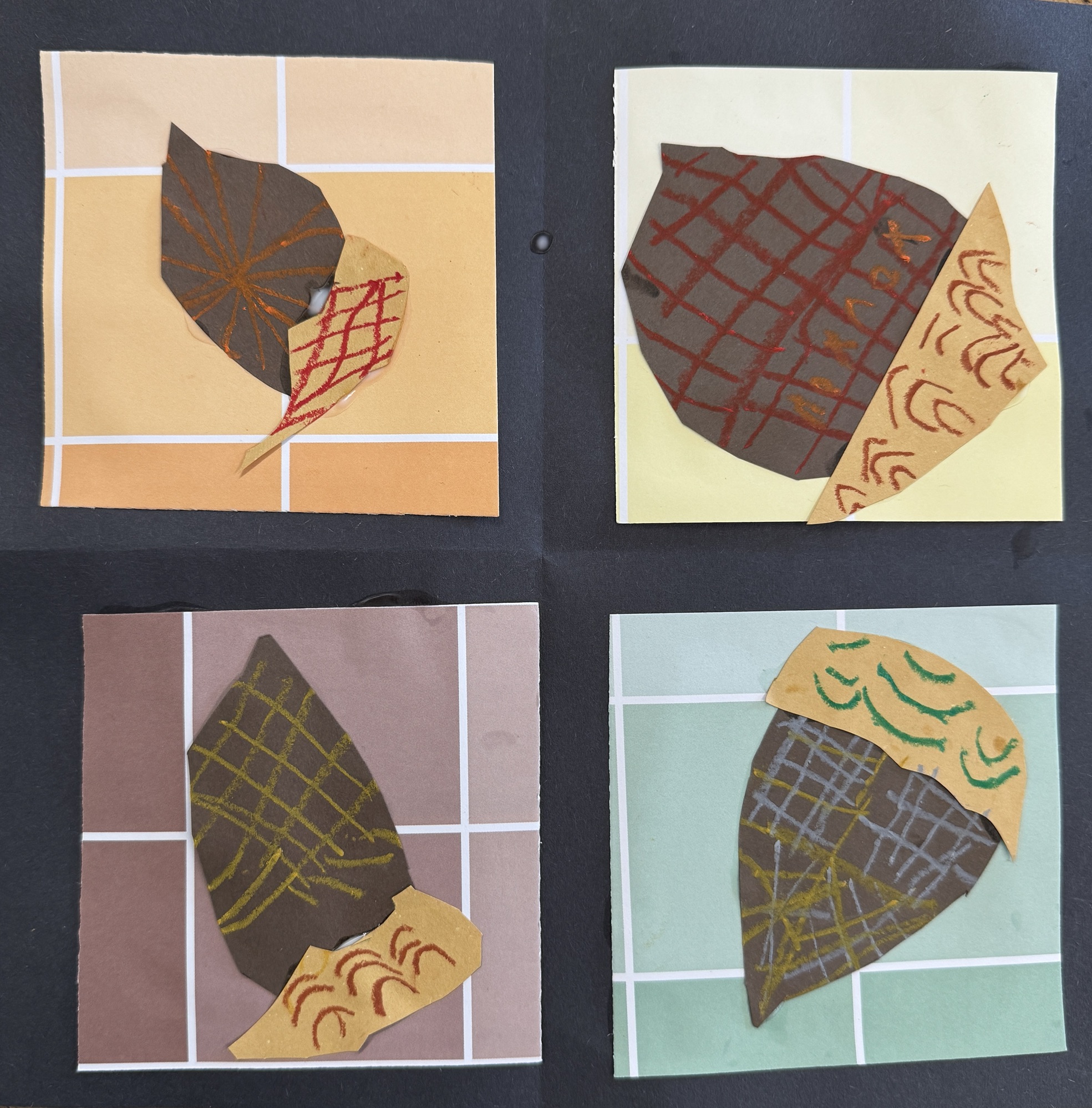
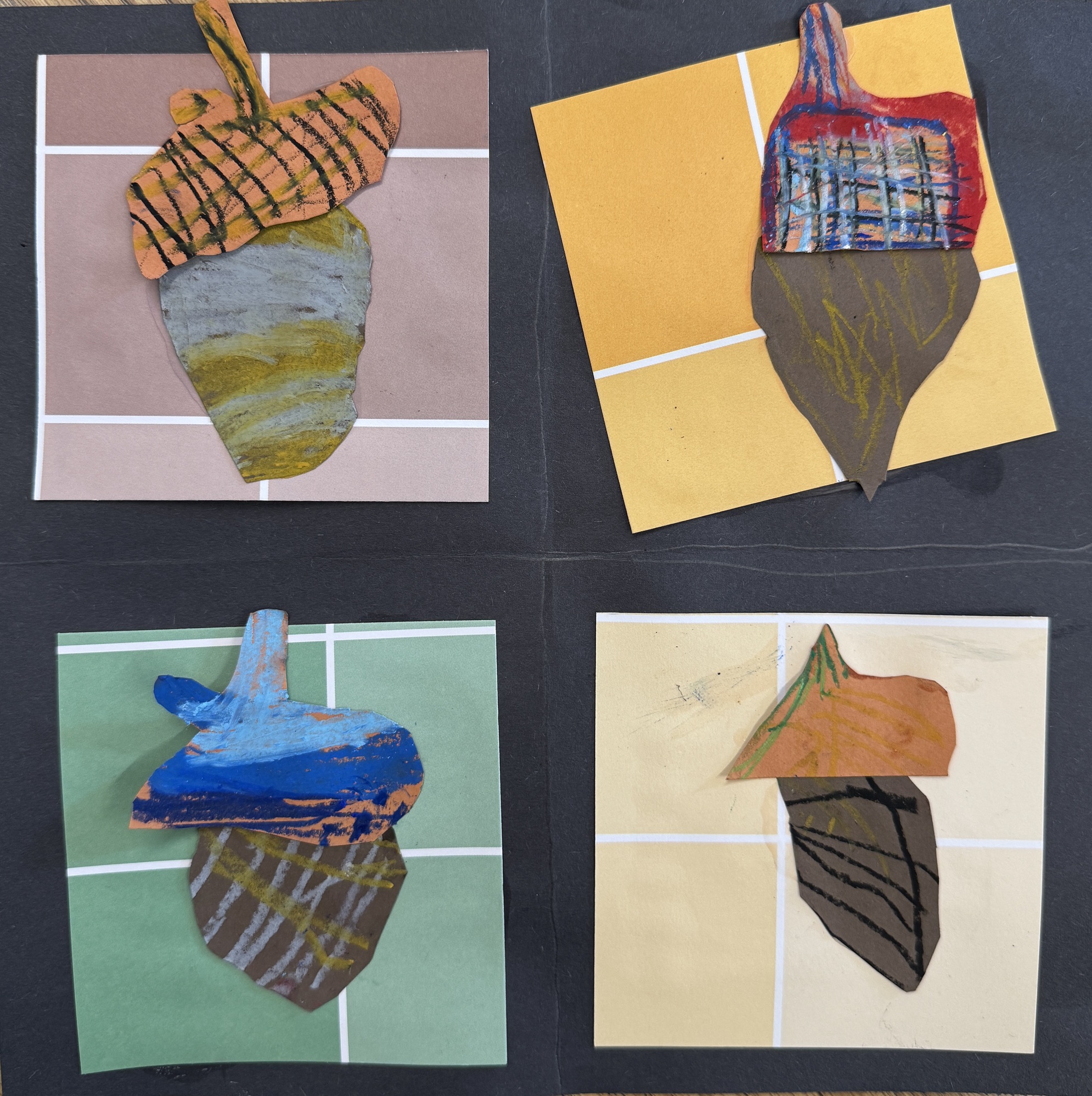
All this science and nature provided the perfect foundation for an art project inspired by Andy Warhol and the Pop Art movement. Today the first graders in my classroom used scissors, construction paper, oil pastels…and wait for it…white glue to create the most adorable acorn art. Scissor work can be challenging for young learners, and to add to the scissor demand I didn’t provide a template. Instead I showed them how to trim the square of paper into the shape of the acorn nut…and another square of paper into the shape of an acorn cap. A few students expressed frustration, but with some encouragement and insistence that they keep trying, all students were able to cut out acorns and their caps independently.
We added some whimsical texture with oil pastels…and then the most challenging part, they had to use white glue to attach their acorn pieces to the background we had assembled. Trust me, white glue can be downright scary in the hands of young artists! But with admonitions to use the glue sparingly, we were successful!
Of course we had to do some writing. Poetry seemed in order–after all this year’s #writeout theme is Poetry for the Planet and I was wanting to keep it short…so we attempted a first grade version of Haiku–a three line poem (without worrying about the syllable count). Here are a few first grade attempts.
J wrote:
Acorns are hard
cozy as fall nears
Spiny as a hedgehog
O wrote:
Don’t fall yet.
Squirrels will get you.
Crunch!
And R wrote:
Acorns look like a balloon that got blown by a man.
Acorns look like a man with a helmet riding a bike to the store.
Acorns look like a top that someone is spinning on the table.
#Writeout we’re off and running! We’d love to know how all of you are celebrating nature and the outdoors in your classrooms and in your lives!
I think this was the first day in my long teaching career that I have ever taught during a solar eclipse. Unfortunately, this wasn’t a total eclipse in our area, but still an eclipse. And on this first day back from Spring Break, we were fortunate. All our of classes were supplied with eclipse viewing glasses…so why not turn the day into an eclipse-centric science phenomenon-based day of learning?
Even before the eclipse began (around 10am our time) we reviewed what we had learned about solar eclipses before our break by watching and listening to a song called “Total Eclipse of the Sun” by PBS kids. I did remind students that we were not going to see totality, but the energy in the classroom was rising. We took our first peek at the sun shortly before recess. With glasses in place, we looked up and could see right away that our usually round sun had a big bite right out of it! From that moment, these first graders were hooked.
After recess, I set up the livestream so that we could keep track of the eclipse for those places in the path of totality and we headed outside with our solar glasses to view the partial eclipse progress about every ten minutes, coming in to sketch and document the time after each viewing.
Totality, even via livestream was exhilarating! “The diamond ring!” they shouted as we watched the sun just about disappear. Four minutes of “nighttime” passed so quickly and then we watched the sun reappear. And just when students thought there was nothing more to notice about our partial eclipse, one more viewing before we headed out for lunch revealed that the “bite” of the sun had changed sides!
And no day of science learning would be complete without adding in some art and writing. After lunch we tried our hand at creating our own eclipses using oil pastels and a masking technique. Students were encouraged to use some artistic license with color–and enjoyed creating these colorful coronas.
Inspired by a poem from the book Welcome to the Wonder House by Rebecca Kai Dotlich made up of all questions, students took a first try at crafting a question poem about their eclipse experience. While we ran out of time before we really had time to finish, here is an early look at a first grade question poem by F.
The Solar Eclipse
When is the next solar eclipse?
Can America have a full eclipse?
Who can track the eclipse?
Can someone see the eclipse from inside an airplane?
Why do we have the moon come in front of the sun on special days?
When was the last eclipse?
When I look up at the moon at night I see a smile on it, but why?
For my own poem, I turned the #verselove Zip Poem prompt into an eclipse teaching poem using my school zip code (and using emoji’s as suggested for the zeros). Thanks for the inspiration Mo!
Zip Poem: Teaching Under the Influence of a Partial Eclipse
9-Solar science eclipsing school day, igniting first grade wonder
2-Planetary alignment
0-☀️
0-🌙
7-Young astronomers’ energy fueling totality-free sky learning
I wrote earlier this week about reading the book, I’m Trying to Love Garbage by Bethany Barton. In response to the book we discussed ways to reduce human trash. I followed that book by reading the gorgeous To Change a Planet by Christina Soontornvat. This beautiful book talks about how collectively we have created problems for our planet….and how collectively, we can also make change. Both words and illustrations are beautiful!
I find that students want to do things to help our planet. They are already aware of the importance of keeping the earth clean, about the value of caring for plants and animals, and are knowledgeable about composting food waste. And we’ve also been exploring the power of words and images to inform others about things that need doing.
So after reading and talking about To Change a Planet, I introduced them to the idea of writing 6 words for the environment. This is a version of the 6-word memoir that many of you may be familiar with. In 6 words for the environment, students come up with 6 words about our planet–to express its beauty, to help others understand how to help, to explain a crisis. We started by brainstorming words related to earth–and they had plenty to contribute.
I showed them how I would compose 6 words for the environment–including showing my first attempt that only had 5 words! I rearranged and revised in front of them so they would know that they should play around with the words. And then they opened their notebooks and started writing their own 6 words for the environment.
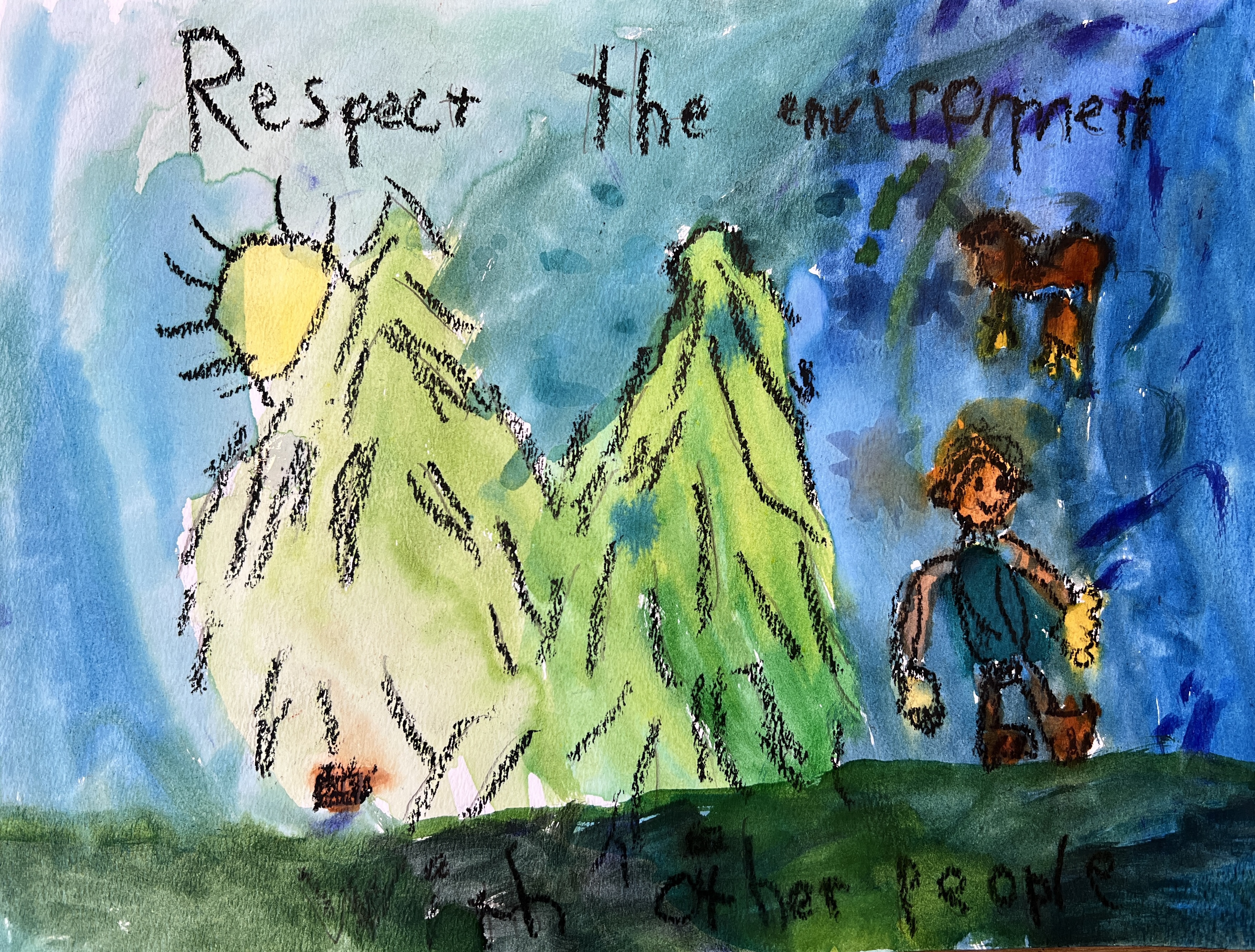
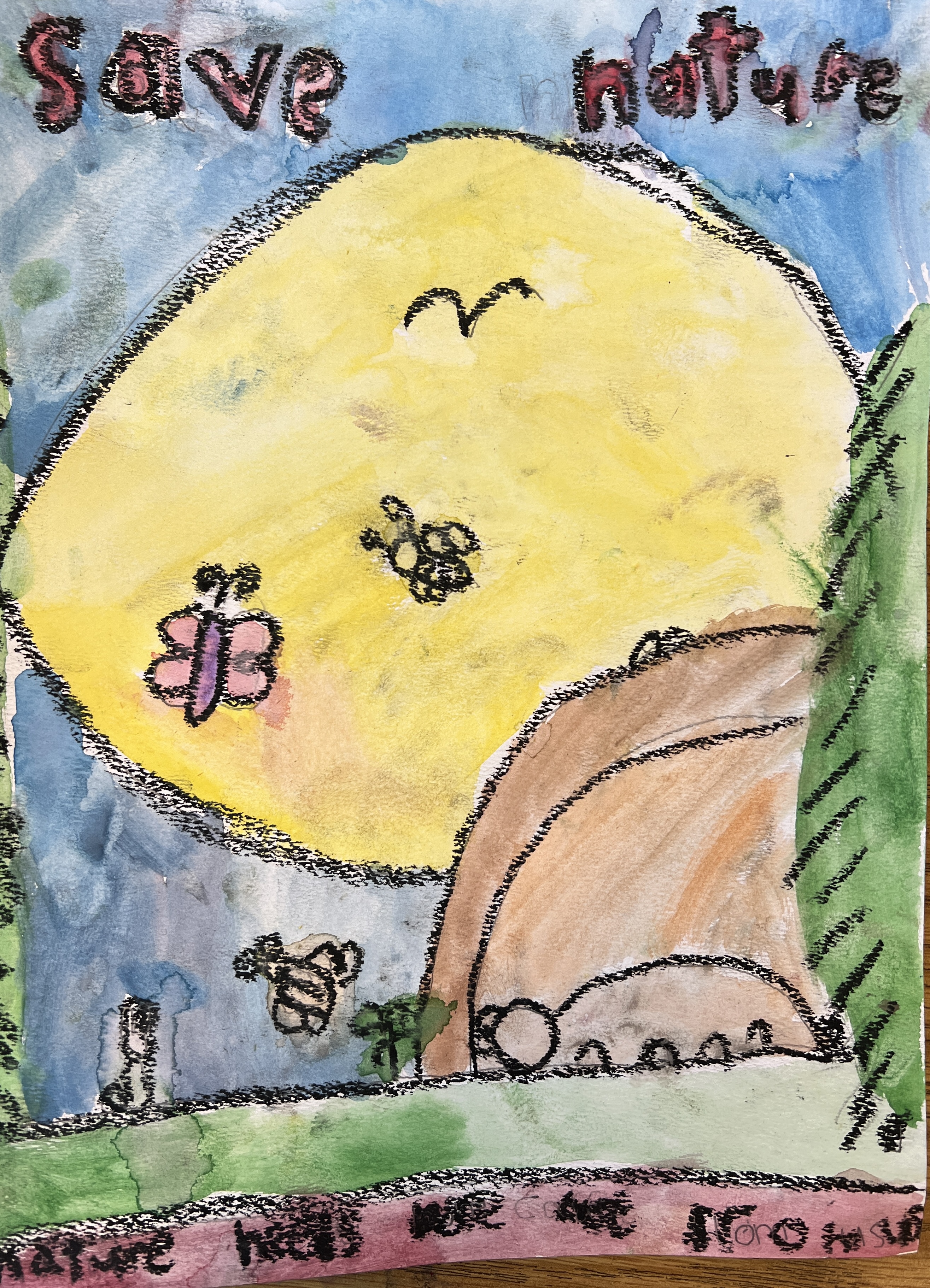
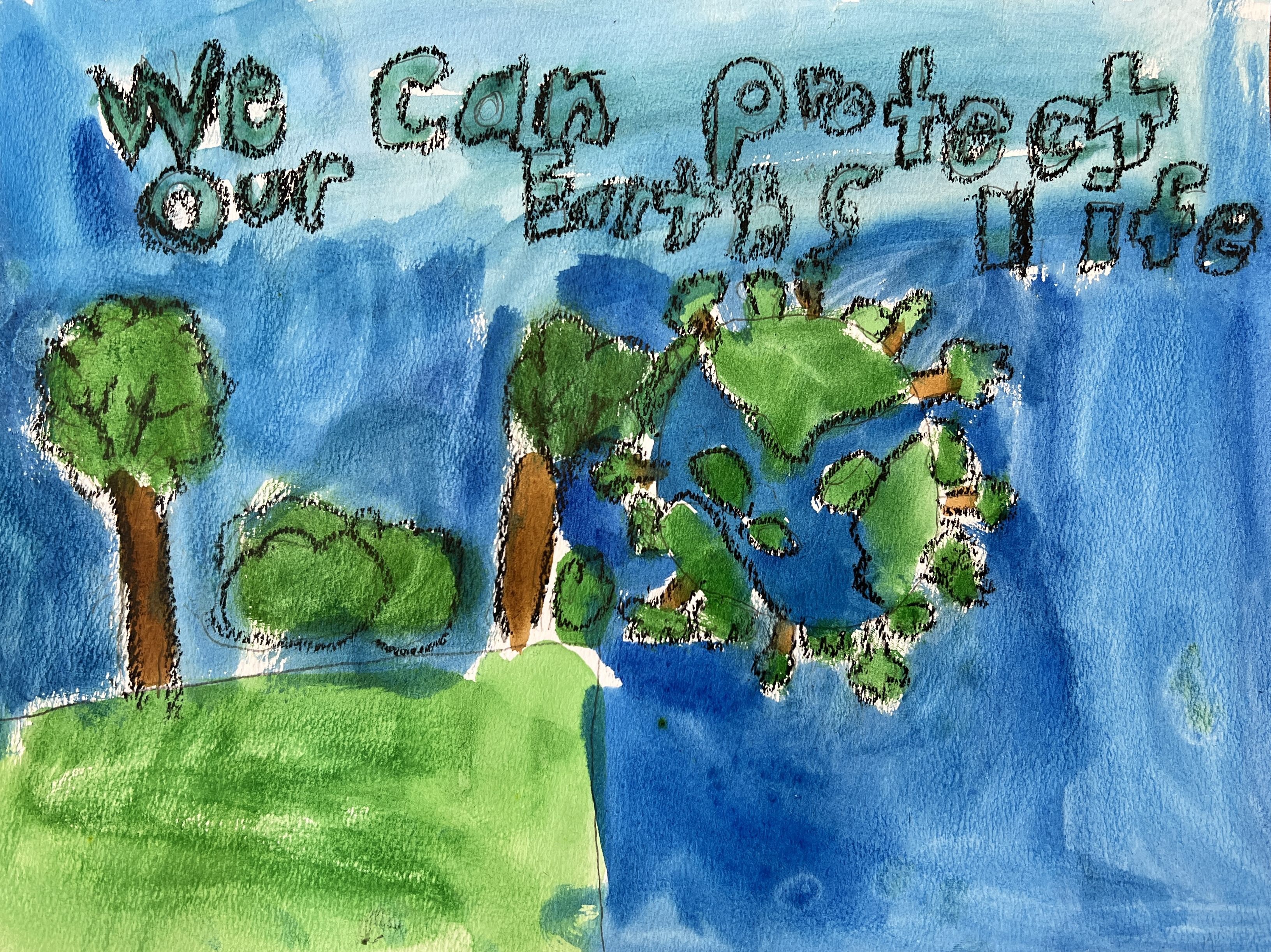
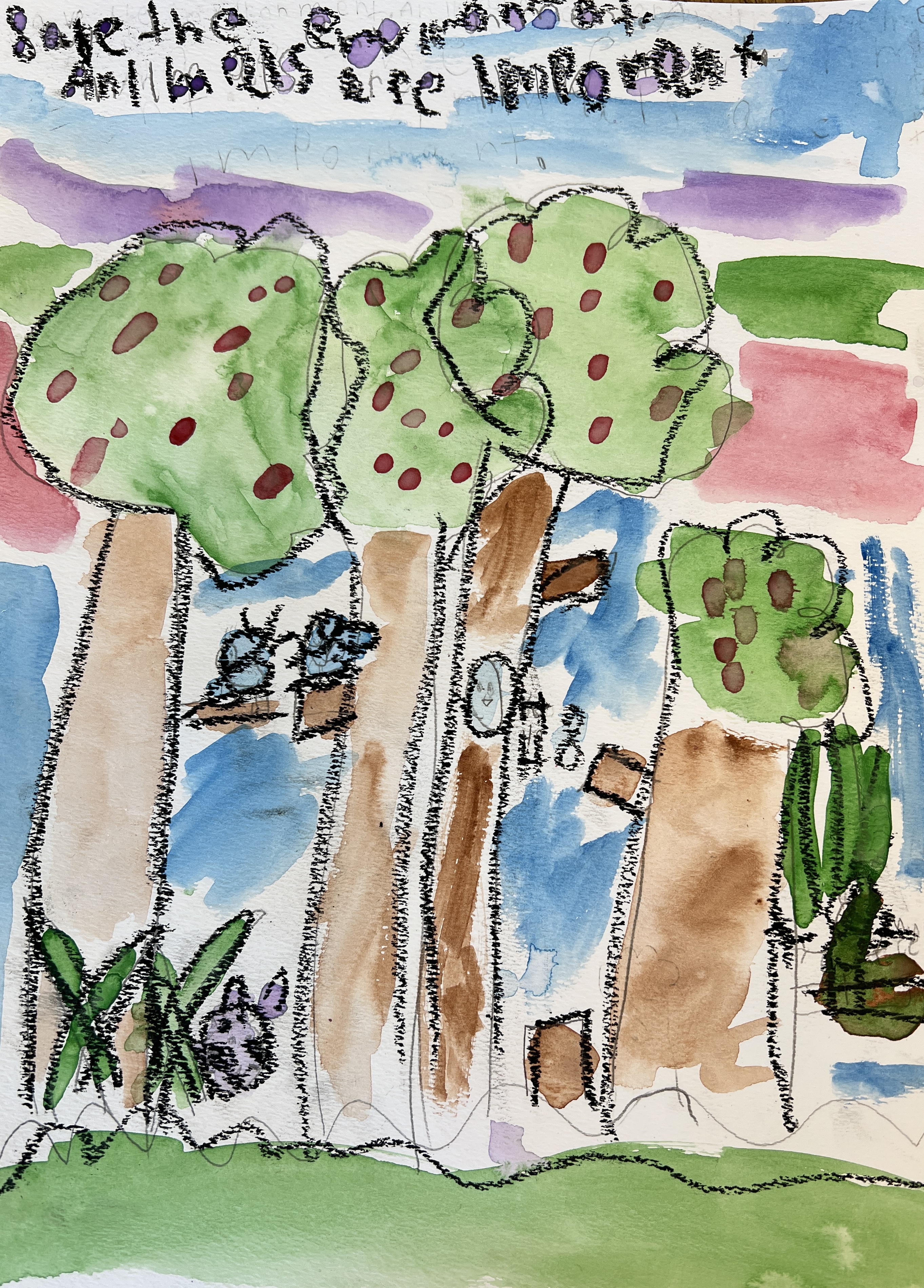
We then took those words and used black oil pastel and watercolor to create posters with their messages. Honestly, next time I will use a different medium. The oil pastel did not allow the words to be easily read, but the images themselves are quite striking. Here’s a few examples:
Respect the environment with other people.Nature needs more care from us.We can protect our Earth’s life.Save the environment. Animals are important.
Integrating environmental literacy into the curriculum is essential. My students (and yours) are our hope for the future. They will be the stewards of our precious planet. I think it’s in good hands.




 Thinking Through My Lens