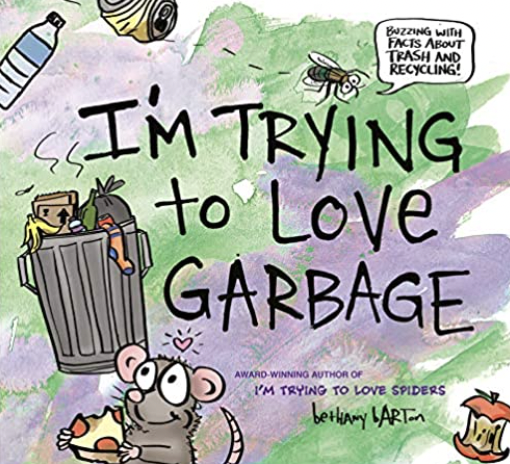
Today I read the book, I’m Trying to Love Garbageby Bethany Barton to my class of first graders. We’ve read other books in the series, including I’m Trying to Love Spiders and I’m Trying to Love Math. My students LOVE these books. Somehow the author manages to hit the perfect balance of funny, gross, and information.
I’m trying to infuse a steady dose of “let’s take care of our earth” throughout the school year, striking a balance of the urgent need to pay attention to the environment with a sense of joy and possibility– that little things DO matter.
This book does a nice job of teaching about nature’s clean up crew–the scavengers, detritivores, and decomposers who break down organic matter and contrasts that with human trash that can take centuries to break down (if at all). They learned about landfills–and were appalled that we, as human, are making huge stacks of trash that will take a long time to break down.
Luckily, at our school we have students engage in trash reduction every day. They compost remains of fruits and vegetables, recycle their paper trays and other recyclable packaging, and limit trash to those things that do not fit into the other categories. We also live in a place that has banned single use plastics, making reuse ordinary.
After reading, they wrote to their parents asking how their families reduce trash–and already, many students were aware of many efforts going on at home. I know that composting and recycling is not enough to change the climate trajectory, but I know that the more we and future generations know and do, the better our chances are to improve the situation.
I love a great book. Especially one that gets kids (and adults) thinking and acting in ways that have a positive impact on the world. What wonderful book have you read to kids lately?
In addition to having students observe, sketch, and write under the influence of nature outdoors, I also like to have them use their iPads to take photos. I’ve learned over the years that most students take better photos if I take the time to teach them some photography techniques. So earlier this week I taught my students three photography techniques: bird’s eye view (shooting from above, looking down), bug’s eye view (getting low to achieve a low perspective, sometimes looking up), and using the rule of thirds where they use the grid feature on their camera to frame their subject thoughtfully off the center.
Once I showed them photos of the three techniques and we noticed how the photographer used their camera, we headed outside to try these techniques. The only rule: no photos of people. We were short on time (this has been quite the week), so I asked students to take 2 photos using each technique. We spent about 7 minutes outside taking photos–with me taking photos too. What I love best is that they were actively engaged in trying out the techniques. I had kids laying on their back shooting the underside of plants, kids holding their iPads up high to get that bird’s eye view, and careful framing using the grid lines.
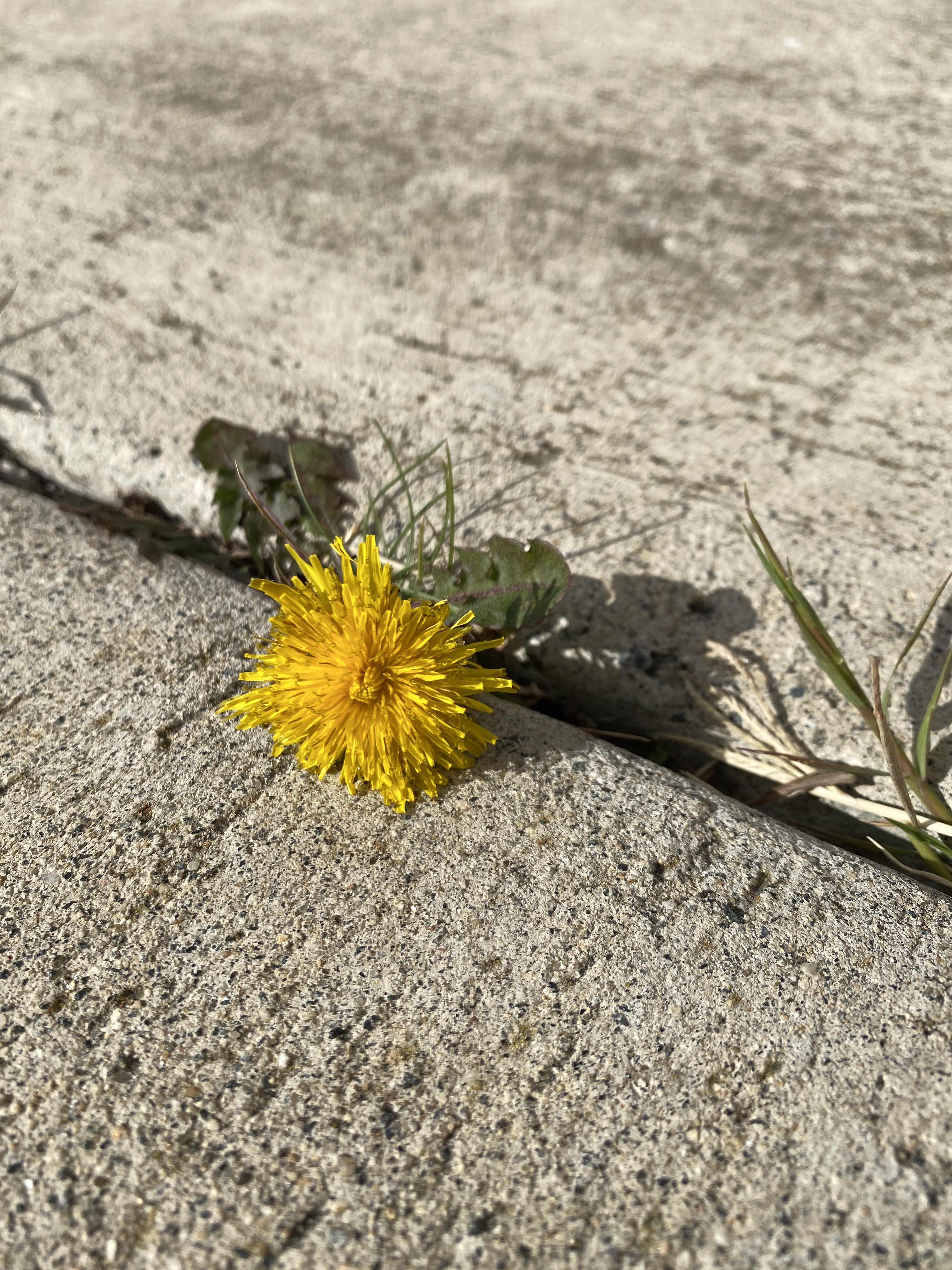
After our reading groups and lunch we came back and took a look at the photos we captured. Each student examined their photos, remembering which technique they used for each photo. I had them pick a favorite and tell us what technique they used and why it was a favorite. Some of the images were stunning! Some were ordinary. But all students felt success–and came up with photos that were intentionally framed and for the most part, did not include their classmates. Here’s the one that resulted from the image I captured above (Thanks L!). Can you guess which technique was used?
Tomorrow we will go on a photography scavenger hunt to give students a chance to put these new skills to use. Wish me luck as we head out to explore and photograph our school campus!
Today we read The Keeper of Wild Words by Brooke Smith. My students were immediately drawn into this story about a grandma (Mimi) and her granddaughter (Brook). Mimi is worried that important “wild” words will disappear if we don’t use them, know them, write them, and care about them. Mimi and Brook have a list of wild words and set off into the outdoors near Mimi’s house to find the words (natural things) on the list. From wrens to dandelions, minnows to drakes, Mimi and Brook identify and appreciate all of the words on the list. In the author’s note at the end, Brooke Smith tells about her inspiration–an article about removing over 100 natural words from a children’s dictionary to make room for words like vandalism and MP3 player.
After we read and talked, we started our own lists of wild words. We had talked about how some people were already being keepers of wild words, noticing one of our students with the name River is keeping a wild word from disappearing. Of course, we had to add River to our list. You might not be surprised to learn that these southern California first graders were quick to add ocean and sunset to their lists of wild words. I had to add egret to my list–my students know I am obsessed with this quirky shore birds with the bright yellow feet.
These young naturalists were inclined to add general words–trees, sky, and clouds, so I encouraged them to be more specific. One student started writing phrases to capture her ideas more fully (she definitely wanted constellations on her list after some sky gazing over the weekend with her family).
Words matter and paying attention to wild words is another way of focusing attention on our natural world. Appreciate for and knowledge of nature and our environment is essential. I’m hopeful that the next generation will reclaim wild knowledge as they work to regenerate the resources that are on the verge of disappearing, just like the wild words Brooke Smith brought to our attention.
On this last day of the Slice of Life challenge I want to thank those at Two Writing Teachers for offering this blogging challenge. I also want to thank my fellow bloggers–those I left comments for and those I read and didn’t comment, and even those I simply didn’t have time to read for engaging in this place of words, ideas, and incredible generosity. There is something about this challenge that keeps me accountable and somehow motivates me to write each and every day in March.
It’s also the perfect day for a bit of reflection and thinking about the take aways of an already busy month of teaching, report card writing, parent conferencing also spent with daily writing. Here are a few of my thoughts:
Writing begets writing. The more I write, the more I seem to have to write about. Early in the month I feel challenged to come up with writing topics and things to say with any kind of eloquence. With each successive day, I find myself mulling over writing topics as I go through the day, turning them over, considering angles I might take, and even then often surprising myself with the actual post that emerges.
A daily slice often means that I am making my teaching practice more visible. I consider the ways instruction and learning interact, often focusing on the ways writing develops with young writers. When I write about what I see my students produce, I understand it on another level. And when my colleagues comment, they also help me see if from new vantages.
Reading and commenting on others’ posts helps me see my teaching life in a larger perspective as I consider stories from other parts of the country (and the world), hearing struggles and successes and making connections in spite of differences.
I love the many stages of life expressed in slice of life posts. Stories of toddlers and teens, grandchildren and aging parents humanize us all. It helps to know that even the best teachers struggle to find the work/life balance and that writing is a way to process the curveballs that life throws.
This is a community where I feel like a dandelion. I thrive and grow where I land. Some days I might land in the crack of the sidewalk, trying to avoid the crush of feet walking over me. Other days I find myself in an open field, swaying in the breeze and soaking up the sun. I’m thankful for landing here and looking forward to next year’s challenge.
This might also be the year that I manage to write a weekly Tuesday slice. I’m making that a regular writing goal. Hope to engage with you all again soon!
March has been a busy month with my Saturdays filled with writing project work. Today was the day for our much awaited Leadership Advanced Institute–a day planned to renew, reconnect, reenergize, and reignite the joy that we have experienced with our colleagues in the past. But three Saturdays in a row is hard.
Luckily we had planned the day we would want. A day filled with social opportunities, engagement with new ideas and thinking, opportunities to inspire writing, and feedback on those writing ideas from our colleagues.
This was our first large-scale in person meeting since the COVID shutdown in 2020. 32 educators gathered on a Saturday because we knew that interactions with each other would be salve to our battered teacher identities.
We created identity heart maps to allow us to connect or reconnect with each other. For some of us, it was the first time we had met off Zoom. A block party got us up and talking, catching up or meeting new friends. Later, we took inspiration from Brene Brown and Daniel Pink as we created maps of our journey from here to there–or there to here.
Our maps became a starting point for writing, sharing our stories–many filled with frustration, regret, and exhaustion. We listened to each other for those moments where the writer might go deeper or the writing might help to explore a complex topic. We talked and listened, knowing the writing would help us through whatever journey we chose to take.
After a lunch delivered–what a treat to sit and eat and talk with friends new and old–we wrote. Time to write is gold! This was not about homework. We will come back and write some more for part two of this Advanced Institute. But before we left, after recording our next steps in writing, we picked a single sentence to read aloud to the group. The symphony of voices and words touched our hearts, knowing we want to hear more, read more, write more. A day of work–but so much more than a job.
I love writing project work and the ways that teachers are the driving force behind proactive change. A conversation with a colleague a few years ago–about the need for climate/environmental education to become “ordinary,” something that students experience regularly, in all their classes, throughout their education career–has stuck with me. And as a result, this year in our local writing project, we convened a group of SDAWP educators to explore that very idea with an added twist: how can we make environmental literacy and justice both ordinary and also have writing at its center?
Today was our celebration and the opportunity to hear details about the work that teachers in this group accomplished. Each put together a 5 minute overview of the work, highlighting student engagement and involvement through writing.
Wow! I felt like I could see these young people growing into advocates and activists right before my eyes. They wrote and spoke with passion about our world, recognizing its beauty AND our need to take better care of it for their future. There were letters, informational pieces, persuasive essays, narratives, poems, artwork, speeches and more. I felt my heart grow three sizes just witnessing this incredible work facilitated by my writing project colleagues.
Our next step is to figure out ways to take this work beyond our group, to and beyond our larger writing project community, and to establish this as something students can expect throughout their schooling. The beauty is that these teachers did not take away anything they were required to teach, instead they worked this content into the learning the students were expected to experience anyway.
Yesterday was International Dot Day, a day inspired by the creativity of Peter Reynolds and the power of each of us having the courage and confidence to “make our mark.” To celebrate dots and creativity and confidence, we began our week with the poem What is a Dot? by Laura Purdie Salas. The first graders in my class had an endless list of ideas of what a dot could be and eagerly illustrated the poem with their own “dotty” ideas. Of course, we also read and discussed The Dot by Peter Reynolds.
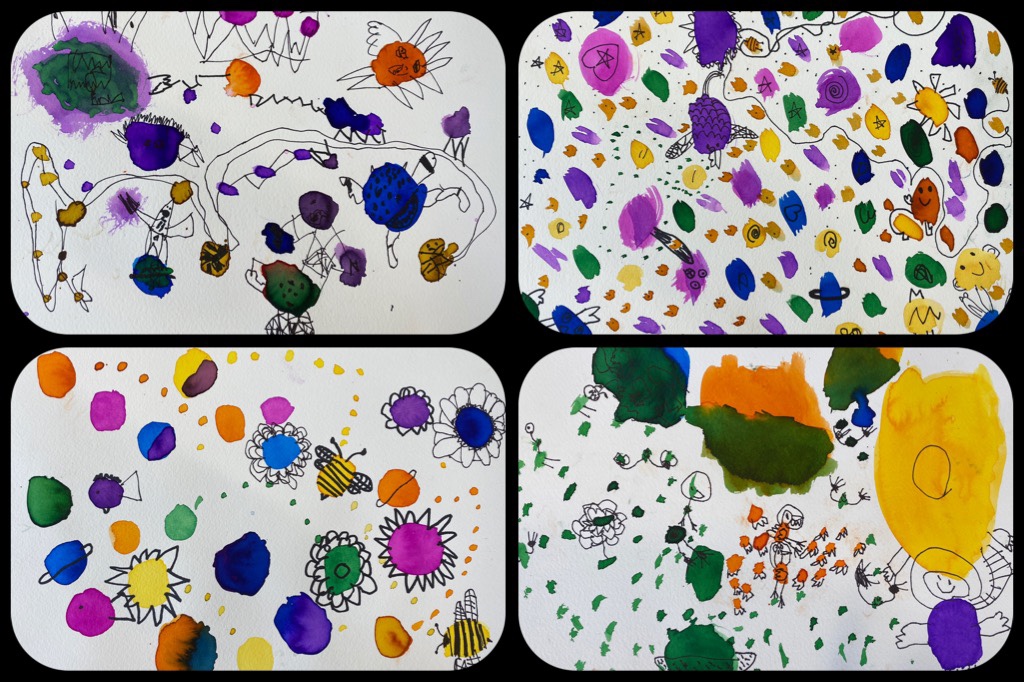
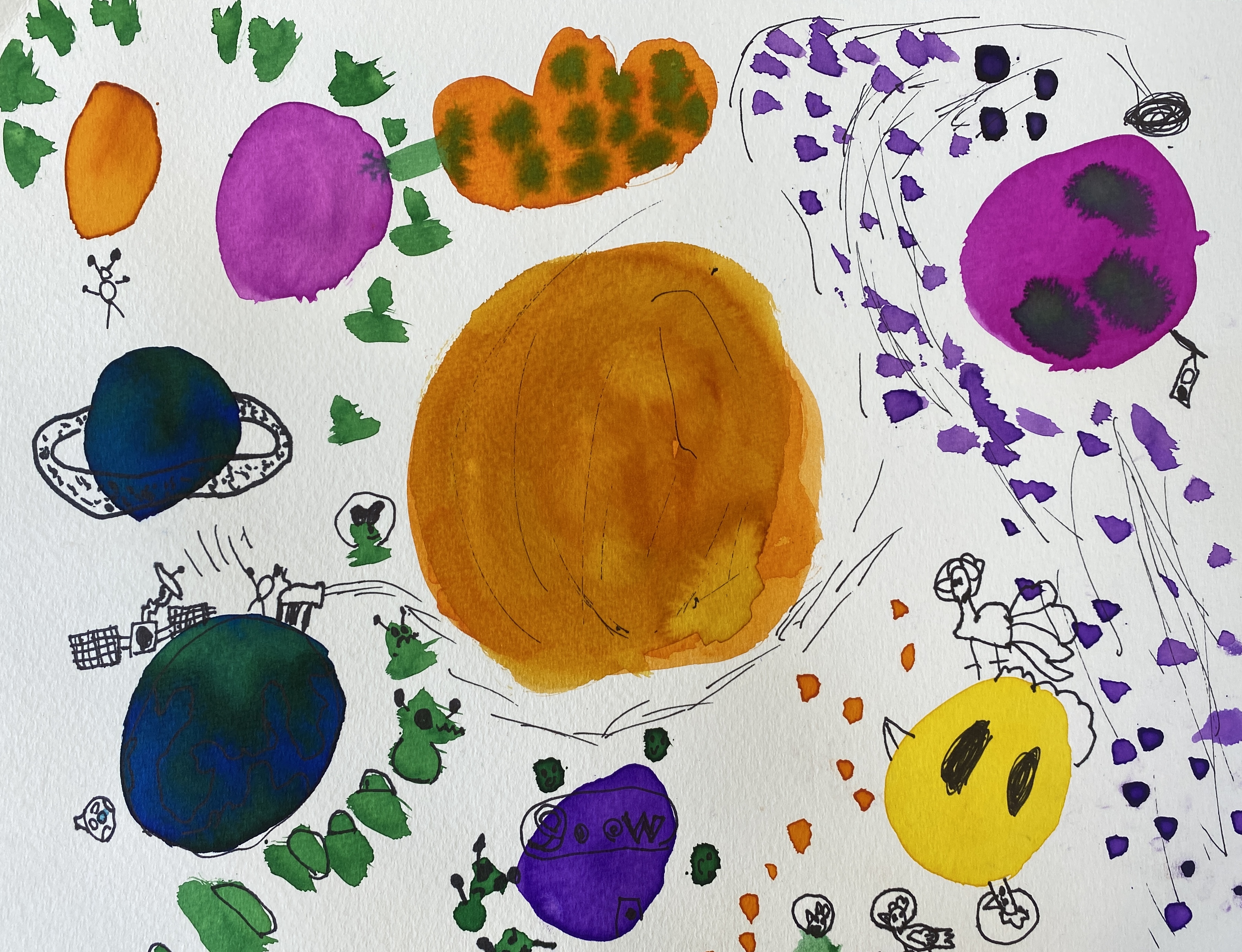
The week got dottier on Tuesday. We broke out the liquid watercolors and painted a page full of dots. These mostly 6-year-old artists knew that making the dots was just the start of this project. They would be transforming their dots into something else using a black sharpie marker the following day. They joyfully and freely painted dot after dot, experimenting with size and placement. They dripped one color onto another, while carrying on a constant narrative of alternative worlds, descriptive details about color, and oohs and aahs of their own discovery. We ended the day by reading Ish, yet another Peter Reynold’s book and talking about encouraging others and not judging our first attempts too harshly when we draw (or try other things too).
Wednesday was the day…International Dot Day! Students came to school dressed in dots and so did I. I l love their creativity in finding dots in their wardrobe. One child found a solar system shirt, each planet a dot. Another noticed the cat faces on her sweater were dots with more dots showing the natural coloring of the cat. There were polka-dotted masks (COVID makes us creative too), socks painted with dot markers, dotted bows in the hair, and I even found a pair of polka dotted earrings! With wardrobe dots in place, students were eager to get started transforming their watercolor dots from the previous day into beautiful pieces of art.
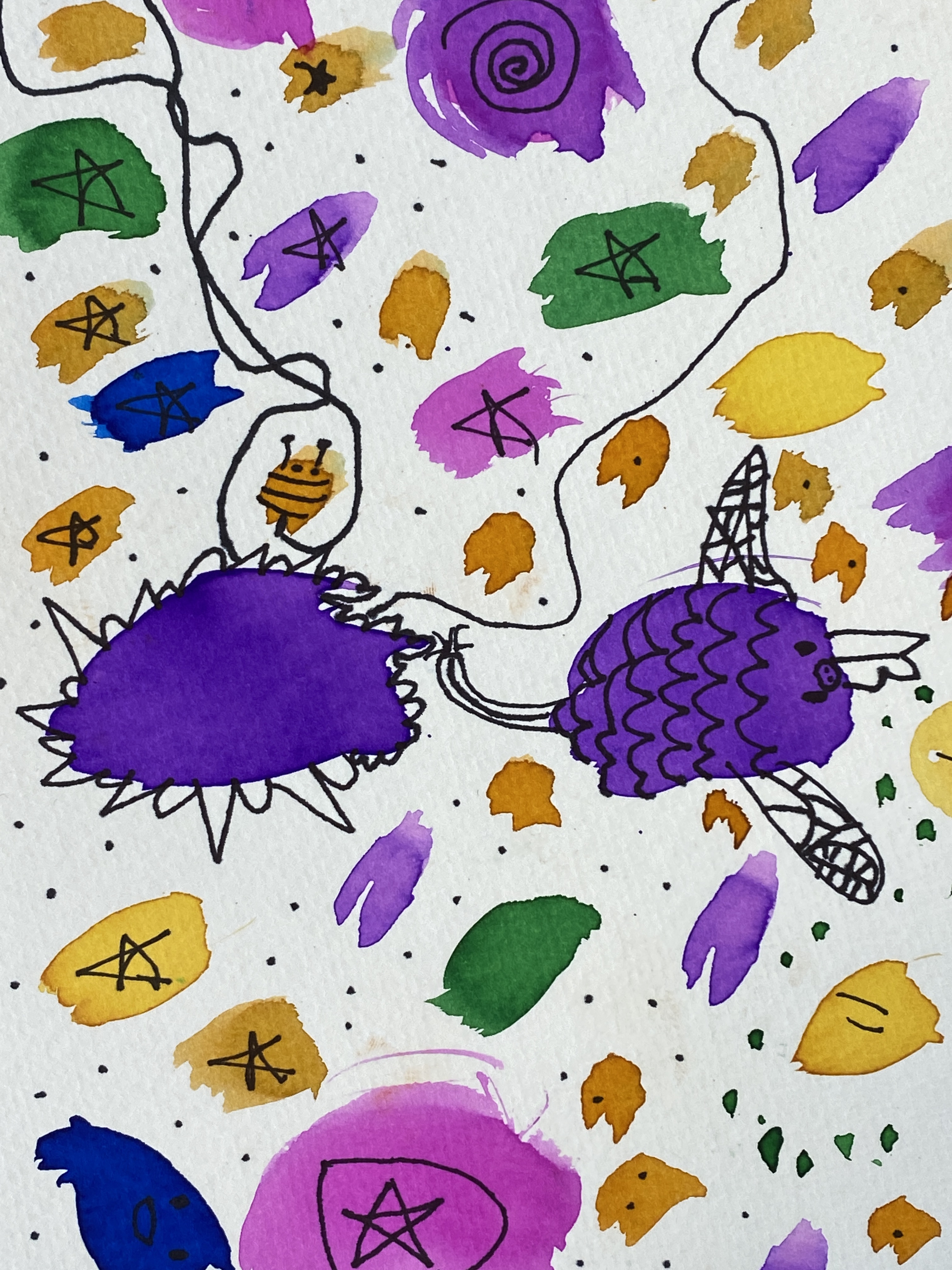
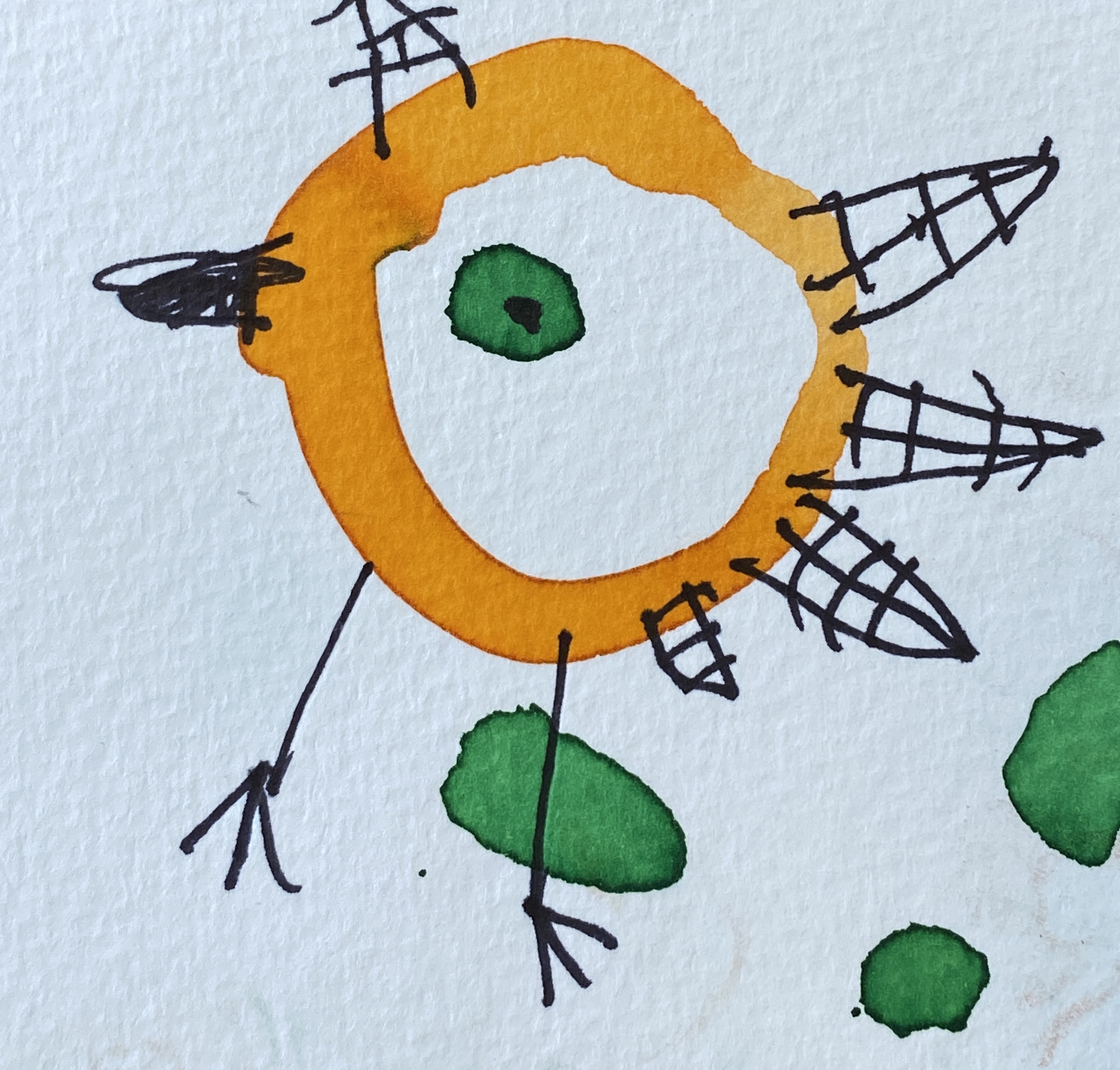
After a bit of modeling by showing what I might do with my own watercolor dots, I handed out the sharpie markers–a thicker one and a thinner one, and reminded students to start thinking about what story they might tell about the dot creation. I love the artistic freedom and courage of first graders. They uncap a permanent marker and confidently draw whatever is on their minds. Dots turned into chickens with space helmets, planets from unnamed galaxies, insects galore (bees, spiders, June bugs, ladybugs…), jellyfish, dragons, and of course, lots and lots of flowers. Along with the drawing was the buzz of conversation, telling the story of the things they were drawing. Clearly kids need to talk their ideas through as they draw.
Once the pens were capped and the drawings done, we took out our writer’s notebooks and set out to put down words to go along with the the art. We started with the simple frame, a dot can be… I showed how as a writer, instead of a sentence like A dot can be a bee, I could expand that sentence saying, A dot can be a pink bee buzzing from flower to flower leaving a trail of heart shaped pollen behind. (And they could see how that sentence also matched my drawing.) And with that short mini lesson, my students were off and writing.
Here’s a few examples:
A dot can be a bee. And a monkey that is blue and yellow. And a purple dragon and the purple dragon is swooping through the clouds. R
A dot can be a flower garden with a hot air balloon with a chicken and a bee and a sleeping cat. The chicken is looking for food. C
The best part of the writing time was that every student, even those who are less confident writers, were engaged with their writing. I heard lots of sounding out to get the words on the page. And students began to stretch their ideas, adding details that bring writing to life. I hope as the year progresses that they become as fearless with their writing as they are with their artwork, knowing that small mistakes might just become a “beautiful oops” or the stepping stone to something magnificent. Risk taking is essential to learning, as is joy. We had a wonderful International Dot Day filled with playfulness, creativity, and lots and lots of learning.
What might you do with a dot? It’s never too late to make your mark!
With the school year coming to a close, I wanted to come up with an activity for students that felt like play–like a party–and still provide academic content to satisfy my ever-present need to make use of all available instructional minutes. (Yes, even in the last week of school)
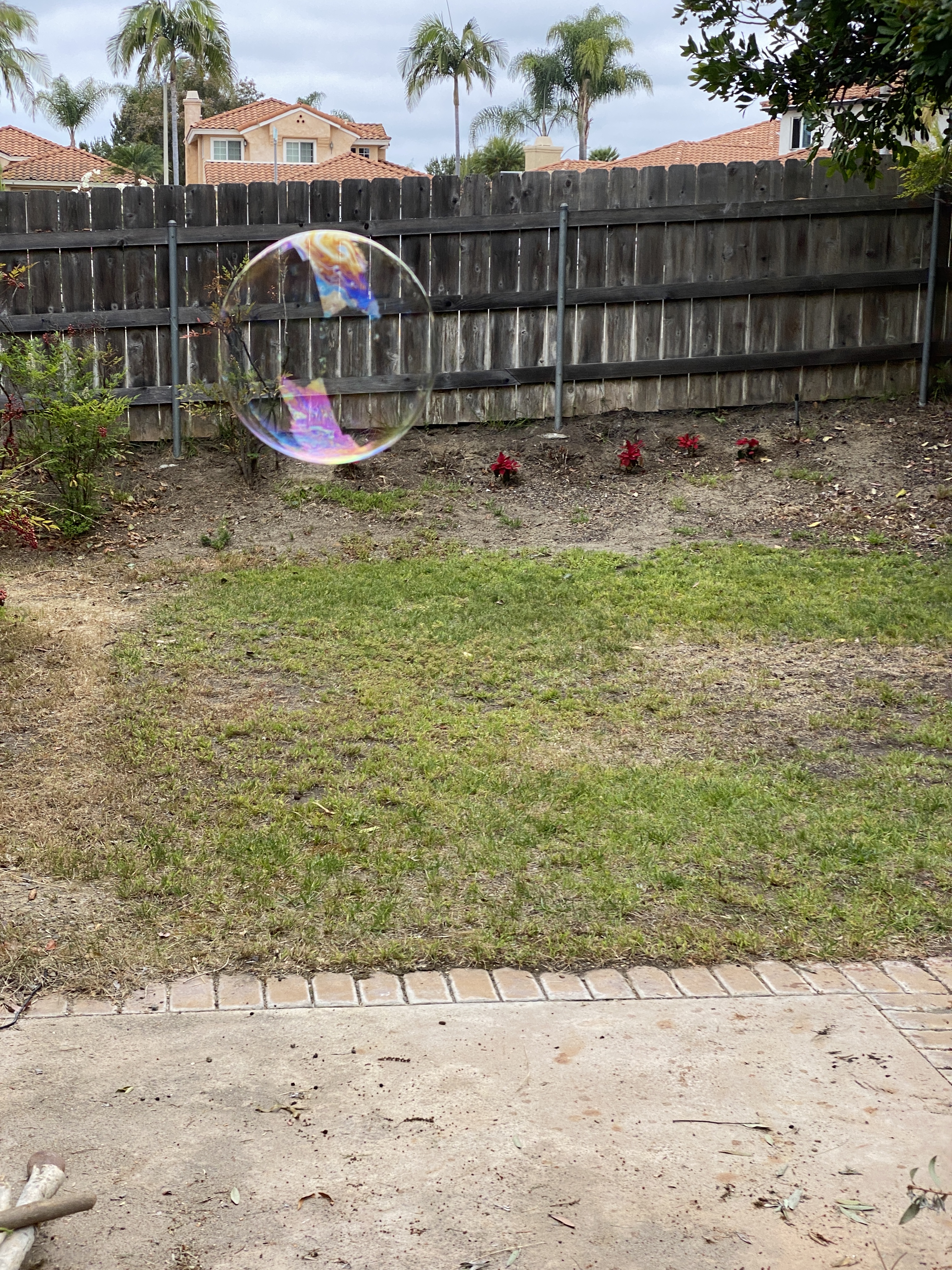
So, when I came across a blog post about making giant bubbles and bubble art, I knew I could turn this into a meaningful day of learning and fun…all wrapped up in a soapy bubble! I’m pretty fascinated by bubbles. I’ve spent quite a bit of time photographing giant bubbles at the beach and I’ve written about the “bubble man” a time or two (or more). I know that the trick to great bubbles is the solution–so prior to having my students explore and experiment, my husband and I tried our hand at bubbles over the weekend.
The basis of all bubbles is soap and water. But if you want the bubbles to be big and to have a bit of staying power, a bit of corn syrup and some glycerin need to be added to the mix. Using smoothie straws and yarn, I created a bubble wand that my students would be able to make on their own and started dipping and waving in my own attempt to create bubbles. This bubble thing is harder than it looks! I didn’t immediately get big beautiful bubbles flying from the wand. But with some patience, some tinkering, and some exploration of how to get a thin film filling with air onto my yarn…bubbles happened. At that point, with bubble solution pre-made, I was ready for a day of bubbles with third graders!
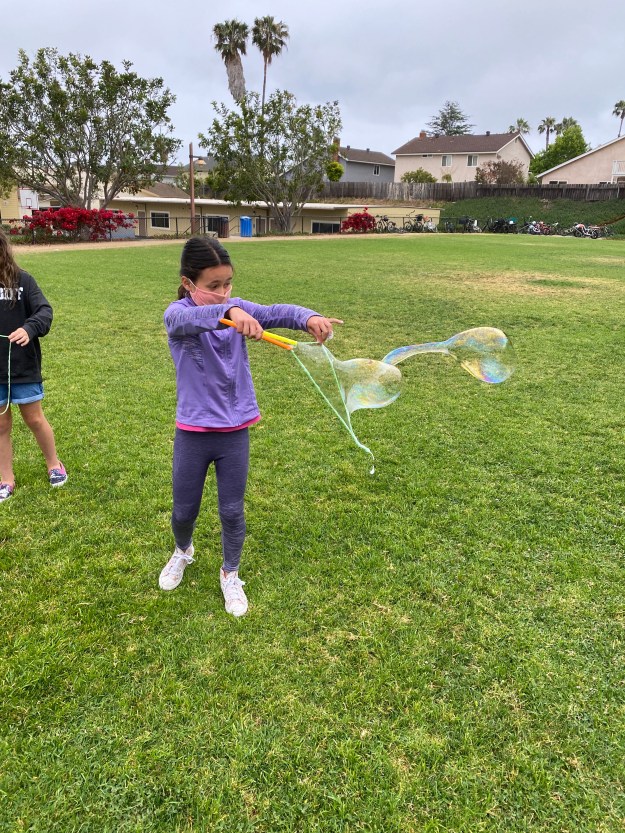
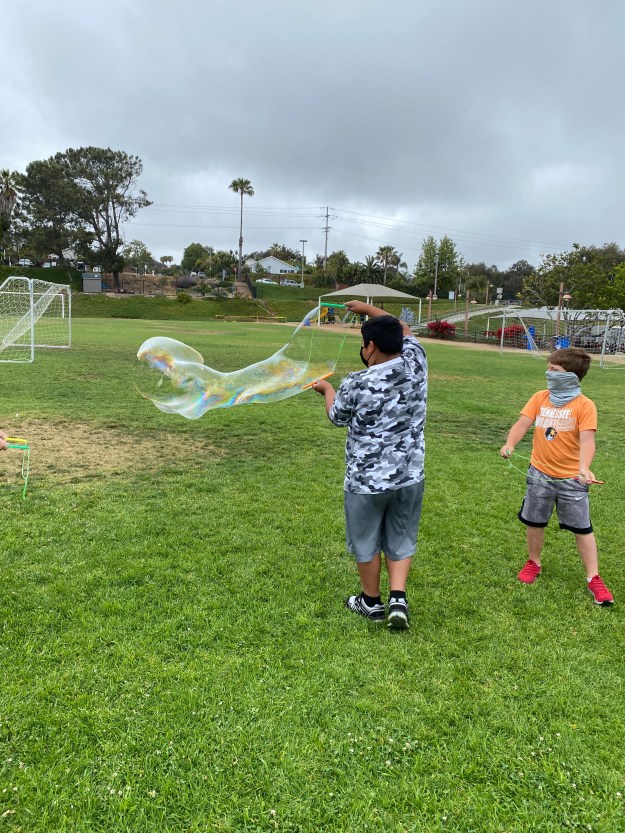
We started with a very interesting TED Talk titled, The Fascinating Science of Bubbles, from Soap to Champagne. We learned about surface tension, the geometry of bubbles and so much more. (If I were to do this in the future, I think I might devote an entire week rather than a whole day to bubbles!) Then we made our bubble wands and headed up to the field to make bubbles.
In spite of warning students that making these bubbles would take patience and experimentation, there was plenty of initial whining that “it’s not working!” I reminded them to keep trying. And then it happened…the first child experienced success! Like wildfire, bubbles emerged, filling the air with irridescent spheres.
The soap solution ran out before student interest waned, which is probably the best possible result! We headed back to the classroom with soapy hands, happy hearts and filled with visions and language about bubbles.
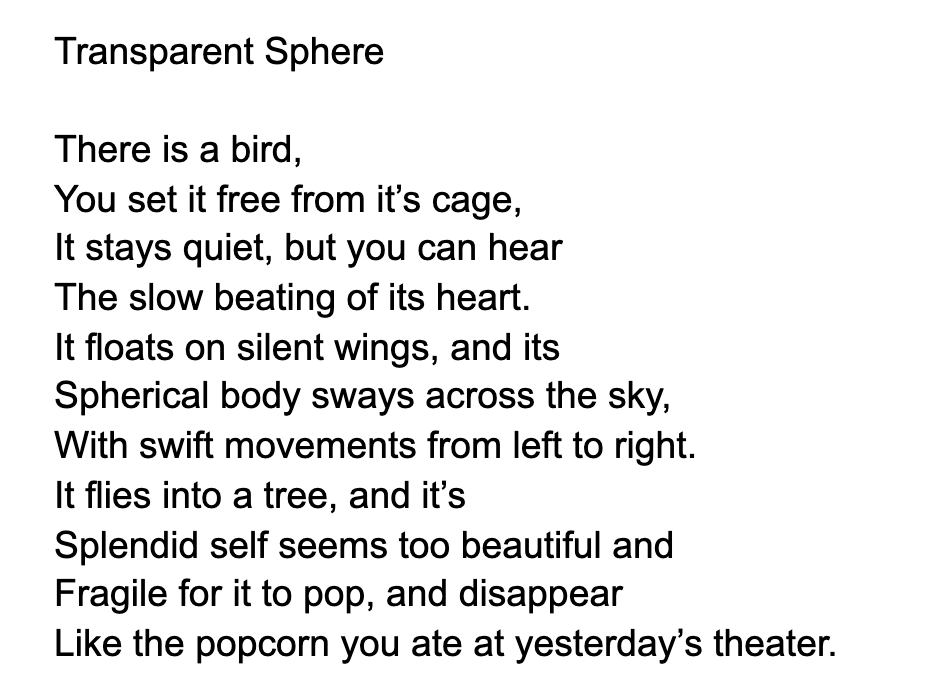
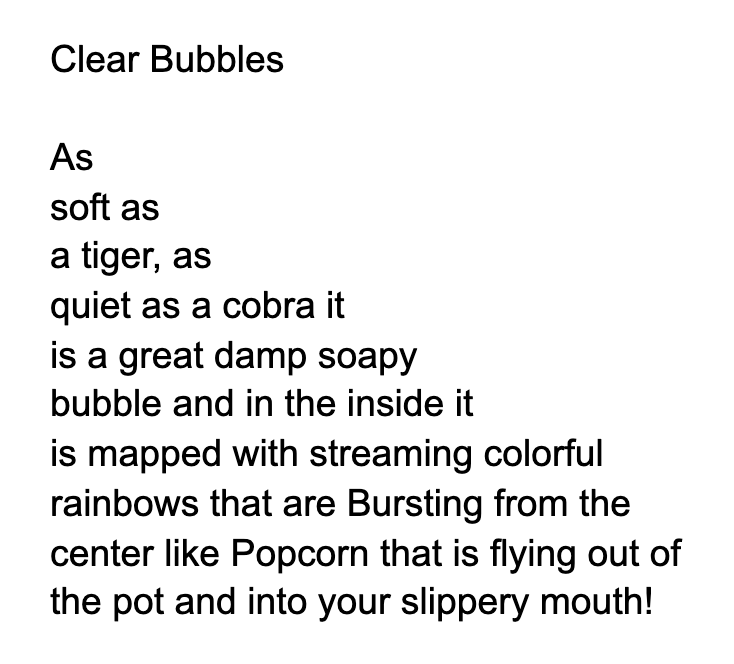
These young scientists are also prolific readers and writers, so after studying Valerie Worth’s short poem, Soap Bubbles, we created a list of bubble words and a list of potential bubble metaphors and then set the magic 7-minute writing timer and started writing. Like bubbles, colorful, delicate, evocative poems floated up, emerging from the points of students’ pencils.
Here’s a couple:
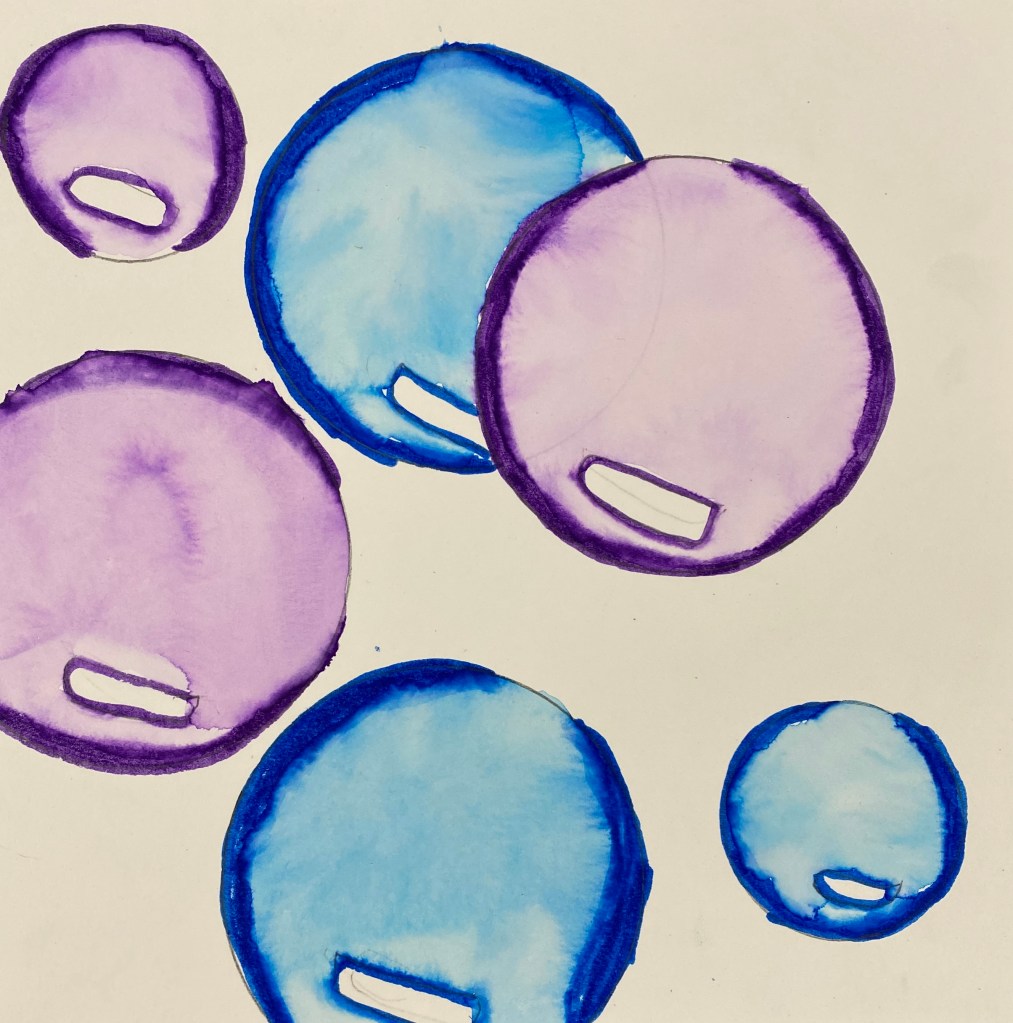
To complement the poetry and the elusive, temporary soap bubbles, we got out paper, pencils, water-based markers and some water and created bubbles…as art! Each artist created their own composition, tracing round shapes, adding a space where a light source reflected off each bubble. Then they added marker and finally, using just water and a paint brush, urged the marker to follow the water, creating beautiful dimensional bubbles on watercolor paper.
There is so much more we could have done with bubbles–including exploring the mathematics of spheres. Overall, it was an amazing day. Students could not believe that an entire school day had passed before they even realized it. Engagement was high, work quality was inspiring…it was an amazing last Monday of the school year! Based on this success, I know I will be working some bubble science into future teaching and learning!
Today was the last day for students to attend school in our hybrid AM/PM schedule. They will be remote for the rest of the week to allow time for parent conferences and then after a week off for spring break, the class will unite and become one whole class that attends school all 5 days together. I look forward to this coming together–and hope that the two halves of my class will complement each other.
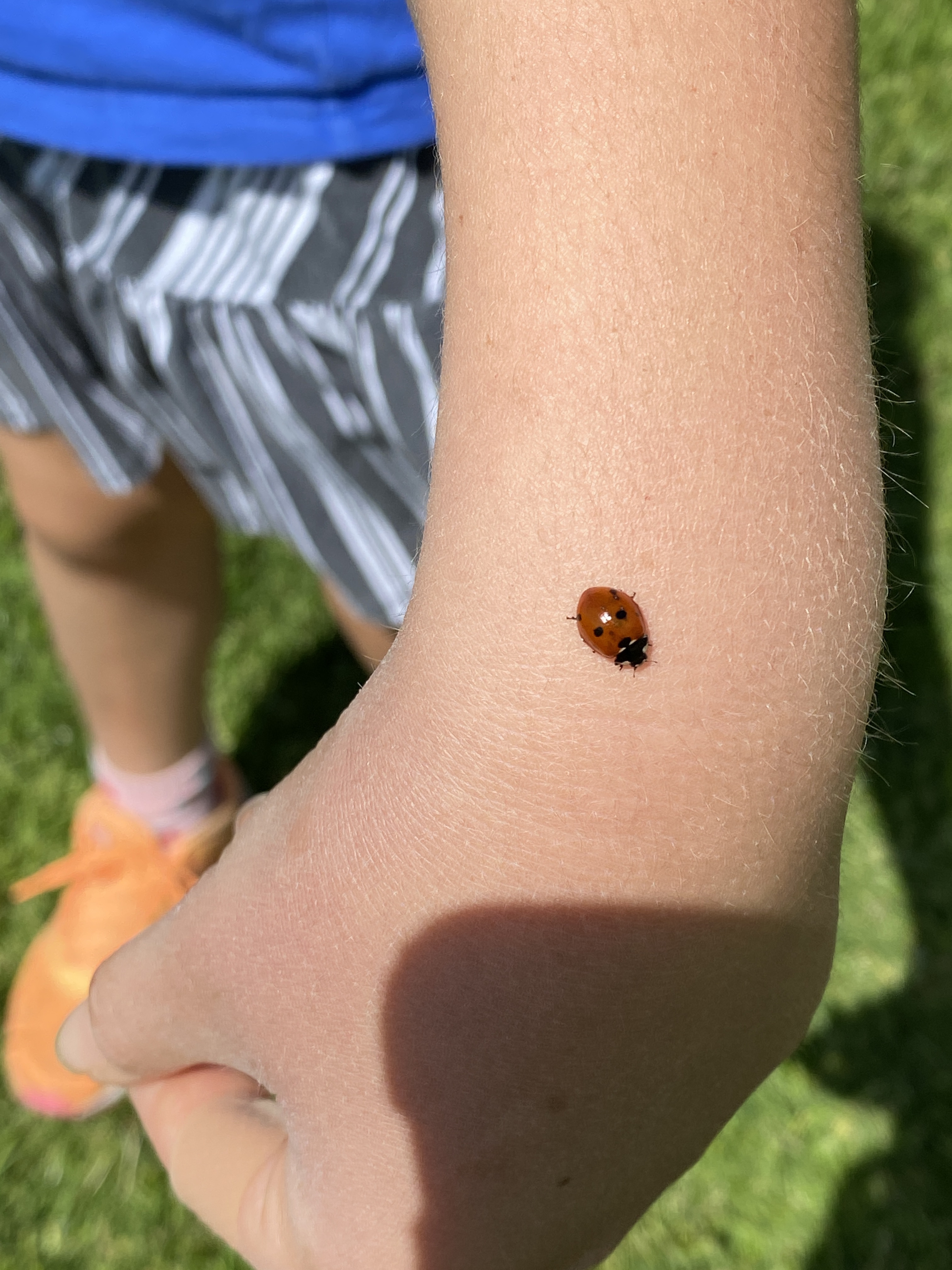
The PM group is the half that NEEDS their fresh air break. They burst from the classroom doors when it is time, unleashing the energy that they have tried (not always successfully) to contain in the classroom. Today started no different. Most of the kids skipped eating a snack and headed straight for the playground equipment. But a couple sat on the grass to eat a bite…and before I knew it, they were chasing ladybugs.
And catching them.
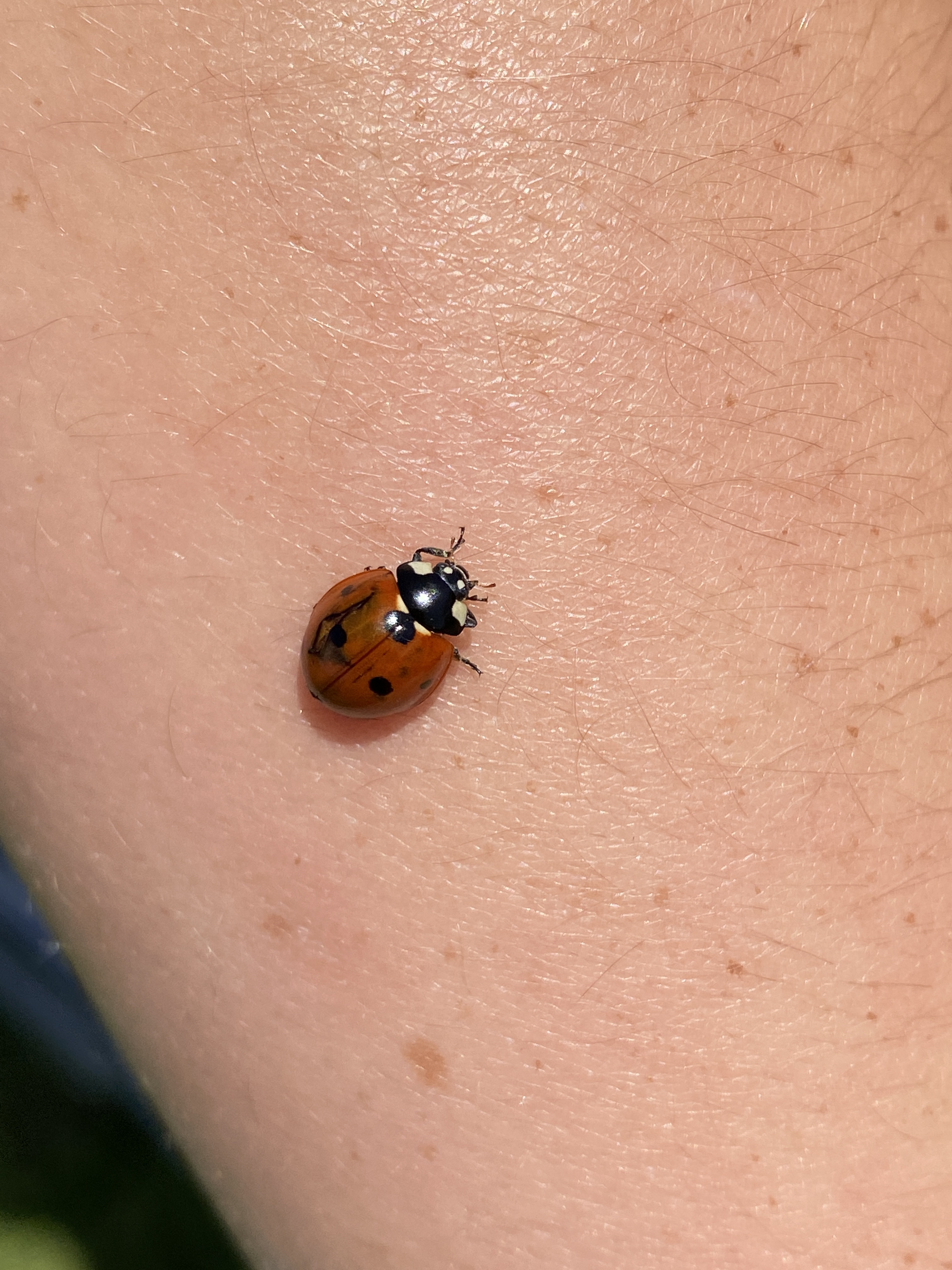
Gently cupping them, they lifted them from the grass to bring them to me to photograph. (I love that they know that I will want to take photos!) They transferred these brilliant red polka-dotted beauties from the cupped palm to rest on the arm so I could get close for a clear, close up photo with my phone. Somehow they could find these tiny gems when they were not visible to others. Like jewelry, they wore these insects as they danced around the field. Sometimes the ladybugs rested patiently on the arm, other times they spread and fluttered their tiny wings in a blur of red.
These kids never stop talking. They kept up a torrent of descriptions and theories as they ran and collected these friendly insects. One theory they floated was that the number of dots was equal to the age of the bug. (Were they thinking days? Insects don’t tend to live very long lives!) Luckily I had just read an article on ladybug varieties, complete with gorgeous photos (who knew that would come in handy!), so I was able to talk to them about the large number of varieties of ladybugs that exist.
An impromptu break chasing ladybugs was the just right way to end this current mode of teaching. Moments like these remind me how much I enjoy the exuberance and energy of children–and the ways they fuel my teaching and my own learning.
I’m craving travel, exploration, connection, shared experiences, the opportunity to get out of the rut of the ordinary. So are my students.
Living and teaching during a pandemic is no picnic. But all of you know that. Uncertainty and change are the only constants…along with masks, hand washing, and physical distancing.
After three weeks of distance learning, my students came back to school last week. Sort of. Part time. I love, love, love having my students in the classroom again. But…
I have half of them at a time. One shift in the morning and a second shift in the afternoon after the janitorial staff comes in and disinfects the classroom. The AM group works independently in the afternoon from home, the PM group does the same in the morning before they come to school. And I am exhausted trying to keep up!
In spite of this hybrid schedule, I want students to have a rich and meaningful learning experience each and every day. I want them to think deeply and for curiosity to be an insatiable itch that only more reading, writing, observation, and investigation begins to scratch. I love to combine rich content with opportunities to explore, create, and connect. Science is often my go-to.
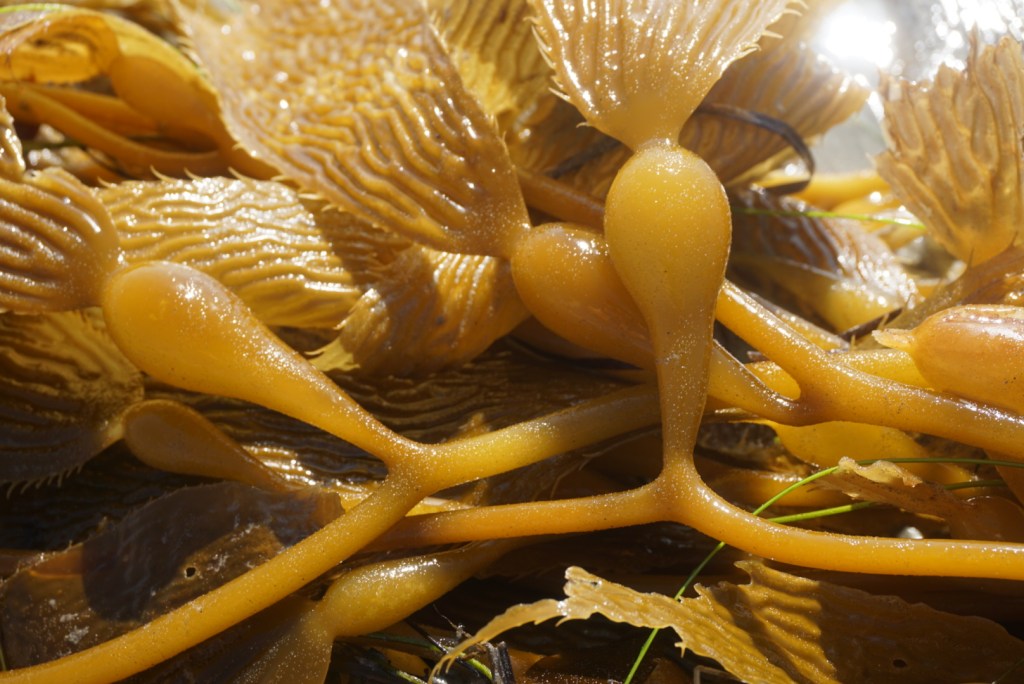
With the Pacific Ocean outside our door and plant and animal adaptations on our list of science standards, it makes all kinds of sense to study our local kelp forest. Macrocystis Pyrifera has become the basis of our study, the algae on which we build our knowledge.
We’ve done some reading, watched a video, and looked at some photos. Most years we head down to the beach and take a close up look or a parent heads in with a bucket full of these amber jewels. But not in coronavirus times.
So what could I do to breathe some life and variety into the learning in this hybrid classroom? What could I do to energize my own planning and teaching?
I decided on a field trip. Wait…the virus, the pandemic. I’m not even allowed to have all my students in the classroom at the same time!
Virtual field trip to the rescue.
My students don’t come to school on Wednesdays. I host a morning Zoom meeting with the entire class and then set them off to work independently for our minimum day. But this week, Wednesday became our field trip day.
I remembered that the Monterey Bay Aquarium had live cams and a huge kelp forest tank, so I headed to their website to see what kinds of opportunities might exist for my students. I uncovered a wealth of resources! This is a place I had always wished I could take my students to visit, but it is halfway up the state…well out of reach of a field trip even in the best of years!
So how would I organize this virtual field trip so my 8 and 9 year old students could access these resources independently? After some trial and error, I decided to create a slide deck to guide them through a variety of activities. I assigned some specific activities and offered choices for others. And to slow them down and encourage close observation and focused attention, I provided a paper packet for note taking…with a reminder that we will use these in class next week.
I know I was more excited about this virtual field trip than they were–there was great disappointment when they learned we weren’t actually going anywhere! But first indications suggest they did have fun…and learn some things. I’ll know more on Monday!
In the meantime, maybe you are in need of a field trip and an immersion into in the kelp forest. Here’s a link to my slide deck.
So, I didn’t get to travel…but I did get to explore and dig myself out of my usual lesson planning routine. I watched sea otters frolic, jellies undulate, and giant kelp sway. And I’m plotting how to put my students’ new found knowledge about the kelp forest ecosystem to creative use in the classroom next week.
I’m also already thinking about that next virtual field trip. Where should we go? What should we study? If you have great ideas about places with a variety of resources, I’d love to hear all about them!