Tag Archives: mentor text

Chasing a Snail: NPM22 Day 1

It’s April! And it’s the first day of National Poetry Month. I don’t profess to be a great poet–but I am able to share my love of words and poetry with my students–especially when I do the things I ask them to do.

So even though this is not a teaching day for me and even though Spring Break begins tomorrow and I won’t see my students until April 11th, I will write a poem each day. I know that I will be better able to coach and guide them if I am doing the poetry writing I want them to try.

I plan to use Eve Merriam’s Peeling an Orange with them when we get back to school after Spring Break, so why not experiment with it as a mentor text today? One of the techniques I notice in this poem is her use of the contrasting words carelessly and meticulously. So, since photos tend to inspire my writing, I took a peek through my camera roll and spotted this one of a snail from a neighborhood walk earlier this week. And here is the poem it inspired:

Chasing a Snail

Hurrying

all feet and shadow

risking the horrifying crunch

or moving in slowly

my phone a wall

as the telescoping antennae

stretch and reach

each centimeter forward

marked with a telltale spot

of drying slime

like invisible ink

in a race against

time and dryness

Taking Our Photos Further: SOL22 Day 16

Back on Monday I wrote about my students and their foray into the garden to explore some photography techniques. We’ve been continuing our project, first by carefully examining each photo, noticing the technique used to take the photo, and then selecting their 3 favorites…one from each technique. Those three photos were then edited. I showed them two main function of the native iPad editing tool: how to crop and/or turn a photo and then had them use a filter to change their photo from color to black and white. (After all, we are studying Ansel Adams!)

Today, the choices got more difficult. They had to select their one favorite of the three edited photos to use as their inspiration for writing some captions–in the form of equations. One of my fellow slicers did a lovely photo essay (I wish I did a better job of keeping track of the blogs I read and leave comments for) where she used Amy Krouse Rosenthal’s This Plus That: Life’s Little Equations as her caption format. I knew this would be an excellent format for my young writers–and after reading and discussing what we noticed in Amy’s book, these 6 and 7 year olds set off to write their own–inspired by their black and white photos.

Here’s a few to share with you (along with the photo inspiration)…please keep in mind that these are first draft efforts!

I absolutely love B’s buckets–there is something perfect about the light and dark of them. Here’s one of his captions (he was quite pleased by this effort!):

Bucket + bucket = Buckets

Our warm weather obviously had an impact on A:

Fun + spring + warm = amazing

Only a few students risked subtraction, I love R’s sentiment!:

Trees – deforestation = Life

You’ve got to love the first grade angles! Here’s H’s view:

Love + joy + garden leaves = plants

This unusual view of sweet peas inspired C’s caption:

Plants + pollination = Flowers

In addition to the photography lesson, the actual photos, and the captions, students used technology to edit and also learned to upload photos to Google Drive, share them with me, and absolutely loved getting to choose from three different black and white filters.

And here is my own–I had to join in the fun!

Smooth stumps + tiny black ants = squirmy kids

Maybe you’ll want to head outside and give this a try! Be sure to share if you do!

Teacher-Writer

What does it mean to identify as teacher-writer?

I write with my students, I write for my students, I write to understand my students, I write to understand my teaching and my students’ learning. That’s probably the definition of teacher-writer.

Today I experimented with a writing provocation I found in a Teachers and Writers Magazine article. It attracted my attention because it began with doing–actually with a blind contour drawing. I love to have students do something as a provocation for writing–probably because I like to DO as a way to instigate my own writing.

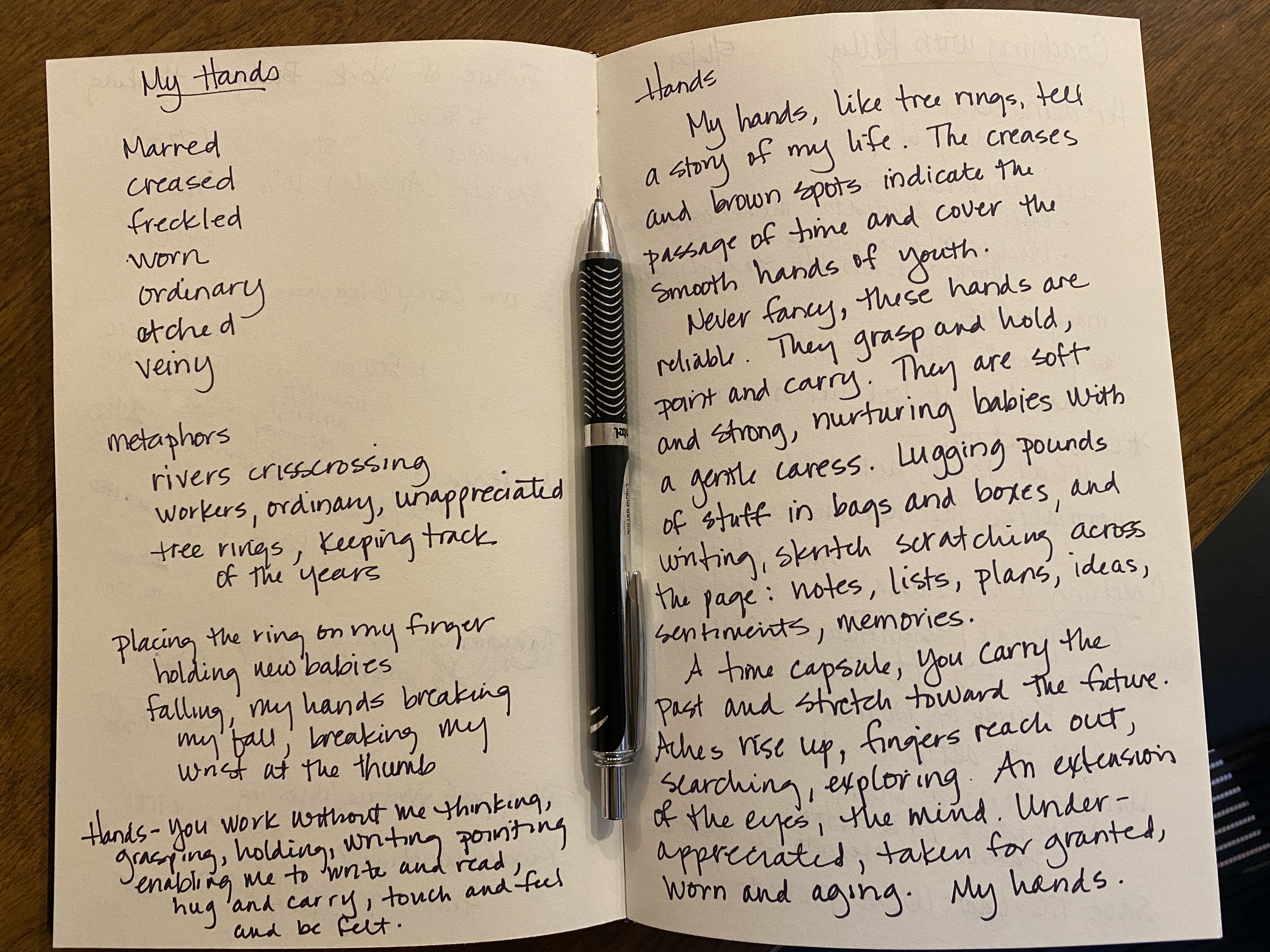
So, following the directions in the article, I used my non-dominant hand to draw my hand, keeping my eyes on my hand and not on the drawing. I tried not to lift my pen, keeping my pen following all the lines and shapes I saw on my hand.

After drawing I opened my notebook and began a list of words evoked by my examination of my hand. then I came up with some metaphors. I thought back to memories about what my hands had touched or done, capturing some of those thoughts in my notebook. I went on to express my gratitude to my hands.

The next step was to write about my hand, using the ideas generated before–or not–for about 7 minutes (my favorite writing time!).

Finally, using a different colored pen, I added words to my blind contour drawing of my hand, creating a collage of sorts. I didn’t directly copy my writing, just added some of the words and phrases I had generated.

Students could go on to write an essay or ode about their hands, having generated a plethora of ideas.

Having tried this writing on as a writer myself helps me identify how it might or might not work for my students. My young students might do better studying their non-dominant hand and using their dominant hand for drawing. I know they will worry about how the drawing might come out–I’ll have to show them some strategies and perhaps do a practice or two before we start for real. We may brainstorm words about their hands as a group before they begin their individual lists. But, I think I’ll try this project with my students. I love the blind contour aspect, the close examination, and the way that careful attention leads to more interesting writing.

What strategies do you use to keep the writerly part of yourself sharp? How do you hone your skills as a teacher-writer? Does anyone know a great picture book that focuses on one body part that is not about hands?

List Poems: NPM #20

On day 20 of the poem-a-day challenge, we tackled the list poem. Using Eileen Spinelli’s Creativity as our mentor text, we studied how this list poem was constructed. Students noticed the list of ordinary objects, pointed out the rhyme, saw the punctuation and got ready to create their own lists.

Often, I base my poems on a photo I’ve taken. But today, I decided to write my list poem about poetry…and found myself putting bits of language from my students into it (including that rat from yesterday!). Here’s my first attempt:

Poetry

Poetry

swirls together

sights and sounds

popping like popcorn

then paints on details

like the furry mountain

that was once a rat

you can smell

the tropical sunscreen

slathered on tender skin

and climb the Eiffel Tower

to view the sights

of Paris below

Poetry

links animals and machines

growling and leaping

flowers and candy

sweet, tasty, colorful

blooming in my imagination

quenching my thirst

with cool, fizzy, wetness

that takes my to the seashore

where poetry lives

®Douillard

Planting Seeds: SOLC #29

We’ve been writing in 7 minute intervals. Every day. Sometimes several times a day. There’s something about the timer that seems to help my students focus intently on the writing. And when the timer sounds, someone always wants to share.

Of course, that 7 minutes is only the smallest part of what it means to write. That timer-influenced writing usually follows a stimulus of some kind (often a picture book or poem), conversation as a group and in partners, studying a mentor text and the moves that writers make, and sometimes drawing or some other kind of art.

Today we wrote about a place we love. But first, last week we read My Papi Has a Motorcycle by Isabel Quintero. We noticed how she focused on places she loved in her community and on her dad and family. We studied her writing. We marked the action words she used: zigzagged, cruised, revs, and roars. We notice the way she uses senses, including sounds and smells and textures, in her descriptions. We paid attention to her comparison of the experience of riding the motorcycle to a comet in the sky. Then we started to name places we love: Tennessee, Legoland, grandma’s house, the kitchen… We sketched a map of this place. And finally, after a quick demonstration of how I might use the mentor text to get started with my writing, I set the timer.

A hush fell over the room. Pencils raced across the page. And when the timer rang, hands started going up. Unfortunately, there was no time to share today. We’ll have to start there tomorrow. I can’t wait to hear how these much-loved places will be transformed into words on the page.

Writing with students is all about planting seeds. I can’t wait to see what blossoms.

Tiny Perfect Things: SOLC #22

Today students continued their work with photography after we read Tiny Perfect Things. We took the iPads and headed out onto the track around the field to uncover our own tiny (or not so tiny) perfect things. We then used Elaine Magliaro’s poem Things to do if you are a Pencil as a mentor text to get started on a poem to accompany the photo each student selected.

We didn’t get to any sort of publication today, so I don’t have student texts to share with you. That will have to come later.

But, I did write with my students, inspired by this photo and our mentor text.

Write About Hands: NPM20 Day 28

Our mentor text for today was Karla Kuskin’s Write About a Radish, a fun reminder that there are topics that are overused and sometimes we need to think about the mundane, the ordinary, the run of the mill when we go looking for poems.

My students had fun with this.  They wrote about grubs, paper, kumquats, an ant, a carrot and more.  I am reminded that it really does take daily practice and a commitment to trying things that feel hard or uncomfortable to get better at whatever skill you are working on.  I can see my students’ daily improvements, moments of breakthrough, troughs of lack of inspiration.  One of the benefits of the this remote learning environment is that I am writing feedback on the poems that are submitted each day–and I see the take up of that feedback in subsequent poems.

My own poems are lacking that kind of feedback.  But lucky for me, I am also learning from my students.  As I study their poems, I learn about my own.  When I see their fresh, unexpected moves, I imagine what those might look like in my own poetry.  And like them, the daily practice matters.

So my own poem, inspired by Karla Kuskin’s Write About a Radish.

Write About Hands


Write about hands

too many people write about diamonds.


The shiny gold setting

the faceted cuts

that reflect the sun

creating a sky full of stars

in the moonless sky.


These hands

with unrefined nails

and sun beaten skin

wear those diamonds,

a symbol of a love

that endures.

®Douillard

img_6783


With a Repeated Refrain: NPM20 Day 22

Today we used a poem by Julie Fogliano called When Green Becomes Tomatoes, from a book by the same name, as our mentor for poetry writing in our virtual classroom.  Two defining features of the poem are the repeated refrain of when green becomes tomatoes” and the use of parentheses to bring in some extra information.

My students came at this poem from some different directions, some picking up on the structural refrain, others on the description of a season or time, while others played with the use of parentheses.  Here are a couple of examples.

Max created this gorgeous piece of digital art and composed a science poem with the repeated refrain:

Screen Shot 2020-04-22 at 9.46.21 AM

E’s poem captures his (and our) sense of this moment when solitude and staying home are our current reality and “busy’ness” is starting to sound good!

Screen Shot 2020-04-22 at 6.57.23 PM

My own poem was inspired by watching some small birds on the tree in my front yard…and then borrowing from Julie Fogliano’s structure to make sense of my thoughts.

Spring’s Song

When chirps become spring’s song

sunlight will flood the sky

and energy will sprout

like greet shoots emerging from rich, damp soil

when chirps become spring’s song

days will stretch

and we will itch

for beaches, parks, and winding mountain paths

when chirps become spring’s song

gentle breezes

will tickle the tree tops

and leaves will dance with the colorful blossoms

when chirps become spring’s song

birds will perch

watching over nests of wide-open mouths

singing songs of promise:

there will be tomorrows

(more happy than sad)

(more future than past)

when the world reopens (even just a tiny bit)

and chirps become spring’s song


®Douillard

img_6670

Question Poems: NPM20 Day 20

Have you written a question poem?  What questions do you have about them?  Can you compose a poem made entirely of questions?

I figured my students, who tend to have a million questions every day–both in person and virtually–would be experts at this poetry form.  To inspire and mentor them, I offered them Yellow Weed by Lilian Moore along with a guiding sheet (in lieu of face-to-face instruction) encouraging them to brainstorm possible questions, to include sensory details and imagery, and to thoughtfully arrange the questions they came up with.

Screen Shot 2020-04-20 at 6.02.04 PM

And their early drafts show promise.  I’m still wishing for more detail, more elaboration, more figurative language, but these 8 and 9 year olds poets are becoming more and more confident writers.

And then I ended up writing my own question poem about a yellow weed–one that I like to describe as a wildflower.  Wild mustard is not native to these parts, but it grows as if it is.  Wild mustard in the spring–with a little water and sunshine–grows lush and tall and is a riot of yellow!

Here’s my question poem–and I might have cheated since I ended with a sentence rather than a question.

Wildflowers


Who plants you by the side of the road?

Is it the wind as it picks up your wispy seeds and slings them wide?

How do you grow tall, so far over my head?

Do rain and sun grab hands and circle you with hope?

Where do you go when the sun is too hot, the ground too dry?

Can you melt back into the soil like an abandoned ice cream cone?

What keeps you coming back?

Do bees and butterflies remember your generosity and return to visit?

Why do I love you?

Tall yellow blossoms wave and sway

reminding me that after the dark and gray of winter, light and warmth will come.


®Douillard

img_6620

What question poem will you write?


Science Poems: NPM20 Day 17

Today my students revisited the poem, Go Fly a Kite by Laura Purdie Salas.  The poem combines kite flying and some science of flight.  After reading and studying the poem, students were challenged to write their own science-based poem.  And they did!

Here’s a couple of student examples.  The first is D’s poem about the egg drop experience that kids were working on before school closed.  They ended up completing this experiment at home.

Screen Shot 2020-04-17 at 5.08.11 PM

And I’m not surprised that P managed to get basketball into his science poem!  (Everything is about basketball in P’s mind!)

Screen Shot 2020-04-17 at 5.09.04 PM

You may notice that the mentor poem was both a rhyming poem and a concrete (shape) poem–and there is evidence of the concrete shape in D’s poem and the rhyme (even when it’s a stretch) in P’s.  It’s a good reminder to me to think those aspects through when I am selecting mentor poems for writing.

My own poem was inspired by the sky when I headed out for my walk this morning and was immediately drawn to look up at the sky.

img_6586

Read the Future


Look up

and read the future

in that freckled sky


blue skies veiled

by layers of stratus

where water molecules

gather and condense


will they release

the promised precipitation?

will raindrops

race down our already saturated hills?


Apply pressure

to keep the sky blue

pushing back against clouds

pressing

the rain away


Look up

that freckled sky

might be a crystal ball

predicting

weekend rain


®Douillard

What science concepts might you include in a poem today?