Tag Archives: poetry

An Invitation to Connect and Make Poetry: NPM20 Day 2

Last night on our National Writing Project connecting the network zoom call, my colleague and I were asked to facilitate a “making” session–a place for a small group to make something together. And since writing is making, we thought about some way to have our group engage in a small writing piece that collectively made something bigger.

Inspired by the Springtime in Washington Haiku Contest: Poems on a Pandemic article another colleague shared with me earlier in the week, we decided to create a shareable slide deck of our own version of Coronavirus Haiku. We invited participants in our breakout session to create a Haiku (short poem, 17 syllables, 5-7-5 pattern), and then add the poem and an image to a slide in the collaborative deck.

I offered my own as example:

So this post serves as an invitation to all of you. Take a few minutes to write a Haiku or other short poem about some aspect of your coronavirus experience. It can be funny, somber, documentary, whimsical, sad, angry…

You can access the slide deck here: Coronavirus Haiku: Short Poems Documenting Life During a Pandemic. Writing is not only making, it is also connecting. And can be healing as well. A few years back I wrote a post about my response to another blogger and colleague’s invitation to write #haikuforHealing–a balm for the tired spirit. So let’s connect and heal as we write together.

Let the Poetry Begin! #npm20

It’s April 1st–the “official” start of National Poetry Month. But really, do we only “do” poetry in April? Poetry plays a role all year in my classroom, but I love to ratchet up the poetry volume in April by getting my students to participate in the poem-a-day challenge. We warmed up Monday and Tuesday, pretending April had already begun, starting with shorter, accessible poems. You can see day1 and day 2 here.

Today our mentor poem was Words are Birds by Francisco X. Alarcon. The first responses (in the comments on our Google Classroom site) were, oh no! This looks hard! Do I have to write something this long? Had I overestimated what my students could do, especially since they are all learning at a distance from me?

I was working on my own poem at the same time–I’ve been adding my poem to the Google Classroom site around mid-morning, to support those who need an extra example, but not offering mine up as the only possibility. And I had scheduled a Google Meet this morning as an Open Mic opportunity–instructing students to be prepared to read one of the poems they have written this week. I wondered if students would still want this video meeting if they had to read a poem and not just have a social check in.

At 10am student faces started to pop into my camera screen. At first I couldn’t hear them–but they could hear me (and apparently each other too). After a restart, both faces and voices came into range, a cacophony of sound. With their mute buttons in place we began our Open Mic. 14 students read their poems this morning, some reading an extra just because. I can see their poetry confidence growing and their skills growing too. And it’s only day 1! (Or day 3 if you count our pre-start!)

Here are a couple of student drafts from today:


And here is my poem for today:

Poems are Clouds

Poems

are clouds

that arrive unscheduled

they love

readers

writers

thinkers

lovers

kids

some poems gather

dark and tall

casting shadows

forcing thoughts

to fear

uncertainty

some poems

are light as the shine

of the sun

on the wet sand

reflecting

joy

    contemplation

                    gratitude

and others

clear the sky

leaving the blue

to stand

alone

freeing writers

to create 

their own clouds

cumulous

stratus

cirrus

billowing, stretching, towering

leaving behind

the weather of feelings and

lightning strikes

of

inspiration

Kim Douillard

4/1/20


Will you celebrate poetry in April? Use poetry as a way to calm frayed nerves, express fears, find comfort in words? I hope so…and I hope I will get to read some of your poems too this month.

SOLC Day 31: On the last day…

I thought I would have something pithy to say on my 31st consecutive post. Instead, I offer the poem I wrote (virtually) with my students today. Our mentor poem today was William Carlos Williams The Red Wheelbarrow.

The Black Crow

Today’s quarantine inspiration

depends upon

the black crow

in the sun-dappled tree

framed by the endless

blue sky

next to the empty

parking lot

®Douillard

And a student version by S:

My shoes 

So many steps

I take 

They may be

muddy 

Beside the concrete 

porch

I will miss writing my daily slice–but have committed to writing and posting a poem a day for the month of April. Maybe some of the rest of you will join me!

SOLC Day 30: Urban Pinecones

With April right around the corner, I launched the poem-a-day challenge with my class today. I am practiced at this launch in the classroom. I know just how to motivate my students, get them engaged with language play, give them feedback on their early attempts and keep the momentum going throughout the month.

But this year, as we all know, is different. I made a short video of myself explaining the challenge. I sent my students out around their homes today in search of “tiny perfect things.” I asked them to pick one of those things and create a list of 10 great words related to one of the tiny perfect things…and then introduced a mentor text poem.

Today’s poem was one I thought would be highly accessible. Things to do if you are a Pencil by Elaine Magliaro Is vivid and fun, and encourages the use of strong verbs and metaphorical thinking. In the remote learning environment, I realized that my examples became even more important and that my feedback was necessary to push students toward more detail and elaboration.

I’ve asked my students to both keep a physical notebook for their poems in progress and to post them on a slide deck that I started for them in Google Classroom. Here are a few examples of student pieces on day 1.

I love that they each found something they cared about to use as their subject. I’m thrilled to see traces of the mentor text, and that there is strong language use even in these first drafts. I am excited to see what day 2 brings.

And here is my poem for the day:

Urban Pinecones

Be tough and hang on tight as cars whiz by

creating a storm of dust and wind.

Prepare to roll

kicked by joggers, bumped by strollers,

slobbered on by neighborhood dogs.

Listen to the stoplight chatter

“Wait”

and heed the warning.

Hope to land above the curb

where the soil awaits.

Hear the echoes of squirrels and coyotes

and the caws of the crows.

And dream of forests

from your pile on the side of the road.

SOLC Day 14: Finding a Poem

My face-to-face meeting with directors of California Writing Project sites all over the state became a Zoom meeting in light of the Corona virus pandemic. I was not looking forward to hours in front of my computer screen, I knew I would miss all the informal opportunities for conversation and camaraderie. But I was wrong. Today’s meeting was energizing and comforting and brought much-needed connection and shared experiences with others who can relate in a world that is suddenly so filled with uncertainty.

Our rich conversations had me jotting down phrases, words I couldn’t forget. And during my beach walk this afternoon, they started to become a poem of sorts. So here’s the early draft…not quite done, found in the words of my colleagues.

Normal 0 false false false EN-US JA X-NONE

Just Wait


In a roiling cauldron of virus brew

we swim

blindly dodging infection

unwilling to get out

sure if we can’t see it, it’s not there


The pandemic spreads

morphing from fear of illness

into a pandemic of disappointment:

canceled events, weekend plans, the coveted spring break

we resist–just this once, I’ll be okay

wash your hands, pump the hand sanitizer


It’s time for each of us to listen loudly

to hear voices of those at risk

each of us is a single brick, interlocking, interconnected

whether we want to be or not


Distance physically

but not emotionally

wash your hands, cough into your elbow

cancel your plans and check on your neighbor

find ways to inject an inoculation of connection

without passing the virus


Write more, read more

Facetime with Grandma, phone call to Dad

and wait…

®Douillard


(And an image from this afternoon’s trip to the grocery store. Empty shelves are so unexpected!)

SOLC Day 3: Writing Under the Influence

Yesterday’s photography foray into the garden was still on students’ minds today.  I always seem to be living (and teaching) on borrowed time, so after finishing up some other work I was able to give students time to go back and look through the photographs they took yesterday.  I asked them to select their three “best” photos…thinking about the categories/compositional strategies they had tried yesterday.  Then of the three, figure out which one would be best as a black and white image.  I showed my own process, talking through the three photos I selected and showing my black and white image (you can see it on yesterday’s post). They were excited…eager to select, eager to edit, and I smartly limited the time to minutes in the single digits.  I called them together, iPads in hand, and had them all hold up their images.  Stunning, striking, interesting, and sometimes surprising…all words that described those photographs.

And with a few minutes until recess, I reminded students about the poem we had read and studied yesterday: Peeling an Orange  by Eve Merriam.  I started my own poem in front of my students, thinking aloud as I talked through what I saw in this mentor text and writing my poem’s first lines.  I knew they were ready as they suggested ideas for my writing, questioned my decisions, and started asking questions about their own writing-to-be.

There is something magical about writing under the influence.  EVERY SINGLE STUDENT in my class had a title and an path forward for their poem in less than 5 minutes…and were asking when they would have time to return to this writing as we walked out to recess.

Just enough structure and lots choice meant students took photos of what caught their eyes. Being outdoors, wandering through the garden felt more like play than work–offering opportunities for creativity and exploration.  Selecting meant making some intentional choices–but choices again.  And nothing makes my students happier than messing with filters in editing mode!

We read and study a poem each week, so my students are familiar with poetry as a mentor text.  They know me well, expecting to write any time we do something creative and artistic. And there is something wonderful about writing short.  Small poems invite students to try something new, explore language, and still know the end is in sight.  The lift is somehow just right.

Here’s a tiny taste:

Screen Shot 2020-03-03 at 8.47.55 PM

And on some crazy whim, I decided to have my students create a slide deck of their small poems and photographs this afternoon.  (Reminiscent of something we did for #writeout and #clmooc)  So here they are:  first draft small poems and Ansel Adam-inspired photos from the garden.  We were definitely under the influence:  of nature, of photography, of freedom and choice, of a mentor text, and of a community of writers composing together.


Collaboration: Learning from a Mentor Text

Have you ever written an etheree?  I hadn’t–and hadn’t even heard of this particular poetic form until I came across the book Thanku: Poems of Gratitude by Miranda Paul.  As I read I came across a poem–an etheree-All This by Liz Garton Scanlon.  A poem that begins with one syllable and builds one syllable at a time until it reaches ten syllables in line ten.  In All This, Scanlon shows appreciation and gratitude for a small pleasure (or maybe a collection of small pleasures)…the snow, a book, a bubble bath, a cat…

Coming back from our winter break in early January, this seemed like a perfect alternative to resolution making and would ease us all back into writing and reading and thinking and planning.  So, in #collaboration with Liz Garton Scanlon, my students and I embarked on some etheree writing…and finally…today, I got their finished Postcards to Myself up on the classroom wall!

It feels like serendipity that this culmination coincided with the #clmooc poetry port invitation #collaboration!  I love that I can celebrate my students’ poetry and the power of a mentor text…and my own poem too.

postcard to myself

And here is a a closer view of a couple of student creations (8 and 9 year olds)…the first by H:

Bone


Skull

Fossil

Dinosaur

Bones in the ground

Brushing off the dust

Prehistoric fossils

Putting on the soft plaster

Breaking the hard rock to find bone

T-Rex has a small name but it’s huge

Fossils are everywhere in the world.

Bones

And another by B:

The Art of Folding Origami


Fold

sharp ends

crisp paper.

Origami

the art of folding

take your time, be precise

make sure you use square paper.

I can fold cranes, swords, hats, and more

fold until your run out of paper

origami is hard, so keep trying.

origami

And my own:

Inhale


Beach

with sand

bright sunshine

cool frothy waves

and perky sea birds.

I walk and watch and shoot

camera ready, focused

helping me see the world clearly.

I have so much to be grateful for

and I breathe in: inhaling sea’s bounty.


®Douillard

egret with reflection

Now it’s your turn to join in the collaboration!  Will you try an etheree?


02022020: Palindrome Day

As I walked in the #warmth of the Sunday morning February sun, these numbers and their connections to Groundhog’s Day wandered through my mind.  With each step, I contemplated dates and years and those inevitable Facebook and Instagram memories that show up reminding you of a post you made a year ago, five years ago, etc.  Eventually a poem began to form and I was able to hang onto some of the pieces and write them down once I returned home.  Here’s my first draft.

02022020

On Groundhog’s Day

it’s Palindrome Day

02022020

patterns suggest

going backwards and forwards

tripping over the same stones

social media memories

mirror life lived “on this day 5 years ago”

that sometimes feel like a snapshot of today


A shadow determines

the arrival of spring

Does a rodent in Philly

really understand

Southern California winters?

Stretches of spring preceding spring’s arrival

sparsely punctuated

with points of weather

months that look like other months

seasons only natives feel

deep in their bones


As we mark this day

02022020

know that patterns

recognizable by their well-worn paths

by the muscle memory that leads the way

can also open possibility

inviting us to forge new trails

pick up the smooth flat stones to skip over

summer-like ocean waves

Let’s start now to create the tomorrow

we envision today

®Douillard

dsc09279

Celebration: Entering Poetry Port

I awoke yesterday morning to a tweet from a #clmooc and #nwp colleague.  I was gifted a poem that celebrated my photography!  (Thanks Kevin)  I’d love to share it here, but I’m not sure how to display the video of the poem.  Right away, I was inspired to write my own poem…you might hear echoes of Kevin’s poem here.  I am also inspired to spend some daily time in the Poetry Port.

Celebrate through the Angles


The curveballs

are inevitable

volleys come in clusters

raining down in torrents

forcing you under

take cover


Celebrations are there too

waiting

hidden among the curveballs

waiting

                           for you to raise your head

to life your eyes

to open your heart

It’s all in the angles

finding the slant

that lets the confetti pour in

that lets light in through the cracks

that shifts the weight of burden

from your tired shoulders

so giggles and squeals pour out


Protect yourself

when the curveballs burst through

AND

stay alert

search out the diagonal

find the obtuse

embrace the acute

find the beauty


There’s always room

for

celebration

®Douillard

dsc08150

Things and Places: #writeout

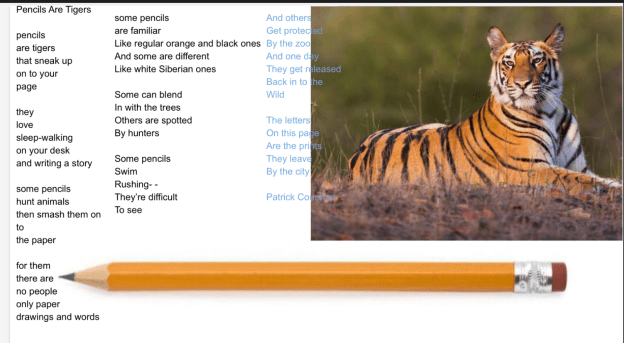
An email subscription led me to a podcast called Everything is Alivewhere inanimate objects are interviewed.  (Full disclosure, I only listened to a few minutes of one podcast–but did read the transcript linked above.)  But, this idea of the personality and alive-ness of inanimate objects got me thinking about inspiration for writing.  And, in the serendipity sort of way I often experience when thinking and writing and lesson planning, I came across an old favorite poem I have used with students called Pencils by Barbara Esbensen.  (You can read Esbensen’s poem linked above.)

I have this idea that students will pick an object that matters to them and create their own inanimate object poetry inspired by Pencils.  Should I have them write about pencils?  No…let them choose something that matters to each of them.  What would I pick? My camera, of course.  So, here’s my try:

Cameras

The rooms in a camera

are a tight fit

but forests seascapes classrooms

crowd right in


In a camera

nature’s colors riot, drawing your eye

and dim light shifts the world

to black and white


From a photographer (experienced or not)

an unexplained photo may emerge

framed by the untold story

living in the stillness, frozen in time


Every image in your camera

is ready to

dance on rays of light

ready

to focus and expose

ready to come right out

and save that moment

so that you can explore

and experience it again and again

®Douillard

Will my third graders be able to animate their inanimate objects?  I think so…and I also think that the objects will connect them to places they love and spend time at…so #writeout it is!  I’ll share the results later in the week!

Here are some of my favorite places that crowd right into the rooms in my camera!

sand art

img_2944

img_3139