Tag Archives: poetry

Pollinate the Future

I love Fridays.  There is something wonderful about a teaching day that is flexible, full, and ready for whatever learning opportunity is needed.  My plan book was blank today, but I knew just what learning would support the learners in our class today.  We didn’t squander a single minute…and left inspired and ready…for more learning, for spring break, and for our 30-day poetry challenge!

My time in the garden yesterday stayed with me today.  I was thinking about bees and the work they do.  As I wrote today (waiting for a table to be ready for us for dinner), I realized that teachers are a lot like bees.  The work we do is often perceived as unremarkable, the day in day out attending to a series of seemingly small skills that add up to fueling all of the professions in our country.  Like bees and pollination, teaching is work that matters in so many ways but seems so inconsequential in its dailiness.  As teachers, we pollinate the future, growing the innovators, the designers, the architects, the scientists, the work force of the future.  I’ve learned to appreciate bees, and I know that teachers are appreciated in many circles, but the teaching profession tends to be under appreciated and misunderstood in our larger society.  Enough from my soapbox, here’s today’s poem:

Bees

Cellophane wings

with invisible speed

buzz buzz

carry fuzzy pollinators

from bloom to bloom

buzz buzz

doing unremarkable work

that matters

to all of us

buzz buzz

pollinating the future

Douillard 2018

bees

I can feel the pollination of poetry taking hold in the classroom.  Students came in to school this morning ready to share poems they had worked on at home overnight.  Here’s a little collection to enjoy!

Trees

Tall, lanky branches

stretch out

like fireworks,

leaves explode into different colors

throughout seasons,

roots grapple to find water in the dry soil.

After getting old

the bark shreds off,

like a snake shedding its skin.

The branches that used to be fireworks

slowly snap, then fall

and break into pieces of branch and twig.

Koa

Avi's tree

The Giant

The giant soars above me

towering over the town

the giant’s arms glide against the wind

over everything in the park

the calm surrounds me

as the roots dig deeper into the ground.

silently watching everything

Photo and poem by Avi

And something playful…

siena's hula hoop

A Hula Hoop

It twirls like never before
it dances like a ballerina
it spins like a dreidel

When it falls it gets back up

Photo and poem by Siena

It’s officially spring break…I can’t wait to see how the poetry momentum sustains when we are away from school!

Garden Poetry

My students are lucky.  They spend a half an hour in our school garden every week, growing vegetables, learning about bugs, noticing what grows well and what struggles, and tasting!  I often don’t get to go out with them, but today because of a shift in my schedule due to conferences, I joined them…and turned it into an opportunity for poetry writing!

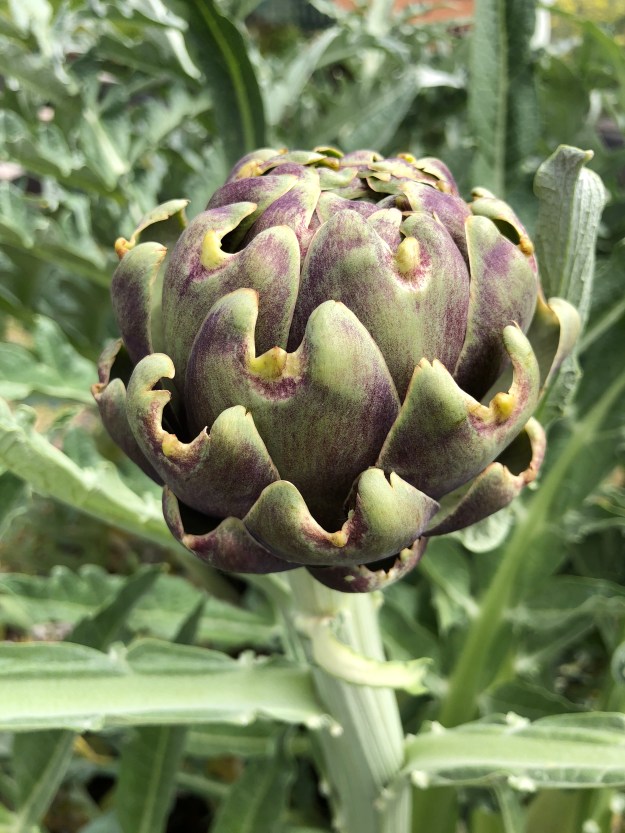
I was drawn to the artichokes, purple and green knots growing strong and tall.  When my students sat down to write, so did I.

artichoke

Artichokes

Globes

like dinosaur paws

clenched

holding a tender heart inside

tiny swords

protect that meaty center

purplish green

beckons…attracting me

and spotted ladybugs

When will they be ripe?

Douillard 2018

I know that photographs and visual images inspire my writing.  It’s true for many of my students as well.  During yesterday’s search for the ordinary, I noticed one of my students arranging jumpropes on the ground and photographing them.  And then this sometimes reluctant writer sat down to write.

Color Brain

Color strings sewing

my brain into thoughts,

ones about madness,

ones about fear,

ones about happiness,

ones about sickness,

ones about coldness,

and ones about love.

On the string of fear

the purple hides

with red,

next to blue and turquoise.

Leah

Leah's photo

How’s your poetry writing coming along?  What inspires your words and thoughts?

Ordinary Inspiration

The weather was gray and gloomy today, but that didn’t stop us from venturing out with our iPads and poetry notebooks in search of inspiration for continuing our poem-a-day challenge. Students were excited about the prospect of exploring the playground as a source of inspiration.  They had 5 minutes to explore and take one photo.  The next 7 minutes were spent drafting a poem.  After some sharing back in the classroom, they had 7 more minutes to revise.

Our school yard is filled with trees, palm trees and pine trees, and the kids love to play under them and around them.  And some were inspired to write a poem featuring a tree, like this one:

Tree

A tree that I’m looking up to

I see it in the distance

I call it my wishtree

It’s as high as the bright blue sky with big bushy leaves

Shining down to me

Calling me

Brayden

My poem for today also features a tree–the iconic palm that stands in the center of the playground.

cardiff palm

The Cardiff Palm

Tall against the thick gray blanket of clouds

that blocks the sun.

Your crown of green fans out:

a home for birds

shade on sunny summer days.

An ever-present sentinel, standing watch

over generations of school children

listening to their playful shrieks

a backrest for tired athletes

a symbol of our coastal community.

Tireless palm

standing tall.

Douillard 2018

Some kids are still refining their poems inspired by William Carlos Williams.  Here’s one inspired by the Red Wheelbarrow:

The Rocky River

So much depends

upon the river.

The fish slither through

the river.

Tadpoles turn into

frogs.

And birds fly over all!

Stone

And this one by This is Just to Say:

Easter Candy


I have stolen the Easter candy

that you hid in the cabinet


that you were probably saving

for after dinner


Forgive me

They tasted so good


The chocolate wafers

gave it away


Kalani


This is Just to Say…

Today’s poetry inspiration came from Williams’ poem of apology, This is Just to Say.  In addition to studying the original, we also read some of the poems written by 6th graders in the book also titled This is Just to Say: Poems of Apology and Forgiveness by Joyce Sidman.

Students had fun playing around with their own poems of apology.  Here’s a couple composed by the third graders in my class to give you a taste:

Dear Romeo,

I’m sorry I have to whip you sometimes

Also, I might tire you out sometimes,

but you’re always a handsome horse

lovable, huggable, gentle, and soft

Oh how I love your long mane

drifting in the sky

when we canter across the field

Love,

Tyler

I gave them a whole 7 minutes of writing time!  It’s conference week, so students are on a minimum day schedule…and time is short!

I’m sorry Kai for poking you.

Sorry, I really didn’t think it through.

Although we had fun doing it, I’m sorry Kai for poking you.

Cody

And one more student poem, this one inspired by yesterday’s Red Wheelbarrow.

The Thread


So much depends on

a brand new jacket

and a loose thread


Pulling

into bits and pieces


until it is

one loose

and wiggly line


Lauryn

I found myself returning to the topic I explore in my first two poems.  Today’s was written to that same egret I featured before–but from a slightly different angle.

This is Just to Say, My Friend


I have stalked you

my lens focused close

waiting for your head to turn

your neck to arch.


You seem so peaceful

and focused as you

stare out at the blue horizon

scanning for danger

or maybe appreciating the view.


I’m sorry for any disturbance

I cause with my close looking

and the click of the shutter.


I just can’t resist your elegant neck

and charming yellow feet!


Douillard 2018

LRG_DSC08563

Maybe, dear reader, you’ll try your own poem of apology today!

Let the Poetry Begin!

My students and I decided to take a 30-day challenge to celebrate National Poetry Month. We have committed to writing a poem each day of the month–in spite of the fact that our spring break begins when school is out on Friday!  Hopefully, a poetry-filled launch this week will keep the poetry spirit alive and well during our time off.

To add to the motivation–for myself and my students–I plan to blog my poem-a-day…and feature poems written by my students on my blog as well.

To get started, I will include my poems one and two here today.  Look for some student poems starting tomorrow–they needed time to refine their early efforts.

Yesterday’s poem was inspired by the snowy egret I watched and photographed on the beach on Friday.

snowy egret

Snowy Egret

Tuned to channel nature

where the constant whoosh and roar of waves

matches the rhythm of my heart


I scan the distant horizon

for the alabaster of my low-tide friend

As I come close

I notice the porcelain statue

with yellow feet

that unexpectedly

stomp and stir the shallows.


He’s rewarded for patience and persistence

with a briny treat.


My reward is the glimpse

of those charming yellow feet.

Today we learned about William Carlos Williams through the book, A River of Words.  After reading a bit about his life and interests, we studied The Red Wheelbarrow to pay attention to how Williams put this iconic poem together.  We then did some writing of our own under the influence of The Red Wheelbarrow.  

Here’s my version, again related to the egret I am so drawn to.

The Tidepools

So much depends

upon

a low tide

on the beach

uncovering shallow pools

filled with fish and crustaceans

nearby the snowy egret

wades and waits.

How are you celebrating National Poetry Month?

Flanerie and a Doodle

I’ve been around the edges of CLMOOC this summer, connected to the planning through Slack and google docs and twitter and Facebook, but mostly staying on the sidelines–watching makes rather than making.  I can come up with excuses, but maybe this is my summer of peripheral participation or lurking as some call it.

But in some ways, I would say I’m making on my own terms this summer.  I’ve made time for babies–joyously playing with those sweet boys who know me as grandma, rolling on the floor, scooping them up for hugs and kisses just because, reading book after book after book until I know (and I suspect they do too) all the words by heart, crooning very old songs in my off-key sort of way and relearning all the Raffi songs I have long forgotten (have you sung “Apples and Bananas” lately?).  I’ve made time for reading–sucking in words: light fiction, mysteries, kid’s novels and graphic novels…I just finished The Handmaid’s Tale (scary), I’m diving into Neil Gaiman’s American Gods and at the same time hanging out with an old favorite author Natalie Goldberg through The Great Spring (a find from a wonderful bookstore in Mendocino, CA).  And I’ve made time for walking–sometimes long aimless walks on the beach, some days of hikes deep into the redwood  forests of northern California, exploring the nooks and crannies of the amazing place I live, of course taking photos all the while.

Yesterday I just had to go to the local beach…that place most of you are familiar with if you read my blog even semi regularly.  I hadn’t been in more than two week, having been out of town exploring other parts of California.  It’s summer, our weather is hot, especially in areas away from the coast so the beach was crowded.  The parking lot was jammed as were the streets nearby.  So I cruised the nearby neighborhoods until I found a parking space, beginning my walk from there.

I walked from the crowds towards the beach space less frequented by visitors, my space, the space I feel called to explore and wander.  As I walked and wandered (using my new word flanerie), I found myself “doodling” with words in my head.  Worrying that I would forget the words at the end of my walk, I stopped and sat on a rock and typed some of the words into my phone to play around with later.

Here’s my word doodle, a poem of sorts.

She’s calling my name in cools

blues, greens, frosted white

singing tunes that synchronize with my breath and heartbeat

inviting me to soak my toes in her earthy tea with each step

Yes, she’s calling my name

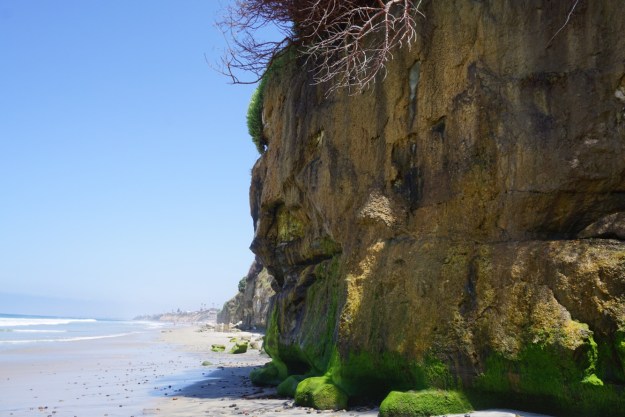
And to top it off, I found a face in the cliff.  I walk here all the time and this is the first time I have seen this face.  Maybe she was calling my name.

bde65fcd-e6e1-42f4-b1d7-11b2d165546d

#haikuforhealing

It’s so easy to break a good habit, even after it has been well established. When I started this blog, I wrote daily for months on end.  Of course, I did it because I knew if I stopped (and I was afraid to stop for even one day), I would have a hard time getting back on track.

I guess I was right.

This week, my friend and colleague Kevin posted a prompt on the NWP iAnthology, inviting some short-form writing in the form of Haiku, 3 line poems, for the purpose of healing the spirit.  #haikuforhealing is a hashtag where people are sharing these poems meant to raise spirits.  I noticed Kevin writing them in December, making posters of them with inspirational images as their backdrop.  I enjoyed them…and thought about writing some of my own.

So when the prompt came up on Saturday, I decided to try my hand at it. I started with a photo I had taken and posted on Instagram.  I imported it into Canva and added my words. My first #haikuforhealing was born.

img_4860

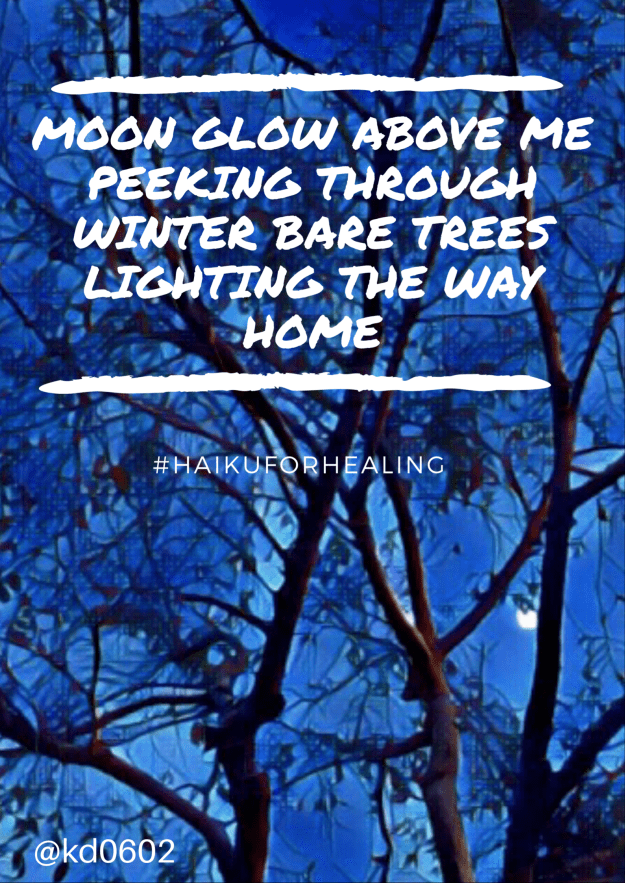
On Sunday my schedule didn’t allow for a long photo-taking walk. Instead, I snapped a shot of the moon through the trees in the Trader Joe’s parking lot.  I messed with it a bit in prisma, amping up the color. Hmmm…a Haiku about the moon?  I could do that.

img_4868

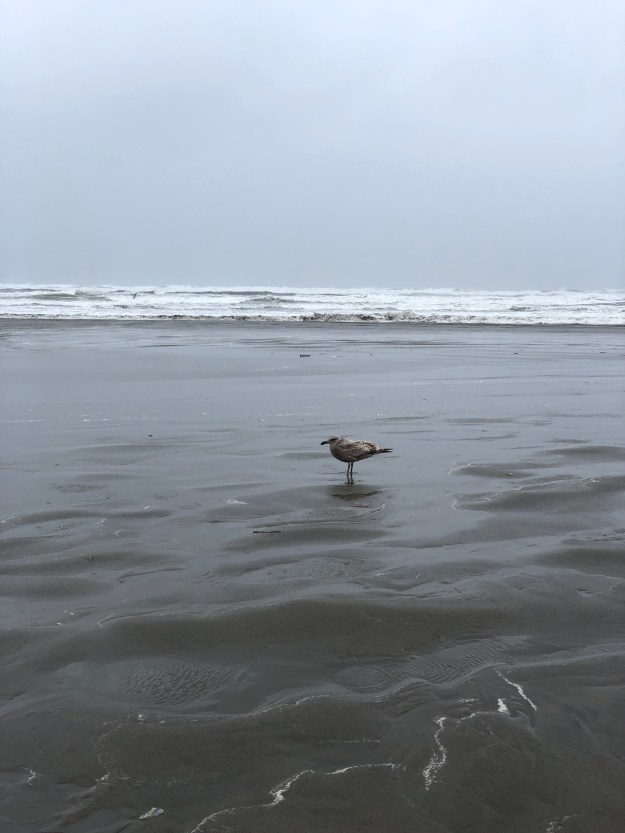
It rained quite a bit on Monday, but it had stopped by the time I left work. Knowing rain was in the forecast later in the week, I decided to take a walk on the beach on the way home.  The clouds were sitting low, hugging the horizon, as the sun tried its best to peek through.  Inspiration for another #haikuforhealing?  Why not?

img_4882

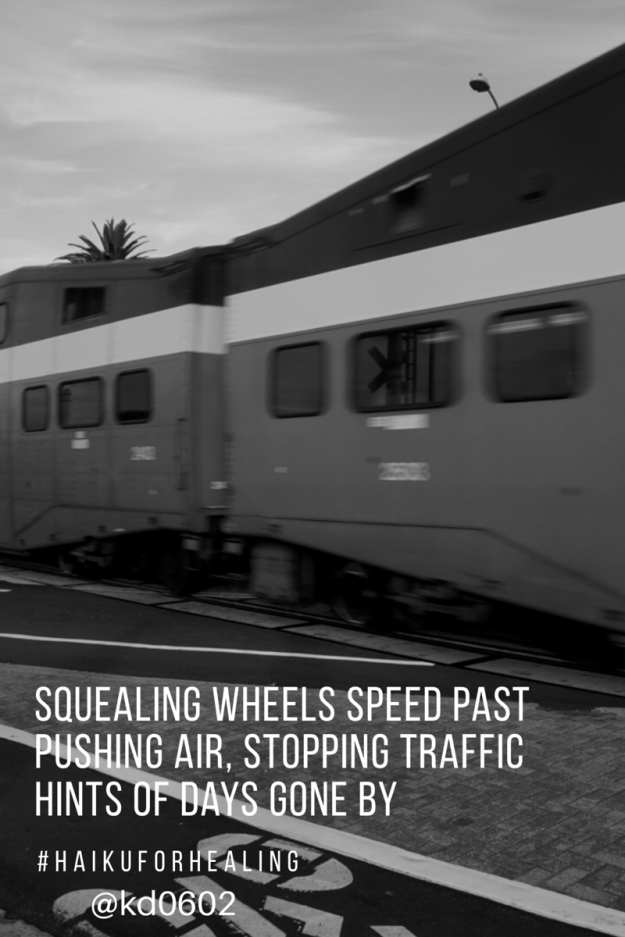
Should I go for four days in a row?  One of the things I love about living near the coast is the proximity to the trains. I hear them as I walk on the beach, I hear them as I teach, and they frequently hold me up at intersections as the guards lower, the lights flash, and the train barrels past.Today I was walking toward my car when the rail guards dropped, giving me just enough time to snap a few shots…and think about a Haiku…

img_4892

I don’t know if I have re-established a habit of daily writing, but I am four days into daily #haikuforhealing writing.  I’m enjoying it.  I like creating the poster with my photograph and words…and sharing it on Twitter (@kd062) makes me feel accountable (at least to myself).

Join in the healing, let Haiku shift your perspective and help you find inspiration, beauty, meaning…  And if you have other ideas to keep the daily writing fresh and doable, I’d love to hear about them!


The Power of Community

Our students are writers, but even a few short weeks ago many didn’t see themselves that way.  They were worried that they didn’t know how to spell, that their writing wasn’t “right,” that others knew something that they didn’t about this mysterious practice called writing.

Like we do every year, we’ve been working to build a community of learners and writers in our multiage class of first, second and third graders. And like Margaret Simon reminds us all in her #digilit post this week, that requires practice, patience, and persistence. Margaret was talking about the use of digital tools–but I would argue, it is the same with or without the digital tools.  But I want to remind us (and myself) that practice doesn’t mean drudgery.  Instead it means establishing a practice, regular opportunities to write in meaningful ways.  It means low stakes opportunities to explore the possibilities of writing, to play with words, to share your attempts with others who are also trying on and experimenting.  And it means knowing that your first attempt is not your only attempt, that writing takes time and multiple iterations that come from layering inspiration, mentor texts, and supportive instruction.

A week ago, we were inspired by the life and poetry of e.e.cummings.  (If you have not yet read the picture book biography of cummings by Matthew Burgess, Enormous Smallness–you should.  It’s quite a treat!) Burgess’s description of cummings exploring the world with “his eyes on tiptoes” made an impression on our young writers.  After studying love is a place by cummings along with a few other poems by various authors as mentors, our students set out to compose a poem about something they love.

They wrote these poems in layers–a little each day over the course of a week–and in a community of other poets (including their teachers) working to express their thinking and visions about something they care about. We read our works-in-progress, noting language we loved, noticing techniques we could borrow, and learning how to “fit” something into a page already full.  (A major impediment to revision for young students…we continually work to show our writers how to make changes without erasing or starting over!)

The resulting poems are magical…and incredibly varied.  From the one that begins, “Shall I compare winter with a magical place…” (inspired by her own knowledge of Shakespeare and her love of snow and ice) to the one that ends, “Time doesn’t exist on a boat on the ocean when fishing,” my heart swells knowing that the power of our writing community has taken hold.

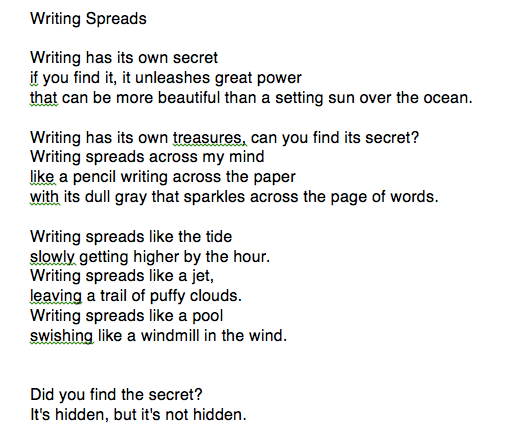
And sometimes you get the piece that feels momentous, a powerful expression from a student who previously didn’t claim writing as something he even wanted to own.  But he is feeling the magic of his words and wants to share them, giving me permission to share them with other writers and learners.  Surrounded by a community of writers and learners and inspired by the mentor text, Trouble, Fly by Susan Marie Swanson and the story, The Waterfall by Jonathan London, B knew he had something to say about writing that is worth sharing with others.
screen-shot-2016-10-23-at-1-19-28-pm

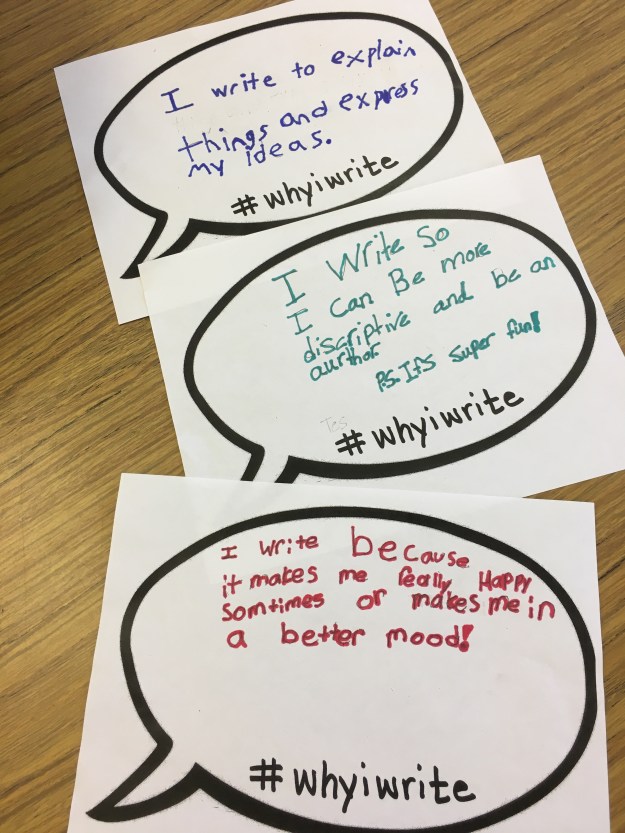
B’s effort shows the results of practice, patience, and persistence.  But this didn’t come from a single lesson.  Instead, it is the result of cumulative effort now in its third year for this student.  B expects to write for many reasons and in many ways on a regular basis. That’s what we do in our learning community.  On Thursday, the National Day on Writing, students put some of those reasons for writing in print to express #whyiwrite to the larger community of writers on Twitter.
img_3788

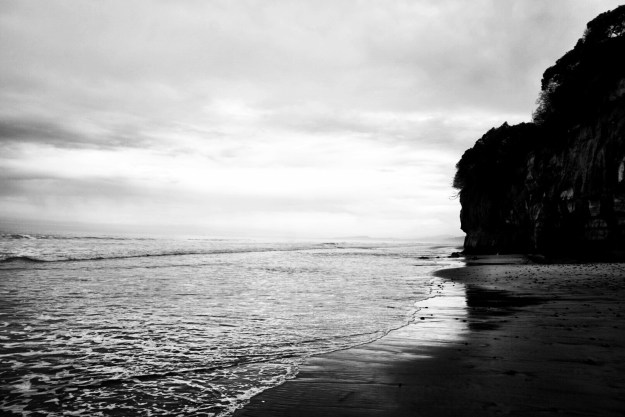
As I think about myself as a writer and as a photographer, I know that practice, patience and persistence also apply to me and my own learning. I wrote last week about writing with light through my photography.  This morning as I walked the beach in a light rain, I wanted to capture the quality of light and feeling of expanse I experienced.  As I poured over and thought about the photos I took, my mind wandered back to one of my photographic mentors, Ansel Adams.  And I found myself inspired by his words…and by his use of black and white to express nature’s powerful beauty.  I took my photo and used a filter to transform it from color to black and white, capturing the mood and expansiveness…and the quiet I was looking for.

When words become unclear, I shall focus with photographs.  When images become inadequate, I shall be content with silence.   Ansel Adams
img_3827


Poetry Play

We challenged the SDAWP SI folks to transmediate their own writing by adding sound and/or animation.  And that meant that I had to figure it out too!  I know I am most comfortable with still photographs and words, so this pushed me out of my comfort zone.  After some frustrating attempts at other applications, I turned to iMovie for my make.  I used my original photos along with a couple others had taken of our group, added a poem I wrote on yesterday’s writing marathon around the UCSD campus, and then recorded my voice.

Here’s my first attempt:

I am wishing that I had taken some video on the writing marathon to add some other texture to the piece. What suggestions would you make to improve this piece?

Doors

Sometimes it’s hard to find openings, ways to get in and get out.

Not all doors look like doors—heavy wooden slabs with handles to turn or pull to open and close. And they are not all found on traditional structures like houses and office buildings.

Sometimes the walls that hold you out are made of reeds growing along the shore,

IMG_6009

and frame your view of the world.  You are bound by your idea of wall instead of freed by the open door.

Other doors aren’t doors at all, they are signs warning you of the rules, enter at your own risk,

IMG_6036

marking boundaries of beginning and ends.

Some doors are small, requiring you to duck low, risk the muck and slime

IMG_6037

as you get a glimpse at the light on the other side.

Some doors are bridges to go over or under or through, marking sides, taking sides, allowing access to both sides.

IMG_6039

There are doors on platforms, high enough to see above the fray, watchtowers of protection,

IMG_6041

hope, and possibility.

Doors can be wide angles, opening to vistas

IMG_6042

But you have to find them, recognize them

as openings

as doors

ways in and ways out.