Tag Archives: writing

Being Intentional

Barb’s blog post about her yellow walk on Wear the Cape Tuesday takes me back to a week or so ago when I first heard of something called streetview that seems to be some version of something we are tagging in the Connected Learning MOOC as a #learning walk.  The streetview/learning walk is not really something new, it involves that ever important skill of noticing that I wrote about the other day and adds another intentional element: documenting the noticing.  The documenting described in the sreetview make was photography—convenient for me!

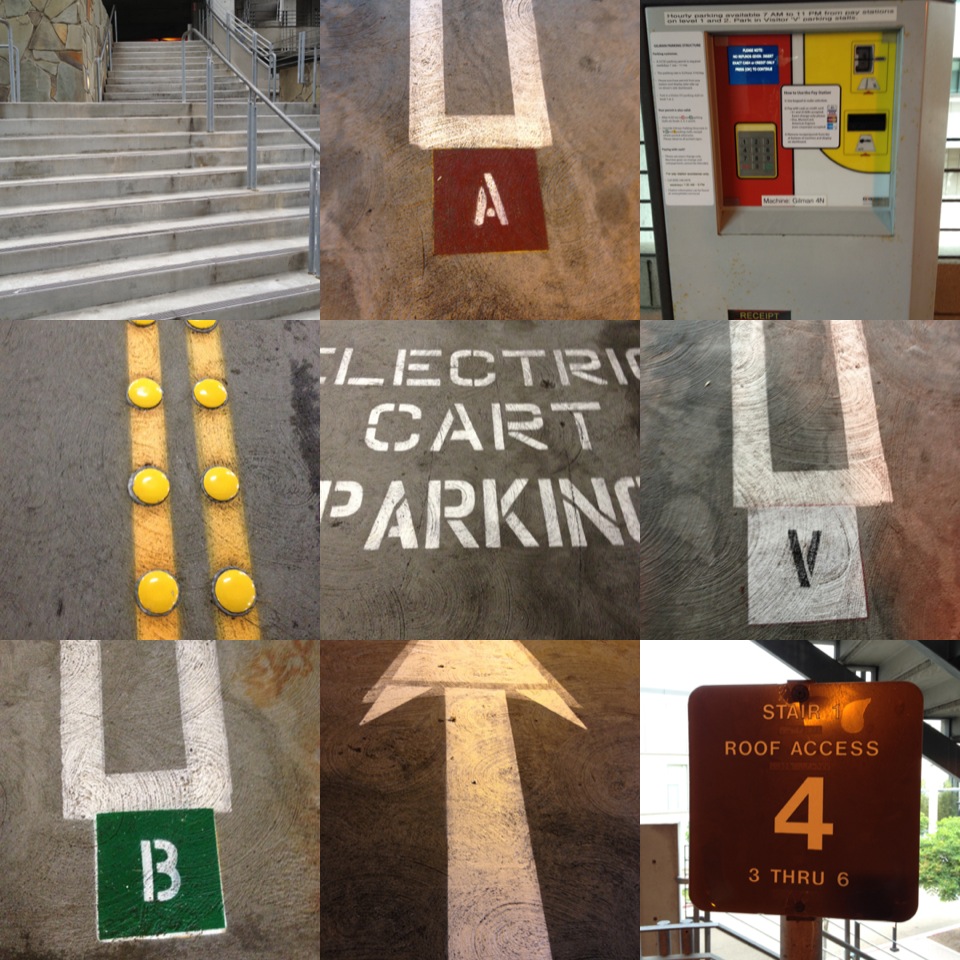
I tried my own version of a learning walk last week focused on the parking garage at UCSD.  I took some pictures, found an app that would let me put them in a collage (many collage apps seem to have a six photo limit—but I needed more), and then thought about what that composition said to me about my experience.
photo

I love that this composition takes away a lot of the cold, institutional feel of the garage and highlights the icons, textures, and angularity.  It would be interesting to capture the smells and sounds of the garage as well as the things to see–capturing more layers of the garage experience.  Mostly what occurs to me by doing this exercise is that I was more aware of interesting details, noticing things I hadn’t noticed before.  (I hadn’t been aware of the electric cart parking space–is that for the all the golf cart-like vehicles?  I’ve never seen one parked in the parking garage!)

In addition to my streetview and Barb’s yellow walk, on Wednesday Linda @hirshmiller, who is also participating in SDAWP Photo Voices photo-a-day, read a piece of writing about her increased noticing as a result of her search for yellow this week.  We were all incredulous as she described her amazement at noticing that her cat, Flounder, had yellow eyes.  And how that discovery sent her on a mission to wake the sleeping pets and peer into their eyes to see what color they are.  (For me, that would have been a small job…for her with her husband’s animal rescue mission and her kids’ aspirations toward animal-focused careers, that meant checking the eyes of 55 animals!)

These experiences are reminding me how important it is to be intentional as we move through our lives, to be open to noticing new details, and to uncovering interesting connections.  Writing does that too…when I write regularly (like I am doing now with this new blogging adventure) I pay close attention to the world around me and make connections in unexpected ways.  What have you noticed lately?

Writing, Science, and Making

On my way to UCSD yesterday morning I listened to this story on our local public radio station about a zombie horror video game inspired by a nature documentary, with commentary from a local entomologist from the San Diego Natural History Museum, Michael Wall.  I’m not much of a video game player, but I love the idea that a nature documentary and the very real behavior of parasites inspired the story of this game.  I started to think about the ways that science and writing are natural partners and the roles that curiosity and creativity play in both.

And then I started to think about the ways that curiosity and creativity often get squished in schools in the name of supporting our learners.  We’ve been reading, writing, and debating formulaic writing in the SDAWP Invitational Summer Institute this week and asking ourselves what is gained and what is lost when writers, especially young writers, are encouraged or even forced to fit their thinking and ideas into five paragraphs (or three or…) predetermined and highly structured by a formula?

I’ve heard people say that “structures” (provided by formulaic writing) free young writers from the frustration of figuring out effective organization for their ideas and their writing.  But I’m guessing that neither the writer of the nature documentary nor the video game maker used a formula to craft the stories behind their movie and game.  I wonder if they even thought they were writing (as in school writing) as they crafted the narrative structures that hold their work…or were they simply making and/or playing as they explored the ideas in their heads?  I’m also wondering if they worked with collaborators–and how that shaped their stories and their productions.  (It sounds like both making and playing to me…and fun!)

My brain is already on fast forward to the new school year as I think about how my students might be inspired to write video games and documentaries and radio podcasts like the one above and who knows what else!  I know I won’t be providing any fill-in-the-blank formulas to structure their compositions.  Instead, I will help them locate mentor texts (texts in the broadest sense of the word) to play with, examine, and study to figure out how they will construct their own.  And I will create and compose along with them.

And for those of you who think your ideas are not clever or original or good enough, take a look at this video (thanks Kristina Campea for sharing on google+ at the #clmooc).

So what inspires your writing and creating?  What structures do you depend on to move from ideas to composition?