Category Archives: teaching

The Strength of Violet

Violet always seems so gentle, so calm…like flowers budding in the spring.

The color of these mussels surprised me.  Sometimes they can look almost black…other times a deep indigo or rich blue.  But on this day, in the warm winter sun they looked violet, understating their strength and resilience.

I admire these creatures who survive in the intertidal zone.  They live part of the time under the sea, covered completely by briny ocean water.  And they live part of the time exposed to the sun and wind and birds and people, holding tightly to the rock.  They have an otherworldly look…like they belong to a time before people walked the earth…and perhaps they did.

mussels

Sometimes we miss the beauty of strength, the ability to adapt, to hold tightly and conserve resources.  Mussels, like some of our students, are stoic.  They don’t complain or call for our attention.  They aren’t showy or dramatic…they’re almost common, easy to overlook.

Who are you overlooking in the classroom?  Which of your students takes care of business without attracting your attention?  And what would happen if you were to notice?  What would you see and learn?

Playing with Shadows

Sunday’s prompt for #sdawpphotovoices had to do with shadows.  (It’s part of our exploration of photography techniques…light is this week’s focus)

And of course, Sunday was overcast most of the day.  So when the sun peeked out from behind the clouds in the later afternoon, I headed outside in search of some shadows.  The first shadow I noticed was my own.  But I’ve taken that shot before (see my post of shadow selfies).

At first it seemed hard to find interesting shadows…and then I started looking for shadows of ordinary things and I spotted this leaf near the hose…a still life with shadow!

photo-92

Further investigation led to me to the sidewalk across the street where the shadow of the tree on the sidewalk along with the shadow of the curb created a shadow tree…not a shadow of an existing tree, but a new tree.

photo-94

Further down the street I noticed that the neighbor’s basketball hoop was making a shadow on the street.  If you look closely, you can almost see the net within the square backboard.

photo-95

As I headed back through the fence to my backyard, I noticed the shadow on the fence.  I love the ways the branches intersect in the shadow.

photo_1

The sun ducked back undercover shortly after my excursion outside, but not before I caught a shadow inside, as the sun shone through the slates of the window blinds onto the floor creating an interesting repeating pattern.

photo-93

I wasn’t excited about taking a picture of a shadow, especially when the sun wasn’t shining when I was out away from home.  But once I headed out and started re-seeing my neighborhood in a playful way…on a shadow hunt…I discovered more than i imagined, and I was having fun chasing after shadows.  There were more that I didn’t include here…including a couple of accidental shadow selfies!

Over coffee with a friend this afternoon, our conversation circled around to play…and the need for teachers to be having fun and playing while they are teaching and working with students.  You know if you, as the teacher, are not having fun, then your students aren’t either. And I don’t know about you, but I always find that I learn the most when I am having fun…almost not even noticing that I am making an effort!

How do you make learning fun?  What are you playing with in the classroom? Chasing shadows seems like it might just be a metaphor for finding play in the classroom…

Ups and Downs

You’ve probably noticed that I love the beach–I take lots of photos there and it’s a wonderful place for walking.  There’s the sea breeze, the beauty of the surroundings…and it’s pretty much flat, making walking easy.

So today, we decided to take a walk away from the beach.  In fact we went to a place that we knew would have some pretty significant uphill and downhill climbs.

And while there is something to be said about staying on the flat and keeping things on a even keel, there is value in the ups and downs too.

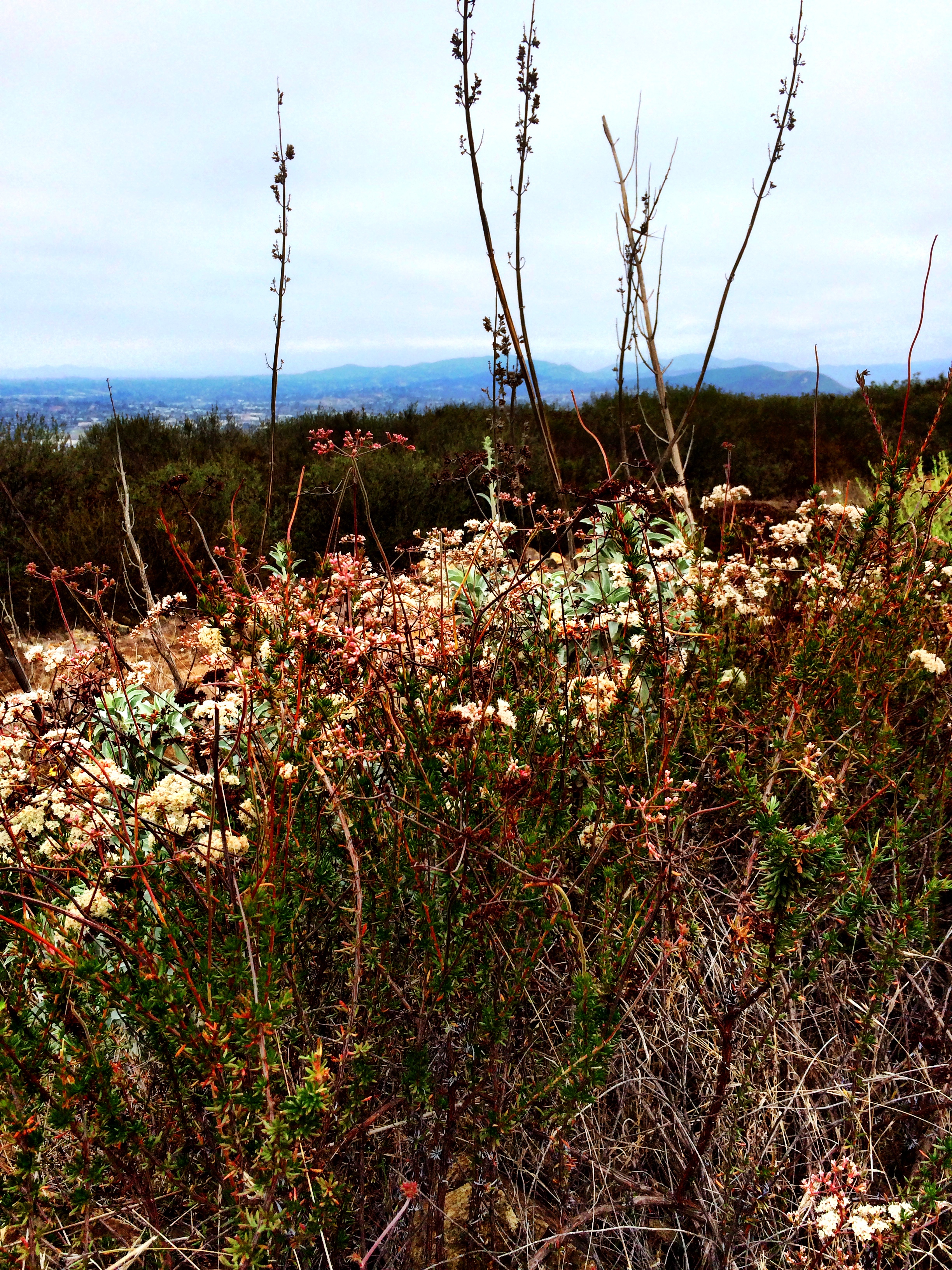
As we started up the gently slope it was easy to set a brisk pace even as I was looking around at the native plants and looking out over the vistas.  I could walk and talk and breathe.

vistas

The first part of the walk continued on a gentle incline.  We walked quickly without feeling labored and then began down a pretty steep decline.  Walking downhill does’t feel too hard…but I was remembering that I was going to have to walk back up that same slope.  And at the bottom there was a pretty steep incline in front of us.  And rather than turning around, we decided to continue up for a bit.  I could feel myself slowing down and my breathing becoming more labored as I headed upward.  And then, about halfway up I noticed a mushroom growing along the side of the trail.  Of course I had to stop, kneel low, and take a photo.

mushroom

When we turned around to head back, lots of steep uphill was in front of me.  I could feel my muscles, my heartbeat, and each and every breath I took.  And yet, I kept climbing and kept walking.  I had to give up talking for a bit…I needed my breath for the climb.  At the hardest point in the climb, the place I was ready to stop, I found myself noticing and naming the native plants.  I recognized the black sage, the lemonade berry, the alkali heath…

As the grade eased, so did my breathing and I began to enjoy the scenery again.  We could see evidence of the rain in the plants, tender green shoots and colorful blossoms decorating these often monochromatic plants.

natives

As the walk came to an end, I felt good.  The ups and downs made my body (and mind) work in some different ways than walking on the flat.  The peaks and valleys made me work harder, and I could feel myself working on both my stamina and my resolve as I walked.

There are many more steep trails that we haven’t yet tried, and in spite of the fact that I know they will feel hard, I can’t wait to head back and explore some more of them.  I have great admiration for the woman I watched run the same trail I had trudged.  I don’t aim to run that route, but I would love to improve my fitness by including more of these challenging walks in my repertoire.

I find myself thinking about ups and downs, peaks and valleys in the classroom too.  There are some climbs that leave us all winded, laboring to get to the next flat stretch.  But, like my experience today, the challenges help us build our stamina, increase our “fitness” for learning together, and remind us that even when things are hard, there are reasons to continue on.

What ups and downs do you experience?  What do they teach you about your life and learning?  I know that I will be including more ups and downs in my walking routine, but don’t worry, I’ll still make time for walks by the beach.

While We Wait

We do a lot of waiting.  In line at the coffee shop, in the lobby at the doctor’s office, to get through the TSA screening at the airport, for meetings to start, movies to start, for our kids to get home…

Sometimes I welcome the opportunity to wait.  It gives me a chance to catch my breath, check in on my email and social media, read a few pages of my book, text my sons, daydream, or just take the time to reflect on my day.  These trees remind me of that good waiting…patiently waiting in line, enjoying the sunshine and the view…

photo-64

The worst kind of waiting is when you have to stay alert and attentive.  When you’re waiting in traffic, about to board your flight, trying to be on time to that afternoon meeting and behind the person with 50 coupons in the grocery store…  At those times you can’t turn your attention to something else and take advantage of waiting as down time.

My students do a lot of waiting too.  They wait in line after recess for us to pick them up and walk back to class, they wait for directions, they wait for their classmates to take their turns ahead of them…

So I find myself thinking about good waiting and frustrating waiting…and wanting to make sure my students have time for reflection and to catch their breath.  But not spend precious time spinning their wheels when they could be doing something more productive.

Today my students were amazing.  They were about to embark on a sewing project (I’ll expand on that in another post) and needed to wait for supplies and wait for help with needle threading, knot tying…  And yet, they were not frustrated.  Instead I saw them watching carefully as they waited, making plans as they waited, and studying every move of someone nearby who started before them.

Attitude is everything.  They were ready to wait today.  They knew waiting was inevitable given the complexity and newness of the task ahead of us…and they waited with joy and anticipation.  This is going to be a great project…my students demonstrated that today!

Documenting Growth

The garden metaphor is pretty common in education–you know, planting seeds and watching them germinate, grow, and eventually bloom.  And as a teacher who keeps her students for three years, I really do get to plant some of those seeds, watch them germinate, grow…and bloom–sometimes a year or two after they are planted.

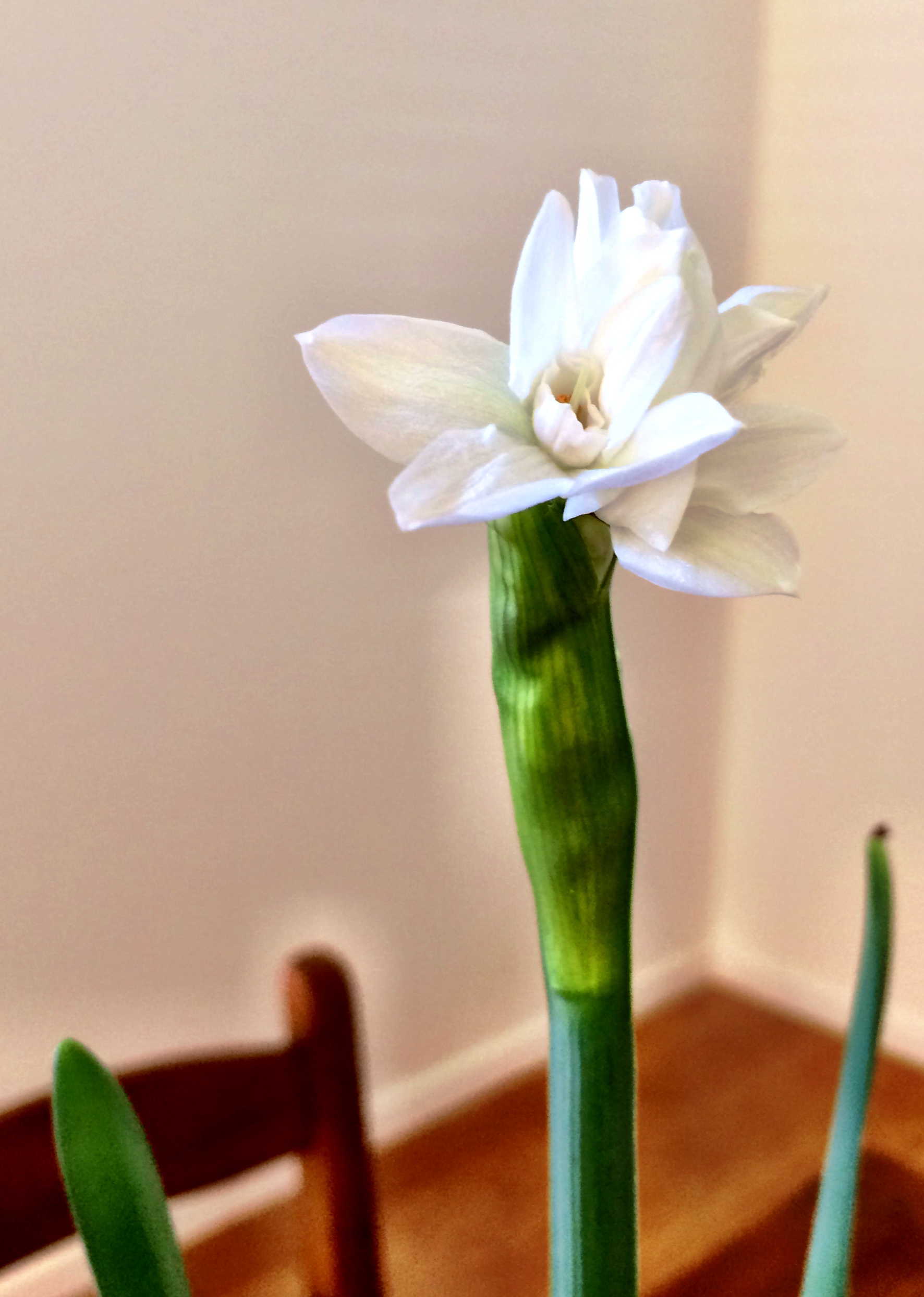
One of the families in our class gave each of us a mason jar planted with a narcissus paperwhite bulb for Christmas with a note on the lid telling us to be sure to take the top off and water.  And since taking that top off three weeks ago, I’ve been watching that bulb.  It began by stretching roots down, filling the jar with stringy white texture.  And then green shoots began to emerge, quickly growing tall above the rim of the jar.

Earlier this week those tall shoots got taller than they had the strength to hold onto and bent over, startling me as I looked up and found the shoots looking down at me.  My handy husband found some old chopsticks and propped the shoots back upright.

Close examination over the last week revealed buds, and I checked daily to see if they were ready to open.  And today when I got home from my morning San Diego Area Writing Project Leadership Group meeting, I found that the blossom had opened.  And of course I had to get my camera out and take some photos to document the growth and capture the beauty.

photo-54

I’m loving this still life, an unedited photo taken with my iPhone.  If you look closely you can see the blossom at the top and the one to the left that is getting ready to bloom.  (You can even see the chopstick props if you really look closely!)

Of course I also wanted to lean in and capture the detail with my macro lens.  The detail of the blossom is revealed by the magnification of the lens.  This is another unedited photo.

photo-55

And sometimes it’s nice to get a different view.  In this shot I used the regular iPhone lens and then brought the image into Camera+ to crop and enhance. I like the effect and how it emphasizes how the shoot changes as it gets close to the blossom.

photo-53

I’ve enjoyed documenting the growth of this bulb through my photography.  It also has me thinking about how we document our students’ growth…and how they keep track of their own growth.  We keep samples of students’ work and have them reflect on their own learning, encouraging them to notice, stretch, and build on what they have learned.

My photographs document my growth as a photographer.  I can see how my composition has improved and as I examine my photos I make plans to try new techniques.  I seek out mentors on other blogs and on other internet sites.

We plan to start our students blogging next week.  We began blogging last year…figuring out how this might work with young students as we worked through each step of the way.  We’ve let the blogs idle as we established our classroom community and let our first graders develop some fluency and confidence with writing.

As we get ready to restart our blogging, I want to think about student blogs as documentation of learning…as portfolios of growth over time. And I want to capture snapshots of their growth like I have with the paperwhites, documenting their progress and their process over time.  Maybe the blogs will be like my camera lens…

Making Time for Making

We’ve been doing a lot of making in our classroom this past week and a half.  Snowflakes, poinsettias, Hopscotch projects…  It’s not that we don’t make at other times, but it seems that we have really gotten in the flow of making lately.

I love it when we can give ourselves and our students the time to plan, design, improve, and finalize a project.  Our snowflakes were just such a project.  Math and science, reading and writing, along with problem solving and some systems thinking all came together to create animal shaped snowflakes that will be accompanied by original snowflake poems later this week.

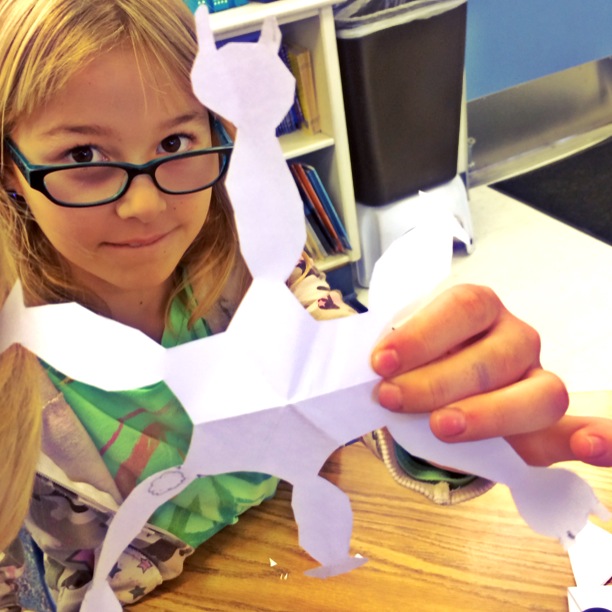
I wrote about the start of the project here and the value of tenacity and iteration for students.  Our students had at least four opportunities to create their snowflake designs–with time to study their own and others’ attempts in between.  And yesterday, all of our students successfully created an animal-shaped snowflake of their own design.  (We did not provide templates, although we did help the few students who needed some additional scaffolding.)

Here are a few examples…and remember these students are 6, 7, and 8 years old!

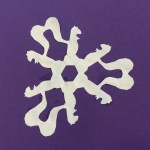
If you look closely you will notice a moose, a giraffe, a squirrel, and a lizard in these four designs.

Students also created winter scenes using computer programming yesterday.  You can read about it here.  And then today, in addition to writing about snowflakes, we began assembling the poinsettias we are making from the paper we painted on Monday.

They still need their finishing touches…but already are beautiful!  And students have learned a lot about poinsettias and a bit about their history.  (The Ecke family, locals from our area, established themselves as primary producers of poinsettias around  the world!)

But what I love best about this making is the productivity and collaboration from our students.  They love making…and once they get past the fear of failure, are willing to take risks and try new ideas to improve their products.  And we see evidence of students taking these ideas home and trying them out there.

One of our students came in this morning with a huge snowflake…a good three feet across…that she made at home.  She had talked her mom into a trip to Michaels to get the big paper that she designed (a butterfly), cut and decorated…and then brought to school so we could see what she had done.

I know there are people who might call these activities “fluff” and complain that this isn’t real learning.  For those people, I wish they could see the energy and enthusiasm, the collaboration and problem solving…and all the reading, writing, math, science and history that are learned in the process of the making.

Have you made time for making lately?

Opportunities to Iterate

My teaching partner and I have been working with our students on coding this year (see here and here and here).  We’ve figured out how to make coding a regular part of our week…and our students are having success with planning, creating, and debugging.  We’re planning a “winter scene” challenge for next week to celebrate the Hour of Code…more about that next week.

Related to this coding effort is our goal of helping students to cultivate “grit” and to see mistakes as learning opportunities.  (See It’s the Little Things for more on grit.)

So this week in addition to our digital work as programmers, we have given students a design challenge…making snowflakes.

These southern CA kids have limited experience with snow (as do I), but learning about snowflakes is fascinating.  We started by reading Snowflake Bentley about Wilson Bentley–a man obsessed with photographing snowflakes using a camera attached to a microscope (back before the technology was very developed).  He showed a tremendous amount of tenacity and grit in his efforts…and finally published his book of snowflake photos when he was 66 years old.

We knew that creating hexagonal snowflakes (by cutting paper) would be challenging for our students, but we decided that this purposeful opportunity to iterate…study mistakes and learn from them for their next attempt, would be a perfect platform for helping to build grit and tenacity.

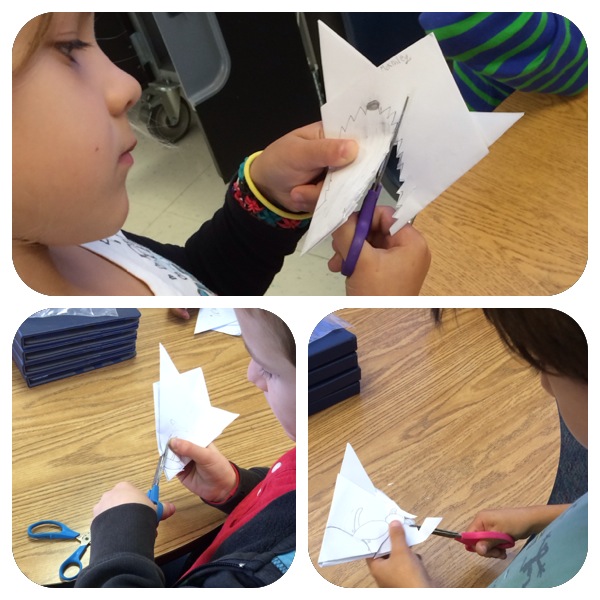
And then to add to the challenge, inspired by Zoo Flakes ABC, our students are creating hexagonal snowflakes in the shape of animals.  Yesterday they learned to fold and began drawing their animal to cut.  Today they tried out their design by cutting out their animal. There were many failures–unconnected pieces that looked nothing like animals or snowflakes, whiny “this is hard” comments, and requests for help cutting (we deferred, reminding  them it was a perfect opportunity for practice).  There were some semi-successes with 6 intact “arms” of something like an animal shape.  And there was lots of concentration and studying of the results.

photo

photo-2

We studied our successes and failures…and then looked at some more “expert” attempts online.  We considered ways to improve even those attempts that were “successful” (in the sense that a snowflake-like shape resulted).  And students are ready to try again tomorrow.

But best of all there were no tears and everyone gave it a try today.  Our students were focused on their design and their cutting…and desperately want their snowflakes to work out.

photo-3

We’re excited about this project…and all that our students will gain from these iterative efforts.  I’ll let you know more as we progress through this project!

What do you do to help your students study their mistakes and try again?

A Change in the Weather

The weather in San Diego is regular…regularly mild and as the weather reporters on the nightly news say, “Night and morning low clouds, with afternoon sunshine.”  Or something to that effect.

So when our weather changes, it is an event.

Today started out cool and overcast.  One of my first graders told me how freezing it was as we walked to the classroom this morning.  She was dressed in a short sleeved t-shirt, jeans, flats without socks, and a faux-fur lined vest.  In contrast, I was wearing a cotton sweater with a corduroy jacket and a windbreaker-like jacket over the top of that and a knit scarf around my neck…along with my slacks, short boots and socks.  I’ve learned over the years to layer since mornings are cool and the day usually warms up.

When I left my school at midday to head off to the university for the other part of my job, I carried my jacket and scarf…but knew I would bring them inside with me when I arrived.

And I’m so glad I did!  By the time I left the university it was raining!  I pulled the hood up on my jacket and tried to figure out how to capture a photo of the rain.  (It continues to look invisible through my camera lens).  Students walking across campus had their sweatshirt hoods up…but there were no umbrellas in sight!

As I got into my car I was hoping that I was ahead of the rush hour traffic.  Remember, the slightest moisture in San Diego brings out the crazy in drivers.

The rain had diminished before I got very far down the road…but as I got closer to home the clouds were mesmerizing.  Big, white clouds were layered with gray clouds that looked like the stuffing from grandma’s quilt.  As I drove, I was thinking about where I could get off the road to try to capture the beauty of the clouds.  (And it is not okay to stop on the freeway!)

I pulled off near my school, watching the streaks of sun shining through the clouds along the coast.  I drove to a spot I see most mornings where tall thin palm trees stand like sentinels overlooking the sea.

photo

And I captured this view looking out to the ocean where the sun was getting ready to set on this short December day.

Change in the weather also means a change in the view…and it was spectacular this evening!  I like the way that change brings a new energy with it.  I can see it in my students when we change up the routines or like today, embark on a new topic of study.

As I look for new photo opportunities, I appreciate change even more than ever.  A fresh view, a new angle, a different frame, a change in the light…they all offer opportunities for photographic magic.  Just like change in the classroom creates new spaces for learning magic…and routines serve as anchors when the seas get rough.

I love the regularity of our weather here…and I love when it changes.  And I still need to learn how to capture a photo of rain…  Now to wait for another one of those rare occasions…

It’s the Little Things

Yesterday I dug out my macro lens and started playing with it again.  It’s one of those things that I love, but I have to stop what I’m doing, take the cover off my phone, unscrew the macro lens from the wide angle, attach it and then lean in to photograph my subject.  Using the macro means coming close, taking time to steady myself and my breathing, and holding still for the perfect shot.  It’s easy to get the focus wrong and come away with a blurry shot.

And in spite of all of that, I love the vantage the macro lens offers.  I get to see small things in new ways.  Things that are easily overlooked suddenly come into focus, creating a stunning new way of understanding the subject.

photo

A familiar TED talk also crossed my Twitter feed this morning.  Angela Duckworth talking about her research about what makes students successful…was it intelligence or something she calls grit?  She found in case after case, holding all other variables steady, that grit made the difference.

This 6 minute video is well worth your time.  But it’s also important to think about not just students and how hard they work, but also how teachers view persistence and effort.  A growth mindset, as described by Carol Dweck, means that errors are seen as part of the learning process.  Mistakes are an opportunity for learning, not an indicator of lack of effort or lack of intelligence.

So back to the macro lens and the little things.  With the help of the macro lens I can appreciate the beauty of things I hadn’t paid much attention to before, like this half blown dandelion in my yard.

photo-2

And with a growth mindset I can also appreciate the little things about my students as I notice how they approach a math problem or understand a science concept or even where their struggles are with decoding.  Instead of seeing what they can’t do, I pay attention to the beauty of what they do know and help them use their strengths as tools to make progress where things seem hard.

photo-3

Like these tiny, ethereal dandelion seeds, learners can take the seeds of understanding from one subject and plant them in others.  And as teachers paying close attention, we can help our students identify their strengths and repurpose them in other situations.

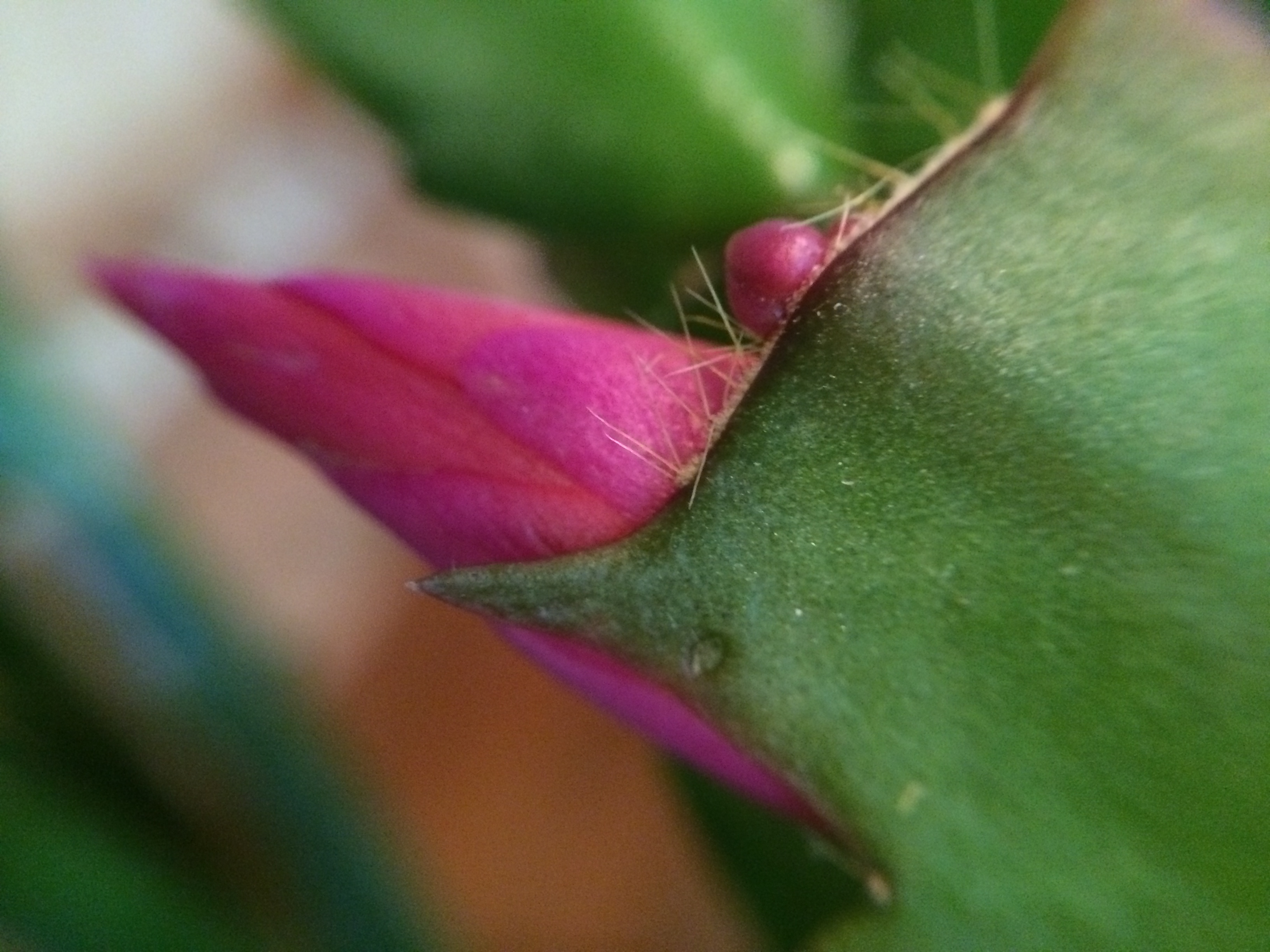
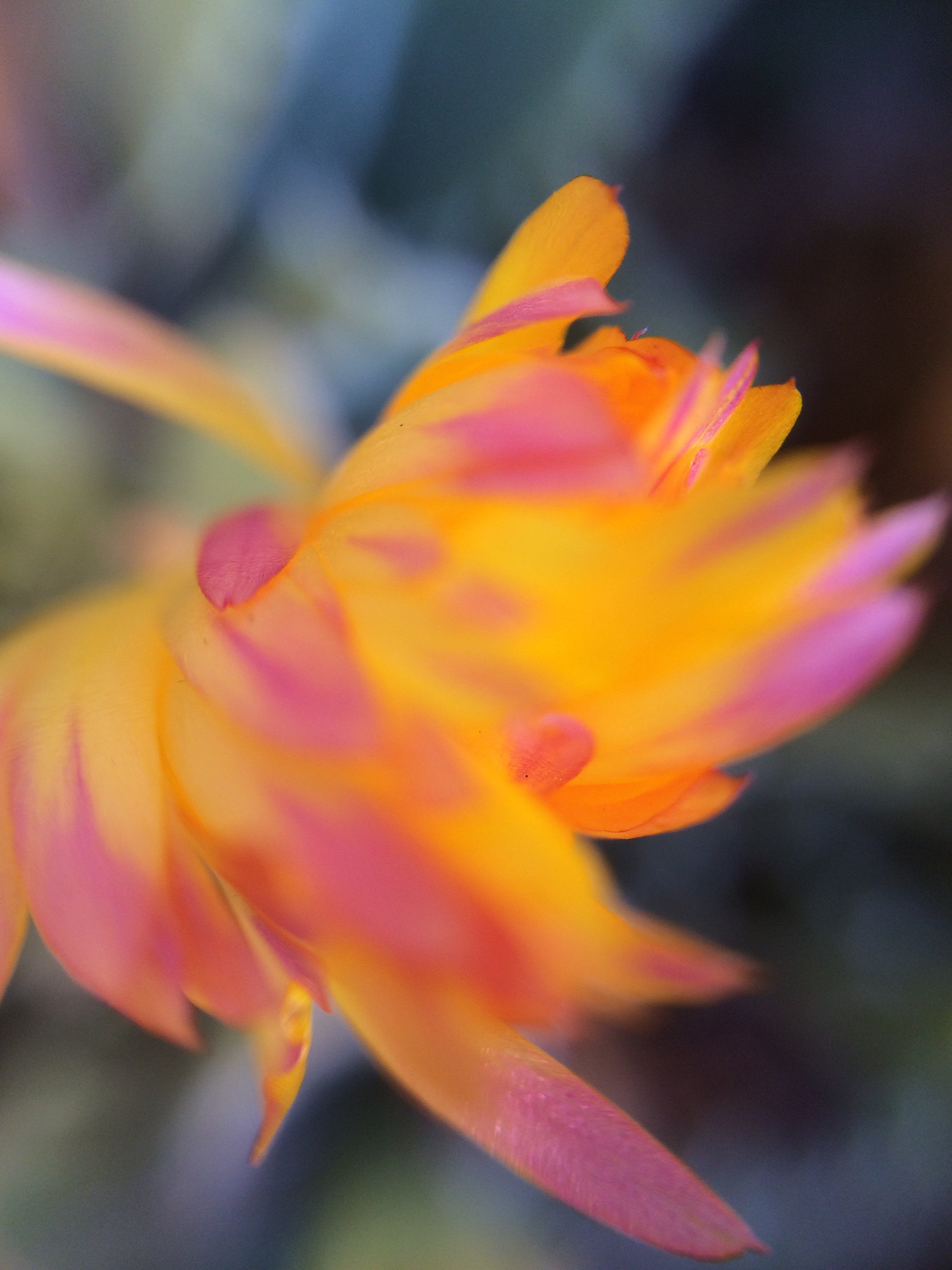
When I went outside this morning the cactus flower blossom in the pot near my front door was closed…looking droopy and like it might be ready to fall off.  But since I was playing with my macro lens, I leaned in and got close…and captured this.

photo-4

Without the lens, my eyes did not capture the beauty and colors that my camera could see (all of these photos are unedited originals).  I noticed later in the day when the sun had reached the door that the blooms opened, yellow and vibrant.

I’m glad that I took some time with my macro lens today…and with Angela Duckworth’s TED talk.  Tomorrow I return to my classroom after a week away for the Thanksgiving holiday. And I’ll be looking closely and leaning in to notice all that my students bring to the learning…even when it seems hard…to appreciate their strengths and re-view their mistakes. We’ll be developing our grit…together.

Systems Thinking

In addition to learning about circuits in the Hacking Your Notebook session, that I described here, at the NWP Annual Meeting in Boston, I also had the opportunity to participate in a three-hour workshop about e-textiles where we made puppets.  This session also involved the basics of circuitry and using a small battery to light up LEDs.

But Melissa and Kylie framed their session in the theory of systems thinking, which has continued to occupy my mind and thoughts ever since I left the session.  They talked about the ways we often simplify explanations in our society by turning to a binary cause and effect model.  Here’s an example of the cause and effect model: if we elect a new president, then the economy will turn around.  Actually, there are many other factors that impact the end result…and in fact, who is president may not even be the most important factor.

Our educational system (and our government) seems to spend a lot of time in the simple cause and effect model, rather than helping our students think more deeply about systems and the ways there are multiple factors, interconnections, and possibilities at work in the outcomes we see.  So the making of puppets in this workshop was about more than learning how circuits work or developing language and writing related to the puppet, it was also a way to think about systems and the problem solving and iteration that it takes to understand and make changes to the overall system.

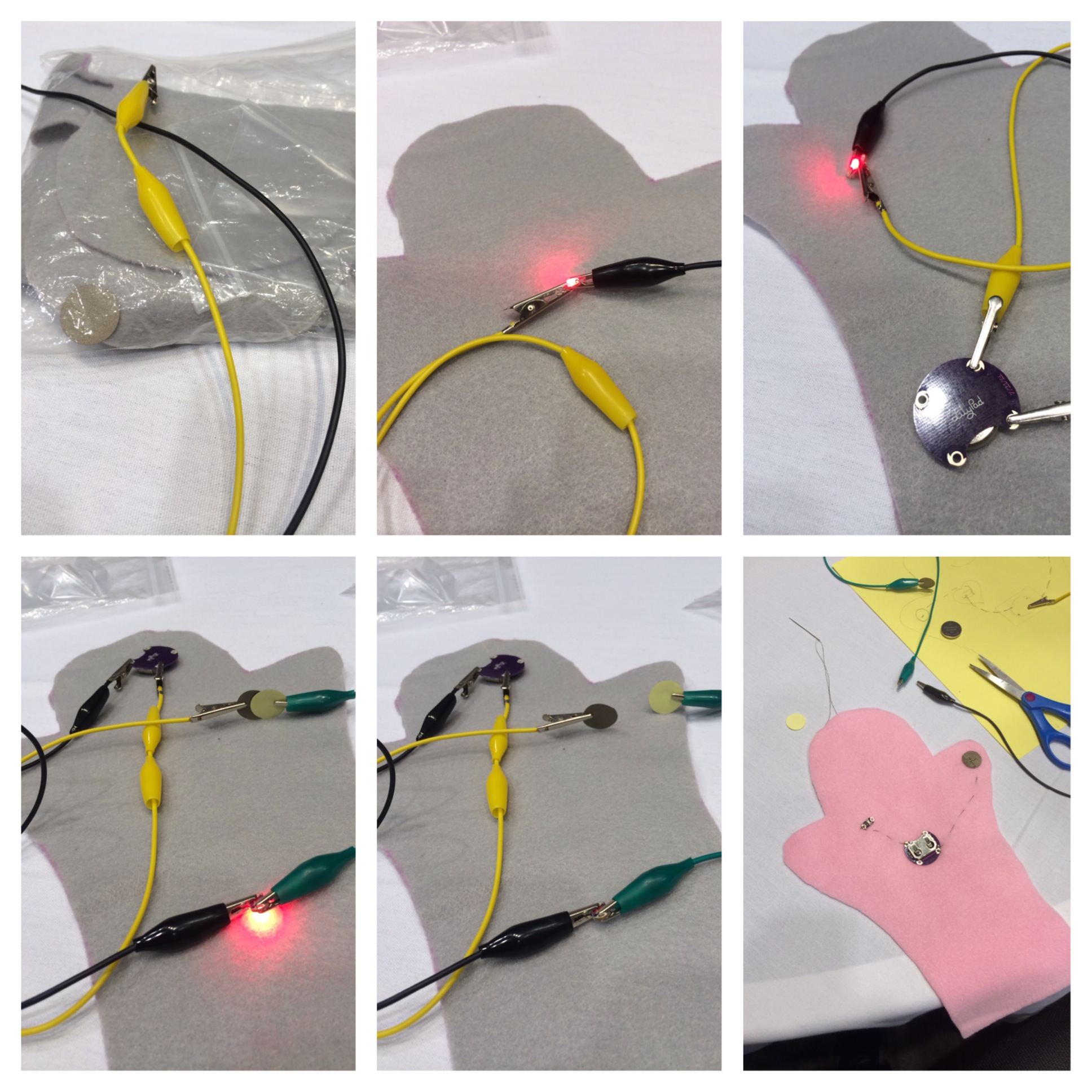
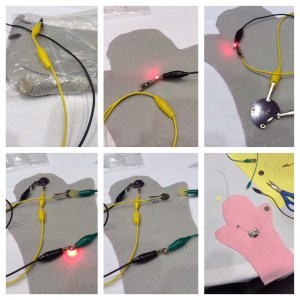
So…with systems in mind, we proceeded to explore circuits with a watch battery, LED lights, and wired alligator clips.  Because of my work with circuits the day before, this part was super easy!  And then they asked us to explore how a switch would work.  It didn’t take much to figure out how to touch the switches to each to open and close the circuit, lighting the LED, and then separating them to turn off the light.

Our goal was to make a puppet that had a light (or two) that would light when you turn on the switch (or make a connection that closes the circuit and turns on the light).  We had two pieces of felt cut out in a puppet pattern, a battery holder, a LED light, and two switches (small pieces of conductive material) along with a host of buttons, ribbons, fabric, yarn, and other materials to use to decorate the puppet.

We began by making a plan.  Tracing our puppet on paper, we drew a diagram of where we would sew our battery holder, LED light(s), and switches, labeling the +/- poles and drawing in the stitches we would sew in with conductive thread.  Having our model in front of us to plan was a perfect step.  We could test and physically trace how the connections should flow as we drew the diagram.

Like in yesterday’s post, there were trickier plans I could have tried, but I opted for a simple plan that I knew I could complete in the time allotted.  And then I got to work.
photo

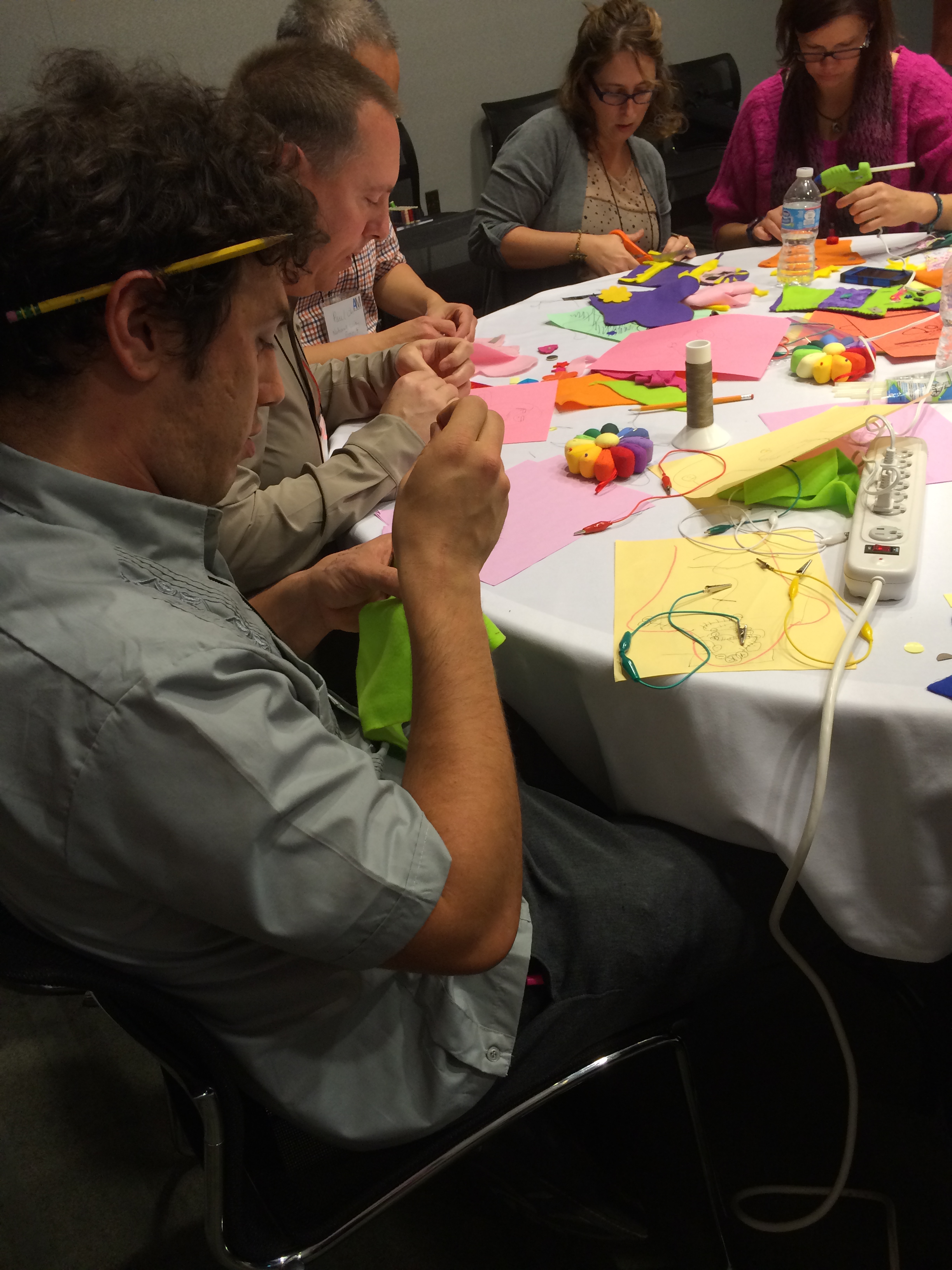
As people worked through their plans and settled into sewing their circuit the room hushed and you could see the intensity of engagement.
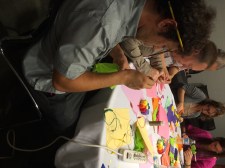
photo-4

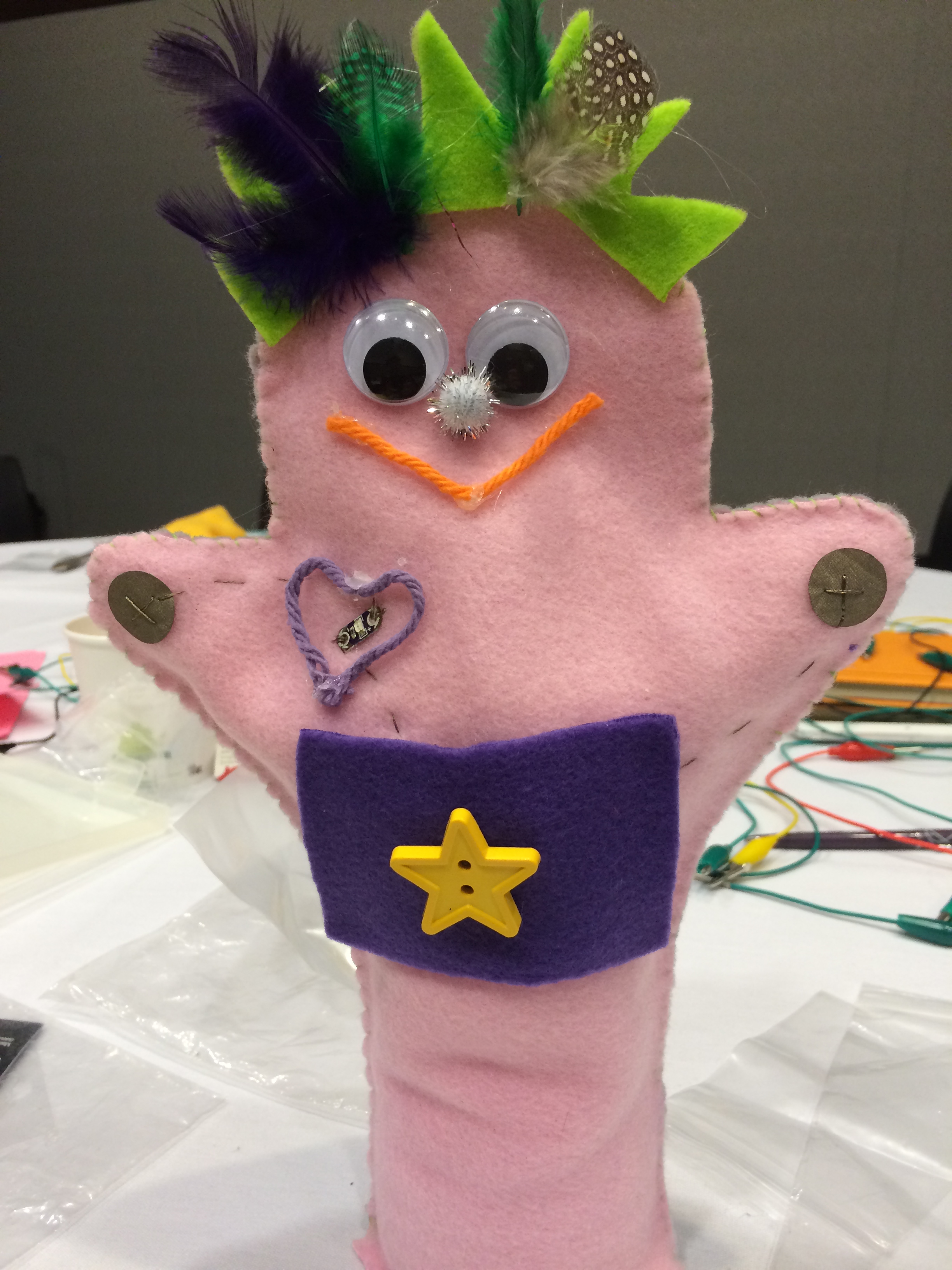
For some the sewing was the hardest part, for others it was working through the circuitry, and for others it was totally about creating the puppet character they had in mind.  Here’s my end result…his heart lights up when his hands touch.
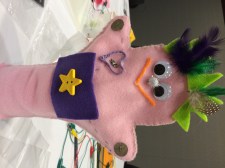
photo-3

There are definitely some things I would do differently the next time I make a puppet.  I learned after I had sewn my circuit in that putting the hands together covered the light…you can see a glow, but it isn’t the effect I had in my head.  Other people were working on pirates and butterflies, some with eyes that lit, some with noses that lit.

And my takeaway has much more to do with systems thinking than it has to do with circuits. I find that I have a better grasp of how to explain some of the approaches I use in my classroom.  Like why design is so important to student learning, why mistakes are valuable to learning…if you take the time to work through what you did and figure out a better outcome, and why students need space to create their own plans and work through the spaces where things are not working the way they intend.

It also has me thinking about other learning opportunities.  I learned to sew as a child, and making clothes and other project definitely involves some systems thinking.  You have to think fabric, including weight, texture, stretch…  Even using a pattern, you have to think about how to lay out the pattern to make best use of the fabric, work with the grain, match the design if the fabric has one…

I’m worried when we make things in the classroom too “neat” that we are working harder and learning more than our students.  That’s one of the things I love best (and hate the most) about teaching writing.  When it’s at its best, it’s messy.  I can have an overall plan in mind for the outcome, but my students benefit from getting “just right” instruction along the way.  And not all my students need the same instruction…and some benefit from learning by watching and listening to their classmates.

After all, the classroom is another system.  When you tweak one aspect, there are many working parts that are impacted.  As an educator it’s important to problem solve and iterate.  It is impossible to make a year-long (or even week-long) plan that won’t change if you are really paying attention to the needs of your students.  We can help break things down for our students, but they also need to figure out how to examine the pieces of a system for themselves in order to understand how the parts interact with the whole.  After all, our students today will be the leaders of tomorrow!

What do you do in the classroom to help your students understand and work through the complexities of systems?