Imagine my surprise this morning when the post by Ethical ELA was hosted by friend and colleague Emily Yamasaki! I was immediately drawn into both the mentor poem, things I have memorized by Maria Giesbrecht and Emily’s poem, Things I Know. I dove deeply into the cool pool of poems that emerged from Emily’s provocation, reading and feeling, admiring and analyzing as I began to think about my own writing for this second day of National Poetry Month.
Things I Know by Heart
The sleek curve of the egret’s neck
in the tidepool at low tide
The smells of love that fill our home
emanating from the kitchen
The silence of his last breath
matching the empty space in our family
My daily commute, etched in the recesses of my mind,
requiring no conscious thought
My childhood phone number
but not my passwords–they continue to elude me
The sweetness of little boys
now into the second generation
Fear of fire, seared into my memory
brought back by ashes that rain down like snowflakes
Fog’s gray blanket
an indicator that spring has arrived
Each of the traffic spots on the 5 between our house and theirs
no matter how long it takes, every trip is worth it
It’s April! And it’s the first day of National Poetry Month. I don’t profess to be a great poet–but I am able to share my love of words and poetry with my students–especially when I do the things I ask them to do.
So even though this is not a teaching day for me and even though Spring Break begins tomorrow and I won’t see my students until April 11th, I will write a poem each day. I know that I will be better able to coach and guide them if I am doing the poetry writing I want them to try.
I plan to use Eve Merriam’s Peeling an Orange with them when we get back to school after Spring Break, so why not experiment with it as a mentor text today? One of the techniques I notice in this poem is her use of the contrasting words carelessly and meticulously. So, since photos tend to inspire my writing, I took a peek through my camera roll and spotted this one of a snail from a neighborhood walk earlier this week. And here is the poem it inspired:
As March comes to an end, National Poetry Month is right around the corner. To get a bit of a head start–especially since we begin our Spring Break next week–I decided we needed to immerse ourselves in some poetry this week.
Poetry is nothing new in our class. We study a poem each week and then illustrate it, creating an anthology of poems we’ve worked with during the school year. We’ve written some poems of our own here and there. But the time is right for a deeper dive.
Daniel Finds a Poem by Micha Archer is a perfect book to get started. The first graders loved that the poem Daniel wrote was a compilation of the answers from all the animals that answered Daniel’s question, “What is poetry?” And it set the perfect stage for our own Poetry Is… brainstorm. After a start yesterday, we took this idea further today, stretching out ideas and embellishing them with vivid description. Here’s a few examples:
Poetry is a glass of warm hot chocolate on a cold, snowy winter day.
Poetry is a grasshopper jumping and hopping and bouncing all around the fields.
Poetry is a coconut with the flavor inside and the outside is so hard and thick like a layer of armor.
Poetry is a slippery fish, as beautiful as a butterfly.
Poetry is the sound of my dad snoring.
And somehow, in my mind, poetry and flowers are a perfect pairing. I had purchased some tulips and daffodils from Trader Joes over the weekend, knowing I wanted students to have a close up look at these symbols of spring (that are not commonly found growing around here). Yesterday students used a black oil pastel on watercolor paper to do a directed drawing of tulips in a vase. Today, we used liquid watercolor to create vibrant paintings of these beautiful spring flowers. The results are stunning!
Watercolor paintings drying on the classroom floor.
I plan to matte them along with the “Poetry Is…” writing. And I think I may have each student contribute one line to create a class Poetry Is poem for a poster to hang on our door! After all, National Poetry Month is right around the corner!
With the school year coming to a close, I wanted to come up with an activity for students that felt like play–like a party–and still provide academic content to satisfy my ever-present need to make use of all available instructional minutes. (Yes, even in the last week of school)
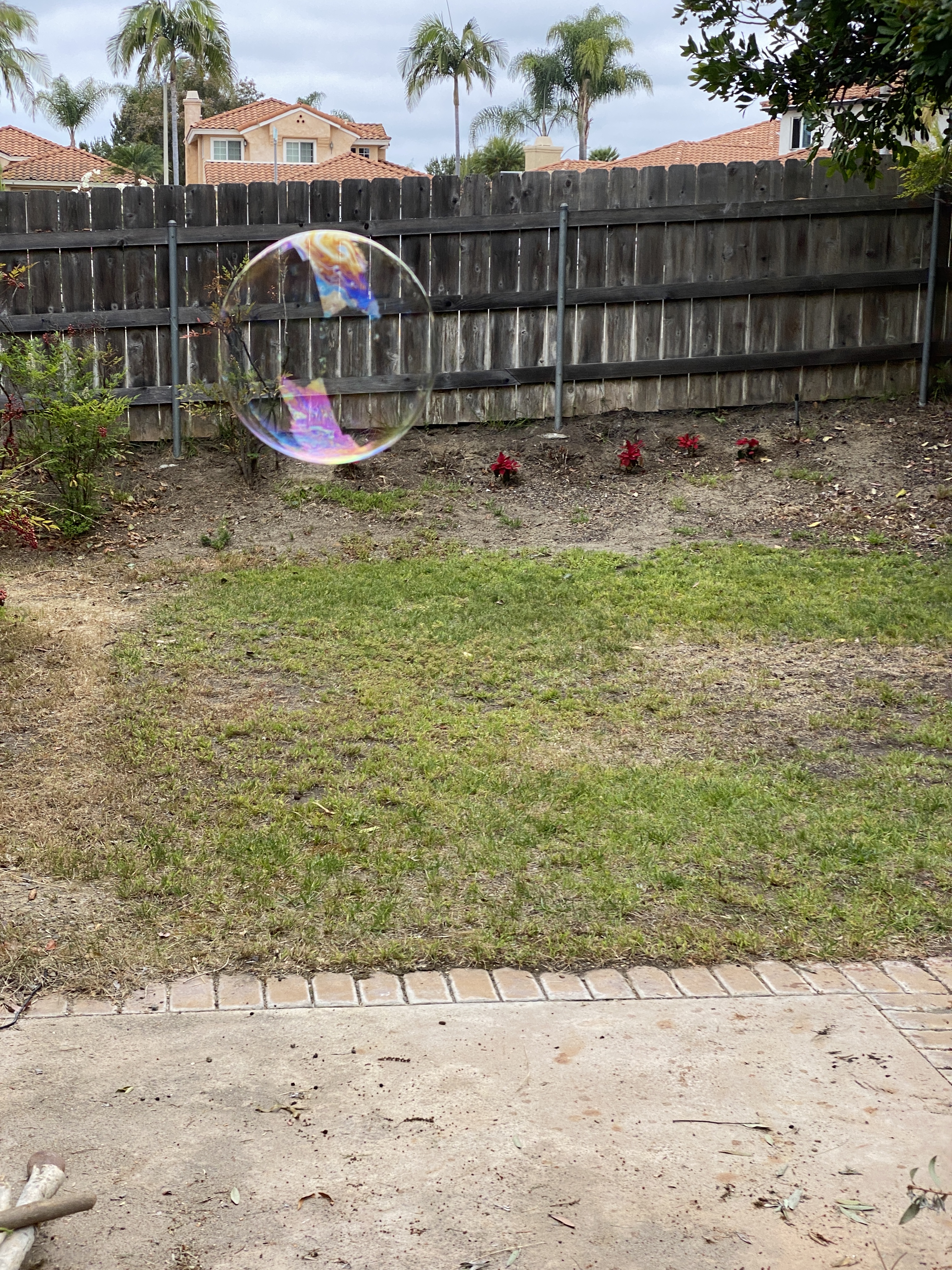
So, when I came across a blog post about making giant bubbles and bubble art, I knew I could turn this into a meaningful day of learning and fun…all wrapped up in a soapy bubble! I’m pretty fascinated by bubbles. I’ve spent quite a bit of time photographing giant bubbles at the beach and I’ve written about the “bubble man” a time or two (or more). I know that the trick to great bubbles is the solution–so prior to having my students explore and experiment, my husband and I tried our hand at bubbles over the weekend.
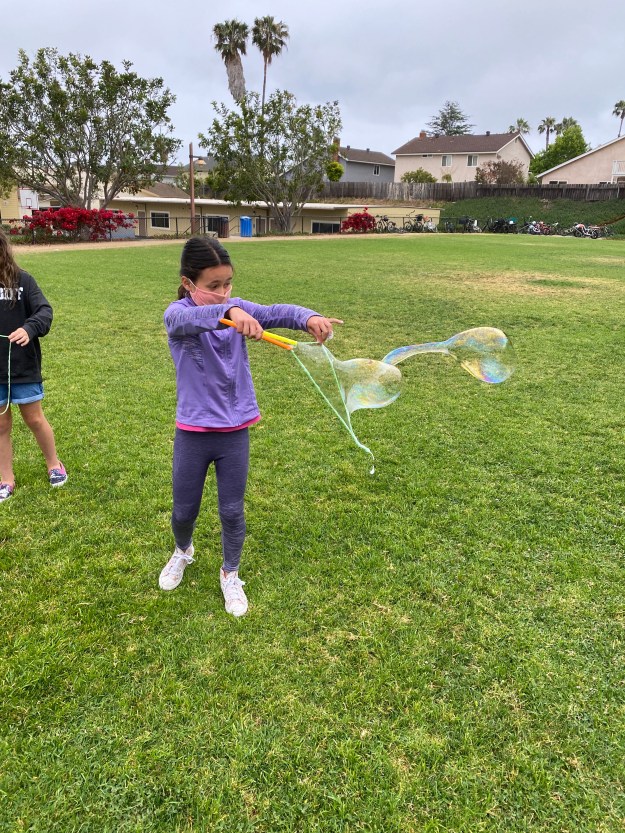
The basis of all bubbles is soap and water. But if you want the bubbles to be big and to have a bit of staying power, a bit of corn syrup and some glycerin need to be added to the mix. Using smoothie straws and yarn, I created a bubble wand that my students would be able to make on their own and started dipping and waving in my own attempt to create bubbles. This bubble thing is harder than it looks! I didn’t immediately get big beautiful bubbles flying from the wand. But with some patience, some tinkering, and some exploration of how to get a thin film filling with air onto my yarn…bubbles happened. At that point, with bubble solution pre-made, I was ready for a day of bubbles with third graders!
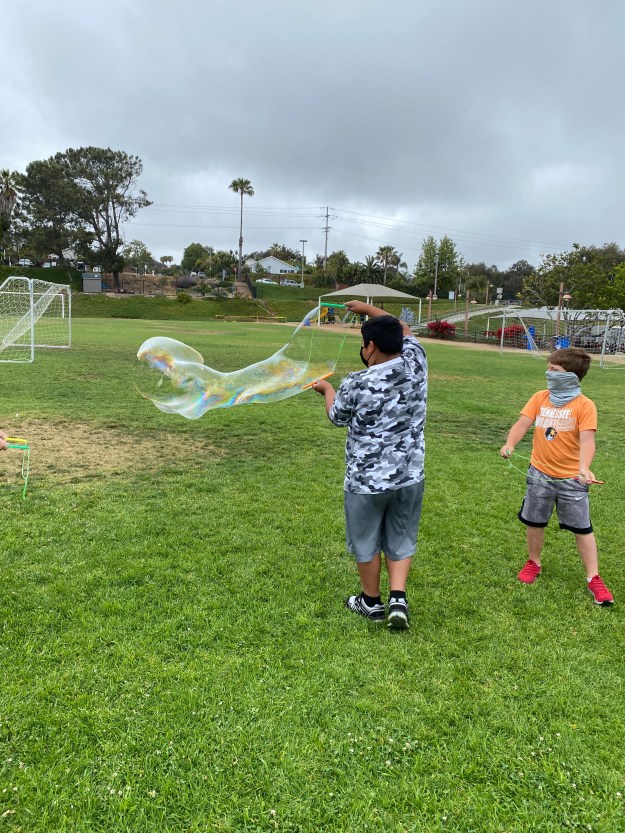
We started with a very interesting TED Talk titled, The Fascinating Science of Bubbles, from Soap to Champagne. We learned about surface tension, the geometry of bubbles and so much more. (If I were to do this in the future, I think I might devote an entire week rather than a whole day to bubbles!) Then we made our bubble wands and headed up to the field to make bubbles.
In spite of warning students that making these bubbles would take patience and experimentation, there was plenty of initial whining that “it’s not working!” I reminded them to keep trying. And then it happened…the first child experienced success! Like wildfire, bubbles emerged, filling the air with irridescent spheres.
The soap solution ran out before student interest waned, which is probably the best possible result! We headed back to the classroom with soapy hands, happy hearts and filled with visions and language about bubbles.
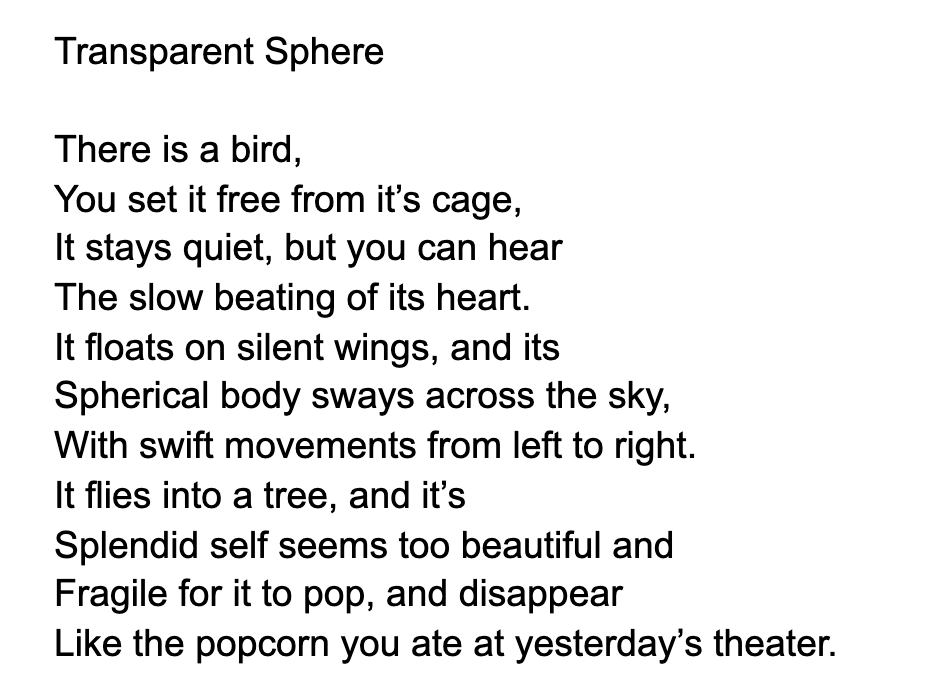
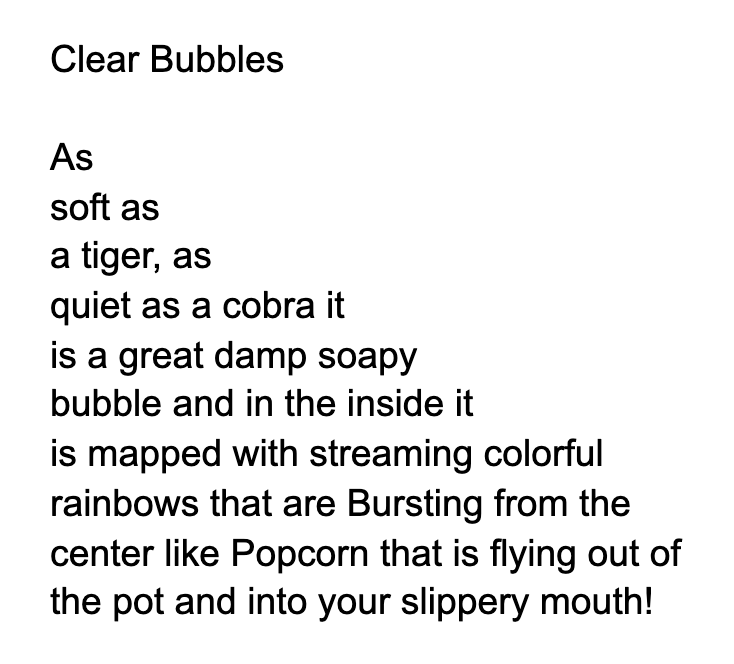
These young scientists are also prolific readers and writers, so after studying Valerie Worth’s short poem, Soap Bubbles, we created a list of bubble words and a list of potential bubble metaphors and then set the magic 7-minute writing timer and started writing. Like bubbles, colorful, delicate, evocative poems floated up, emerging from the points of students’ pencils.
Here’s a couple:
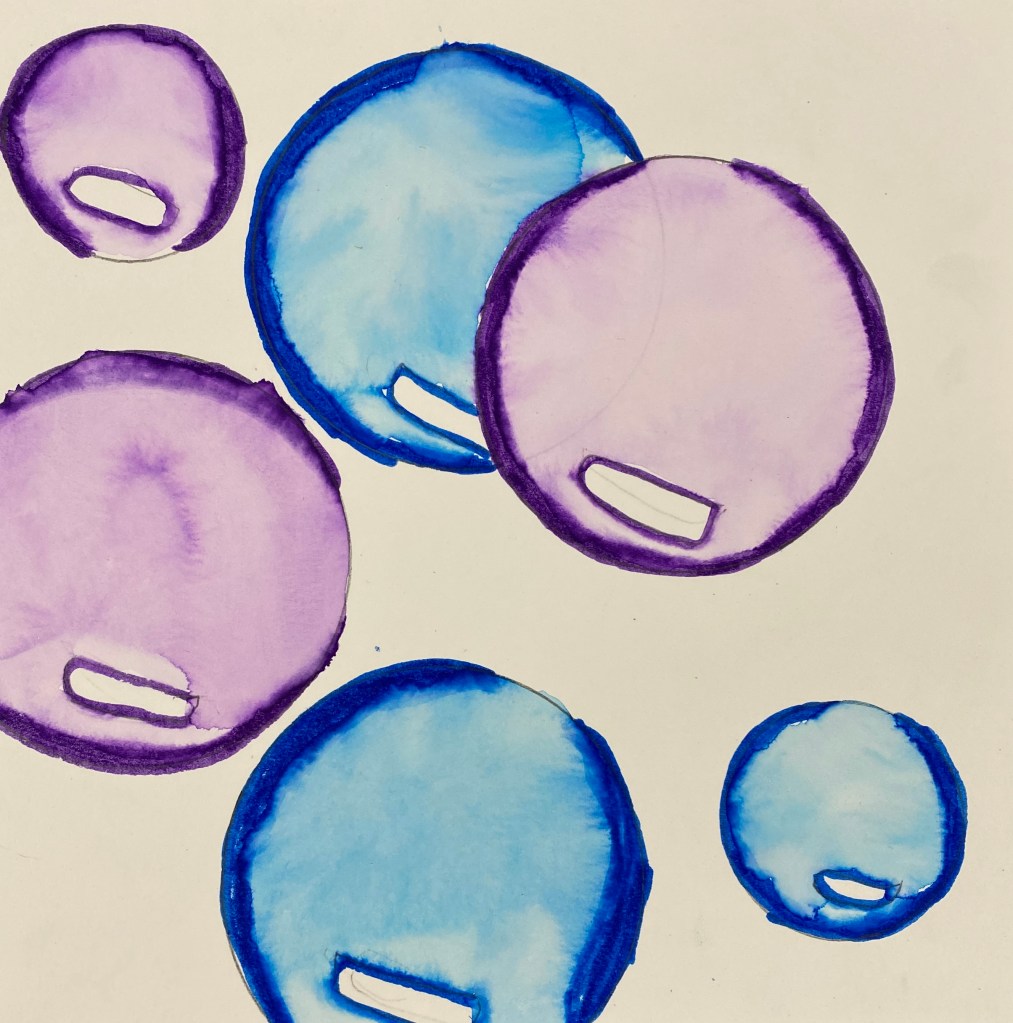
To complement the poetry and the elusive, temporary soap bubbles, we got out paper, pencils, water-based markers and some water and created bubbles…as art! Each artist created their own composition, tracing round shapes, adding a space where a light source reflected off each bubble. Then they added marker and finally, using just water and a paint brush, urged the marker to follow the water, creating beautiful dimensional bubbles on watercolor paper.
There is so much more we could have done with bubbles–including exploring the mathematics of spheres. Overall, it was an amazing day. Students could not believe that an entire school day had passed before they even realized it. Engagement was high, work quality was inspiring…it was an amazing last Monday of the school year! Based on this success, I know I will be working some bubble science into future teaching and learning!
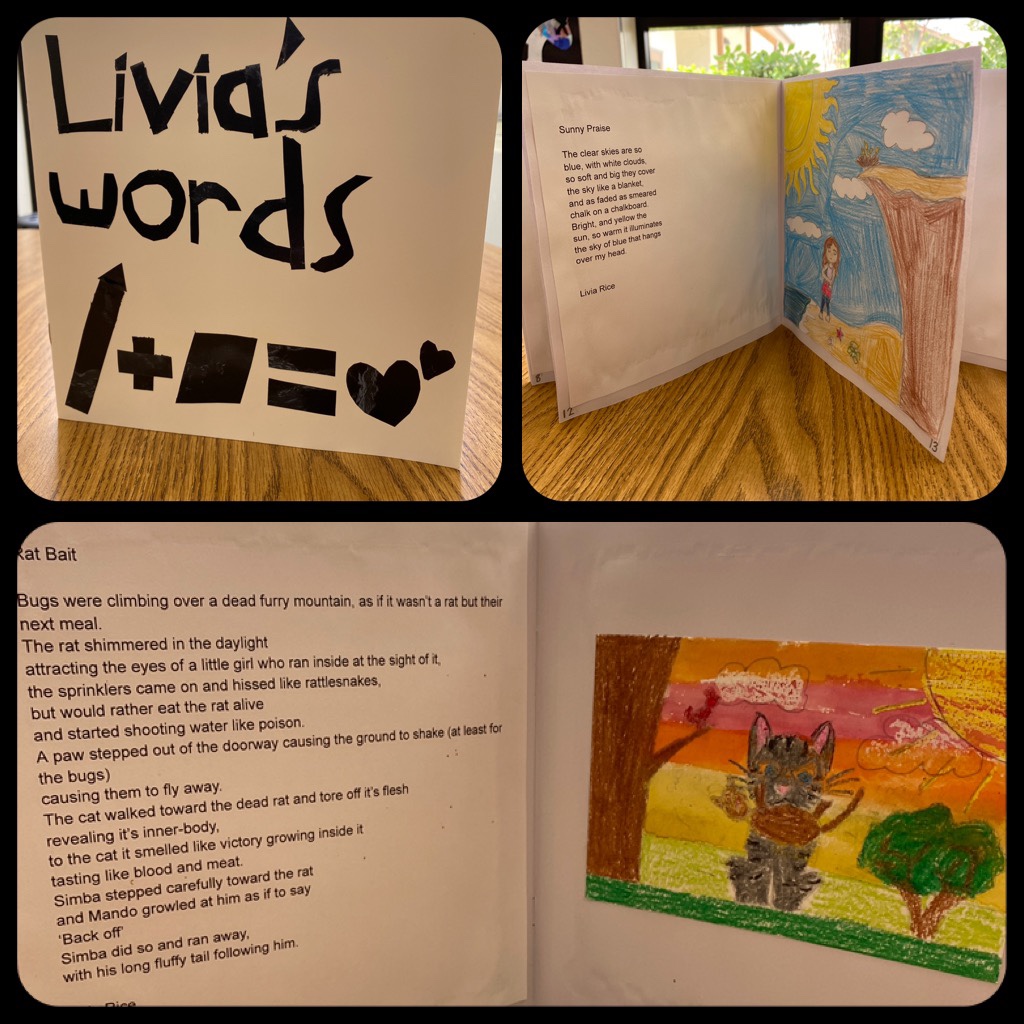
I wrote a poem a day during the month of April and challenged my students to do the same. And while not every student wrote every day, they did write a lot of poems. When you put that much effort into daily writing, it seems that something more needs to happen. I knew from past experience that drafting a poem each day is just the first step in moving my students toward seeing themselves as writers. So as the month of April wound down, my students and I started the process of curating a personal anthology of poems.
It’s not enough to simply select a poem and call it done. I had to move my students toward meaningful revision–and that meant giving them strategies and techniques to make their poems better. They re-read each poem they selected and considered how they might add a comparison (simile or metaphor), how they might personify an animal or object, how more specific details could help the reader “see” the ideas being expressed. So no matter how small the change was, each poem was revised. Because I had 16 page blank books for each student, we selected and revised ten poems and created five art pieces to go along with them.
As we worked through this intensive process, I kept asking myself, “Is it worth the time and energy–theirs and mine–to put this anthology together?” As I read poem after poem (25 students times 10 poems each), I started to see these young writers in a new way. They had gained confidence and knew what it meant to revise. I watched them own each poem, claiming their writing and making changes that satisfied each of them. I noticed some started poems from scratch. For them, the original poem was simply a pre-writing activity and a new idea emerged when faced with revision. For others, revision meant adding on to a poem, further developing the kernel of an idea that they had started earlier. Some revisions were the change of a single word–the poets were satisfied with their original effort and only went through the motions to satisfy the revision mandate.
And as we finished the last touches, gluing the final poems into place and typing up a table of contents I asked myself again…was this project worth it? There is no Open House celebration this year where families will come through and admire displays of student work products and ooh and aah the hard work done specifically for their benefit–something that has always made projects like this a necessity in the past. But still…my answer is yes, this intensive focus on poetry for more than a month has been totally worth it. Here are a few reasons why:
Students see themselves as writers. They confidently write daily and have developed both fluency and style. All those poetry techniques also make other kinds of writing better.
Revision has become ordinary. We do this routinely and resistance to going back to a piece of writing has dropped. Writers revise and we are writers.
All of our writing matters in our community of writers. Everyone will share their writing and everyone can pick out bits of excellence when they hear it in each other’s writing.
A project gives everyone a reason to persist. No one wants a half-finished book, so everyone pushed through, developing stamina as they worked through the revision of all ten poems.
250 student poems later and ten more of my own and we have created 26 individual anthologies of poetry. They are beautifully imperfect and incredibly perfect at the same time. And totally worth the time and effort.
We did it! I wrote last week about my experimentation with a poetry teller, a way for my students to go back through their own poetry and then play around with remixing their poetry with a classmate.
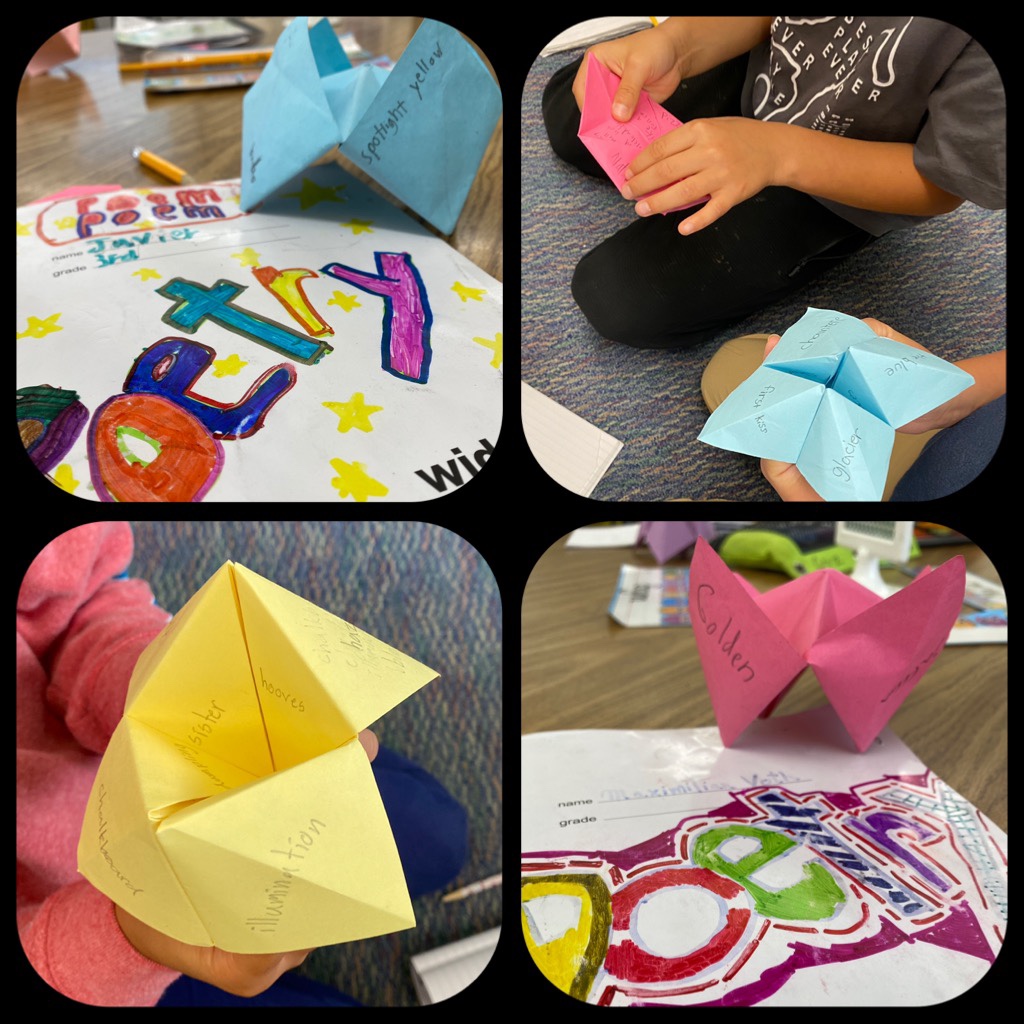
So this morning, students folded their way into their collaborative game. Some students were familiar with classic fortune tellers and were eager to put their fingers into the folds and start moving the teller around. And no one seemed to think it was one bit strange to make this into a poetry tool. They found colors, they located interesting nouns, and pinpointed some poetic phrases–all from their cache of poems written during April. In partners they played with their poetry tellers, collecting words and phrases that they knew they would use soon for some poetry writing.
I set the parameters: use the words you collected (it’s okay if there is a word you decide not to use), you can add extra words of your choice, make the poem make sense, and have fun! We used that magical 7 minute timer and students’ pencils flew across the page. When the chime sounded, hands shot up. They had poems to share!
Here’s a couple (these are third graders, 8 and 9 years old):
Words collected: blood orange, green, snow, lamp, the sun is cotton candy, the puddles of the ditch
Poem:
Unusual
The sky is blood orange
the lamp is green
the trees are snow
the sun is cotton candy
the puddles of the ditch are rainbow
there’s something fishy today
And another:
Words collected: ice, profusion, cats, frame, the sunlight bounces into my eyes, illumination, snowy caps, sister, hooves, the cloud is as soft and big, it covers the sky like a blanket
Poem:
Transition to Spring
Ice.
A very cold word
You see it a lot during brutal winters.
Hooves pounding on cold snow under our feet.
Cats.
Sinking their paws into the snow.
The snowy caps on mountain tops
are guarded by a forest.
There are many natural frames in the
tree tops.
Then the snow is illuminated by the sun.
I step outside and the sunlight bounces into my eyes.
My sister’s snowman melts away.
The clouds are so soft and big.
They cover the sky like a blanket.
It is spring now.
Making games out of writing definitely infuses playfulness into the process for kids. They loved manipulating their poetry tellers and would have played with them much longer than I had time for today. I count this as a win–and as a great way to have students remix poems. I’d love to hear what you would do with a tool/toy like this one. How would you modify it to support writers and learners?
Earlier this week I read a post by a virtual friend, NomadWarMachine, who described her path to transforming the origami fortune teller of our youth into what she called a line of thought-une teller. I immediately knew that this would be a great activity to modify for my students as a culmination of our month of poetry writing.
My idea is to have my students mine their month of poetry, pulling colors, words, and poetic phrases to construct a poetry teller. Once constructed, I see it as a game where partners play the poetry teller to collect a set of words and phrases that they will then use to compose a version of a found poem that includes their words and those of their partner.
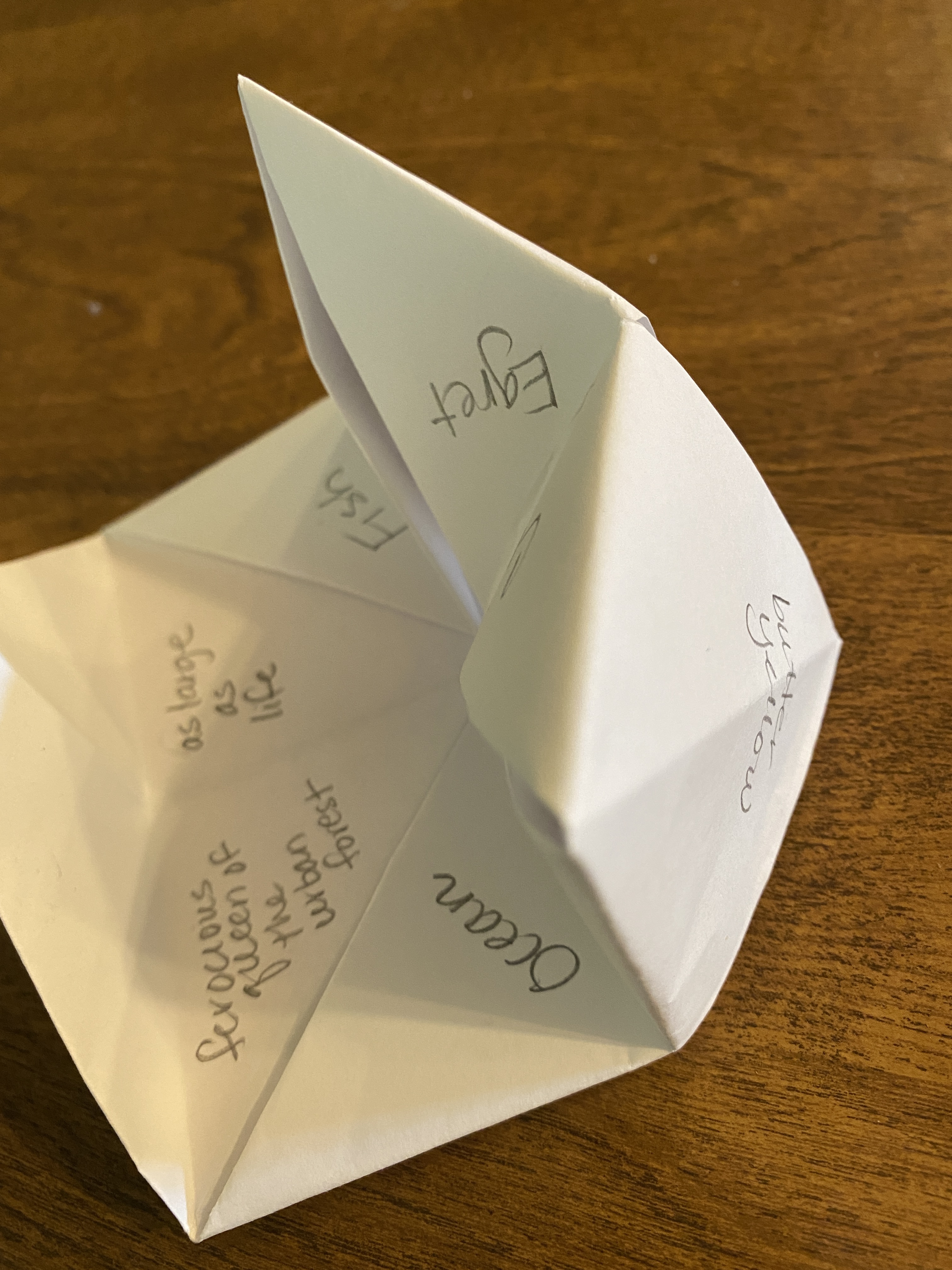
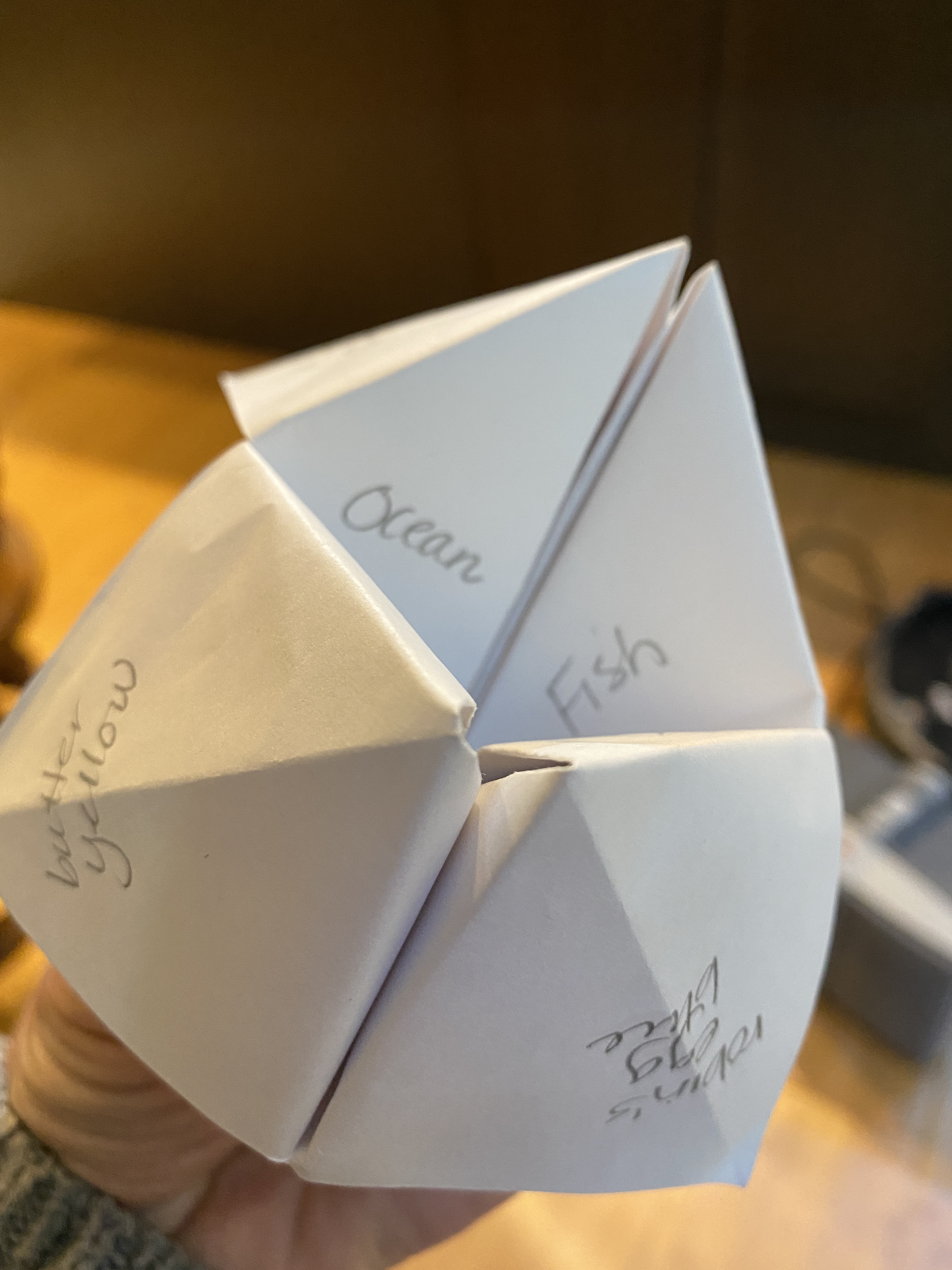
I experimented with my own poetry teller, playing this game with myself. I collected two phrases, two colors, and four nouns from my poetry. Then I worked to arrange and rearrange them into a new poem.
You can see my prototype poetry teller and resulting poem below.
I look forward to trying this out with students next week, I hope they find this to be a fun and generative way to look back at their own poems, collect some language from their peers, and have a meaningful activity to remix the two as they create new poetic compositions.
Back in March I wrote a slice of life about a new structure I had noticed behind a fence and hedge in my neighborhood. Today I noticed something new, which also became the subject for poem #29 (one day to go!).
Today we studied Francisco X Alarcon’s poem: Words are Bird as our mentor text. My students noticed that way words were described as birds, something that was new for them to think about. It took a bit of work and experimentation for the kids to find their own metaphors. Some that they came up with included: hand sanitizer is a warrior, trees are magical, and words are gum in your hair. I was a bit skeptical about that last one–and expressed that while I wouldn’t rule it out, it seemed like a difficult one to write for a word lover like me (and this student happens to be a word lover). While I don’t have the text in front of me to share with you all, let me tell you that she did manage it…in some interesting ways!
I may have taken the easy way out, writing my poem about poetry. Here’s the draft I wrote with my students today:







 Thinking Through My Lens