Tag Archives: science

Exploring Acorns: A #writeout Adventure

When life gives you acorns…make art and poetry!

Most weeks I work with my friend and colleague Carol over Zoom since we live in different parts of the state. So when we got to meet in person a few weeks ago, I was delighted to be gifted with a bag of acorns to explore with my students. The acorns where Carol lives are huge…and they have the caps that look like knitted beanies.

So, in honor of #writeout, a collaboration between the National Writing Project and the National Park Service, we got out the acorns and the hand lenses AND our sketchbooks to really study them carefully. We also read two wonderful picture books: Because of an Acorn by Lola Schaefer–a book about the interdependence of the ecosystem where acorns thrive–and Acorn Was a Little Wild by Jen Arena–a fanciful book about an adventurous acorn who after an encounter with a hungry squirrel preparing for winter, ended up as an adventurous oak tree.

And…we had to watch the wonderful video with Ranger McKenzie from Sequoia National Park about how oak trees drop tremendous numbers of acorns every few years…all at the same time in a process called masting, and that scientists have figured out that trees “talk” to each other through their root systems.

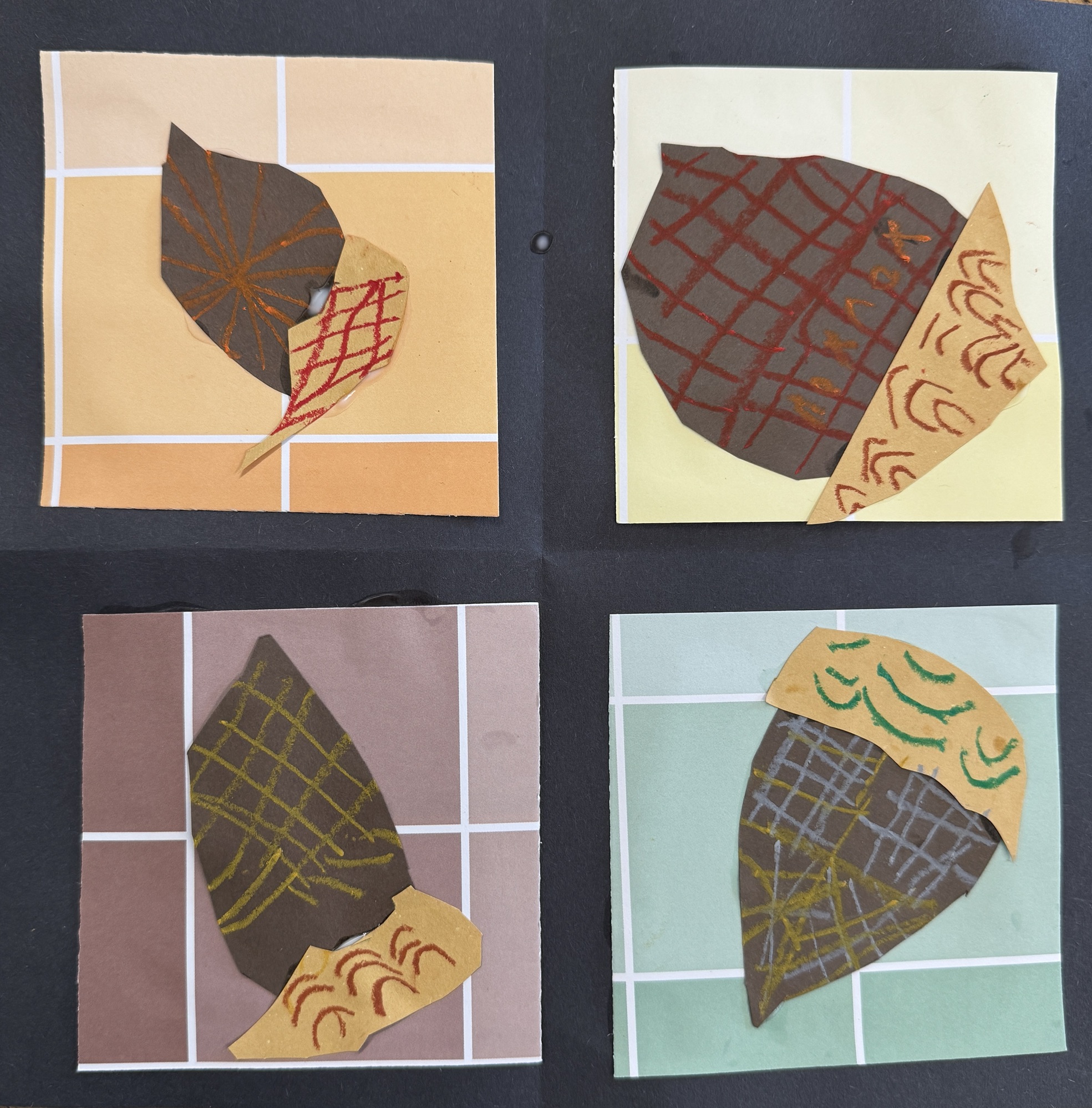
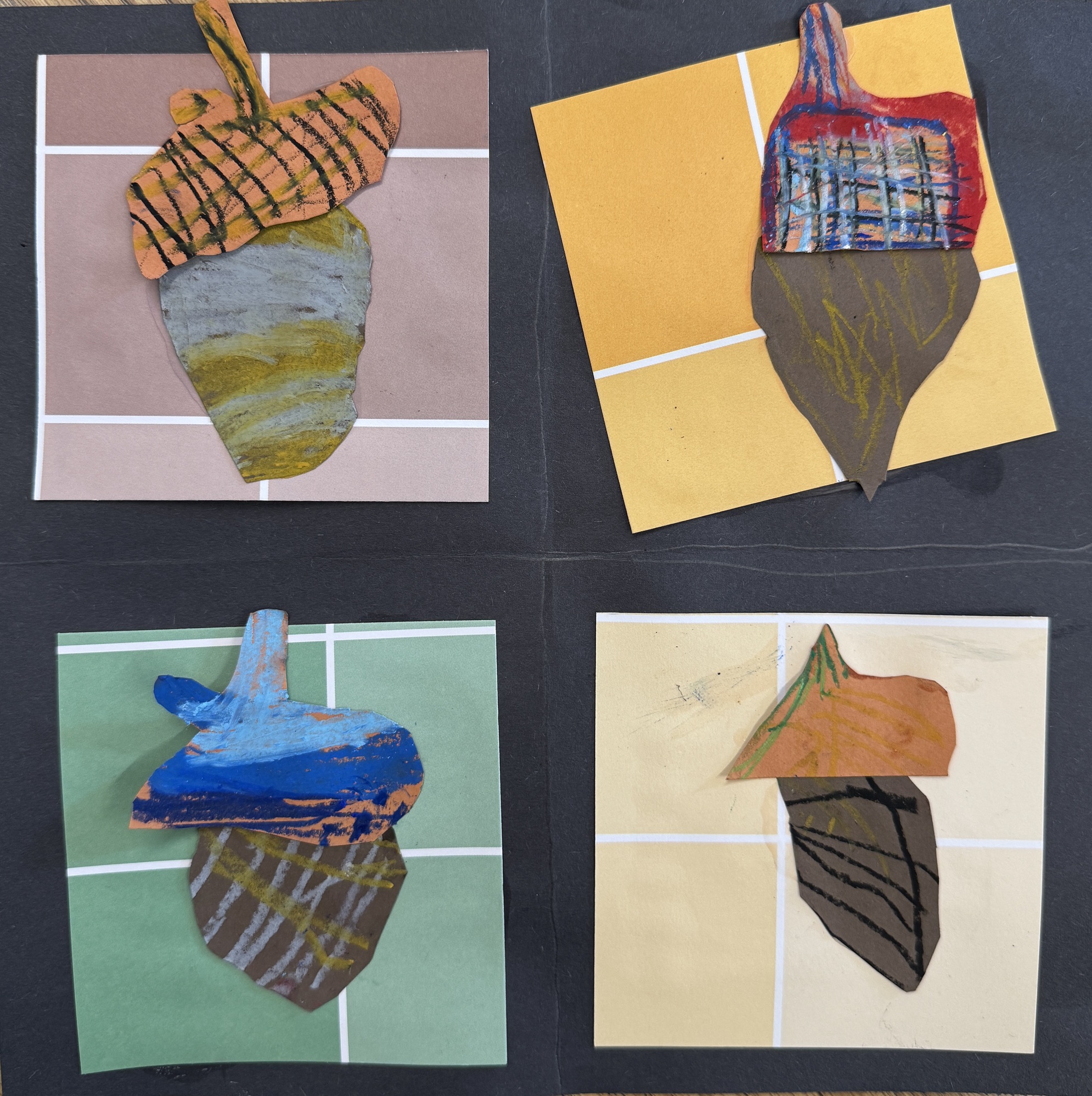
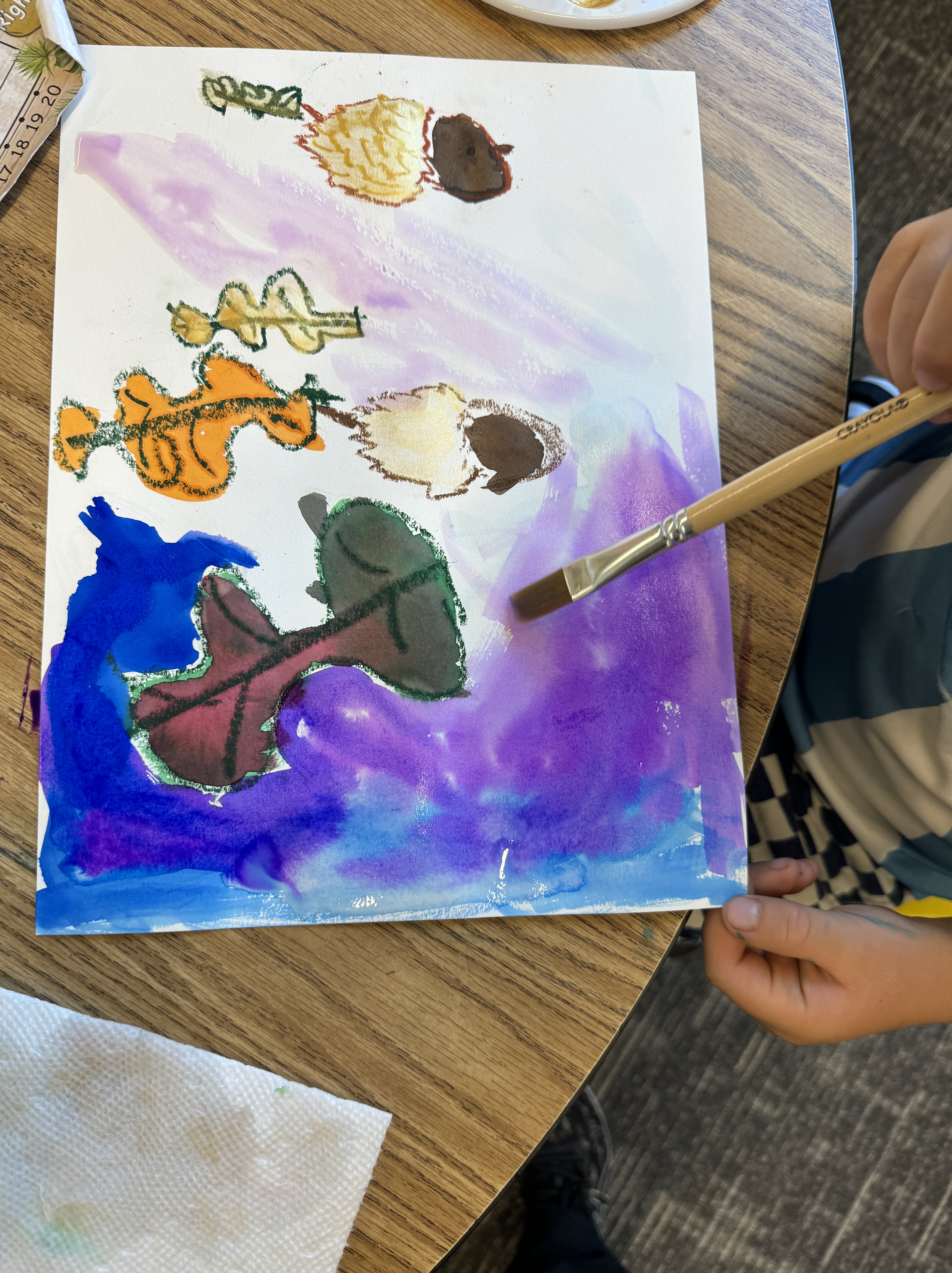
All this science and nature provided the perfect foundation for an art project inspired by Andy Warhol and the Pop Art movement. Today the first graders in my classroom used scissors, construction paper, oil pastels…and wait for it…white glue to create the most adorable acorn art. Scissor work can be challenging for young learners, and to add to the scissor demand I didn’t provide a template. Instead I showed them how to trim the square of paper into the shape of the acorn nut…and another square of paper into the shape of an acorn cap. A few students expressed frustration, but with some encouragement and insistence that they keep trying, all students were able to cut out acorns and their caps independently.

We added some whimsical texture with oil pastels…and then the most challenging part, they had to use white glue to attach their acorn pieces to the background we had assembled. Trust me, white glue can be downright scary in the hands of young artists! But with admonitions to use the glue sparingly, we were successful!
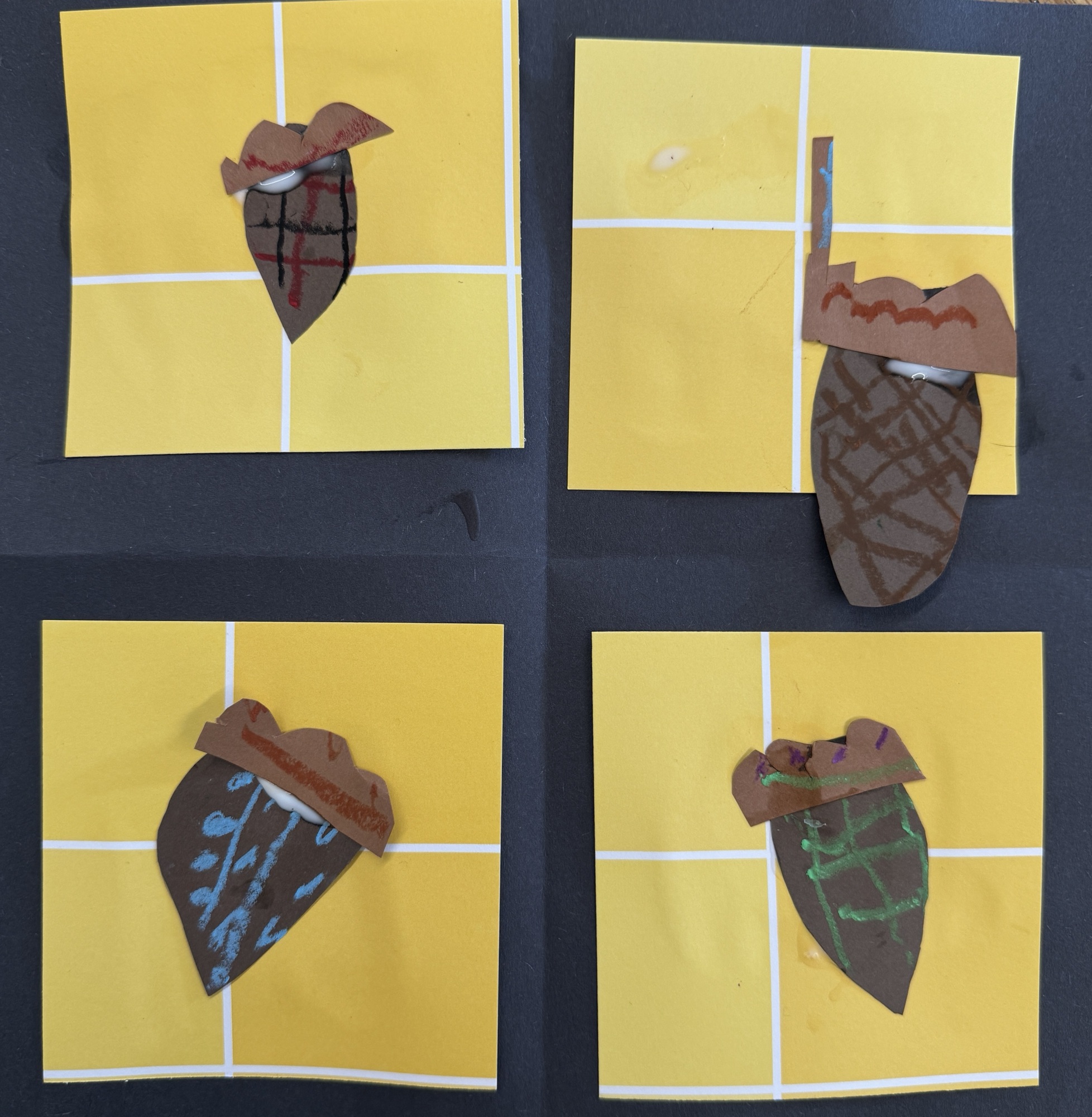
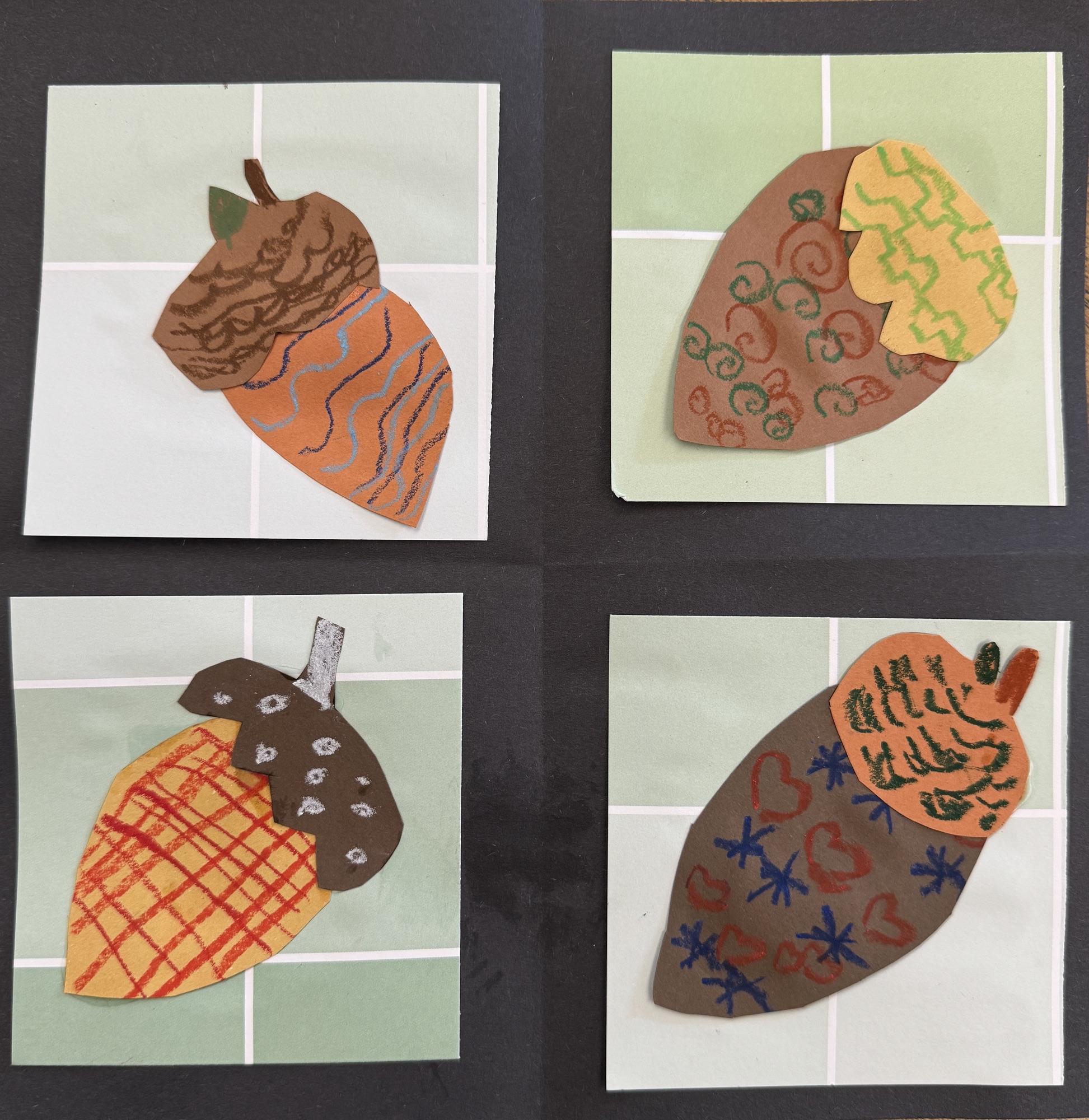
Of course we had to do some writing. Poetry seemed in order–after all this year’s #writeout theme is Poetry for the Planet and I was wanting to keep it short…so we attempted a first grade version of Haiku–a three line poem (without worrying about the syllable count). Here are a few first grade attempts.

J wrote:

Acorns are hard

cozy as fall nears

Spiny as a hedgehog

O wrote:

Don’t fall yet.

Squirrels will get you.

Crunch!

And R wrote:

Acorns look like a balloon that got blown by a man.

Acorns look like a man with a helmet riding a bike to the store.

Acorns look like a top that someone is spinning on the table.

#Writeout we’re off and running! We’d love to know how all of you are celebrating nature and the outdoors in your classrooms and in your lives!
Under the Influence of Acorns

On some days, my students and I head outside for inspiration for our writing and learning and on other days, we bring nature right inside the classroom. Fall is known for leaves changing colors, animals preparing for winter, acorns dropping… But in southern California that isn’t what we see outdoors. Our trees are mostly green, the weather is warm, and no one really hibernates. But in first grade students don’t seem to notice that our fall is different…and so, we often import the icons of fall.

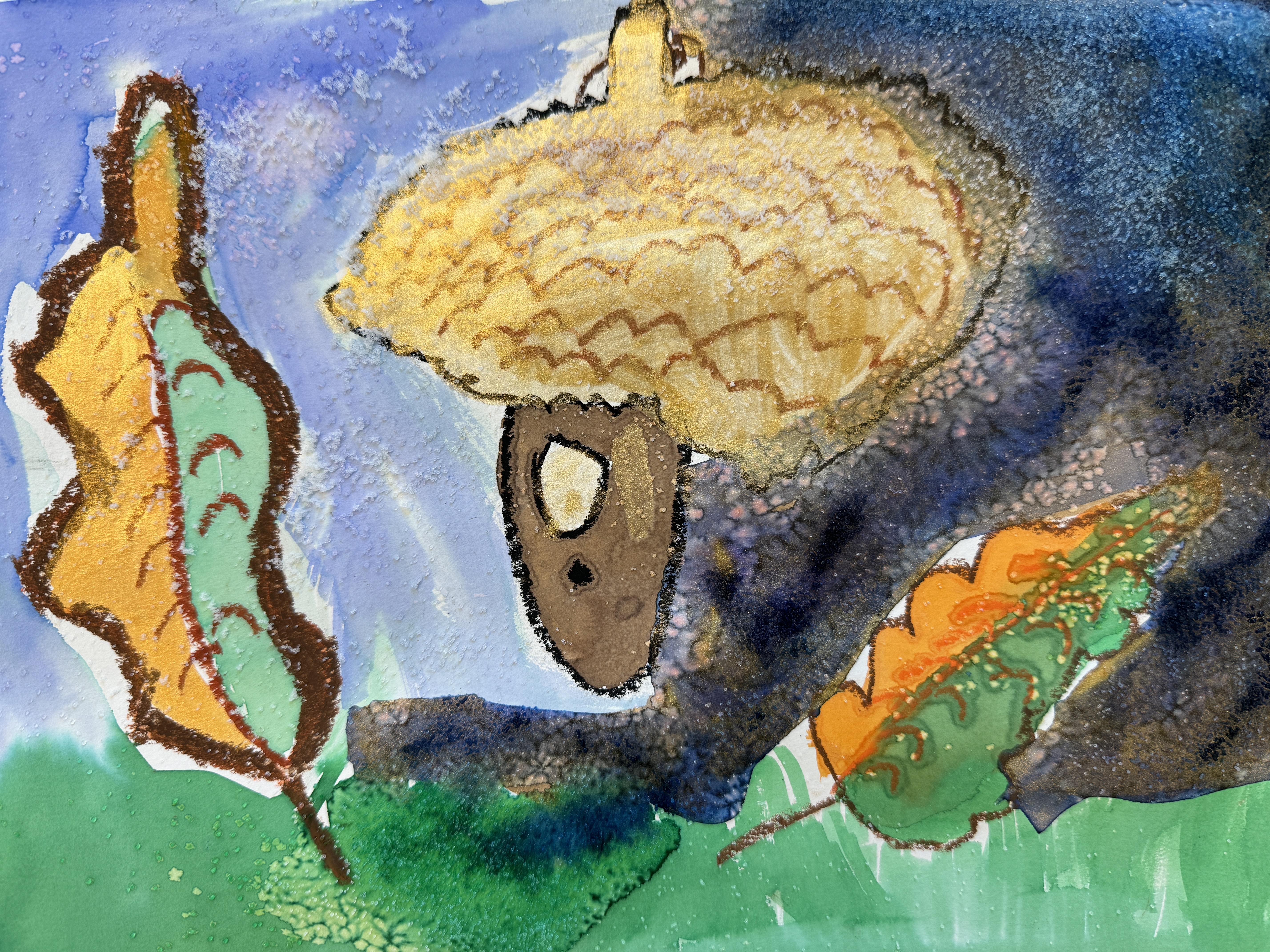
Yesterday after reading, Because of an Acorn and talking about the interconnectedness of plants and animals, we watched a video from a park ranger at Sequoia National Park where we learned more about oaks, acorns, and the communications between trees. And then I pulled out my stash of acorns, saved from a year ago when a friend from the central part of our state shared some from her neighborhood. My students examined these extra large acorns carefully, delighting in the texture of their caps, the smoothness of the acorn itself, and the way it rattled when they shook it (they have dried out somewhat after being in my classroom for a year). Then then carefully sketched the acorns and some oak leaves (using our book as reference). Many spontaneously began adding notes, noticing the point at the bottom, the variations in color, and more. Obviously the note taking carried over from our nature notebooking described in my previous post.

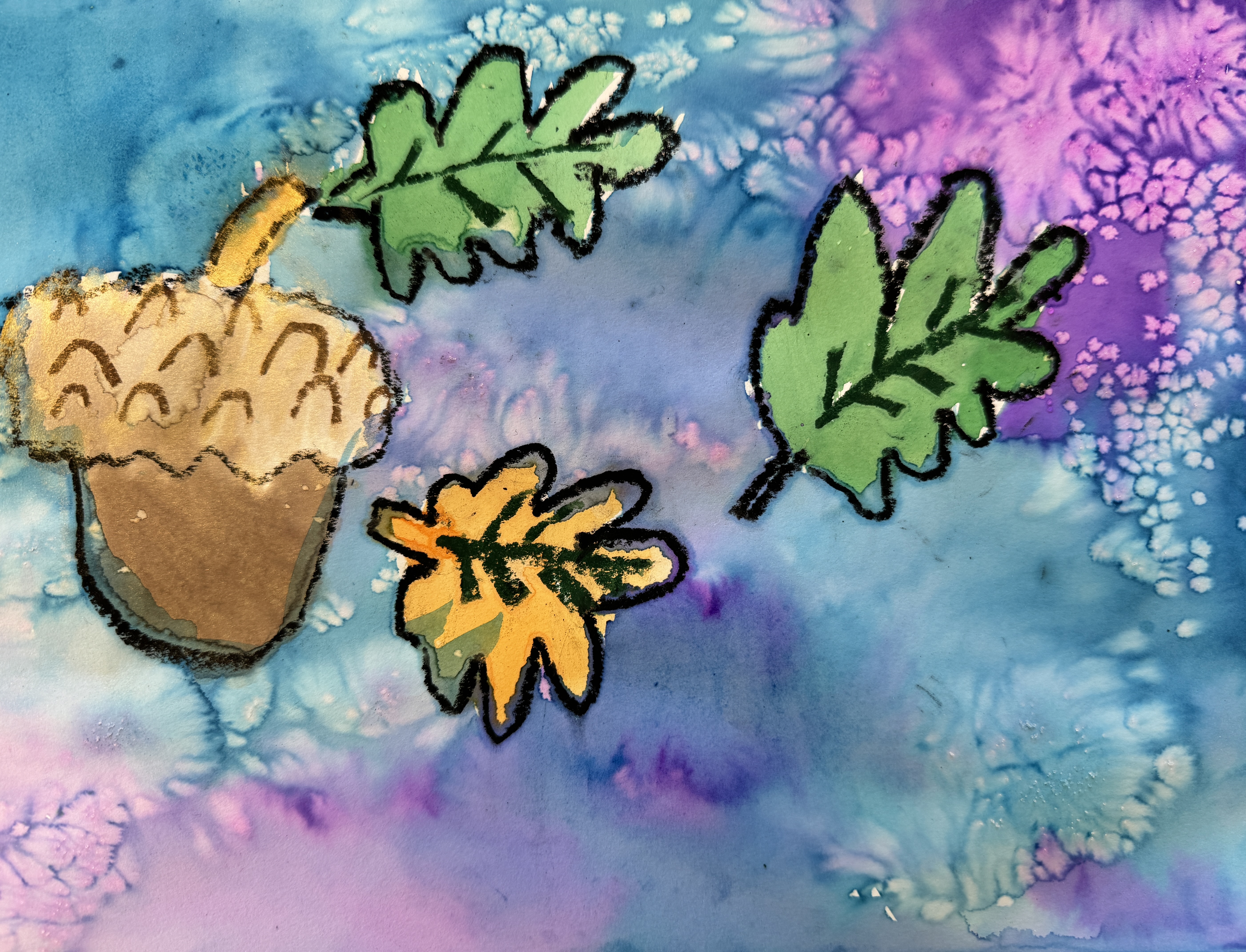
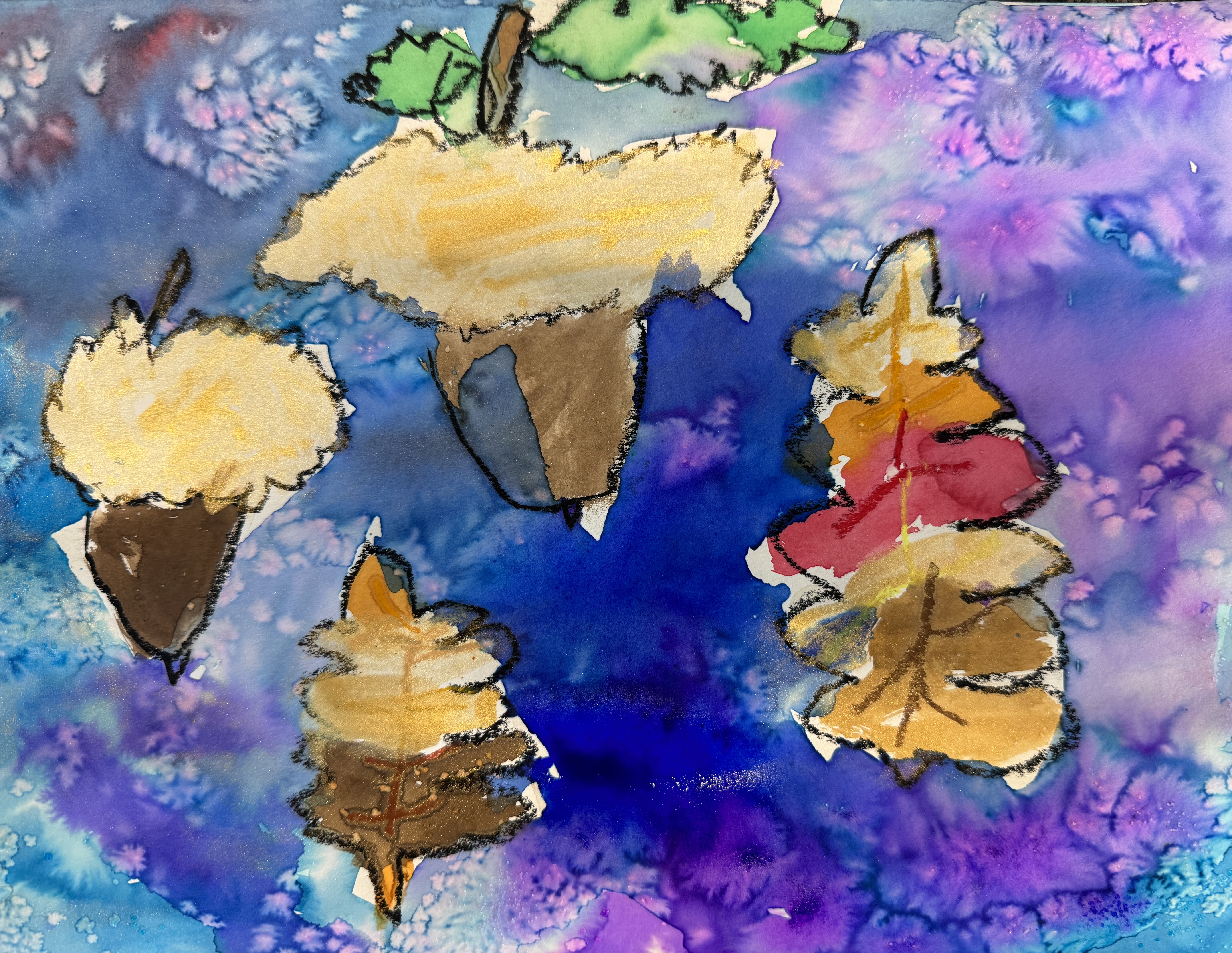
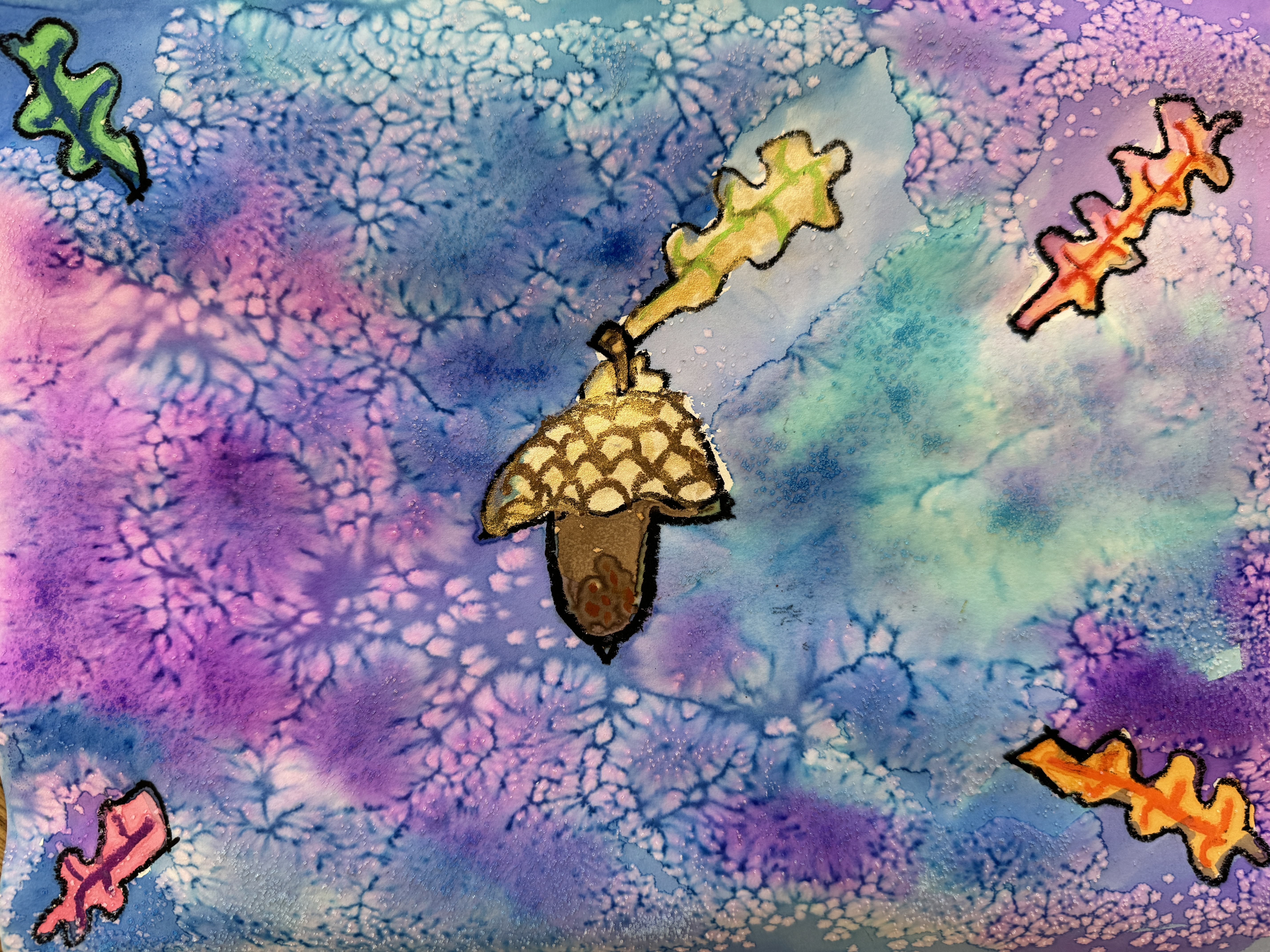
In this case, the goal of the sketching was practice for a watercolor project. Our subject was the acorn, and then we experimented with three different watercolor techniques: oil pastel resist (using oil pastel to create a border to keep paint from running), wet on wet (painting the background with water before applying the paint), and then adding some pinches of salt to create a starburst effect. First graders have so much freedom as artists, they grab the oil pastel with confidence, seemingly not worrying that they will not be able to erase a mistake. They drew and painted…with stunning outcomes.

And since the ranger in the video offered as a prompt, imagine a dialogue between trees…which we expanded to include a conversation between acorns and oaks, students experimented with writing about that interaction. They are new to the writing of dialogues, but their first drafts show some promise. Here’s a couple (typed by me for ease of reading).

An acorn falls off an oak tree. Am acorn hangs from a branch. An acorn drops and a chipmunk will eat it. Hi oak. Are you going to drop the acorns? Oh. I will when it is fall. Hey oak trees, you want to drop acorns! Now it is fall. The oak trees wait. Let me tell the other oak trees so they know. Now it is winter. The animals are hibernating. The bunnies are gathering food for winter.

And…

A squirrel asks an oak tree, can I have one acorn? The oak tree said no you can not have an acorn. Acorn said please! Okay said oak tree but I’m keeping an eye on you! And if you grow into a tree then I will talk to a scientist, so don’t forget squirrel. But wait! I have to tell the other oak trees so we can do a masting said oak tree. Hey oak trees, let’s do a masting yelled oak tree. The oak trees did.

My students were most impressed with their own volume of writing, most filling more than a page with their words. I love that they picked up on some of the science from the video–the idea of a masting, the phenomenon where oaks drop an extreme number of acorns every 3-5 years was information directly from the park ranger.

How are you letting #writeout influence your writing and the writing of your students?

Life Cycle? NPM23 Day 10

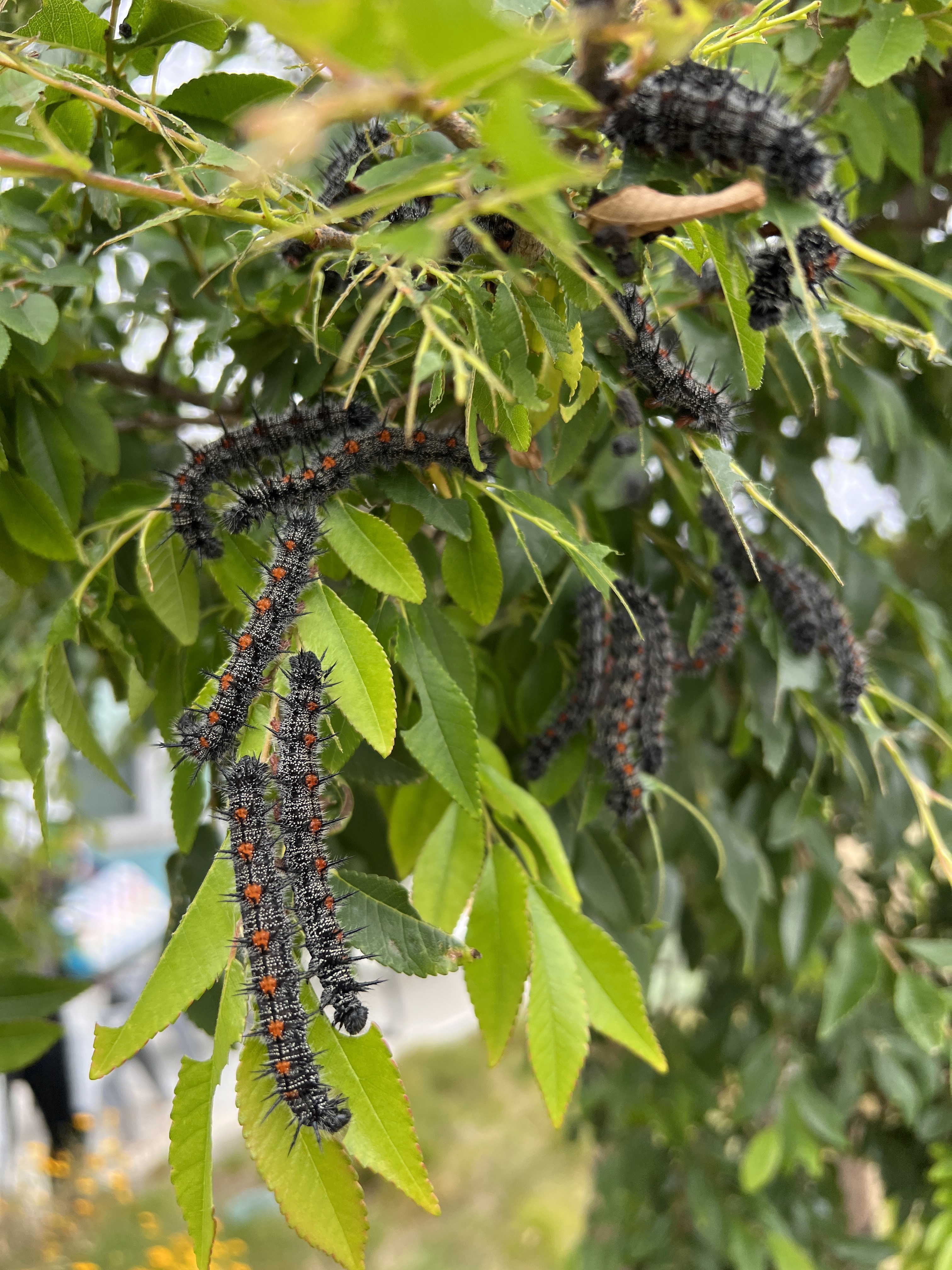
An invitation to write a science poem–yes please! And the serendipity of our caterpillar sighting at school today made the perfect topic for the “whimsical science poems” at #verselove that Brittany prompted.

Life Cycle?

Caterpillar crossing

scrunch by scrunch

to the oohs and aahs

of its first grade audience

And then they notice the poop

on the picnic table and our eyes rise up

Fireworks explode

in a tree full of caterpillars

hanging

like tinsel

on a 1960’s Christmas tree

Will they be there tomorrow

or will they be

                bird snacks

before

                chrysalising

into blossoms

flying

egg laying

a new crop

of caterpillars

A life cycle continued

or broken?

Bubbles

With the school year coming to a close, I wanted to come up with an activity for students that felt like play–like a party–and still provide academic content to satisfy my ever-present need to make use of all available instructional minutes. (Yes, even in the last week of school)

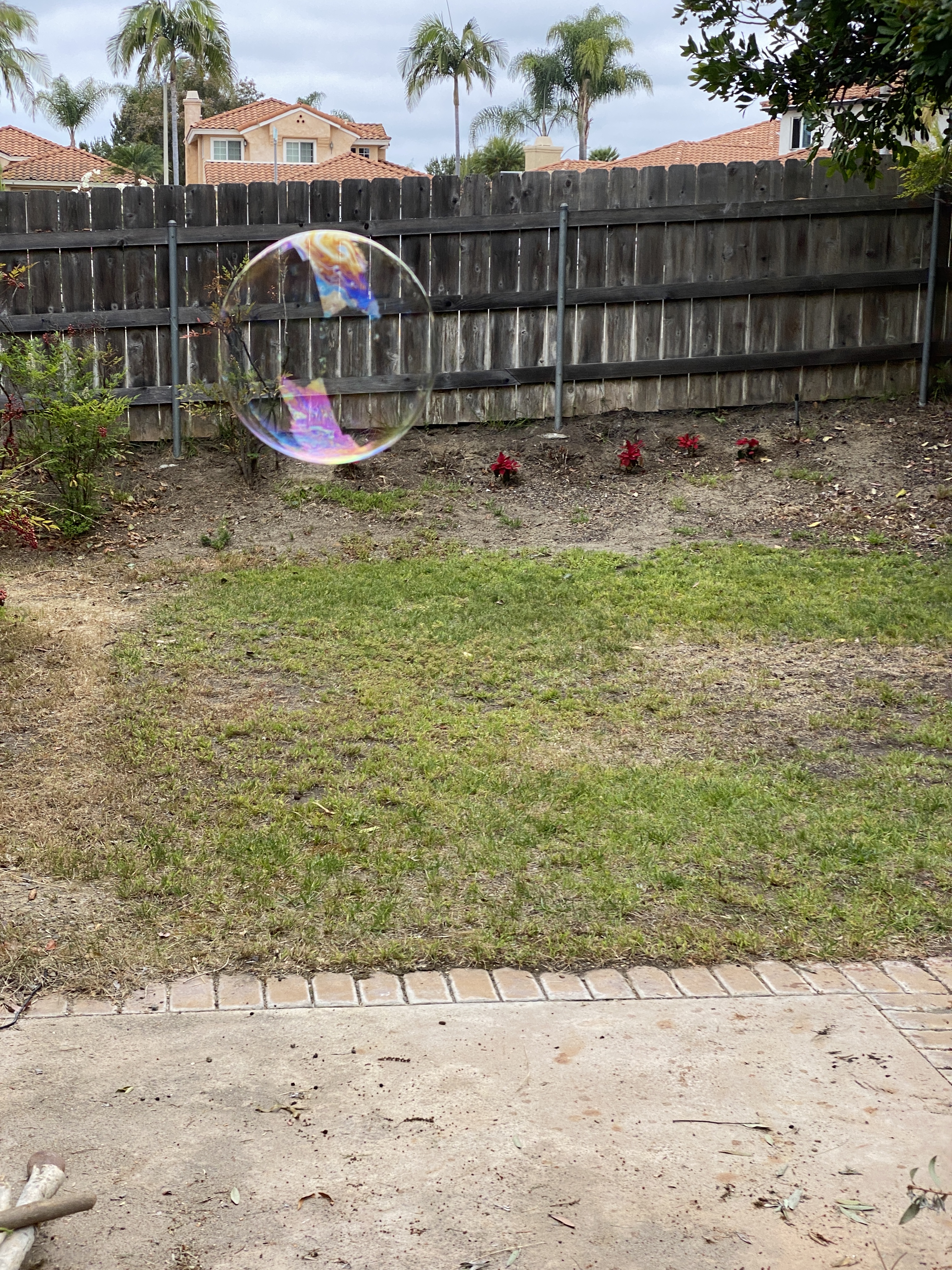
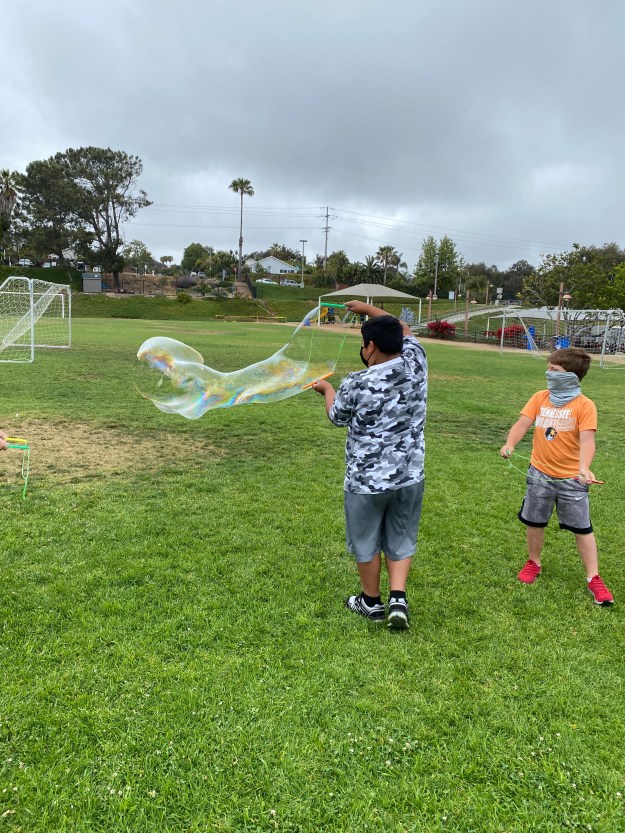
So, when I came across a blog post about making giant bubbles and bubble art, I knew I could turn this into a meaningful day of learning and fun…all wrapped up in a soapy bubble! I’m pretty fascinated by bubbles. I’ve spent quite a bit of time photographing giant bubbles at the beach and I’ve written about the “bubble man” a time or two (or more). I know that the trick to great bubbles is the solution–so prior to having my students explore and experiment, my husband and I tried our hand at bubbles over the weekend.

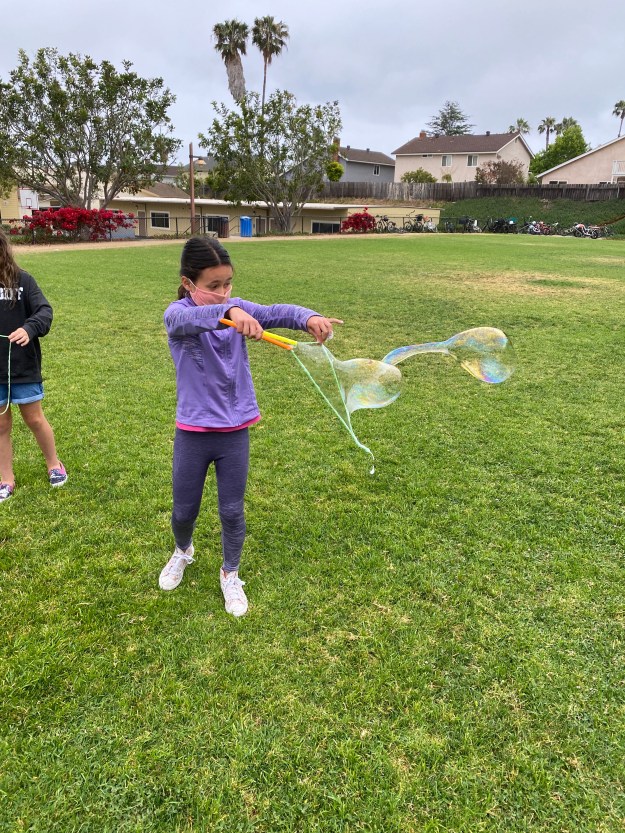
The basis of all bubbles is soap and water. But if you want the bubbles to be big and to have a bit of staying power, a bit of corn syrup and some glycerin need to be added to the mix. Using smoothie straws and yarn, I created a bubble wand that my students would be able to make on their own and started dipping and waving in my own attempt to create bubbles. This bubble thing is harder than it looks! I didn’t immediately get big beautiful bubbles flying from the wand. But with some patience, some tinkering, and some exploration of how to get a thin film filling with air onto my yarn…bubbles happened. At that point, with bubble solution pre-made, I was ready for a day of bubbles with third graders!

We started with a very interesting TED Talk titled, The Fascinating Science of Bubbles, from Soap to Champagne. We learned about surface tension, the geometry of bubbles and so much more. (If I were to do this in the future, I think I might devote an entire week rather than a whole day to bubbles!) Then we made our bubble wands and headed up to the field to make bubbles.

In spite of warning students that making these bubbles would take patience and experimentation, there was plenty of initial whining that “it’s not working!” I reminded them to keep trying. And then it happened…the first child experienced success! Like wildfire, bubbles emerged, filling the air with irridescent spheres.

The soap solution ran out before student interest waned, which is probably the best possible result! We headed back to the classroom with soapy hands, happy hearts and filled with visions and language about bubbles.

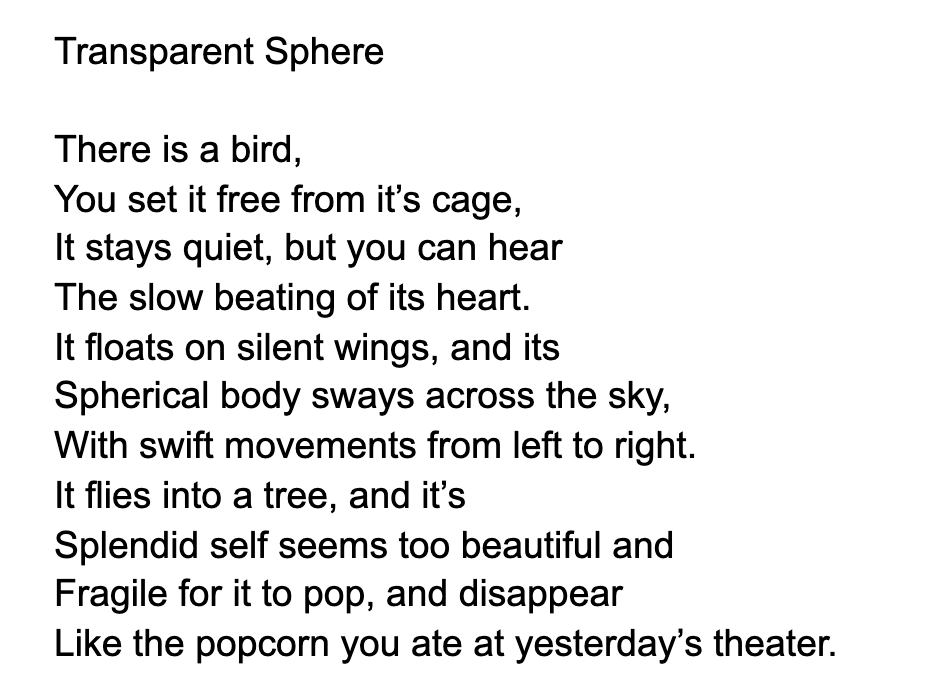
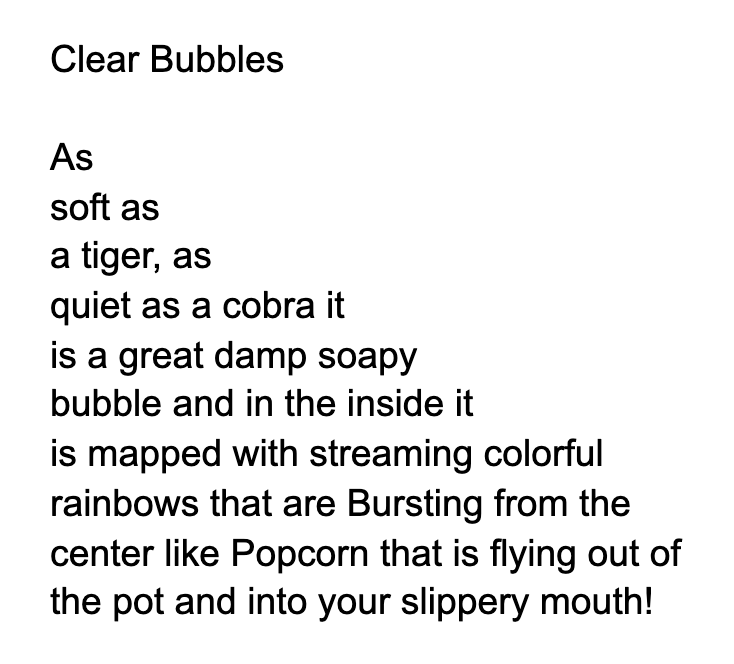
These young scientists are also prolific readers and writers, so after studying Valerie Worth’s short poem, Soap Bubbles, we created a list of bubble words and a list of potential bubble metaphors and then set the magic 7-minute writing timer and started writing. Like bubbles, colorful, delicate, evocative poems floated up, emerging from the points of students’ pencils.

Here’s a couple:

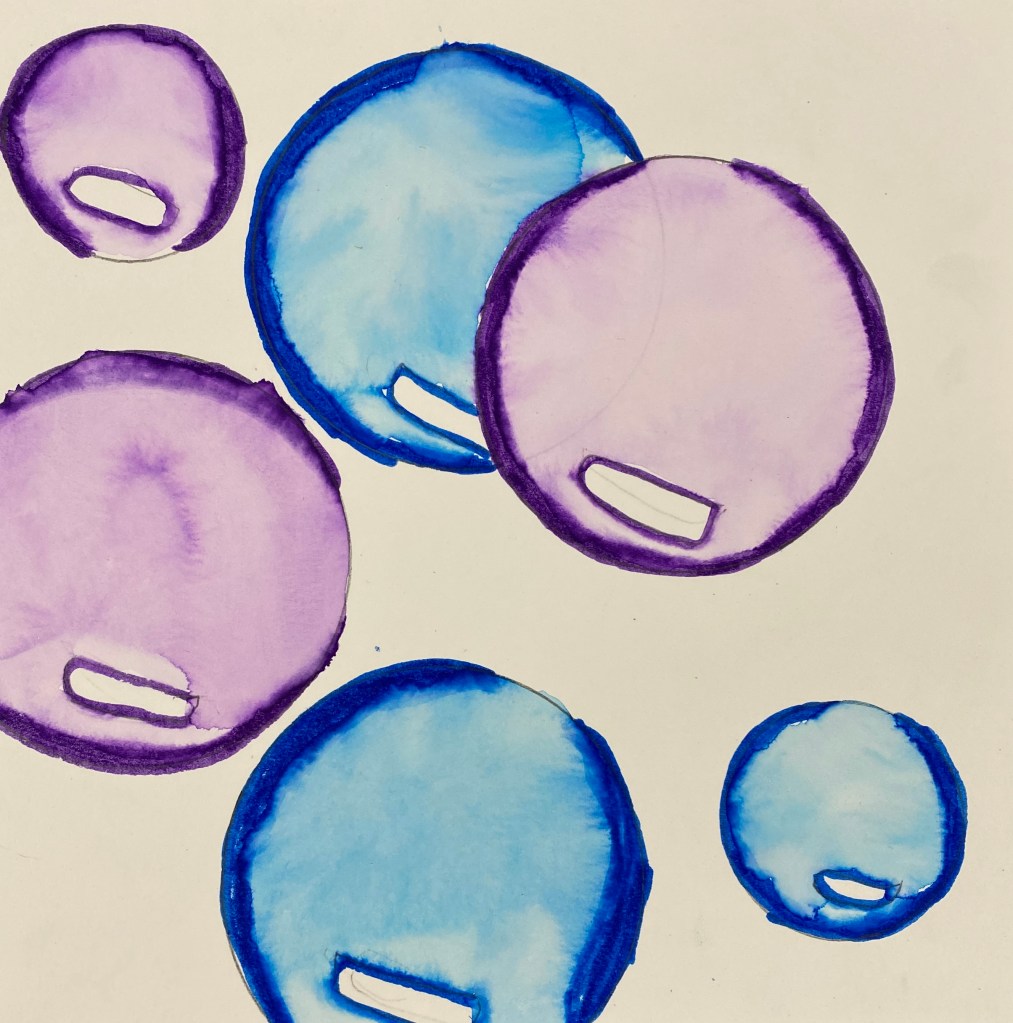
To complement the poetry and the elusive, temporary soap bubbles, we got out paper, pencils, water-based markers and some water and created bubbles…as art! Each artist created their own composition, tracing round shapes, adding a space where a light source reflected off each bubble. Then they added marker and finally, using just water and a paint brush, urged the marker to follow the water, creating beautiful dimensional bubbles on watercolor paper.

There is so much more we could have done with bubbles–including exploring the mathematics of spheres. Overall, it was an amazing day. Students could not believe that an entire school day had passed before they even realized it. Engagement was high, work quality was inspiring…it was an amazing last Monday of the school year! Based on this success, I know I will be working some bubble science into future teaching and learning!

Science Poems: NPM20 Day 17

Today my students revisited the poem, Go Fly a Kite by Laura Purdie Salas.  The poem combines kite flying and some science of flight.  After reading and studying the poem, students were challenged to write their own science-based poem.  And they did!

Here’s a couple of student examples.  The first is D’s poem about the egg drop experience that kids were working on before school closed.  They ended up completing this experiment at home.

Screen Shot 2020-04-17 at 5.08.11 PM

And I’m not surprised that P managed to get basketball into his science poem!  (Everything is about basketball in P’s mind!)

Screen Shot 2020-04-17 at 5.09.04 PM

You may notice that the mentor poem was both a rhyming poem and a concrete (shape) poem–and there is evidence of the concrete shape in D’s poem and the rhyme (even when it’s a stretch) in P’s.  It’s a good reminder to me to think those aspects through when I am selecting mentor poems for writing.

My own poem was inspired by the sky when I headed out for my walk this morning and was immediately drawn to look up at the sky.

img_6586

Read the Future


Look up

and read the future

in that freckled sky


blue skies veiled

by layers of stratus

where water molecules

gather and condense


will they release

the promised precipitation?

will raindrops

race down our already saturated hills?


Apply pressure

to keep the sky blue

pushing back against clouds

pressing

the rain away


Look up

that freckled sky

might be a crystal ball

predicting

weekend rain


®Douillard

What science concepts might you include in a poem today?

The Eyes Have It! NPM 2019 Day 4

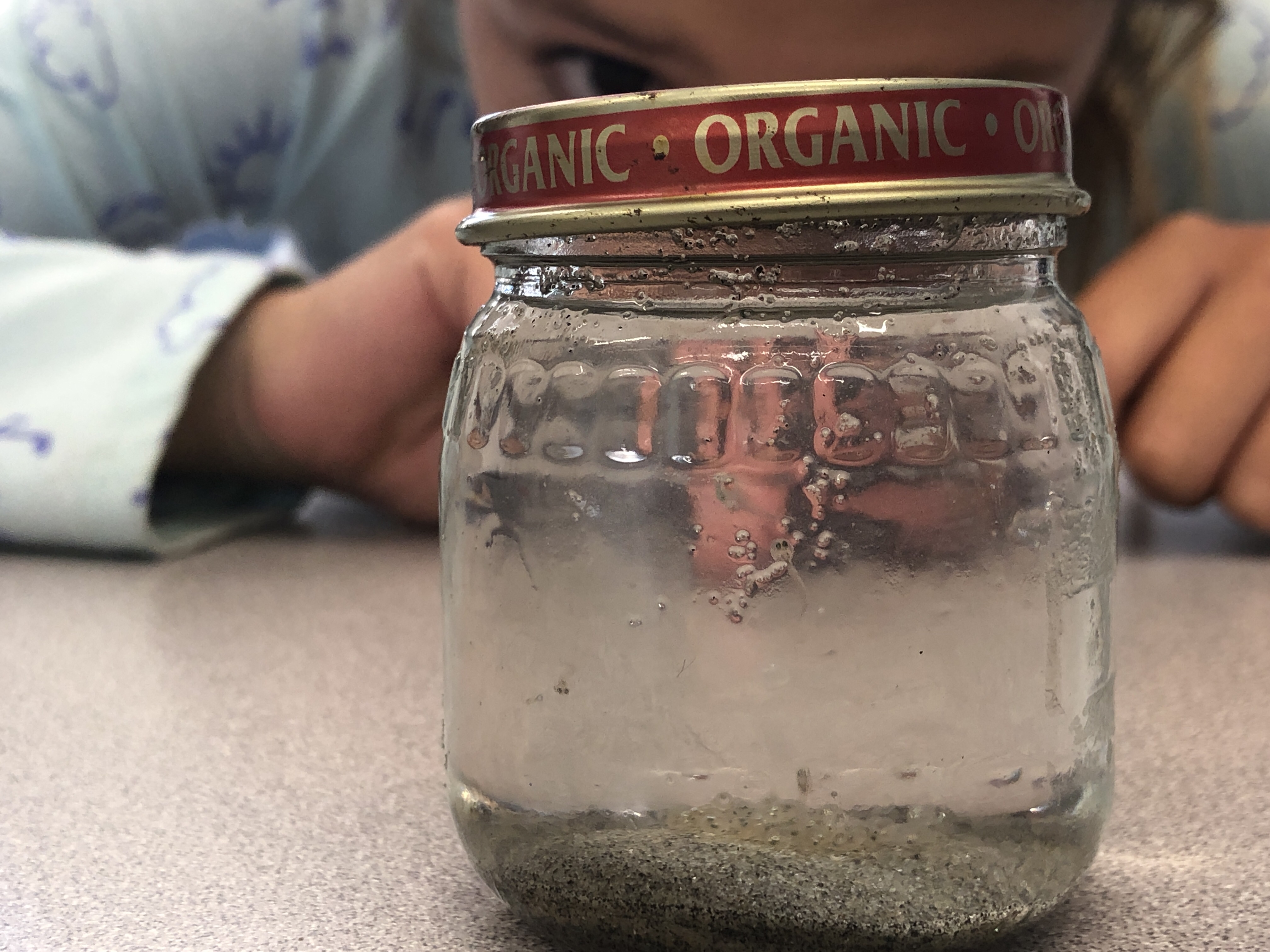
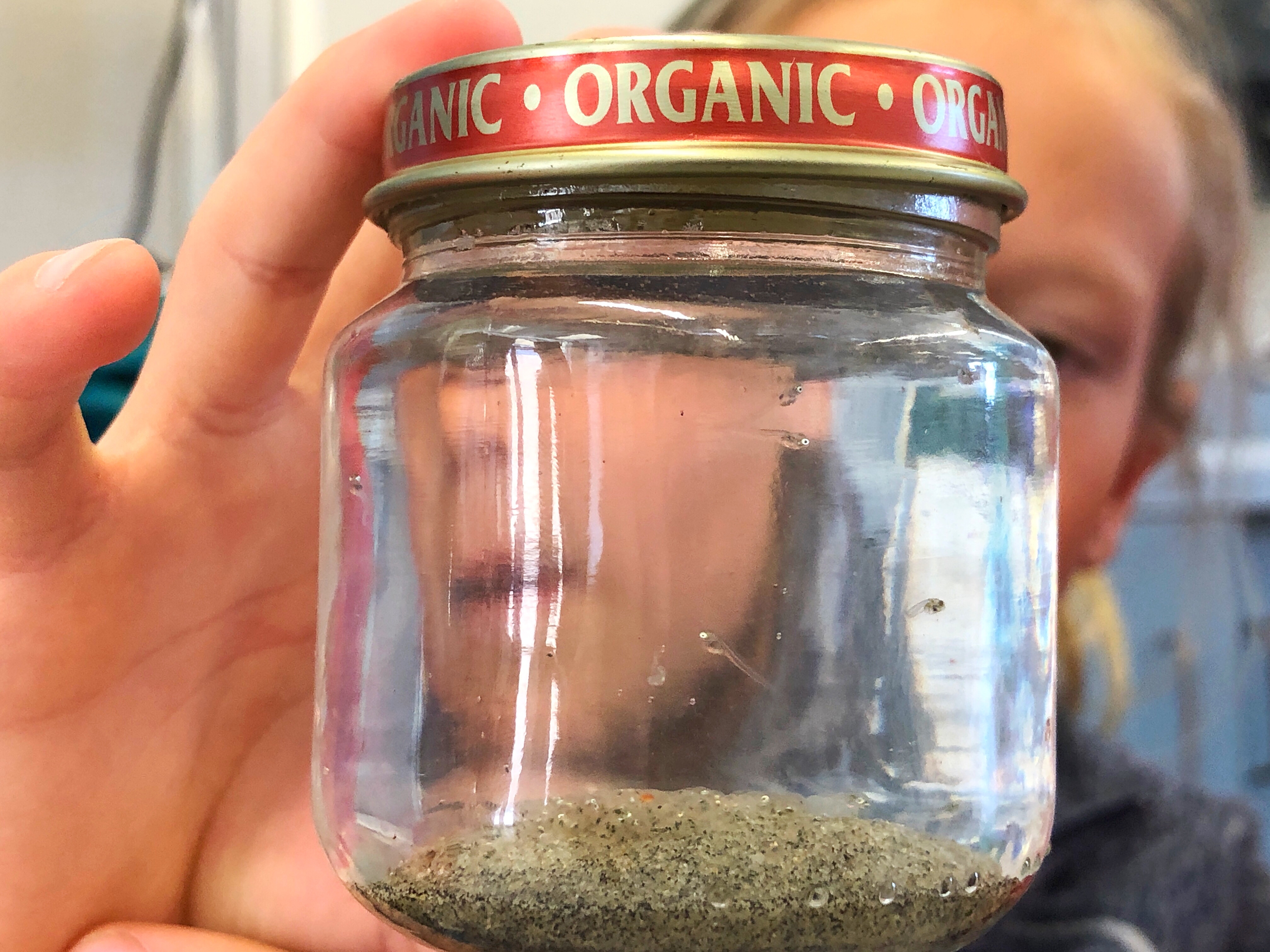
I’m not in the classroom on Thursday, so no stories of poetry with my students today. But yesterday we did have quite an experience in the science lab.  You might remember that a week ago I wrote a post about grunion, our special little southern California fish.  Well yesterday…sure enough, we had the opportunity to replicate the motion of the ocean and hatch tiny transparent grunion right in front of our eyes!
A spoonful of sand (that we hoped were laden with grunion eggs) in a glass baby food jar, some ocean water til almost full, twist the lid on, and then some gentle swirling or shaking…and voila!  We noticed the eyes first, and then my students’ eyes  opened wide.  The wonder was apparent on their faces…and in their squeals of delight.  Our science teacher promised she would take these babies back to their home at the end of the day.  It was such fun hatching these very special fish, and getting a close-up view of nature in action. I suspect my students will remember this experience for a very long time!

img_0200

And for Day 4 of National Poetry Month, a Tanka:

Grunion

Laid in midnight sand

rocking waves hatch fish babies

new eyes view the world

peering through briny water

can the babies hear the squeals?

©Douillard

img_0203

I wonder if any of my students wrote grunion poems today.


Something Fishy: SOLC 2019 Day 27

Just when we thought the week couldn’t get any fishier, it did!  You already know about the angle fish and the wire fish…today was all about real fish.

Wednesdays are our science lab day and our science teacher always goes to great lengths to make things relevant and hands-on for the kids.  I knew that she’d gone to a grunion run last weekend…and the grunion were running.  If you’re not from coastal southern California, you may not know about grunion.  They are small silver fish, about the length of a dollar bill…and they’re pretty special.  They are the only fish who come onshore to lay their eggs in the sand and they are found only along our coast from northern Baja to southern Santa Barbara.  They spawn from March to June, riding high tides onto the shore to lay their eggs.  A couple weeks later, at the next high tide, the eggs are washed back into the ocean, requiring the wave motion to hatch.

I remember grunion runs from my own teenaged days.  Since grunion only surf onto the beach late at night, it was the perfect opportunity for groups of preteens to head to the beach, hanging out in the moonlight, trying not to scare off the grunion.  (I don’t know who talked the adult drivers into that duty!)  If you’re under 16 you don’t need a fishing license to pick up the fish…not that I can ever remember wanting to pick them up!  Lucky for us, our science teacher was able to collect some grunion (and eggs) on her grunion run last weekend for our students to study.

img_0032

Students were able to touch the fish (yeah, they were dead), measure them to determine their age, and gently squeeze them to determine whether they were female (if reddish eggs came out) or male (if a milky liquid came out).

As you can see, they were eager to handle them, some with gloves and some with their bare hands.

We also took the opportunity to present our science teacher with a gift of fish from us. Each student contributed one of their wire fish (Calder inspired) to our collective fish mobile.  The best part was that each student figured out their own fish’s balancing point, tied a piece of fishing line to that point, and then small groups hung their fish together.  We tied each string of fish from a piece of drift wood that I found on one of my beach walks. The result was stunning!  I’m including a photo–although it doesn’t begin to do it justice!

img_0020

Next week students will string their own individual fish mobiles…and continue their study of grunion.  If we’re lucky, we will be able to get some of those grunion eggs to hatch…right in front of our eyes!
A Tiny Celebration of Writing

I aspire to a daily writing practice, following my thoughts where they lead, planting seeds of ideas that may produce something more at a later date, documenting life’s everyday events—both ordinary and extraordinary. Many days I fail to write, excusing myself mostly because the practice is not firmly established enough to be a habit that I no longer have to prioritize. But sometimes I get the opportunity to write in the course of my day…a treat that reminds me of my intention.

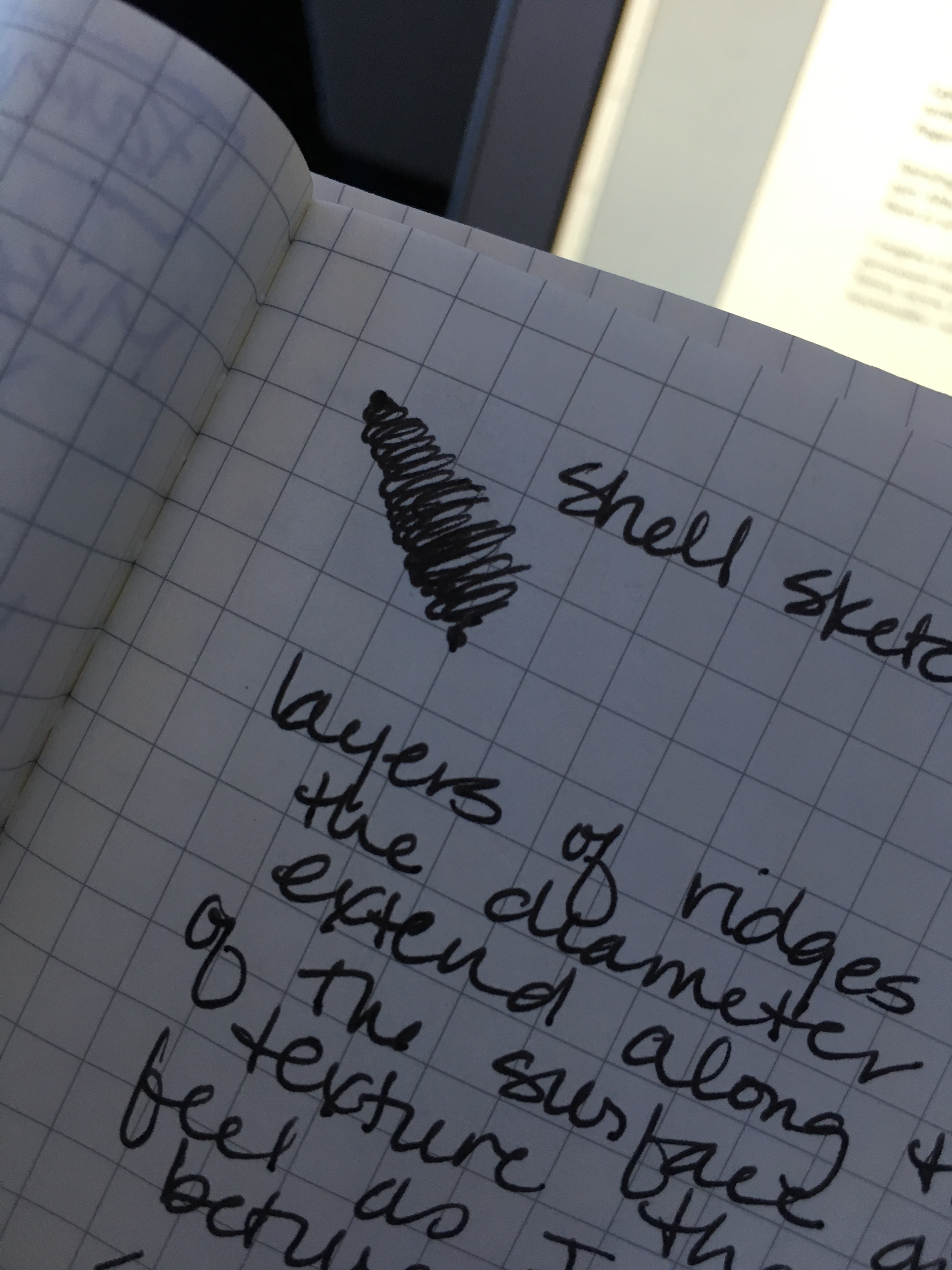
Last week as part of some work bringing National Writing Project (NWP) teachers and science museums together to consider ways they might partner to support students and teachers, I wrote. On my table a hotel coffee cup contained some small shells and a couple of hand lenses. We were invited to examine a shell, sketch, and write.

Here’s my beginning thinking—the result of taking about five minutes to sketch and write.

img_5890

Layers of ridges that wrap the diameter and also extend along the length give the surface a spiky texture that I can feel as I roll the shell between my fingers.

Spiraling up from a tiny sharp tip, an opening is revealed on one side of the widest part. Although I’ve seen a version of this shell many times, I don’t know who lives there or what it is called.

I imagine a tiny snail carrying its home on its back, washed with the tides without a permanent resting place. Perhaps these creatures are the original Tiny House Nation, secure, bringing their homes—intricately assembled for efficiency and functionality—with them wherever they roam.

I’m reminded again of the importance of establishing this daily practice, even if in tiny spurts—one I regularly espouse for my students and teachers I work with. Can I spare five minutes a day for writing? Of course, everyone has five minutes somewhere. Why don’t I write for five minutes every day? There are a million excuses—among them, the fear that I will need not five minutes but an hour once I get started.

So today I’ve written another five minutes or more, moving this small piece from my notebook to my blog and adding a bit of context. I hope this is a catalyst for reestablishing that daily writing habit, even if for only five minutes a day. Today I will celebrate the tiny start and be reminded that small starts are betting than not starting at all.

Weekly Photo Challenge: Something I Learned this Week

I’m lucky.  As a classroom teacher I have opportunities for learning all the time…from my students, out in the community, from my colleagues, with my “colleagues at a distance” (on MOOCs and social media), …and at home, from my family…  I am surrounded by learning.

On Thursday, we had the opportunity to take our students to the local waste water treatment plant.  We’ve been studying water (something we don’t have enough of here in San Diego!) and have a parent in our class who happens to be the deputy mayor in our community.  She was eager to make the connection between the study of the properties of water and the water cycle and the municipal responsibilities of getting water to our taps and then treated as the water heads back out into nature’s cycle.  So when she asked if we’d like to have her arrange a field trip to the water treatment plant just a couple of miles away, we were eager to go.

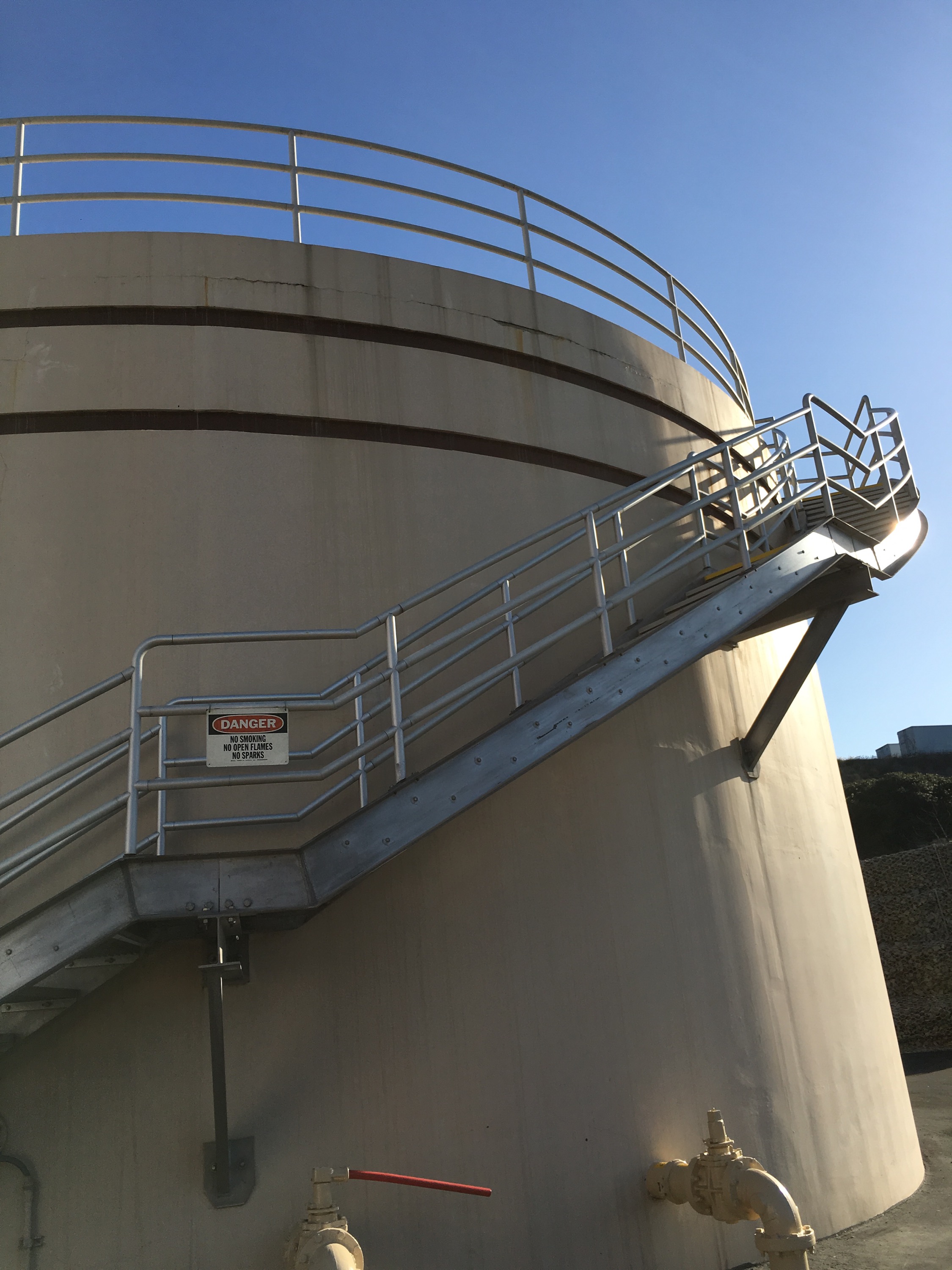
And even more fun, the water plant manager and the other employees were delighted to have us visit.  They had us break into three groups and then took us on a tour of the plant, carefully explaining and describing all the processes in the treatment cycle.  We started at the huge digester tanks, filled with the solid waste being cleaned by natural occurring microorganisms.  We learned that the temperature of the tanks is about the same as our body temperature when we have a fever…up to about 102 degrees.

IMG_7263

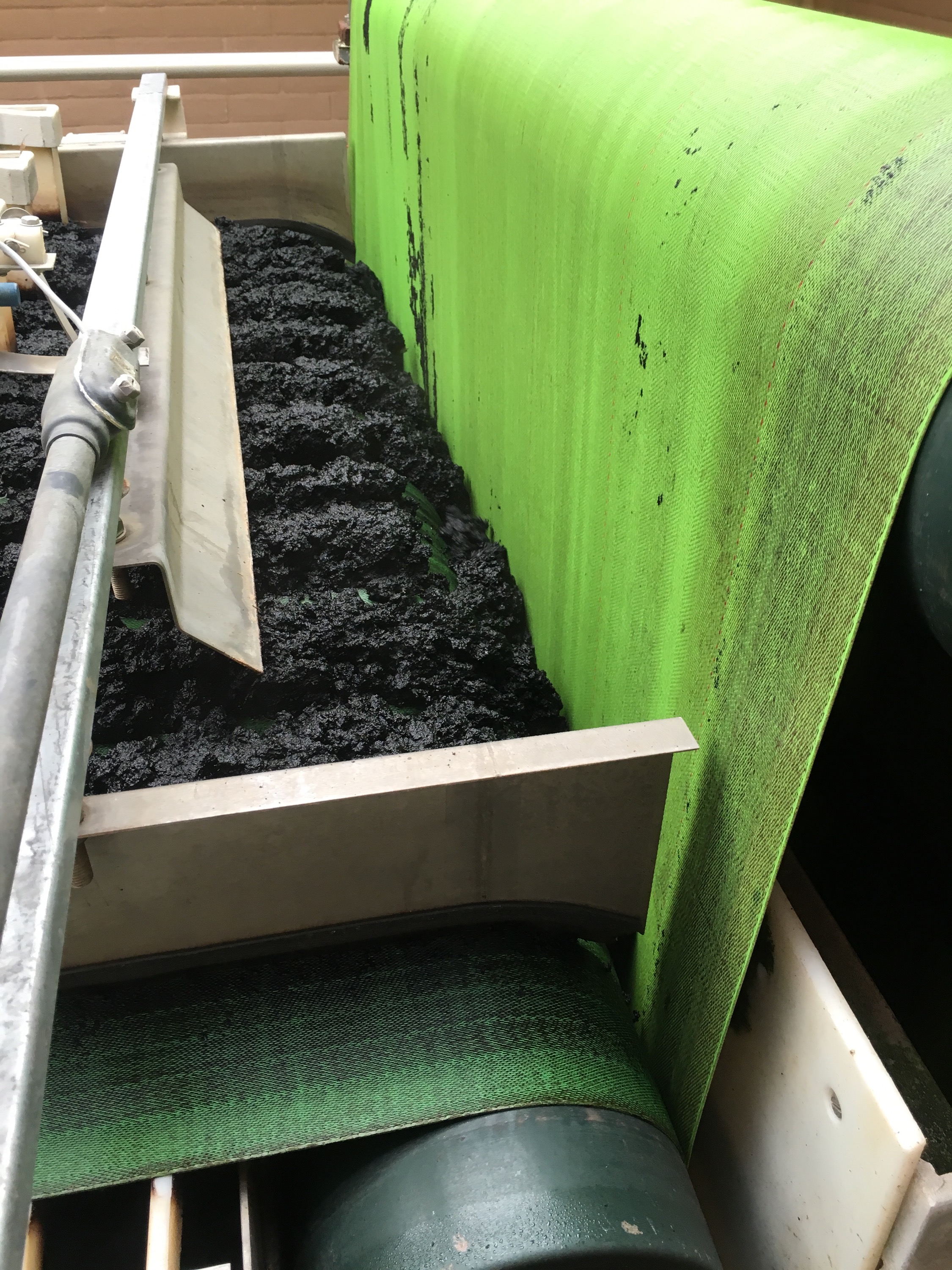
After spending 15 days in the digester, the now activated sludge is sent through a process that separates the water from the solids.  We watched the belts squeeze out the water and send the dry activated sludge into a truck to be hauled off to Arizona where it is used as fertilizer for livestock crops (alfalfa and the sort).

IMG_7272

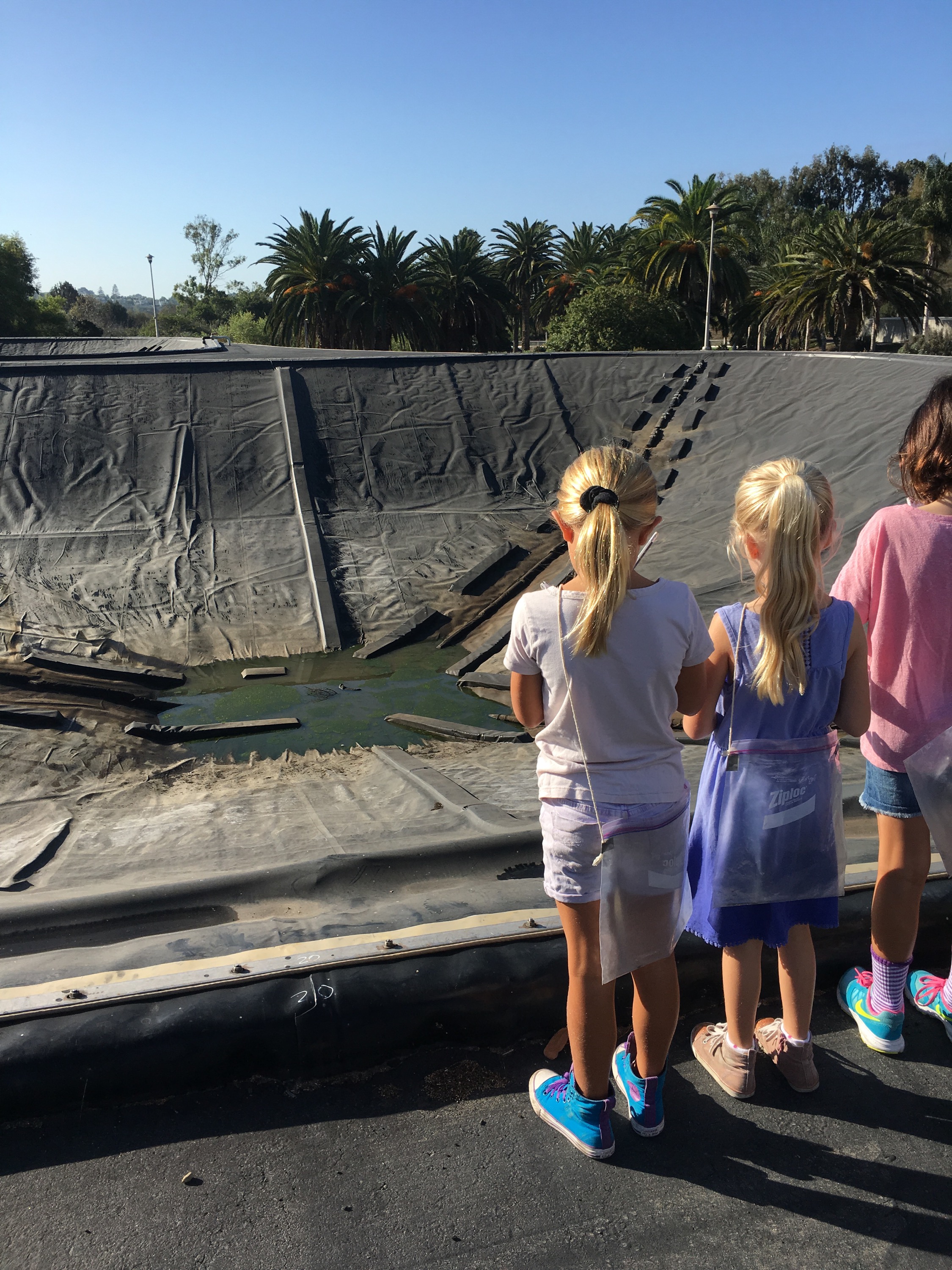
We saw the big overflow tanks…where waste water collects under these big sheets (the water you can see on top is some accumulation as the result of the rain we got last week).  There is an inflow of 3 million gallons a day!  (And they have a duplicate tank just in case there is a problem with one–they explained the importance of redundancy to keep the operation moving.)
IMG_7276

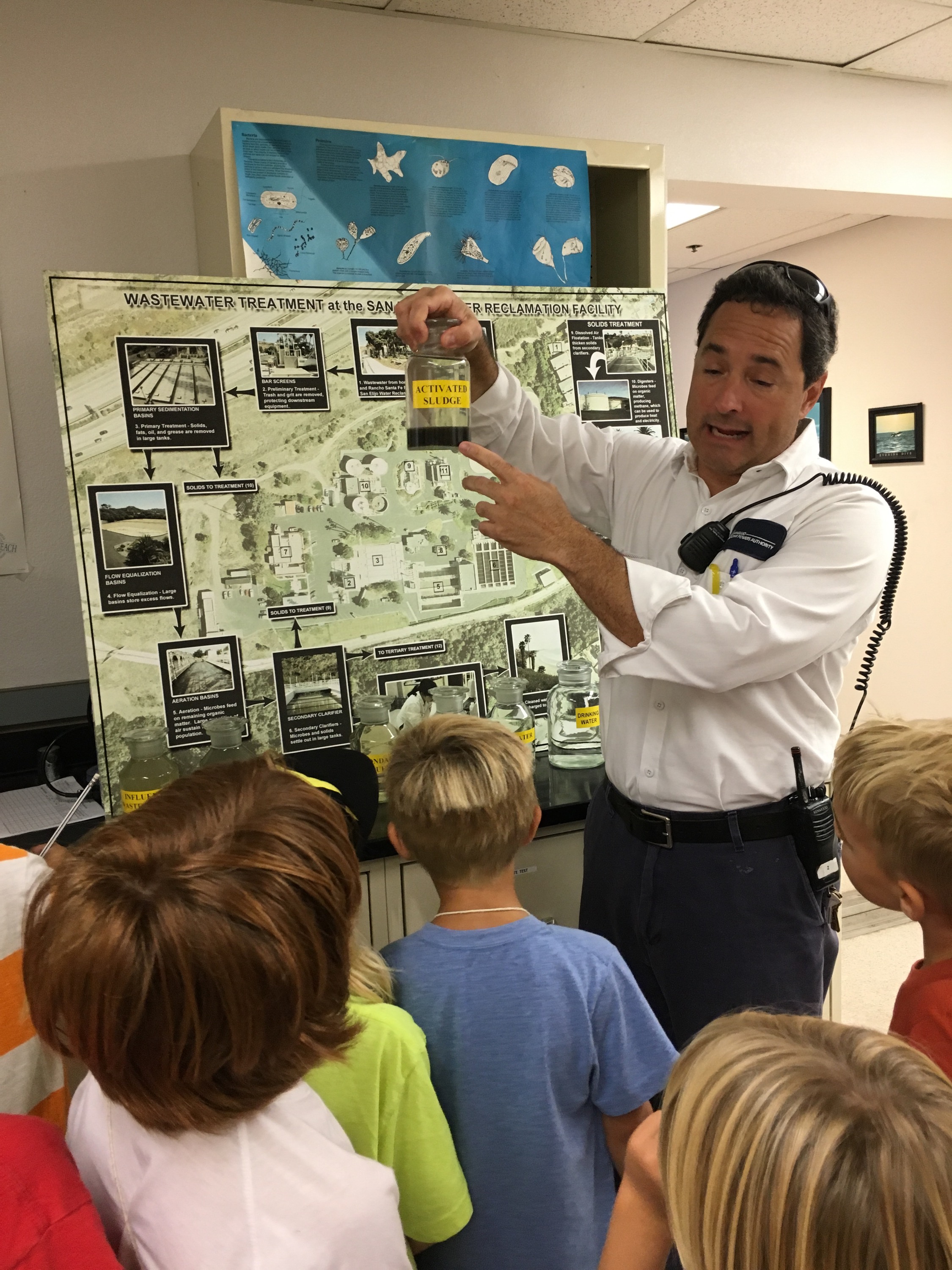
After than, we got to walk through the lab…and take a peek at all the science equipment in use. We noticed test tubes and vials, everything scientists need to test hypotheses, collect data, and carefully examine what is going on with the water they care for.  We also got to see samples of the different stages of water cleaning.  (They use a three-part process to get water to the recycled stage)  Dale carefully explained each step in the water cleaning process to our young students.

IMG_7288

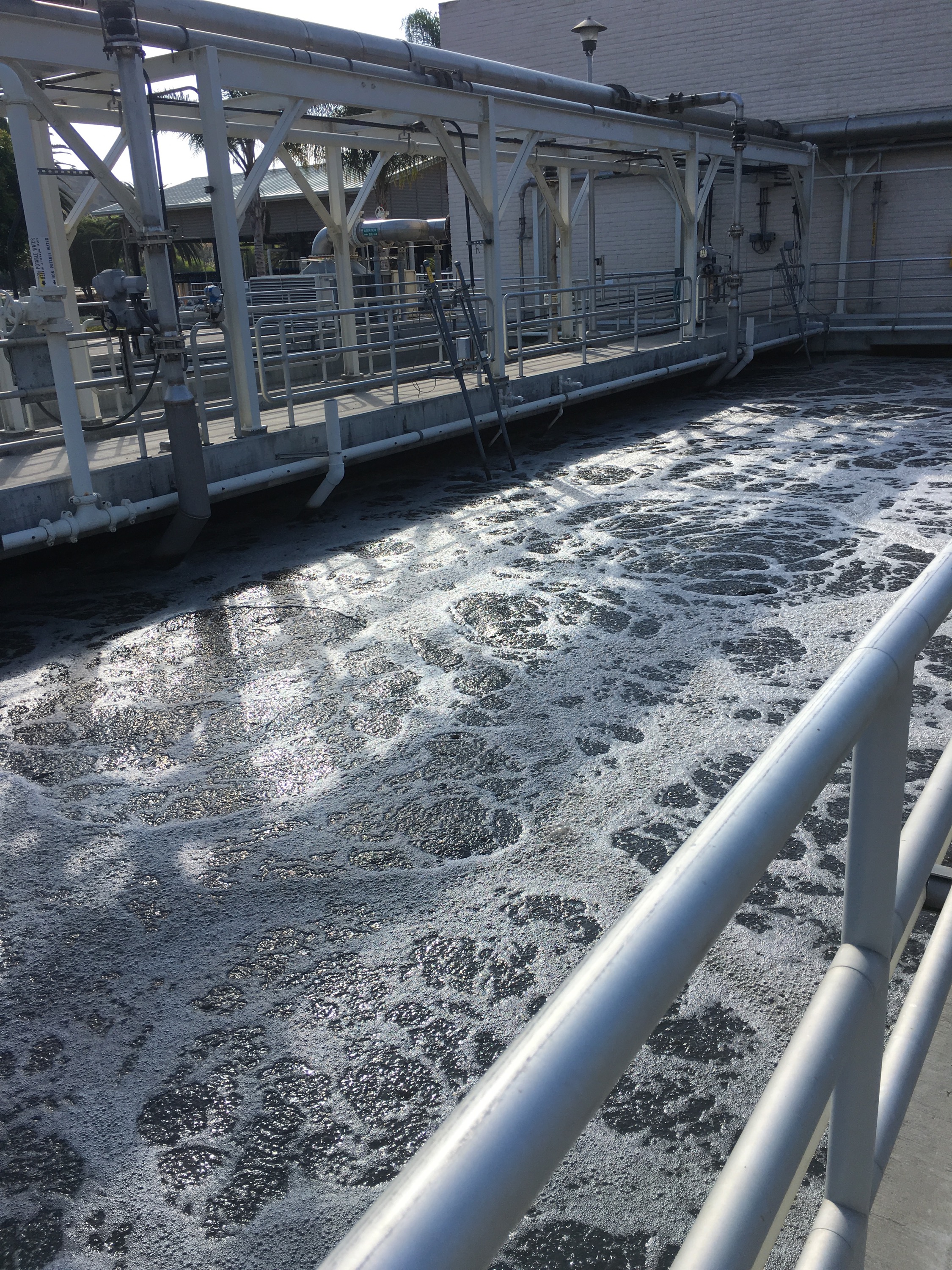
We learned about the way that air is used to clean water…and watched the water bubble with the air pumped through it.

IMG_7307

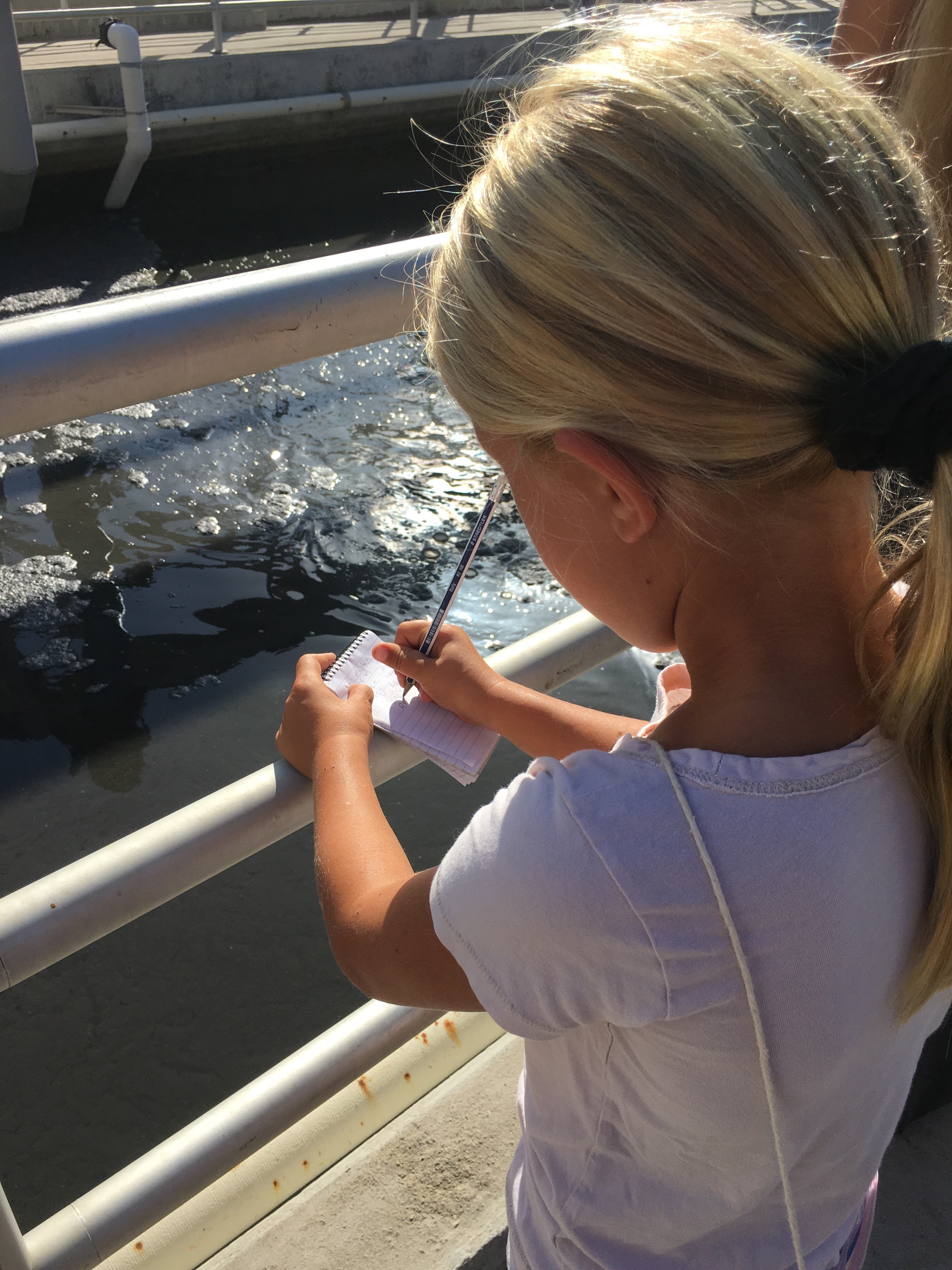
And this student was enthralled with all she was learning…she took pages and pages of notes in her little reporters notebook.  (She proudly announced that she filled 17 pages!)

IMG_7306

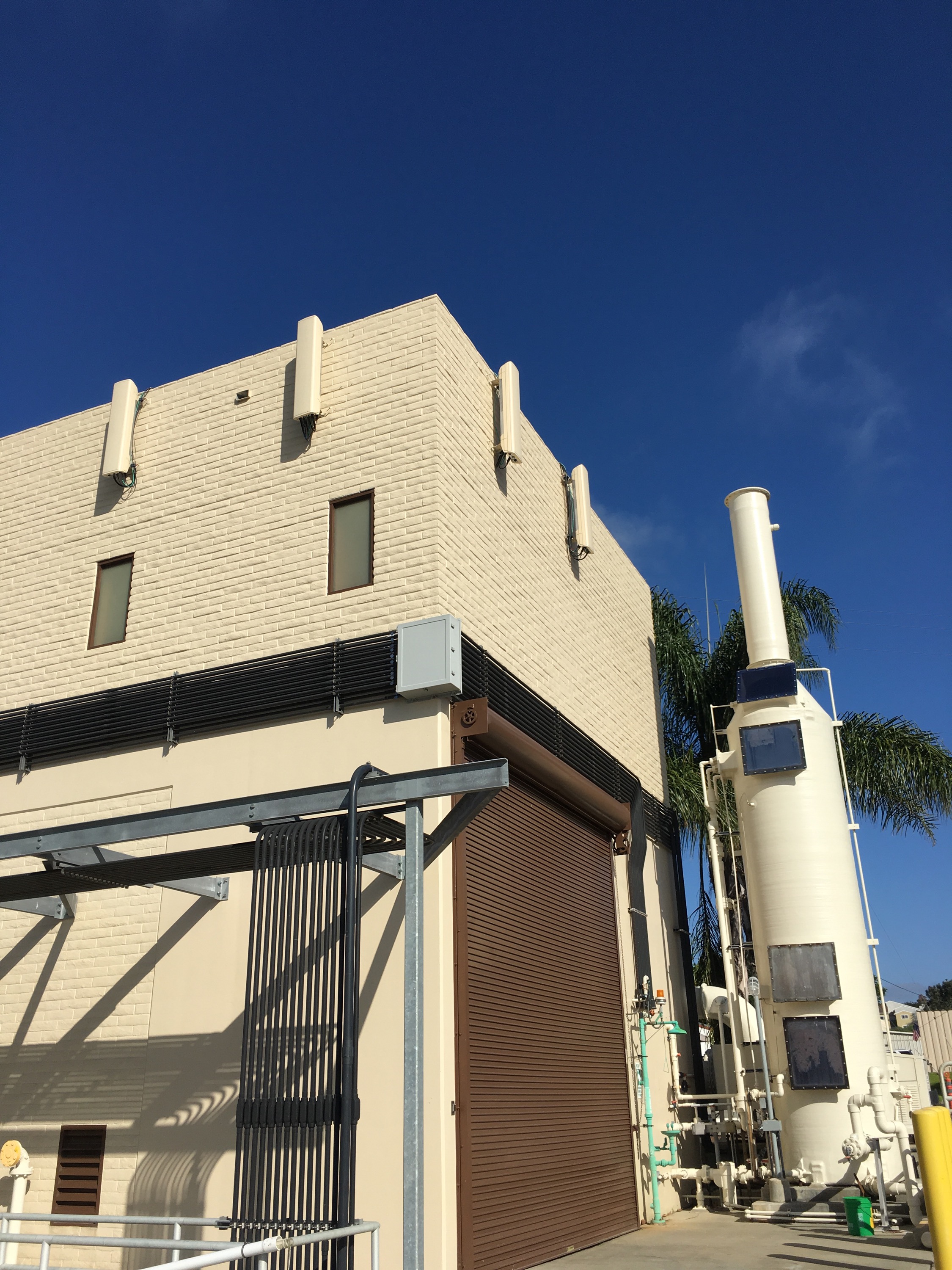
I hadn’t thought about the technology of keeping odors at a minimum, but this space ship looking thing cleans smells from the air before it goes back into the air.

IMG_7299

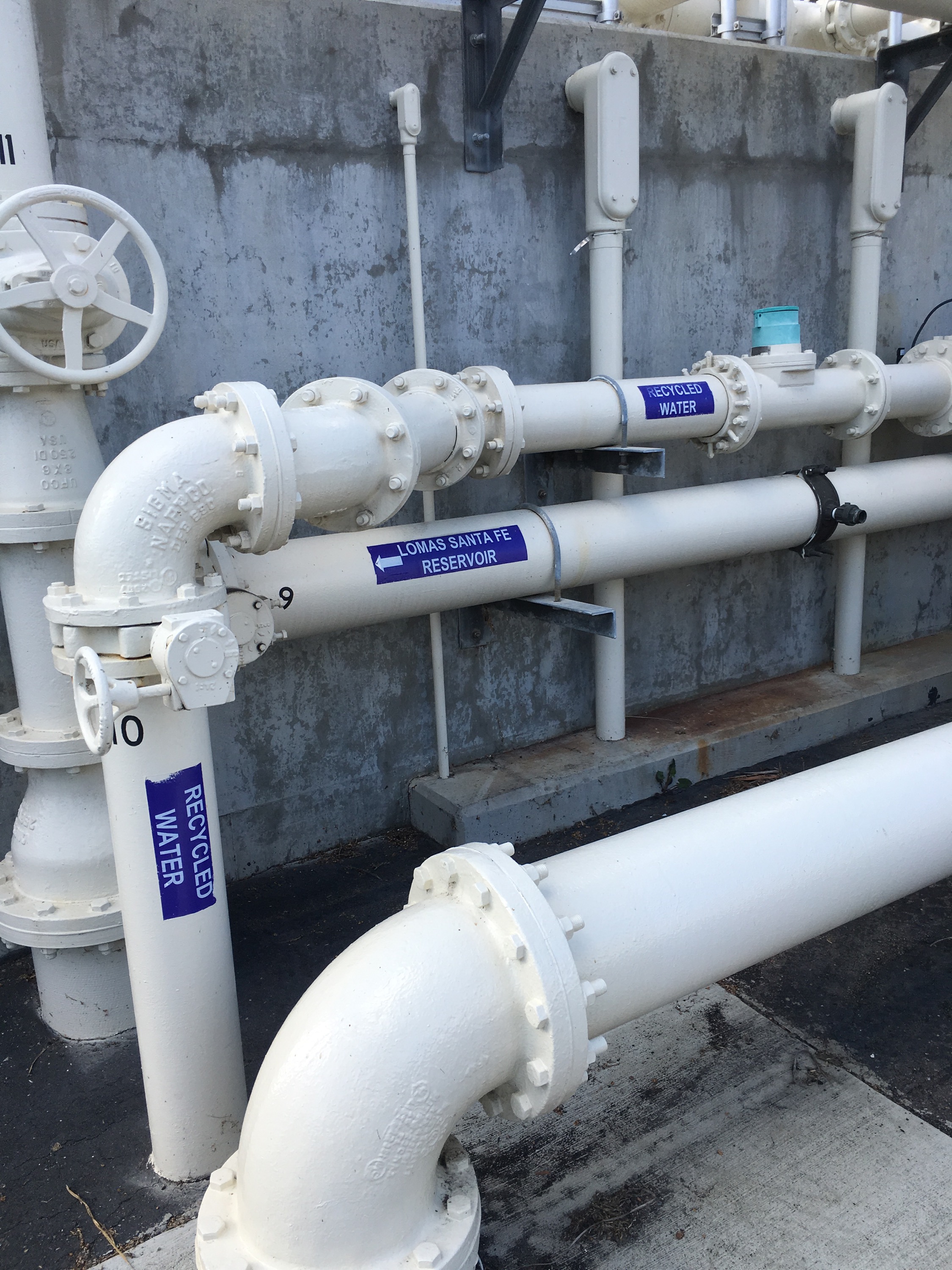
Once water goes through the primary, secondary, and tertiary processes, it gets to the recycled water state…for use in landscaping and on golf courses.  This stage flows into the purple pipes that carry this water throughout our community, but at the plant the water flows through these white pipes that will eventually meet up with the purple ones!

IMG_7316

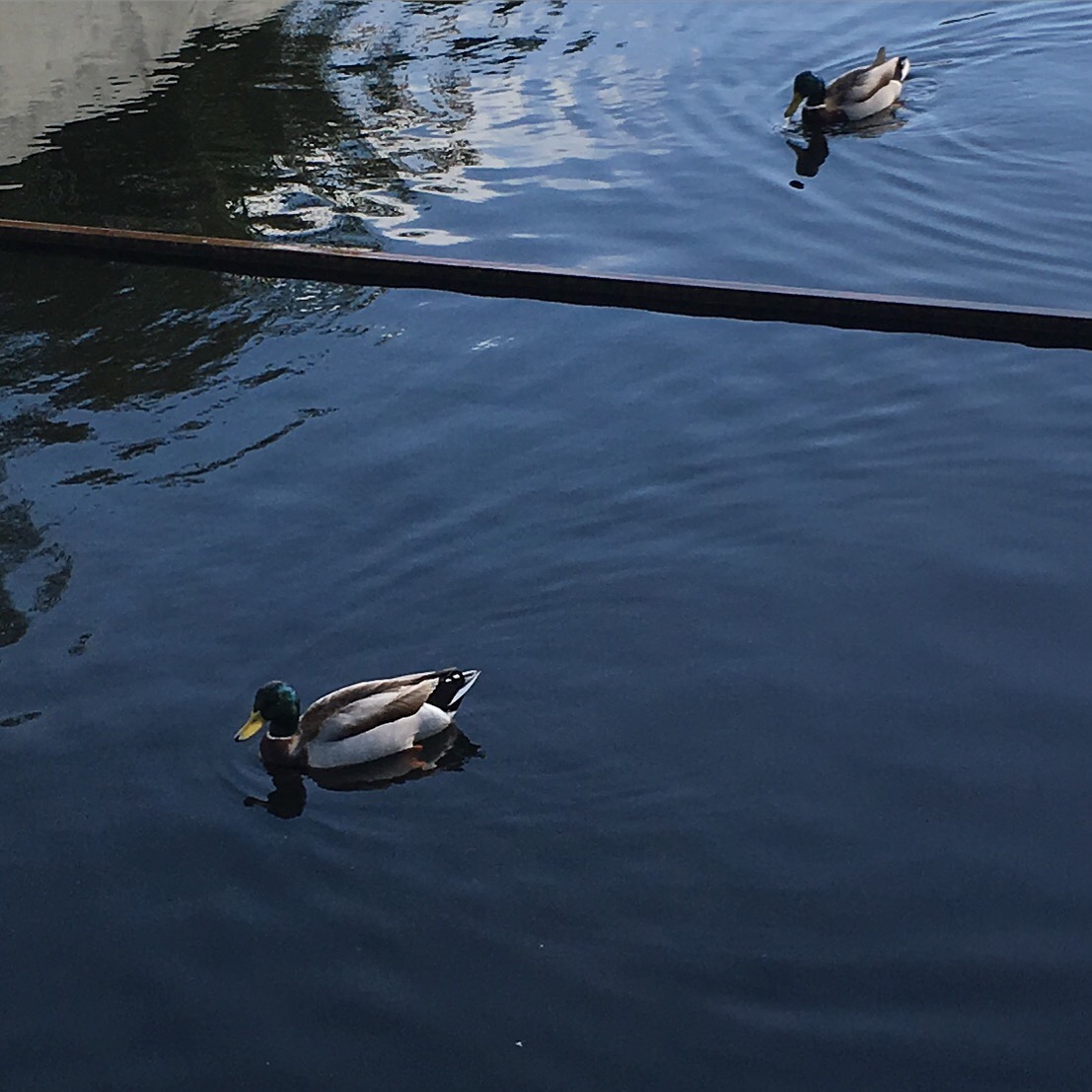
And whatever recycled water is not needed for the purple pipes is piped out into the ocean, joining the salt water and becoming part of our natural water cycle once again.  The ducks have decided that this is a great place to hang out…right across the street from the lagoon!  I think they see this place as their own private spa!

IMG_7317

So…what have you learned this week?  Maybe it’s a longer story of a particular place…or a snippet that caught your fancy and taught you something new.

You can post your photo alone or along with some words: commentary, a story, a poem…maybe even a song! I love to study the photographs that others’ take and think about how I can use a technique, an angle, or their inspiration to try something new in my own photography. (I love a great mentor text…or mentor photo, in this case!) I share my photography and writing on social media. You can find me on Instagram and Twitter using @kd0602. If you share your photos and writing on social media too, please let me know so I can follow and see what you are doing. To help our Weekly Photo community find each other, use the hashtag #learning for this week and include @nwpianthology in your post.

I’m looking forward to learning from you this week…pinpoint something you learned this week and share that learning with the rest of us through your lens!

Learning in the Intersections

You all probably remember them, those iconic experiences of heading out on a school day with your classmates and teacher to a local museum or art gallery to extend and enhance what was going on the in classroom…a field trip!  And in the best of times, those field trips are memorable, often motivating learning beyond the school curriculum.  Maybe one of those experiences even fueled your passion for a particular field of study.

But often, field trips are fraught with conflict.  Are you heading out of the classroom to “do school” somewhere else?  Is it a free day of fun with friends where the learning is incidental and accidental…if it happens at all?  What role do teachers and museum personnel play in the field trip experience? What about chaperones?  And what about students and their interests and passions?

Through Intersectionsa project funded by the National Science Foundation through the National Writing Project and the Association of Science and Technology Centersthe San Diego Area Writing Project, in partnership with the San Diego Natural History Museum and the Reuben H. Fleet Science Center,has been exploring the conflicts and tensions surrounding field trips.

In our second year of investigating how to support student learning in the context of a field trip, we have learned a lot.  Most significantly, we’ve learned the power of the interaction and co-learning of formal educators (those who work in school settings) and informal educators (those who work in out-of-school spaces like museums).  We discovered that our goals for student learning are mostly the same, and through our interactions, we have reconsidered how we might achieve those goals.  But first we had to let go of all that we have no control over–including exhibit layout and signage, field trip costs and transportation, and the uneven qualifications of chaperones, especially when it comes to facilitating student learning.

We’ve decided this year to focus on ways to support students as agents of their own learning, depending less on the adults who accompany them and trusting that a rich museum experience will result in meaningful learning–even when students do not complete worksheets that ensure they have learned specific facts or answered a series of questions delineated by grade level standards.

So we have asked teachers to prepare students for their trip by asking them to explore the exhibit, noting what interests them, and taking back interesting tidbits and lingering questions for further investigation through the creation of some kind of project back in the classroom following the trip.  And to better understand how this works in action–with a variety of grade levels and school contexts–we are observing students in action through a series of field trip pilots.

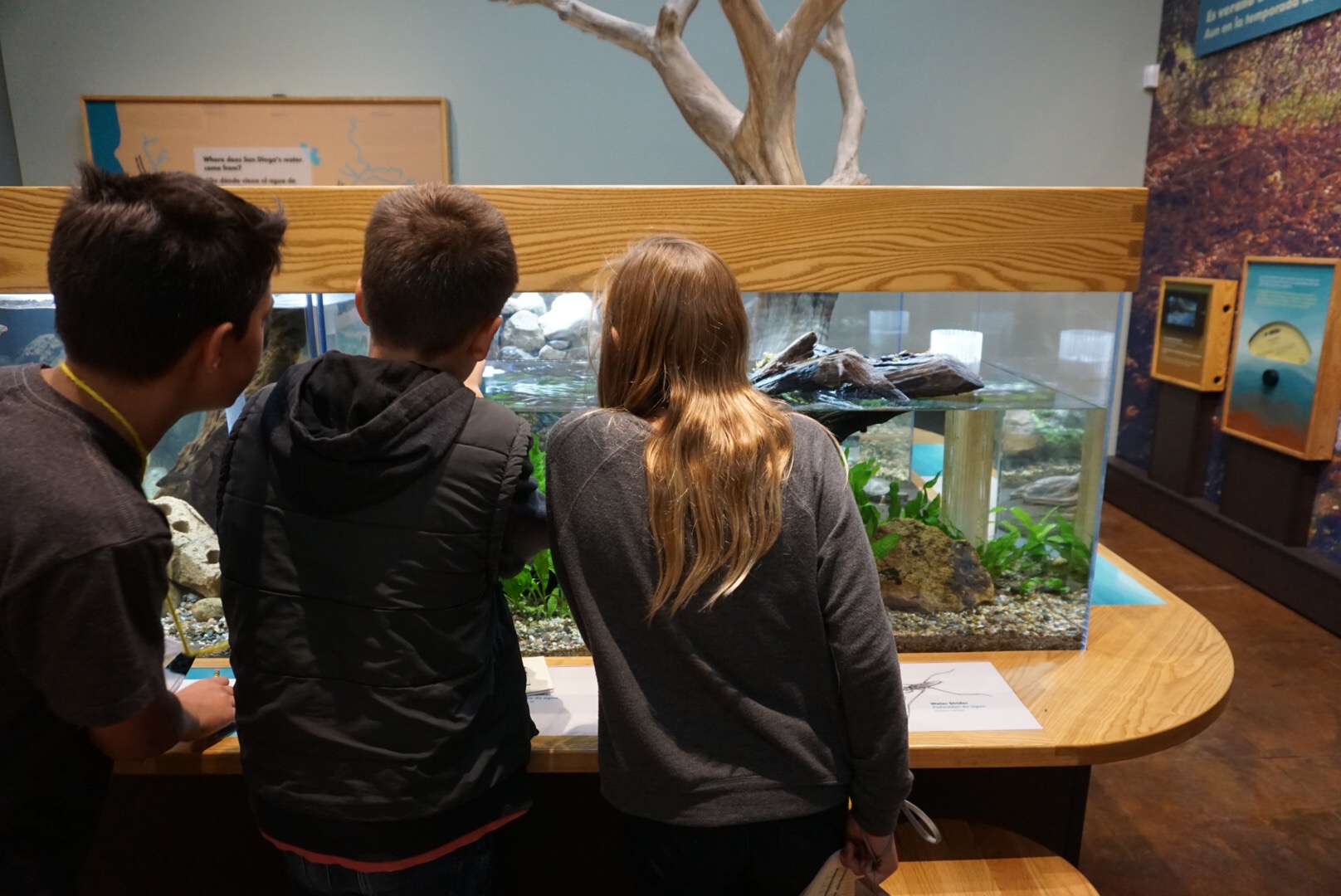
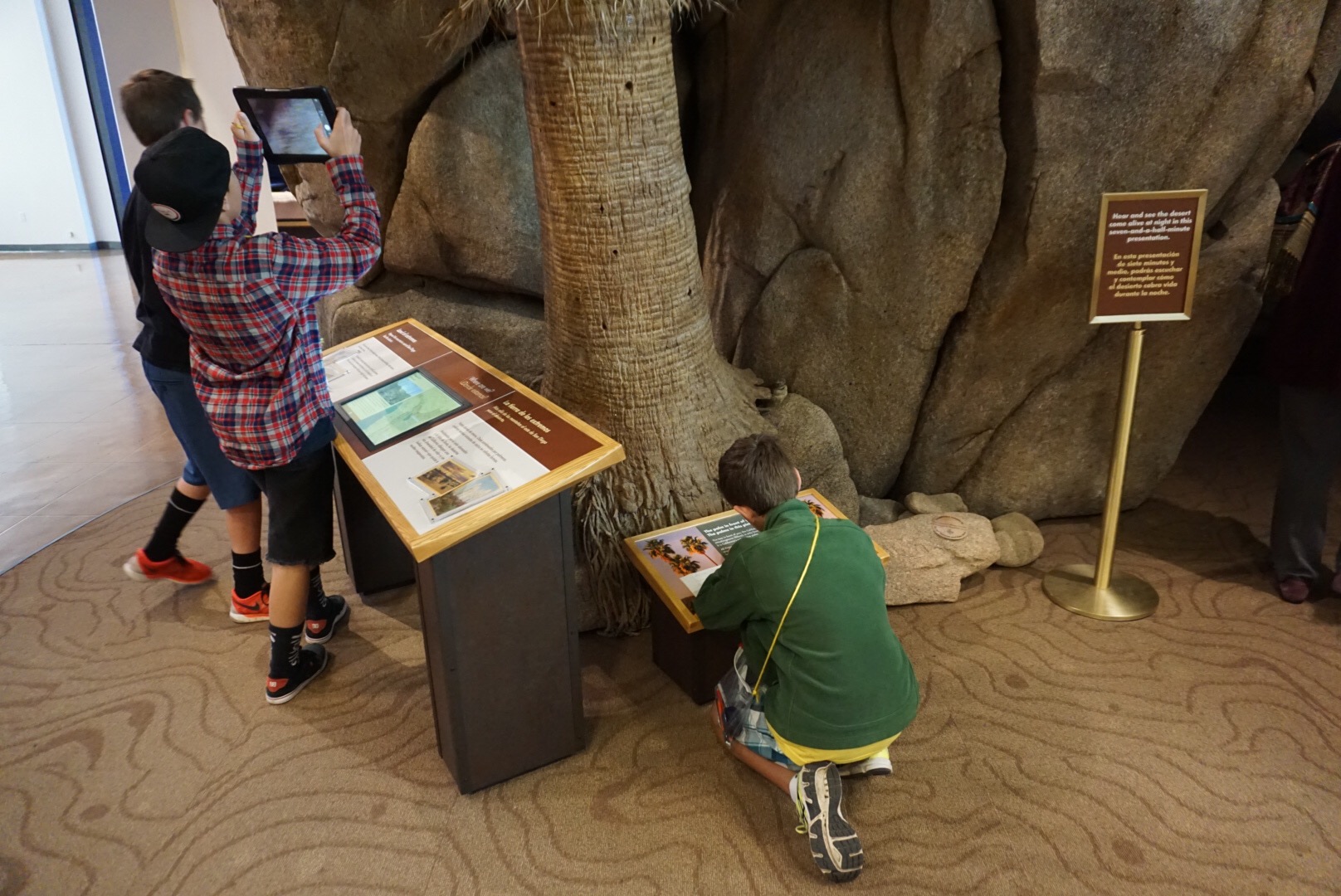
Today we observed sixth graders in action.  They came with a charge–to notice adaptations of plants and animals evident in the Coast to Cactus exhibit so they could create a project displaying their learning back at school next week.

IMG_4435

We watched students looking closely, in conversation with each other as they observed live animals in the exhibit.

IMG_4433

Students working alone, taking notes from the exhibit signage.  And others in pairs and triads, some taking photos, others sketching, and some simply flipping buttons and spinning dials.

IMG_4434

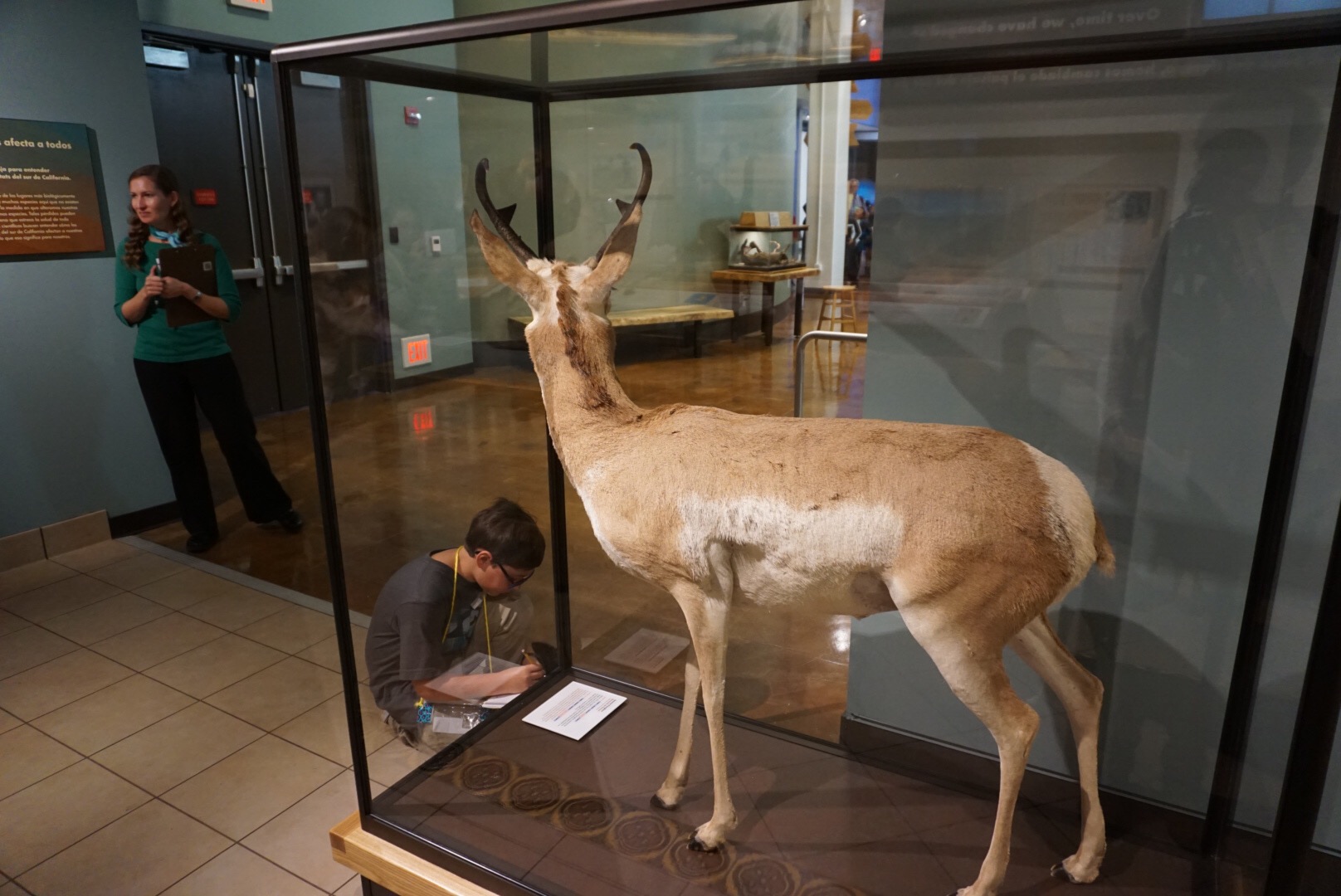
This student seems to be under surveillance by both the researcher and the stuffed deer as he takes notes from the informational placard.

IMG_4436

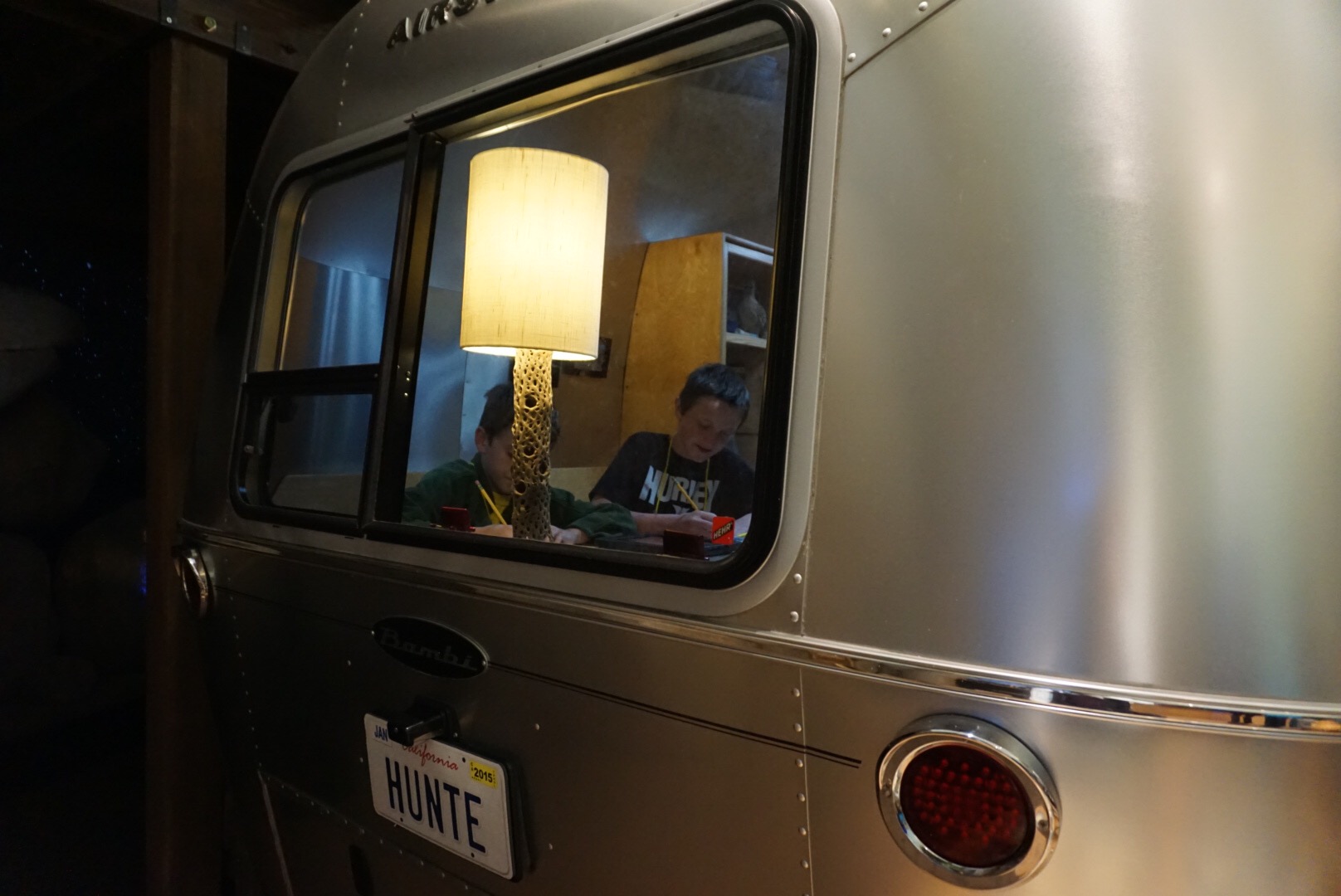
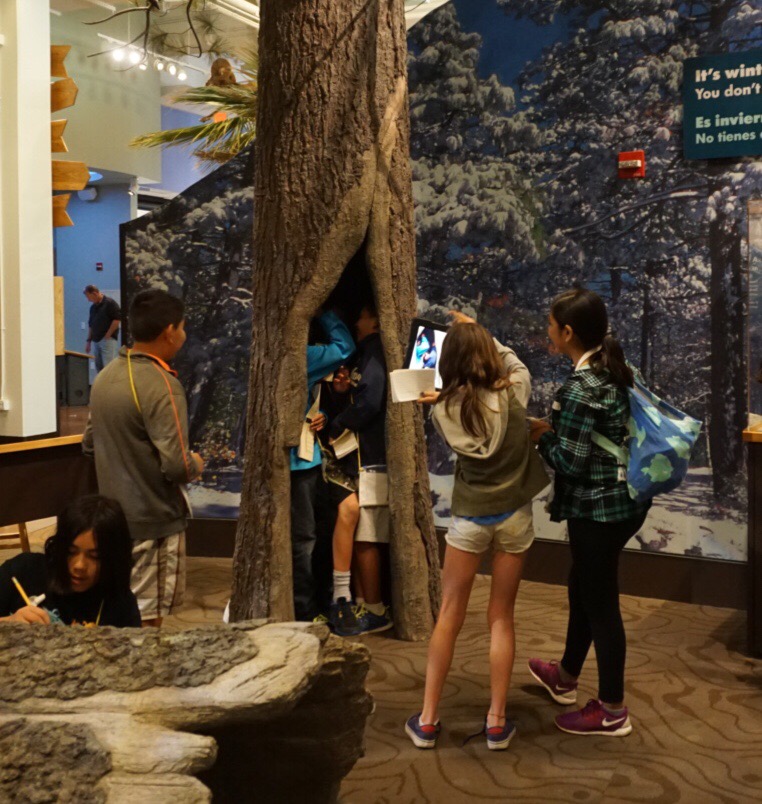
Some students found cozy nooks to meet and write–like inside this Bambi airstream that is a part of the exhibit.  While others took a bit of time away to see how many boys would fit inside the hollow tree trunk while a classmate looked on and snapped their photo!

IMG_4438

And the questions linger.  How much like school should a field trip be?  Do students need to “on task” by completing forms, taking notes, answering questions…  Or can they be talking to each other, turning dials, inventing their own competitions and games related to the exhibits, crawling through tunnels and squeezing into tree trunks…and still be learning?  Do they need to “do” the museum, reading each sign, looking at each artifact from start to finish?  Or is it okay to  focus their time and attention on the areas that most pique their interests?

I’m interested in what these students will create when they head back to school.  How will the visit to the museum influence their project?  What will they remember most about this trip?  Will they come back on their own, with their families?  How would they use the museum if left to their own devices?

We are paying attention to the intersections of formal and informal learning, of writing and science…and of student interest driven inquiry and teacher/adult directed learning.  And with each pilot field trip, I have more questions about supporting student learning as we work to help students initiate and shape their own learning using field trips as a tool.

How do you view the iconic field trip?  How do you prepare your students/your own children for out-of-school learning experiences?  What outcomes do you hope for when you think field trip?  We’d love to hear about your thoughts and experiences!